

Consumer Insights
Uncover trends and behaviors shaping consumer choices today
Procurement Insights
Optimize your sourcing strategy with key market data
Industry Stats
Stay ahead with the latest trends and market analysis.
Drug-Resistant Refractory Epilepsy is a severe neurological condition in which seizures continue despite the use of two or more appropriately chosen and tolerated anti-seizure medications. According to Niels Pacheco et al., 2024, nearly one-third of epilepsy patients worldwide develop a drug-resistant form, indicating a substantial unmet clinical burden. The therapeutic landscape includes novel anti-seizure drugs, neurostimulation devices, epilepsy surgery, and ketogenic dietary therapies. According to the drug-resistant refractory epilepsy pipeline analysis by Expert Market Research, growing R&D focus, precision therapies, and technological advancements are expected to support steady pipeline expansion and treatment innovation in the coming years.
Major companies involved in the drug-resistant refractory epilepsy pipeline analysis include iQure Australia Pty Ltd., Avance Clinical Pty Ltd., and others.
Leading drugs currently in the pipeline include Rapamycin, NRTX-1001, iQ-007, and others.
The pipeline growth is driven by novel mechanisms targeting resistant seizure pathways, rising investment in precision neurology, and accelerated regulatory support for orphan and breakthrough epilepsy therapies.
The Drug-Resistant Refractory Epilepsy Pipeline Analysis Report by Expert Market Research gives comprehensive insights into drug-resistant refractory epilepsy therapeutics currently undergoing clinical trials. It covers various aspects related to the details of each of these drugs under development for drug-resistant refractory epilepsy. The drug-resistant refractory epilepsy report assessment includes the analysis of over 100 pipeline drugs and 50+ companies. The drug-resistant refractory epilepsy pipeline landscape will include an analysis based on efficacy and safety measure outcomes published for the trials, including their adverse effects on patients suffering from the condition, and alignment with drug-resistant refractory epilepsy treatment guidelines to ensure optimal care practices.
The assessment part will include a detailed analysis of each drug, drug class, clinical studies, phase type, drug type, route of administration, and ongoing product development activities related to drug-resistant refractory epilepsy.
Read more about this report - Request a Free Sample
Drug-resistant refractory epilepsy is a neurological condition in which seizures persist despite adequate trials of two or more appropriate anti-epileptic drugs. It occurs due to complex mechanisms such as altered brain networks, genetic mutations, structural brain abnormalities, or changes in drug targets, leading to continued abnormal electrical activity.
Drug-resistant refractory epilepsy is managed using advanced anti-epileptic drugs, epilepsy surgery, neurostimulation devices, ketogenic diets, and emerging targeted therapies aimed at reducing seizure frequency and improving quality of life. In September 2025, Rapport Therapeutics reported that RAP-219, an oral investigational drug for drug-resistant refractory epilepsy, achieved nearly 80% seizure reduction in a Phase 2a trial by selectively targeting TARPγ8-regulated AMPA receptor activity in focal seizure regions.
The pipeline underscores a substantial unmet medical need driven by high disease incidence and limited treatment responsiveness. As per Elekta, epilepsy affects nearly 50 million people worldwide, and while antiseizure medications control seizures in up to 70% of patients, approximately 30% develop medically intractable or drug-resistant epilepsy. Supporting this, Ignacio Lagger et al., 2023, and Niels Pacheco et al., 2024, report that nearly one-third of patients continue to experience seizures despite ongoing therapy. In the United States, Rosemarie Kobau et al., 2023, estimate active epilepsy prevalence at 1.1% among adults. Consequently, the drug pipeline increasingly emphasizes novel mechanisms and targeted therapies to address refractory epilepsy.
This section of the report covers the analysis of drug-resistant refractory epilepsy drug candidates based on several segmentations, including:
By Phase
The pipeline assessment report covers 50+ drug analyses based on phase:
By Drug Class
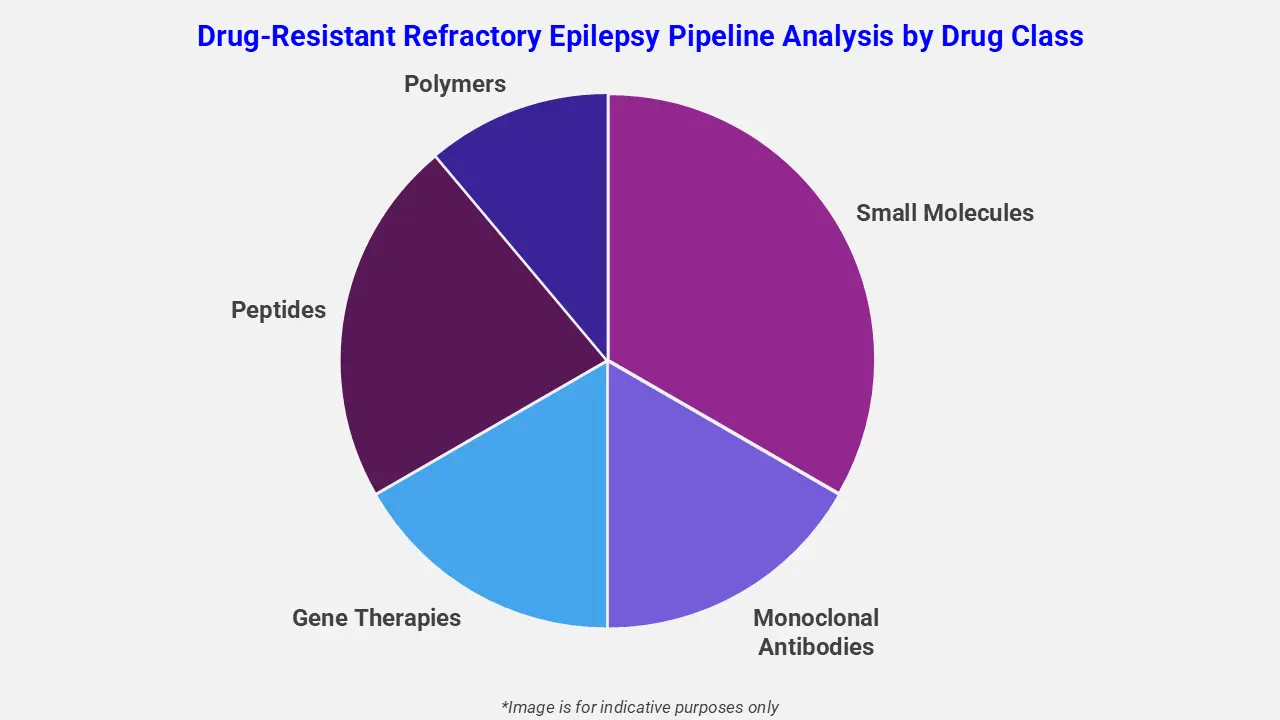
The drug-resistant refractory epilepsy pipeline analysis report covers 50+ drug analyses based on drug classes:
By Route of Administration
The pipeline assessment report covers 50+ drug analyses based on the route of administration:
The report covers phase I, phase II, phase III, phase IV, and early-phase drugs. The coverage includes an in-depth analysis of each drug across these phases. According to EMR analysis, phase I, at 30%, covers a major share of the total drug-resistant refractory epilepsy clinical trials, reflecting strong early-stage clinical activity and sustained research investment. Phase II at 30% indicates advancing efficacy validation and optimized dosing strategies. Early phase I at 21% highlights innovation and novel mechanism exploration. Phase III at 15% supports late-stage validation and regulatory readiness.
The drug molecule categories covered under the drug-resistant refractory epilepsy pipeline analysis include small molecules, monoclonal antibodies, gene therapies, peptides, and polymers. The drug-resistant refractory epilepsy report provides a comparative analysis of the drug classes for each drug in various phases of clinical trials for drug-resistant refractory epilepsy. Novel receptor-targeted therapies are emerging in the pipeline to improve seizure control. For instance, ES-481, a selective TARP-γ8-dependent AMPA receptor antagonist, is under investigation in a Phase IIa trial. It works by modulating excitatory neurotransmission in the brain, demonstrating significant reductions in seizure frequency while maintaining a favorable safety and tolerability profile.
The EMR report for the drug-resistant refractory epilepsy pipeline covers the profile of key companies involved in clinical trials and their drugs under development. It provides a detailed drug-resistant refractory epilepsy therapeutic assessment, analyzing the competitive dynamics of the clinical trial landscape. Below is the list of a few players involved in drug-resistant refractory epilepsy clinical trials:
This section covers the detailed analysis of each drug under multiple phases, including phase I, phase II, phase III, phase IV, and emerging drugs for drug-resistant refractory epilepsy. It includes product description, trial ID, study type, drug class, mode of administration, and recruitment status of drug-resistant refractory epilepsy drug candidates.
Rapamycin is being evaluated in a Phase III clinical study sponsored by Katarzyna Kotulska at the Children’s Memorial Health Institute, Poland, for drug-resistant refractory epilepsy associated with tuberous sclerosis complex. The randomized, double-blind, placebo-controlled RaRE-TS study is examining the safety, tolerability, and efficacy of rapamycin versus placebo. Rapamycin is a macrolide mTOR inhibitor that modulates aberrant mTOR signaling implicated in TSC-related epilepsy. The drug is being administered systemically, with treatment phases including dose adjustment, core blinded evaluation, and open-label observation, while seizure reduction and safety outcomes are being assessed.
NRTX-1001 is an allogeneic GABAergic interneuron cell therapy sponsored by Neurona Therapeutics and is being developed for drug-resistant refractory epilepsy. The ongoing open-label Phase 1/2 study is examining the safety, tolerability, and preliminary efficacy of a single-dose intracerebral administration in adults with unilateral mesial temporal lobe epilepsy. The drug is working by restoring inhibitory neuronal signaling to reduce hyperexcitability, driving seizures. The study is demonstrating durable seizure reduction, preserved cognition, and improved quality of life. Based on these results, a Phase 3 EPIC trial is planned to begin enrolling participants in the second half of 2025, under an FDA RMAT designation.
iQ-007 is a first-in-class, orally available small molecule being developed by iQure Australia Pty Ltd for drug-resistant epilepsy and focal seizures. The Phase 1 study is evaluating safety, tolerability, and pharmacokinetics in healthy adult volunteers. This randomized, double-blind, placebo-controlled trial examined single and multiple ascending oral doses to characterize exposure and dose-response relationships. iQ-007 is enhancing the activity of the glutamate transporter EAAT2, aiming to reduce excessive excitatory neurotransmission associated with refractory seizures. The study is continuing through early 2026.
*Please note that this is only a partial list; the complete list of drugs will be available in the full report.*
The Drug-Resistant Refractory Epilepsy Pipeline Analysis Report provides a strategic overview of the latest and future landscape of treatments for drug-resistant refractory epilepsy. It provides necessary information for making informed investment decisions along with research, development, and strategic planning efforts. The stakeholders will benefit from the essential insights into drug-resistant refractory epilepsy collaborations, regulatory environments, and potential growth opportunities.


Upto 15% Off
USD
$1999 $1799
$3099 $2789
$4599 $3909
$5999 $5099


*While we strive to always give you current and accurate information, the numbers depicted on the website are indicative and may differ from the actual numbers in the main report. At Expert Market Research, we aim to bring you the latest insights and trends in the market. Using our analyses and forecasts, stakeholders can understand the market dynamics, navigate challenges, and capitalize on opportunities to make data-driven strategic decisions.*
Explore our key highlights of the report and gain a concise overview of key findings, trends, and actionable insights that will empower your strategic decisions.
|
Scope of the Report |
Details |
|
Drug Pipeline by Clinical Trial Phase |
|
|
Route of Administration |
|
|
Drug Classes |
|
|
Leading Sponsors Covered |
|
|
Geographies Covered |
|
Mini Report
One User
USD 1,999
USD 1,799
tax inclusive*
Single User License
One User
USD 3,099
USD 2,789
tax inclusive*
Five User License
Five User
USD 4,599
USD 3,909
tax inclusive*
Corporate License
Unlimited Users
USD 5,999
USD 5,099
tax inclusive*
*Please note that the prices mentioned below are starting prices for each bundle type. Kindly contact our team for further details.*
Flash Bundle
Small Business Bundle
Growth Bundle
Enterprise Bundle
*Please note that the prices mentioned below are starting prices for each bundle type. Kindly contact our team for further details.*
Flash Bundle
Number of Reports: 3
20%
tax inclusive*
Small Business Bundle
Number of Reports: 5
25%
tax inclusive*
Growth Bundle
Number of Reports: 8
30%
tax inclusive*
Enterprise Bundle
Number of Reports: 10
35%
tax inclusive*
How To Order

Select License Type
Choose the right license for your needs and access rights.

Click on ‘Buy Now’
Add the report to your cart with one click and proceed to register.

Select Mode of Payment
Choose a payment option for a secure checkout. You will be redirected accordingly.
Strategic Solutions for Informed Decision-Making
Gain insights to stay ahead and seize opportunities.

Get insights & trends for a competitive edge.

Track prices with detailed trend reports.

Analyse trade data for supply chain insights.

Leverage cost reports for smart savings

Enhance supply chain with partnerships.

Connect For More Information
Our expert team of analysts will offer full support and resolve any queries regarding the report, before and after the purchase.
Our expert team of analysts will offer full support and resolve any queries regarding the report, before and after the purchase.
We employ meticulous research methods, blending advanced analytics and expert insights to deliver accurate, actionable industry intelligence, staying ahead of competitors.
Our skilled analysts offer unparalleled competitive advantage with detailed insights on current and emerging markets, ensuring your strategic edge.
We offer an in-depth yet simplified presentation of industry insights and analysis to meet your specific requirements effectively.




