

Consumer Insights
Uncover trends and behaviors shaping consumer choices today
Procurement Insights
Optimize your sourcing strategy with key market data
Industry Stats
Stay ahead with the latest trends and market analysis.
Atrial flutter is a macro-reentrant supraventricular tachyarrhythmia characterized most commonly by a large re-entry circuit involving the cavotricuspid isthmus (CTI) in the right atrium. According to Granada et al., the first population-based investigation of atrial flutter identified 181 new cases, corresponding to an overall incidence of 88 cases per 100,000 person-years; incidence increased from 5 per 100,000 in individuals younger than 50 years to 587 per 100,000 among those older than 80 years. According to the atrial flutter epidemiology forecast by Expert Market Research, Atrial flutter is strongly associated with advancing age, male sex, heart failure, chronic pulmonary disease, hypertension, ischemic heart disease, and other structural cardiovascular conditions.
Base Year
Historical Period
Forecast Period
Read more about this report - REQUEST FREE SAMPLE COPY IN PDF
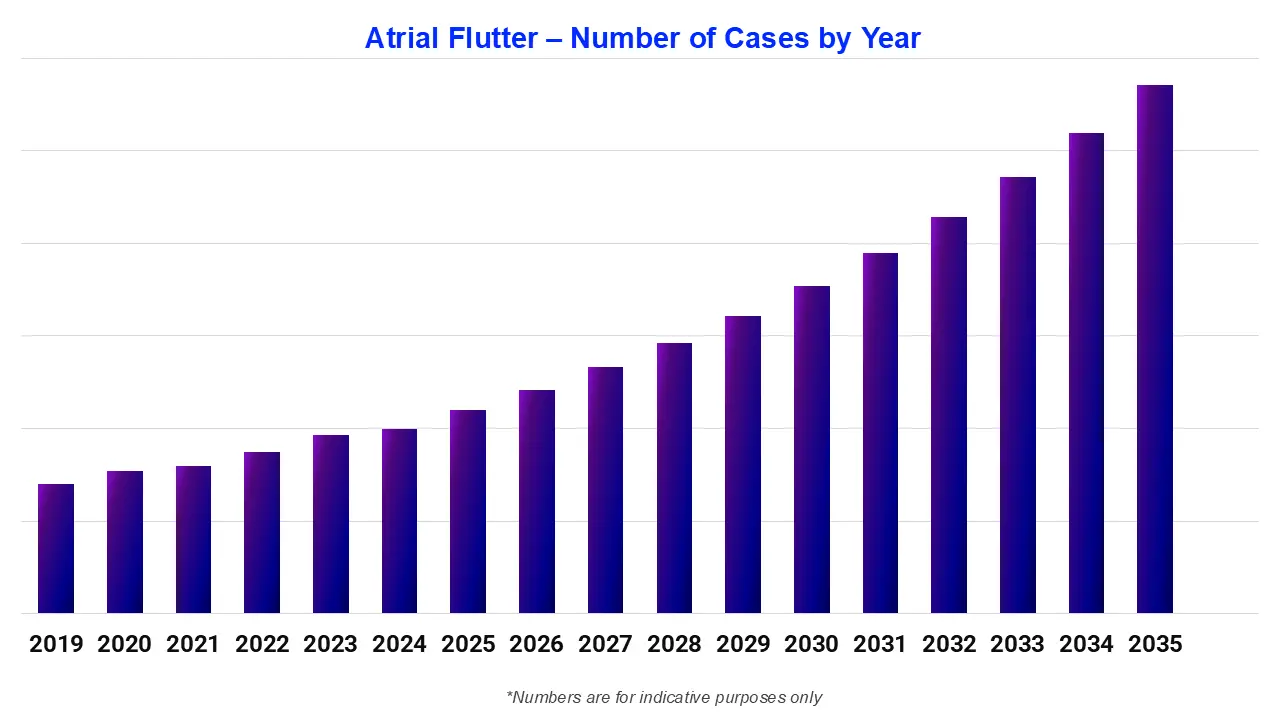
Expert Market Research's “Atrial Flutter Epidemiology Forecast Report 2026-2035” offers comprehensive information on the prevalence and demographics of Atrial Flutter. It projects the future incidence and prevalence rates of Atrial Flutter cases across various populations. The study covers age, gender, and type as major determinants of the Atrial Flutter population. The report highlights patterns in the prevalence of Atrial Flutter over time and projects future trends based on multiple variables.
The report provides a comprehensive overview of the disease, as well as historical and projected data on the epidemiology of Atrial Flutter in the 8 major markets.
Regions Covered
Atrial flutter is a type of heart rhythm disorder where the heart's upper chambers beat too fast but in a regular, organized pattern. Disrupted electrical pathways cause this rapid pacing, distinct from the chaotic rhythm of atrial fibrillation. Common symptoms include heart palpitations, shortness of breath, fatigue, and dizziness. If left untreated, blood can pool in the heart, significantly increasing stroke and heart failure risks. Management options from resources typically involve rate-controlling medications, blood thinners, electrical cardioversion, or catheter ablation to restore normal rhythm.
|
Parameter |
Insight |
|
Largest Patient Pool |
United States |
|
Fastest Growing Region |
Asia |
|
High-Risk Population |
Older adults, particularly men and individuals with cardiovascular or pulmonary comorbidities |
|
Key Diagnostic Method |
12-lead electrocardiography (ECG), supported by electrophysiological assessment when required |
|
Major Risk Factor |
Structural cardiovascular disease and advancing age |
|
Major gap in the market |
Under-recognition of AFL, coexistence with AF, and persistent thromboembolic risk after apparently successful rhythm treatment |
The Atrial Flutter epidemiology division offers information on the patient pool from history to the present as well as the projected trend for each of the 8 major markets. Expert Market Research provides both current and predicted trends for the Atrial Flutter epidemiology scenario by examining a wide range of studies. Additionally, the report covers the diagnosed patient pool for Atrial Flutter and their trends. The data is broken down into specific categories, such as total prevalent cases in males and females, and total diagnosed cases across different age groups and patient pools.
|
Epidemiology Segment |
Key Insights |
|
Diagnosed Prevalent Cases of the Disease |
According to the population-based study by Granada et al., 181 incident AFL cases were identified among 58,820 residents during four years of ascertainment, corresponding to 88 cases per 100,000 person-years. Atrial flutter alone accounted for approximately 37 per 100,000 person-years, while many patients also experienced AF. |
|
Gender-Specific Cases of the Disease |
According to Granada et al., atrial flutter was approximately 2.5 times more common in men than women. Age-adjusted incidence was approximately 125 per 100,000 in men versus 59 per 100,000 in women. |
|
Age-Specific Cases of the Disease |
Atrial flutter is strongly age-dependent. Granada et al. reported incidence increasing from 5 per 100,000 among individuals younger than 50 years to 587 per 100,000 among those older than 80 years. Heart failure and chronic pulmonary disease further increased risk. |
|
Ethnicity-Wise Cases of the Disease |
Contemporary epidemiological evidence demonstrates geographic and ethnic variation in the broader AF/AFL burden, but robust AFL-only ethnicity-specific prevalence estimates are limited. U.S. mortality analyses for combined AF/AFL demonstrate significant racial differences, with non-Hispanic White populations having higher recorded mortality but faster increases among non-Hispanic Black populations in some settings. These findings concern AF/AFL combined, not isolated AFL. |
|
Mortality and Survival Analysis of the Disease |
Atrial flutter is associated with clinically significant long-term mortality. In the Marshfield population study, AFL alone was independently associated with increased late mortality (HR 1.7; 95% CI 1.2–2.6) compared with controls. |
|
Disease Type |
Prevalence |
|
Typical / CTI-Dependent Atrial Flutter |
Typical CTI-dependent AFL is the principal clinical form and involves a macro-reentrant circuit traversing the cavotricuspid isthmus. It is generally highly amenable to catheter ablation. Contemporary electrophysiology consensus identifies CTI ablation as the recommended treatment because of its high procedural effectiveness and relatively low complication burden. |
|
Atypical / Non-CTI-Dependent Atrial Flutter |
Atypical AFL comprises diverse macro-reentrant circuits that do not depend on the CTI and is frequently encountered after previous AF ablation, cardiac surgery, or in the presence of atrial scar. A 2025 EHRA survey reported that 67.6% of electrophysiologists considered catheter ablation first-line therapy for atypical AFL, although mapping and ablation strategies vary considerably. |
|
Post-Ablation / Scar-Related Atrial Flutter |
Post-procedural AFL can arise from atrial scar or gaps in previous ablation lines, particularly following AF ablation. These arrhythmias can be technically complex because the re-entry circuit may involve the mitral isthmus, left atrial roof, or regions of atrial scar. The 2024 international ablation consensus recognizes CTI-dependent flutter as mechanistically linked to AF and emphasizes appropriate identification and treatment during AF ablation. |
|
Idiopathic Atypical Atrial Flutter |
Idiopathic atypical AFL occurs without previous cardiac surgery, AF ablation, or recognized structural heart disease and represents a smaller clinical subgroup. A 2024 Japanese study found atrial scar in all 22 patients with idiopathic atypical AFL undergoing ablation and reported a higher subsequent risk of cardiovascular adverse outcomes compared with CTI-dependent AFL. |
Read more about this report - REQUEST FREE SAMPLE COPY IN PDF
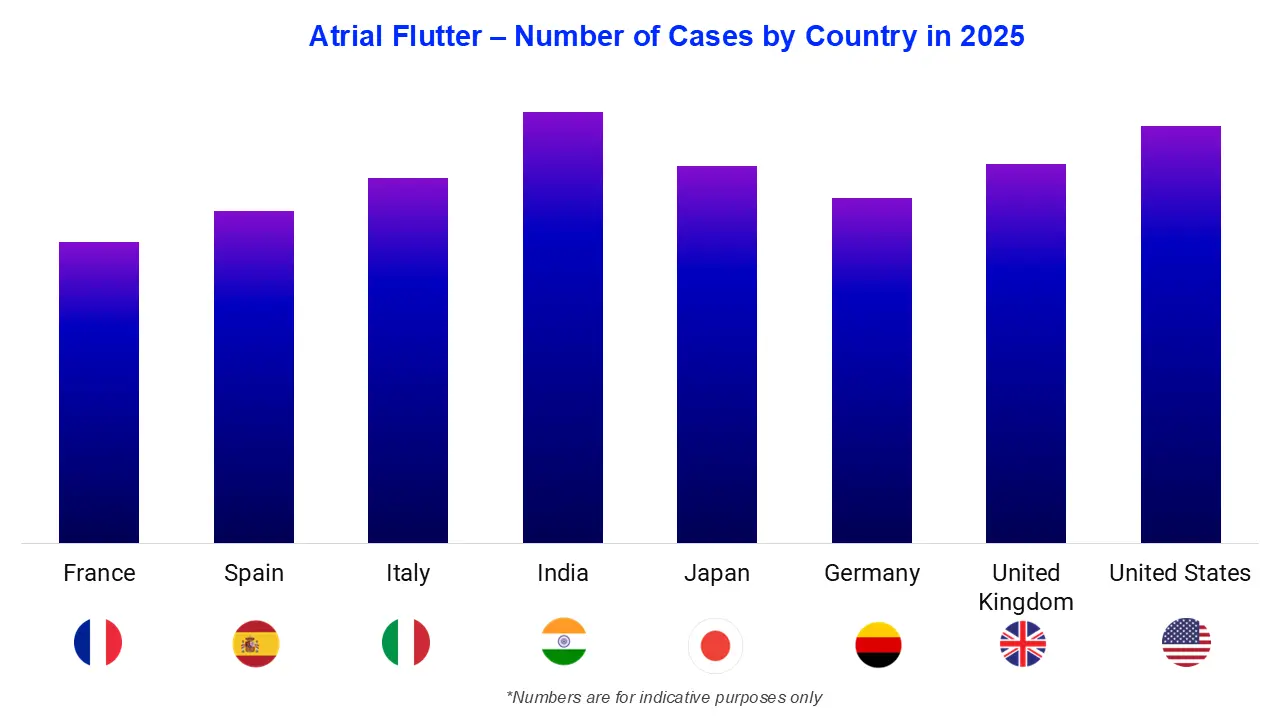
The Atrial Flutter epidemiology data and findings for the United States, Germany, Spain, Italy, France, the United Kingdom, Japan, and India are also provided in the epidemiology section.
|
Country |
Key Insights |
|
United States |
The United States has the strongest classic population-based evidence for AFL-only incidence. Granada et al. reported 88 cases per 100,000 person-years, with incidence reaching 587 per 100,000 among individuals >80 years and being approximately 2.5 times higher in men. |
|
Germany |
Germany has population-based evidence on atrial fibrillation/atrial flutter, although contemporary AFL-only estimates remain limited. In the German Heinz Nixdorf Recall Study, 4,814 participants aged 45–75 years were evaluated, with AF/AFL prevalence of 3.2% overall, including 4.3% among men and 2.1% among women. Over a median 16.7-year follow-up, the incidence rate was 9.4 per 1,000 person-years, demonstrating a substantial arrhythmia burden in the German population. |
|
France |
France contributes substantially to European AF/AFL epidemiological surveillance, but a directly comparable contemporary national incidence estimate specifically for isolated AFL is not sufficiently established. European GBD analyses demonstrate a substantial burden of combined AF/AFL across Western Europe, with higher absolute incidence than Central and Eastern European regions. |
|
Italy |
Italy forms part of the substantial European AF/AFL disease burden, but current population-level publications generally report AF and AFL together. Consequently, a precise national AFL-only prevalence or incidence figure should not be stated without a dedicated Italian AFL cohort or registry. European GBD data demonstrate persistent and substantial AF/AFL incidence, prevalence, mortality, and DALY burden across the region. |
|
Spain |
Spain contributes to the European AF/AFL burden, but robust contemporary national AFL-only epidemiological estimates are limited. Available European GBD analyses demonstrate substantial country-level heterogeneity in combined AF/AFL incidence, prevalence, mortality, and DALYs |
|
United Kingdom |
The United Kingdom has substantial evidence concerning AF/AFL hospitalizations and cardiovascular outcomes, but contemporary national estimates frequently combine AF and AFL. Therefore, a specific AFL-only incidence figure should not be inferred from combined AF/AFL statistics. |
|
Japan |
Japan has substantial electrophysiological research on AFL, including contemporary studies of atypical AFL. A 2024 Japanese cohort of patients undergoing AFL ablation identified 89 patients, including 22 with idiopathic atypical AFL and 67 with CTI-dependent AFL; idiopathic atypical AFL was associated with greater subsequent cardiovascular risk. PubMed However, a contemporary nationwide AFL-only prevalence estimate is not sufficiently established. |
|
India |
India represents a large potential population for AFL because of its substantial cardiovascular risk-factor burden, but reliable contemporary nationwide AFL-only prevalence and incidence estimates are limited. GBD analyses indicate a very large, combined AF/AFL burden in India, with India among the countries contributing the highest absolute numbers of AF/AFL cases. These estimates should not be represented as AFL-only figures. |
According to contemporary epidemiological evidence, important gaps remain in the independent characterization of atrial flutter because AFL is frequently combined with AF in administrative databases, registries, and Global Burden of Disease analyses. This complicates estimation of the true AFL-specific prevalence, incidence, mortality, and healthcare burden. The problem is particularly relevant because AF and AFL frequently coexist, while patients successfully treated for CTI-dependent AFL can subsequently develop clinically important AF. The FLUTFIB study demonstrated the importance of continuous monitoring after CTI ablation for detecting previously unrecognized AF. PubMed Emerging opportunities include dedicated AFL registries, improved ECG-based case ascertainment, systematic monitoring for post-ablation AF, standardized reporting of CTI-dependent and atypical AFL, and improved integration of rhythm monitoring with thromboembolic-risk assessment.
The management of atrial flutter focuses on hemodynamic stabilization when required, ventricular rate control, restoration of sinus rhythm, prevention of thromboembolism, and definitive elimination of the re-entry circuit. According to the 2023 ACC/AHA/ACCP/HRS guideline, anticoagulant therapy for AFL should be based on the same thromboembolic-risk profile used for AF, and anticoagulation should generally continue for at least four weeks after successful cardioversion or ablation. For typical CTI-dependent AFL, catheter ablation is the principal definitive treatment because of its high efficacy and low procedural risk. The 2024 international electrophysiology consensus specifically identifies CTI ablation as the recommended treatment for CTI-dependent AFL.


Upto 15% Off
USD
$1999 $1799
$2999 $2699
$4399 $3739
$5799 $4929


*While we strive to always give you current and accurate information, the numbers depicted on the website are indicative and may differ from the actual numbers in the main report. At Expert Market Research, we aim to bring you the latest insights and trends in the market. Using our analyses and forecasts, stakeholders can understand the market dynamics, navigate challenges, and capitalize on opportunities to make data-driven strategic decisions.*
Explore our key highlights of the report and gain a concise overview of key findings, trends, and actionable insights that will empower your strategic decisions.
|
Report Features |
Details |
|
Base Year |
2025 |
|
Historical Period |
2019-2025 |
|
Forecast Period |
2026-2035 |
|
Epidemiology Statistics Provided |
|
|
Segmentation Provided |
|
|
Geographies Covered |
|
Datasheet
One User
USD 1,999
USD 1,799
tax inclusive*
Single User License
One User
USD 2,999
USD 2,699
tax inclusive*
Five User License
Five User
USD 4,399
USD 3,739
tax inclusive*
Corporate License
Unlimited Users
USD 5,799
USD 4,929
tax inclusive*
*Please note that the prices mentioned below are starting prices for each bundle type. Kindly contact our team for further details.*
Flash Bundle
Small Business Bundle
Growth Bundle
Enterprise Bundle
*Please note that the prices mentioned below are starting prices for each bundle type. Kindly contact our team for further details.*
Flash Bundle
Number of Reports: 3
20%
tax inclusive*
Small Business Bundle
Number of Reports: 5
25%
tax inclusive*
Growth Bundle
Number of Reports: 8
30%
tax inclusive*
Enterprise Bundle
Number of Reports: 10
35%
tax inclusive*
How To Order

Select License Type
Choose the right license for your needs and access rights.

Click on ‘Buy Now’
Add the report to your cart with one click and proceed to register.

Select Mode of Payment
Choose a payment option for a secure checkout. You will be redirected accordingly.
Strategic Solutions for Informed Decision-Making
Gain insights to stay ahead and seize opportunities.

Get insights & trends for a competitive edge.

Track prices with detailed trend reports.

Analyse trade data for supply chain insights.

Leverage cost reports for smart savings

Enhance supply chain with partnerships.

Connect For More Information
Our expert team of analysts will offer full support and resolve any queries regarding the report, before and after the purchase.
Our expert team of analysts will offer full support and resolve any queries regarding the report, before and after the purchase.
We employ meticulous research methods, blending advanced analytics and expert insights to deliver accurate, actionable industry intelligence, staying ahead of competitors.
Our skilled analysts offer unparalleled competitive advantage with detailed insights on current and emerging markets, ensuring your strategic edge.
We offer an in-depth yet simplified presentation of industry insights and analysis to meet your specific requirements effectively.




