

Consumer Insights
Uncover trends and behaviors shaping consumer choices today
Procurement Insights
Optimize your sourcing strategy with key market data
Industry Stats
Stay ahead with the latest trends and market analysis.
Chronic myelogenous leukemia (CML), also referred to as chronic myeloid leukemia, remains a rare but clinically significant myeloproliferative neoplasm characterized by the Philadelphia chromosome and the constitutively active BCR::ABL1 fusion oncogene. A 2025 JAMA review by Elias Jabbour and Hagop Kantarjian described CML as a disease with an annual incidence of approximately 2 cases per 100,000 population, with approximately 9,300 newly diagnosed patients annually in the United States and an estimated 150,000 U.S. patients living with CML. According to the chronic myelogenous leukemia epidemiology forecast by Expert Market Research, the disease continues to represent an important clinical and market burden because improved survival has created a large and growing prevalent population requiring prolonged molecular monitoring and long-term TKI therapy.
Base Year
Historical Period
Forecast Period
Read more about this report - Request a Free Sample
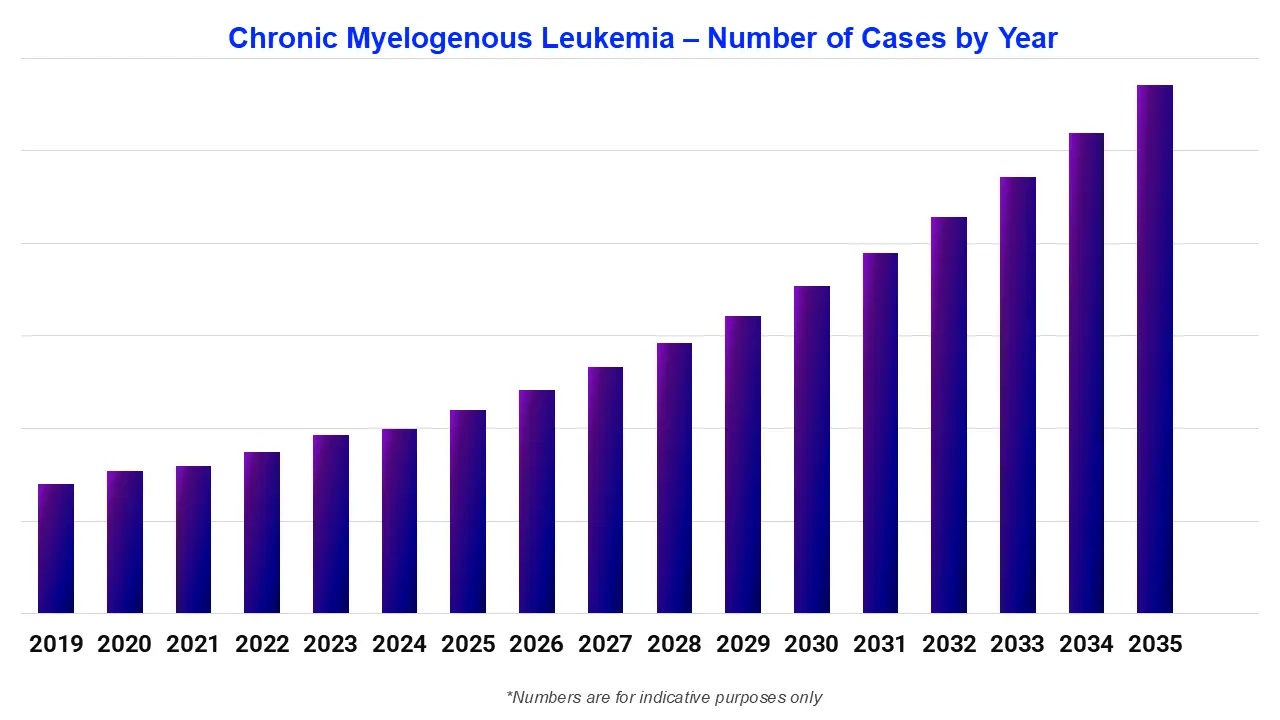
Expert Market Research's “Chronic Myelogenous Leukemia Epidemiology Forecast Report 2026-2035” offers comprehensive information on the prevalence and demographics of Chronic Myelogenous Leukemia. It projects the future incidence and prevalence rates of Chronic Myelogenous Leukemia cases across various populations. The study covers age, gender, and type as major determinants of the Chronic Myelogenous Leukemia population. The report highlights patterns in the prevalence of Chronic Myelogenous Leukemia overtime and projects future trends based on multiple variables.
The report provides a comprehensive overview of the disease, as well as historical and projected data on the epidemiology of Chronic Myelogenous Leukemia in the 8 major markets.
Regions Covered
Chronic myelogenous leukemia (CML), also referred to as chronic myeloid leukemia, remains a rare but clinically significant myeloproliferative neoplasm characterized by the Philadelphia chromosome and the constitutively active BCR::ABL1 fusion oncogene. The disease arises from a hematopoietic stem-cell clone carrying the BCR::ABL1 rearrangement and is characterized by abnormal myeloid proliferation. Contemporary CML management has transformed the disease from a frequently fatal leukemia into a predominantly chronic condition for many patients, largely because BCR::ABL1-directed tyrosine kinase inhibitors (TKIs) provide sustained molecular disease control. The contemporary epidemiology of CML is increasingly shaped by improved survival and prolonged disease control rather than high short-term mortality. A 2025 review reported that the widespread use of BCR::ABL1 TKIs has reduced annual mortality to approximately 1%, resulting in substantial accumulation of prevalent patients receiving long-term therapy.
|
Parameter |
Insight |
|
Largest Patient Pool |
United States |
|
Fastest Growing Country |
India |
|
High-Risk Population |
Patients with BCR::ABL1 T315I mutation, resistance or intolerance to multiple TKIs, advanced-phase disease, high ELTS risk, inadequate molecular response and significant treatment-related comorbidity |
|
Key Diagnostic Method |
BCR::ABL1 molecular testing by standardized quantitative real-time PCR |
|
Major Risk Factor |
Older age |
|
Major gap in the market |
TKI resistance and intolerance, persistent disease despite multiple treatment lines, limited access to standardized molecular monitoring, cardiovascular toxicity, treatment adherence, affordability and incomplete ability to achieve durable treatment-free remission |
The Chronic Myelogenous Leukemia epidemiology division offers information on the patient pool from history to the present as well as the projected trend for each of the 8 major markets. Expert Market Research provides both current and predicted trends for the Chronic Myelogenous Leukemia epidemiology scenario by examining a wide range of studies. Additionally, the report covers the diagnosed patient pool for Chronic Myelogenous Leukemia and their trends. The data is broken down into specific categories, such as total prevalent cases in males and females, and total diagnosed cases across different age groups and patient pools.
|
Epidemiology Segment |
Key Insights |
|
Diagnosed Prevalent Cases of the Disease |
According to the U.S. National Cancer Institute's current SEER dataset, 76,692 people were estimated to be living with CML in the United States in 2023. The 2025 review by Kantarjian et al. estimated approximately 150,000 prevalent U.S. patients in 2025, illustrating the effect of long-term survival and differences between registry-based and clinical-model prevalence estimates. |
|
Gender-Specific Cases of the Disease |
CML demonstrates a consistent male predominance. Current U.S. SEER data for 2019–2023 show an age-adjusted incidence of 2.7 per 100,000 among males compared with 1.6 per 100,000 among females. Thus, men experienced approximately 1.7-fold the incidence observed among women in the contemporary U.S. dataset. |
|
Age-Specific Cases of the Disease |
CML is predominantly diagnosed in older adults. Current SEER data identify a median age at diagnosis of 67 years, with 23.7% of diagnoses occurring among patients aged 65–74 years and 21.7% among those aged 75–84 years. Patients younger than 20 years accounted for only 1.6% of contemporary U.S. diagnoses. |
|
Ethnicity-Wise Cases of the Disease |
Contemporary U.S. SEER data demonstrate variation in incidence across racial and ethnic groups. Among men, incidence was 2.9 per 100,000 in non-Hispanic White individuals, 2.4 in non-Hispanic Black individuals, 2.2 among Hispanic individuals and 1.6 among non-Hispanic Asian/Pacific Islander individuals. Among women, the corresponding rates were 1.7, 1.7, 1.5 and 0.9 per 100,000, respectively. These differences may reflect demographic structure, environmental exposure, healthcare access and ascertainment rather than a single biological determinant. |
|
Mortality and Survival Analysis of the Disease |
Contemporary U.S. mortality data show a CML death rate of 0.3 per 100,000 based on 2020–2024 mortality data, with the death rate substantially higher among older adults. The latest SEER report estimates a 5-year relative survival of 71.1%, although this survival estimate is based on diagnoses during 2016–2022 and therefore is not used as a 2023–2026 incident-cohort outcome. Contemporary clinical reviews emphasize that TKI therapy has transformed CML into a chronic disease for most patients, while mortality remains concentrated among patients with advanced disease, resistance, intolerance or other high-risk features. |
|
Disease Type |
Prevalence |
|
Chronic-Phase CML (CML-CP) |
Chronic-phase CML represents the dominant clinical presentation and the principal addressable population for long-term BCR::ABL1-targeted therapy. Most newly diagnosed patients enter treatment during chronic phase, and contemporary management focuses on achieving sustained molecular response while minimizing long-term toxicity. |
|
Accelerated-Phase CML |
Accelerated-phase disease represents an advanced biological state with increased risk of progression to blast phase. Contemporary management requires intensified BCR::ABL1 inhibition and individualized assessment of molecular response, resistance and eligibility for allogeneic hematopoietic stem-cell transplantation. The 2025 ELN framework emphasizes individualized treatment sequencing according to disease biology and treatment response. |
|
Blast-Phase CML |
Blast-phase CML is the most aggressive form of the disease and may manifest as myeloid or lymphoid blast transformation. Management generally requires potent BCR::ABL1 inhibition combined with lineage-appropriate acute-leukemia therapy and consideration of allogeneic transplantation where feasible. Contemporary Chinese pediatric data published in 2024 continue to demonstrate the clinical severity and rarity of blast-phase CML in children. |
|
BCR::ABL1 T315I-Positive CML |
T315I represents a particularly important molecularly defined treatment segment because it confers resistance to several ATP-competitive TKIs. Contemporary 2025 guidance identifies ponatinib, asciminib and olverembatinib among the relevant therapeutic options depending on regulatory jurisdiction and disease context. |
Read more about this report - Request a Free Sample
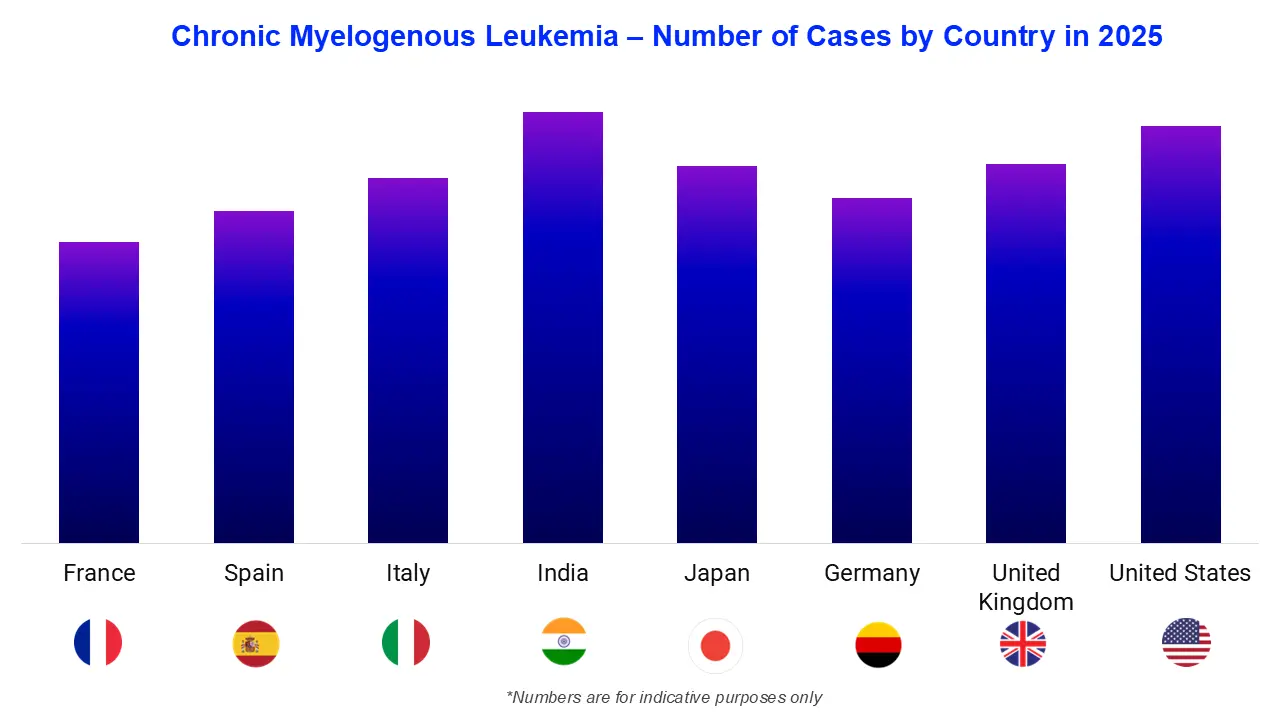
The Chronic Myelogenous Leukemia epidemiology data and findings for the United States, Germany, Spain, Italy, France, the United Kingdom, Japan, and India are also provided in the epidemiology section.
|
Country |
Key Insights |
|
United States |
The United States represents one of the largest and most mature CML treatment markets. Current SEER data estimate 76,692 people living with CML in 2023, while the 2026 Cancer Stat Facts estimates 9,650 new cases and 1,170 deaths for 2026. The contemporary 2025 clinical literature estimates approximately 150,000 prevalent U.S. patients, reflecting the expanding pool generated by prolonged TKI-associated survival. |
|
Germany |
Germany represents a mature European CML market with extensive access to standardized BCR::ABL1 molecular monitoring. A contemporary 2024 German real-world analysis of 819 patients demonstrated routine qPCR monitoring, with 87.7% of patients monitored through EUTOS-certified laboratories. Treatment changes were primarily associated with adverse effects rather than inadequate response, illustrating the importance of TKI tolerability and long-term treatment optimization. |
|
France |
France represents an established CML treatment market with mature population-based healthcare data and broad access to molecular monitoring and TKI therapy. Contemporary French CML literature continues to emphasize the epidemiological consequence of prolonged survival and the resulting expansion of the prevalent population. A nationally representative CML-specific incidence figure restricted exclusively to 2023–2026 observations was not identified in the reviewed evidence; therefore, no historical value is substituted. |
|
Italy |
Italy provides particularly useful contemporary CML prevalence evidence. A 2024 study by the Lombardy Hematology Network directly enumerated patients at the beginning of 2023 and identified 2,285 registered patients, corresponding to a prevalence of 0.23 per 1,000 inhabitants in Lombardy. The study also demonstrated increasing concentration of CML care in specialized centres and persistent treatment discontinuation challenges. |
|
Spain |
Spain represents an important European CML market with established hematology networks and molecular monitoring infrastructure. Contemporary Spanish practice is increasingly aligned with the 2025 ELN framework, emphasizing molecular milestones, personalized TKI selection and treatment-free remission. A new population-wide CML incidence estimate restricted to 2023–2026 was not identified in the reviewed literature; older registry estimates were therefore deliberately excluded. |
|
United Kingdom |
The United Kingdom represents a mature CML market with established NHS hematology services and standardized molecular monitoring. The 2026 ADAPT 2.0 survey, conducted among UK clinicians between December 2023 and June 2024, found that treatment goals increasingly included major molecular response, deep molecular response and treatment-free remission. |
|
Japan |
Japan represents a highly developed Asia-Pacific CML market with increasing use of next-generation BCR::ABL1 inhibition. A 2024 Japanese report evaluated deep molecular response and treatment-free remission following asciminib treatment, illustrating growing clinical interest in treatment discontinuation beyond conventional ATP-competitive TKIs. Contemporary Japanese reviews also emphasize asciminib, ponatinib optimization and TFR as important components of modern CML management. |
|
India |
India represents a high-growth but heterogeneous CML market. Contemporary Indian clinical literature identifies persistent unmet needs after failure or intolerance of two or more TKIs, including non-durable responses, resistance, adverse events, reduced quality of life and access to advanced therapies. A 2026 Indian-focused review specifically highlights asciminib and ponatinib as important options for patients beyond second-line treatment. A nationally representative CML prevalence estimate restricted exclusively to 2023–2026 data was not identified, so no historical Indian incidence number is presented. |
According to contemporary 2023–2026 evidence, the epidemiology of chronic myelogenous leukemia is increasingly defined by a paradox: CML remains a relatively uncommon leukemia, but its prevalent population is expanding because modern BCR::ABL1-targeted therapy permits prolonged survival. A 2025 review estimated approximately 150,000 U.S. patients living with CML and approximately 5 million patients worldwide. The U.S. SEER programme, using a different methodology, estimated 76,692 prevalent patients in 2023. Discrepancy demonstrates an important epidemiological gap: CML prevalence estimates vary according to registry coverage, modelling assumptions, treatment access and definitions of prevalent disease. A major opportunity therefore exists in developing standardized, contemporary CML prevalence registries that distinguish newly diagnosed patients, patients receiving active TKI therapy, patients in deep molecular remission and patients in treatment-free remission
The management of chronic myelogenous leukemia primarily focuses on suppressing the BCR::ABL1-positive leukemic clone, preventing progression to accelerated or blast phase, achieving durable deep molecular response, minimizing treatment-related toxicity and, in appropriately selected patients, enabling sustained treatment-free remission. Contemporary CML management is fundamentally different from the treatment paradigm used for acute leukemias because most chronic-phase patients require long-term molecular disease control rather than conventional cytotoxic chemotherapy. The 2025 European LeukemiaNet recommendations represent the current major international framework for CML management. The updated recommendations incorporate changes in disease classification, first-line treatment selection, molecular response interpretation, dose reduction for toxicity, treatment sequencing, treatment discontinuation, fertility and management of comorbidities.


Upto 15% Off
USD
$2699 $2429
$4299 $3869
$5799 $4949
$6999 $5949


*While we strive to always give you current and accurate information, the numbers depicted on the website are indicative and may differ from the actual numbers in the main report. At Expert Market Research, we aim to bring you the latest insights and trends in the market. Using our analyses and forecasts, stakeholders can understand the market dynamics, navigate challenges, and capitalize on opportunities to make data-driven strategic decisions.*
Explore our key highlights of the report and gain a concise overview of key findings, trends, and actionable insights that will empower your strategic decisions.
|
Report Features |
Details |
|
Base Year |
2025 |
|
Historical Period |
2019-2025 |
|
Forecast Period |
2026-2035 |
|
Epidemiology Statistics Provided |
|
|
Segmentation Provided |
|
|
Geographies Covered |
|
Datasheet
One User
USD 2,699
USD 2,429
tax inclusive*
Single User License
One User
USD 4,299
USD 3,869
tax inclusive*
Five User License
Five User
USD 5,799
USD 4,949
tax inclusive*
Corporate License
Unlimited Users
USD 6,999
USD 5,949
tax inclusive*
*Please note that the prices mentioned below are starting prices for each bundle type. Kindly contact our team for further details.*
Flash Bundle
Small Business Bundle
Growth Bundle
Enterprise Bundle
*Please note that the prices mentioned below are starting prices for each bundle type. Kindly contact our team for further details.*
Flash Bundle
Number of Reports: 3
20%
tax inclusive*
Small Business Bundle
Number of Reports: 5
25%
tax inclusive*
Growth Bundle
Number of Reports: 8
30%
tax inclusive*
Enterprise Bundle
Number of Reports: 10
35%
tax inclusive*
How To Order

Select License Type
Choose the right license for your needs and access rights.

Click on ‘Buy Now’
Add the report to your cart with one click and proceed to register.

Select Mode of Payment
Choose a payment option for a secure checkout. You will be redirected accordingly.
Strategic Solutions for Informed Decision-Making
Gain insights to stay ahead and seize opportunities.

Get insights & trends for a competitive edge.

Track prices with detailed trend reports.

Analyse trade data for supply chain insights.

Leverage cost reports for smart savings

Enhance supply chain with partnerships.

Connect For More Information
Our expert team of analysts will offer full support and resolve any queries regarding the report, before and after the purchase.
Our expert team of analysts will offer full support and resolve any queries regarding the report, before and after the purchase.
We employ meticulous research methods, blending advanced analytics and expert insights to deliver accurate, actionable industry intelligence, staying ahead of competitors.
Our skilled analysts offer unparalleled competitive advantage with detailed insights on current and emerging markets, ensuring your strategic edge.
We offer an in-depth yet simplified presentation of industry insights and analysis to meet your specific requirements effectively.




