

Consumer Insights
Uncover trends and behaviors shaping consumer choices today
Procurement Insights
Optimize your sourcing strategy with key market data
Industry Stats
Stay ahead with the latest trends and market analysis.
The cannabinoid bioavailability enhancement market was valued at USD 1.75 Billion in 2025 and is projected to reach USD 8.78 Billion by 2035, growing at a CAGR of 17.50%. Growth is supported by the poor oral absorption of cannabinoids, expanding prescription use in epilepsy and pain, the spread of legal hemp and cannabis products, and consumer demand for faster-acting, consistent doses.
Patent activity spans self-emulsifying lipid systems, nanoemulsions and nanoparticles, liposomal carriers, cyclodextrin complexes, prodrugs and water-soluble forms, together with oromucosal, transdermal, inhaled and intranasal delivery routes. Commercial validation includes the 2018 FDA approval of a plant-derived cannabidiol oral solution for severe childhood epilepsy and the long-running oromucosal spray programme for spasticity. Producers of consumer products have followed by filing on water-soluble beverage and edible formats, which adds to filing volume.
This Cannabinoid Bioavailability Enhancement Patent Landscape Analysis Report provides a structured view of patent filing trends, leading assignees, jurisdictions, technology clusters and competitive positioning across the delivery systems, routes and formulations that improve cannabinoid absorption.
The cannabinoid bioavailability enhancement market is experiencing strong growth, driven by the low absorption of oral cannabinoids, expanding prescription use in epilepsy and pain, and demand for fast-acting consumer products. Cannabidiol is commonly reported to reach only about 6% oral bioavailability, so food effects and dose variability create a clear opening for lipid systems and nanoemulsions.
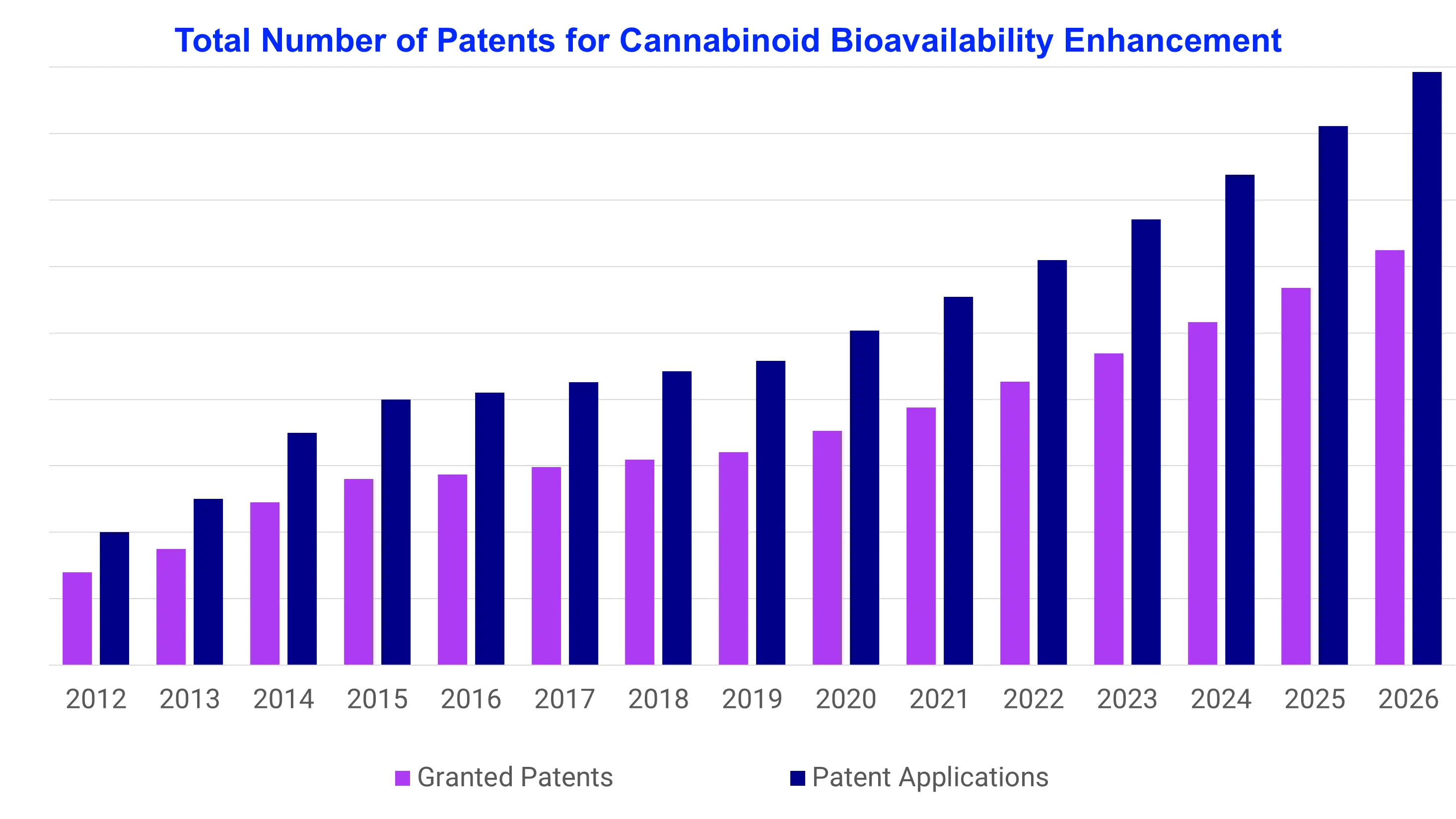
Patent activity is accelerating, with 350+ cannabinoid bioavailability enhancement patents granted in 2025, reflecting strong innovation momentum in self-emulsifying lipid systems that raise oral absorption, nanoemulsions and nanoparticles for water-soluble cannabinoid products, cyclodextrin complexes and prodrugs that improve solubility, and oromucosal, transdermal and inhaled routes that bypass first-pass metabolism.
Top assignees in the cannabinoid bioavailability enhancement patent landscape include Jazz Pharmaceuticals, Canopy Growth, Aurora Cannabis, Avicanna, and Tilray, with the United States, Europe, and China as the dominant patent jurisdictions.
Cannabinoids such as cannabidiol and tetrahydrocannabinol dissolve poorly in water and are broken down extensively in the gut wall and liver, so only a small share of an oral dose reaches the bloodstream. Absorption also varies widely between patients and with food intake, which complicates dosing for conditions that need steady plasma levels, such as epilepsy and chronic pain. These limits have turned delivery science into a commercial priority for pharmaceutical developers, nutraceutical brands and cannabis producers alike. Demand characteristics differ by channel: prescription products require reproducible pharmacokinetics for regulators, whereas wellness products compete on onset speed, taste and the clarity of water-soluble beverages.
Market growth is driven by the wide gap between the cannabinoid dose swallowed and the amount absorbed, since oral cannabidiol is commonly reported at about 6% bioavailability and exposure rises several-fold when taken with a fatty meal. Formulations that narrow this gap let developers lower doses and reduce batch-to-batch variability. Regulatory validation came with the 2018 FDA approval of Epidiolex and its European approval in 2019, which showed that a cannabinoid oral solution can meet pharmaceutical standards. Legal changes such as the 2018 United States Farm Bill and the 2019 Canadian authorisation of edibles, extracts and topicals opened large consumer segments for infused beverages and softgels.
A reported oral bioavailability near 6% for cannabidiol indicates that roughly nineteen of every twenty milligrams swallowed never reach circulation, which raises the cost of each effective dose and creates a direct commercial case for absorption technology. Inhaled delivery is often cited near 31%, showing that bypassing first-pass metabolism can multiply exposure, and this supports filings on vaporised, oromucosal and intranasal routes. Exposure that rises several-fold with a high-fat meal shows how food changes the dose reaching the patient, which pushes developers toward lipid systems that behave consistently whether or not a patient has eaten. Approvals for severe childhood epilepsy, where dose precision matters, strengthen the premium placed on reproducible formulations.
Read more about this report - REQUEST FREE SAMPLE COPY IN PDF
Filing intensity in cannabinoid bioavailability enhancement follows commercial investment in cannabis and hemp products. After the 2018 Farm Bill and Canada's 2019 rules on edibles, extracts and topicals, licensed producers and consumer brands raised spending on research and filed on emulsions, water-soluble powders and infused beverages. Pharmaceutical developers have filed more selectively, protecting dosing regimens, solid dispersions and prodrugs tied to clinical programmes. Consolidation, including the 2021 acquisition of GW Pharmaceuticals by Jazz Pharmaceuticals and the Tilray and Aphria combination in the same year, moved large formulation estates into fewer assignee groups, while weaker cannabis equity valuations after 2021 slowed filings by smaller producers.
More than 5,200 patent families related to cannabinoid bioavailability enhancement were identified across the landscape. Filing peaked between roughly 2019 and 2022, when legalisation of hemp-derived products in the United States and of derivative products in Canada drew consumer brands into formulation work. The largest clusters cover self-emulsifying lipid systems, nanoemulsions and nanoparticles, and liposomal and lipid-based carriers, while cyclodextrin complexes, water-soluble forms and prodrugs form a steady second tier. Route-focused families on oromucosal, transdermal, inhaled and intranasal delivery add a further layer, and filings have levelled off more recently as developers concentrate on fewer, better-supported formulations.
Rising prescription use and the spread of infused consumer products have a direct counterpart in the growth of lipid, nanoemulsion and route-focused filings, which shows that demand for reliable absorption is being converted into protected formulation know-how.
This report analyses patent activity and market trends associated with cannabinoid bioavailability enhancement across the United States, Europe, China, Japan, South Korea, India and international filings made through the World Intellectual Property Organization (WIPO). Coverage includes formulations, delivery systems and administration routes that raise the amount of cannabinoid reaching the bloodstream, drawn from national offices and regional authorities. Market context reflects use of these technologies by Pharmaceutical Companies, Nutraceutical and Wellness Brands, Contract Development and Manufacturing Organisations, hospitals and specialty clinics, and Academic and Research Institutes, linking patent coverage to demand in each region.
The scope includes enhancement technologies such as self-emulsifying delivery systems, nanoemulsions and nanoparticles, liposomal and lipid-based carriers, cyclodextrin complexes, and water-soluble forms and prodrugs. Routes of administration covered are oral, sublingual and oral mucosal, transdermal and topical, inhalation, and intranasal. Applications considered are pain management, epilepsy and neurological disorders, anxiety and sleep disorders, dietary supplements and wellness, and oncology supportive care. Patents are further grouped by technology cluster to show where innovation concentrates.
The analysis includes patent activity from pharmaceutical companies developing prescription cannabinoid medicines, licensed cannabis producers and hemp processors, and nutraceutical and wellness brands launching water-soluble and fast-acting products. Specialist delivery technology firms that license lipid, nanoparticle and cyclodextrin platforms are also covered, as are contract development and manufacturing organisations that formulate on behalf of others. Universities, research institutes and hospital-affiliated teams that file on pharmacokinetics, solubilisation and clinical dosing are included, together with ingredient suppliers whose filings relate to cannabinoid bioavailability enhancement.
The report will cover the following sections in detail:
Analysis by Enhancement Technology
Analysis by Route of Administration
Analysis by Application
Cannabinoid Bioavailability Enhancement Patent Filing Trend Analysis
Early filings in cannabinoid bioavailability enhancement centred on oromucosal sprays and lipid solutions for prescription medicines, building on work dating from the 2000s for products such as nabiximols. A second wave after 2014 introduced self-emulsifying lipid systems, cyclodextrin complexes and liposomes as researchers documented the poor and variable absorption of oral cannabidiol. Since 2018, legalisation of hemp and derivative products has brought nanoemulsions, water-soluble powders and infused beverage technologies into the record, and recent applications address prodrugs and transdermal systems. Grants of more than 350 patents in 2025 indicate a sizeable base of enforceable rights and a continuing pipeline of applications.
Patent filings increased at an estimated annual growth rate of approximately 11% between 2020 and 2024. Nanoemulsion and water-soluble product filings grew fastest, supported by demand from beverage and edible makers in North America. Transdermal and oromucosal families expanded more slowly, tied to a smaller number of prescription programmes, while cyclodextrin and prodrug filings held steady. Applicants also broadened claims from single formulations to combinations of carrier, emulsifier and dosing regimen, since a complete formulation is harder to design around than a single excipient.
Among the players with cannabinoid bioavailability enhancement patent families, new entrants have been identified, which can be either established companies or startups developing novel technology in the field. Some of the major companies mentioned in this report (a non-exhaustive list) are as follows:
Jazz Pharmaceuticals entered cannabinoid bioavailability enhancement at scale through its 2021 acquisition of GW Pharmaceuticals, which brought a portfolio covering plant-derived cannabinoid medicines, formulation and delivery. Epidiolex, a cannabidiol oral solution in a sesame oil base, received FDA approval in 2018 for seizures linked to Lennox-Gastaut syndrome and Dravet syndrome, and its label was later extended to tuberous sclerosis complex. Sativex, an oromucosal spray, is marketed through partners in many countries outside the United States, and approvals span the United States, Europe and other regions. The intellectual property strategy combines patents on cannabinoid compositions, dosing regimens and indications with formulation filings that extend protection as products mature. Commercially, the company is positioned as the leading prescription cannabinoid supplier within a neurology-focused portfolio.
Canopy Growth holds a broad cannabinoid portfolio built around its Canadian licensed production, consumer brands such as Tweed and Tokyo Smoke, and medical offerings supplied under the Spectrum Therapeutics name. Product formats include oils, softgel capsules, sprays, beverages and other infused products, and ownership of the Storz and Bickel vaporiser business gives the company an inhaled delivery route. Regulatory standing rests on its status as a federally licensed producer under Canada's Cannabis Act, with derivative product categories permitted since 2019, together with medical supply in several international markets. The intellectual property strategy centres on formulation, extraction and infused product processes, with water-soluble and fast-onset formats a recurring theme. Commercially, the company is positioned as a consumer and medical brand operator that uses delivery technology to differentiate its products.
Other companies include Aurora Cannabis, Avicanna, and Tilray.
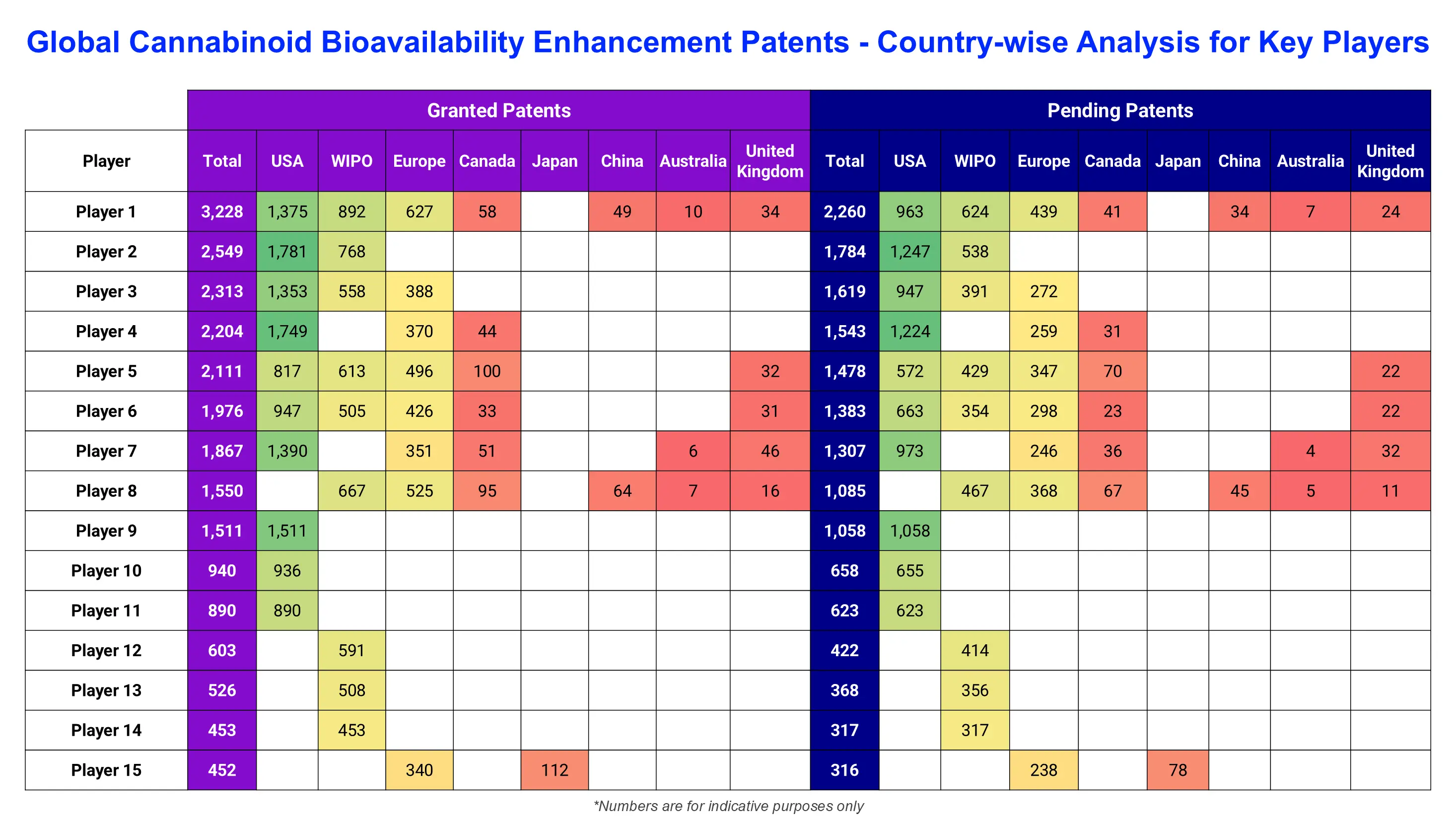
The leading assignees, Jazz Pharmaceuticals, Canopy Growth, Aurora Cannabis, Avicanna and Tilray, hold a meaningful share of analysed patent families, but a long tail of universities, specialist delivery firms and small producers indicates a fragmented landscape. Jazz Pharmaceuticals concentrates on pharmaceutical cannabinoid compositions, dosing and oral and oromucosal formulations, while Canopy Growth files on beverage, infused product and inhalation technologies. Aurora Cannabis protects extraction, oil and capsule formulation processes for medical products, Avicanna focuses on topical, transdermal and oral systems developed with academic partners, and Tilray covers medical formulations and infused consumer formats.
*Please note that this is only a partial list; the complete list of key players is available in the full report. Additionally, the list of key players can be customized to better suit your needs.*
The report assesses patent activity across major jurisdictions, including:
The United States is the largest single jurisdiction for cannabinoid bioavailability enhancement, reflecting its prescription cannabinoid approvals, a large hemp and wellness product market and the strength of patent enforcement. Europe follows through European Patent Office filings and national validations, supported by medical cannabis programmes in Germany and the United Kingdom and by the European approval of a cannabidiol epilepsy medicine. China has become a growing filing centre as domestic institutions and ingredient makers work on hemp-derived cannabidiol extraction and formulation. Japan, South Korea and India show smaller but rising activity, and WIPO filings reveal which families applicants intend to take into several markets at once, with Canada active mainly through producer-led applications.
Read more about this report - REQUEST FREE SAMPLE COPY IN PDF
The patent landscape is segmented by the technology categories most closely associated with cannabinoid bioavailability enhancement, which include:
Among these, self-emulsifying lipid delivery systems and nanoemulsions account for the largest share of recent patent activity. Applicants are filing on oil and surfactant combinations that form fine droplets in the gut, medium-chain triglyceride and long-chain lipid vehicles, and powders that disperse in water. Growth in this cluster has outpaced cyclodextrin and prodrug filings because lipid systems can be added to existing oils, capsules and beverages without needing a new active molecule, and every major assignee now maintains active lipid programmes.
The cannabinoid bioavailability enhancement market is competitive and fragmented, shaped by one large pharmaceutical franchise, several licensed producers and a group of specialist delivery developers. Competition has moved from simple oils toward engineered carriers that promise faster onset, lower dose and clear beverage compatibility, and licensing of lipid and nanoparticle platforms to consumer brands is increasingly common. Filings from universities and small developers show that formulation design is still unsettled, and positions in clinical evidence for absorption will influence which products win prescriber and regulator confidence.
Companies are focusing on:
Emerging innovation themes include dried lipid powders and sugar-based carriers that dissolve cleanly in beverages, minor cannabinoids and terpene blends formulated with matched carriers, and prodrugs designed for stability and controlled release. Transdermal patches and intranasal sprays are gaining attention as routes that avoid first-pass metabolism, while mucoadhesive films and oral strips target fast onset. Developers are also studying pharmacokinetic profiles by food state and age group, and applying in vitro digestion models to predict absorption before clinical studies begin.
The patent landscape for cannabinoid bioavailability enhancement maps how innovation is distributed across enhancement technologies, administration routes and applications in more than 5,200 patent families, and it identifies the assignees and jurisdictions where protection is concentrated. Filings in lipid systems, nanoemulsions and prodrugs show where formulation investment is directed, while older oromucosal and oil-based families indicate where freedom to operate depends on expiry timelines. Together, the findings give pharmaceutical developers, consumer brands and investors a structured view of competitive positions.
The landscape provides actionable intelligence for the following nine uses:
Patent research was conducted across major patent databases, including national and regional office records and international filings published under the Patent Cooperation Treaty. Search strategies combined Cooperative Patent Classification codes for pharmaceutical preparations and drug delivery with keyword queries on cannabinoids, emulsions, carriers, routes and solubility. Records were gathered through the latest complete publication period, and equivalent filings were consolidated into patent families so that each invention was counted once.
Screening removed duplicate families and filings with no relevance to cannabinoid bioavailability enhancement. Remaining records were reviewed and classified by enhancement technology, route of administration, application, assignee and jurisdiction. Assignee names were standardised so that subsidiaries and name variants were attributed to a single owner, and legal status was used to separate granted patents from pending applications.
Market analysis supported the interpretation of patent trends through review of regulatory approvals, clinical study publications, company disclosures and product launches. Patent activity was compared with approval timelines and commercial rollouts to show how innovation tracks demand. Findings were cross-checked across sources, and analyst estimates are described as approximate where exact counts were not available.


Upto 15% Off
USD
$2699 $2429
$4299 $3869
$5799 $4949
$6999 $5949


*While we strive to always give you current and accurate information, the numbers depicted on the website are indicative and may differ from the actual numbers in the main report. At Expert Market Research, we aim to bring you the latest insights and trends in the market. Using our analyses and forecasts, stakeholders can understand the market dynamics, navigate challenges, and capitalize on opportunities to make data-driven strategic decisions.*
EMR's Cannabinoid Bioavailability Enhancement Patent Landscape Analysis provides a comprehensive assessment of patent filings, innovation clusters, assignee portfolios, and geographic filing patterns across the cannabinoid bioavailability enhancement landscape. The report identifies 5,200+ patent families, evaluates leading jurisdictions including the United States, Europe, and China, and profiles the top assignees by portfolio size.
The global cannabinoid bioavailability enhancement market was valued at USD 1.75 Billion in 2025. The market is projected to reach USD 8.78 Billion by 2035, expanding at a CAGR of 17.50% during 2026 - 2035.
The report analyses approximately 5,200+ patent families related to cannabinoid bioavailability enhancement. These include filings from the United States, Europe, China, and international WIPO filings.
Key companies operating within the landscape include Jazz Pharmaceuticals, Canopy Growth, Aurora Cannabis, Avicanna, and Tilray, among others. These organisations collectively account for a significant portion of patent activity analysed in this report.
The report evaluates patent activity across the United States, Europe, China, Japan, South Korea, India, and international WIPO filings. The United States is the largest single jurisdiction for cannabinoid bioavailability enhancement, with 1,000+ patents associated with it across the 5,200+ patent families analysed.
Yes. The report scope can be customised based on geography, technology segment, assignee selection, time period, or specific innovation cluster focus. Readers can contact the EMR team to scope a customised study, such as a tailored patent landscape focused on particular enhancement technologies, administration routes or therapeutic applications in cannabinoid bioavailability enhancement.
Patent landscape analysis helps organisations understand innovation trends, competitive activity, technology whitespace, and IP risk across a defined domain. For cannabinoid bioavailability enhancement, this report supports strategic decisions in R&D prioritisation, licensing evaluation, competitive benchmarking, and market entry planning.
Explore our key highlights of the report and gain a concise overview of key findings, trends, and actionable insights that will empower your strategic decisions.
|
Scope of the Report |
Details |
|
Analysis by Enhancement Technology |
|
|
Analysis by Route of AdministrationAnalysis by Route of Administration |
|
|
Analysis by Application |
|
|
Analysis by End User |
|
|
Key Players Mentioned |
|
|
Geographies Covered |
|
Mini Report
One User
USD 2,699
USD 2,429
tax inclusive*
Single User License
One User
USD 4,299
USD 3,869
tax inclusive*
Five User License
Five User
USD 5,799
USD 4,949
tax inclusive*
Corporate License
Unlimited Users
USD 6,999
USD 5,949
tax inclusive*
*Please note that the prices mentioned below are starting prices for each bundle type. Kindly contact our team for further details.*
Flash Bundle
Small Business Bundle
Growth Bundle
Enterprise Bundle
*Please note that the prices mentioned below are starting prices for each bundle type. Kindly contact our team for further details.*
Flash Bundle
Number of Reports: 3
20%
tax inclusive*
Small Business Bundle
Number of Reports: 5
25%
tax inclusive*
Growth Bundle
Number of Reports: 8
30%
tax inclusive*
Enterprise Bundle
Number of Reports: 10
35%
tax inclusive*
How To Order

Select License Type
Choose the right license for your needs and access rights.

Click on ‘Buy Now’
Add the report to your cart with one click and proceed to register.

Select Mode of Payment
Choose a payment option for a secure checkout. You will be redirected accordingly.
Strategic Solutions for Informed Decision-Making
Gain insights to stay ahead and seize opportunities.

Get insights & trends for a competitive edge.

Track prices with detailed trend reports.

Analyse trade data for supply chain insights.

Leverage cost reports for smart savings

Enhance supply chain with partnerships.

Connect For More Information
Our expert team of analysts will offer full support and resolve any queries regarding the report, before and after the purchase.
Our expert team of analysts will offer full support and resolve any queries regarding the report, before and after the purchase.
We employ meticulous research methods, blending advanced analytics and expert insights to deliver accurate, actionable industry intelligence, staying ahead of competitors.
Our skilled analysts offer unparalleled competitive advantage with detailed insights on current and emerging markets, ensuring your strategic edge.
We offer an in-depth yet simplified presentation of industry insights and analysis to meet your specific requirements effectively.




