

Consumer Insights
Uncover trends and behaviors shaping consumer choices today
Procurement Insights
Optimize your sourcing strategy with key market data
Industry Stats
Stay ahead with the latest trends and market analysis.
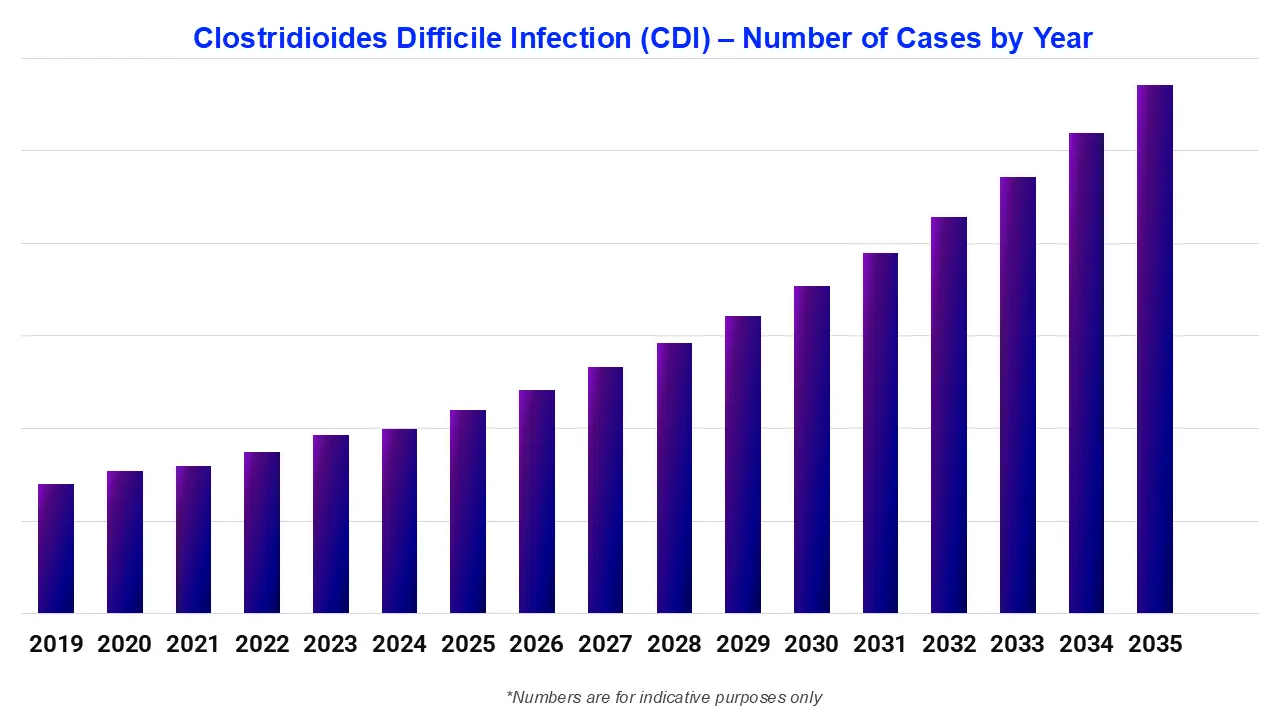
Clostridioides difficile infection (CDI) is an intestinal infection caused by toxigenic Clostridioides difficile, an anaerobic, spore-forming bacterium capable of producing toxins A and B that disrupt intestinal epithelial integrity and induce inflammatory colitis. CDC's Emerging Infections Program (EIP) documented 15,608 incident CDI cases in 2024 across 10 surveillance sites covering approximately 12.55 million people, corresponding to 124.4 cases per 100,000 population. Of the estimated cases, 8,453 were classified as community-associated and 7,155 as healthcare-associated. According to Clostridioides Difficile Infection Epidemiology Forecast by Expert Market Research, CDI is relevant to the broader infectious disease and gastrointestinal therapeutics market, particularly through expenditure on diagnosis, antimicrobial treatment, recurrence prevention and microbiota-directed management.
Base Year
Historical Period
Forecast Period
Read more about this report - Request a Free Sample
Expert Market Research's “Clostridioides difficile infection (CDI) Epidemiology Forecast Report 2026-2035” offers comprehensive information on the prevalence and demographics of Clostridioides difficile infection (CDI). It projects the future incidence and prevalence rates of Clostridioides difficile infection (CDI) cases across various populations. The study covers age, gender, and type as major determinants of the Clostridioides difficile infection (CDI) population. The report highlights patterns in the prevalence of Clostridioides difficile infection (CDI) overtime and projects future trends based on multiple variables.
The report provides a comprehensive overview of the disease, as well as historical and projected data on the epidemiology of Clostridioides difficile infection (CDI) in the 8 major markets.
Regions Covered
Clostridioides difficile infection (CDI) is an intestinal infection caused by toxigenic Clostridioides difficile, an anaerobic, spore-forming bacterium capable of producing toxins A and B that disrupt intestinal epithelial integrity and induce inflammatory colitis. CDI most commonly occurs when disruption of the normal intestinal microbiota, particularly after antimicrobial exposure, permits colonization by toxigenic C. difficile followed by toxin production. The clinical spectrum extends from diarrhea and abdominal pain to severe colitis, ileus, toxic megacolon, sepsis, intestinal perforation and death. Contemporary epidemiological literature recognizes CDI as an important healthcare-associated infection while also emphasizing the substantial contribution of community-associated disease.
|
Parameter |
Insight |
|
Largest Patient Pool |
England |
|
Fastest Growing Country |
England |
|
High-Risk Population |
Older adults, hospitalized patients, residents of long-term healthcare settings, people exposed to recent antibiotics, and individuals with major underlying illnesses or impaired immunity |
|
Key Diagnostic Method |
Stool toxin testing, glutamate dehydrogenase testing and nucleic-acid amplification testing, generally interpreted through a multistep diagnostic algorithm rather than as isolated tests. |
|
Major Risk Factor |
Recent systemic antibiotic exposure is a dominant modifiable risk factor; hospitalization, advanced age, healthcare exposure and microbiota disruption further increase risk. CDC found antibiotic exposure during the previous 12 weeks in 70% of 2024 EIP cases. |
|
Major gap in the market |
Community-associated transmission pathways, asymptomatic carriage, environmental reservoirs and differences in testing practices remain incompletely defined, particularly outside high-income countries. |
The Clostridioides Difficile Infection (CDI) epidemiology division offers information on the patient pool from history to the present as well as the projected trend for each of the 8 major markets. Expert Market Research provides both current and predicted trends for the Clostridioides difficile infection (CDI) epidemiology scenario by examining a wide range of studies. Additionally, the report covers the diagnosed patient pool for Clostridioides difficile infection (CDI) and their trends. The data is broken down into specific categories, such as total prevalent cases in males and females, and total diagnosed cases across different age groups and patient pools.
|
Epidemiology Segment |
Key Insights |
|
Diagnosed Prevalent Cases of the Disease |
CDC's EIP surveillance recorded 14,312 CDI infections in 2023; approximately 53% were community-associated and 47% healthcare-associated. 15,608 incident CDI cases were identified across the 10 EIP sites, corresponding to 124.4 cases per 100,000 population. NHS acute trusts reported 16,838 CDI cases during FY 2023–2024. |
|
Gender-Specific Cases of the Disease |
U.S. 2024 incidence was 141.4 per 100,000 among women versus 106.9 among men, demonstrating higher observed incidence among females. |
|
Age-Specific Cases of the Disease |
Incidence increased sharply with age, from 32.1 per 100,000 among 1-17-year-olds to 609.7 per 100,000 among people aged 80 years or older in the 2024 U.S. EIP population. |
|
Ethnicity-Wise Cases of the Disease |
U.S. 2024 incidence was highest among non-Hispanic White persons (159.0 per 100,000), followed by non-Hispanic Black persons (117.8), Hispanic/Latino persons (75.5) and non-Hispanic Asian/NHPI persons (59.0). These differences should be interpreted as population-level disparities rather than proof of biological susceptibility. |
|
Mortality and Survival Analysis of the Disease |
CDC's 2024 clinical-course dataset recorded 315 in-hospital deaths, approximately 4% of the 8,452 cases receiving complete clinical review. A 2026 global mortality analysis reported an age-standardized CDI-related mortality rate of 2.44 per million in 2023 among included countries. |
Read more about this report - Request a Free Sample
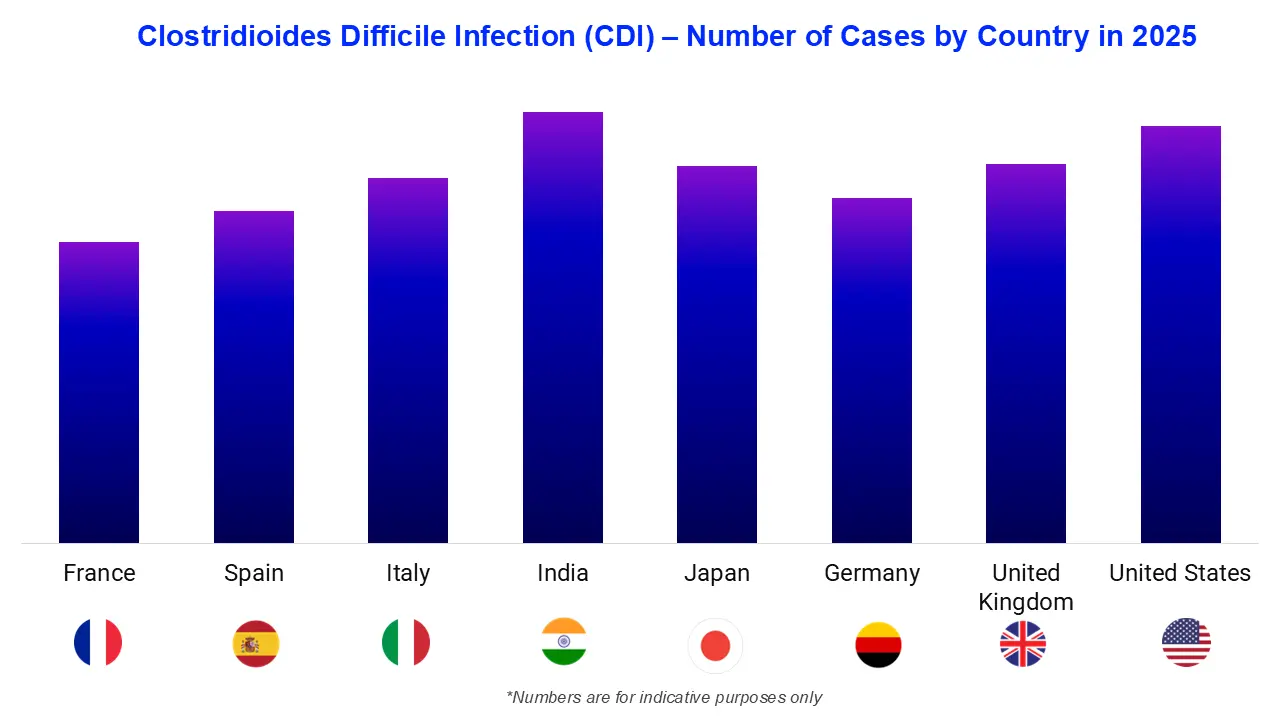
The Clostridioides difficile infection (CDI) epidemiology data and findings for the United States, Germany, Spain, Italy, France, the United Kingdom, Japan, and India are also provided in the epidemiology section.
|
Country |
Key Insights |
|
United States |
CDC's EIP recorded 14,312 CDI infections in 2023 and 15,608 incident cases in 2024 across 10 active surveillance sites. In 2024, incidence was 124.4 per 100,000 population, 54% of cases were community-associated and 46% healthcare-associated. |
|
Germany |
Germany continues to report CDI as an important healthcare-associated infection, but no directly comparable national 2023–2026 incident CDI series suitable for inclusion alongside CDC EIP and UKHSA data was identified in the reviewed current sources. A national numeric estimate is therefore not inserted. |
|
France |
CDI is a recognized healthcare-associated infection in France, but a directly comparable national 2023–2026 population-based CDI series was not identified in the reviewed contemporary sources. Current epidemiological assessment is therefore better based on institutional and European surveillance studies rather than an unsupported national incidence estimate. |
|
Italy |
Italy remains a clinically relevant European CDI setting, but the reviewed 2023–2026 sources did not provide a nationally comparable population-based CDI surveillance series suitable for direct comparison with the U.S. or English datasets. Current literature continues to identify CDI as an important cause of healthcare-associated diarrhea and recurrent disease. |
|
Spain |
Spain remains within the European CDI disease burden, but a nationally standardized 2023–2026 CDI incidence dataset comparable with the CDC EIP or UKHSA methodology was not identified in the reviewed evidence. National-level interpretation should therefore remain cautious. |
|
United Kingdom |
England reported 16,838 CDI cases in FY 2023–2024 and 18,970 in FY 2024–2025, a 12.7% increase. The 2024–2025 rate was 33.3 per 100,000 population, demonstrating continued growth in reported national burden. |
|
Japan |
Japan remains a clinically recognized CDI setting, but no nationally comparable 2023–2026 incidence series was identified in the current review that could be reported without combining incompatible institutional and national methodologies. |
|
India |
A 2023 Mumbai study using standardized CDC Laboratory-Identified event criteria identified 68 incident CDI events. Recent national population-level surveillance remains limited, and the available evidence does not support extrapolation of this single-center burden to India as a whole. |
The primary epidemiological gap in CDI is the incomplete separation of colonization, symptomatic infection and transmission. Detection of toxigenic C. difficile does not necessarily establish active disease, while patients with compatible diarrhea may be missed when testing is not performed. Contemporary diagnostic reviews therefore emphasize that CDI is fundamentally a clinical diagnosis supported by laboratory testing rather than a laboratory-positive diagnosis in isolation. This distinction affects incidence estimates, recurrence assessment and international comparability. A second major gap is the incomplete understanding of community-associated CDI. CDC's 2024 EIP surveillance classified 54% of incident cases as community-associated, demonstrating that a substantial proportion of contemporary disease cannot be explained by hospital acquisition alone.
The management of Clostridioides difficile infection primarily focuses on confirming clinically significant infection, assessing disease severity, discontinuing unnecessary inciting antibiotics where possible, administering appropriate anti-C. difficile therapy and preventing recurrence. Contemporary 2026 AGA guidance continues to place fidaxomicin or vancomycin at the center of treatment for initial CDI, with microbiota-based therapy incorporated increasingly into management after recurrent disease. Diagnosis should be based on compatible symptoms, usually acute diarrhea, together with laboratory evidence. Contemporary guidance emphasizes algorithmic testing rather than relying on a single assay because nucleic-acid amplification can detect toxigenic organisms in colonized patients who do not have active toxin-mediated disease.


Upto 15% Off
USD
$2699 $2429
$4299 $3869
$5799 $4949
$6999 $5949


*While we strive to always give you current and accurate information, the numbers depicted on the website are indicative and may differ from the actual numbers in the main report. At Expert Market Research, we aim to bring you the latest insights and trends in the market. Using our analyses and forecasts, stakeholders can understand the market dynamics, navigate challenges, and capitalize on opportunities to make data-driven strategic decisions.*
Explore our key highlights of the report and gain a concise overview of key findings, trends, and actionable insights that will empower your strategic decisions.
|
Report Features |
Details |
|
Base Year |
2025 |
|
Historical Period |
2019-2025 |
|
Forecast Period |
2026-2035 |
|
Epidemiology Statistics Provided |
|
|
Segmentation Provided |
|
|
Geographies Covered |
|
Datasheet
One User
USD 2,699
USD 2,429
tax inclusive*
Single User License
One User
USD 4,299
USD 3,869
tax inclusive*
Five User License
Five User
USD 5,799
USD 4,949
tax inclusive*
Corporate License
Unlimited Users
USD 6,999
USD 5,949
tax inclusive*
*Please note that the prices mentioned below are starting prices for each bundle type. Kindly contact our team for further details.*
Flash Bundle
Small Business Bundle
Growth Bundle
Enterprise Bundle
*Please note that the prices mentioned below are starting prices for each bundle type. Kindly contact our team for further details.*
Flash Bundle
Number of Reports: 3
20%
tax inclusive*
Small Business Bundle
Number of Reports: 5
25%
tax inclusive*
Growth Bundle
Number of Reports: 8
30%
tax inclusive*
Enterprise Bundle
Number of Reports: 10
35%
tax inclusive*
How To Order

Select License Type
Choose the right license for your needs and access rights.

Click on ‘Buy Now’
Add the report to your cart with one click and proceed to register.

Select Mode of Payment
Choose a payment option for a secure checkout. You will be redirected accordingly.
Strategic Solutions for Informed Decision-Making
Gain insights to stay ahead and seize opportunities.

Get insights & trends for a competitive edge.

Track prices with detailed trend reports.

Analyse trade data for supply chain insights.

Leverage cost reports for smart savings

Enhance supply chain with partnerships.

Connect For More Information
Our expert team of analysts will offer full support and resolve any queries regarding the report, before and after the purchase.
Our expert team of analysts will offer full support and resolve any queries regarding the report, before and after the purchase.
We employ meticulous research methods, blending advanced analytics and expert insights to deliver accurate, actionable industry intelligence, staying ahead of competitors.
Our skilled analysts offer unparalleled competitive advantage with detailed insights on current and emerging markets, ensuring your strategic edge.
We offer an in-depth yet simplified presentation of industry insights and analysis to meet your specific requirements effectively.




