

Consumer Insights
Uncover trends and behaviors shaping consumer choices today
Procurement Insights
Optimize your sourcing strategy with key market data
Industry Stats
Stay ahead with the latest trends and market analysis.
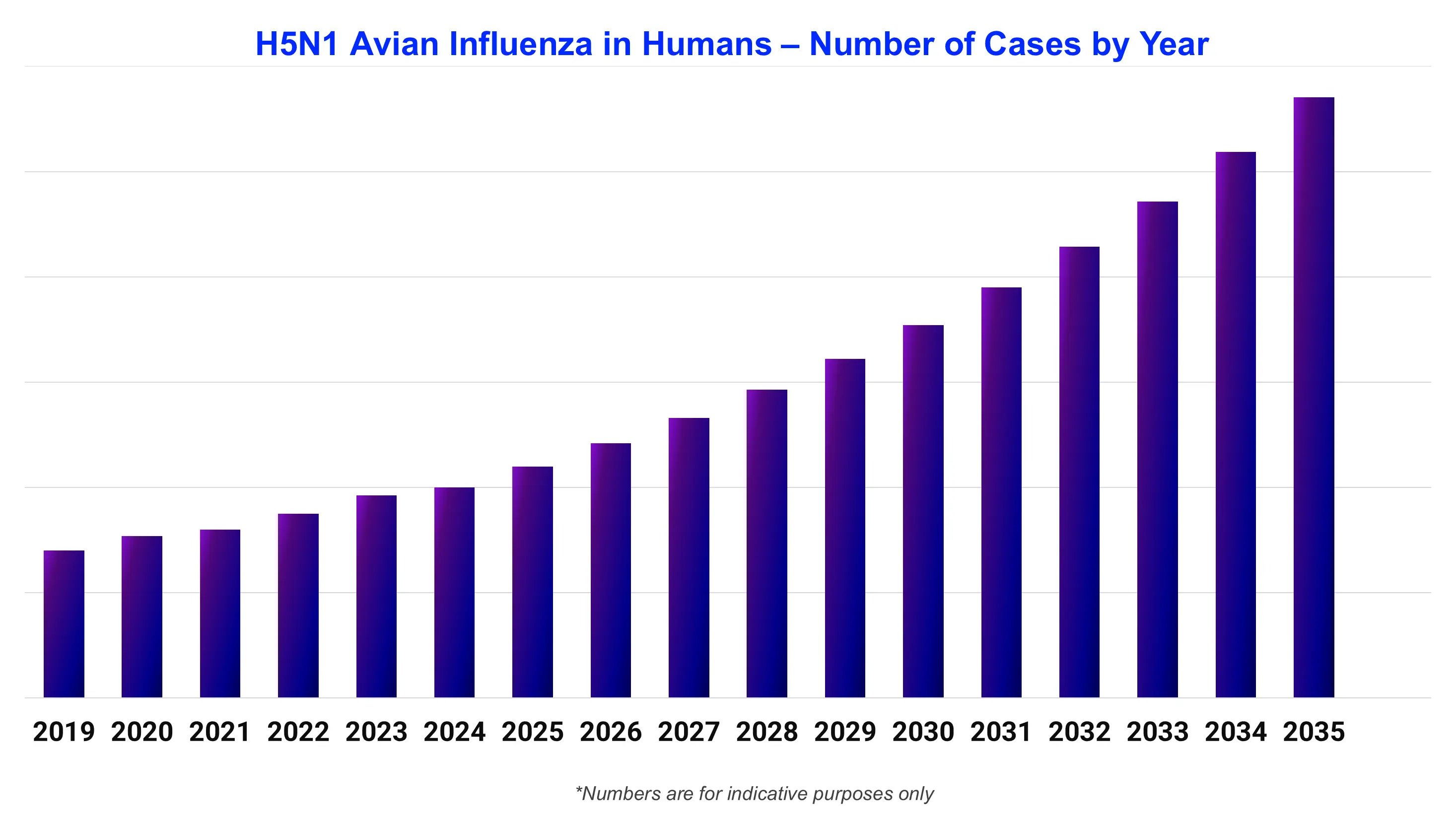
H5N1 avian influenza in humans is a viral infection caused by avian influenza A(H5N1) viruses that primarily affect birds but can infect humans. According to the Centers for Disease Control and Prevention, 1,022 human cases have been reported globally since 1997, including 12 cases from August 2025 to June 2026. As per the H5N1 avian influenza in humans epidemiology forecast by Expert Market Research, ongoing surveillance remains important.
Base Year
Historical Period
Forecast Period
Read more about this report - REQUEST FREE SAMPLE COPY IN PDF
Expert Market Research's “H5N1 Avian Influenza in Humans Epidemiology Forecast Report 2026-2035” offers comprehensive information on the prevalence and demographics of H5N1 avian influenza in humans. It projects the future incidence and prevalence rates of H5N1 avian influenza in humans cases across various populations. The study covers age, gender, and type as major determinants of the H5N1 avian influenza in humans population. The report highlights patterns in the prevalence of H5N1 avian influenza in humans over time and projects future trends based on multiple variables.
The report provides a comprehensive overview of the disease, as well as historical and projected data on the epidemiology of H5N1 avian influenza in humans in the 8 major markets.
Regions Covered
H5N1 avian influenza is an infection caused by influenza A(H5N1) viruses that primarily circulate among birds but can infect mammals, including humans following close contact with infected animals or contaminated environments. Human infection can range from asymptomatic or mild illness to severe respiratory disease, pneumonia, acute respiratory distress syndrome, and death. H5N1 belongs to the broader group of avian influenza viruses, which includes multiple influenza A subtypes. Avian influenza viruses are also classified as low pathogenic or highly pathogenic based on their effects in poultry, rather than disease severity in humans.
|
Parameter |
Insight |
|
Largest Patient Pool |
United States |
|
Fastest Growing Country |
India |
|
High-Risk Population |
Poultry workers, dairy workers, animal handlers, backyard poultry owners, and individuals with direct or close exposure to infected animals. |
|
Key Diagnostic Method |
Molecular testing, particularly RT-PCR, is central to laboratory confirmation of H5N1 infection. |
|
Major Risk Factor |
Direct or close contact with infected or sick animals, particularly poultry and other infected mammals, or contaminated environments. |
|
Major gap in the market |
Limited human case numbers and nonspecific early symptoms can create challenges in timely recognition, testing, and surveillance, particularly among exposed populations. |
The H5N1 avian influenza in humans epidemiology division offers information on the patient pool from history to the present as well as the projected trend for each of the 8 major markets. Expert Market Research provides both current and predicted trends for the H5N1 avian influenza in humans epidemiology scenario by examining a wide range of studies. Additionally, the report covers the diagnosed patient pool for H5N1 avian influenza in humans and their trends. The data is broken down into specific categories, such as total prevalent cases in males and females, and total diagnosed cases across different age groups and patient pools.
|
Epidemiology Segment |
Key Insights |
|
Diagnosed Prevalent Cases of the Disease |
According to the Centers for Disease Control and Prevention (2026), 1,022 human H5N1 cases had been reported worldwide since 1997 as of June 10, 2026. The cases have occurred sporadically, primarily following direct or close exposure to infected poultry or other animals. |
|
Gender-Specific Cases of the Disease |
As per World Health Organization (2022), the two H5N1 cases identified in Spain in 2022 were both male poultry workers aged 19 and 27 years. Both infections were asymptomatic and associated with occupational exposure to infected poultry. |
|
Age-Specific Cases of the Disease |
According to the Centers for Disease Control and Prevention (2026), recent international H5N1 infections have occurred in both children and adults. Among eight Cambodian cases reported since August 2025, four occurred in children and four in adults. |
|
Ethnicity-Wise Cases of the Disease |
Human H5N1 infections have been reported across diverse geographic populations, with cases historically concentrated in countries where close contact with infected poultry or contaminated environments occurs. |
|
Mortality and Survival Analysis of the Disease |
According to the World Health Organization (2026), 993 human H5N1 cases and 477 deaths were reported globally from January 2003 through December 19, 2025, corresponding to a 48.0% case fatality rate. |
Read more about this report - REQUEST FREE SAMPLE COPY IN PDF
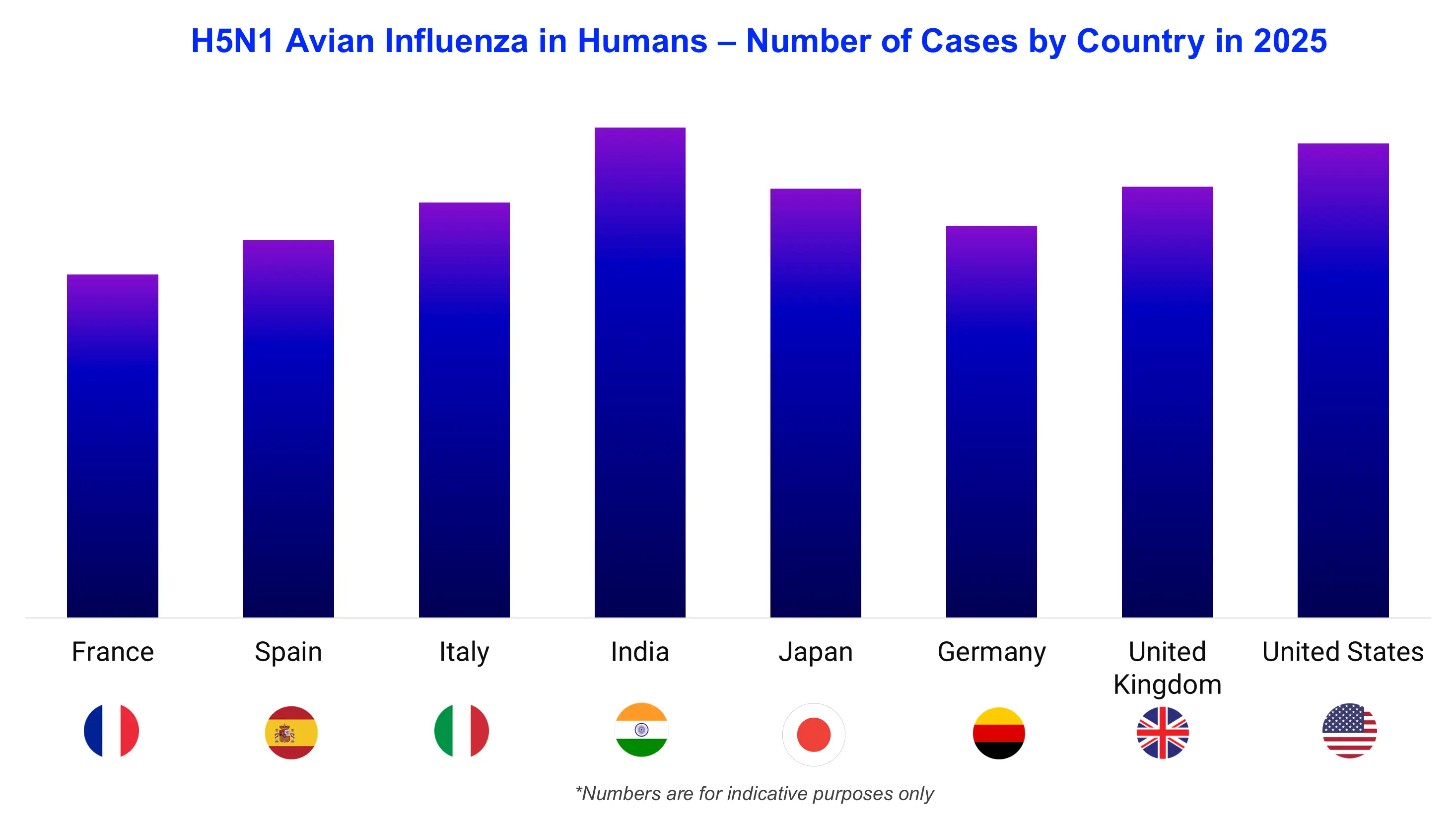
The H5N1 Avian Influenza in Humans epidemiology data and findings for the United States, Germany, Spain, Italy, France, the United Kingdom, Japan, and India are also provided in the epidemiology section.
|
Country |
Key Insights |
|
United States |
According to the Centers for Disease Control and Prevention (2025), 70 human H5N1 cases were identified in the United States during 2024–2025 through mid-April 2025. Most confirmed cases were associated with exposure to infected animals, including poultry and dairy cattle. |
|
Germany |
Human H5N1 epidemiology in Germany has been characterized by the potential for zoonotic exposure where infected birds are present. Historical H5N1 activity in Germany involved extensive infection among wild birds, creating opportunities for exposure at the human-animal interface. |
|
France |
Human H5N1 infection risk in France is associated with occupational and environmental exposure to infected poultry. Such exposure can occur among poultry workers and individuals involved in handling or controlling infected birds. |
|
Italy |
Human H5N1 epidemiological risk in Italy is associated with exposure to infected birds and contaminated environments. Occupational activities involving poultry can increase opportunities for zoonotic exposure when H5N1 is circulating in birds. |
|
Spain |
According to the World Health Organization (2022), two human H5N1 infections were identified in Spain in 2022 among poultry workers. Both were 19- and 27-year-old males, were asymptomatic, and were associated with exposure to infected poultry or contaminated environments. |
|
United Kingdom |
According to the World Health Organization (2022), one human H5N1 infection was reported in the United Kingdom in 2021. The case was asymptomatic and occurred in an individual living with a large number of domestic birds infected with H5N1. |
|
Japan |
Human H5N1 epidemiological risk in Japan is associated with exposure to infected birds and contaminated environments. Historical H5N1 outbreaks in poultry have required surveillance and measures to reduce opportunities for human exposure. |
|
India |
According to the Centers for Disease Control and Prevention (2026), India reported one human H5N1 infection since August 2025. The case occurred in a child in March 2026, with backyard poultry in the village identified as a possible environmental exposure. |
A major unmet need across the United States, Germany, France, Italy, Spain, the United Kingdom, Japan, and India is the continued strengthening of early detection and surveillance among people with occupational or environmental exposure to infected animals. H5N1 infections can initially present with nonspecific respiratory or ocular symptoms, potentially complicating recognition. Opportunities therefore exist for expanded molecular testing capacity, integrated human-animal surveillance, rapid diagnostic approaches, and improved monitoring of high-risk occupational groups. India represents an important surveillance focus because additional human infections have been documented during 2025–2026, highlighting the need for sustained preparedness and rapid case identification.
H5N1 avian influenza in humans treatment in humans primarily involves early administration of antiviral therapy and appropriate supportive care. Antiviral treatment with oseltamivir is recommended as soon as possible for patients with progressive, complicated, or severe disease and for individuals at increased risk of severe illness. Clinical management may include oxygen supplementation, respiratory support, fluid management, and treatment of complications according to disease severity. Patients should also undergo appropriate clinical assessment, laboratory testing, monitoring, and infection-control measures. Current seasonal influenza vaccines do not provide protection against human infection with H5N1 viruses.


Upto 15% Off
USD
$2699 $2429
$4299 $3869
$5799 $4949
$6999 $5949


*While we strive to always give you current and accurate information, the numbers depicted on the website are indicative and may differ from the actual numbers in the main report. At Expert Market Research, we aim to bring you the latest insights and trends in the market. Using our analyses and forecasts, stakeholders can understand the market dynamics, navigate challenges, and capitalize on opportunities to make data-driven strategic decisions.*
Explore our key highlights of the report and gain a concise overview of key findings, trends, and actionable insights that will empower your strategic decisions.
|
Report Features |
Details |
|
Base Year |
2025 |
|
Historical Period |
2019-2025 |
|
Forecast Period |
2026-2035 |
|
Epidemiology Statistics Provided |
|
|
Segmentation Provided |
|
|
Geographies Covered |
|
Datasheet
One User
USD 2,699
USD 2,429
tax inclusive*
Single User License
One User
USD 4,299
USD 3,869
tax inclusive*
Five User License
Five User
USD 5,799
USD 4,949
tax inclusive*
Corporate License
Unlimited Users
USD 6,999
USD 5,949
tax inclusive*
*Please note that the prices mentioned below are starting prices for each bundle type. Kindly contact our team for further details.*
Flash Bundle
Small Business Bundle
Growth Bundle
Enterprise Bundle
*Please note that the prices mentioned below are starting prices for each bundle type. Kindly contact our team for further details.*
Flash Bundle
Number of Reports: 3
20%
tax inclusive*
Small Business Bundle
Number of Reports: 5
25%
tax inclusive*
Growth Bundle
Number of Reports: 8
30%
tax inclusive*
Enterprise Bundle
Number of Reports: 10
35%
tax inclusive*
How To Order

Select License Type
Choose the right license for your needs and access rights.

Click on ‘Buy Now’
Add the report to your cart with one click and proceed to register.

Select Mode of Payment
Choose a payment option for a secure checkout. You will be redirected accordingly.
Strategic Solutions for Informed Decision-Making
Gain insights to stay ahead and seize opportunities.

Get insights & trends for a competitive edge.

Track prices with detailed trend reports.

Analyse trade data for supply chain insights.

Leverage cost reports for smart savings

Enhance supply chain with partnerships.

Connect For More Information
Our expert team of analysts will offer full support and resolve any queries regarding the report, before and after the purchase.
Our expert team of analysts will offer full support and resolve any queries regarding the report, before and after the purchase.
We employ meticulous research methods, blending advanced analytics and expert insights to deliver accurate, actionable industry intelligence, staying ahead of competitors.
Our skilled analysts offer unparalleled competitive advantage with detailed insights on current and emerging markets, ensuring your strategic edge.
We offer an in-depth yet simplified presentation of industry insights and analysis to meet your specific requirements effectively.




