

Consumer Insights
Uncover trends and behaviors shaping consumer choices today
Procurement Insights
Optimize your sourcing strategy with key market data
Industry Stats
Stay ahead with the latest trends and market analysis.
HER2-Mutant Non-Small Cell Lung Cancer (HER2-mutant NSCLC) is a molecularly defined subset of NSCLC characterized by activating mutations in the ERBB2 gene, most commonly involving the tyrosine kinase domain and exon 20 insertions. Contemporary literature estimates HER2 mutations in approximately 1%-4% of NSCLC overall, although prevalence varies according to population, histology, testing technology, and variant classification. According to HER2-Mutant NSCLC Epidemiology Forecast by Expert Market Research (EMR), assessment therefore requires molecularly confirmed HER2 mutation to be separated from other HER2-altered NSCLC populations.
Base Year
Historical Period
Forecast Period
Read more about this report - Request a Free Sample
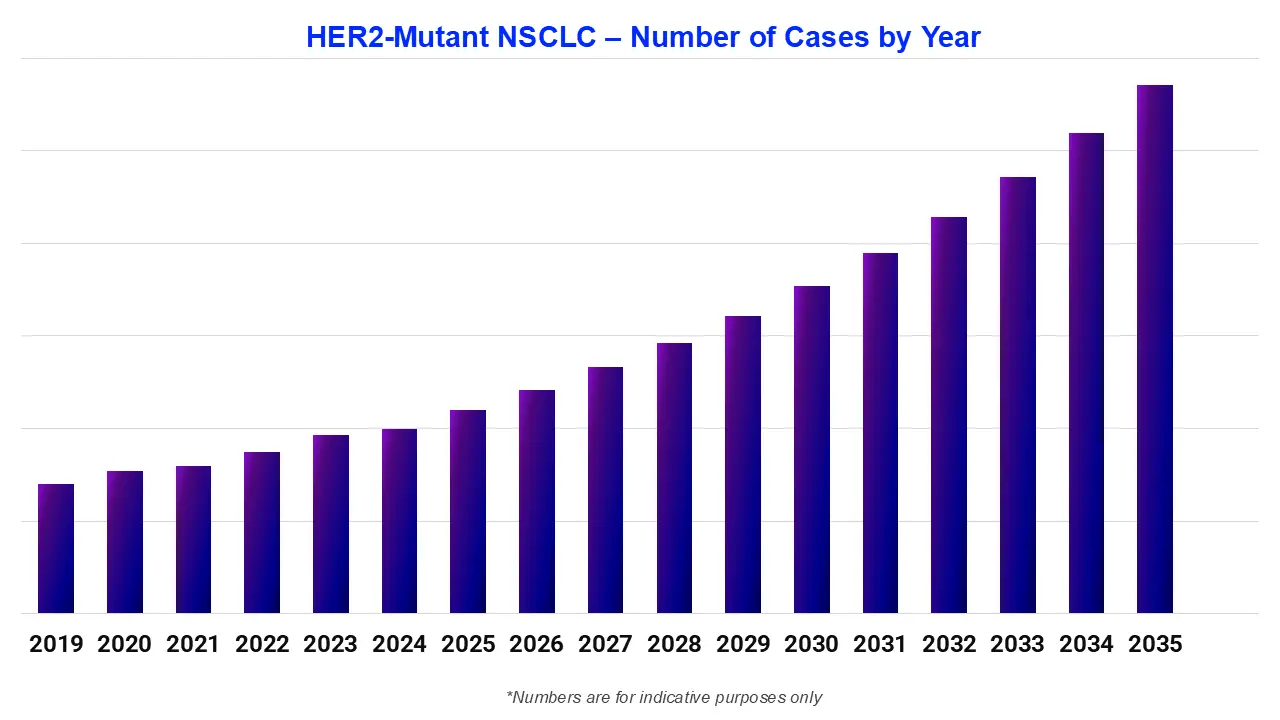
Expert Market Research's “HER2-Mutant NSCLC Epidemiology Forecast Report 2026-2035” offers comprehensive information on the prevalence and demographics of HER2-Mutant NSCLC. It projects the future incidence and prevalence rates of HER2-Mutant NSCLC cases across various populations. The study covers age, gender, and type as major determinants of the HER2-Mutant NSCLC population. The report highlights patterns in the prevalence of HER2-Mutant NSCLC over time and projects future trends based on multiple variables.
The report provides a comprehensive overview of the disease, as well as historical and projected data on the epidemiology of HER2-Mutant NSCLC in the 8 major markets.
Regions Covered
HER2-Mutant Non-Small Cell Lung Cancer (HER2-mutant NSCLC) is a molecularly defined subset of NSCLC characterized by activating mutations in the ERBB2 gene, most commonly involving the tyrosine kinase domain and exon 20 insertions. HER2-mutant NSCLC is predominantly associated with lung adenocarcinoma and occurs disproportionately in women and never or light smokers compared with unselected NSCLC populations. Most activating variants occur in the tyrosine kinase domain, with exon 20 insertions representing the dominant mutation class. The A775_G776insYVMA/p.Y772_A775dup variant is among the most frequently identified alterations. HER2-mutant tumors may exhibit aggressive clinical behavior, frequent metastatic disease, and clinically relevant central nervous system involvement. Recent genomic studies also demonstrate heterogeneity in outcomes according to the precise HER2 mutation and its molecular context.
|
Parameter |
Insight |
|
Largest Patient Pool |
Japan |
|
Fastest Growing Country |
United States |
|
High-Risk Population |
Women, never smokers, younger patients, and individuals with lung adenocarcinoma are disproportionately represented among HER2-mutant NSCLC cases. Recent Chinese genomic analyses identify enrichment among women and never smokers, while HER2-mutant disease is also associated with a clinically important risk of brain metastases. |
|
Key Diagnostic Method |
Comprehensive NGS is preferred for identifying activating HER2 mutations, while tissue NGS is favored when adequate tissue is available. Validated plasma ctDNA testing can complement tissue testing when tissue is unavailable or inadequate. HER2 IHC alone cannot reliably identify HER2-mutant NSCLC. |
|
Major Risk Factor |
Tobacco smoking is the leading modifiable risk factor for NSCLC, while exposure to secondhand smoke, occupational carcinogens, radon, air pollution, prior thoracic radiation, and genetic susceptibility also contribute to lung cancer risk. |
|
Major gap in the market |
Major gaps include incomplete molecular testing, limited data on non-exon-20 mutations and CNS treatment, acquired resistance, and few validated therapies for earlier-stage disease. Distinguishing HER2 mutations from amplification and overexpression remains a key diagnostic need. |
The HER2-Mutant NSCLC epidemiology division offers information on the patient pool from history to the present as well as the projected trend for each of the 8 major markets. Expert Market Research provides both current and predicted trends for the HER2-Mutant NSCLC epidemiology scenario by examining a wide range of studies. Additionally, the report covers the diagnosed patient pool for HER2-Mutant NSCLC and their trends. The data is broken down into specific categories, such as total prevalent cases in males and females, and total diagnosed cases across different age groups and patient pools.
|
Epidemiology Segment |
Key Insights |
|
Diagnosed Prevalent Cases of the Disease |
HER2 mutations are uncommon but clinically actionable alterations in NSCLC. A 2026 targeted literature review found reported prevalence of 1.6%-4.8% in East Asia, 1.2%-3.9% in Europe, and 1.5%-4.4% in North America, with weighted averages of 3.5%, 1.8%, and 2.0%, respectively. A 2024 LC-SCRUM-Asia analysis identified HER2 mutations in 402 of 15,251 NSCLC patients, corresponding to 2.6%. |
|
Gender-Specific Cases of the Disease |
HER2-mutant NSCLC has a marked female enrichment relative to unselected NSCLC. Contemporary molecular reviews consistently identify women as a disproportionately represented population, particularly among never-smoking adenocarcinoma patients. A 2025 South China study found exon 20 mutations were more frequent among men within its HER2-mutant subgroup, demonstrating mutation-specific heterogeneity. |
|
Age-Specific Cases of the Disease |
HER2-mutant NSCLC can occur across adulthood but is frequently identified at a younger age than smoking-associated NSCLC. A 2025 South China multicenter study reported a median age of 58.5 years among patients with HER2 alterations. Contemporary Chinese reviews also identify younger age as a recurrent characteristic of HER2-mutant disease, although no standardized age-specific population incidence has been established. |
|
Ethnicity-Wise Cases of the Disease |
HER2 mutation prevalence differs geographically. The 2026 targeted literature review reported weighted prevalence of 3.5% in East Asia, 1.8% in Europe, and 2.0% in North America. Chinese NGS cohorts from 2019-2024 reported 3.8%-5.6%, while Japanese and Korean cohorts generally ranged from 2.1%-4.2%. These differences reflect both population biology and substantial variation in molecular testing methodology and cohort selection. |
|
Mortality and Survival Analysis of the Disease |
HER2-mutant NSCLC historically had poor outcomes with conventional systemic treatment, although contemporary HER2-directed therapy has changed the therapeutic landscape. A 2025 final DESTINY-Lung02 analysis confirmed durable activity of trastuzumab deruxtecan in previously treated metastatic HER2-mutant NSCLC. Median progression-free survival with the approved 5.4-mg/kg dose was 7.1 months. Prognosis remains heterogeneous according to mutation type, metastatic burden, CNS disease, and subsequent treatment access. |
Read more about this report - Request a Free Sample
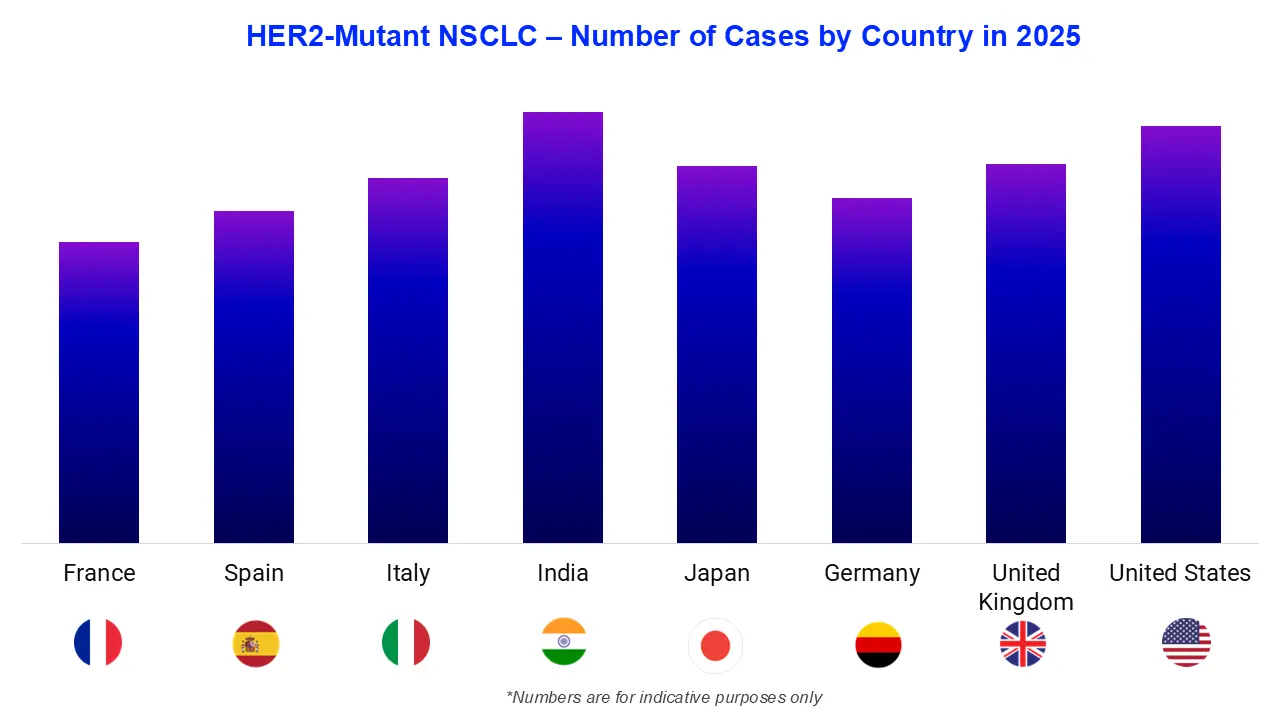
The HER2-Mutant NSCLC epidemiology data and findings for the United States, Germany, Spain, Italy, France, the United Kingdom, Japan, and India are also provided in the epidemiology section.
|
Country |
Key Insights |
|
United States |
Contemporary U.S. genomic datasets have generally reported HER2 mutation frequencies around 1.5%-4.1% depending on cohort and testing platform. A large Flatiron Health-Foundation Medicine dataset included 9,206 NSCLC cases and identified HER2 mutations in 1.9%. HER2 mutation testing is clinically important because activating ERBB2 alterations constitute a therapeutically actionable molecular subgroup of advanced NSCLC. |
|
Germany |
European genomic studies generally report HER2 mutation frequencies across a measurable range, with the 2026 targeted review reporting a prevalence of 1.2%–3.9% in Europe and a weighted average of 1.8%. Germany contributes to the growing body of European molecular evidence on HER2-mutant NSCLC, while differences in molecular testing practices and variant classification provide opportunities for further refinement of national epidemiological estimates. |
|
France |
Contemporary European datasets provide a useful reference for understanding HER2-mutant NSCLC in France, with European HER2 mutation frequencies generally ranging from 1.2%–3.9%. French patients are represented in European molecular oncology datasets, providing an established evidence base for characterizing HER2-mutant disease. Continued adoption of standardized NGS-based testing can further strengthen country-specific epidemiological assessment. |
|
Italy |
Italy is contributing to the growing European evidence base on HER2-mutant NSCLC through molecularly characterized NSCLC cohorts and broader genomic datasets. European studies report HER2 mutation frequencies within the 1.2%–3.9% range, providing a useful benchmark for the Italian population. Increasing adoption of broad genomic profiling in advanced nonsquamous NSCLC is expected to support more comprehensive identification and characterization of patients with actionable HER2 mutations. |
|
Spain |
Spain contributes to European molecular profiling datasets that report HER2 mutation frequencies generally within the 1.2%–3.9% range. These findings provide an important epidemiological reference for understanding HER2-mutant NSCLC in the Spanish population. Continued expansion of standardized molecular testing and national genomic data collection can further enhance the characterization of HER2-mutant NSCLC and support more precise patient-population assessment. |
|
United Kingdom |
The United Kingdom has established molecular testing pathways for advanced NSCLC, providing an important infrastructure for identifying patients with actionable HER2 mutations. European literature reports HER2 mutation frequencies broadly within the 1.2%–3.9% range, offering a relevant benchmark for the UK population. Increasing access to comprehensive NGS can further strengthen detection of activating HER2 mutations, which cannot be reliably identified through HER2 protein expression alone. |
|
Japan |
Japanese and Korean cohorts generally report HER2 mutation prevalence of approximately 2.1%-4.2%. The 2024 LC-SCRUM-Asia analysis identified HER2 mutations in 402 of 15,251 NSCLC patients, or 2.6%, across a large Asian molecular database. Earlier Japanese genomic cohorts included in contemporary reviews have reported approximately 2.7%-4.9%, demonstrating persistent variation by assay and population. |
|
India |
Contemporary Indian population-level data remain limited. A 2024 systematic review identified HER2 exon 20 insertions at approximately 1.5% in one Indian NSCLC dataset, but the evidence base is substantially smaller than for East Asia, North America, or Europe. Consequently, this figure should not be extrapolated into a national prevalence estimate. Expanded NGS access is important for identifying Indian patients with actionable HER2 mutations. |
The principal epidemiological gap in HER2-mutant NSCLC is not simply the rarity of the alteration but the absence of standardized molecular ascertainment across populations. Contemporary studies report approximately 1%-4% prevalence overall, with weighted regional estimates of 3.5% in East Asia, 1.8% in Europe, and 2.0% in North America. Differences arise from sequencing platforms, inclusion of variants of uncertain significance, tissue versus plasma testing, cohort selection, and whether all ERBB2 mutations or only oncogenic alterations are counted. The distinction is clinically important because HER2 amplification and HER2 protein overexpression are not interchangeable with activating HER2 mutation. Broader NGS implementation therefore has the potential to identify patients missed by limited biomarker testing.
Management of HER2-mutant NSCLC is centered on molecularly guided systemic therapy. Trastuzumab deruxtecan (T-DXd) remains the principal approved HER2-directed therapy for unresectable or metastatic NSCLC with activating HER2 mutations following prior systemic treatment in the United States. Current prescribing information specifies a dose of 5.4 mg/kg intravenously every three weeks. F Final DESTINY-Lung02 results reported a median progression-free survival of 10.0 months with the approved 5.4 mg/kg dose. Treatment requires monitoring for interstitial lung disease/pneumonitis, cytopenias, nausea, and other adverse events. Platinum-based chemotherapy and immunotherapy may be used according to disease setting and prior treatment, although their activity in HER2-mutant tumors is less predictable than in some other molecularly defined NSCLC populations.


Upto 15% Off
USD
$2699 $2429
$4299 $3869
$5799 $4949
$6999 $5949


*While we strive to always give you current and accurate information, the numbers depicted on the website are indicative and may differ from the actual numbers in the main report. At Expert Market Research, we aim to bring you the latest insights and trends in the market. Using our analyses and forecasts, stakeholders can understand the market dynamics, navigate challenges, and capitalize on opportunities to make data-driven strategic decisions.*
Explore our key highlights of the report and gain a concise overview of key findings, trends, and actionable insights that will empower your strategic decisions.
|
Report Features |
Details |
|
Base Year |
2025 |
|
Historical Period |
2019-2025 |
|
Forecast Period |
2026-2035 |
|
Epidemiology Statistics Provided |
|
|
Segmentation Provided |
|
|
Geographies Covered |
|
Datasheet
One User
USD 2,699
USD 2,429
tax inclusive*
Single User License
One User
USD 4,299
USD 3,869
tax inclusive*
Five User License
Five User
USD 5,799
USD 4,949
tax inclusive*
Corporate License
Unlimited Users
USD 6,999
USD 5,949
tax inclusive*
*Please note that the prices mentioned below are starting prices for each bundle type. Kindly contact our team for further details.*
Flash Bundle
Small Business Bundle
Growth Bundle
Enterprise Bundle
*Please note that the prices mentioned below are starting prices for each bundle type. Kindly contact our team for further details.*
Flash Bundle
Number of Reports: 3
20%
tax inclusive*
Small Business Bundle
Number of Reports: 5
25%
tax inclusive*
Growth Bundle
Number of Reports: 8
30%
tax inclusive*
Enterprise Bundle
Number of Reports: 10
35%
tax inclusive*
How To Order

Select License Type
Choose the right license for your needs and access rights.

Click on ‘Buy Now’
Add the report to your cart with one click and proceed to register.

Select Mode of Payment
Choose a payment option for a secure checkout. You will be redirected accordingly.
Strategic Solutions for Informed Decision-Making
Gain insights to stay ahead and seize opportunities.

Get insights & trends for a competitive edge.

Track prices with detailed trend reports.

Analyse trade data for supply chain insights.

Leverage cost reports for smart savings

Enhance supply chain with partnerships.

Connect For More Information
Our expert team of analysts will offer full support and resolve any queries regarding the report, before and after the purchase.
Our expert team of analysts will offer full support and resolve any queries regarding the report, before and after the purchase.
We employ meticulous research methods, blending advanced analytics and expert insights to deliver accurate, actionable industry intelligence, staying ahead of competitors.
Our skilled analysts offer unparalleled competitive advantage with detailed insights on current and emerging markets, ensuring your strategic edge.
We offer an in-depth yet simplified presentation of industry insights and analysis to meet your specific requirements effectively.




