

Consumer Insights
Uncover trends and behaviors shaping consumer choices today
Procurement Insights
Optimize your sourcing strategy with key market data
Industry Stats
Stay ahead with the latest trends and market analysis.
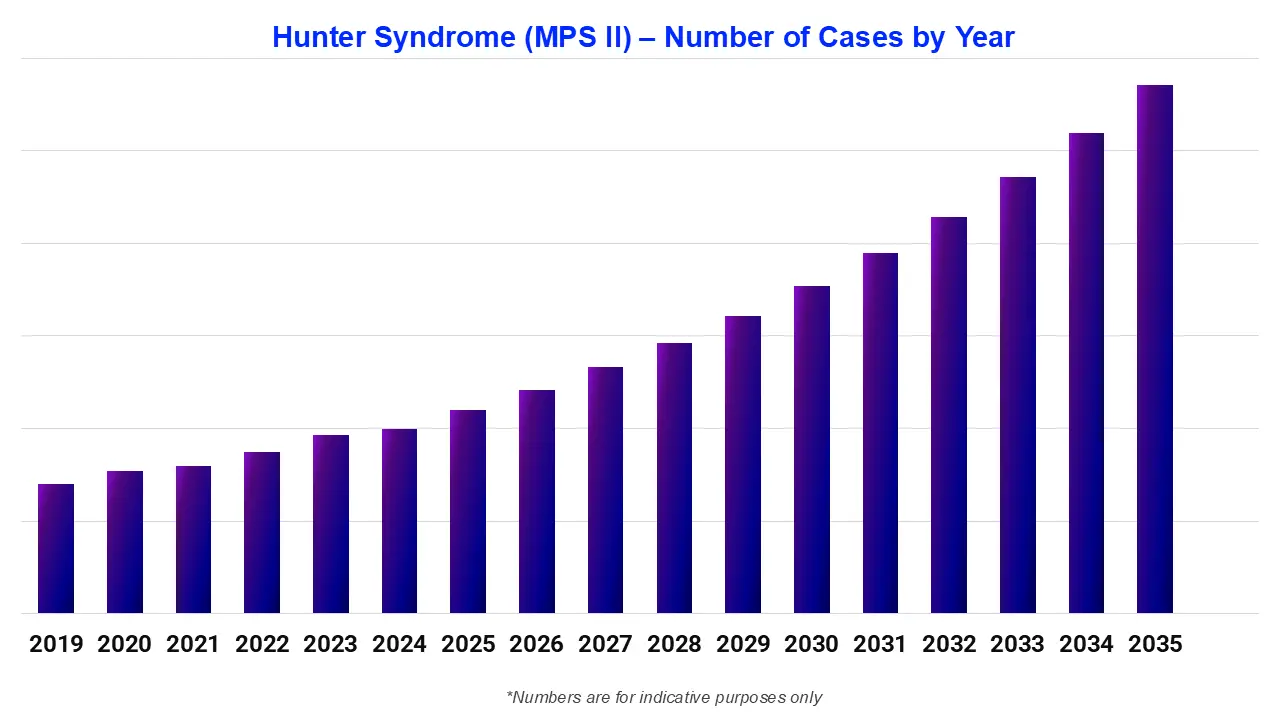
Hunter syndrome (mucopolysaccharidosis type II) is a rare X-linked lysosomal storage disorder caused by iduronate-2-sulfatase deficiency, leading to glycosaminoglycan accumulation. As per Adjoa Safoa Panyin Quaicoe et al. (2025), its global incidence is approximately 1 in 162,000 live male births. According to Hunter syndrome (MPS II) epidemiology forecast by Expert Market Research, disease burden is expected to remain clinically significant.
Base Year
Historical Period
Forecast Period
Read more about this report - Request a Free Sample
Expert Market Research's “Hunter syndrome (MPS II) Epidemiology Forecast Report 2026-2035” offers comprehensive information on the prevalence and demographics of Hunter syndrome (MPS II). It projects the future incidence and prevalence rates of Hunter syndrome (MPS II) cases across various populations. The study covers age, gender, and type as major determinants of the Hunter syndrome (MPS II) population. The report highlights patterns in the prevalence of Hunter syndrome (MPS II) over time and projects future trends based on multiple variables.
The report provides a comprehensive overview of the disease, as well as historical and projected data on the epidemiology of Hunter syndrome (MPS II) in the 8 major markets.
Regions Covered
Hunter syndrome, or mucopolysaccharidosis type II (MPS II), is a rare, progressive lysosomal storage disorder caused by pathogenic variants in the IDS gene, resulting in deficient iduronate-2-sulfatase activity. This enzyme deficiency causes glycosaminoglycans to accumulate in cells and progressively damage multiple organs, including the skeletal system, heart, respiratory tract, and central nervous system. MPS II is inherited in an X-linked manner and primarily affects males, although rare symptomatic females have been reported. Clinically, the disease is broadly categorized into severe, neuronopathic and attenuated, non-neuronopathic forms.
|
Parameter |
Insight |
|
Largest Patient Pool |
United States |
|
Fastest Growing Country |
India |
|
High-Risk Population |
Males with pathogenic IDS variants. MPS II is X-linked and predominantly affects males. Individuals with a family history of MPS II are also important candidates for genetic evaluation |
|
Key Diagnostic Method |
Iduronate-2-sulfatase enzyme activity testing and molecular genetic testing. Diagnosis is established through deficient enzyme activity and/or identification of a pathogenic IDS variant |
|
Major Risk Factor |
Pathogenic IDS gene variants. Reduced or absent iduronate-2-sulfatase activity causes glycosaminoglycan accumulation and disease manifestations |
|
Major gap in the market |
Delayed diagnosis and limited access to specialized diagnosis and treatment. The rarity and multisystem presentation of MPS II can complicate recognition, while treatment access varies across healthcare systems |
The Hunter syndrome (MPS II) epidemiology division offers information on the patient pool from history to the present as well as the projected trend for each of the 8 major markets. Expert Market Research provides both current and predicted trends for the Hunter syndrome (MPS II) epidemiology scenario by examining a wide range of studies. Additionally, the report covers the diagnosed patient pool for Hunter syndrome (MPS II) and their trends. The data is broken down into specific categories, such as total prevalent cases in males and females, and total diagnosed cases across different age groups and patient pools.
|
Epidemiology Segment |
Key Insights |
|
Diagnosed Prevalent Cases of the Disease |
Mucopolysaccharidosis type II (MPS II) is a rare disorder with epidemiological estimates varying across populations. According to Adjoa Safoa Panyin Quaicoe et al. (2025), global incidence is one in 162,000 live male births. |
|
Gender-Specific Cases of the Disease |
MPS II occurs almost exclusively in males because of its X-linked inheritance pattern. According to Barbara K. Burton et al. (2025), female patients represented 1.1% of patients in the Hunter Outcome Survey, highlighting the rarity of affected females. |
|
Age-Specific Cases of the Disease |
Disease onset generally occurs during early childhood. According to Adjoa Safoa Panyin Quaicoe et al. (2025), symptoms usually begin at preschool age, while Takeda Pharmaceuticals U.S.A., Inc. reports diagnosis predominantly between 18 and 36 months. |
|
Ethnicity-Wise Cases of the Disease |
Epidemiological variation has been reported across ethnic populations. As per Takeda Pharmaceuticals U.S.A., Inc., estimated incidence is higher in certain ethnicities. Krithi Rao et al. (2023) also reported a higher rate among Jews in Israel. |
|
Mortality and Survival Analysis of the Disease |
MPS II has a progressive disease course, with the rate of progression varying among affected individuals. According to the National Library of Medicine, the condition is progressively debilitating, while disease progression differs between individuals. |
|
Disease Type |
Prevalence |
|
Neuronopathic Form |
The neuronopathic form represents the more severe clinical phenotype of Hunter syndrome and is characterized by neurological involvement, developmental impairment, and progressive multisystem disease. |
|
Non-Neuronopathic Form |
The non-neuronopathic form represents a less neurologically affected phenotype, with disease burden primarily involving somatic systems such as the skeletal, respiratory, cardiovascular, and gastrointestinal systems. |
Read more about this report - Request a Free Sample
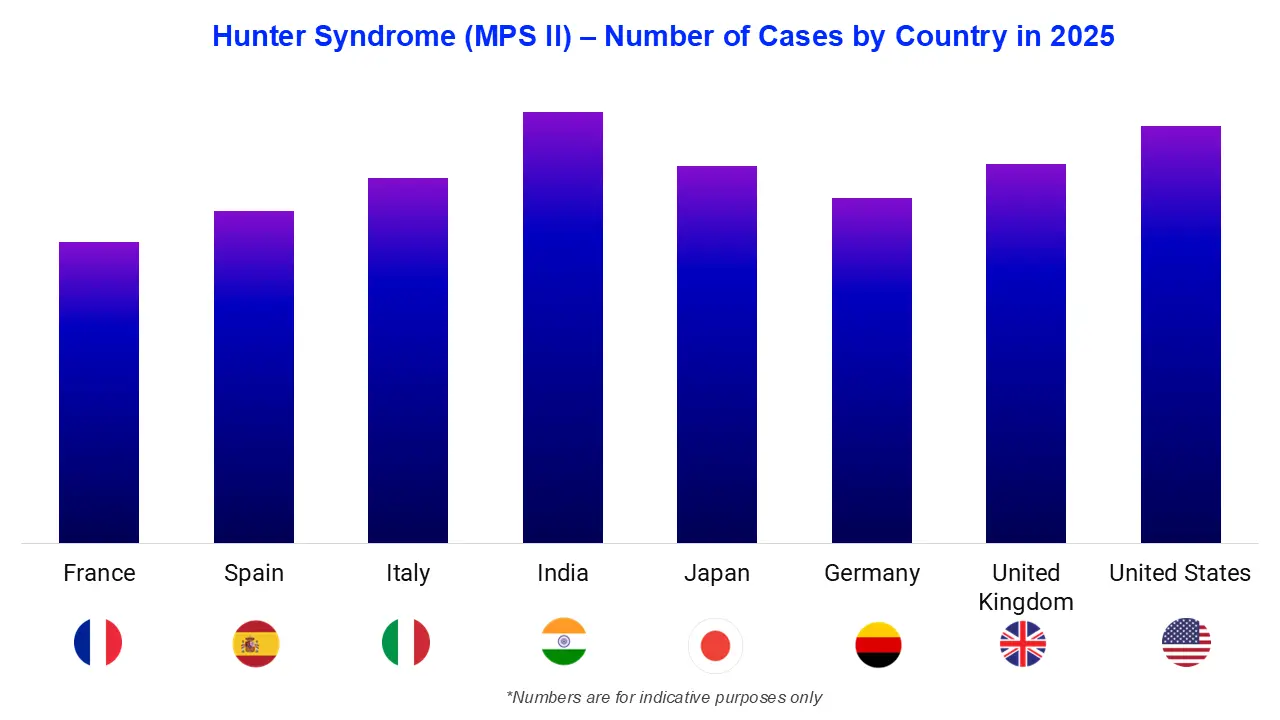
The Hunter syndrome (MPS II) epidemiology data and findings for the United States, Germany, Spain, Italy, France, the United Kingdom, Japan, and India are also provided in the epidemiology section.
|
Country |
Key Insights |
|
United States |
According to Qi Kang et al. (2024), the incidence of MPS in the United States was 0.98 per 100,000 live births, with MPS I, II, and III each accounting for 26% of cases. As per Olulade Ayodele et al. (2024), MPS II birth prevalence was approximately one in 73,000 in recent screening studies. |
|
Germany |
MPS II epidemiology in Germany follows the broader pattern of this rare X-linked disorder, with affected individuals predominantly being male. The epidemiological profile is also characterized by early childhood symptom onset and variation in disease progression. |
|
France |
In France, MPS II represents a rare inherited disorder within the mucopolysaccharidosis spectrum. Its epidemiological profile is characterized predominantly by affected males, with symptoms generally emerging during early childhood. |
|
Italy |
Italy reflects the predominantly male epidemiological distribution reported for MPS II. The condition generally becomes apparent during early childhood, while the clinical progression can vary among affected individuals. |
|
Spain |
MPS II in Spain follows the broader epidemiological characteristics of this rare X-linked disorder. Affected individuals are predominantly male, and symptoms commonly emerge during the early childhood period. |
|
United Kingdom |
According to Krithi Rao et al. (2023), MPS II incidence in the United Kingdom was one in 171,132 live births, equivalent to 0.584 per 100,000 live births. The disease predominantly affects males and generally presents during childhood. |
|
Japan |
As per Olulade Ayodele et al. (2024), newborn-screening initiatives estimated MPS II birth prevalence in Japan at approximately one in 15,000, indicating substantial population-level variation compared with estimates from the United States. |
|
India |
According to Krithi Rao et al. (2023), MPS II is predominantly observed among males in India. The epidemiological profile is characterized by its rare occurrence, early-life presentation, and occasional reports of affected females. |
The Hunter syndrome epidemiology landscape presents opportunities to improve early diagnosis, genetic confirmation, and access to disease-specific treatment across the United States, Europe, Japan, and India. The multisystem nature of MPS II can result in patients being evaluated by multiple specialties before a definitive diagnosis is established. Expanded awareness among pediatricians, geneticists, metabolic specialists, and other relevant clinicians could support earlier referral for enzyme and molecular testing. In India, published clinical cohorts demonstrate an established pool of genetically characterized patients, creating opportunities to strengthen diagnostic infrastructure, genetic counseling, and access to specialized therapies.
Hunter syndrome treatment focuses on reducing glycosaminoglycan accumulation, slowing disease progression, and managing multisystem complications. Enzyme replacement therapy (ERT) with intravenous idursulfase is an established treatment that can improve several somatic manifestations, although conventional idursulfase has limited penetration across the blood-brain barrier. CNS-penetrant ERT, including tividenofusp alfa-eknm, provides an additional therapeutic approach where approved. Supportive management includes respiratory, cardiac, hearing, orthopedic, and rehabilitative care. Hematopoietic stem cell transplantation has been investigated but is not established as standard treatment because controlled evidence in MPS II remains limited.


Upto 15% Off
USD
$2699 $2429
$4299 $3869
$5799 $4949
$6999 $5949


*While we strive to always give you current and accurate information, the numbers depicted on the website are indicative and may differ from the actual numbers in the main report. At Expert Market Research, we aim to bring you the latest insights and trends in the market. Using our analyses and forecasts, stakeholders can understand the market dynamics, navigate challenges, and capitalize on opportunities to make data-driven strategic decisions.*
Explore our key highlights of the report and gain a concise overview of key findings, trends, and actionable insights that will empower your strategic decisions.
|
Report Features |
Details |
|
Base Year |
2025 |
|
Historical Period |
2019-2025 |
|
Forecast Period |
2026-2035 |
|
Epidemiology Statistics Provided |
|
|
Segmentation Provided |
|
|
Geographies Covered |
|
Datasheet
One User
USD 2,699
USD 2,429
tax inclusive*
Single User License
One User
USD 4,299
USD 3,869
tax inclusive*
Five User License
Five User
USD 5,799
USD 4,949
tax inclusive*
Corporate License
Unlimited Users
USD 6,999
USD 5,949
tax inclusive*
*Please note that the prices mentioned below are starting prices for each bundle type. Kindly contact our team for further details.*
Flash Bundle
Small Business Bundle
Growth Bundle
Enterprise Bundle
*Please note that the prices mentioned below are starting prices for each bundle type. Kindly contact our team for further details.*
Flash Bundle
Number of Reports: 3
20%
tax inclusive*
Small Business Bundle
Number of Reports: 5
25%
tax inclusive*
Growth Bundle
Number of Reports: 8
30%
tax inclusive*
Enterprise Bundle
Number of Reports: 10
35%
tax inclusive*
How To Order

Select License Type
Choose the right license for your needs and access rights.

Click on ‘Buy Now’
Add the report to your cart with one click and proceed to register.

Select Mode of Payment
Choose a payment option for a secure checkout. You will be redirected accordingly.
Strategic Solutions for Informed Decision-Making
Gain insights to stay ahead and seize opportunities.

Get insights & trends for a competitive edge.

Track prices with detailed trend reports.

Analyse trade data for supply chain insights.

Leverage cost reports for smart savings

Enhance supply chain with partnerships.

Connect For More Information
Our expert team of analysts will offer full support and resolve any queries regarding the report, before and after the purchase.
Our expert team of analysts will offer full support and resolve any queries regarding the report, before and after the purchase.
We employ meticulous research methods, blending advanced analytics and expert insights to deliver accurate, actionable industry intelligence, staying ahead of competitors.
Our skilled analysts offer unparalleled competitive advantage with detailed insights on current and emerging markets, ensuring your strategic edge.
We offer an in-depth yet simplified presentation of industry insights and analysis to meet your specific requirements effectively.




