

Consumer Insights
Uncover trends and behaviors shaping consumer choices today
Procurement Insights
Optimize your sourcing strategy with key market data
Industry Stats
Stay ahead with the latest trends and market analysis.
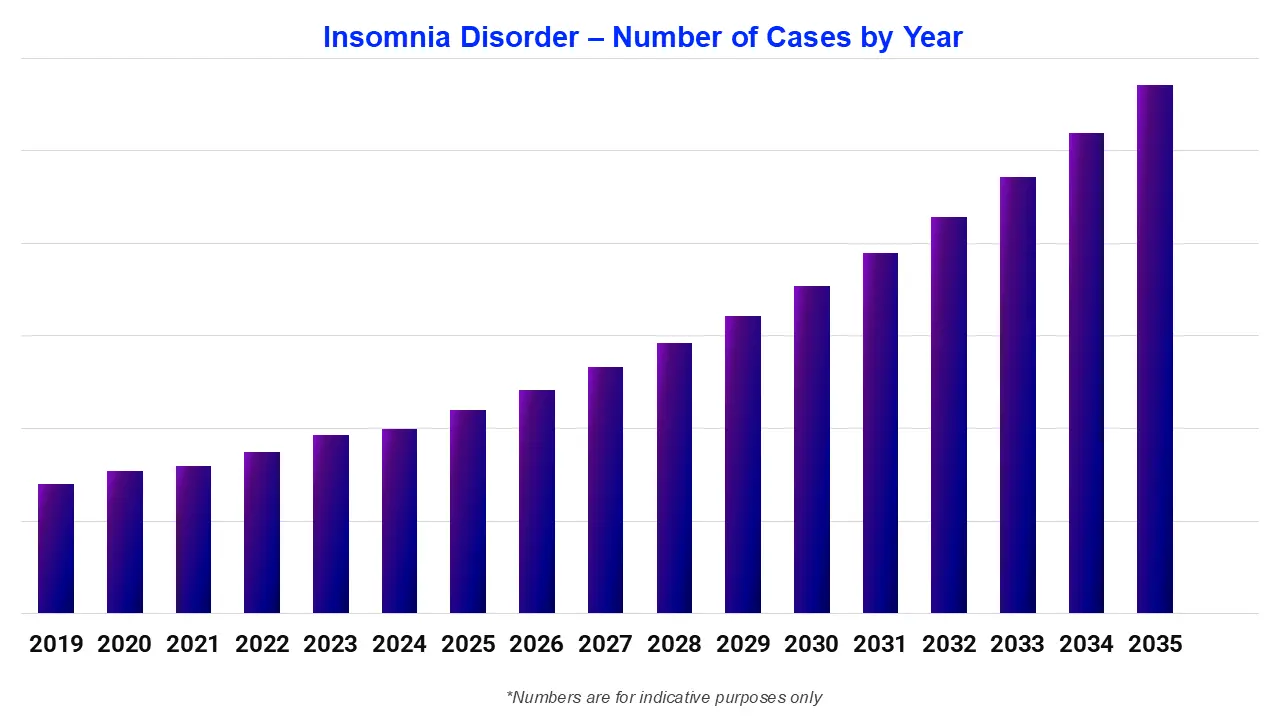
Insomnia disorder is a sleep disorder characterized by difficulty falling asleep, staying asleep, or waking earlier than desired despite adequate opportunity for sleep. According to the American Academy of Sleep Medicine, 12% of Americans have been diagnosed with chronic insomnia. As per the insomnia disorder epidemiology forecast by Expert Market Research, chronic insomnia affects a large portion of the global population, highlighting its substantial disease burden worldwide.
Base Year
Historical Period
Forecast Period
Read more about this report - Request a Free Sample
Expert Market Research's “Insomnia Disorder Epidemiology Forecast Report 2026-2035” offers comprehensive information on the prevalence and demographics of insomnia disorder. It projects the future incidence and prevalence rates of insomnia disorder cases across various populations. The study covers age, gender, and type as major determinants of the insomnia disorder population. The report highlights patterns in the prevalence of insomnia disorder over time and projects future trends based on multiple variables.
The report provides a comprehensive overview of the disease, as well as historical and projected data on the epidemiology of insomnia disorder in the 8 major markets.
Regions Covered
Insomnia disorder is a sleep disorder characterized by persistent difficulty falling asleep, staying asleep, or waking too early, despite having adequate opportunity to sleep, with associated daytime impairment. It can occur independently or alongside medical, psychiatric, or other sleep conditions. Common forms include sleep-onset insomnia, sleep-maintenance insomnia, and early-morning awakening insomnia. Chronic insomnia disorder generally involves symptoms occurring at least three nights per week for at least three months. Sleep disturbance may be associated with stress, anxiety, depression, irregular sleep schedules, medical conditions, medications, or environmental factors.
|
Parameter |
Insight |
|
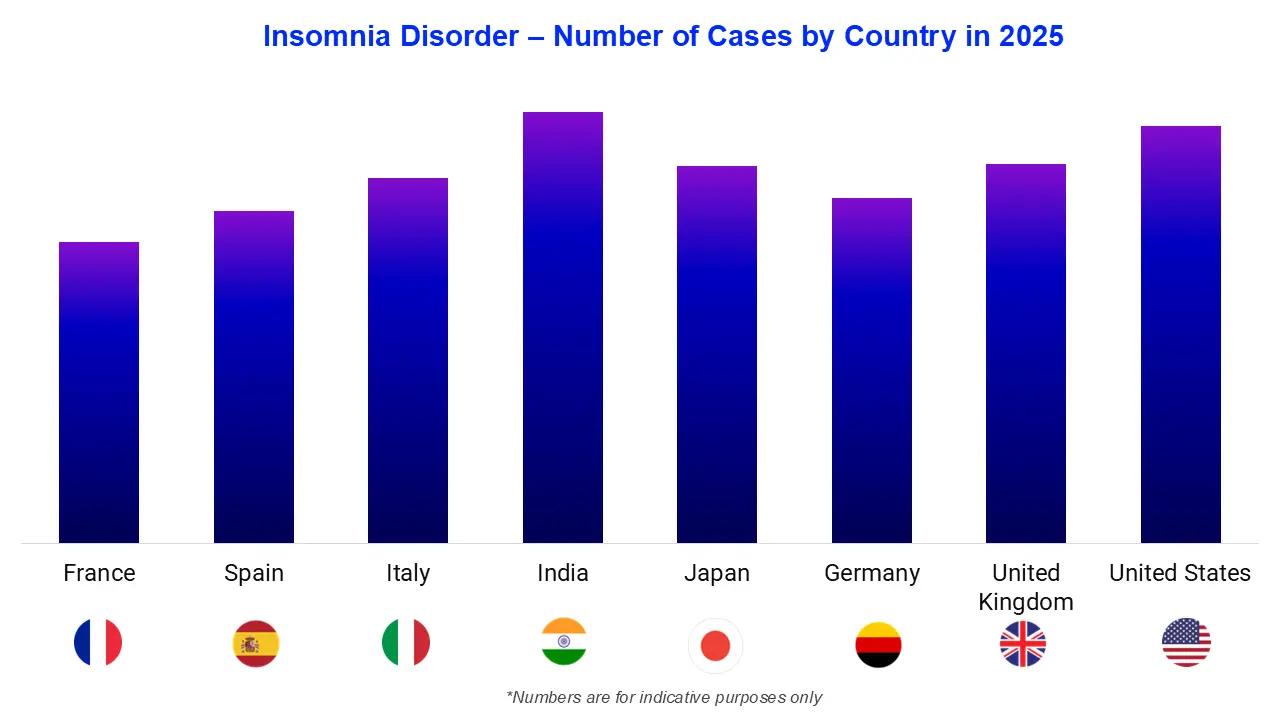
Largest Patient Pool |
United States |
|
Fastest Growing Region |
India |
|
High-Risk Population |
Older adults, women, and individuals with mental health conditions |
|
Key Diagnostic Method |
Clinical evaluation using sleep history, sleep questionnaires, and sleep diaries |
|
Major Risk Factor |
Psychological stress and mental health disorders |
|
Major gap in the market |
Underdiagnosis and limited access to evidence-based CBT-I |
The insomnia disorder epidemiology division offers information on the patient pool from history to the present as well as the projected trend for each of the 8 major markets. Expert Market Research provides both current and predicted trends for the insomnia disorder epidemiology scenario by examining a wide range of studies. Additionally, the report covers the diagnosed patient pool for insomnia disorder and their trends. The data is broken down into specific categories, such as total prevalent cases in males and females, and total diagnosed cases across different age groups and patient pools.
|
Epidemiology Segment |
Key Insights |
|
Diagnosed Prevalent Cases of the Disease |
Chronic insomnia disorder affects approximately 10% of adults in the United States, while 30–50% report insomnia symptoms. The American Academy of Sleep Medicine reports that 12% of Americans have received a chronic insomnia diagnosis. |
|
Gender-Specific Cases of the Disease |
In a study of 33,004 participants, females accounted for 56.8% of the population. Wendemi Sawadogo et al. (2024) identified differences in mortality risk associated with insomnia symptoms across male and female populations and age groups. |
|
Age-Specific Cases of the Disease |
Hareth Almajid et al. (2024) reported the highest insomnia prevalence among individuals aged 40-60 years at 45.7%, followed by those aged 18–24 years at 38.6% and 25–39 years at 38.4%. |
|
Ethnicity-Wise Cases of the Disease |
Rupsha Singh et al. (2024) examined longitudinal insomnia symptom patterns across racial and ethnic groups among 519 participants. The cohort included non-Hispanic White, Black/African American, Hispanic/Latinx, and other racial or ethnic groups. |
|
Mortality and Survival Analysis of the Disease |
During an average follow-up of 8.4 years, 8,935 deaths were recorded among 33,004 participants. Wendemi Sawadogo et al. (2024) found higher mortality risks among certain male and female groups with insomnia symptoms. |
|
Disease Type |
Prevalence |
|
Acute insomnia |
Acute insomnia represents a common form of insomnia, typically characterized by a short-term course. It contributes substantially to the overall burden of insomnia and may progress to persistent symptoms in some individuals. |
|
Chronic insomnia |
Chronic insomnia constitutes a major form of insomnia disorder and accounts for a substantial burden among affected adults. It represents the persistent form of the condition and is the principal type reflected in the provided epidemiological data. |
Read more about this report - Request a Free Sample
The insomnia disorder epidemiology data and findings for the United States, Germany, Spain, Italy, France, the United Kingdom, Japan, and India are also provided in the epidemiology section.
|
Country |
Key Insights |
|
United States |
Chronic insomnia disorder affects approximately 10% of US adults, while 30–50% report insomnia symptoms. The American Academy of Sleep Medicine also reports that 12% of Americans have been diagnosed with chronic insomnia. |
|
Germany |
As per Anna Heidbreder (2024), approximately 6% of adults in Germany suffer from insomnia, indicating a notable prevalence within the country's adult population. |
|
France |
According to UPSA, insomnia affects approximately 1 in 5 adults in France, reflecting a substantial burden among the adult population. |
|
Italy |
Insomnia remains an important epidemiological concern among the Italian population, with its burden varying across demographic groups and population characteristics. |
|
Spain |
A study by Manuel de Entrambasaguas et al. (2023) reported insomnia prevalence ranging from 5.7% to 19% across European countries. Spain recorded a prevalence of 6.4% in the late 1990s, with chronic insomnia disorder subsequently showing a substantial increase. |
|
United Kingdom |
Insomnia represents a relevant epidemiological concern among adults in the United Kingdom, contributing to the broader burden of sleep disorders observed across European populations. |
|
Japan |
Insomnia remains an important population-level epidemiological concern in Japan, with variations in prevalence likely reflecting differences across demographic and age groups. |
|
India |
According to Jagadish Anjanappa et al. (2025), insomnia affects 33% of adults in India, with older adults notably affected. Urbanization, lifestyle changes, and increasing stress levels are identified as factors associated with the condition. |
The insomnia disorder landscape presents significant opportunities to improve early diagnosis, treatment access, and long-term disease management. Underdiagnosis remains an important gap because many individuals experiencing persistent sleep difficulties do not receive formal assessment or evidence-based treatment. Expanding access to CBT-I, particularly through digitally delivered and guided programs, represents an important opportunity across the United States, Europe, Japan, and India. Integrating insomnia screening into primary care and mental health services could improve identification of patients with persistent symptoms. India also offers substantial growth potential through greater sleep-health awareness, improved screening, and expansion of specialized sleep-care services.
Insomnia treatment primarily focuses on behavioral and psychological interventions, with cognitive behavioral therapy for insomnia (CBT-I) recommended as the first-line treatment for chronic insomnia in adults. CBT-I combines cognitive restructuring, stimulus control, sleep restriction, relaxation techniques, and sleep-hygiene education. Digital CBT-I may also improve access to treatment. When CBT-I is unavailable or insufficient, clinicians may consider short-term pharmacological treatment based on individual needs, risks, and comorbidities. Treatment may also involve addressing underlying medical or psychiatric conditions, maintaining regular sleep schedules, and improving sleep-related behaviors.


Upto 15% Off
USD
$1999 $1799
$2999 $2699
$4399 $3739
$5799 $4929


*While we strive to always give you current and accurate information, the numbers depicted on the website are indicative and may differ from the actual numbers in the main report. At Expert Market Research, we aim to bring you the latest insights and trends in the market. Using our analyses and forecasts, stakeholders can understand the market dynamics, navigate challenges, and capitalize on opportunities to make data-driven strategic decisions.*
Explore our key highlights of the report and gain a concise overview of key findings, trends, and actionable insights that will empower your strategic decisions.
|
Report Features |
Details |
|
Base Year |
2025 |
|
Historical Period |
2019-2025 |
|
Forecast Period |
2026-2035 |
|
Epidemiology Statistics Provided |
|
|
Segmentation Provided |
|
|
Geographies Covered |
|
Datasheet
One User
USD 1,999
USD 1,799
tax inclusive*
Single User License
One User
USD 2,999
USD 2,699
tax inclusive*
Five User License
Five User
USD 4,399
USD 3,739
tax inclusive*
Corporate License
Unlimited Users
USD 5,799
USD 4,929
tax inclusive*
*Please note that the prices mentioned below are starting prices for each bundle type. Kindly contact our team for further details.*
Flash Bundle
Small Business Bundle
Growth Bundle
Enterprise Bundle
*Please note that the prices mentioned below are starting prices for each bundle type. Kindly contact our team for further details.*
Flash Bundle
Number of Reports: 3
20%
tax inclusive*
Small Business Bundle
Number of Reports: 5
25%
tax inclusive*
Growth Bundle
Number of Reports: 8
30%
tax inclusive*
Enterprise Bundle
Number of Reports: 10
35%
tax inclusive*
How To Order

Select License Type
Choose the right license for your needs and access rights.

Click on ‘Buy Now’
Add the report to your cart with one click and proceed to register.

Select Mode of Payment
Choose a payment option for a secure checkout. You will be redirected accordingly.
Strategic Solutions for Informed Decision-Making
Gain insights to stay ahead and seize opportunities.

Get insights & trends for a competitive edge.

Track prices with detailed trend reports.

Analyse trade data for supply chain insights.

Leverage cost reports for smart savings

Enhance supply chain with partnerships.

Connect For More Information
Our expert team of analysts will offer full support and resolve any queries regarding the report, before and after the purchase.
Our expert team of analysts will offer full support and resolve any queries regarding the report, before and after the purchase.
We employ meticulous research methods, blending advanced analytics and expert insights to deliver accurate, actionable industry intelligence, staying ahead of competitors.
Our skilled analysts offer unparalleled competitive advantage with detailed insights on current and emerging markets, ensuring your strategic edge.
We offer an in-depth yet simplified presentation of industry insights and analysis to meet your specific requirements effectively.




