Consumer Insights
Uncover trends and behaviors shaping consumer choices today
Procurement Insights
Optimize your sourcing strategy with key market data
Industry Stats
Stay ahead with the latest trends and market analysis.
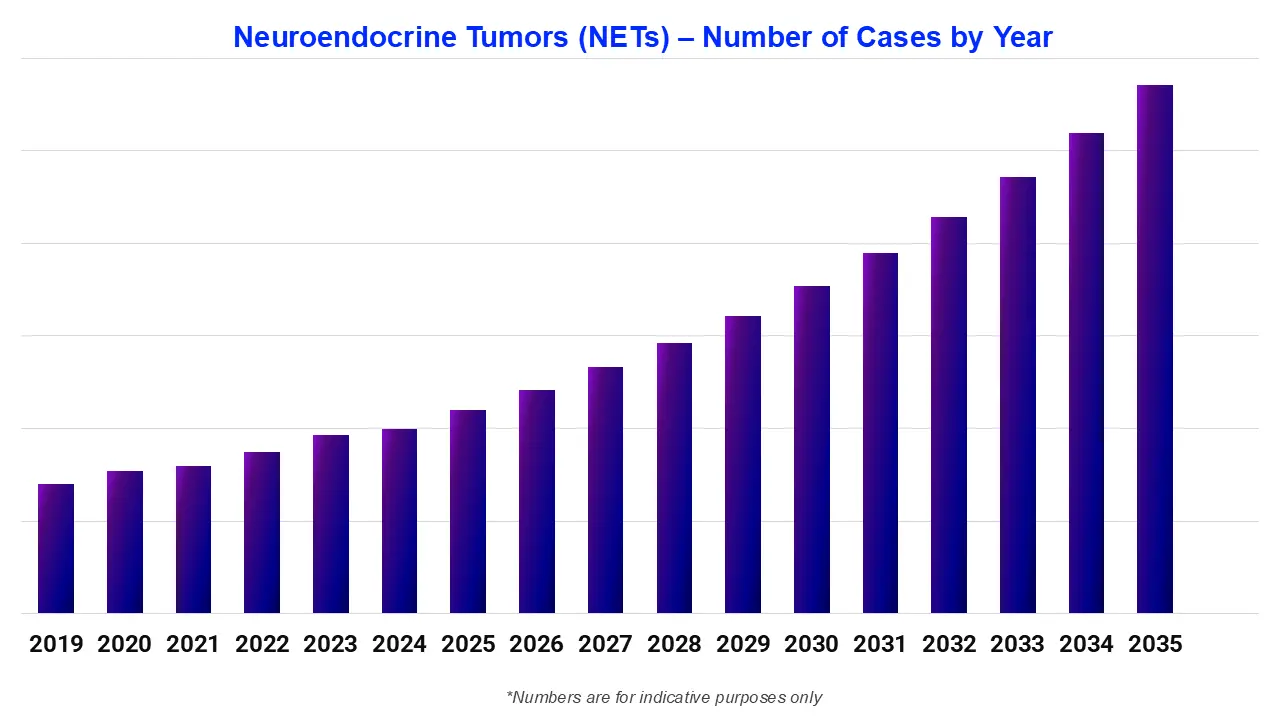
Neuroendocrine tumors (NETs) are rare neoplasms arising from specialized neuroendocrine cells throughout the body. According to GI Cancers Alliance, the reported worldwide incidence of gastrointestinal NETs is 8.2 per 100,000 people. As per the neuroendocrine tumors (NETs) epidemiology forecast by Expert Market Research, increasing detection and diagnosis are contributing to the growing recognized disease burden.
Base Year
Historical Period
Forecast Period
Read more about this report - Request a Free Sample
Expert Market Research's “Neuroendocrine Tumors (NETs) Epidemiology Forecast Report 2026-2035” offers comprehensive information on the prevalence and demographics of neuroendocrine tumors (NETs). It projects the future incidence and prevalence rates of neuroendocrine tumors (NETs) cases across various populations. The study covers age, gender, and type as major determinants of the neuroendocrine tumors (NETs) population. The report highlights patterns in the prevalence of neuroendocrine tumors (NETs) over time and projects future trends based on multiple variables.
The report provides a comprehensive overview of the disease, as well as historical and projected data on the epidemiology of neuroendocrine tumors (NETs) in the 8 major markets.
Regions Covered
Neuroendocrine tumors (NETs) are a diverse group of cancers that arise from neuroendocrine cells, which produce hormones and transmit signals throughout the body. These tumors can develop in organs such as the gastrointestinal tract, pancreas, and lungs and may grow slowly or aggressively depending on their grade and differentiation. NETs are broadly classified as functional tumors, which produce excess hormones and cause characteristic symptoms, and nonfunctional tumors, which do not produce clinically significant hormones. They may also be classified as well-differentiated NETs or poorly differentiated neuroendocrine carcinomas based on cellular characteristics.
|
Parameter |
Insight |
|
Largest Patient Pool |
United States |
|
Fastest Growing Country |
India |
|
High-Risk Population |
Adults with hereditary predisposition, certain genetic syndromes, and individuals with relevant chronic conditions |
|
Key Diagnostic Method |
Histopathological examination supported by immunohistochemistry, imaging, and biomarker testing |
|
Major Risk Factor |
Most NETs have no clearly established modifiable risk factor; hereditary syndromes are important risk factors for selected NETs |
|
Major gap in the market |
Underdiagnosis and delayed diagnosis |
The neuroendocrine tumors (NETs) epidemiology division offers information on the patient pool from history to the present as well as the projected trend for each of the 8 major markets. Expert Market Research provides both current and predicted trends for the neuroendocrine tumors (NETs) epidemiology scenario by examining a wide range of studies. Additionally, the report covers the diagnosed patient pool for neuroendocrine tumors (NETs) and their trends. The data is broken down into specific categories, such as total prevalent cases in males and females, and total diagnosed cases across different age groups and patient pools.
|
Epidemiology Segment |
Key Insights |
|
Diagnosed Prevalent Cases of the Disease |
According to Cancer Therapy Advisor, more than 170,000 people in the United States are living with neuroendocrine tumors, with approximately 12,000 new cases diagnosed annually. The increasing incidence and prevalence have been associated with improved detection, awareness, and survival. |
|
Gender-Specific Cases of the Disease |
As per University of Colorado, gastrointestinal neuroendocrine tumors are slightly more common in women than in men. The available epidemiological information indicates a modest gender difference, while broader gender-specific prevalence estimates are not provided in the supplied data. |
|
Age-Specific Cases of the Disease |
According to University of Colorado, the typical age range for diagnosis of gastrointestinal neuroendocrine tumors is 55-65 years. For lung neuroendocrine tumors, the typical diagnostic age range is 45-55 years, indicating variation across tumor locations. |
|
Ethnicity-Wise Cases of the Disease |
According to University of Colorado, gastrointestinal and lung neuroendocrine tumors are more common among White people than among other ethnic and racial groups. The supplied information indicates racial differences in occurrence but does not provide comparative prevalence estimates. |
|
Mortality and Survival Analysis of the Disease |
According to Cancer Therapy Advisor, more than 170,000 people in the United States are living with neuroendocrine tumors, while approximately 12,000 new cases occur annually. The increasing prevalence has been partly associated with improved survival and detection. |
|
Disease Type |
Prevalence |
|
Gastrointestinal NETs (GI-NETs) |
According to GI Cancers Alliance, gastrointestinal NETs have a worldwide incidence of 8.2 per 100,000 people. The most common primary sites are the small intestine (30.8%), rectum (26.3%), colon (17.6%), pancreas (12.1%), and appendix (5.7%). |
|
Lung (Bronchopulmonary) NETs |
According to University of Colorado, lung NETs represent an important anatomical group and typically occur at a diagnostic age of 45–55 years. These tumors arise in the lungs and can also involve the bronchi. |
|
Pancreatic NETs (pNETs) |
According to GI Cancers Alliance, the pancreas accounts for 12.1% of gastrointestinal NET primary sites. According to University of Colorado, pancreatic NETs are associated with inherited syndromes and factors including multiple endocrine neoplasia type 1, diabetes, and chronic pancreatitis. |
|
Other-Site NETs |
Neuroendocrine tumors can occur throughout the body in addition to the gastrointestinal tract, lungs, and pancreas. The supplied information identifies the lungs, small intestine, appendix, pancreas, and rectum among commonly affected sites. |
Read more about this report - Request a Free Sample
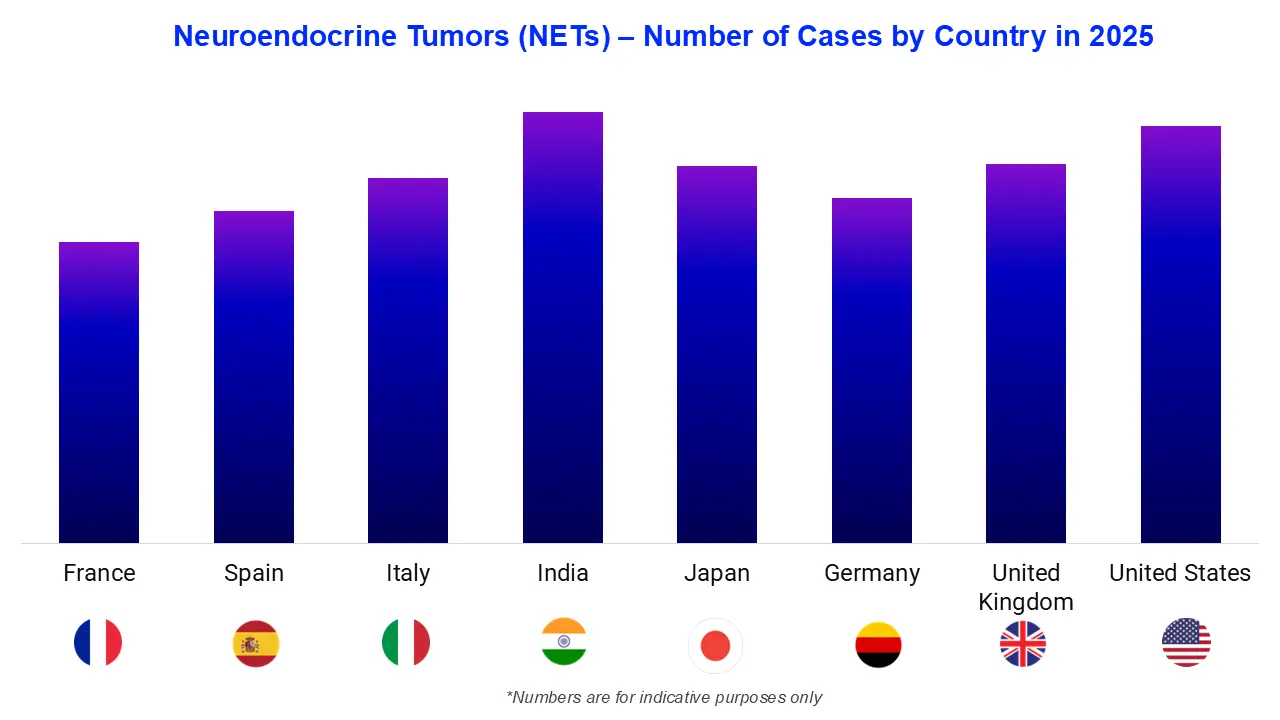
The neuroendocrine tumors (NETs) epidemiology data and findings for the United States, Germany, Spain, Italy, France, the United Kingdom, Japan, and India are also provided in the epidemiology section.
|
Country |
Key Insights |
|
United States |
According to Cancer Therapy Advisor, the United States has an estimated annual incidence of approximately 7 cases per 100,000 individuals, with more than 170,000 people living with neuroendocrine tumors and approximately 12,000 new cases annually. |
|
Germany |
The epidemiological burden of neuroendocrine tumors in Germany encompasses tumors arising across gastrointestinal, pancreatic, pulmonary, and other anatomical sites. The distribution of cases is influenced by tumor location and the identification of tumors through diagnostic evaluation. |
|
France |
Neuroendocrine tumor epidemiology in France includes disease across gastrointestinal and pancreatic sites, with the overall burden reflecting variation in primary tumor location. Gastrointestinal tumors represent an important component of the broader neuroendocrine tumor spectrum. |
|
Italy |
The epidemiological profile of neuroendocrine tumors in Italy includes tumors occurring across gastrointestinal and pancreatic sites. The distribution of gastrointestinal tumors varies by primary anatomical location, including the small intestine, rectum, colon, pancreas, and appendix. |
|
Spain |
Neuroendocrine tumors in Spain form part of the broader gastrointestinal and pancreatic neuroendocrine tumor burden. Epidemiological patterns encompass variation in primary tumor sites, while improved detection can contribute to identification of tumors that may otherwise remain undiagnosed. |
|
United Kingdom |
Neuroendocrine tumor epidemiology includes a broad distribution across gastrointestinal and pancreatic sites. According to GI Cancers Alliance, gastrointestinal neuroendocrine tumors have a reported worldwide incidence of 8.2 per 100,000 people, providing context for the broader epidemiological burden. |
|
Japan |
According to Baizhou Tan et al. (2024), the incidence of gastroenteropancreatic neuroendocrine neoplasms in Japan was 3.53 per 100,000 individuals. Rectal neuroendocrine neoplasms accounted for 53% of cases, followed by pancreatic and gastric sites. |
|
India |
According to Sunil Kumar Verma et al. (2024), the annual incidence of neuroendocrine tumors is 2.5–5 per 100,000, with an incidence rate of approximately 2 per 100,000 also reported. Neuroendocrine tumors account for around 0.5% of all malignancies. |
The regional neuroendocrine tumor epidemiology landscape has important gaps related to delayed diagnosis, limited disease awareness, and variation in access to specialized diagnostic testing. NETs can present with nonspecific symptoms, which may contribute to diagnosis at advanced stages. Opportunities exist to improve recognition of NETs in primary and specialist care, expand access to high-quality imaging and pathology, and strengthen multidisciplinary referral pathways. In emerging markets such as India, increasing awareness and diagnostic capacity could improve case identification. Greater use of molecular and receptor-based diagnostics may also support earlier characterization and more personalized treatment strategies.
Neuroendocrine tumors (NETs) treatment depends on tumor location, stage, grade, differentiation, hormone secretion, and overall health. Localized tumors may be treated with surgical resection, while advanced or unresectable disease may require systemic or targeted approaches. Peptide receptor radionuclide therapy (PRRT) is an important treatment option for selected somatostatin receptor-positive tumors. Other approaches include somatostatin analogs, targeted therapies, chemotherapy, liver-directed therapies, and radiation therapy. For certain pancreatic neuroendocrine tumors, targeted agents such as everolimus or sunitinib may be used. Treatment plans are often individualized through multidisciplinary care.
Gastric Neuroendocrine Tumors Pipeline Analysis
Gastroenteropancreatic Neuroendocrine Tumors (GEP-NETs) Pipeline Analysis


Upto 15% Off
USD
$2699 $2429
$4299 $3869
$5799 $4949
$6999 $5949


*While we strive to always give you current and accurate information, the numbers depicted on the website are indicative and may differ from the actual numbers in the main report. At Expert Market Research, we aim to bring you the latest insights and trends in the market. Using our analyses and forecasts, stakeholders can understand the market dynamics, navigate challenges, and capitalize on opportunities to make data-driven strategic decisions.*
Explore our key highlights of the report and gain a concise overview of key findings, trends, and actionable insights that will empower your strategic decisions.
|
Report Features |
Details |
|
Base Year |
2025 |
|
Historical Period |
2019-2025 |
|
Forecast Period |
2026-2035 |
|
Epidemiology Statistics Provided |
|
|
Segmentation Provided |
|
|
Geographies Covered |
|
Datasheet
One User
USD 2,699
USD 2,429
tax inclusive*
Single User License
One User
USD 4,299
USD 3,869
tax inclusive*
Five User License
Five User
USD 5,799
USD 4,949
tax inclusive*
Corporate License
Unlimited Users
USD 6,999
USD 5,949
tax inclusive*
*Please note that the prices mentioned below are starting prices for each bundle type. Kindly contact our team for further details.*
Flash Bundle
Small Business Bundle
Growth Bundle
Enterprise Bundle
*Please note that the prices mentioned below are starting prices for each bundle type. Kindly contact our team for further details.*
Flash Bundle
Number of Reports: 3
20%
tax inclusive*
Small Business Bundle
Number of Reports: 5
25%
tax inclusive*
Growth Bundle
Number of Reports: 8
30%
tax inclusive*
Enterprise Bundle
Number of Reports: 10
35%
tax inclusive*
How To Order

Select License Type
Choose the right license for your needs and access rights.

Click on ‘Buy Now’
Add the report to your cart with one click and proceed to register.

Select Mode of Payment
Choose a payment option for a secure checkout. You will be redirected accordingly.
Strategic Solutions for Informed Decision-Making
Gain insights to stay ahead and seize opportunities.
Get insights & trends for a competitive edge.
Track prices with detailed trend reports.
Analyse trade data for supply chain insights.

Leverage cost reports for smart savings
Enhance supply chain with partnerships.

Connect For More Information
Our expert team of analysts will offer full support and resolve any queries regarding the report, before and after the purchase.
Our expert team of analysts will offer full support and resolve any queries regarding the report, before and after the purchase.
We employ meticulous research methods, blending advanced analytics and expert insights to deliver accurate, actionable industry intelligence, staying ahead of competitors.
Our skilled analysts offer unparalleled competitive advantage with detailed insights on current and emerging markets, ensuring your strategic edge.
We offer an in-depth yet simplified presentation of industry insights and analysis to meet your specific requirements effectively.