

Consumer Insights
Uncover trends and behaviors shaping consumer choices today
Procurement Insights
Optimize your sourcing strategy with key market data
Industry Stats
Stay ahead with the latest trends and market analysis.
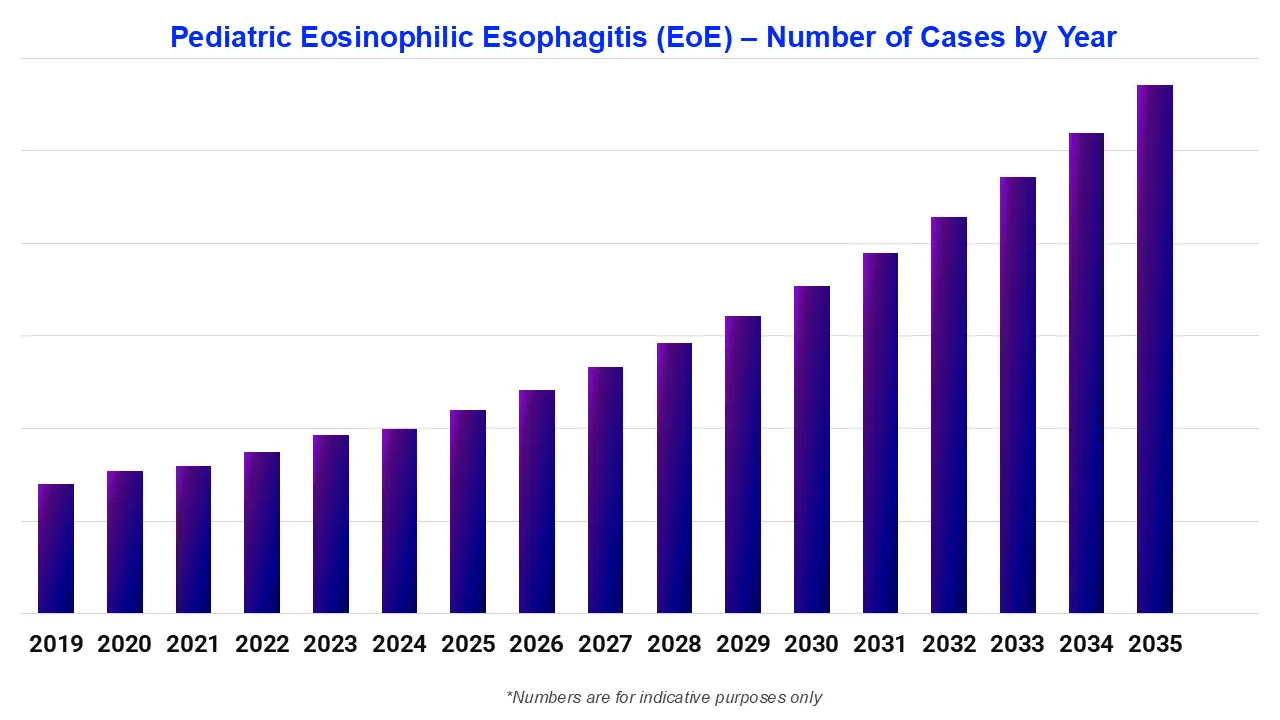
Pediatric eosinophilic esophagitis (EoE) is a chronic immune-mediated inflammatory disorder of the esophagus. A 2024 pediatric cohort of 256 children reported a mean diagnostic age of 9 years, 72% male representation, and 60% mucosal remission. A US analysis identified 20,435 EoE cases in 2022, with an overall prevalence of 163.08 per 100,000. According to pediatric eosinophilic esophagitis (eoe) epidemiology forecast by Expert Market Research (EMR), eosinophilic esophagitis has an overall incidence of approximately 33.9 cases per 100,000 patient-years and prevalence of approximately 147.4 cases per 100,000 individuals, although these figures encompass the broader EoE population rather than children specifically.
Base Year
Historical Period
Forecast Period
Read more about this report - Request a Free Sample
Expert Market Research's “Pediatric Eosinophilic Esophagitis (EoE) Epidemiology Forecast Report 2026-2035” offers comprehensive information on the prevalence and demographics of Pediatric Eosinophilic Esophagitis (EoE). It projects the future incidence and prevalence rates of Pediatric Eosinophilic Esophagitis (EoE) cases across various populations. The study covers age, gender, and type as major determinants of the Pediatric Eosinophilic Esophagitis (EoE) population. The report highlights patterns in the prevalence of Pediatric Eosinophilic Esophagitis (EoE) over time and projects future trends based on multiple variables.
The report provides a comprehensive overview of the disease, as well as historical and projected data on the epidemiology of Pediatric Eosinophilic Esophagitis (EoE) in the 8 major markets.
Regions Covered
Pediatric eosinophilic esophagitis (EoE) is a chronic, immune-mediated inflammatory disorder of the esophagus characterized by esophageal dysfunction and eosinophil-predominant inflammation. Pediatric EoE develops through predominantly type 2 immune mechanisms involving epithelial alarmins, cytokines such as IL-4, IL-5 and IL-13, eosinophilic recruitment and esophageal tissue remodeling. Clinical presentation varies considerably with age: younger children commonly develop feeding difficulties, vomiting and poor weight gain, whereas older children and adolescents more frequently present with dysphagia and food impaction.
|
Parameter |
Insight |
|
Largest Patient Pool |
United States |
|
Fastest Growing Region |
Japan |
|
High-Risk Population |
Boys and children with atopic disease represent important high-risk groups. A 2024 pediatric cohort found 72% of affected children were male, while a separate pediatric study reported 70% male representation and 67% White identification. Atopy, asthma, food allergy and other allergic conditions are frequently associated with pediatric EoE. |
|
Key Diagnostic Method |
Upper gastrointestinal endoscopy with multiple esophageal biopsies remains the key diagnostic procedure. Diagnosis requires compatible symptoms together with esophageal histology demonstrating at least 15 eosinophils per high-power field after appropriate clinical assessment. The 2024 ESPGHAN guideline emphasizes systematic biopsy sampling because endoscopic appearance alone can be normal despite active histological disease. |
|
Major Risk Factor |
Atopic predisposition is a major risk context, with food allergy, asthma, allergic rhinitis and atopic dermatitis frequently accompanying EoE. Genetic susceptibility and environmental exposures also contribute. In the 2024 Asian meta-analysis, a history of atopy was reported in 57.2% of patients with EoE, although estimates varied between individual studies. |
|
Major gap in the market |
Major unmet needs include delayed diagnosis, repeated endoscopies for histological monitoring, restrictive elimination diets, limited pediatric specialist availability and incomplete long-term disease control. Although dupilumab expanded treatment options in 2024 for children aged 1 year and older weighing at least 15 kg, access, long-term treatment strategy and disease monitoring remain important gaps. |
The Pediatric Eosinophilic Esophagitis (EoE) epidemiology division offers information on the patient pool from history to the present as well as the projected trend for each of the 8 major markets. Expert Market Research provides both current and predicted trends for the Pediatric Eosinophilic Esophagitis (EoE) epidemiology scenario by examining a wide range of studies. Additionally, the report covers the diagnosed patient pool for Pediatric Eosinophilic Esophagitis (EoE) and their trends. The data is broken down into specific categories, such as total prevalent cases in males and females, and total diagnosed cases across different age groups and patient pools.
|
Epidemiology Segment |
Key Insights |
|
Diagnosed Prevalent Cases of the Disease |
The global pooled prevalence of EoE was 40.04 cases per 100,000 inhabitants in a systematic review encompassing 40 studies, more than 288 million participants and 147,668 EoE cases. Prevalence increased to 74.42 per 100,000 during 2017-2022. Pediatric-specific estimates vary substantially according to geography and case ascertainment. |
|
Gender-Specific Cases of the Disease |
Pediatric EoE demonstrates a consistent male predominance. A 2024 cohort of 256 children reported 184 males, corresponding to 72% of the study population. Another 2024 pediatric phenotype study reported 70% male representation. This approximately 2-3:1 male predominance is repeatedly observed in pediatric clinical cohorts, although its biological basis remains incompletely understood. |
|
Age-Specific Cases of the Disease |
Pediatric EoE can occur throughout childhood, but symptom phenotype changes with age. A 2024 cohort reported a mean diagnostic age of 9 years. Children younger than 2 years most commonly presented with vomiting, those aged 2-<6 years more frequently showed poor weight gain, while children aged 6-18 years more often presented with food impaction and abdominal pain. |
|
Ethnicity-Wise Cases of the Disease |
Contemporary ethnicity-specific prevalence data remain limited. A 2024 pediatric study reported that 67% of its 91 participants identified as White, but this represents the composition of a single multidisciplinary EoE clinic rather than population prevalence. Global meta-analysis indicates substantially higher EoE prevalence in high-income countries and North America, suggesting important geographic and environmental influences. |
|
Mortality and Survival Analysis of the Disease |
Pediatric EoE is generally associated with chronic morbidity rather than disease-specific mortality. Persistent inflammation can produce esophageal remodeling, strictures, dysphagia, and food impaction. In a 2024 pediatric cohort investigating age-specific outcomes, 99 of 164 children with available follow-up endoscopies, or 60%, achieved mucosal remission. Long-term disease control is therefore principally assessed through symptom, histological, and structural outcomes. |
|
Disease Type |
Prevalence |
|
Inflammatory Phenotype |
The inflammatory phenotype represents pediatric EoE dominated by active mucosal eosinophilic inflammation without established fibrostenotic disease. In a multicenter study, 84% of pediatric patients had an inflammatory phenotype, compared with 16% with fibrostenotic disease. Younger children more commonly presented with vomiting, abdominal pain and poor weight gain. |
|
Fibrostenotic Phenotype |
The fibrostenotic phenotype develops with chronic eosinophilic inflammation, fibrosis, rings and strictures. In the same pediatric study, 16% of children had fibrostenotic disease. Fibrostenotic disease was associated with greater need for dilation, while dysphagia and food impaction were more common with structural disease. |
|
Mixed Inflammatory-Fibrostenotic Phenotype |
The mixed phenotype combines active inflammation with structural remodeling, including dysphagia, food impaction and esophageal narrowing. Although pediatric-specific prevalence estimates for this phenotype remain limited, broader EoE data show that mixed disease represents a substantial proportion of patients with established fibrostenotic features. |
|
Feeding-Dysfunction Predominant Phenotype |
A 2025 systematic review of 10 studies found feeding difficulties in 13%–75.3% of children with EoE, although substantial variation existed between studies. A 2024 cohort of 256 children also found that younger patients more frequently presented with feeding difficulty and poor weight gain. |
Read more about this report - Request a Free Sample
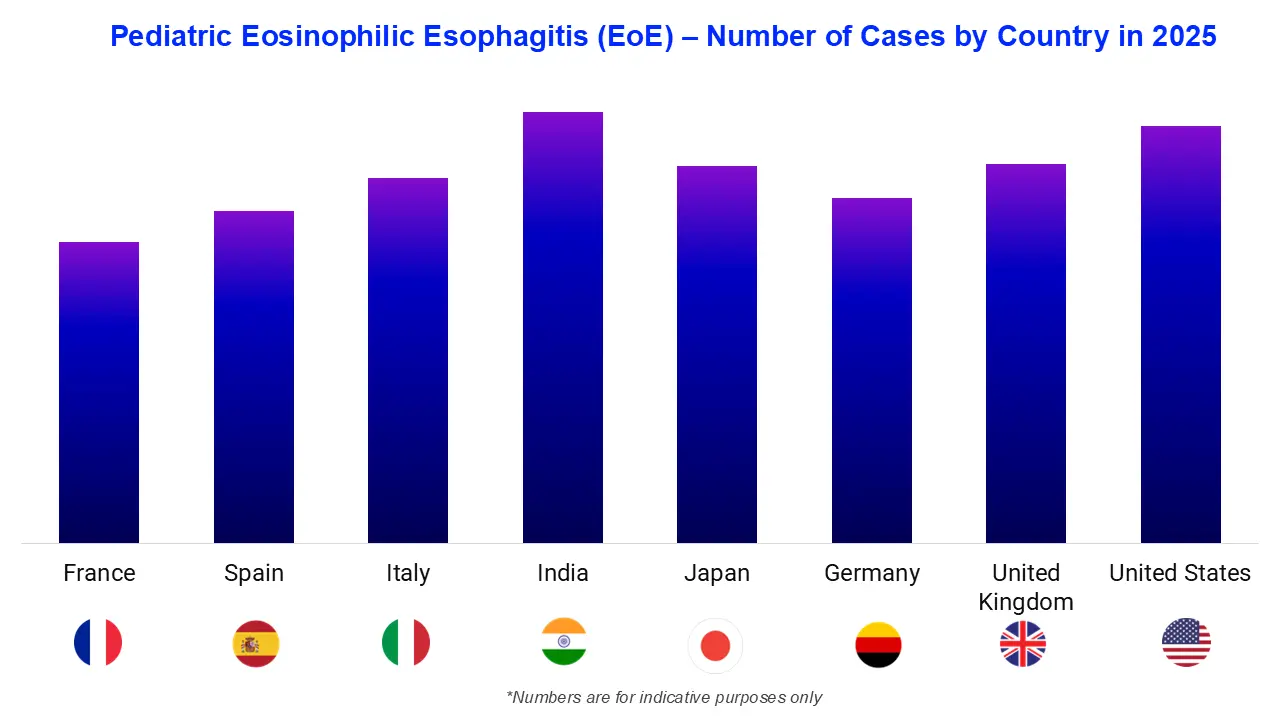
The Pediatric Eosinophilic Esophagitis (EoE) epidemiology data and findings for the United States, Germany, Spain, Italy, France, the United Kingdom, Japan, and India are also provided in the epidemiology section.
|
Country |
Key Insights |
|
United States |
A 2024 analysis of two large US administrative databases identified 20,435 EoE cases in 2022 and estimated overall prevalence at 163.08 per 100,000. Prevalence was 204.45 per 100,000 among males and 122.06 per 100,000 among females. These estimates encompass all ages rather than pediatric EoE specifically but demonstrate the substantial recognized US disease burden. |
|
Germany |
Contemporary German pediatric data remain limited, but a 2026 prospective pediatric study specifically addressed this evidence gap and followed 50 children with EoE. The study reflects increasing recognition of pediatric EoE in Germany and emphasizes treatment success, atopic comorbidities and longitudinal disease monitoring. A robust nationwide pediatric prevalence estimate for Germany is not currently sufficiently established. |
|
France |
France contributes to European EoE surveillance and pediatric gastroenterology research, but a contemporary nationwide pediatric prevalence estimate is not sufficiently standardized for reliable presentation as a 2023-2026 national figure. European meta-analysis demonstrates increasing EoE incidence across countries and identifies substantial geographical variation, emphasizing the influence of diagnostic intensity and differences in endoscopic ascertainment. |
|
Italy |
Italy has developed dedicated pediatric EoE clinical guidance. The 2025 Italian guideline emphasizes multidisciplinary management involving pediatric gastroenterologists, allergists and dietitians, with endoscopy central to diagnosis and monitoring. Contemporary national prevalence remains incompletely characterized, although Italian pediatric research continues to demonstrate increasing recognition of eosinophilic gastrointestinal diseases and the need for standardized pediatric EoE pathways. |
|
Spain |
Spain represents one of the highest-burden European settings for EoE. A population-based study covering two Spanish regions reported pediatric EoE prevalence of 143.6 per 100,000 in 2024 and an average pediatric incidence of 15.74 per 100,000 person-years across 2006-2024, rising to 23.95 per 100,000 during the most recent decade. Pediatric prevalence had approximately doubled from earlier estimates. |
|
United Kingdom |
The UK contributes substantially to European EoE research, with contemporary European meta-analysis demonstrating increasing incidence over time and higher rates in regional studies than nationwide datasets. However, a single current nationwide pediatric prevalence estimate is not sufficiently standardized for direct reporting. Pediatric gastroenterology services increasingly emphasize biopsy-based diagnosis and long-term monitoring because EoE is a chronic disease. |
|
Japan |
A 2024 population-based Japanese study identified 1,010 EoE cases among 15.2 million insured individuals. Overall EoE incidence reached 2.82 per 100,000 person-years and prevalence 10.68 per 100,000 in 2022, nearly threefold and eightfold higher, respectively, than in 2017. These are all-age estimates, but they demonstrate rapidly increasing recognition of EoE in Japan. |
|
India |
A prospective Indian pediatric study involving 200 children undergoing elective upper gastrointestinal endoscopy identified EoE in 7 patients, corresponding to a hospital-based prevalence of 3.5%. Among 20 children evaluated for dysphagia, 4 had EoE, while 2 of 3 children presenting with food-bolus impaction and dysphagia had EoE. These findings support substantial under-recognition and the need for larger multicenter studies. |
The principal epidemiological gap in pediatric EoE is the combination of increasing disease recognition with substantial diagnostic heterogeneity and limited population-based pediatric surveillance. Global meta-analysis found 40.04 cases per 100,000 overall, increasing to 74.42 per 100,000 during 2017-2022, while the European systematic review demonstrated significantly higher incidence in regional studies than nationwide studies. The Spanish 2024 population-based study provides particularly strong evidence of continued growth, reporting pediatric prevalence of 143.6 per 100,000 and an incidence of 23.95 per 100,000 during the most recent decade. In India, the 3.5% prevalence among children undergoing elective endoscopy illustrates the difference between general-population prevalence and prevalence in clinically selected pediatric populations.
The management of pediatric EoE focuses on controlling esophageal inflammation, achieving histological remission, improving symptoms and preventing progressive remodeling and strictures. Current strategies include proton pump inhibitors, swallowed topical corticosteroids, empiric or targeted elimination diets and endoscopic dilation for clinically significant narrowing. The 2024 ESPGHAN guideline recommends individualized dietary or pharmacological treatment with endoscopic and histological reassessment. Dupilumab substantially expanded pediatric treatment options: the US FDA expanded its EoE indication in January 2024 to children aged 1 year and older weighing at least 15 kg. Budesonide oral suspension (Eohilia) was approved in February 2024 for adults and pediatric patients aged 11 years and older for a 12-week treatment course. These approvals represent important advances, although long-term disease-modifying treatment, treatment sequencing, access and monitoring remain areas of continuing clinical need.


Upto 15% Off
USD
$2699 $2429
$4299 $3869
$5799 $4949
$6999 $5949


*While we strive to always give you current and accurate information, the numbers depicted on the website are indicative and may differ from the actual numbers in the main report. At Expert Market Research, we aim to bring you the latest insights and trends in the market. Using our analyses and forecasts, stakeholders can understand the market dynamics, navigate challenges, and capitalize on opportunities to make data-driven strategic decisions.*
Explore our key highlights of the report and gain a concise overview of key findings, trends, and actionable insights that will empower your strategic decisions.
|
Report Features |
Details |
|
Base Year |
2025 |
|
Historical Period |
2019-2025 |
|
Forecast Period |
2026-2035 |
|
Epidemiology Statistics Provided |
|
|
Segmentation Provided |
|
|
Geographies Covered |
|
Datasheet
One User
USD 2,699
USD 2,429
tax inclusive*
Single User License
One User
USD 4,299
USD 3,869
tax inclusive*
Five User License
Five User
USD 5,799
USD 4,949
tax inclusive*
Corporate License
Unlimited Users
USD 6,999
USD 5,949
tax inclusive*
*Please note that the prices mentioned below are starting prices for each bundle type. Kindly contact our team for further details.*
Flash Bundle
Small Business Bundle
Growth Bundle
Enterprise Bundle
*Please note that the prices mentioned below are starting prices for each bundle type. Kindly contact our team for further details.*
Flash Bundle
Number of Reports: 3
20%
tax inclusive*
Small Business Bundle
Number of Reports: 5
25%
tax inclusive*
Growth Bundle
Number of Reports: 8
30%
tax inclusive*
Enterprise Bundle
Number of Reports: 10
35%
tax inclusive*
How To Order

Select License Type
Choose the right license for your needs and access rights.

Click on ‘Buy Now’
Add the report to your cart with one click and proceed to register.

Select Mode of Payment
Choose a payment option for a secure checkout. You will be redirected accordingly.
Strategic Solutions for Informed Decision-Making
Gain insights to stay ahead and seize opportunities.

Get insights & trends for a competitive edge.

Track prices with detailed trend reports.

Analyse trade data for supply chain insights.

Leverage cost reports for smart savings

Enhance supply chain with partnerships.

Connect For More Information
Our expert team of analysts will offer full support and resolve any queries regarding the report, before and after the purchase.
Our expert team of analysts will offer full support and resolve any queries regarding the report, before and after the purchase.
We employ meticulous research methods, blending advanced analytics and expert insights to deliver accurate, actionable industry intelligence, staying ahead of competitors.
Our skilled analysts offer unparalleled competitive advantage with detailed insights on current and emerging markets, ensuring your strategic edge.
We offer an in-depth yet simplified presentation of industry insights and analysis to meet your specific requirements effectively.




