India’s GLP-1 moment and Rise of GLP-1 Foods
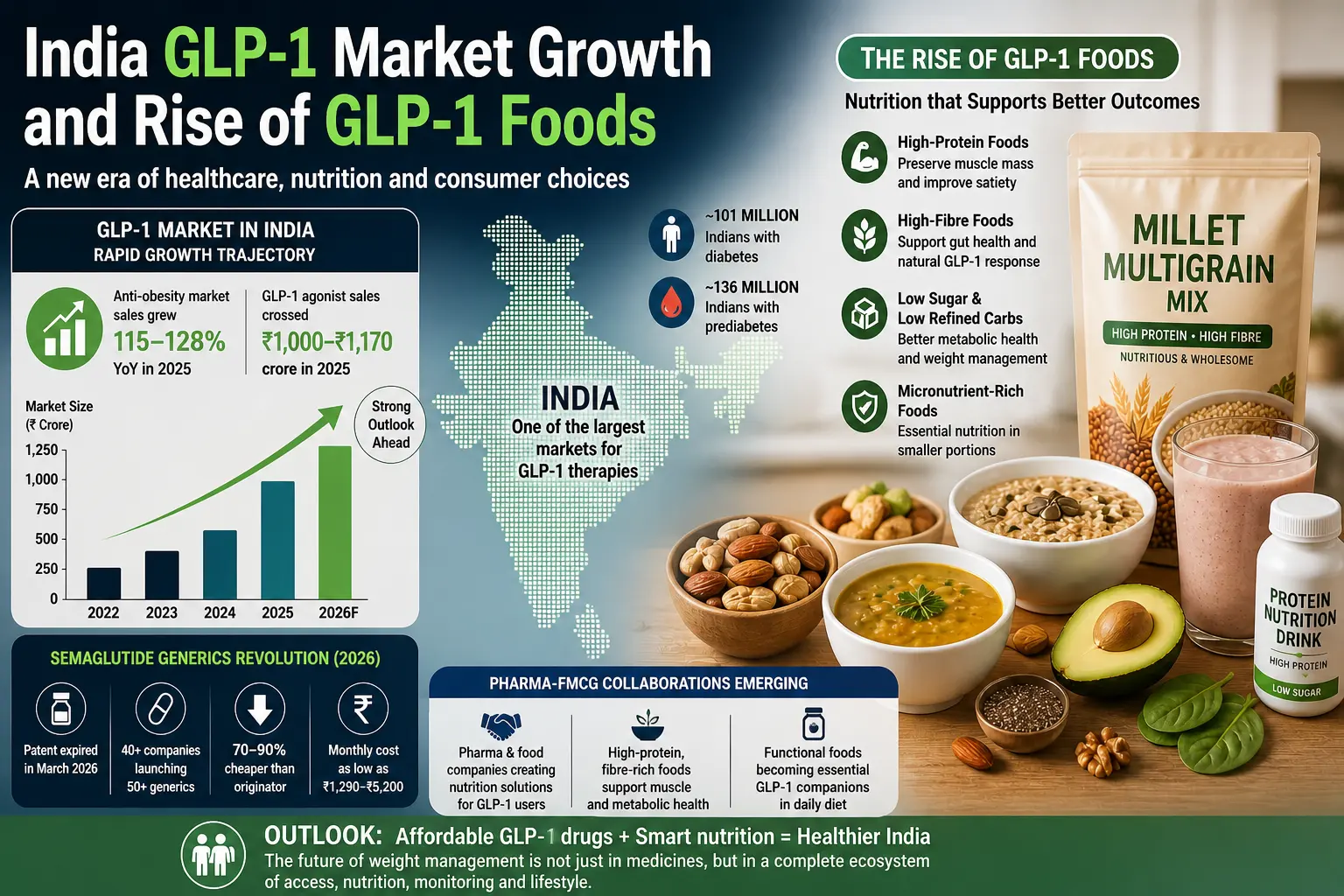
India sits at the center of the global GLP‑1 story because of its huge metabolic burden and its capabilities in generics manufacturing. Recent estimates suggest around 101 million Indians with diabetes and 136 million with prediabetes, making India one of the largest potential markets for GLP‑1 receptor agonists.
In 2025, India saw the launch of the three major branded GLP‑1 drugs for obesity and type 2 diabetes: Mounjaro (tirzepatide), Wegovy and Ozempic (semaglutide), with launches staggered through March, June and December. Within a year, GLP‑1 agonists transformed the anti‑obesity segment: Business Standard and PharmaTrac data indicate that anti‑obesity market sales rose about 115–128% year-on-year in 2025, with GLP‑1 agonist sales alone crossing roughly ₹1,000–₹1,170 crore and outpacing overall Indian pharma market growth several-fold.
The real inflection point, however, came in 2026 with the fall of semaglutide’s patent wall. Semaglutide’s Indian patent expiry in March 2026 has triggered a flood of generics: experts expect 40+ Indian companies to launch 50+ branded semaglutide generics, often 70–90% cheaper than the originator, with monthly costs dropping to roughly ₹1,290–₹5,200 in some early launches. The government’s production-linked incentive (PLI) scheme also supports local manufacturing of complex GLP‑1 drugs, with incentives expected to scale as domestic production grows.
But the next question is no longer only about access. It is about the ecosystem around GLP‑1: nutrition, monitoring and regulation. GLP‑1 receptor agonists work by slowing gastric emptying, increasing satiety and reducing appetite, which helps with blood sugar control and weight loss. The trade-off is that many patients eat less overall, and a meaningful share of weight loss can come from lean mass, raising concerns about muscle loss, frailty and long-term metabolic resilience.
These dynamics are driving interest in “GLP‑1 companion foods” — nutrition strategies and formulated products designed specifically to maintain protein intake and muscle mass during appetite suppression, provide fibre and micronutrients in smaller portion sizes, and fit with the gastrointestinal tolerability profile of GLP‑1 drugs. FoodNavigator‑Asia notes that Asia’s market for GLP‑1 companion foods is still nascent but poised for rapid growth if costs fall and mass uptake occurs, with India singled out as one of the most likely markets to drive a regional boom once semaglutide generics scale.
What counts as “GLP‑1 foods” in India?
The term “GLP‑1 foods” is not yet a regulated category in India. Instead, it serves as a convenient shorthand for foods that support the nutritional needs of GLP‑1 users or interact modestly with physiological processes such as satiety, gastric emptying and gut hormones.
Several food patterns and ingredients are especially relevant. High-protein foods such as dairy, eggs, pulses, fish, soy and whey help offset lean mass loss and support satiety. High-fibre foods such as fruits, vegetables, whole grains, millets, legumes and seeds can slow digestion and naturally stimulate GLP‑1 secretion. Low-sugar, low-refined-carb products reduce glycemic load while providing more micronutrients per calorie. An NDTV health feature aimed at Indian readers highlights high-fibre fruits, vegetables and grains as foods that “mimic” some effects of GLP‑1 drugs by slowing gastric emptying and reducing appetite. That makes traditional food groups like millets and whole grains newly relevant in the GLP‑1 context.
For clinicians and dietitians, the practical recommendation is clear: GLP‑1 users in India should be nudged toward smaller, protein-first meals, millet- and multigrain-based staples instead of refined wheat and polished rice, and cautious, evidence-based use of protein and micronutrient supplements with verified quality.
Pharma-FMCG collaborations
Indian industry is already responding to these nutritional challenges. Recent reporting shows pharmaceutical and packaged-food companies exploring collaborations to create dietary support products for GLP‑1 users, especially following semaglutide’s patent expiry and the launch of more affordable injections.
Examples include Dr. Reddy’s Laboratories and Nestlé, using their nutraceutical joint venture to develop high-protein and fortified products for weight-loss patients. Mankind Pharma is reportedly establishing a dedicated “Mankind Nutrition” division focused on muscle-preserving, protein-rich nutrition alongside obesity prescriptions. Snack manufacturers like Parle Products are reformulating products to offer more fibre and less sugar for the emerging GLP‑1 consumer segment.
Executives quoted in these reports describe GLP‑1 weight-management medications as driving one of the most significant shifts in consumer food purchasing in a generation. As appetite shrinks, demand is rising for high-protein, fibre-rich and functional foods that help maintain energy and muscle retention. FoodNavigator‑Asia similarly frames GLP‑1 as a new focus for food and drink innovation, with brands racing to position themselves as essential GLP‑1 companions in urban markets.
Reliance-Manna: strategic positioning
Amid this landscape, Reliance Consumer Products Limited’s acquisition of Southern Health Foods Pvt Ltd, owner of the Manna brand, shows how major Indian conglomerates are repositioning for the GLP‑1 era.
In February 2026, Reliance’s FMCG arm acquired 100% of Southern Health Foods for ₹156.42 crore, making the Tamil Nadu-based health food maker a wholly owned subsidiary. Manna has spent over two decades building a portfolio that includes millet-based staples, multigrain mixes, breakfast cereals, baby foods, health beverages, oats and dry fruits. Reliance has said the deal strengthens its food and staples portfolio, builds a strong vertical in the millet-based foods segment, and allows it to leverage its distribution, R&D and supply chain scale to turn Manna into a pan‑India health-food brand. The company’s move fits neatly with the national “Shree Anna” push and the broader shift toward millet-based nutrition.
While the acquisition press release does not explicitly mention GLP‑1, the strategic fit is obvious. Manna’s core products are exactly the kind of nutrient-dense staples GLP‑1 users and dietitians are likely to prioritize as appetite decreases. Reliance gains credibility in health-focused categories just as GLP‑1 generics and companion foods become a fast-growing consumer need in urban India.
In India, the GLP‑1 story is no longer just about breakthrough drugs; it is about building the food, pharmacy and care ecosystem that will determine whether this moment delivers lasting metabolic health or only short-term weight loss.











Share