

Consumer Insights
Uncover trends and behaviors shaping consumer choices today
Procurement Insights
Optimize your sourcing strategy with key market data
Industry Stats
Stay ahead with the latest trends and market analysis.
The bioactive peptides and amino acids for health market was valued at USD 6.20 Billion in 2025 and is projected to reach USD 17.29 Billion by 2035, growing at a CAGR of 10.80%. Demand is supported by ageing populations seeking muscle and joint support, the popularity of collagen supplements for skin and beauty, growth in sports nutrition, and interest in food-derived peptides for blood pressure and glucose management.
Patent activity covers collagen peptide manufacture by enzymatic hydrolysis, milk and whey peptides with blood pressure or glucose effects, amino acid blends for muscle maintenance, plant protein hydrolysates, and encapsulation that protects peptides through digestion. Japan's system of Foods with Function Claims, opened in 2015 alongside the older Foods for Specified Health Uses framework, gave peptide products a clear route to health claims, and food groups and supplement makers have widened filings to match.
This Bioactive Peptides and Amino Acids for Health Patent Landscape Analysis Report provides a structured view of patent filing trends, leading assignees, jurisdictions, technology clusters and competitive positioning across peptide and amino acid ingredients used for muscle, joint, skin, metabolic, gut and immune health.
The bioactive peptides and amino acids for health market is experiencing strong growth, driven by ageing populations, the rise of sports and active nutrition, and consumer demand for collagen and food-derived peptides. Japan's system of Foods with Function Claims, introduced in 2015, allowed peptide and amino acid products to carry health claims, which encouraged product launches and supporting patent filings.
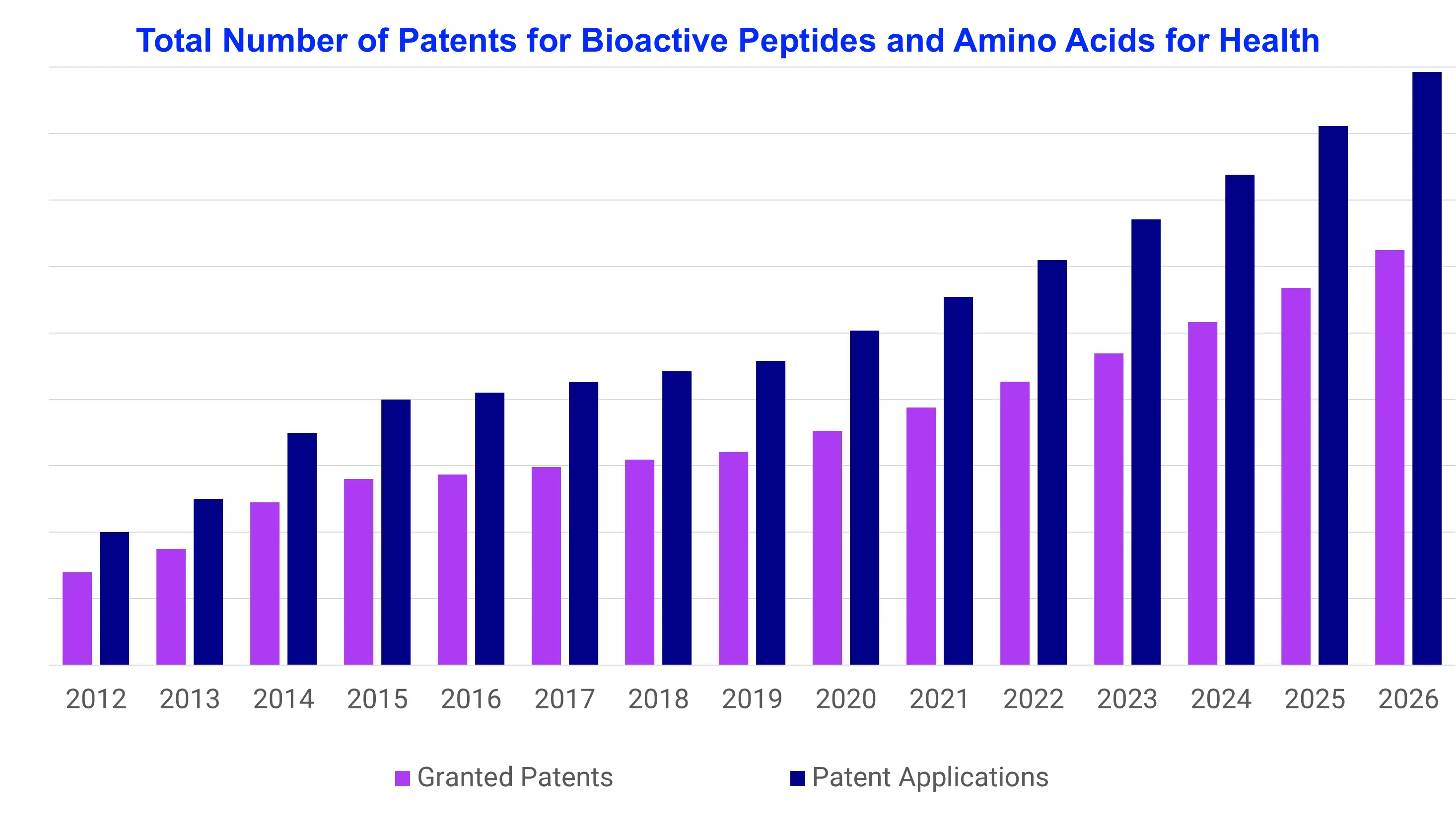
Patent activity is accelerating, with 1,500+ bioactive peptides and amino acids for health patents granted in 2025, reflecting strong innovation momentum in collagen peptides that support joint and skin health, food-derived peptides that help regulate blood pressure and glucose, amino acid blends that preserve muscle in ageing and sport, and encapsulation that protects peptides through digestion.
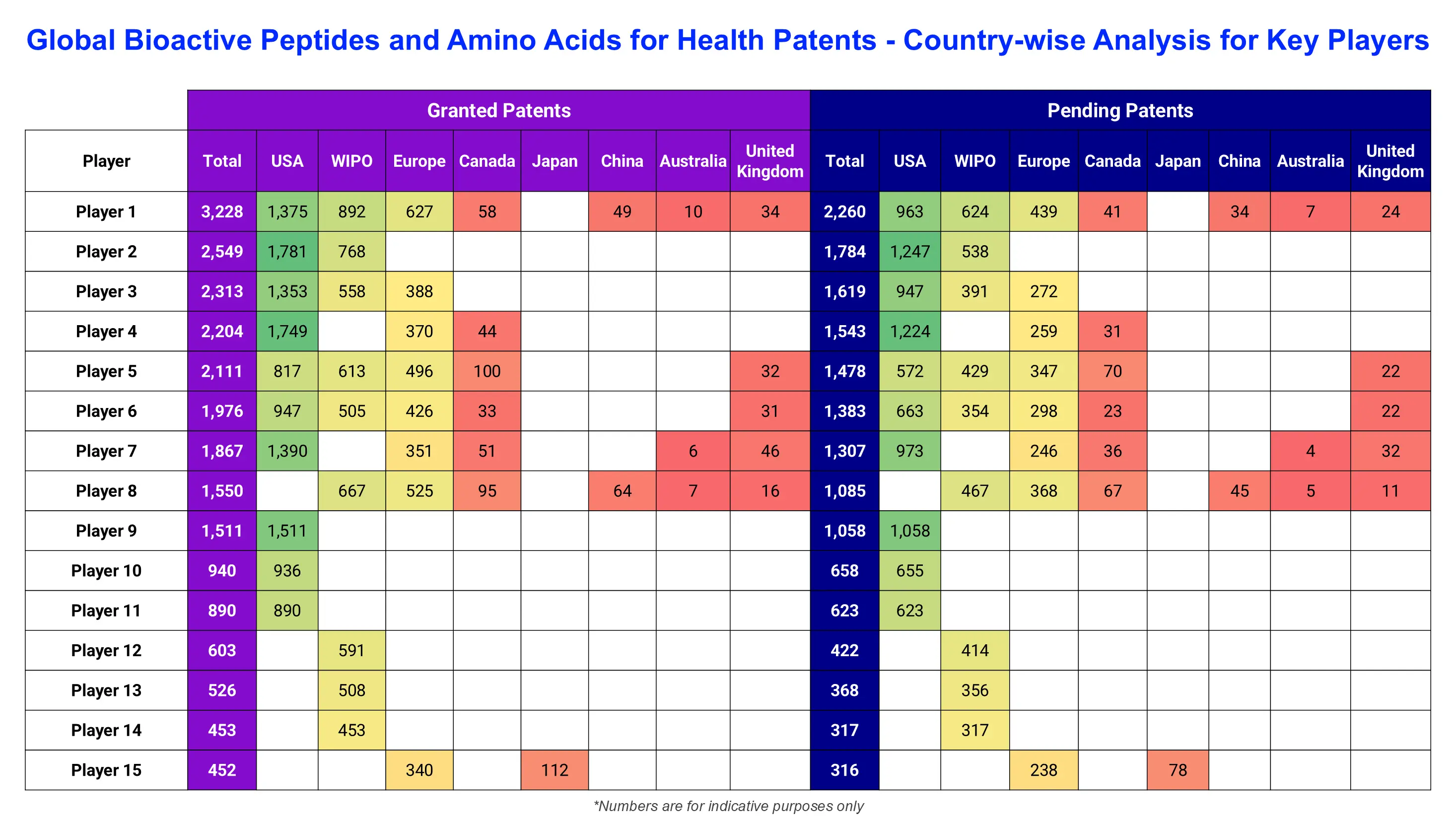
Top assignees in the bioactive peptides and amino acids for health patent landscape include Ajinomoto, Nestle, Kyowa Hakko Bio, Danone, and Fonterra, with the United States, China, and Japan as the dominant patent jurisdictions.
Bioactive peptides and amino acids have moved from gym bags into mainstream nutrition for ageing adults, women, athletes and patients. Short protein fragments released by enzymatic digestion or fermentation can influence blood pressure, glucose handling, joint comfort, skin elasticity and immune response, while amino acids such as leucine, glutamine and citrulline support muscle protein synthesis and recovery. Collagen peptides have become a visible consumer category, and milk, soy and rice derived peptides are used in foods for cardiovascular and metabolic support. Demand is shaped by loss of muscle mass with age, the growth of protein-enriched foods, and consumer preference for ingredients backed by clinical studies. Suppliers compete on bioavailability, taste, solubility and the strength of human evidence behind each claim.
The market growth is driven by rising demand for collagen peptides, which are sold as powders, capsules and ready-to-drink beverages for skin, joint and bone health, and by the use of leucine-rich amino acid and whey peptide products to slow muscle loss in older adults. Japan opened its system of Foods with Function Claims in 2015, and the long-standing Foods for Specified Health Uses framework has approved peptide products such as lactotripeptides for blood pressure. Nestle Health Science bought Vital Proteins in 2020, which showed the scale of consumer collagen demand. Age-related loss of muscle, known as sarcopenia, is commonly estimated to affect roughly one in ten adults over 60, so products that preserve muscle find a steady buyer base.
Collagen peptide supplements are typically taken at daily doses of 2.5 to 15 grams in clinical studies, which supports repeat purchase and steady ingredient volumes for suppliers. Leucine thresholds of about 2 to 3 grams per serving are widely used in muscle nutrition, so formulators design blends and whey peptide products around that dose, which favours suppliers with consistent amino acid profiles. Japan's Foods with Function Claims rules require notification with scientific evidence, which pushes companies to fund human trials, and those trials in turn become patent claims on specific peptide sequences and dose ranges. Ready-to-drink and bar formats add demand where taste and solubility are solved by hydrolysis and encapsulation, while infant and medical nutrition remain a premium outlet that depends on peptide-based formulas.
Read more about this report - REQUEST FREE SAMPLE COPY IN PDF
Filing intensity in bioactive peptides and amino acids for health follows investment by ingredient makers, dairy cooperatives and food groups that are building branded health ingredients. Acquisitions of consumer collagen and supplement brands by large nutrition companies have been matched by filings on collagen hydrolysis, peptide sequences, dosage forms and delivery systems. Ingredient suppliers such as Fonterra and Kyowa Hakko Bio file on process and use claims that secure supply of differentiated peptides and amino acids, whereas branded companies file on formulations and health claims for finished products. Spending on clinical studies precedes many of these filings, since use claims are strongest when backed by human data.
More than 7,100 patent families related to bioactive peptides and amino acids for health were identified across the landscape. Filing peaked between roughly 2019 and 2023, when collagen peptide, plant peptide and muscle nutrition applications multiplied alongside consumer demand for protein and healthy ageing products. The largest clusters cover collagen peptides, milk and whey-derived peptides, and amino acid blends for muscle, while food-derived peptides for blood pressure and glucose and the encapsulation of peptides form a strong second tier. Older families on amino acid fermentation and peptide hydrolysis remain numerous because process improvements are filed continuously, and newer plant-derived peptide families are growing from a smaller base.
Growing consumer demand for collagen, muscle nutrition and metabolic health products is mirrored by rising filings on peptide sequences, amino acid blends and delivery systems, showing that commercial demand is now being converted into patent protection across ingredient, formulation and use claims.
This report analyses patent activity and market trends associated with bioactive peptides and amino acids for health across the United States, Europe, China, Japan, South Korea, India and international filings made through the World Intellectual Property Organization (WIPO). Coverage includes peptides, protein hydrolysates, amino acids and their derivatives used to support muscle, joint, skin, metabolic, gut and immune health, drawn from national offices and regional authorities. Market context reflects use by Dietary Supplement Manufacturers, Food and Beverage Companies, Sports Nutrition Brands, Cosmetic and Personal Care Companies and Academic and Research Institutes, linking patent coverage to product demand in each region.
The scope includes collagen peptides, milk and whey-derived peptides, plant-derived peptides, essential and branched-chain amino acids, and specialty amino acid derivatives as ingredient types. Health functions covered are muscle and sports nutrition, joint and bone health, metabolic and cardiovascular health, skin and beauty, and gut and immune health. Product formats considered are powders, capsules and tablets, ready-to-drink beverages, functional foods and bars, and infant and medical nutrition, and patents are grouped by technology cluster to show where innovation concentrates.
The analysis includes patent activity from amino acid producers, dairy and protein ingredient suppliers, branded supplement and sports nutrition companies, food and beverage manufacturers, and infant and medical nutrition companies. Cosmetic and personal care companies that file on oral beauty and collagen products are also covered, together with biotechnology start-ups developing novel peptides and fermentation routes. Universities, research institutes and hospital-affiliated teams that patent peptide sequences, hydrolysis methods and clinical uses are included, as are contract manufacturers and encapsulation specialists whose filings relate to bioactive peptides and amino acids for health.
The report will cover the following sections in detail:
Analysis by Ingredient Type
Analysis by Health Function
Analysis by Product Format
Bioactive Peptides and Amino Acids for Health Patent Filing Trend Analysis
The evolution of patent filings for bioactive peptides and amino acids for health begins with fermentation and purification of single amino acids, followed by enzymatic hydrolysis of milk, soy and collagen proteins to release peptides with measurable activity. Japanese applicants led early work on blood pressure lowering peptides in the 1990s, and sports nutrition filings on amino acid ratios grew in the 2000s. In the last decade, filings moved toward collagen peptides for skin and joints, plant-derived peptides, sequence-specific peptides identified by computational screening, and encapsulation for oral delivery. Annual grants of more than 1,500 patents in 2025 indicate a large base of enforceable rights and a continuing pipeline of new applications.
Patent filings increased at an estimated annual growth rate of approximately 7% between 2020 and 2024. Collagen peptide and plant-derived peptide applications grew fastest, supported by consumer demand and clinical studies on skin, joint and muscle outcomes. Amino acid filings expanded more slowly because the core compounds are well known, so claims now focus on blends, ratios, dosage forms and new uses. Encapsulation and delivery filings grew steadily, since protecting peptides from digestion and masking bitterness are persistent formulation problems.
Among the players with bioactive peptides and amino acids for health patent families, new entrants have been identified, which can be either established companies or startups developing novel technology in the field. Some of the major companies mentioned in this report (a non-exhaustive list) are as follows:
Ajinomoto holds one of the deepest portfolios in bioactive peptides and amino acids for health, built on fermentation production of amino acids and on research into their roles in muscle, sleep, gut and metabolic function. Its consumer and sports nutrition lines include the AminoVital range of amino acid supplements for athletes and the Glyna glycine product marketed in Japan for sleep quality. The company also supplies amino acids for infant, clinical and medical nutrition and for pharmaceutical use, under food and pharmaceutical quality systems in several regions. Its intellectual property strategy combines process patents on fermentation and purification with use and composition claims for specific amino acid ratios and health effects. Commercially, the company is positioned as a vertically integrated ingredient and brand owner, which allows it to supply food manufacturers as well as its own consumer products.‑‑‑
Nestle covers bioactive peptides and amino acids for health through Nestle Health Science, which combines clinical nutrition, consumer supplements and infant nutrition. Its Peptamen peptide-based enteral formulas and the Alfamino amino acid-based formula for infants with cow's milk protein allergy show how peptide and amino acid science is applied in medical settings, while the 2020 acquisition of Vital Proteins gave the company a leading collagen peptide brand in the United States. Products are marketed in line with national food and medical nutrition rules in each region, and clinical products are supplied under medical supervision. The intellectual property approach combines protein hydrolysis and fractionation know-how from its research centres with product and use claims tied to clinical outcomes. Commercially, the company is positioned across hospital, retail and online channels, which gives new peptide ingredients several routes to market.
Other companies include Kyowa Hakko Bio, Danone, and Fonterra.
The leading assignees, Ajinomoto, Nestle, Kyowa Hakko Bio, Danone and Fonterra, hold a notable share of analysed patent families, indicating a moderately concentrated landscape. Ajinomoto and Kyowa Hakko Bio hold deep coverage in amino acid production and amino acid based health ingredients, while Nestle files across peptide-based clinical nutrition, collagen and infant formulas. Danone concentrates on peptide and amino acid based infant and medical nutrition, and Fonterra protects dairy peptide, whey protein and lactoferrin related processes and uses. A long tail of ingredient suppliers, universities and Asian food companies adds specialised claims on sequences, hydrolysis and delivery.
*Please note that this is only a partial list; the complete list of key players is available in the full report. Additionally, the list of key players can be customized to better suit your needs.*
The report assesses patent activity across major jurisdictions, including:
The United States is the largest single jurisdiction for bioactive peptides and amino acids for health, reflecting the size of its dietary supplement and sports nutrition markets, the demand for collagen products and the strength of patent enforcement. China follows with a large volume of filings from universities, food groups and ingredient producers working on peptide hydrolysis and functional foods. Japan remains a major centre owing to its long history of amino acid and peptide research, established health claim systems and companies such as Ajinomoto and Kyowa Hakko Bio. Europe, South Korea and India show steady activity linked to dairy, infant nutrition and supplement industries, and WIPO filings show which families applicants intend to take into several markets at once.
Read more about this report - REQUEST FREE SAMPLE COPY IN PDF
The patent landscape is segmented by the technology categories most closely associated with bioactive peptides and amino acids for health, which include:
Among these, collagen peptides for joint and skin account for the largest share of recent patent activity. Applicants are filing on hydrolysis conditions that control molecular weight, specific di- and tripeptides such as prolyl-hydroxyproline that are reported to reach the bloodstream, bovine, marine and porcine sources, and combinations with vitamin C, hyaluronic acid and minerals. Growth in this cluster has outpaced amino acid filings since clinical studies on skin hydration and joint comfort supported consumer products, and several large assignees now maintain active collagen or hydrolysate programmes.
The bioactive peptides and amino acids for health market is competitive, shaped by amino acid producers, dairy ingredient cooperatives, global nutrition companies and a growing group of specialist peptide developers. Competition has moved from commodity protein toward ingredients with clinical evidence and branded claims, and large buyers have acquired consumer collagen and supplement brands to secure access to shoppers. Patent filings from newer entrants in plant-derived peptides, fermentation-derived peptides and sequence-specific bioactives show that the field is still open, and positions on delivery technology and health claims will influence who captures premium ingredient and branded revenue.
Companies are focusing on:
Emerging innovation themes include sequence-specific peptides identified by computational screening and mass spectrometry, plant-derived peptides that match animal-sourced products in function, and precision fermentation routes that produce peptides and proteins without animal sources. Interest is growing in peptides and amino acids that act on the gut and its microbiome, in glucose-regulating peptides for people at risk of type 2 diabetes, and in products that support muscle in people using weight-loss medicines. Developers are also exploring encapsulation, taste masking and bioavailability enhancers that allow higher doses in beverages and gummies.
The patent landscape for bioactive peptides and amino acids for health maps how innovation is distributed across ingredient types, health functions and product formats in more than 7,100 patent families, and it identifies the assignees and jurisdictions where protection is concentrated. Filings in collagen peptides, muscle nutrition and delivery systems show where capital is being directed, while mature amino acid production families indicate where freedom to operate depends on expiry timelines. Together, the findings give ingredient makers, brand owners and investors a structured view of competitive positions.
The landscape provides actionable intelligence for the following nine uses:
Patent research was conducted across major patent databases, including national and regional office records and international filings published under the Patent Cooperation Treaty. Search strategies combined Cooperative Patent Classification codes for peptides, amino acids and nutritional compositions with keyword queries on collagen, whey, plant hydrolysates, health functions and product formats. Records were gathered through the latest complete publication period, and equivalent filings were consolidated into patent families so that each invention was counted once.
Screening removed duplicate families and filings with no relevance to bioactive peptides and amino acids for health. Remaining records were reviewed and classified by technology cluster, ingredient type, health function, product format, assignee and jurisdiction. Assignee names were standardised so that subsidiaries and name variants were attributed to a single owner, and legal status was used to separate granted patents from pending applications.
Market analysis supported the interpretation of patent trends through review of regulatory frameworks for health claims, clinical study publications, company disclosures and product launch records. Patent activity was compared with approval timelines and commercial launches to show how innovation tracks demand. Findings were cross-checked across sources, and analyst estimates are described as approximate where exact counts were not available.


Upto 15% Off
USD
$2699 $2429
$4299 $3869
$5799 $4949
$6999 $5949


*While we strive to always give you current and accurate information, the numbers depicted on the website are indicative and may differ from the actual numbers in the main report. At Expert Market Research, we aim to bring you the latest insights and trends in the market. Using our analyses and forecasts, stakeholders can understand the market dynamics, navigate challenges, and capitalize on opportunities to make data-driven strategic decisions.*
EMR's Bioactive Peptides and Amino Acids for Health Patent Landscape Analysis provides a comprehensive assessment of patent filings, innovation clusters, assignee portfolios, and geographic filing patterns across the bioactive peptides and amino acids for health landscape. The report identifies 7,100+ patent families, evaluates leading jurisdictions including the United States, China, and Japan, and profiles the top assignees by portfolio size.
The global bioactive peptides and amino acids for health market was valued at USD 6.20 Billion in 2025. The market is projected to reach USD 17.29 Billion by 2035, expanding at a CAGR of 10.80% during 2026 - 2035.
The report analyses approximately 7,100+ patent families related to bioactive peptides and amino acids for health. These include filings from the United States, China, Japan, and international WIPO filings.
Key companies operating within the landscape include Ajinomoto, Nestle, Kyowa Hakko Bio, Danone, and Fonterra, among others. These organisations collectively account for a significant portion of patent activity analysed in this report.
The report evaluates patent activity across the United States, Europe, China, Japan, South Korea, India, and international WIPO filings. The United States is the largest single jurisdiction for bioactive peptides and amino acids for health, with 2,500+ patents associated with it across the 7,100+ patent families analysed.
Yes. The report scope can be customised based on geography, technology segment, assignee selection, time period, or specific innovation cluster focus. Readers can contact the EMR team to scope a customised study, such as a tailored patent landscape focused on collagen peptides, particular health functions or assignee portfolios in bioactive peptides and amino acids for health.
Patent landscape analysis helps organisations understand innovation trends, competitive activity, technology whitespace, and IP risk across a defined domain. For bioactive peptides and amino acids for health, this report supports strategic decisions in R&D prioritisation, licensing evaluation, competitive benchmarking, and market entry planning.
Explore our key highlights of the report and gain a concise overview of key findings, trends, and actionable insights that will empower your strategic decisions.
|
Scope of the Report |
Details |
|
Analysis by Ingredient Type |
|
|
Analysis by Health FunctionAnalysis by Health Function |
|
|
Analysis by Product Format |
|
|
Analysis by End User |
|
|
Key Players Mentioned |
|
|
Geographies Covered |
|
Mini Report
One User
USD 2,699
USD 2,429
tax inclusive*
Single User License
One User
USD 4,299
USD 3,869
tax inclusive*
Five User License
Five User
USD 5,799
USD 4,949
tax inclusive*
Corporate License
Unlimited Users
USD 6,999
USD 5,949
tax inclusive*
*Please note that the prices mentioned below are starting prices for each bundle type. Kindly contact our team for further details.*
Flash Bundle
Small Business Bundle
Growth Bundle
Enterprise Bundle
*Please note that the prices mentioned below are starting prices for each bundle type. Kindly contact our team for further details.*
Flash Bundle
Number of Reports: 3
20%
tax inclusive*
Small Business Bundle
Number of Reports: 5
25%
tax inclusive*
Growth Bundle
Number of Reports: 8
30%
tax inclusive*
Enterprise Bundle
Number of Reports: 10
35%
tax inclusive*
How To Order

Select License Type
Choose the right license for your needs and access rights.

Click on ‘Buy Now’
Add the report to your cart with one click and proceed to register.

Select Mode of Payment
Choose a payment option for a secure checkout. You will be redirected accordingly.
Strategic Solutions for Informed Decision-Making
Gain insights to stay ahead and seize opportunities.

Get insights & trends for a competitive edge.

Track prices with detailed trend reports.

Analyse trade data for supply chain insights.

Leverage cost reports for smart savings

Enhance supply chain with partnerships.

Connect For More Information
Our expert team of analysts will offer full support and resolve any queries regarding the report, before and after the purchase.
Our expert team of analysts will offer full support and resolve any queries regarding the report, before and after the purchase.
We employ meticulous research methods, blending advanced analytics and expert insights to deliver accurate, actionable industry intelligence, staying ahead of competitors.
Our skilled analysts offer unparalleled competitive advantage with detailed insights on current and emerging markets, ensuring your strategic edge.
We offer an in-depth yet simplified presentation of industry insights and analysis to meet your specific requirements effectively.




