

Consumer Insights
Uncover trends and behaviors shaping consumer choices today
Procurement Insights
Optimize your sourcing strategy with key market data
Industry Stats
Stay ahead with the latest trends and market analysis.
The smart insulin delivery devices market was valued at USD 7.40 Billion in 2025 and is expected to reach USD 24.24 Billion by 2035, expanding at a CAGR of 12.60% during 2026 - 2035. The growth is supported by a global diabetes population above 800 million adults, rising use of continuous glucose monitors, broader payer coverage of automated insulin delivery, and the extension of closed-loop systems to type 2 diabetes.
Patent activity has expanded steadily since 2020, with more than 15,000 patent families covering dosing algorithms, connected pens, patch pumps, and sensor integration. Filings cluster around algorithm tuning, pump hardware miniaturisation, and wireless interoperability, and recent FDA clearances for type 2 indications and interoperable controllers have validated these clusters commercially.
This Smart Insulin Delivery Devices Patent Landscape Analysis Report provides assignee rankings, jurisdictional filing patterns, technology segmentation, and strategic intelligence for device makers, pharmaceutical companies, and investors.
The smart insulin delivery devices market is experiencing strong growth, driven by rising insulin-treated diabetes prevalence, wider continuous glucose monitor use, and expanding reimbursement for automated insulin delivery. Omnipod 5 received FDA clearance for adults with type 2 diabetes in 2024, and the Tandem Control-IQ+ algorithm followed with a type 2 indication in 2025, opening a far larger insulin-treated population to automated dosing.
Patent activity is accelerating, with 2,100+ smart insulin delivery devices patents granted in 2025, reflecting strong innovation momentum in automated insulin dosing algorithms, connected pen dose capture, continuous glucose monitor integration, and tubeless patch pump design.
Top assignees in the smart insulin delivery devices patent landscape include Medtronic, Novo Nordisk, Insulet, Roche, and Tandem Diabetes Care, with the United States, China, and Europe as the dominant patent jurisdictions.
The market growth is driven by the move from manual insulin injection to automated, sensor-linked dosing, which reduces time spent outside the glucose target range. The International Diabetes Federation estimates more than 580 million adults live with diabetes, and a large share of them use insulin. FDA clearance of automated insulin delivery for type 2 diabetes in 2024 and 2025 widened the eligible population considerably.
North America leads the market because reimbursement for continuous glucose monitors and pumps is well established there. Medicare coverage of continuous glucose monitoring for insulin-treated patients raised sensor penetration, and each additional sensor user becomes a candidate for an automated pump. Europe follows, where national health systems in the United Kingdom, Germany, and the Nordic countries have funded closed-loop systems for type 1 diabetes. The growth rate also reflects a recovering base, since pump supply constraints and recalls in earlier years held back unit shipments.
Installed base data show how adoption converts into patent activity. Insulet reported more than 500,000 Omnipod users globally in 2024, and a user base of that size generates the real-world data that algorithm developers use to refine dosing logic. Connected pens add a second route, since people on multiple daily injections can adopt dose tracking at a fraction of pump cost. Both routes expand the number of devices sending data to controllers, which raises demand for interoperability and software patents.
Read more about this report - REQUEST FREE SAMPLE COPY IN PDF
Patent filing in smart insulin delivery devices tracks the maturity of sensor accuracy. Once continuous glucose monitors reached dependable accuracy, device makers filed heavily on algorithms that translate sensor readings into insulin commands. Pump makers file on infusion set design, occlusion detection, and cartridge handling, while pen makers file on dose-capture electronics.
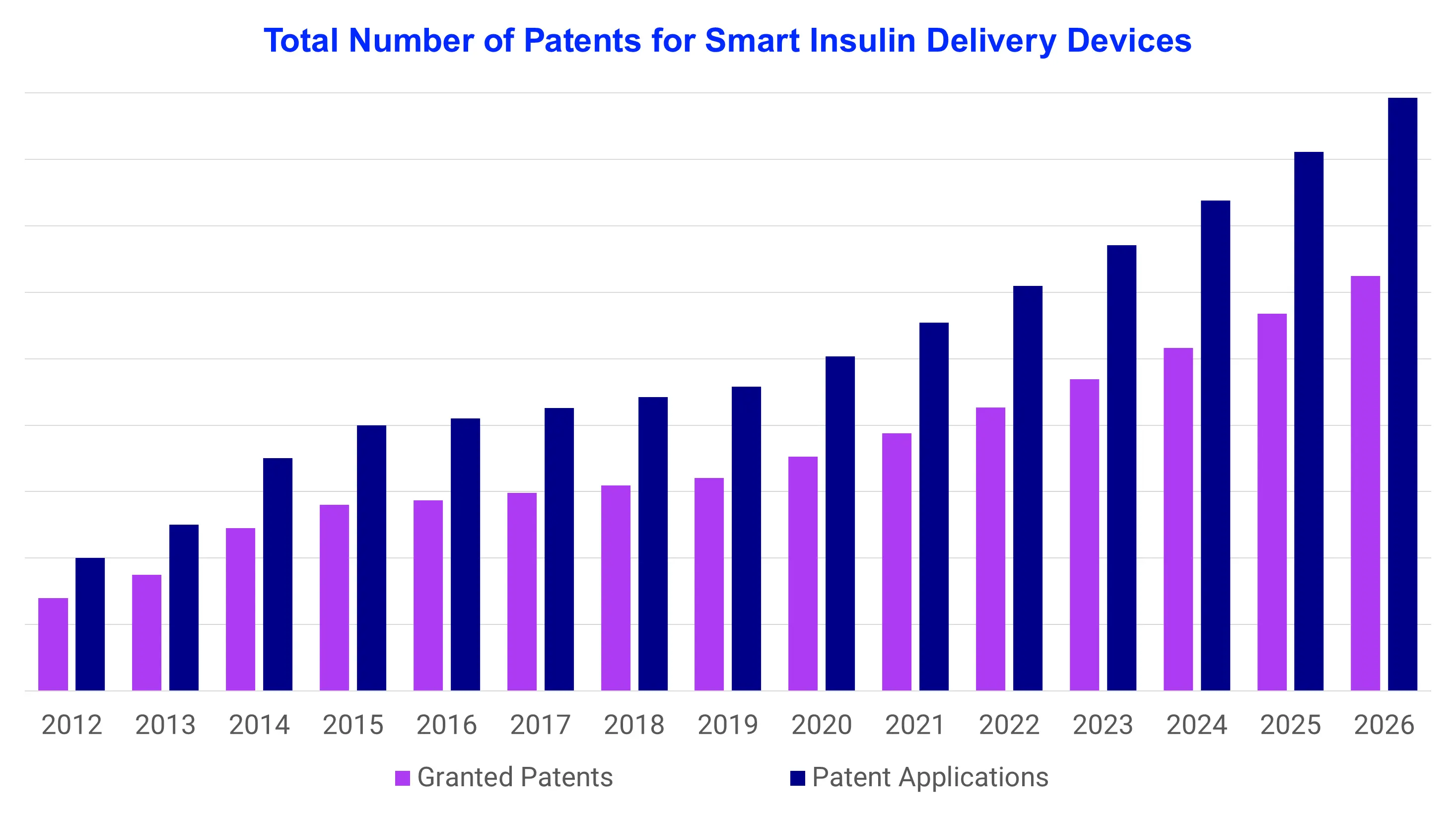
Global filings exceed 15,000 patent families, with peak filing years between 2020 and 2024. Algorithm and software families grew fastest in this period, and filings for patch pump hardware followed the commercial launches of tubeless systems.
Demand for automated dosing in type 2 diabetes and paediatric care directly increases filings on adaptive algorithms, sensor interoperability, and compact pump hardware.
The analysis covers connected insulin pens and caps, tubed insulin pumps, patch pumps, automated insulin delivery algorithms, continuous glucose monitor integration, smartphone applications, and dose decision support software. Interoperable controllers that pair with multiple pumps and sensors are included as a distinct cluster.
Patent families are grouped by technology, device format, and clinical application, and assigned to the ultimate parent entity. Granted patents, pending applications, and family size are reviewed for the period from 2015 to 2025, with attention to filings from 2020 onward.
The scope covers device manufacturers, insulin producers, sensor developers, software companies, universities, and research hospitals that hold relevant families.
The report will cover the following sections in detail:
Analysis by Technology
Analysis by Device Format
Analysis by Application
Smart Insulin Delivery Devices Patent Filing Trend Analysis
Annual filings in smart insulin delivery devices grew at an estimated 9% to 11% per year between 2020 and 2024. Growth came from algorithm refinement, expansion of closed-loop systems to type 2 diabetes, and the arrival of patch pumps from multiple manufacturers.
Granted patents rose in 2024 and 2025 as applications filed during the 2020 to 2022 surge completed examination. China shows the sharpest increase in new filings, led by domestic pump and sensor developers, while United States filings remain concentrated among established device makers.
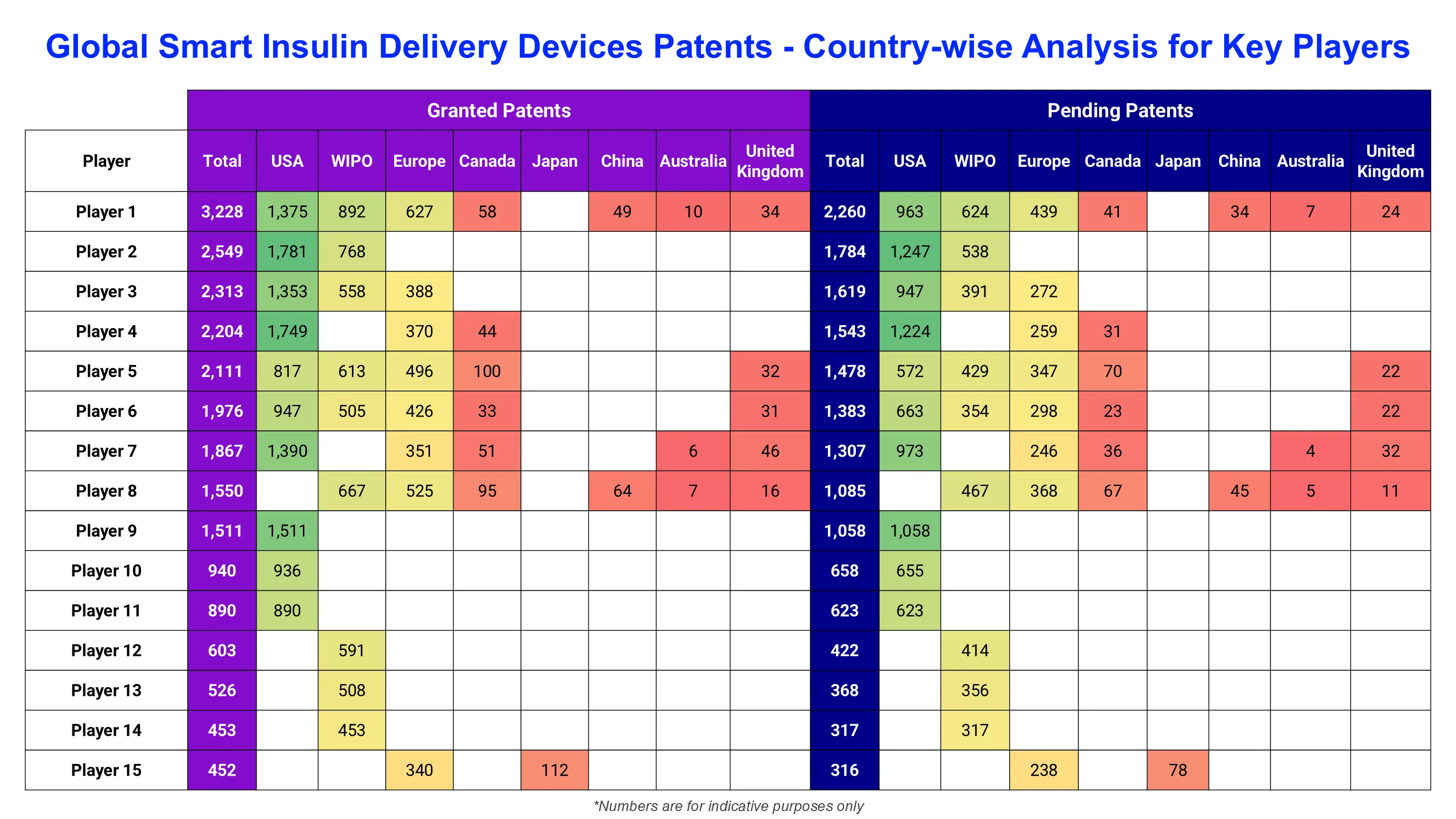
Among the players with smart insulin delivery devices patent families, new entrants have been identified, which can be either established companies or startups developing novel technology in the field. Some of the major companies mentioned in this report (a non-exhaustive list) are as follows:
Medtronic holds one of the largest portfolios in smart insulin delivery devices, built over decades of pump development and extended through the acquisition of Companion Medical, maker of the InPen connected pen. Its MiniMed 780G system with the SmartGuard algorithm is cleared in the United States and sold across Europe and Asia. The company added Simplera Sync sensor compatibility in 2025 and has moved to separate its diabetes business into a standalone entity. Its IP strategy layers algorithm, sensor, and pump-hardware claims across families filed in the United States, Europe, and China. Medtronic positions the 780G as an adjustable-target system with meal detection for adults and children.
Novo Nordisk focuses on the connected pen segment, with NovoPen 6 and NovoPen Echo Plus recording dose time and quantity through near-field communication. Its portfolio covers dose-capture electronics, cartridge recognition, and pen-to-app data transfer, filed alongside a large base of insulin formulation and injector patents. The company supplies data to third-party apps and glucose monitoring platforms and leaves pump building to others. Its IP strategy protects the pen platform and its software links across the United States, Europe, and China. Novo Nordisk positions connected pens as the entry point for people on multiple daily injections who stay outside pump therapy.
Other companies include Roche, Tandem Diabetes Care, and Eli Lilly.
The top five assignees hold an estimated 35% to 40% of global patent families, which indicates a moderately concentrated field. Medtronic leads through its long pump history, while Insulet and Tandem Diabetes Care hold dense algorithm and hardware clusters around their current platforms. A long tail of start-ups, universities, and sensor companies holds the remaining families.
*Please note that this is only a partial list; the complete list of key players is available in the full report. Additionally, the list of key players can be customized to better suit your needs.*
The report assesses patent activity across major jurisdictions, including:
The United States leads in filing volume, supported by the largest insulin-pump market and the FDA pathway for interoperable devices. China ranks second as domestic manufacturers file on pumps, sensors, and algorithms for a large diabetes population. Europe follows through the European Patent Office, where closed-loop systems have strong public funding.
Read more about this report - REQUEST FREE SAMPLE COPY IN PDF
The report segments patent activity by the following technology areas:
Among these, automated insulin dosing algorithms hold the largest share of patent families, reflecting their role as the main differentiator between competing systems.
Competition in smart insulin delivery devices combines pump makers, pharmaceutical insulin producers, and sensor companies. Medtronic, Insulet, and Tandem Diabetes Care compete on closed-loop performance, while Novo Nordisk, Eli Lilly, and Sanofi position connected pens for injection users. Dexcom and Abbott supply the sensors that most automated systems depend on, which makes sensor partnerships a central part of IP strategy.
Companies are focusing on:
Emerging innovation themes include fully automated meal-time dosing without manual carbohydrate entry, dual-hormone and adjunct drug delivery, smartphone-native pump control, and pens that communicate directly with continuous glucose monitors. Interoperable controllers that pair with several pumps and sensors have drawn increased filings since 2023, supported by FDA designations for interoperable devices. Machine learning for personalised dosing is a growing cluster, especially in Europe and China.
The patent field in smart insulin delivery devices is shifting from hardware claims to software and interoperability claims. Early pump patents protect mechanics, while recent families protect algorithms, data exchange, and sensor pairing. Companies with large installed bases hold an advantage, since real-world data supports continuous algorithm improvement and generates new filings.
Technology segments, device formats, and applications are mapped to assignee activity, and the report provides actionable intelligence supporting:
The study searches patent databases including the USPTO, the European Patent Office, WIPO PATENTSCOPE, the China National Intellectual Property Administration, the Japan Patent Office, and Espacenet. Queries combine keywords with CPC classes A61M 5/172 for infusion control, A61M 5/142 for pumps, A61M 5/31 for syringes and pens, and G16H 20/17 for insulin-related health informatics.
Search results are screened for relevance, and applications are consolidated into patent families to avoid double counting. Assignee names are harmonised across subsidiaries and acquired companies, and each family is tagged by technology, device format, and application.
The market side draws on regulatory filings from the FDA and European authorities, company annual reports, clinical trial registries, and peer-reviewed literature on automated insulin delivery. Patent counts are rounded approximations and are cross-checked against product launches and clearances.
Smart Insulin Pens Patent Landscape Report


Upto 15% Off
USD
$2699 $2429
$4299 $3869
$5799 $4949
$6999 $5949


*While we strive to always give you current and accurate information, the numbers depicted on the website are indicative and may differ from the actual numbers in the main report. At Expert Market Research, we aim to bring you the latest insights and trends in the market. Using our analyses and forecasts, stakeholders can understand the market dynamics, navigate challenges, and capitalize on opportunities to make data-driven strategic decisions.*
EMR’s Smart Insulin Delivery Devices Patent Landscape Analysis provides a comprehensive assessment of patent filings, innovation clusters, assignee portfolios, and geographic filing patterns across the smart insulin delivery devices landscape. The report identifies 15,000+ patent families, evaluates leading jurisdictions including the United States, China, and Europe, and profiles the top assignees by portfolio size.
The global smart insulin delivery devices market was valued at USD 7.40 Billion in 2025. The market is projected to reach USD 24.24 Billion by 2035, expanding at a CAGR of 12.60% during 2026-2035.
The report analyses approximately 15,000+ patent families related to smart insulin delivery devices. These include filings from the United States, China, Europe, and international WIPO filings.
Key companies operating within the landscape include Medtronic, Novo Nordisk, Insulet, Roche, and Tandem Diabetes Care, among others. These organisations collectively account for a significant portion of patent activity analysed in this report.
The report evaluates patent activity across the United States, Europe, China, Japan, South Korea, India, and international WIPO filings. The United States leads the patent activity, accounting for an estimated 40% to 45% of filings in smart insulin delivery devices.
Yes. The report scope can be customised based on geography, technology segment, assignee selection, time period, or specific innovation cluster focus. Please connect with the EMR team to define the customisation scope.
Patent landscape analysis helps organisations understand innovation trends, competitive activity, technology whitespace, and IP risk across a defined domain. For smart insulin delivery devices, this report supports strategic decisions in R&D prioritisation, licensing evaluation, competitive benchmarking, and market entry planning.
Explore our key highlights of the report and gain a concise overview of key findings, trends, and actionable insights that will empower your strategic decisions.
|
Scope of the Report |
Details |
|
Analysis by Technology |
|
|
Analysis by Device Format |
|
|
Analysis by Application |
|
|
Analysis by End User |
|
|
Key Players Mentioned |
|
|
Geographies Covered |
|
Mini Report
One User
USD 2,699
USD 2,429
tax inclusive*
Single User License
One User
USD 4,299
USD 3,869
tax inclusive*
Five User License
Five User
USD 5,799
USD 4,949
tax inclusive*
Corporate License
Unlimited Users
USD 6,999
USD 5,949
tax inclusive*
*Please note that the prices mentioned below are starting prices for each bundle type. Kindly contact our team for further details.*
Flash Bundle
Small Business Bundle
Growth Bundle
Enterprise Bundle
*Please note that the prices mentioned below are starting prices for each bundle type. Kindly contact our team for further details.*
Flash Bundle
Number of Reports: 3
20%
tax inclusive*
Small Business Bundle
Number of Reports: 5
25%
tax inclusive*
Growth Bundle
Number of Reports: 8
30%
tax inclusive*
Enterprise Bundle
Number of Reports: 10
35%
tax inclusive*
How To Order

Select License Type
Choose the right license for your needs and access rights.

Click on ‘Buy Now’
Add the report to your cart with one click and proceed to register.

Select Mode of Payment
Choose a payment option for a secure checkout. You will be redirected accordingly.
Strategic Solutions for Informed Decision-Making
Gain insights to stay ahead and seize opportunities.

Get insights & trends for a competitive edge.

Track prices with detailed trend reports.

Analyse trade data for supply chain insights.

Leverage cost reports for smart savings

Enhance supply chain with partnerships.

Connect For More Information
Our expert team of analysts will offer full support and resolve any queries regarding the report, before and after the purchase.
Our expert team of analysts will offer full support and resolve any queries regarding the report, before and after the purchase.
We employ meticulous research methods, blending advanced analytics and expert insights to deliver accurate, actionable industry intelligence, staying ahead of competitors.
Our skilled analysts offer unparalleled competitive advantage with detailed insights on current and emerging markets, ensuring your strategic edge.
We offer an in-depth yet simplified presentation of industry insights and analysis to meet your specific requirements effectively.




