The EMR pricing report on Tomato Paste provides insights into the top 10 leading trading countries and regions.
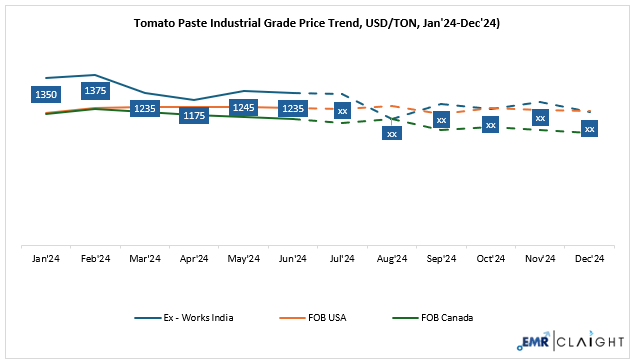
In early 2024, the international price of tomato paste varied among the top 10 trading countries due to differences in production, export, and intermediate demand. In 2025, the tomato paste price trends are expected to remain stable or see a slight increase due to a combination of reduced global supply and steadily growing demand. As the largest supplier in the market, China continued to influence prices negatively through high export supply in the global market, even then being able to maintain its domestic demand and take advantage of low processing costs; the surplus had an oversized effect on Asia and African markets. Meanwhile, European suppliers like Italy and Spain experienced a drop in domestic production due to weather issues which led to rise in costs of production. The U.S. reported strong yield on crop production; however, the prices held, due to increased logistics and processing costs, made price movements comparable to prices before the increase in costs.
| Tomato Paste Industrial Grade Price (USD/TON) YoY Change, Ex-Works India |
| Month |
2023 Price |
2024 Price |
YoY Change |
Expert Market Research Price Prediction for 2025 |
| October |
1115 USD/TON |
1105 USD/TON |
- 1% |
Prices are expected to stay stable or rise slightly due to lower supply and growing demand. |
| November |
1150 USD/TON |
1160 USD/TON |
+ 1% |
| December |
1105 USD/TON |
1075 USD/ TON |
- 3% |
Get Real-Time Prices (Monthly, Quarterly, and Yearly) - Download Free Sample
In the other geographies Turkey, Ukraine, and Iran saw some moderate price rises (inflation and currency were issues) while also issues with costs available products to sell created drops in pricing. In South America, Chile saw higher prices than in 2023, but this was due to a different pricing strategy to target a premium market in the export with no domestic demand for the pricing point; along with Portugal having a similar pricing strategy. Brazil and Mexico were more sensitive to importing tomato paste full journey pricing thus delays in freight and some shipments caused wide swings in pricing. Overall, with China's pricing structure bringing world prices to one bench price; this only limited the regional effects of the local production, and trading activity generated some differences at the region-level pricing during the 2024 production season.
Tomato Paste Price Forecast
The global tomato paste market outlook saw major price volatility in 2024, which was impacted by weather conditions, supply chain interruptions, and changing consumer preferences. Heavy rainfall during the monsoon season in India caused damage to tomato crops that increased prices for raw tomatoes and therefore prices for tomato paste. Production costs in China increased, while the demand for tomato products increased, meaning Chinese tomato paste was less competitive on the global market so other producers such as Turkey and India became more attractive. Global tomato production reached record levels of 45.8 million metric tons in 2024 but regionally we saw challenges arise, especially in Iran with a 30% decline in production and the United States having inventories of 4.03 million tons which is a large supply that would lower prices. Broader macroeconomic factors affecting tomato paste price forecast suggests that going forward, after production levels begin to normalize, prices should regain some stability as fresh tomato supplies come to market but complications from weather, logistics, and politics will continue to affect regional variations in pricing in 2024 and beyond.
Get Real-Time Prices (Monthly, Quarterly, and Yearly) - Download Free Sample
Global Trade and Supply Chain Implications
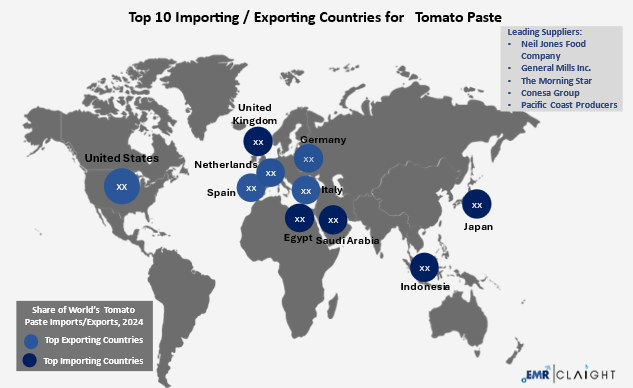
| Leading Exporting Countries |
Leading Importing Countries |
Major Suppliers |
| Italy |
United Kingdom |
Neil Jones Food Company (U.S.) |
| United States |
Japan |
General Mills Inc. (U.S.) |
| Netherlands |
Russia |
Pacific Coast Producers (U.S.) |
| Spain |
France |
Arzia b.v. (Netherlands) |
| Germany |
Saudi Arabia |
The Morning Star (USA) |
| Poland |
South Korea |
Casalasco – Pomì Brand (Italy) |
| India |
Egypt |
Conesa Group (Spain) |
| Turkey |
Indonesia |
The Kraft Heinz Company (U.S.) |
The global trade and supply dynamics for tomato paste in 2024 were affected by uneven production across regions, rising production and freight costs, and supply shortages. Global raw tomato production increased to record levels of 45.8 million metric tons, but weak yields in some regions influenced not just their export decisions, but how balanced the market was for tomato paste export flows. China maintained its status as the largest exporter in 2024, but rising production and freight costs reduced its price competitiveness, so different sourcing decisions were made by buyers, especially in Southeast Asia and even some parts of Africa. Other countries, like Turkey and Spain, were able to increase their market share by taking advantage of alternative trade dynamics in which China was the alternative.
In the U.S., stable production allowed for inventory building, and stockpiles totaled over 4.03 million short tons of tomato paste in March 2025, which also reduced the demand for imports. In Europe, weather and climate-related factors inhibited supply, particularly in the southern European hubs; thereby increasing reliance on imports to meet food processing supply needs. Furthermore, across all jurisdictions, challenges including container shortage and high ocean freight rates increased the costs for imported tomato paste in North America and Europe. These circumstances highlighted the sensitivity of global tomato paste trade and flow to regional shocks and pressures as well as reaffirming a strategy of diversified sources and regionalization.
Feedstock Analysis
The price of tomato paste is directly linked to the price and availability of its primary raw material—processing tomatoes—plus associated costs in labor, energy, packaging, and transportation. In 2024, with world tomato production reaching a record 45.8 million metric tons, regional variations in production and inflationary forces impacted raw material price dynamics. In California, the world's number one processing tomato producer, water availability, labor shortage, and high input prices (notably fuel and fertilizer) sustained high farmgate prices in the face of a good crop. These upstream influences, combined with high processing and energy prices, supported firm paste pricing analysis for much of the year.
In Spain and Italy, in Europe, adverse weather during key planting and harvesting periods affected input use and yields, constricting supply and raising raw tomato prices. In addition, higher packaging costs (metal cans, aseptic bags) and logistics challenges are added to the overall cost basis for processors. Raw tomato supply was not a limiting factor globally, but regional cost differentials and processing margins largely influenced paste prices in large markets. Econometric market analysis also suggests that, the 2024 tomato paste market was the result of the compounding effect of raw material input costs, energy, and supply chain limitations, underscoring the pivotal role of farm-level economics in determining trends in paste prices.
Demand and supply Outlook for Tomato Paste
Tomato paste global demand and supply in 2024 are favorable on the strength of strong aggregate crop production and shifting regional patterns of demand. Production of tomatoes globally reached a record 45.8 million metric tons, with the likes of the U.S., China, and Italy producing significantly. Nevertheless, regional variations in the quality of production, climatic conditions for harvest, and efficiency in processing have led to an uneven supply situation. In North America, in particular California, stable production and favorable weather resulted in stable supply, although increasing processing and input costs eroded operating margins. This should yield stable prices unless there are other cost shocks in the pipeline.
On the demand side, global retail and industrial channel consumption of tomato paste is maintaining strong, with vigorous growth in the emerging markets as demand for processed food increases. Growth in the advanced markets has, however, been steady. In the EU, domestic South market tight supply is to drive sustained import demand, with Asian markets aggressively pursuing alternatives as rising costs from traditional markets such as China. Overall, the market for tomato paste will experience stable prices in the short run with potential upside pressure if global logistics disruption or energy market volatility affects processing or shipping. Regional differences will continue to drive short-term supply-demand balance and price.
| Report Features |
Coverage - Detail Report Annual Subscription |
| Product Name |
Tomato Paste |
| Report Coverage |
Price Forecasting and Historical Analysis: Monthly historical prices (2021-2024), short- and long-term price forecasts (2025-2026), scenario forecasts (most probable, optimistic, pessimistic) |
| Regional and Grade-wise Market Breakdown: The top 10 countries in terms of production, consumption, export, and import, regional insights (USA, North West Europe, China, India, South East Asia, Brazil, Mexico, South Africa, Nigeria, GCC, Japan, South Korea, etc.). |
| Grade Wise Price Trends with Incoterms: Variation in price by product grade and specifications, and Incoterms. |
| Price Drivers and Cost Structure: Feedstock correlations, production costs, market competition, government policies, economic factors |
| Supply and Demand Analysis: Regional supply-demand analysis (North America, Europe, Asia Pacific, etc.), company-level and grade-level supply-demand, plant shutdown, expansion, force majeure, details |
| Trade Balance Analysis: Historical deficit and surplus countries, net importers and exporters, Product movement, Supply Chain, Freight, Duties and Taxes |
| Production Cost Breakdown: Direct and indirect cost breakdowns: raw material, labour, processing, packaging, overhead, R&D, taxes |
| Profitability Assessment: Profit margin evaluations |
| Industry News and Macroeconomic Context: Geopolitical events, policy updates, GDP, inflation, exchange rates, and their impact on coal prices |
| Data Overview: Macroeconomic Impact, Supply-Demand, Government/Industry Inputs, Custom Insights |
| Currency |
USD (Data can also be provided in the local currency) |
| Customization Scope |
The report can also be customised based on the requirements of the customer |
| Post-Sale Analyst Support |
Till the end of the subscription |
| Data Access |
Lifetime Access, Visualisation |
| Delivery Format |
PDF and Excel through email (We can also provide the editable version of the report in PPT/Word format on special request) |
Gain a competitive edge with EMR's comprehensive price forecasting reports. Dive deep into the latest market dynamics and price outlook for your specific materials, ensuring you stay ahead of the curve with actionable insights and strategic foresight.
What Our Reports Include:
Historical Price Data and Analysis:
- In-depth review of prices (including feedstock) over the past 5 years.
- Visualizations and trend analysis to identify historical patterns and seasonality.
Supply and Demand Analysis:
- Detailed industry analysis of current supply and demand trends shaping the market, along with projections for how these dynamics are expected to evolve during the forecast period.
- Insights from our extensive supplier and trader network, government websites, industry bodies, and global trade data.
Latest Industry News:
- Up-to-date information on recent developments and geopolitical events.
- Pricing analysis of how these events are likely to impact future prices.
Key Macroeconomic Indicators:
- Evaluation of economic indicators such as GDP growth, inflation rates, and PMI.
- Insights into how these indicators affect prices.
Price Outlook:
- Forecasted price trends analysis for the next 2 years using statistical modelling and fundamental & technical price analysis.
- Scenario analysis and potential price fluctuations.
Why Choose Our Reports?
- Accurate Data: Our reports are based on reliable data sources, including primary interviews, government websites, and industry bodies.
- Comprehensive Insights: We offer a holistic view of the market, considering all factors related to demand, supply, macroeconomic environment, and input costs.
- Timely Updates: Reports are updated monthly, with options for quarterly or semi-annual subscriptions.
- Expert Support: Our team of analysts is available for consultations and customized requirements.
Key Benefits:
- Informed Procurement Decisions: Gain insights on when to buy and how to negotiate better, mitigating the impact of price volatility.
- Competitive Advantage: Leverage our robust and time-tested forecasting methodology to stay ahead in the market.
- Actionable Insights: Make better market decisions with detailed market forecasts and analysis.