

Consumer Insights
Uncover trends and behaviors shaping consumer choices today
Procurement Insights
Optimize your sourcing strategy with key market data
Industry Stats
Stay ahead with the latest trends and market analysis.

The global air traffic control (ATC) market was valued at USD 10.81 Billion in 2025. The rise of low-cost carriers is increasing air traffic density, pushing airports to adopt real-time ATC upgrades that enhance routing efficiency, reduce delays, and support quick turnaround operations. As a result, the market is expected to grow at a CAGR of 5.60% during the forecast period of 2026-2035 to reach a value of USD 18.64 Billion by 2035.
One of the most pivotal trends steering the global market is the integration of AI into traffic control operations. AI-driven systems are reshaping how air traffic is monitored, predicted, and rerouted in real-time. For instance, in January 2024, the United Kingdom’s NATS introduced an AI-based digital control system that analyses vast volumes of radar and weather data, significantly reducing delays and human error. According to EUROCONTROL, AI applications are expected to reduce runway occupancy times significantly across Europe by 2030, easing congestion at major hubs. The trend is also catching pace in the United States, where the FAA's NextGen programme integrates data fusion and machine learning, further reshaping the air traffic control (ATC) market dynamics.
Another major growth lever is the rise in government investments supporting ATC infrastructure upgrades. India’s Ministry of Civil Aviation allocated INR 170 crore in December 2023 for modernising its ATC towers and integrating ADS-B surveillance. Similarly, the European Commission committed over EUR 350 million in February 2023 for enhancing cross-border air traffic coordination under the Single European Sky initiative. These funding boosts reflect a global consensus on decongesting airspaces, improving flight predictability and minimising carbon emissions.
As more developing economies adopt advanced surveillance and communication technology to keep pace with traffic surges, the air traffic control (ATC) market is witnessing a paradigm shift. The intersection of AI, digitisation, and international collaboration is creating lucrative avenues for vendors to offer scalable and intelligent ATC solutions worldwide.
Base Year
Historical Period
Forecast Period
Compound Annual Growth Rate
5.6%
Value in USD Billion
2026-2035
*this image is indicative*
AI-driven decision support systems have now become critical tools in ATC operations. In FY20, the FAA approved live trials for MITRE Corporation’s AI-enabled Traffic Flow Management System, which optimises rerouting during extreme weather and airspace conflicts. These tools can interpret high-dimensional datasets far faster than human controllers, supporting smarter flight sequencing. The commercial viability of such systems is accelerating, with global providers like Thales and Indra incorporating proprietary AI modules into legacy frameworks, streamlining overall coordination between aircraft, controllers and navigation aids, accelerating the growth of the air traffic control (ATC) market.
The deployment of space-based ADS-B (Automatic Dependent Surveillance–Broadcast) has revolutionised airspace visibility, particularly over oceans and remote terrains. For instance, Aireon’s constellation enables real-time tracking of over 90% of global flights, including polar routes. ICAO's revised standards now mandate adoption for all high-density FIRs (Flight Information Regions). Such initiatives are expanding air traffic capacity and enabling flexible routing, which is essential for airlines aiming to reduce fuel costs and emissions while maintaining optimal safety, propelling air traffic control (ATC) market expansion.
Eco-centric air traffic management is becoming central to government and industry agendas. EUROCONTROL’s “Green ATM” programme, launched in June 2022, includes dynamic taxiing solutions and continuous descent operations (CDOs), expected to reduce CO2 emissions. In the United States, the FAA is deploying Terminal Flight Data Manager (TFDM) systems at major airports to reduce idle time on taxiways. Meanwhile, in March 2025 India’s AAI partnered with ICAO for carbon offset modelling using real-time ATC data.
Digital Remote Towers (DRTs) are redefining air traffic management market trends by allowing multiple airports to be controlled from a centralised digital facility. Sweden’s LFV pioneered this model at Örnsköldsvik Airport. In May 2022, Germany’s DFS opened a multi-airport digital tower centre in Leipzig to manage operations across the country’s regional airports. These towers use ultra-HD cameras, radar feeds, and real-time meteorological data, providing cost-effective scalability without compromising situational awareness.
With increasing flight volumes, cross-border traffic management has become essential for eliminating bottlenecks and miscommunication in congested airspaces. The Single European Sky ATM Research (SESAR) 3 programme, backed by over EUR 2 billion in EU funding, is building interlinked control systems across 40+ European countries. In Asia-Pacific, the ASEAN Seamless Sky initiative is deploying integrated air traffic management platforms across member nations, targeting interoperability, stimulating further demand in the air traffic control (ATC) market. These programmes align regulatory procedures, flight plan submissions, and surveillance capabilities, thus reducing handoff delays and safety risks. This harmonisation is particularly valuable for long-haul carriers and air cargo players.
Read more about this report - REQUEST FREE SAMPLE COPY IN PDF
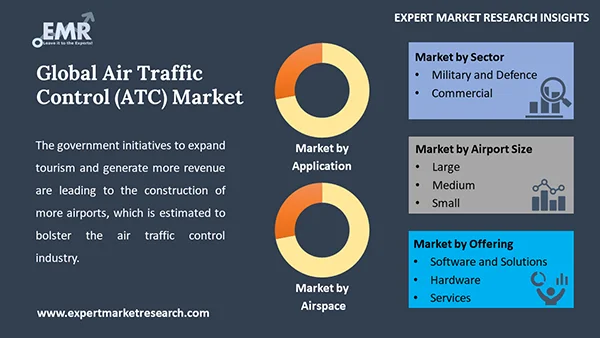
The EMR’s report titled “Global Air Traffic Control (ATC) Market Report and Forecast 2026-2035” offers a detailed analysis of the market based on the following segments:
Market Breakup by Air Space
Key Insight: The global air traffic control (ATC) industry report, divided by airspace, features ARTCCs as the dominant category due to their extensive control range and necessity in transnational aviation. Meanwhile, TRACON units are seeing the fastest growth, driven by increased urban flight density and airport expansions. ATC Towers remain essential for visual navigation and last-mile command, especially in mixed traffic zones.
Market Breakup by Application
Key Insight: Among all the applications considered in the air traffic control (ATC) market report, automation leads the market, owing to its ability to deliver precision and streamline operations. Communication is emerging as the fastest-growing category, powered by evolving demands for seamless real-time data flow. Navigation and surveillance continue to provide foundational support to ATC infrastructures, ensuring aircraft position accuracy and situational awareness.
Market Breakup by Offering
Key Insight: All three offerings, including hardware, software & solutions, and services, are fundamental to ATC transformation. Software is leading the market with its flexibility and AI potential, while hardware is evolving with sensor-rich, autonomous components. Services, especially maintenance and training, have become vital for long-term operability, particularly in emerging regions adopting ATC systems.
Market Breakup by Airport Size
Key Insight: Airport size impacts the scale and sophistication of ATC deployment. Large airports largely contribute to the air traffic control (ATC) market revenue owing to high-volume, complex air traffic, while medium airports are fast catching up, supported by government incentives and decentralisation of aviation traffic. Small airports remain vital for point-to-point regional operations, often embracing digital ATC systems to reduce capex and staffing burdens.
Market Breakup by Sector
Key Insight: The air traffic control (ATC) market is bifurcated by two major sectors including commercial and military. Commercial aviation leads the charge, propelled by globalised travel and logistics growth, while the defence sector is evolving into a high-growth sector amid rising geopolitical concerns. The need for synchronised, secure, and scalable traffic management across both sectors is strengthening dual-use technologies and collaborative protocols.
Market Breakup by Region
Key Insight: As per the regional dynamics, North America leads the overall air traffic control (ATC) market growth with institutional sophistication and long-standing regulatory support. Europe maintains strong momentum through SESAR-backed harmonisation. Asia Pacific outpaces all others in terms of growth, powered by state-led modernisation drives. Latin America and MEA, while nascent, are increasingly prioritising ATC in their airport development agendas, adding new demand frontiers for global vendors.
By Air Space, Air Route Traffic Control Centres Dominate the Market Due to Wide-Area Surveillance and Traffic Density
Air Route Traffic Control Centres (ARTCCs) accounted for the largest share in the market due to their critical role in managing long-haul en-route traffic across high-altitude corridors. These centres handle aircraft over wide geographical spans, especially on transcontinental and intercontinental flights. These centres now operate with automated conflict detection systems and real-time weather rerouting modules, ensuring safer, more fuel-efficient operations. Additionally, the Asia-Pacific region has ramped up ARTCC investments to tackle the surging demand in China and Southeast Asia, boosting ARTCCs’ dominance in market revenue.
Terminal Radar Approach Control (TRACON) centres are witnessing rapid growth in the air traffic control (ATC) market as urban airports become congested. TRACON units manage arriving and departing flights within a 30 to 50 nautical mile radius of busy airports and are crucial in minimising runway delays. As mega-cities expand and UAV integration nears, TRACON systems are projected to play a vital role in the market’s short- to mid-term expansion.
Automation Applications Lead the Market Due to Increased Focus on Error Reduction and Efficiency
Automation remains the dominant application in ATC systems as airports move toward error-proof and predictive flight control environments. Modern ATC automation solutions can process high-frequency data feeds in real-time, alerting operators to conflicts, weather threats, or equipment malfunctions. In June 2024, France’s DSNA introduced automated sequencing systems to manage peak-hour departures in Paris CDG. Such deployments help improve decision accuracy, minimise human intervention, and handle unpredictable traffic surges.
As per the air traffic control (ATC) market report, communication systems are experiencing rapid growth as airlines demand real-time data exchange between cockpit crews and ground stations. Innovations in IP-based voice systems and datalink technologies are replacing legacy VHF channels. The United Kingdom initiated 5G trials at Manchester Airport to assess its application in ground-to-aircraft communication in February 2019. Such efforts underscore a shift toward faster, secure, and always-on connectivity. As drone traffic and hybrid air mobility platforms expand, the need for dynamic communication channels is expected to rise sharply.
By Offering, Software and Solutions Register the Largest Share Due to AI-Driven Upgrades
As the ATC landscape digitises rapidly, software and solutions have taken the lead in the market, accounting for the largest revenue share. Airlines and airport authorities are investing heavily in traffic flow management systems, predictive analytics tools, and cloud-based surveillance software. In December 2024, Indra Sistemas partnered with EUROCONTROL to deploy an integrated digital ATC platform that automates conflict detection using AI. These modular systems are easier to upgrade and integrate with legacy hardware, offering cost-effective scalability. The demand for dynamic rerouting and real-time flight visualisation is encouraging software vendors to provide highly customisable interfaces.
Hardware offerings are rapidly driving the air traffic control (ATC) market value due to the installation of advanced radar systems, ultra-HD cameras, and ADS-B transceivers. Emerging economies like Brazil are investing in robust ATC infrastructure to replace outdated systems. Additionally, the integration of surveillance radars with AI processors is transforming traditional hardware into smart systems that support remote operations. Demand is also rising for cyber-resilient ATC equipment in military and dual-use airports.
By Airport Size, Large Airports Account for the Largest Share Due to High Flight Throughput
Large airports drive the air traffic control (ATC) market revenue due to the scale and complexity of traffic they manage. These hubs handle thousands of take-offs and landings daily, requiring multi-layered ATC systems that include TRACONs, ARTCCs, and digital control towers. Heathrow, JFK, and Changi have deployed AI-backed tower automation to manage peak congestion and minimise ground delays. Additionally, they use predictive analytics to avoid runway incursions and improve slot coordination.
Medium-sized airports are expanding their ATC capacities as part of government strategies to improve regional air connectivity. Under India’s UDAN scheme and similar regional expansion initiatives in Europe and Africa, investments are being channelled into mid-tier airports to decongest metro hubs. These airports are now equipped with remote tower technology and modular ATC systems to support increasing air traffic from budget carriers, shaping the air traffic control (ATC) market dynamics.
Commercial Sectors Clock in a Substantial Share of the Market Due to Global Passenger Volume Surge
The commercial sector remains the largest contributor to the market growth, driven by the relentless rise in passenger and freight traffic. Airlines are pushing for automated ATC solutions to reduce turnaround times and enhance route efficiency. Advanced ATC systems are being rolled out at new terminals and satellite hubs to streamline aircraft movement across borders. The integration of 4D trajectory modelling and collaborative decision-making (CDM) platforms is improving accuracy and reducing in-air congestion, making the commercial sector loaded with air traffic control (ATC) market opportunities.
The military and defence sector is gaining momentum, driven by geopolitical tensions, increased airspace surveillance needs, and drone activity. Governments are modernising ATC systems to monitor air incursions, coordinate with civil aviation, and integrate UAV command centres. The Indian Air Force is integrating civil-military coordination platforms to deconflict airspace in busy corridors. These applications require hardened infrastructure, redundant systems, and 24/7 operability, driving up defence-related ATC investments significantly.
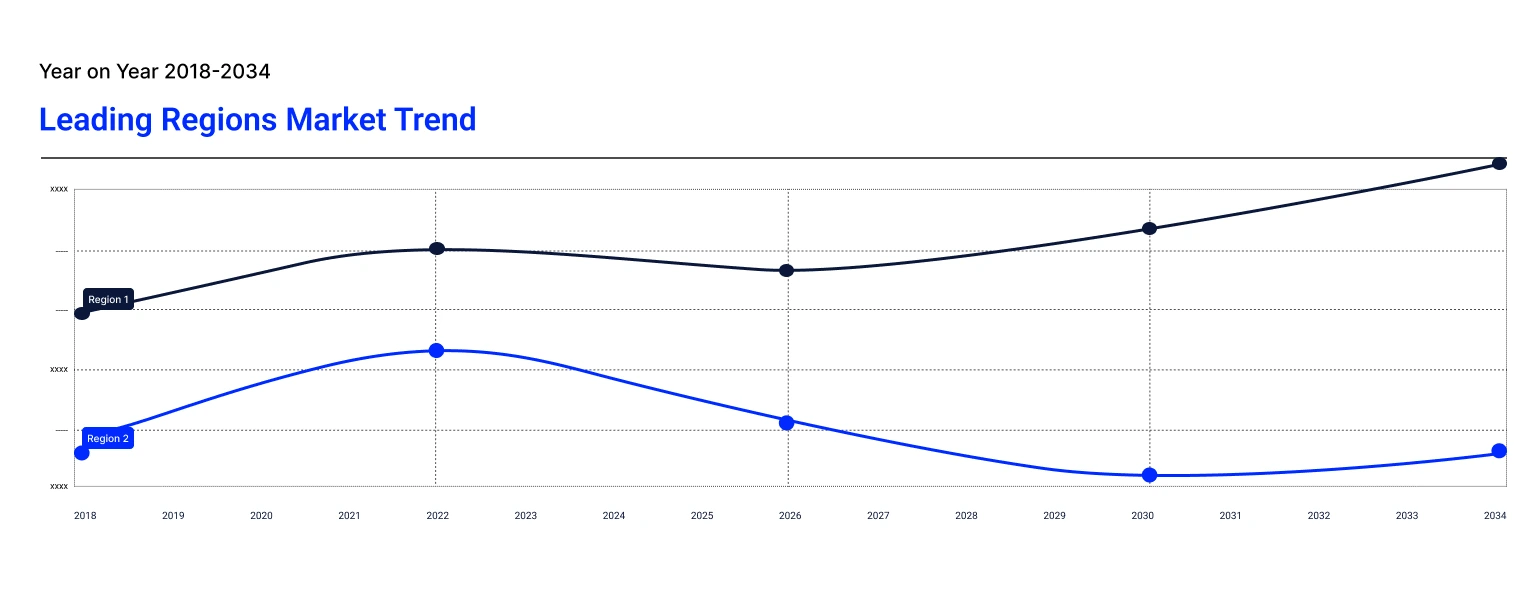
North America Secures the Leading Position in the Market Due to Infrastructure Maturity and FAA Programmes
North America remains the leading regional market, backed by high air travel demand, modern airport infrastructure, and institutional support like the FAA’s NextGen programme. Canada’s NAV CANADA is also integrating AI into its airspace management under partnerships with satellite surveillance firms. The presence of tech giants and aerospace leaders also accelerates product innovation and deployment speed, giving North America a competitive edge in operational readiness and regulatory compliance.
The Asia Pacific air traffic control (ATC) market is emerging as the fastest-growing regional market due to massive investments in airport infrastructure and a surge in regional air traffic. China, India, and ASEAN countries are actively upgrading ATC systems to meet skyrocketing passenger demand. In October 2023, China launched its “Air Silk Road” programme, expanding digital towers across the Belt and Road route.
Global air traffic control (ATC) market players are mostly focusing on AI-driven automation, cross-border coordination, and eco-efficient ATC upgrades. Vendors are investing in digital twin technology, satellite-based surveillance, and remote tower capabilities. Strategic collaborations with governments and airport authorities are creating avenues for long-term contracts and integration of cutting-edge solutions.
Air traffic control companies are also entering partnerships to co-develop interoperable systems across jurisdictions. Start-ups are emerging with cloud-native ATC platforms, targeting underserved airports in Asia and Africa. Firms can find opportunities in retrofitting existing infrastructure and offering hybrid civil-military systems for dual-use airspace control. Market players must align with green aviation goals, invest in cybersecurity, and ensure compliance with evolving global aviation protocols to sustain their competitive advantage.
Adacel Technologies Limited, established in 1987 and headquartered in Melbourne, focuses on speech recognition-based ATC simulation and real-time control systems. It provides tower simulators and Oceanic control systems to civil and defence clients globally. Adacel's Aurora ATM system is used by the FAA and several Pacific Island nations, offering advanced route optimisation and multilingual interface capabilities.
BAE Systems plc, founded in 1999 and based in London, offers ATC solutions tailored to defence-grade security and civil-military coordination. Its ATC technology is integrated into radar networks and deployed at military airbases and joint-use airports worldwide. The company is also working on AI-supported threat detection integrated into control towers to enhance national airspace protection.
Frequentis AG, formed in 1947 and headquartered in Vienna, Austria, is known for its IP-based voice communication systems and tower automation software. It partners with EUROCONTROL and ANSPs to roll out remote digital towers and deploy data-sharing platforms that enable harmonised traffic management across European and Asian airspaces.
Indra Sistemas S.A., founded in 1992 and based in Madrid, Spain, delivers full-spectrum ATC systems, from surveillance radars to flight data processing. Indra’s iTEC collaboration with DFS, ENAIRE, and NATS is transforming control centres into AI-supported hubs.
*Please note that this is only a partial list; the complete list of key players is available in the full report. Additionally, the list of key players can be customized to better suit your needs.*
Other key players in the air traffic control (ATC) market are Leonardo S.p.A., Northrop Grumman Corporation, Raytheon Technologies Corporation, and Saab AB, among others.
Explore the latest trends shaping the air traffic control (ATC) market 2026-2035 with our in-depth report. Gain strategic insights, future forecasts, and key market developments that can help you stay competitive. Download a free sample report or contact our team for customized consultation on air traffic control (ATC) market trends 2026.


Upto 15% Off
USD
$2499 $2249
$3999 $3599
$4999 $4249
$5999 $5099


*While we strive to always give you current and accurate information, the numbers depicted on the website are indicative and may differ from the actual numbers in the main report. At Expert Market Research, we aim to bring you the latest insights and trends in the market. Using our analyses and forecasts, stakeholders can understand the market dynamics, navigate challenges, and capitalize on opportunities to make data-driven strategic decisions.*
Get in touch with us for a customized solution tailored to your unique requirements and save upto 35%!
In 2025, the air traffic control (ATC) market reached an approximate value of USD 10.81 Billion.
The market is projected to grow at a CAGR of 5.60% between 2026 and 2035.
The market is estimated to witness a healthy growth in the forecast period of 2026-2035 to reach almost USD 18.64 Billion by 2035.
Firms are customising eco-friendly ATC systems, co-developing interoperable platforms, enhancing cybersecurity, offering remote control towers, and aligning innovations with government digitalisation and sustainability targets for long-term growth.
The key industry trends include the rising construction of airports as a part of government initiatives, especially in the emerging economies.
The major regions in the industry North America, Europe, the Asia Pacific, Latin America, and the Middle East and Africa.
The major market divisions, based on airspace, include air route traffic control centres, terminal radar approach control, and air traffic control tower.
The major applications include communication, navigation, surveillance, and automation.
The significant market divisions, based on offering, include hardware, software and solutions, and services.
The different market segments, based on airport size, include large, medium, and small.
The major sectors include commercial, and military and defence.
The major players in the industry are Adacel Technologies Limited, BAE Systems plc, Frequentis AG, Indra Sistemas, S.A., Leonardo S.p.A., Northrop Grumman Corporation, Raytheon Technologies Corporation, and Saab AB, among others.
Companies in the air traffic control (ATC) market face hurdles with regulatory fragmentation, cyber vulnerabilities, high capital costs, and adapting to unmanned traffic integration.
Explore our key highlights of the report and gain a concise overview of key findings, trends, and actionable insights that will empower your strategic decisions.
| REPORT FEATURES | DETAILS |
| Base Year | 2025 |
| Historical Period | 2019-2025 |
| Forecast Period | 2026-2035 |
| Scope of the Report |
Historical and Forecast Trends, Industry Drivers and Constraints, Historical and Forecast Market Analysis by Segment:
|
| Breakup by Airspace |
|
| Breakup by Application |
|
| Breakup by Offering |
|
| Breakup by Airport Size |
|
| Breakup by Sector |
|
| Breakup by Region |
|
| Market Dynamics |
|
| Competitive Landscape |
|
| Companies Covered |
|
| Report Price and Purchase Option | Explore our purchase options that are best suited to your resources and industry needs. |
| Delivery Format | Delivered as an attached PDF and Excel through email, with an option of receiving an editable PPT, according to the purchase option. |
Datasheet
One User
USD 2,499
USD 2,249
tax inclusive*
Single User License
One User
USD 3,999
USD 3,599
tax inclusive*
Five User License
Five User
USD 4,999
USD 4,249
tax inclusive*
Corporate License
Unlimited Users
USD 5,999
USD 5,099
tax inclusive*
*Please note that the prices mentioned below are starting prices for each bundle type. Kindly contact our team for further details.*
Flash Bundle
Small Business Bundle
Growth Bundle
Enterprise Bundle
*Please note that the prices mentioned below are starting prices for each bundle type. Kindly contact our team for further details.*
Flash Bundle
Number of Reports: 3
20%
tax inclusive*
Small Business Bundle
Number of Reports: 5
25%
tax inclusive*
Growth Bundle
Number of Reports: 8
30%
tax inclusive*
Enterprise Bundle
Number of Reports: 10
35%
tax inclusive*
How To Order

Select License Type
Choose the right license for your needs and access rights.

Click on ‘Buy Now’
Add the report to your cart with one click and proceed to register.

Select Mode of Payment
Choose a payment option for a secure checkout. You will be redirected accordingly.
Gain insights to stay ahead and seize opportunities.

Get insights & trends for a competitive edge.

Track prices with detailed trend reports.

Analyse trade data for supply chain insights.

Leverage cost reports for smart savings

Enhance supply chain with partnerships.

Connect For More Information
Our expert team of analysts will offer full support and resolve any queries regarding the report, before and after the purchase.
Our expert team of analysts will offer full support and resolve any queries regarding the report, before and after the purchase.
We employ meticulous research methods, blending advanced analytics and expert insights to deliver accurate, actionable industry intelligence, staying ahead of competitors.
Our skilled analysts offer unparalleled competitive advantage with detailed insights on current and emerging markets, ensuring your strategic edge.
We offer an in-depth yet simplified presentation of industry insights and analysis to meet your specific requirements effectively.





Share