

Consumer Insights
Uncover trends and behaviors shaping consumer choices today
Procurement Insights
Optimize your sourcing strategy with key market data
Industry Stats
Stay ahead with the latest trends and market analysis.
The Australia chiller market was valued at USD 92.23 Million in 2025. The industry is expected to grow at a CAGR of 5.03% during the forecast period of 2026-2035 to reach a value of USD 150.66 Million by 2035. The market growth is mainly attributed to the rapid expansion of the country’s data center sector, which is significantly influencing the demand for advanced and energy-efficient cooling solutions.
The surging adoption of artificial intelligence, cloud computing, and digital services has created unprecedented cooling requirements for hyperscale and colocation data centers, particularly in Sydney and Melbourne. NSW currently leads the sector, accounting for 56 per cent of the USD 30 billion market, while Victoria contributes 30 per cent, with both states implementing fast-tracks approvals and infrastructure programs to attract further investment. These developments are driving Australia chiller market demand growth for compact, high-capacity, and reliable chiller systems.
Companies like Johnson Controls are responding with solutions such as the YORK® YVAM air-cooled magnetic bearing chillers, launched in July 2025, which deliver superior energy efficiency, zero on-site water usage, and operational flexibility for high-density AI workloads. The growth is not limited to data centres; it also spans commercial applications like hospitals, corporate offices, and public buildings, as well as industrial sectors including pharmaceuticals, food and beverages, and chemicals, further boosting product demand. Regional expansion into Queensland, Western Australia, and emerging hubs such as Perth and Adelaide is broadening market reach. This, in turn, is fueling the Australia chiller market revenue, positioning advanced and reliable chillers as essential to supporting Australia’s evolving industrial and digital infrastructure landscape.
As per industry reports, in 2023, Australia’s import of medical devices reached USD 5334 million due to the ageing population which drives the demand for chillers in the medical sector.
In October 2022, Euroklimat dispensed an R290 air-cooled propane chiller to a Coles Supermarket for air conditioning. This is Australia’s first retail installation.
In March 2024, Johnson Controls confirmed cyber security compliance for three chiller solutions certified by Exida-a leading company for product certification.
Compound Annual Growth Rate
5.03%
Value in USD Million
2026-2035
Beijer Ref completed the acquisition of Heatcraft Australia, strengthening its presence in the region. The move enhances the company’s capabilities in refrigeration and chiller solutions, expanding distribution and service offerings. This strategic expansion reflects broader market trends of consolidation and growing demand for advanced cooling technologies in Australia.
Hussmann, a Panasonic company, partnered with Refra to bring advanced natural refrigeration systems to Australia, including Transcritical CO₂ racks, chillers, and R290 heat pumps. The collaboration reflects a shift toward greener, energy-efficient technologies, aligning with Australian market trends emphasizing sustainability, efficiency, and modern cold chain needs.
Petit Forestier Group has acquired a major stake in Eurocold, an Australian refrigerated vehicle rental company, marking its entry into the local cooling market. The move indirectly boosts demand for reliable chilling and refrigeration systems to support cold chain logistics, reinforcing Australia’s growing focus on advanced cooling solutions.
Johnson Controls acquired Gordon Brothers Industries, Australia’s largest industrial refrigeration design and service provider, to expand its local portfolio. The deal combines GBI’s engineering expertise with Johnson Controls’ smart and sustainable technologies, strengthening large-scale cooling and chiller capabilities. This move reflects ongoing consolidation and rising demand for efficient, climate-resilient refrigeration solutions in the Australian market.
The strong climate variability in Australia, with scorching 50°C summers and sub-zero winters, is a major factor propelling the Australia chiller market value. Extreme temperatures increase the need for reliable and robust cooling solutions across residential, commercial, and critical infrastructure sectors. For example, in April 2024, Carrier launched high-performance chillers using ultra-low GWP refrigerants for data centers, addressing climate-adaptive requirements. Such innovations directly respond to environmental challenges, boosting the overall market value and reinforcing demand for advanced, energy-efficient chiller systems nationwide.
Sustainability and regulatory pressures are further driving the growth of the Australia chiller industry, particularly in industrial applications. Automation in sectors like food and beverage production requires smart, connected chillers to support 24/7 operations. Daikin’s July 2023 launch of its third-generation R32 scroll chiller, with a record 1,012 kW capacity, highlights technology’s role in meeting industrial demand. High-capacity, energy-efficient chillers ensure continuous operation while complying with environmental standards, underpinning sustained demand across multiple industrial verticals.
Environmental sustainability is becoming central to Australia chiller market dynamics, with businesses and institutions prioritizing low-GWP and energy-efficient technologies. A notable example came in June 2025, when Trane Technologies introduced its Aries N chiller line using R-290 (propane) refrigerant, aligning with government standards for green operations. This development highlights the shift toward eco-friendly chilling solutions, where end-users now expect systems that not only deliver reliable cooling but also support long-term sustainability goals across Australia’s expanding commercial and urban infrastructure.
Increased investment in regional healthcare infrastructure is driving growth in the Australia chiller market. The USD 975,000 funding boost for Albury Wodonga Health in October 2024, aimed at upgrading surgical theatres, kitchens, and sanitation facilities, highlights the need for reliable, high-performance HVAC and cooling systems. As hospitals modernize and consolidate services, demand for energy-efficient chillers that ensure precise temperature control and hygiene standards rises, directly contributing to Australia chiller market growth across commercial healthcare facilities.
Homegrown innovation and product customization are boosting the chiller industry growth in Australia. A notable example is Aqua Chiller’s 2025 launch of its Sentinel, Apex, and Zeus industrial chiller lines, specifically engineered to withstand high-temperature Australian environments. Such locally developed solutions enhance operational resilience, energy efficiency, and adaptability for diverse industrial applications. By addressing unique climatic and sectoral requirements, localized manufacturing not only strengthens competitiveness but also ensures industries are better equipped for both present operational demands and future expansion.
The EMR’s report titled “Australia Chiller Market Report and Forecast 2026-2035” offers a detailed analysis of the market based on the following segments:
Market Breakup by Product Type
Key Insight: Air-cooled chillers are gaining notable traction in the market, with less than 350 kW units serving residential and small offices, while 350–500 kW and 500–700 kW systems meet hospital and public building needs. Larger categories such as 700–1,000 kW and more than 1,000 kW are expanding rapidly in data centers and large industrial sites. Water-cooled chillers, though more capital-intensive, are gaining demand in heavy-duty applications. This structure reflects key trends in the Australia chiller market, where both compact and high-capacity solutions drive growth.
Market Breakup by Compressor Type
Key Insight: Screw chillers hold the largest market share due to efficiency and adaptability across industrial sectors such as food, beverages, and petrochemicals. Centrifugal chillers are the fastest-growing, supported by high-capacity requirements in data centers and hospitals. Scroll chillers serve smaller installations like residential complexes and public buildings, while others cover niche, modular applications. These dynamics underline comprehensive industry analysis that highlights centrifugal chillers as the emerging preference for high-performance cooling in the Australia chiller market.
Market Breakup by Application
Key Insight: Commercial applications significantly to the rising Australia chiller demand, with strong uptake from corporate offices, hospitals, public buildings, and data centers, the latter showing the fastest growth with rising digital infrastructure. Industrial applications are also significant, led by medical and pharmaceuticals, followed by food and beverages, chemicals, petrochemicals, and plastics. Residential usage remains smaller but is gradually expanding with urban development. Together, these segments point to consistent demand growth across varied end-user industries.
Market Breakup by Region
Key Insight: New South Wales holds the largest share due to its concentration of commercial activity, while Victoria benefits from strong industrial and healthcare projects. Queensland is the fastest growing, supported by food processing, logistics, and construction. Western Australia shows notable demand from mining operations, while the Australian Capital Territory grows steadily through government and institutional investments. These regional dynamics emphasize the scale of Australia chiller industry landscape, reflecting both established hubs and emerging growth centers.
By product type, air cooled chillers gain traction
Air-cooled chillers are likely to witness 5.44% CAGR through 2035, due to the growing need for flexible and modular cooling solutions that can adapt to varying operational needs. Organizations increasingly require systems that can scale easily, simplify installation, and allow quick maintenance. For example, in March 2025, Smardt’s AeroPure AF Series features modular designs, containerized shipping options, and configurable capacities for data centers and commercial applications, illustrating how adaptability and scalability are driving innovation and supporting rising the demand for chillers in the region.
Meanwhile, water-cooled chillers are a preferred choice at critical facilities for their ability to deliver high-capacity and reliable cooling. Industries and infrastructures such as data centers and hospitals require uninterrupted temperature control, where even minor fluctuations can disrupt operations or compromise safety. Water-cooled systems offer consistent performance, energy efficiency, and durability for continuous operation. This strong adoption is fueling the growth of the Australia chiller market, establishing operational reliability as the core driver for this segment.
By compressor type, screw chillers represent the biggest market portion
Screw chillers are likely to record 4.9% CAGR through 2035 due to their exceptional load adaptability, making them ideal for commercial, industrial, and data center applications with fluctuating cooling requirements. Their ability to maintain stable performance under part-load conditions, combined with modular designs and variable-speed drives, ensures energy efficiency and operational reliability. This flexibility allows operators to optimize cooling for diverse environments while reducing energy consumption. Such advantages are driving the chiller market expansion, as businesses increasingly adopt versatile and high-performance screw chiller solutions.
Besides this, technological innovation in magnetic bearing compressors for centrifugal chiller is boosting their demand in Australia. Midea’s AirBoost MAG and APEX chillers launched in June 2025, integrate ultra-long-life double-row bearings, smart anti-surge technology, and modular, scalable designs. These features provide superior reliability, energy efficiency, and low maintenance, meeting the demands of commercial high-rises, industrial facilities, and large-scale retrofits. By demonstrating the advantages of advanced centrifugal technology, such innovations are encouraging adoption of next-generation, high-performance solutions in the Australia chiller market.
By application, commercial chillers generate the highest revenue
Commercial chillers will likely witness 5.4% CAGR through 2035 as businesses increasingly adopt energy-efficient cooling solutions. Regulatory focus on energy efficiency is driving building owners to choose systems that reduce electricity consumption, comply with sustainability requirements, and optimize operational performance. The Commercial Energy Efficiency Handbook under NCC 2022 provides guidance for Class 3 and Class 5–9 commercial buildings, covering performance requirements, compliance pathways, and provisions for on-site renewable energy and electric vehicles. These measures encourage reduced energy use in building design and key equipment, boosting adoption of energy-efficient chillers in offices, hospitals, and large commercial facilities while improving comfort and overall sustainability.
Industrial chillers are witnessing notable demand in the Australia chiller market is the growing demand for versatile, energy-efficient, and reliable industrial cooling solutions across various sectors. Manufacturers are focusing on customization, advanced control systems, and durable components to meet evolving industry needs. For instance, in July 2025, Aqua Chiller’s launch of its extensive range, from compact lab chillers to large-scale screw units, demonstrates this trend, highlighting the importance of tailored solutions, high-quality components, and strong customer support in driving market growth.
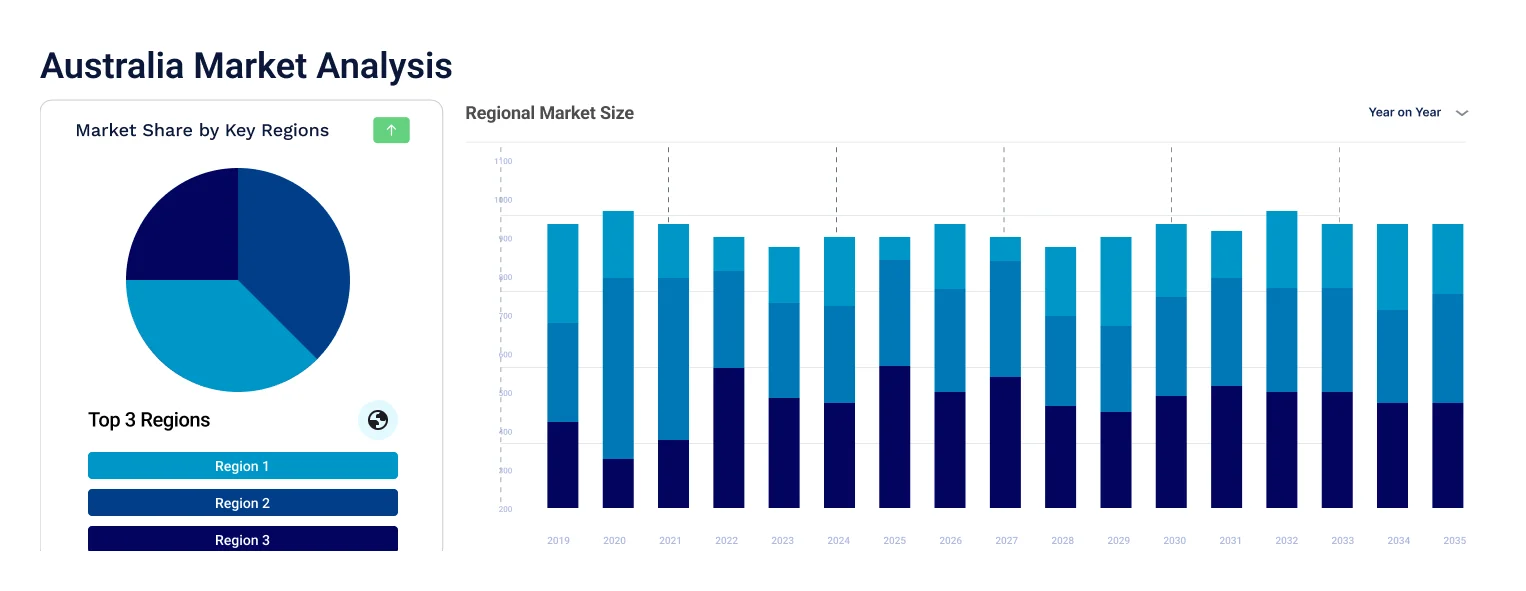
By Region, New South Wales dominate the market
New South Wales is expected to record 4.83% CAGR through 2035, driven by operational reliability and high demand from commercial buildings, hospitals, and data centers. Facilities in the region require continuous and stable cooling to ensure safety and prevent disruptions. Supporting this trend, in December 2024, Conry Tech launched trials of its Bull Ant micro-chillers at the University of New South Wales, showcasing reliable, decentralized cooling technology that reduces energy use and emissions while meeting the needs of critical facilities, further supporting the Australia chiller market growth.
On the other hand, Queensland demonstrates steady adoption of chillers attributed to the state’s strong regulatory framework and safety standards for natural refrigerants. The ATMOsphere Australia 2025 conference highlighted Queensland’s tighter hydrocarbon certification and licensing system, which ensures safe deployment of R290 and CO₂ chillers. By addressing environmental and operational risks while promoting skills development, these regulations boost confidence among manufacturers and operators. Initiatives like this are directly boosting the chiller market in Australia, encouraging wider adoption of energy-efficient, sustainable, and reliable cooling solutions.
Leading Australia chiller market players focus on innovation and sustainability to strengthen their positions in the chiller industry. Efforts include offering energy-efficient HVAC solutions, integrating smart building technologies, and retrofitting older systems to reduce operational costs and emissions. Investments in low-GWP refrigerants, high-efficiency chillers, and digital monitoring solutions enhance reliability and performance. These strategies are driving industry growth, as chiller companies expand their presence through regional partnerships and service networks across commercial, industrial, and healthcare segments.
Growth is also driven by advanced, high-capacity cooling solutions and customized system designs. Strategies include integrating IoT-enabled controls, predictive maintenance, and energy optimization for data centers, hospitals, and large commercial complexes. Modular and tailor-made chiller systems cater to industrial and commercial needs, while localized service support ensures efficient deployment and maintenance. Such strategic initiatives contribute to the growth of the Australia chiller market, enabling players to meet evolving infrastructure demands and capture emerging opportunities.
Established in 1885 and headquartered in Ireland, Johnson Controls specializes in building technologies and energy-efficient HVAC solutions, offering advanced chillers and smart building systems for commercial and industrial applications. The company emphasizes sustainability and digital integration to reduce energy consumption and enhance operational efficiency across diverse infrastructures.
Founded in 1915 and based in the United States, Carrier provides high-efficiency HVAC and refrigeration systems, emphasizing sustainable solutions and digital monitoring for large-scale commercial and industrial facilities. The company continues to innovate in low-GWP refrigerants and smart cooling technologies to meet evolving environmental standards.
Headquartered in Ireland and founded in 1913, Trane Technologies delivers innovative, high-capacity cooling solutions, IoT-enabled controls, and energy-efficient systems for data centers, hospitals, and commercial buildings. The company invests in research and development to drive sustainable solutions and improve system performance across global markets.
An Australian company established in 1971, Thermal Engineering focuses on customized chiller solutions, modular systems, and energy optimization strategies for industrial and commercial clients across the region. The company is recognized for its local expertise and ability to tailor systems for diverse operational requirements.
*Please note that this is only a partial list; the complete list of key players is available in the full report. Additionally, the list of key players can be customized to better suit your needs.*
Other players in the Australia chiller industry include Barry Brown & Sons, KR Chillers Australia Pty Ltd, Fluid Chillers Australia, Aqua Cooler Pty Ltd., and several more.
Explore the latest trends shaping the Australia Chiller Market 2026-2035 with our in-depth report. Gain strategic insights, future forecasts, and key market developments that can help you stay competitive. Get a free sample report or contact our team for customized consultation on Australia chiller market trends 2026.


Upto 15% Off
USD
$3499 $3149
$5599 $5039
$6999 $5949
$8459 $7190


*While we strive to always give you current and accurate information, the numbers depicted on the website are indicative and may differ from the actual numbers in the main report. At Expert Market Research, we aim to bring you the latest insights and trends in the market. Using our analyses and forecasts, stakeholders can understand the market dynamics, navigate challenges, and capitalize on opportunities to make data-driven strategic decisions.*
In 2025, the Australia chiller market reached an approximate value of USD 92.23 Million.
The market is projected to grow at a CAGR of 5.03% between 2026 and 2035.
The Australia chiller market is estimated to witness healthy growth in the forecast period of 2026-2035 to reach a value of USD 150.66 Million by 2035.
Key strategies driving the market include energy-efficient and low-GWP chillers, smart IoT-enabled systems, modular and high-capacity designs, localized manufacturing, and sustainability-focused solutions.
The key trends of the chiller market in Australia include the rise of smart connected chillers and demand for energy-efficient chillers.
The key players in the market include Johnson Controls International PLC, Carrier Global Corporation, Trane Technologies PLC, Thermal Engineering, Barry Brown & Sons, KR Chillers Australia Pty Ltd, Fluid Chillers Australia, Aqua Cooler Pty Ltd., and others
New South Wales leads the market growth due to its concentration of commercial activity, data centers, hospitals, and regional infrastructure investments.
Explore our key highlights of the report and gain a concise overview of key findings, trends, and actionable insights that will empower your strategic decisions.
| REPORT FEATURES | DETAILS |
| Base Year | 2025 |
| Historical Period | 2019-2025 |
| Forecast Period | 2026-2035 |
| Scope of the Report |
Historical and Forecast Trends, Industry Drivers and Constraints, Historical and Forecast Market Analysis by Segment:
|
| Breakup by Product Type |
|
| Breakup by Compressor Type |
|
| Breakup by Application |
|
| Breakup by Region |
|
| Market Dynamics |
|
| Competitive Landscape |
|
| Companies Covered |
|
Datasheet
One User
USD 3,499
USD 3,149
tax inclusive*
Single User License
One User
USD 5,599
USD 5,039
tax inclusive*
Five User License
Five User
USD 6,999
USD 5,949
tax inclusive*
Corporate License
Unlimited Users
USD 8,459
USD 7,190
tax inclusive*
*Please note that the prices mentioned below are starting prices for each bundle type. Kindly contact our team for further details.*
Flash Bundle
Small Business Bundle
Growth Bundle
Enterprise Bundle
*Please note that the prices mentioned below are starting prices for each bundle type. Kindly contact our team for further details.*
Flash Bundle
Number of Reports: 3
20%
tax inclusive*
Small Business Bundle
Number of Reports: 5
25%
tax inclusive*
Growth Bundle
Number of Reports: 8
30%
tax inclusive*
Enterprise Bundle
Number of Reports: 10
35%
tax inclusive*
How To Order

Select License Type
Choose the right license for your needs and access rights.

Click on ‘Buy Now’
Add the report to your cart with one click and proceed to register.

Select Mode of Payment
Choose a payment option for a secure checkout. You will be redirected accordingly.
Strategic Solutions for Informed Decision-Making
Gain insights to stay ahead and seize opportunities.

Get insights & trends for a competitive edge.

Track prices with detailed trend reports.

Analyse trade data for supply chain insights.

Leverage cost reports for smart savings

Enhance supply chain with partnerships.

Connect For More Information
Our expert team of analysts will offer full support and resolve any queries regarding the report, before and after the purchase.
Our expert team of analysts will offer full support and resolve any queries regarding the report, before and after the purchase.
We employ meticulous research methods, blending advanced analytics and expert insights to deliver accurate, actionable industry intelligence, staying ahead of competitors.
Our skilled analysts offer unparalleled competitive advantage with detailed insights on current and emerging markets, ensuring your strategic edge.
We offer an in-depth yet simplified presentation of industry insights and analysis to meet your specific requirements effectively.




