

Consumer Insights
Uncover trends and behaviors shaping consumer choices today
Procurement Insights
Optimize your sourcing strategy with key market data
Industry Stats
Stay ahead with the latest trends and market analysis.
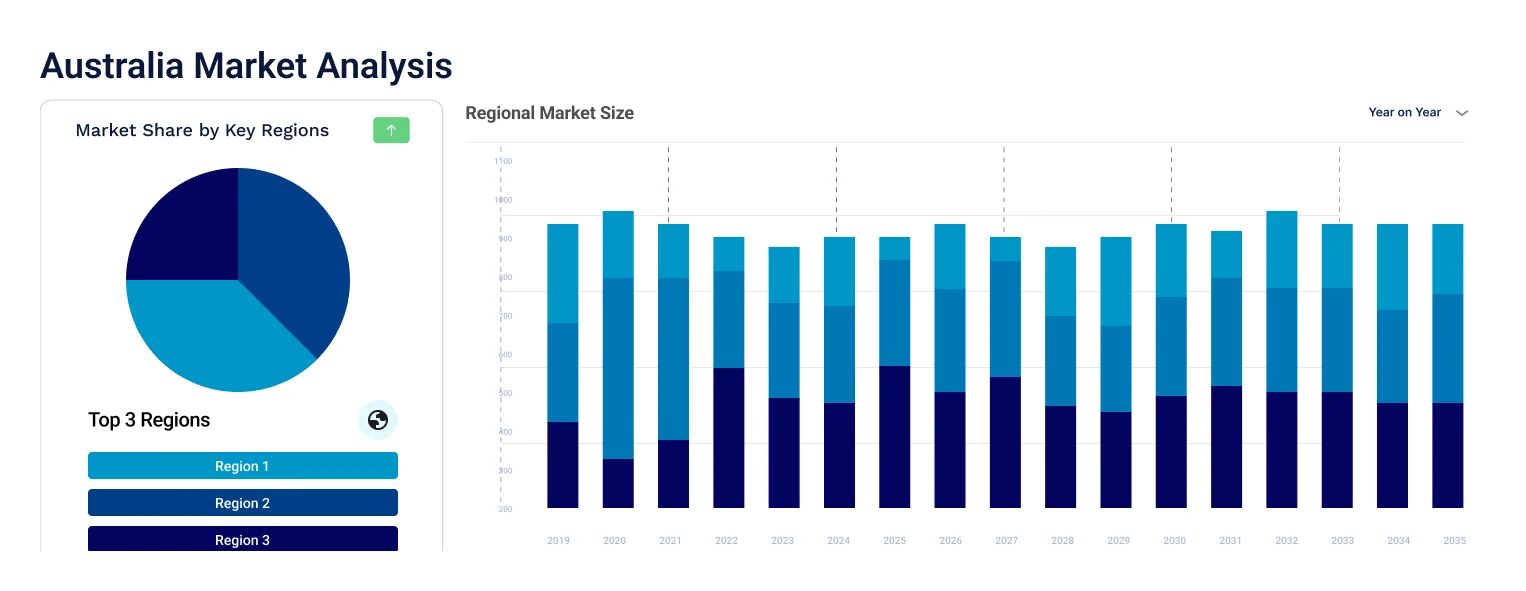
The Australia commercial vehicle market attained a value of USD 16.30 Billion in 2025 and is projected to expand at a CAGR of 4.40% through 2035. The market is further expected to achieve USD 25.07 Billion by 2035. The pace of fleet renewal is increasing due to more stringent safety regulations, aging vehicle fleets, and increased downtime demands, thus prompting operators to procure newer vehicles equipped with technology, better residual value, and customized according to applications.
There are two key drivers that are influencing trends in the Australia commercial vehicle market. One, the safety and emission regulations in the market are accelerating the need for replacement, compelling the OEMs to redesign the platform based on advanced driver assistance systems and efficient powertrains. Second, fleet electrification is increasingly feasible with growing range and support packages that include financing and charging facilities.
The Australia commercial vehicle market is moving towards the product-led phase of its development cycle, with Volvo Group Australia launching the first locally built OEM electric trucks from its Queensland Wacol manufacturing plant in July 2026. This follows Volvo's agreement with Linfox to supply 30 heavy-duty electric trucks, including both FM and FH Electric, and marks the move from importing pilot trucks to developing trucks designed specifically for Australian use cases. Volvo's specifications reflect its intent to enhance utilization rather than to view electrification as simply regulatory compliance.
In addition, competitive pressure across the Australia commercial vehicle market scope is increasing on incumbent truck manufacturers. In January 2026, Isuzu Australia unveiled more than 200 MY25 trucks covering all classes of light, medium and heavy trucks with its I-MACS technology platform, which is integrating safety, powertrain and other technologies to provide application-specific trucks for fleet customers.This development highlights growing demand for advanced, customized trucks, encouraging competitors to accelerate technological innovation and strengthen fleet-focused offerings.
Compound Annual Growth Rate
4.4%
Value in USD Billion
2026-2035
Read more about this report - REQUEST FREE SAMPLE COPY IN PDF
Vero, Uber and Cover Genius introduced Australia’s first mileage-based ride-share insurance cover through a blend of private and commercial vehicle insurance cover on a digital platform. Commercial vehicle insurance companies can therefore create flexible and usage-based policies for rideshare fleets in Australia.
Ford introduced Transit City in Australia and New Zealand as part of its commercial vehicle lineup in the urban market environment. Competitors in the Australia commercial vehicle market could introduce compact commercial vehicles that would be economical and competitively priced.
Zenobé worked together with an Australian logistics company to help with fleet electrification and to provide charging infrastructure for electric commercial vehicles. Companies can create electric-fleet solutions that integrate the vehicle, the charging infrastructure, financing, and energy management for the Australian logistics companies.
The Farizon V7E electric van was made ready for sale in the Australia commercial vehicle market, increasing the competition in the rising zero-emission commercial vehicle segment. The manufacturers are able to make the electric vans available faster and make specific versions of them.
The market for commercial vehicles in the country is shifting from electric truck pilot programs to local production, as NewVolt began construction of Australia’s first open-access heavy-duty truck charging hub in Melbourne, supporting freight electrification and zero-emission transport, in August 2026. Similarly, Volvo’s next generation of FH, FM, and FMX Electric trucks can travel up to 400 km, increasing their applications in regional distribution, construction, utilities, and refuse applications. Such a development in the Australia commercial vehicle market comes following an order for 30 trucks from Linfox, consisting of 29 FM Electric and 1 FH Electric, with Volvo planning to produce one-third of the trucks in the order locally.
Charging infrastructure is emerging as a strategic growth area that complements commercial vehicle electrification, as manufacturers and infrastructure providers seek to overcome the operational limitations of heavy-duty fleets. Through ARENA’s NewVolt Electrified Freight Network project, set between September 2025 and December 2028, three heavy battery electric vehicle charging hubs will be developed in Melbourne, encouraging the uptake of 54 medium and heavy-duty electric trucks. Meanwhile, ARENA committed AUD 12.3 million in funding for Mondo Power for shared electric truck charging hub in western Melbourne, boosting the overall Australia commercial vehicle market growth.
Product differentiation across the Australia commercial vehicle market scope through configuration, safety, and powertrain is currently becoming more common among commercial vehicle manufacturers compared to the traditional practice of refreshing products. In July 2025, HERE and EROAD partnered to improve trucking across Australia and New Zealand through advanced navigation, mapping, and fleet-management technologies. Such technology partnerships are encouraging manufacturers to integrate connected solutions, improve fleet efficiency, enhance driver safety, and offer increasingly tailored commercial vehicles.
Electrification of commercial vehicles is becoming part of packages combining finance, fleet operations, and charging services for dealing with the high up-front cost of electric trucks. In July 2026, Zenobē and Woolworths launched a 148-truck electric fleet in Australia, representing a significant step toward decarbonizing heavy-duty freight operations. This project involves the use of electric trucks along with the provision of charging stations and fleet management solutions to Woolworths, accelerating the Australia commercial vehicle market penetration. It serves as a testament to the feasibility of electric trucks for freight transport at an industrial level. Such electrification projects can motivate other companies in Australia to adopt such projects.
Government regulation in terms of efficiency is becoming an increasingly important part of the strategy of Australia's commercial vehicle manufacturers, especially in the light-commercial market. The New Vehicle Efficiency Standard from the Australian government began its operations in January 2025, with emissions targets in place for new light commercial vehicles including utes and vans. Further, the Australia commercial vehicle market observes increased incentive for manufacturers to invest in more efficient powertrains and low emissions. In March 2026, the NSW government introduced temporary freight measures, supporting trucking operations, and maintaining goods movement amid fuel supply pressures.
The Expert Market Research's report titled “Australia Commercial Vehicle Market Report and Forecast 2026-2035” offers a detailed analysis of the market based on the following segments:
Market Breakup by Type
Key Insight: The Australia commercial vehicle market revolves around trades, service, last mile logistics, and distribution that are characterized by their need for maneuverability and adaptable bodywork. For the medium and heavy commercial vehicles, the categories are determined by the presence of freight corridors, construction projects, resource movement, and operations where durability and uptime affect purchasing decisions. In May 2025, Kimberly-Clark launched its first electric truck with TR Group, Volvo, Ofload, and Brisbane Transport, advancing sustainable freight operations. Lighter vehicles capitalize on the replacements that occur in smaller enterprises, while medium and heavy rely on quarry work and specialized operations to drive sales.
Market Breakup by Propulsion Type
Key Insight: As per the Australia commercial vehicle market report, electric vehicles are becoming relevant in places where the duty cycle, depot operations, and high yearly utilization justify charging costs, especially in urban deliveries and return-to-depot vehicle fleets. Internal combustion engine-powered vehicles continue to be important in cases where long distances need to be traveled, in off-road operations, heavy cargos, and situations where fueling stations and maintenance facilities are critical. The diesel engine is relevant in harsh haulage cycles, while battery electric platforms are being assessed using total cost of ownership, route feasibility, charging opportunities, and fleet carbon reduction strategies.
Market Breakup by End Use
Key Insight: Logistics is one of the basic centers that is boosting demand in the Australia commercial vehicle market due to the need to have reliable vehicles that meet different delivery schedules in parcel transportation, warehousing, retail stocking, and inter-state transportation. Mining and construction industries require robust trucks that can traverse difficult terrains, carry heavy loads, have special bodyworks, and operate continuously at the sites. The industrial sector needs versatile vehicles for transportation in industrial plants, maintenance, materials movement, and equipment transportation.
Market Breakup by Region
Key Insight: New South Wales can be considered a significant source of demand due to Sydney’s high logistical activities, construction needs, and distribution networks that enable wide usage of commercial vehicles. Victoria can rely on the manufacturing sector, warehouses, port-based freight, and metropolitan deliveries to ensure the demand for a number of vehicle types. The state of Queensland can benefit from its mining, agricultural, constructional, tourist needs, as well as regional freight demands. The demand in the Australian Capital Territory has a narrower focus related to governmental, service, municipal, and passenger transport uses. The Western Australia commercial vehicle market is mainly affected by resource exploitation, offsite operations, and long-haul needs.
Light commercial vehicles generate maximum demand in the market due to urban freight needs
Light commercial vehicles are dominant since Australian city freight and tradesmen, field services, and last mile logistics networks operate more efficiently on highly maneuverable platforms. Utes, vans, and small trucks are well-suited for contractors who want configurable cargo space and simpler operating conditions, thereby propelling growth in the Australia commercial vehicle market. Modern fleet managers consider safety systems, connectivity, cargo space flexibility, and body integration while acquiring new vehicles. In April 2025, Jameel Motors launched Farizon’s electric commercial vehicles in Australia, offering zero-emission vans and trucks for diverse commercial applications.
The medium and heavy commercial vehicle category is the one that shows the greatest growth potential across the Australia commercial vehicle market scope. This is due to infrastructure development, resource extraction, inter-state freight transportation, and specialized hauling, which demand greater load-carrying capabilities and robustness. Managers in construction, mining, agriculture, and long haulage select their vehicles considering duty cycles, axle configurations, towing capacities, and reliability.
By propulsion type, IC-engine vehicles dominate the market due to fueling networks and long-haul capability
IC-engined vehicles continue to prevail the Australia commercial vehicle market since the country’s freight transportation network operates in a scenario of large distances, remote areas, challenging terrains, and scenarios requiring quick refueling opportunities. In diesel engines, there are such advantages as range, towability, load carrying performance, maintenance ecology, and interoperability with legacy fleet infrastructure. Heavy-haulage firms require reliable operation under conditions of mines, construction sites, agricultural works, and inter-state transportation. In March 2023, Isuzu Australia welcomed next-generation light and medium-duty trucks, featuring advanced safety, powertrain technology, and its first factory-produced zero-emission vehicle.
Electrified vehicles are one of the most rapidly developing technologies since fleet operators consider trucks according to total cost of ownership criteria, predictability of routes, access to charging facilities and emission targets. Battery-electric vehicles can be used under conditions of urban delivery, depot distribution, municipal services, and return to base operations due to opportunities for charging in downtime. Manufacturers in the Australia commercial vehicle market are working on electric vehicles with load carrying capability and power take-off system integration.
By end use, the logistics category dominates the market as operators prioritize payload utilization and uptime
The logistics segment is the most predominant end-use market as Australia’s freight network relies on vehicles that perform well for parcel distribution, warehousing, retail stocking, refrigerated movement and interstate transportation. Fleet operators focus on efficient payload capacity, loading facilities, flexibility of routes, fuel efficiency, and uptime during the process of delivery cycles, propelling demand in the Australia commercial vehicle market. Van and rigid truck vehicles are used for urban distribution, whereas the prime movers are used for longer distances. Telematics systems, fleet management systems, safety, and configurable body systems assist operators in maximizing the usage of assets. In June 2026, Dongfeng launched its CAPTAIN.45 light-duty truck in Australia, targeting urban and regional logistics with localized specifications and support.
The commercial mining and construction vehicles segment relies heavily on harsh operating conditions, payload specifications, body specifications, and constant use of vehicles at sites, contributing to the Australia commercial vehicle market value. The demand for such vehicles includes tippers, haulers, service vehicles, and vehicle carriers that can work effectively in conditions of dust, bad terrain, steep grades, and loading cycles. The operators focus on durability of chassis, torque capacity, ground clearance, braking efficiency, and ease of servicing as any delay can affect the project schedule. In June 2026, BHP, Rio Tinto and Caterpillar launched battery-electric haul truck trials in Pilbara, advancing zero-emission mining and freight electrification.
Read more about this report - REQUEST FREE SAMPLE COPY IN PDF
New South Wales secures the leading position in the market freight activity and construction
The Australia commercial vehicle market is dominated by New South Wales by a significant margin. This is due to the role of Sydney in providing heavy freight, construction, warehouses, and last mile transportation. There are a variety of uses for commercial vehicles ranging from vans, utes, rigid trucks, and prime movers in this part of the country. The emphasis for the use of the vehicle would be maneuverability, payload flexibility, reliability and the ability to be serviced in an existing network, whereas the requirement of the contractor for the construction sector would be versatility in handling of material and equipment. In November 2025, GAC entered Australia with three new vehicles, launching a localized strategy to establish its brand and strengthen market presence.
Growth in the Western Australia commercial vehicle market is mining, resource processing, infrastructure development and remote site logistics that require the use of commercial vehicles. In this case, the main factors to consider would be payload capacity, durability, range, off-road capability, and serviceability since the operations are typically carried out in isolated locations and have a tough duty cycle.
Competition is more oriented towards the provision of fit-for-purpose products instead of just model changes. Australia commercial vehicle market players are spending resources to provide advanced driver assistance system features, telematics, connected fleet services, electrified powertrains, and various configurations in order to serve logistics, construction, mining, and passenger transportation applications.
Opportunities that are worth considering include electric and low-emission trucks, financing of fleets, driver-assistance solutions, telematics, connected fleet management, and vocational vehicle configurations. Australia commercial vehicle companies also find opportunities to create combined solutions including financing and new vehicles in order to help customers to adopt more efficient and safe commercial vehicles.
Founded in 1925, the headquarters of Ford Australia is located in Victoria, Australia. The company operates in the commercial vehicles segment with products like Ranger and Transit. The Australian engineering capacity helps the Ranger's design for international markets, and product improvements focus on towing, off-road ability, connectivity, and fleet adaptability.
Founded in Australia in 1988, Isuzu Australia's headquarters is in Victoria. The company provides light-, medium-, and heavy-duty trucks with more than 70 dealers and service centers. Their MY25 range includes advanced safety, powertrain technologies, and application-specific designs.
Mitsubishi Motors Australia was formed in 1980 and has its headquarters in Adelaide, Australia, where it acts as the importer and distributor of Mitsubishi automobiles and spare parts. The company’s business is mainly focused on the Triton Utility with features such as all-wheel drive, towing capabilities, and practical configurations.
General Motors Australia and New Zealand Pty Ltd. was founded in the year 1926, and its headquarters is located in Melbourne, Australia. The company helps meet commercial needs through GM Specialty Vehicles and its aftersales services. The Silverado pickups are brought into Australia using the GM Specialty Vehicles with factory-standard conversions.
Other key players in the market include Volkswagen Group Australia Pty Ltd., Mercedes-Benz Australia/Pacific Pty Ltd, and UD Trucks Corp., among others.
*Please note that this is only a partial list; the complete list of key players is available in the full report. Additionally, the list of key players can be customized to better suit your needs.*
Unlock the latest insights with our Australia commercial vehicle market trends 2026 report. Discover regional growth patterns, consumer preferences, and key industry players. Stay ahead of competition with trusted data and expert analysis. Download your free sample report today and drive informed decisions in the market.


Upto 15% Off
USD
$2499 $2249
$3999 $3599
$4999 $4249
$5999 $5099


*While we strive to always give you current and accurate information, the numbers depicted on the website are indicative and may differ from the actual numbers in the main report. At Expert Market Research, we aim to bring you the latest insights and trends in the market. Using our analyses and forecasts, stakeholders can understand the market dynamics, navigate challenges, and capitalize on opportunities to make data-driven strategic decisions.*
The market is projected to grow at a CAGR of 4.40% between 2026 and 2035.
The commercial vehicle market is categorised according to type, which includes light commercial vehicles and medium and heavy commercial vehicles.
The key players are Ford Motor Company of Australia Pty Limited, Isuzu Australia Limited, Mitsubishi Motors Australia Limited, General Motors Australia and New Zealand Pty Ltd., Volkswagen Group Australia Pty Ltd., Mercedes-Benz Australia/Pacific Pty Ltd and UD Trucks Corp. among others.
Based on the propulsion type, the market is divided into electric vehicle and IC engines.
The market is broken down into New South Wales, Victoria, Queensland, Australian Capital Territory, Western Australia, and others.
In 2025, the market reached an approximate value of USD 16.30 Billion.
Companies face high electrification costs, limited heavy-truck charging infrastructure, long-distance operating requirements, regulatory changes, supply-chain complexity, skilled-technician shortages, and uncertainty around residual values for emerging powertrains.
Stakeholders are expanding electric portfolios, developing depot charging, integrating telematics, strengthening financing packages, tailoring vocational configurations, and building technician capabilities while aligning products with evolving efficiency standards.
Explore our key highlights of the report and gain a concise overview of key findings, trends, and actionable insights that will empower your strategic decisions.
| REPORT FEATURES | DETAILS |
| Base Year | 2025 |
| Historical Period | 2019-2025 |
| Forecast Period | 2026-2035 |
| Scope of the Report |
Historical and Forecast Trends, Industry Drivers and Constraints, Historical and Forecast Market Analysis by Segment:
|
| Breakup by Type |
|
| Breakup by Propulsion Type |
|
| Breakup by End Use |
|
| Breakup by Region |
|
| Market Dynamics |
|
| Competitive Landscape |
|
| Companies Covered |
|
Datasheet
One User
USD 2,499
USD 2,249
tax inclusive*
Single User License
One User
USD 3,999
USD 3,599
tax inclusive*
Five User License
Five User
USD 4,999
USD 4,249
tax inclusive*
Corporate License
Unlimited Users
USD 5,999
USD 5,099
tax inclusive*
*Please note that the prices mentioned below are starting prices for each bundle type. Kindly contact our team for further details.*
Flash Bundle
Small Business Bundle
Growth Bundle
Enterprise Bundle
*Please note that the prices mentioned below are starting prices for each bundle type. Kindly contact our team for further details.*
Flash Bundle
Number of Reports: 3
20%
tax inclusive*
Small Business Bundle
Number of Reports: 5
25%
tax inclusive*
Growth Bundle
Number of Reports: 8
30%
tax inclusive*
Enterprise Bundle
Number of Reports: 10
35%
tax inclusive*
How To Order

Select License Type
Choose the right license for your needs and access rights.

Click on ‘Buy Now’
Add the report to your cart with one click and proceed to register.

Select Mode of Payment
Choose a payment option for a secure checkout. You will be redirected accordingly.
Strategic Solutions for Informed Decision-Making
Gain insights to stay ahead and seize opportunities.

Get insights & trends for a competitive edge.

Track prices with detailed trend reports.

Analyse trade data for supply chain insights.

Leverage cost reports for smart savings

Enhance supply chain with partnerships.

Connect For More Information
Our expert team of analysts will offer full support and resolve any queries regarding the report, before and after the purchase.
Our expert team of analysts will offer full support and resolve any queries regarding the report, before and after the purchase.
We employ meticulous research methods, blending advanced analytics and expert insights to deliver accurate, actionable industry intelligence, staying ahead of competitors.
Our skilled analysts offer unparalleled competitive advantage with detailed insights on current and emerging markets, ensuring your strategic edge.
We offer an in-depth yet simplified presentation of industry insights and analysis to meet your specific requirements effectively.




