

Consumer Insights
Uncover trends and behaviors shaping consumer choices today
Procurement Insights
Optimize your sourcing strategy with key market data
Industry Stats
Stay ahead with the latest trends and market analysis.
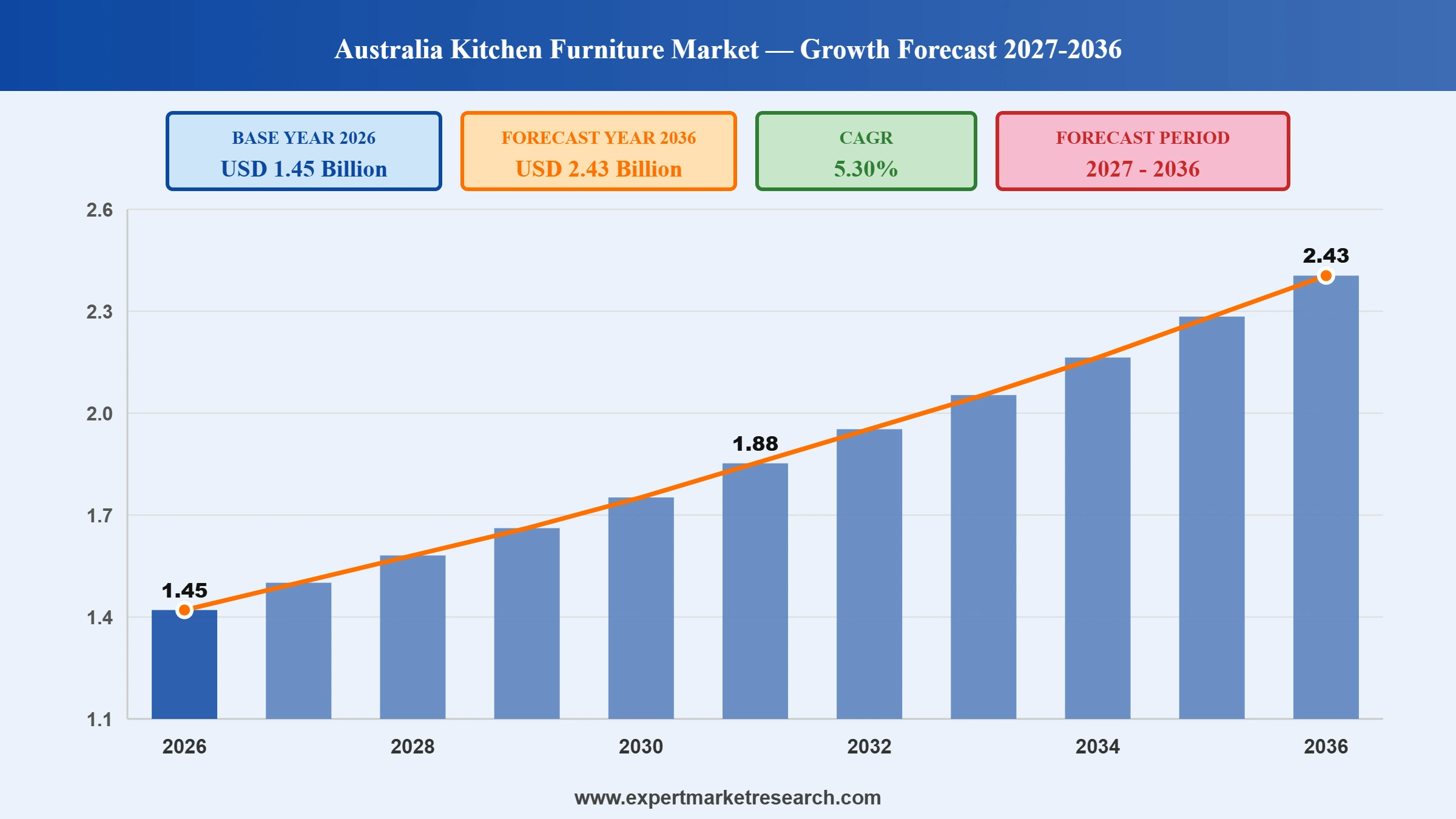
The Australia kitchen furniture market attained a value of USD 1.38 Billion in 2025 and is projected to expand at a CAGR of 5.30% through 2035. The market is further expected to achieve USD 2.31 Billion by 2035. Increased demand for kitchen storage is prompting manufactures to come up with pull-out organizers, corner designs, and ergonomic drawers that increase accessibility without taking up more floor space.
In the Australia kitchen furniture market, manufacturers are trying to integrate modular cabinet systems along with the custom finishes and digital design software that makes kitchen planning easy. For example, in October 2025, Ingka Group launched an upgraded 3D kitchen planning experience of IKEA in 17 countries including Australia, so that customers can design their own kitchens using predesigned kitchens with pricing displayed in real-time. This platform aligns with IKEA's strategy of making kitchen planning easy while increasing customer conversions through visualizations of their kitchen layouts before making purchases. IKEA states that it processes about 1.75 million design projects through its kitchen planning annually, highlighting the commercial aspect of digital product configuration.
Housing activities and demands for renovations are impacting product innovation and distribution approaches as well. According to the Australia kitchen furniture market analysis, the preliminary estimate of the total value of residential dwellings in the country in the December quarter 2025 was AUD 12,307.2 billion. This indicates that there are ample opportunities for cabinet manufacturers and joiners to offer replacement cabinets, drawers, and benchtops without demolishing the structures of homes.
Another demand driving factor in the Australia kitchen furniture market is the requirement of kitchen furniture kits in newly built homes and commercial housing projects. Builders prefer standardized cabinets and easy to order products and supplies that minimize delays in installing kitchen cabinets. At the same time, homeowners are focused on maximizing storage capacity using deep drawers, garbage receptacles, and pantries. Manufacturers that provide modular product offerings and ordering services designed for contractors can help enhance coordination during projects.
Read more about this report - REQUEST FREE SAMPLE COPY IN PDF
Fantastic Furniture collaborated with Are Media for Fantastic by Design, a series of social content that included room transformations, audience voting, and inspiration from furniture that is shoppable. Companies in the Australia kitchen furniture market can utilize interactive campaigns that highlight the use of their furniture in a shoppable format.
The expansion of operations by Artisan Furniture included local fulfillment, inventories, and retailer relationships in the provision of furniture that was made of handcrafted solid wood. Kitchen furniture companies can expand operations locally through fulfillment, digital inventories, and sourcing of sustainable wood.
Through the acquisition of Ramler International, Southern Aluminum was able to increase production capacity and enhance its portfolio in the areas of hospitality and contract furniture. Companies may benefit from acquisitions and alliances with the aim of increasing production capacity and creating commercial kitchen solutions, thus widening the Australia kitchen furniture market scope.
Furniture brand Cozey expanded into the Australian market using e-commerce platforms that provide adaptable furniture, washable covers, and fulfillment from Sydney. Kitchen furniture firms can therefore create modular cabinetry as well as online customization software.
Configuration digitally is increasingly used by kitchen furniture suppliers as a commercial tool which would enable clients to compare configurations, finishes, and prices before making purchases. For example, in April 2026, GlobeWest launched 12 collections featuring over 350 designs, boosting demand in the Australia kitchen furniture market. This includes modular sofas, sculptural tables, storage and homewares, combining natural materials, comfort and functionality for residential and commercial interiors.
Renovation activity brings opportunities for suppliers of replacement cabinetry, drawers, and furniture items that can revamp the space without having to renovate the kitchen extensively. In August 2025, Kaboodle Kitchen introduced earthy cabinetry colors inspired by global design research, offering calming, nature-inspired finishes that align with evolving residential kitchen aesthetics. Such levels of activity offer good opportunities for Australia kitchen furniture market players. Companies may benefit from standardized cabinet sizes, variety of finishes, and compatibility with existing layouts.
A modular system enables players in the Australia kitchen furniture market to develop different domestic designs using standard cabinets and interchangeable parts. This is shown by the METOD system of furniture by IKEA, which includes configurable cabinets, drawer solutions, fronts, and tops and is guaranteed to last for 25 years. The advantage of such systems is that they can enable retailers to reduce the number of products and customers to repaint their cabinets without having to buy new ones. In July 2026, BASISTEM entered Australia through Knoxone, introducing premium kitchen and wardrobe storage systems, including pull-outs, drawer organizers and pantry fittings for modern interiors. For suppliers in Australia, the marketing opportunity would be in the design of such adaptable modules for different domestic spaces, including renovations.
Choosing materials is becoming a point of differentiation in the Australia kitchen furniture market as suppliers look for durability, aesthetic appeal, and environmental performance of materials. Suppliers can focus on recycling material into panels, responsible sourcing of timber, low emission finishes, and replaceable cabinet fronts. This way, they can make the product more useful and beneficial for builders and commercial buyers who need clear material specifications for their projects. In June 2026, Kmart introduced K Home in Melbourne, showcasing affordable furniture, storage and homeware through immersive room displays, challenging IKEA, and established furniture retailers.
Construction of housing remains one of the factors that affect the potential market for kitchen furniture manufacturers, especially those who manufacture kitchen furniture in project-related procurement situations. For instance, Cultivated and Nexus Designs Showcased NEWNEW in July 2025. The collaboration highlighted restored, landfill-bound furniture at Melbourne’s Green Design Show, promoting circular design and sustainable furniture practices. Companies can leverage such Australia kitchen furniture market opportunities for cabinetry, pantry systems, and packages of kitchen furniture.
The Expert Market Research's report titled “Australia Kitchen Furniture Market Report and Forecast 2026-2035” offers a detailed analysis of the market based on the following segments:
Market Breakup by Product
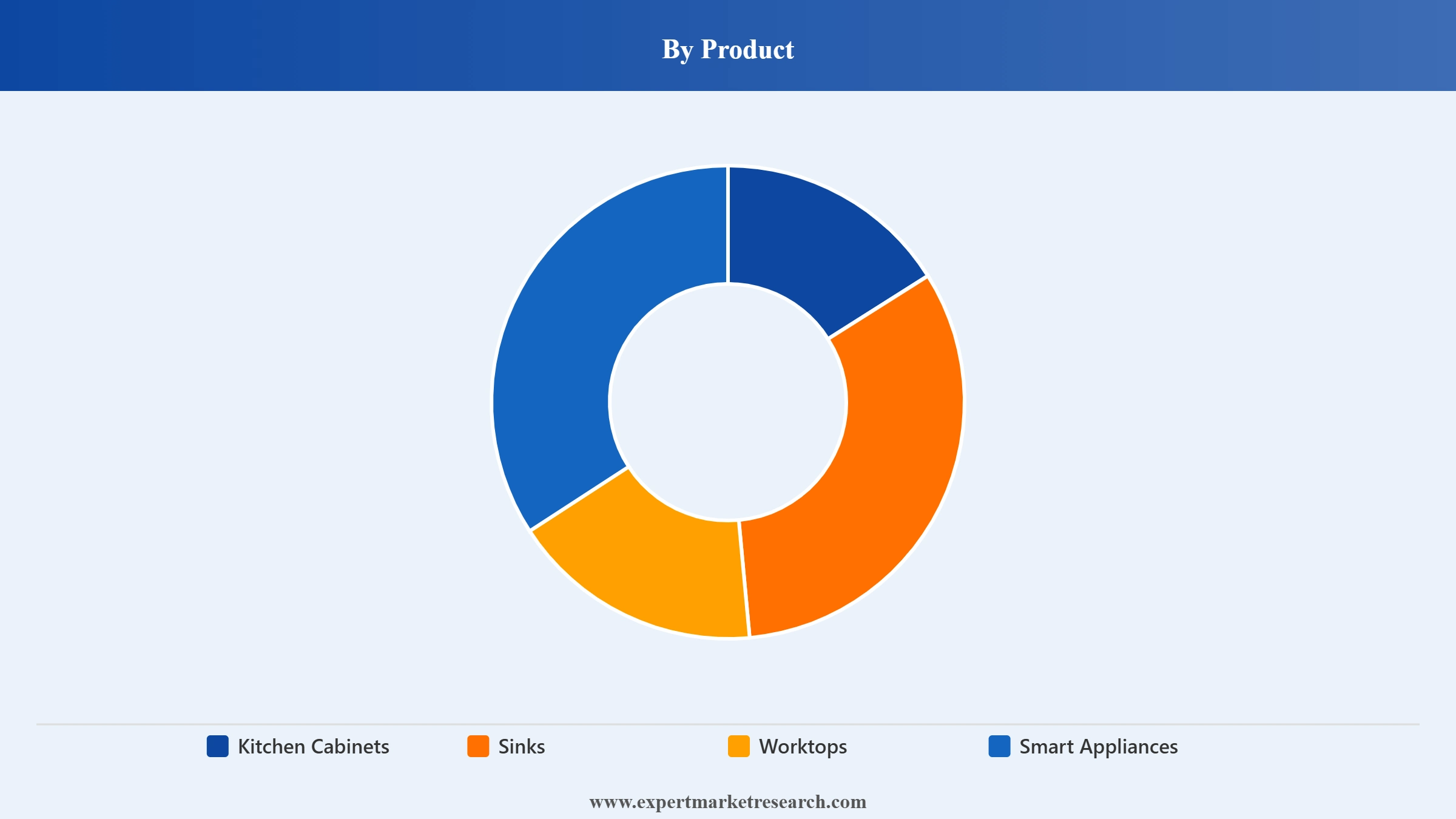
Key Insight: Kitchen cabinets are an important aspect of kitchen furniture due to their provision of vital storage space, organizing work surfaces, and being the basis on which a well-coordinated kitchen layout is found. Kitchen sinks secure expanding share in the Australia kitchen furniture market owing to their strength, bowl design, drainage system, and their integration with cabinets. Work surfaces are chosen based on their resistance to scratches, heat, and appearance. In December 2024, OPPOLIA introduced durable sinks, multifunctional faucets, and pull-out baskets, improving kitchen storage, convenience, and functionality.
Market Breakup by Material
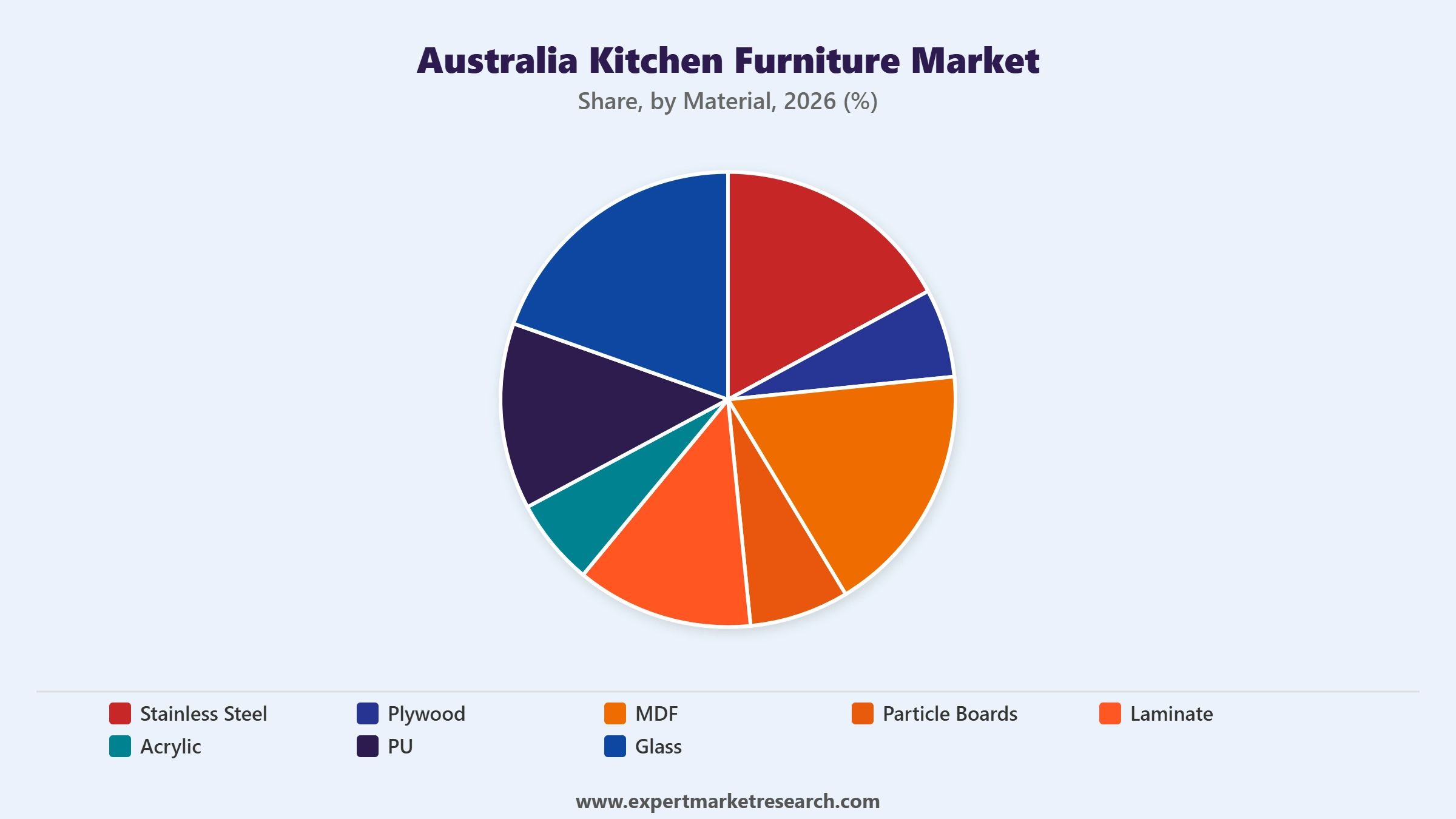
Key Insight: As per the Australia kitchen furniture market report, stainless steel works well for sinks and certain types of cabinets where hygienic properties, rust prevention, and ease of maintenance are required. Plywood is used for structurally tough cabinets and custom furniture, while MDF works well for painted doors. Particle boards are used for economically modular kitchens due to their efficiency and decorative appearance. Laminates offer a good surface finish and many design options, while acrylics add a glossy contemporary look to the cabinet fronts.
Market Breakup by End Use
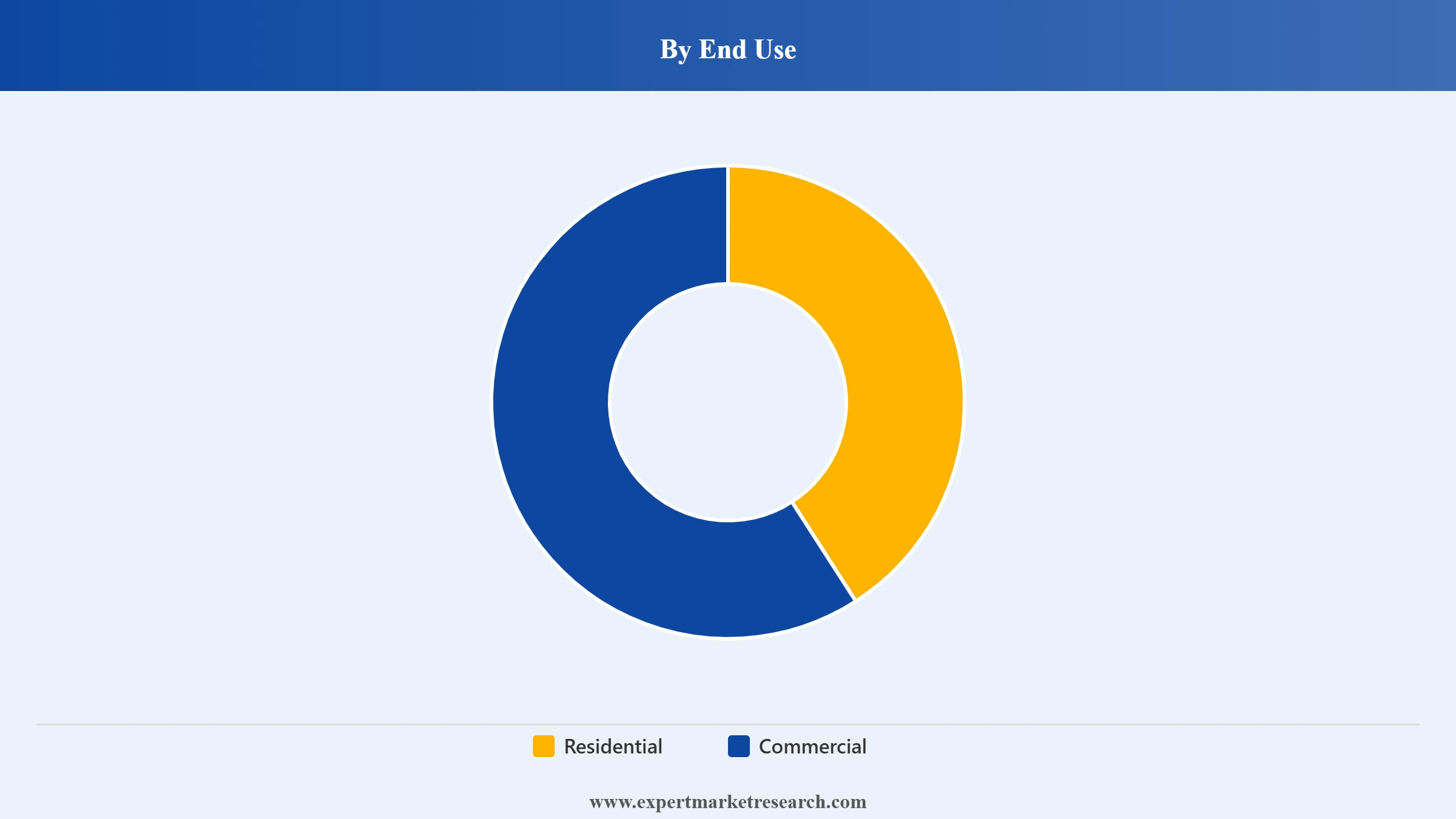
Key Insight: Residential consumers emphasize storage space, aesthetics, functionality in terms of use within the home, and cabinets that match the decor of the rooms, contributing to the Australia kitchen furniture market value. Home builders are mostly interested in consistency in their specifications and timelines when it comes to installation, whereas renovation consumers want flexible dimensions as well as replacements for damaged parts. Commercial consumers value durability, ease of cleaning, workflow, and compatibility with other commercial equipment.
Market Breakup by Distribution Channel
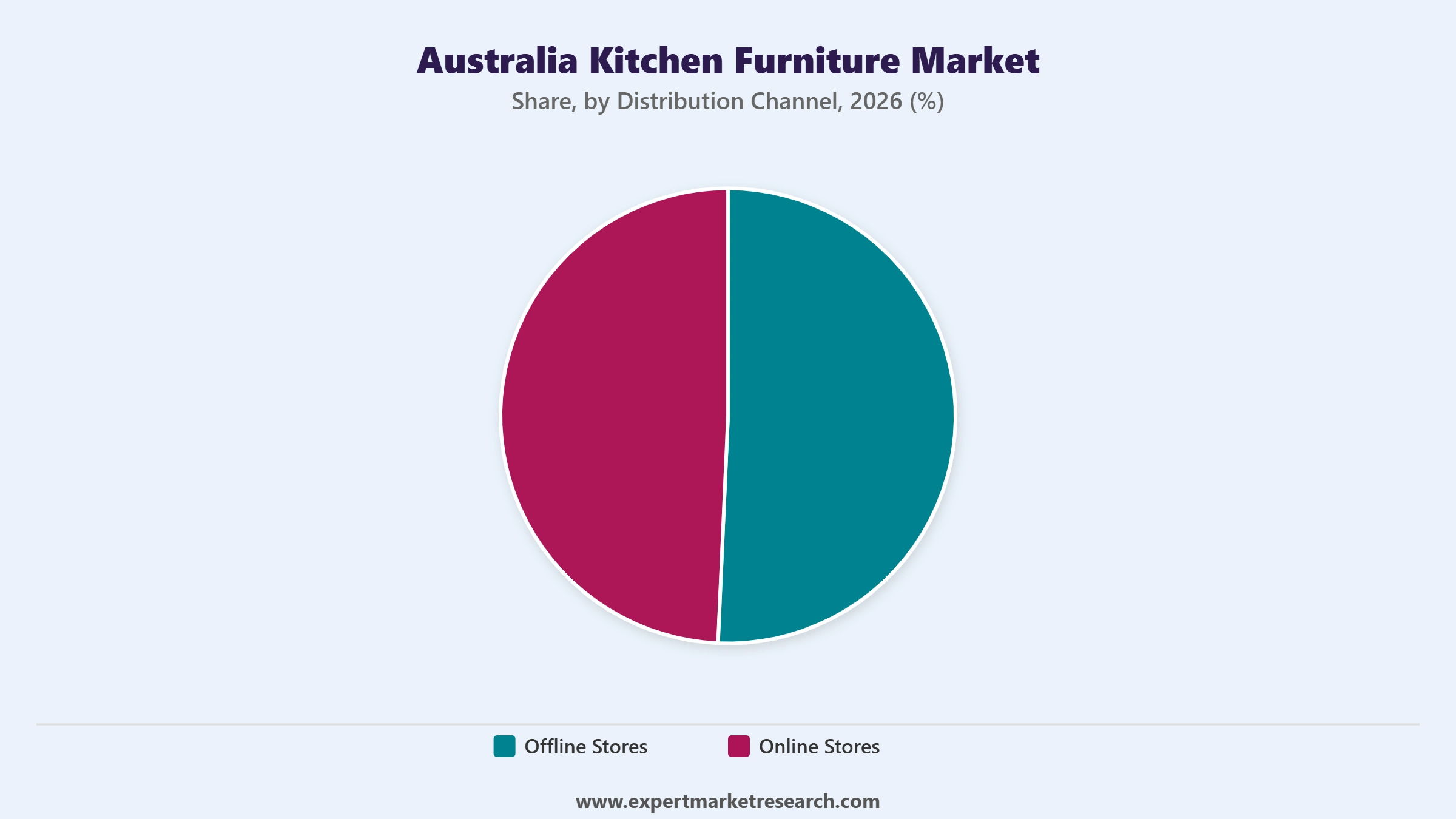
Key Insight: Physical stores facilitate the purchasing of kitchen furniture by means of tangible product assessment, consultations, customization of designs, and coordination with installers. Online stores enable buyers to make comparisons regarding the finishing, sizes, packaged components, and costs of products when conducting research about the products at their own leisure. Electronic catalogs can also facilitate the specification process among homeowners, designers, and contractors, further contributing to demand in the Australia kitchen furniture market.
Market Breakup by Region
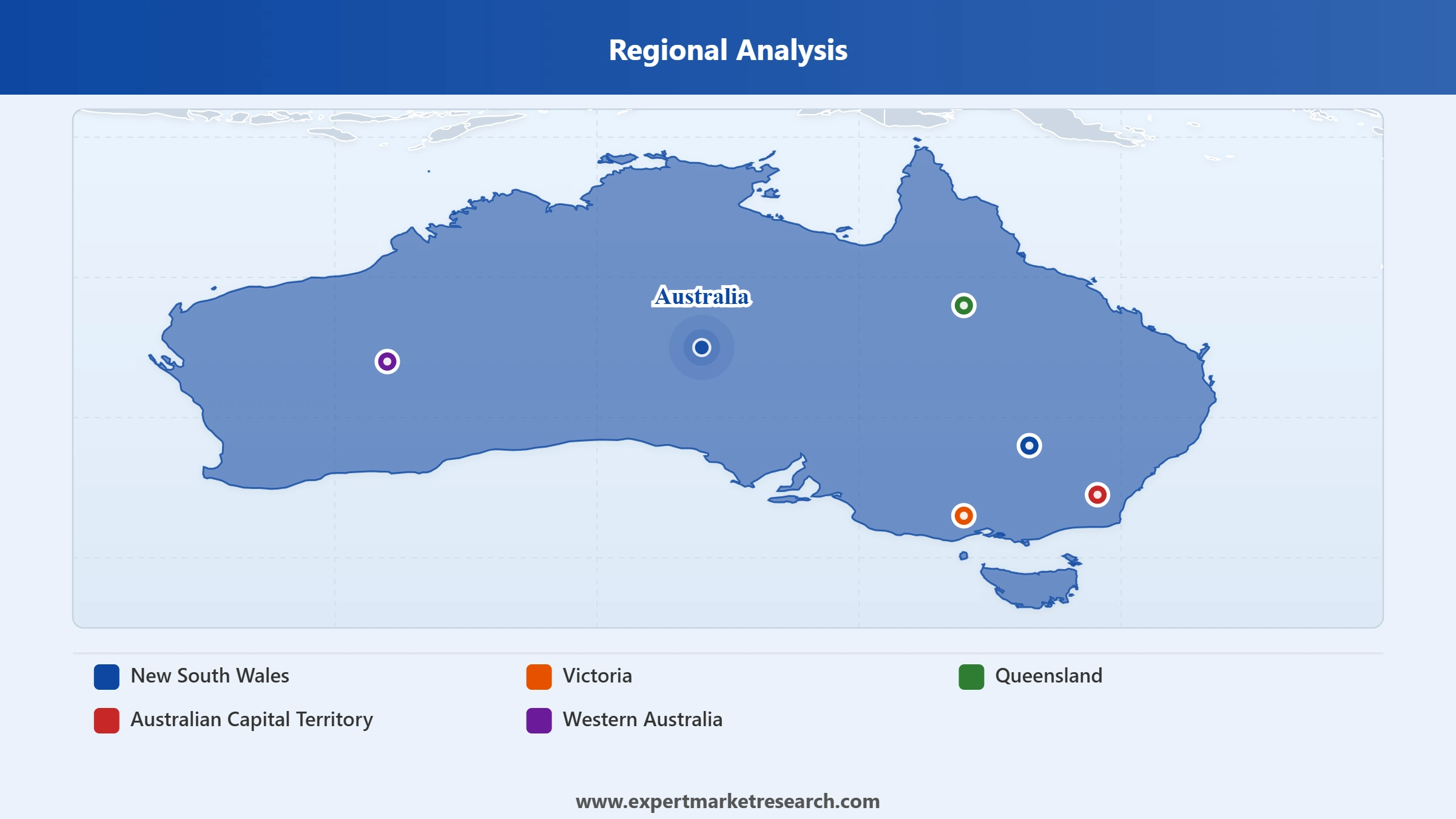
Key Insight: New South Wales is advantaged by the diversity of Sydney’s population, the number of showrooms, and the demand for cabinetry suitable for apartments. Victoria provides opportunities in Melbourne in terms of residential properties, established houses, and modern cabinetry. Queensland supports demand for kitchens in residential areas, where functional designs are required to suit the environment. The Western Australian market growth is supported by Perth’s housing market, established homes, and renovation work that needs to be coordinated to produce cabinetry. The Australian Capital Territory provides opportunities through homeowners, apartments, and governmental accommodation projects.
Read more about this report - REQUEST FREE SAMPLE COPY IN PDF
By product, kitchen cabinets dominate the market due to essential storage requirements and customizable modular configurations
Kitchen cabinets are becoming the core of procurement strategies in the Australia kitchen furniture industry , providing important storage space as well as defining the entire kitchen design. In Australia, modular cabinets that cater to different sizes of rooms, appliance placement, and storage needs are becoming popular choices among homeowners and renovation firms. Differentiation between the products can be done through soft close drawers, pullout pantries, adjustable shelves, and changing cabinet fronts. Standardized size and coordinated finishes would make it easier for bulk procurement and installation for constructors. In January 2024, NK Kitchen introduced an online shop offering cabinetry products and convenient digital access to kitchen solutions.
Read more about this report - REQUEST FREE SAMPLE COPY IN PDF
The rise of smart appliances provides companies in the Australia kitchen furniture market a chance to design cabinets that will fit connected ovens, fridges, dishwashers, and induction cooktops. Integration needs determine the cabinet size, ventilation options, electricity needs, and appliance panel placement. Manufacturers can collaborate with different appliance and kitchen furniture designers to provide coordinated designs which ensure perfect installation and matching aesthetics. Demand might be driven by homeowners looking for automated cooking, monitoring, and better energy management.
By material, particle boards lead demand in the market due to affordability, consistent dimensions, and efficient mass production
The Australia kitchen furniture market observes great versatility in particle boards in cost effective kitchen cabinetry due to their uniformity in thickness and machining and efficient use in standard furniture making. Kitchen cabinet manufacturers often use panels with melamine or laminate finishes to create coordinated, durable, and cost-effective cabinetry solutions. In addition, moisture resistance is an essential feature, especially in areas such as sinks and dishwashers. In June 2025, ForestOne introduced 24 sustainable decorative panel designs across three finishes for cabinetry, furniture, and wardrobes.
Read more about this report - REQUEST FREE SAMPLE COPY IN PDF
Another excellent alternative boosting the Australia kitchen furniture demand forecast is plywood since it makes good kitchen cabinets with its strength, screw retention, and high quality. Plywood can be used in cabinet carcases, drawers and in some cases exposed surfaces. Manufacturers can differentiate their ranges through certified timber sourcing, precision-machined panels, and coordinated finishes.
Residential end use accounts for the dominant market position owing to household renovations, new homes, and personalized kitchen layouts
Residential applications contribute to the Australia kitchen furniture market revenue due to the importance of kitchens as functional rooms in new constructions and refurbishments. The owners are looking for harmoniously designed cabinetry, good storage opportunities, resilient countertops, and configurations based on their cooking and entertainment behavior. Manufacturers usually prefer those specifications that are easy to replicate and install, and finishes which might attract future housing clients. In refurbishments, flexible furniture is required to fit the existing dimensions without big structural adjustments.
Read more about this report - REQUEST FREE SAMPLE COPY IN PDF
In commercial kitchens of hospitality establishments, offices, accommodation facilities, and certain institutional establishments, there is a need for furniture which will be durable enough, easily cleaned, reliable in terms of hardware, and based on the specific staff movement and equipment placement. The suppliers of this type of furniture may offer modular cabinetry, stainless-steel workstations, and storage systems tailored according to individual needs of each facility, driving the Australia kitchen furniture market penetration. In February 2026, ducksnest. highlighted European-inspired dining, seating and living furniture, emphasizing craftsmanship, timeless aesthetics and everyday functionality.
By distribution channel, offline stores continue to dominate the market through physical product inspection, design consultations, and installation assistance
Offline stores play a critical role in contributing to the overall Australia kitchen furniture industry revenue as clients evaluate parameters such as finishes, cabinet construction, hardware, and samples of worktops before specifying their requirements. Showrooms allow the retailer to show a complete kitchen layout to clients and offer measurement, consultation on design, and installation services. Such services are particularly important when making custom orders and during renovation projects when the coordination of the dimensions and appliance compatibility is required. In October 2026, Discount Custom Cabinets introduced Edgeline Ridge, a slim Shaker cabinet line featuring warm mid-tone stains, solid birch construction and soft-close hardware.
Read more about this report - REQUEST FREE SAMPLE COPY IN PDF
Online stores accelerate the Australia kitchen furniture market expansion as suppliers reach customers via digital catalogues, configurable products and quotation request forms. Customers can compare finishes, sizes, storage accessories and packages of cabinets before visiting the showroom and ordering installation. Accurate description and realistic visualizations are important in this segment since there are certain measurement and compatibility issues.
New South Wales accounts for a significant share in the market owing to concentrated housing activity, urban renovations, and established retail networks
New South Wales commands an expanding share in the Australia kitchen furniture market due to Sydney's existing stock of houses, construction of apartments, and renovations that lead to the diverse demand for kitchen furniture. There is a need to supply furniture to homeowners who renovate old kitchens as well as to builders who are building new homes. The efficient use of space, built-in storage, durable countertops, and modern finishes are applicable both for apartments and detached houses. In July 2026, Poliform renovated its Sydney showroom, showcasing premium furniture, kitchens, wardrobes, and customizable interior solutions.
Read more about this report - REQUEST FREE SAMPLE COPY IN PDF
Queensland offers ample opportunities for the Australia kitchen furniture market growth that include supplying furniture to expanding residential neighborhoods, detached houses, and renovation works. Customers may prefer practical furniture, open spaces, durable materials, and furniture for kitchens adjacent to dining or entertainment areas. Manufacturers need to pay attention to humidity and moisture that the furniture will be exposed to when choosing the type of panels, edging, and hardware.
Competition within the industry is based on modular design, performance in terms of materials, improved storage capacity, and project delivery efficiency. Australia kitchen furniture companies are competing in terms of high-quality tops, engineered fittings, decorative panels, and cabinetry systems that complement built-in appliances. Some potential areas of growth include renovation-focused furniture sets, moisture-resistant parts, and online design assistance services for helping clients see what their order will look like before purchasing.
Moreover, Australia kitchen furniture market players can build up business ties with constructors, joineries, architects, and kitchenware retailers may help in securing repeat orders. Investing in panel processing automation, flexible finishes, and materials provenance tracking can aid in increasing product reliability.
Formed in 1987 in Australia, Caesarstone Australia Pty Ltd. has its manufacturing base in Australia. On the other hand, its parent company produces engineered stone, porcelain, and other high-end surfaces for kitchen worktops. It helps fabricators and retailers in providing unique surface solutions.
Blum Australia Pty Ltd. is incorporated in 2000 in Australia. The parent company produces furniture fittings which include hinges, lift systems, drawer runners, box systems, and pocket systems to enhance accessibility of storage in modern kitchen furniture.
Fletcher Building started in 1915, and the company is based in Auckland, New Zealand. Fletcher Building Group engages in various operations including building products, distribution, construction materials, and residential development in both Australia and New Zealand. By building products division which includes brands such as Laminex, the company deals with decorative panels, laminates, and surfaces that are suitable for kitchen cabinetry and interiors.
Borg Manufacturing Company was set up by the Borg Family on the Central Coast of Australia and was established in 1990. The company is headquartered in Somersby, New South Wales. The Borg Group provides decorative panels, particle board, MDF, melamine surfaces, and cabinetry materials via its manufacturing operations.
Other key players in the market include GoldenHome Living Co., Ltd., Hettich Holding GmbH & Co., Bonlex Australia, and Du Pont de Nemours, among others.
*Please note that this is only a partial list; the complete list of key players is available in the full report. Additionally, the list of key players can be customized to better suit your needs.*
Unlock the latest insights with our Australia kitchen furniture market trends 2026 report. Discover regional growth patterns, consumer preferences, and key industry players. Stay ahead of competition with trusted data and expert analysis. Download your free sample report today and drive informed decisions in the market.


Upto 15% Off
USD
$2499 $2249
$3999 $3599
$4999 $4249
$5999 $5099


*While we strive to always give you current and accurate information, the numbers depicted on the website are indicative and may differ from the actual numbers in the main report. At Expert Market Research, we aim to bring you the latest insights and trends in the market. Using our analyses and forecasts, stakeholders can understand the market dynamics, navigate challenges, and capitalize on opportunities to make data-driven strategic decisions.*
In 2025, the market reached an approximate value of USD 1.38 Billion.
The market is projected to grow at a CAGR of 5.30% between 2026 and 2035.
The kitchen furniture is estimated to witness a healthy growth in the forecast period of 2026-2035 to reach USD 2.31 Billion by 2035.
Manufacturers are expanding modular portfolios, improving moisture-resistant finishes, integrating digital configurators, strengthening builder partnerships, securing material supply, and developing traceable, durable products while streamlining installation and after-sales support.
Key trends aiding the market expansion are growing demand for sustainable and eco-friendly kitchen equipment, shift towards modular kitchen, and integration of smart technologies in kitchens.
Regions considered in the market are New South Wales, Victoria, Queensland, Western Australia, and Australian Capital Territory, among others.
Stainless steel, plywood, MDF, particle boards, laminate, acrylic, PU, and glass are some of the materials considered in the report.
Based on end use, the market segmentations include residential and commercial.
Products in the market are kitchen cabinets, sinks, worktops, and smart appliances, among others.
The key players in the market include Caesarstone Australia Pty Ltd., Blum Australia Pty Ltd., Fletcher Building Group, Borg Manufacturing Pty Ltd., GoldenHome Living Co., Ltd., Hettich Holding GmbH & Co., Bonlex Australia, and Du Pont de Nemours, among others.
Companies face volatile panel and hardware costs, skilled installer shortages, lengthy project timelines, imported-component dependence, changing design preferences, and stricter engineered-stone safety requirements while maintaining competitive pricing and reliable product quality.
Explore our key highlights of the report and gain a concise overview of key findings, trends, and actionable insights that will empower your strategic decisions.
| REPORT FEATURES | DETAILS |
| Base Year | 2025 |
| Historical Period | 2019-2025 |
| Forecast Period | 2026-2035 |
| Scope of the Report |
Historical and Forecast Trends, Industry Drivers and Constraints, Historical and Forecast Market Analysis by Segment:
|
| Breakup by Product |
|
| Breakup by Material |
|
| Breakup by End Use |
|
| Breakup by Distribution Channel |
|
| Breakup by Region |
|
| Market Dynamics |
|
| Competitive Landscape |
|
| Companies Covered |
|
Datasheet
One User
USD 2,499
USD 2,249
tax inclusive*
Single User License
One User
USD 3,999
USD 3,599
tax inclusive*
Five User License
Five User
USD 4,999
USD 4,249
tax inclusive*
Corporate License
Unlimited Users
USD 5,999
USD 5,099
tax inclusive*
*Please note that the prices mentioned below are starting prices for each bundle type. Kindly contact our team for further details.*
Flash Bundle
Small Business Bundle
Growth Bundle
Enterprise Bundle
*Please note that the prices mentioned below are starting prices for each bundle type. Kindly contact our team for further details.*
Flash Bundle
Number of Reports: 3
20%
tax inclusive*
Small Business Bundle
Number of Reports: 5
25%
tax inclusive*
Growth Bundle
Number of Reports: 8
30%
tax inclusive*
Enterprise Bundle
Number of Reports: 10
35%
tax inclusive*
How To Order

Select License Type
Choose the right license for your needs and access rights.

Click on ‘Buy Now’
Add the report to your cart with one click and proceed to register.

Select Mode of Payment
Choose a payment option for a secure checkout. You will be redirected accordingly.
Strategic Solutions for Informed Decision-Making
Gain insights to stay ahead and seize opportunities.

Get insights & trends for a competitive edge.

Track prices with detailed trend reports.

Analyse trade data for supply chain insights.

Leverage cost reports for smart savings

Enhance supply chain with partnerships.

Connect For More Information
Our expert team of analysts will offer full support and resolve any queries regarding the report, before and after the purchase.
Our expert team of analysts will offer full support and resolve any queries regarding the report, before and after the purchase.
We employ meticulous research methods, blending advanced analytics and expert insights to deliver accurate, actionable industry intelligence, staying ahead of competitors.
Our skilled analysts offer unparalleled competitive advantage with detailed insights on current and emerging markets, ensuring your strategic edge.
We offer an in-depth yet simplified presentation of industry insights and analysis to meet your specific requirements effectively.




