

Consumer Insights
Uncover trends and behaviors shaping consumer choices today
Procurement Insights
Optimize your sourcing strategy with key market data
Industry Stats
Stay ahead with the latest trends and market analysis.
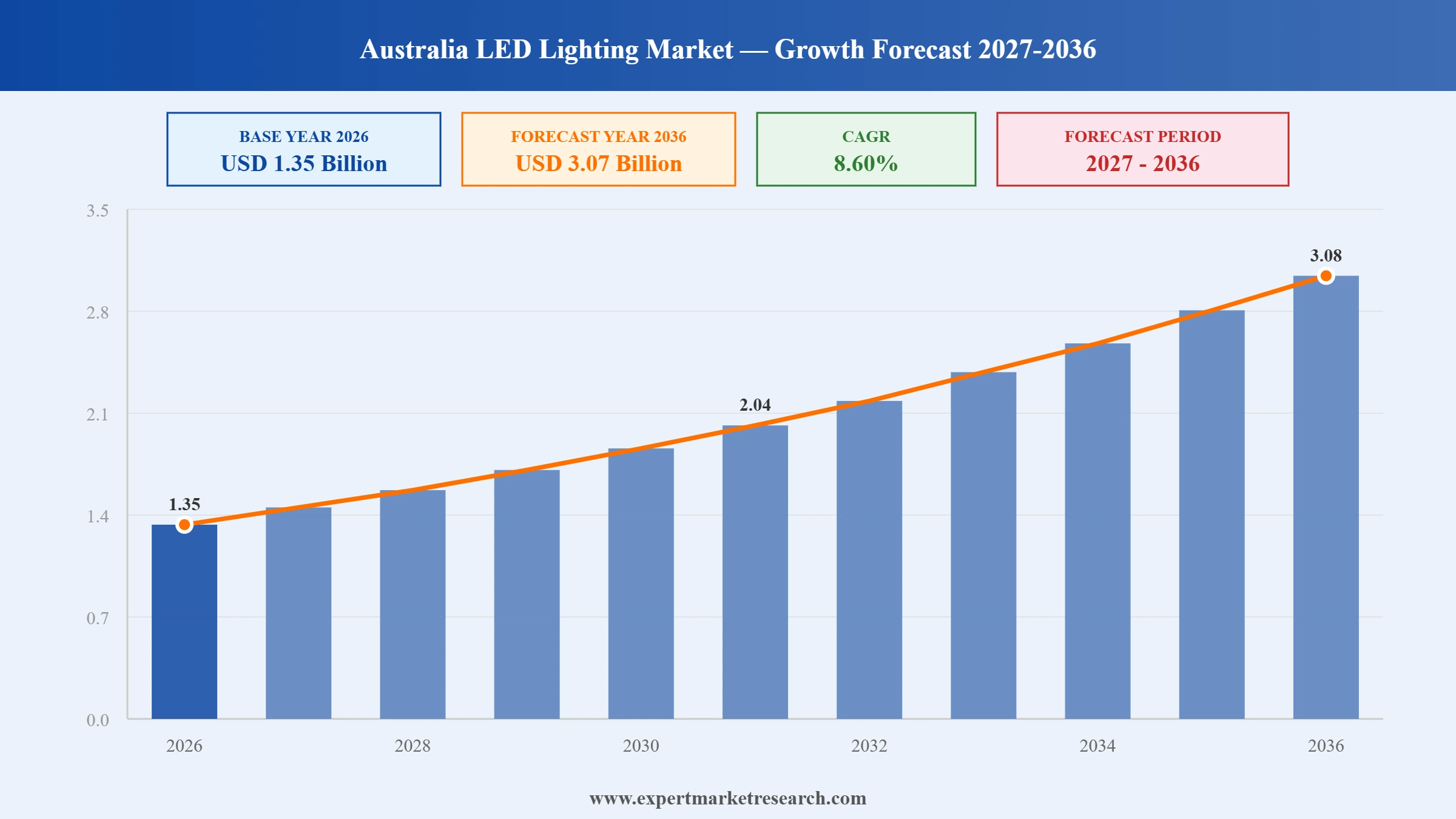
The Australia LED lighting market attained a value of USD 1.24 Billion in 2025 and is projected to expand at a CAGR of 8.60% through 2035. The market is further expected to achieve USD 2.83 Billion by 2035, driven by declining LED component costs, expanding government energy-efficiency mandates, and rising retrofit demand across residential, commercial, and industrial buildings. Growth spans luminaires and lamps deployed across retrofit and new installations, with luminaire and lamp manufacturers increasingly competing on smart connectivity, product certification, and regional distribution depth across New South Wales, Victoria, Queensland, and other states.
Rising electricity costs and mounting sustainability commitments continue to anchor steady demand across the Australia LED lighting market, as households and businesses increasingly favour energy-efficient fixtures over legacy incandescent and fluorescent alternatives. Manufacturers are also investing in smart, connected lighting products, reflecting the industry's pursuit of solutions that extend beyond basic illumination toward automation and remote control.
The Australia LED lighting market is witnessing further developments as global lighting manufacturers realign their Australian product portfolios around unified branding and connected-lighting platforms. In June 2026, Signify began transitioning its specification luminaire ranges across Australia to the unified Signify brand, starting with sports lighting and extending to road, solar, tunnel, and flood luminaires by the end of 2026. This consolidation reflects manufacturers' recognition that a single, globally recognised brand simplifies specification for commercial and municipal buyers.
In addition, regulatory compliance deadlines are increasingly shaping product development and distribution timelines, reflecting the industry's adjustment to tightening energy-efficiency and safety standards. Under the GEMS Determination 2025, all LED lamps sold in Australia must be registered and compliant by 3 March 2026, a deadline reshaping product roadmaps across the wider australia led lighting market as manufacturers accelerate certification programmes to maintain shelf access ahead of the deadline.
Read more about this report - REQUEST FREE SAMPLE COPY IN PDF
Global lighting manufacturers are increasingly consolidating fragmented product portfolios inherited from past acquisitions into single, globally recognised names. In June 2026, this shift saw the phased retirement of several legacy Australian fixture ranges in favour of one unified corporate identity across sports, road, solar, tunnel, and flood categories by year end. The move consolidates several legacy product lines under one globally recognised name, simplifying specification for architects and lighting designers. Companies can leverage unified branding to reduce buyer confusion and strengthen cross-category recognition among commercial specifiers.
Regulators are tightening product registration requirements as older, non-compliant stock works through Australian distribution channels. A national energy-efficiency framework now requires manufacturers to complete formal government registration for replacement bulb products by early 2026, creating an immediate cutoff for items lacking certification. Suppliers unable to meet the deadline risk losing shelf access across major retail and wholesale channels. Companies can leverage early compliance certification to secure continued distributor relationships as non-compliant competitors exit the market.
State-level subsidy programmes that have underpinned years of office and retail fixture upgrades are beginning to sunset as their funding periods expire. One of the largest such schemes stopped accepting new commercial project bookings at the end of the first quarter of 2026, prompting installers to redirect customers toward remaining interstate alternatives. The scheme had previously subsidised widespread commercial LED retrofits across the state. Companies can leverage the transition period to shift commercial customers toward remaining state-based rebate programmes such as Victoria's VEU scheme.
International specialist manufacturers continue entering the local commercial-vehicle lighting segment, drawn by strong demand from mining, agriculture, and transport fleets. A UK manufacturer expanded its trans-Tasman footprint in spring 2025 with a compact, durable fixture engineered specifically for heavy trucks operating in harsh outdoor conditions. The launch reflects growing international manufacturer interest in Australia's outdoor and commercial vehicle lighting segment. Companies can leverage specialist commercial-vehicle product lines to differentiate from general-purpose outdoor lighting suppliers.
Established commercial lighting suppliers are investing in dedicated infrastructure to support growing order volumes rather than continuing to operate from ageing rented premises. Decrolux Lighting completed a purpose-built double-storey office, warehouse, and workshop facility in June 2026, featuring a large mezzanine for additional storage, delivered on time and within budget to accommodate the company's expanding team and operations. Companies can leverage purpose-built facility investment to support continued order growth without the operational disruption of outgrowing existing premises, a consideration that becomes increasingly pressing for manufacturers experiencing sustained demand across multiple product categories simultaneously.
Australian-owned lighting manufacturers are recalibrating pricing structures as input costs and component sourcing conditions continue to shift. Haneco Lighting issued an updated product price list in May 2026 to its network of electrical wholesalers and contractors nationwide, reflecting the company's ongoing adjustment of its LED downlight, batten, and floodlight ranges. Companies can leverage transparent, regularly updated wholesale pricing to maintain trust with electrical wholesale channel partners during periods of cost volatility, particularly as contractors increasingly compare supplier pricing transparency when selecting long-term procurement relationships for ongoing project work.
New baseline cybersecurity obligations are reshaping product certification requirements well beyond traditional electrical and energy-efficiency testing. A national ruleset covering most consumer-facing connected hardware took effect in early March 2026, sweeping in Wi-Fi and Zigbee-enabled fixtures alongside other household smart devices. The rules add a compliance layer for connected lighting suppliers alongside existing electrical safety and energy-efficiency requirements. Vendors of smart bulbs, downlights, and lighting controllers are adjusting certification processes to meet the new baseline ahead of enforcement, with several suppliers expanding local testing capacity to avoid delays to product launch timelines once the rules take full effect.
State rebate regulators are recalibrating scheme economics as programmes mature and shift focus between residential and commercial categories. Revised Victorian Energy Upgrades programme fees for 2026 and 2027 took effect from 1 January 2026, with commercial lighting activities such as fluorescent, halogen, and high-bay replacement remaining a strong rebate opportunity even as some residential lighting subsidies have wound back. Companies can leverage continued commercial-tier VEU eligibility to sustain business-to-business retrofit sales even where residential incentive support has narrowed, redirecting sales and marketing focus toward commercial property managers still eligible for the stronger rebate tier.
This Expert Market Research Report titled "Australia LED Lighting Market Report and Forecast 2026-2035" offers a detailed analysis of the market based on the following segments:
Market Breakup by Product Type
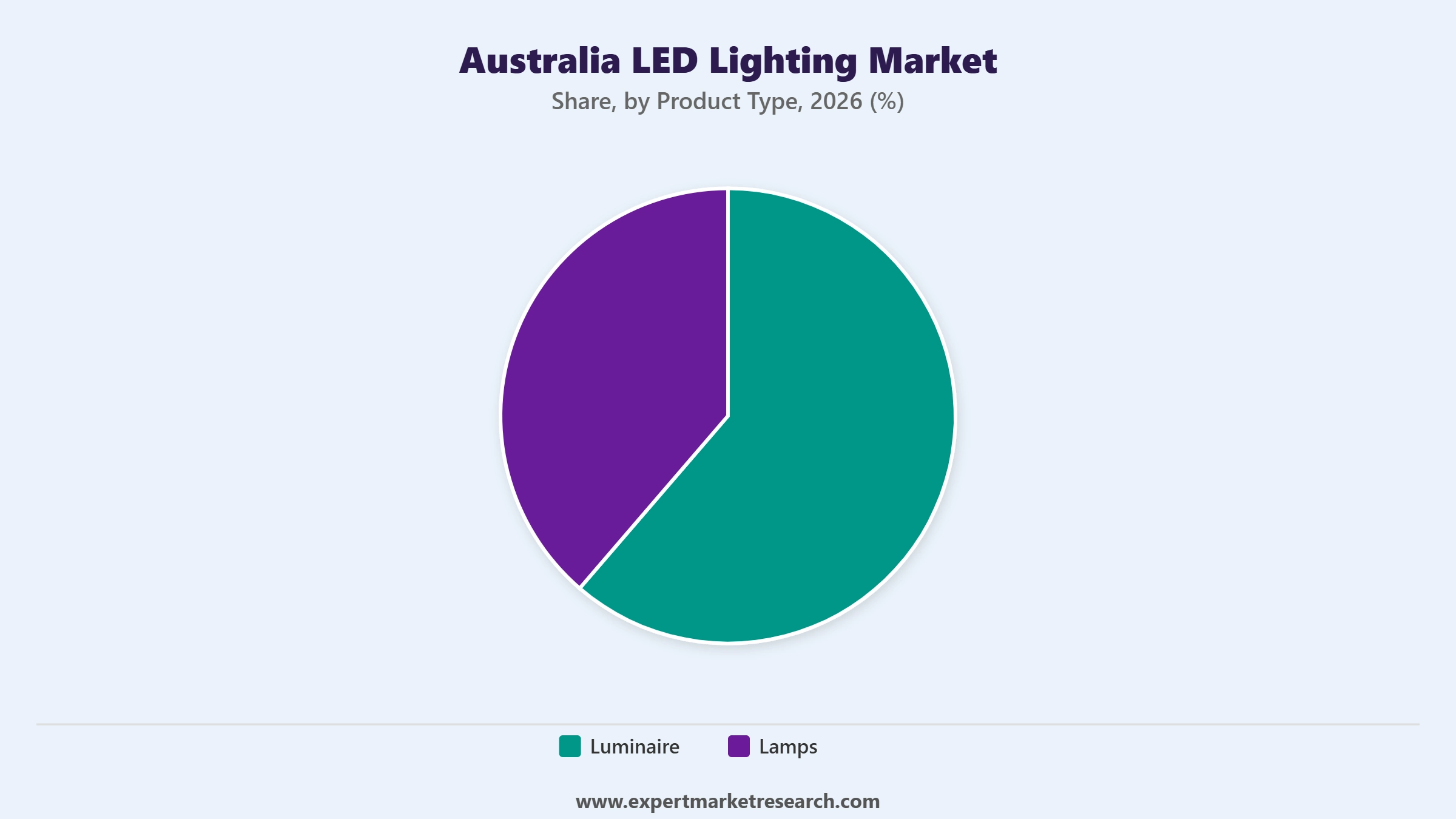
Key Insight: Luminaire accounts for the largest share of the australia led lighting market, with Troffers representing its dominant sub-category given widespread commercial ceiling-grid adoption. High Bay serves warehouse and industrial facility lighting requiring high-mounting illumination. Track Lights support retail and gallery display applications requiring adjustable beam direction. Streetlight is expanding as utilities pursue large-scale conversion programmes, illustrated by Ausgrid's 2026 rollout exceeding 240,000 LED streetlight installations across New South Wales. Others covers specialised luminaire formats serving niche commercial and architectural requirements. Lamps is growing at the fastest pace, with T-Lamps and A-Lamps together anchoring the retrofit replacement bulb category, both directly affected by the GEMS Determination 2025 compliance deadline of 3 March 2026, while Others captures smaller-volume lamp formats. Manufacturers across both categories continue investing in compliance-ready product lines ahead of the deadline, with several suppliers expanding local testing and certification capacity to reduce approval turnaround times for new fixture ranges entering the market.
Market Breakup by Installation Type
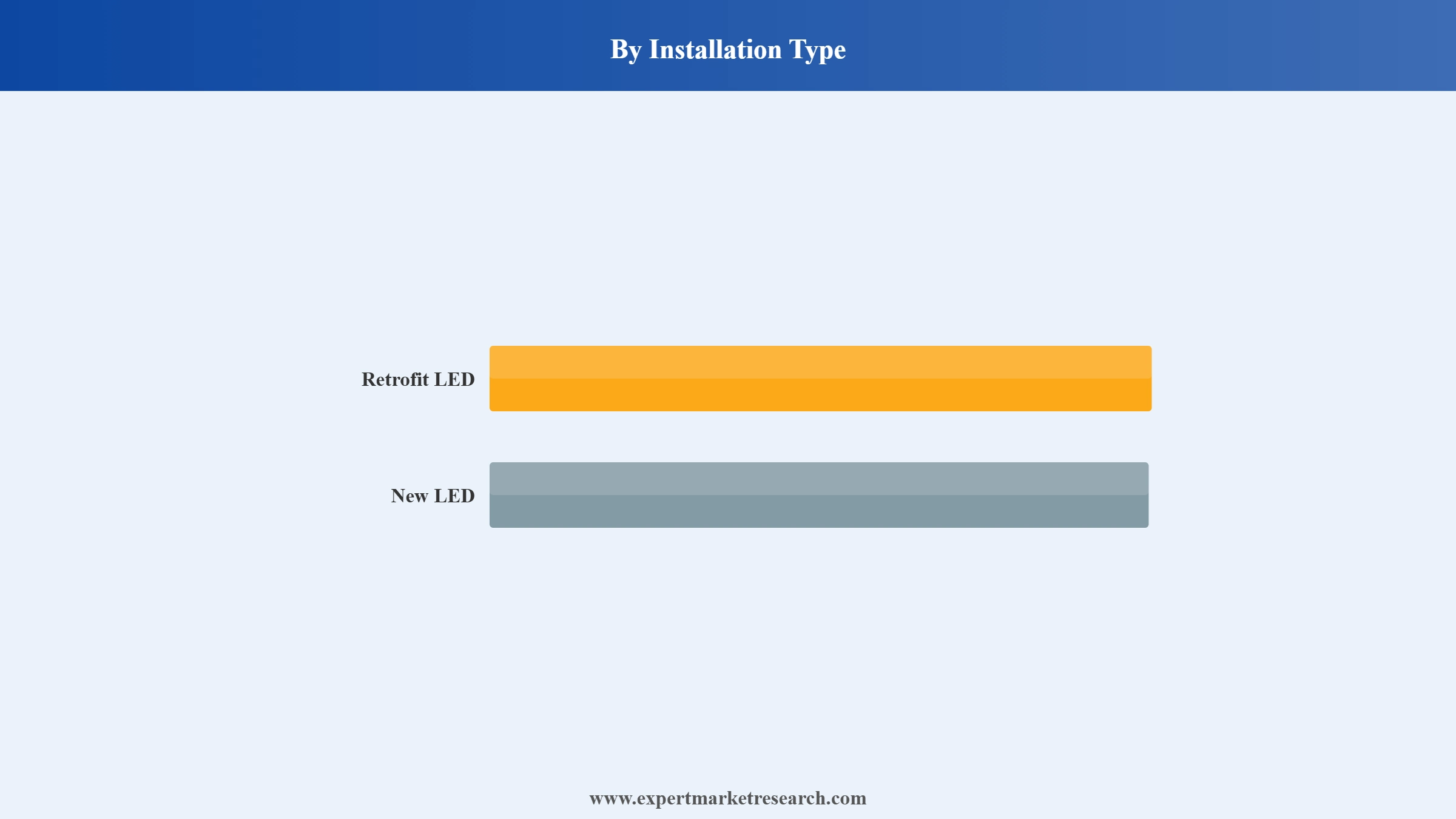
Key Insight: Retrofit LED accounts for the largest share of the market, reflecting straightforward installation into existing fixtures without major structural alterations, a category directly targeted by New South Wales' Energy Savings Scheme before its commercial lighting activity concluded on 31 March 2026. New LED is growing at the fastest pace at a CAGR of 10.70%, as new commercial and residential construction increasingly specifies LED fixtures from the outset rather than retrofitting legacy lighting at a later stage, a shift reinforced by updated building codes that increasingly mandate minimum lighting efficiency standards for newly approved developments across most Australian states and territories.
Market Breakup by Application
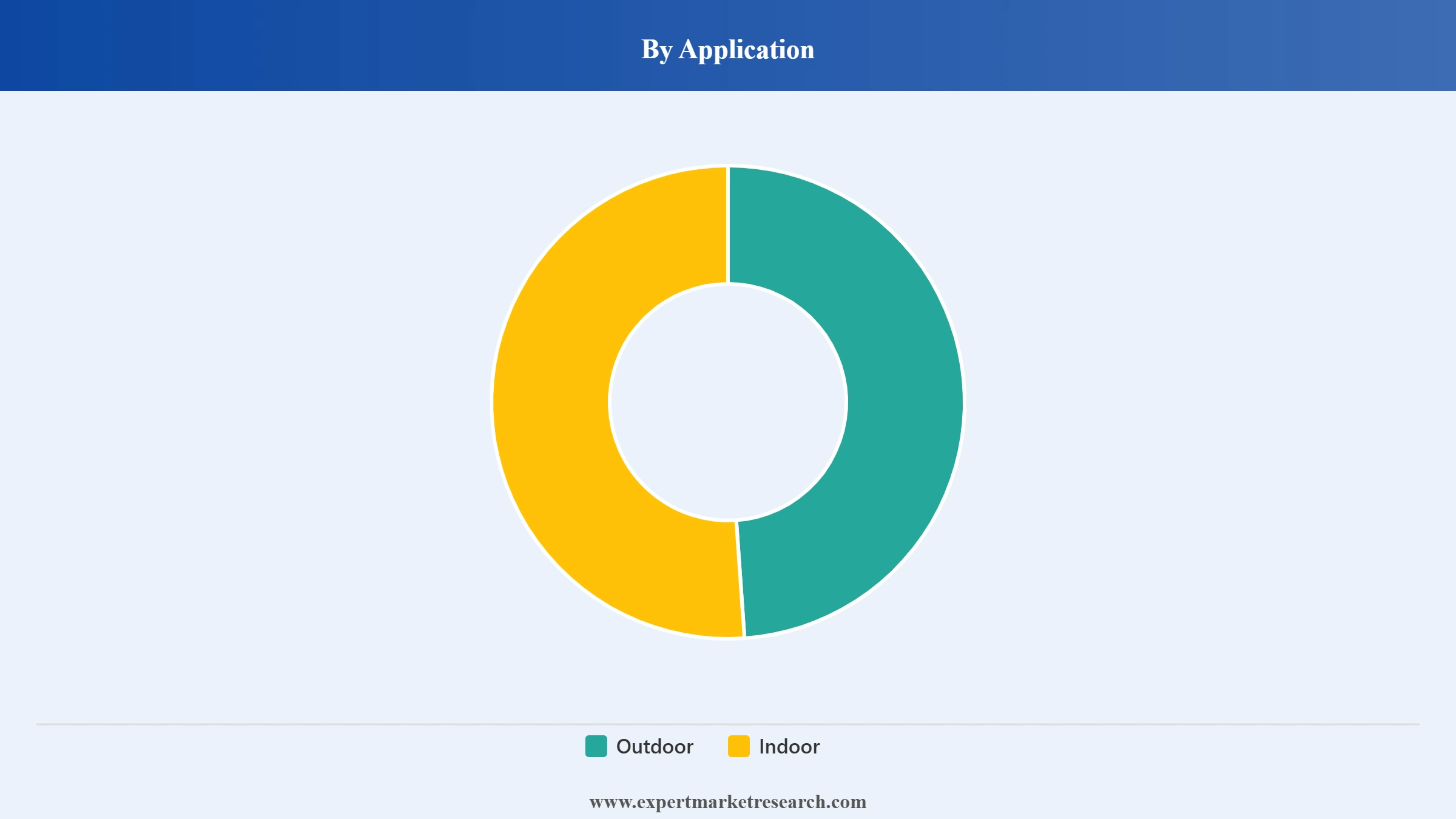
Key Insight: Indoor accounts for the largest share of the market, supported by sustained residential and commercial interior lighting demand, an application increasingly shaped by the Cyber Security (Security Standards for Smart Device) Rules 2025 that commenced 4 March 2026 for connected indoor lighting products. Outdoor is growing at the fastest pace at a CAGR of 10.30%, illustrated by Lazer Lamps' April 2025 launch of its AIR LED light bar for heavy trucks and commercial vehicles across Australia and New Zealand, as councils and utilities simultaneously expand streetlight and public-space conversion programmes, with several regional councils fast-tracking additional conversion tenders to capture remaining state-level rebate funding before scheme closure dates.
Market Breakup by End Use
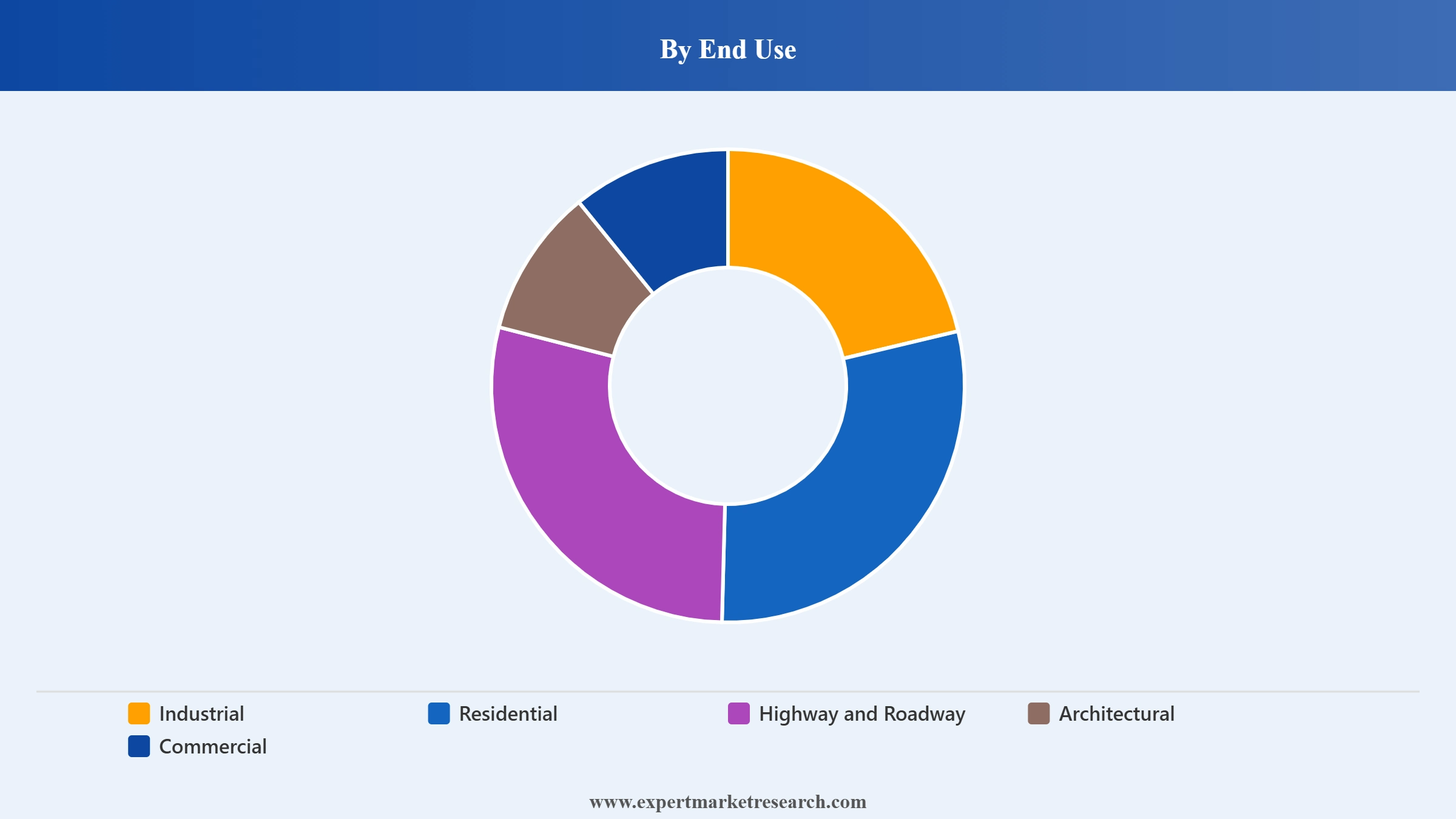
Key Insight: Commercial accounts for the largest share of the market, an end use directly affected by the conclusion of New South Wales' Energy Savings Scheme commercial lighting activity on 31 March 2026. Residential is a substantial contributor, supported by Victoria's ongoing 2026 Energy Efficiency Rebate programmes subsidising household LED upgrades. Highway and Roadway demand is expanding through utility-led streetlight conversion, illustrated by Ausgrid's 2026 rollout exceeding 240,000 LED streetlight installations across New South Wales. Industrial demand is reinforced by Western Australia's mining and resources sector adoption. Architectural serves premium design-led lighting requirements across hospitality and retail projects. Others encompasses smaller-volume end-use categories including government and institutional facilities, where longer procurement cycles and stricter compliance documentation requirements tend to slow adoption relative to faster-moving commercial and residential segments.
Market Breakup by Distribution Channel
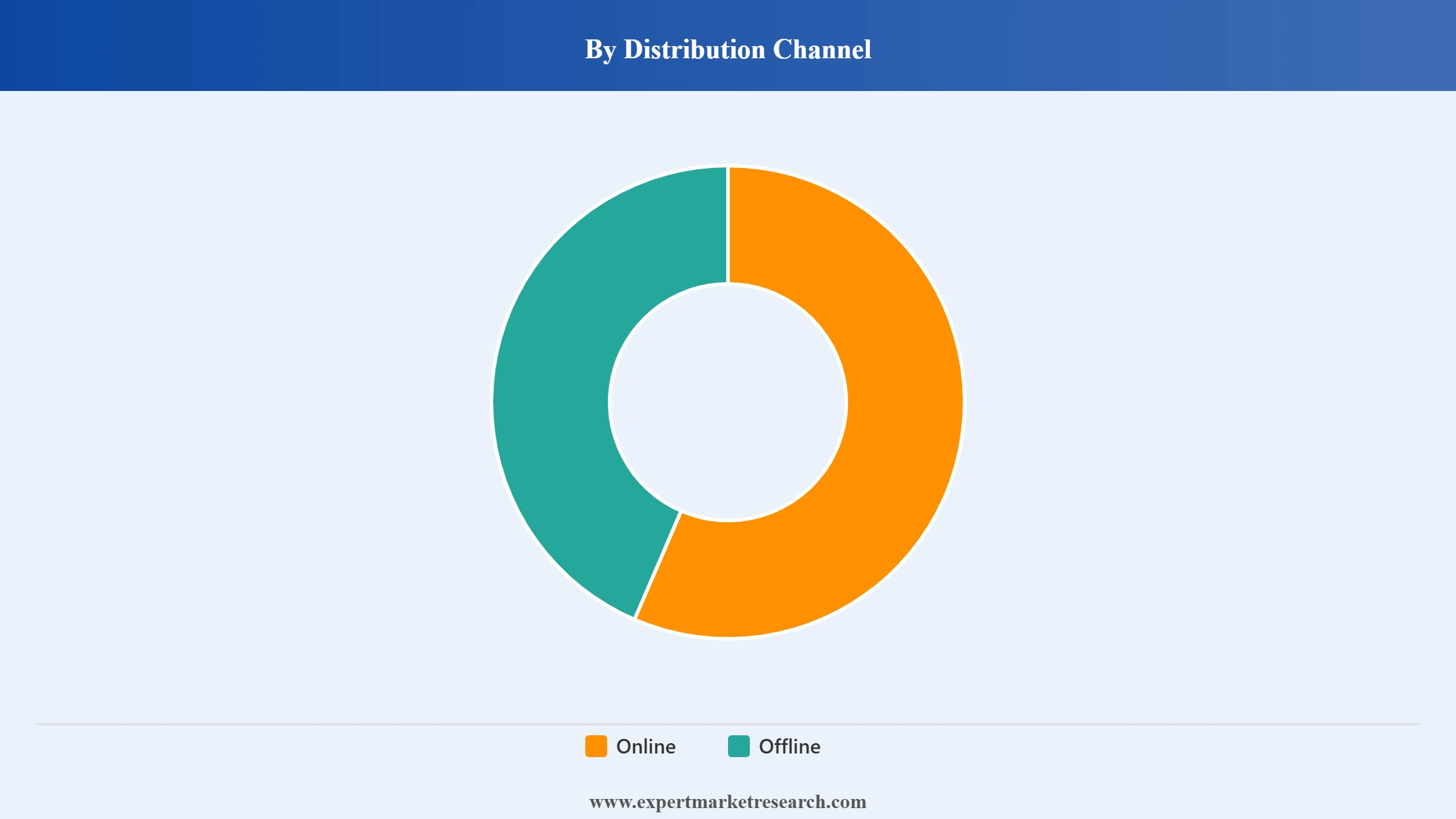
Key Insight: Offline accounts for the largest share of the market, reflecting the continued dominance of electrical wholesalers and accredited installers, a channel structure reinforced by rebate programmes such as Victoria's VEU scheme that route subsidised upgrades through accredited providers. Online is growing steadily as consumers increasingly purchase residential LED lamps and smart lighting products directly through e-commerce platforms rather than physical retail outlets.
Market Breakup by Region
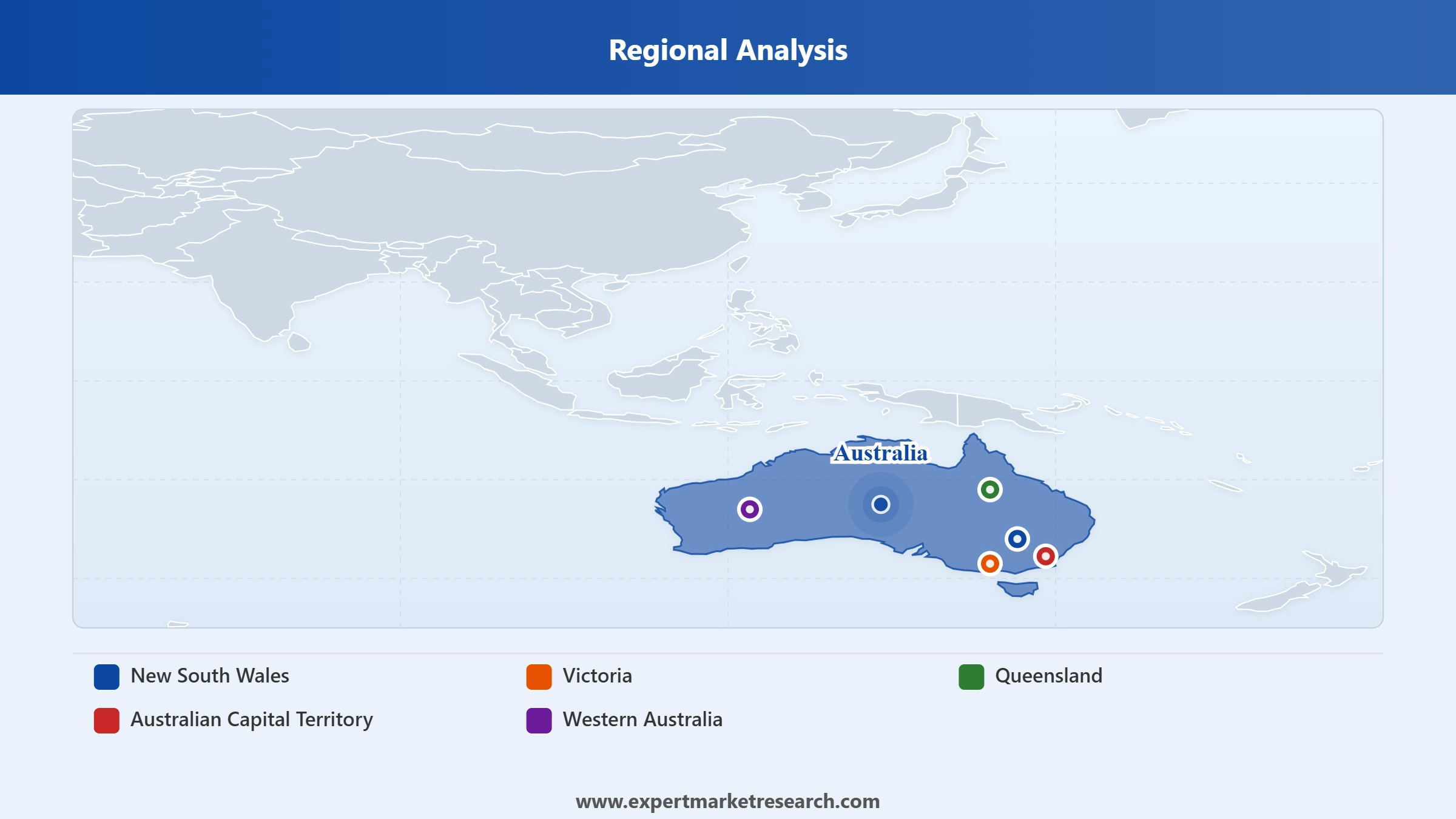
Key Insight: New South Wales accounts for the largest share of the market, anchored by Ausgrid's 2026 streetlight rollout exceeding 240,000 LED installations and the state's dense commercial and residential construction activity. Victoria is a substantial contributor, supported by its ongoing 2026 Energy Efficiency Rebate programmes covering LED lighting alongside solar and battery upgrades. Queensland continues to see steady commercial and residential adoption tied to population growth across its major population centres. Australian Capital Territory represents a smaller, slower-growing market given its limited geographic scale. Western Australia is emerging as the fastest-growing region at an estimated CAGR of 10.40%, supported by industrial-sector LED adoption across the state's mining and resources operations. Others captures smaller state and territory markets including South Australia and Tasmania, where lighting demand remains tied primarily to smaller-scale residential renovation activity and modest commercial construction pipelines.
Read more about this report - REQUEST FREE SAMPLE COPY IN PDF
By product type, luminaire leads the market while lamps grows fastest given ongoing retrofit replacement demand
Luminaire continues to account for the largest share of the market, reflecting sustained commercial and outdoor fixture demand across offices, warehouses, and public infrastructure, a position reinforced by Signify's June 2026 move to consolidate its specification luminaire ranges under one unified global brand across sports, road, solar, tunnel, and flood categories. Established luminaire suppliers keep winning repeat specification business, since architects and facility managers rarely deviate from proven fixture ranges once a project is underway, and unified branding from major suppliers is expected to further simplify that specification process.
Read more about this report - REQUEST FREE SAMPLE COPY IN PDF
Lamps is growing at the fastest pace across the australia led lighting market as households and businesses replace legacy bulbs ahead of the GEMS Determination 2025 compliance deadline of 3 March 2026, which requires all LED lamps to be registered and compliant. Retailers and wholesalers are simultaneously clearing non-compliant stock ahead of the deadline, accelerating clearance pricing across the T-Lamp and A-Lamp categories in particular.
By installation type, retrofit LED leads the market while new LED grows fastest given rising new-build specification
Retrofit LED continues to represent substantial demand tied to the large installed base of ageing incandescent and fluorescent fixtures across Australian homes and businesses. This retrofit base was previously supported by New South Wales' Energy Savings Scheme, which concluded its commercial lighting activity on 31 March 2026, prompting installers to shift focus toward residential retrofit work and state schemes still offering rebate support in Victoria and elsewhere.
Read more about this report - REQUEST FREE SAMPLE COPY IN PDF
New LED is growing at a fast pace as new commercial and residential construction increasingly specifies LED fixtures from the outset, at a projected CAGR of 10.70% through 2035, reflecting builders' and developers' preference for energy-efficient fixtures embedded during initial construction rather than later retrofit.
By application, indoor leads the market while outdoor grows fastest given expanding streetlight and public-space demand
Indoor continues to account for the largest share of the market, tied to sustained residential and commercial interior lighting demand across offices, retail, and homes, an application layer increasingly shaped by the Cyber Security (Security Standards for Smart Device) Rules 2025 that commenced 4 March 2026, adding a new compliance layer specifically for Wi-Fi and Zigbee-enabled indoor fixtures and controllers.
Read more about this report - REQUEST FREE SAMPLE COPY IN PDF
Outdoor is growing at the fastest pace at a projected CAGR of 10.30%, illustrated by Lazer Lamps' April 2025 launch of its AIR LED light bar for heavy trucks and commercial vehicles across Australia and New Zealand, alongside expanding council and utility streetlight conversion programmes that continue to prioritise higher-lumen, longer-life fixtures for arterial road and public-space applications.
By end use, commercial leads the market while industrial grows at a fast pace given resources-sector adoption
Commercial continues to account for the largest share of the market, an end use directly shaped by the conclusion of New South Wales' Energy Savings Scheme commercial lighting activity on 31 March 2026, which had subsidised widespread office and retail LED retrofits.
Read more about this report - REQUEST FREE SAMPLE COPY IN PDF
Residential demand remains substantial, supported by Victoria's ongoing 2026 Energy Efficiency Rebate programmes covering household LED upgrades alongside solar and battery incentives. Highway and Roadway demand continues to expand through utility-led conversion, illustrated by Ausgrid's 2026 rollout exceeding 240,000 LED streetlight installations across New South Wales. Industrial demand is reinforced by Western Australia's mining and resources sector adoption, while Architectural and Others each serve smaller, design-led and institutional demand pools respectively.
By distribution channel, offline leads the market while online grows steadily given e-commerce adoption
Offline continues to account for the largest share of the market, reflecting the continued dominance of electrical wholesalers and accredited installers, a structure reinforced by rebate programmes such as Victoria's VEU scheme that route subsidised upgrades through accredited providers rather than direct online purchase, keeping trade-qualified installation tightly linked to eligibility for ongoing government incentive payments.
Read more about this report - REQUEST FREE SAMPLE COPY IN PDF
Online is growing steadily as consumers increasingly purchase residential LED lamps and smart lighting products directly through e-commerce platforms, a shift particularly pronounced for smart, connected lighting products now subject to the Cyber Security Rules 2025 baseline security standards effective 4 March 2026, with compliant certification badges increasingly used as a purchase-decision signal in online product listings.
New South Wales commands the largest share of the market through its concentrated commercial and streetlight conversion activity
New South Wales holds the largest share of the Australia LED lighting market, anchored by Ausgrid's 2026 streetlight rollout exceeding 240,000 LED installations, including a further 62,000 lights being deployed across Maitland and Lake Macquarie, alongside dense commercial and residential construction activity across Sydney and the Hunter region.
Read more about this report - REQUEST FREE SAMPLE COPY IN PDF
Western Australia posts the fastest regional growth rate at an estimated 10.40% CAGR, propelled by industrial-sector LED adoption across the state's mining and resources operations. Victoria continues to see steady growth, reinforced by its ongoing 2026 Energy Efficiency Rebate programmes, including the Victorian Energy Upgrades scheme, subsidising household and commercial LED upgrades. Queensland maintains steady commercial and residential adoption tied to population growth across its major population centres. Australian Capital Territory represents a smaller, slower-growing market given its limited geographic scale and population base. Others, including South Australia and Tasmania, continues to serve distinct regional demand patterns tied to more modest population and construction activity.
The industry is fragmented, with australia led lighting market companies ranging from established domestic luminaire and lamp manufacturers to international specialist suppliers competing across product type, installation type, and regional segments. Established players operate across the full lighting value chain, from luminaire and lamp design through manufacturing and distribution to commercial, residential, and industrial end customers.
Competitive dynamics among australia led lighting players are increasingly shaped by regulatory compliance timelines, the pace of smart-lighting product development, and the strength of state-level distribution networks. Manufacturers are investing in connected lighting technology, energy-efficiency certification, and differentiated design to secure long-term relationships with commercial specifiers and residential customers alike.
Founded in 2001 and headquartered in Melbourne, Australia, Decrolux Lighting specialises in commercial lighting solutions for sectors including aged care, education, and sports facilities, providing luminaires, downlights, and streetlighting products available Australia-wide. The company emphasises in-house product testing and compliance with Australian lighting standards across its project-based design and supply model. Decrolux's focus on institutional and public-sector commercial projects differentiates its offering from residential-focused lighting suppliers.
Founded in 1998 and headquartered in Melbourne, Australia, Aqualux Lighting is an Australian-owned, family-run specialist in outdoor and landscape lighting, with an integrated design and manufacturing facility enabling rapid custom lighting solutions for architects and designers. The company's product range spans residential, commercial, and architectural landscape lighting applications. Aqualux's vertically integrated manufacturing model differentiates its offering from suppliers reliant on imported, non-customisable fixture ranges.
Founded in 2006 and headquartered in Sydney, Australia, Tovo Australasia provides advanced LED lighting technology for both commercial and residential markets, with a focus on innovation and light-quality performance. The company's product range serves indoor and outdoor applications across a range of building types. Tovo's technology-led product development approach differentiates its offering from suppliers competing primarily on price.
Founded in 1989 and headquartered in Melbourne, Australia, SAL National is a leading Australian lighting manufacturer supplying a wide range of lighting solutions across residential, commercial, and industrial sectors. The company has built a long-standing reputation for quality and product breadth across its decades of operation. SAL National's diversified sector coverage differentiates its offering from suppliers concentrated in a single end-use category.
Other key players in the Australia LED lighting market include Haneco Lighting Australia Pty Ltd., among others.
*Please note that this is only a partial list; the complete list of key players is available in the full report. Additionally, the list of key players can be customized to better suit your needs.*
Unlock the latest insights with our Australia LED lighting market trends 2026 report. Discover regional growth patterns, product type and installation type trends, and key industry players. Stay ahead of competition with trusted data and expert analysis. Download your free sample report today and drive informed decisions in the market.


Upto 15% Off
USD
$2499 $2249
$3999 $3599
$4999 $4249
$5999 $5099


*While we strive to always give you current and accurate information, the numbers depicted on the website are indicative and may differ from the actual numbers in the main report. At Expert Market Research, we aim to bring you the latest insights and trends in the market. Using our analyses and forecasts, stakeholders can understand the market dynamics, navigate challenges, and capitalize on opportunities to make data-driven strategic decisions.*
In 2025, the market reached an approximate value of USD 1.24 Billion.
The market is projected to grow at a CAGR of 8.60% between 2026 and 2035.
The market is estimated to witness a healthy growth in the forecast period of 2026-2035 to reach USD 2.83 Billion by 2035.
Consolidating product ranges under unified global brands, accelerating regulatory compliance certification ahead of deadlines, and developing smart, connected lighting products meeting new security and energy-efficiency standards.
Key trends aiding the market expansion include technological advancements in LED chips, declining costs of LED lights, improved performance, and the ban on incandescent bulbs.
Regions considered in the market are New South Wales, Victoria, Queensland, Western Australia, and Australian Capital Territory, among others.
Based on end use, the market segmentations include industrial, residential, highway and roadway, architectural, and commercial, among others.
The market can be segmented by product type into luminaires (including troffers, high bay, track lights, and streetlight, among others) and lamps (including -lamps and a-lamps, among others).
The key players in the market include Decrolux Lighting Pty Ltd., Aqualux Lighting, Tovo Australasia Pty Ltd., SAL National Pty Ltd., and Haneco Lighting Australia Pty Ltd., among others.
Manufacturers face tightening regulatory compliance deadlines under the GEMS Determination and Cyber Security Rules, price competition from imported products, and the wind-down of some state-level rebate programmes reducing retrofit subsidies in certain states.
Explore our key highlights of the report and gain a concise overview of key findings, trends, and actionable insights that will empower your strategic decisions.
| REPORT FEATURES | DETAILS |
| Base Year | 2025 |
| Historical Period | 2019-2025 |
| Forecast Period | 2026-2035 |
| Scope of the Report |
Historical and Forecast Trends, Industry Drivers and Constraints, Historical and Forecast Market Analysis by Segment:
|
| Breakup by Product Type |
|
| Breakup by Installation Type |
|
| Breakup by Application |
|
| Breakup by End Use |
|
| Breakup by Distribution Channel |
|
| Breakup by Region |
|
| Market Dynamics |
|
| Competitive Landscape |
|
| Companies Covered |
|
Datasheet
One User
USD 2,499
USD 2,249
tax inclusive*
Single User License
One User
USD 3,999
USD 3,599
tax inclusive*
Five User License
Five User
USD 4,999
USD 4,249
tax inclusive*
Corporate License
Unlimited Users
USD 5,999
USD 5,099
tax inclusive*
*Please note that the prices mentioned below are starting prices for each bundle type. Kindly contact our team for further details.*
Flash Bundle
Small Business Bundle
Growth Bundle
Enterprise Bundle
*Please note that the prices mentioned below are starting prices for each bundle type. Kindly contact our team for further details.*
Flash Bundle
Number of Reports: 3
20%
tax inclusive*
Small Business Bundle
Number of Reports: 5
25%
tax inclusive*
Growth Bundle
Number of Reports: 8
30%
tax inclusive*
Enterprise Bundle
Number of Reports: 10
35%
tax inclusive*
How To Order

Select License Type
Choose the right license for your needs and access rights.

Click on ‘Buy Now’
Add the report to your cart with one click and proceed to register.

Select Mode of Payment
Choose a payment option for a secure checkout. You will be redirected accordingly.
Strategic Solutions for Informed Decision-Making
Gain insights to stay ahead and seize opportunities.

Get insights & trends for a competitive edge.

Track prices with detailed trend reports.

Analyse trade data for supply chain insights.

Leverage cost reports for smart savings

Enhance supply chain with partnerships.

Connect For More Information
Our expert team of analysts will offer full support and resolve any queries regarding the report, before and after the purchase.
Our expert team of analysts will offer full support and resolve any queries regarding the report, before and after the purchase.
We employ meticulous research methods, blending advanced analytics and expert insights to deliver accurate, actionable industry intelligence, staying ahead of competitors.
Our skilled analysts offer unparalleled competitive advantage with detailed insights on current and emerging markets, ensuring your strategic edge.
We offer an in-depth yet simplified presentation of industry insights and analysis to meet your specific requirements effectively.




