

Consumer Insights
Uncover trends and behaviors shaping consumer choices today
Procurement Insights
Optimize your sourcing strategy with key market data
Industry Stats
Stay ahead with the latest trends and market analysis.
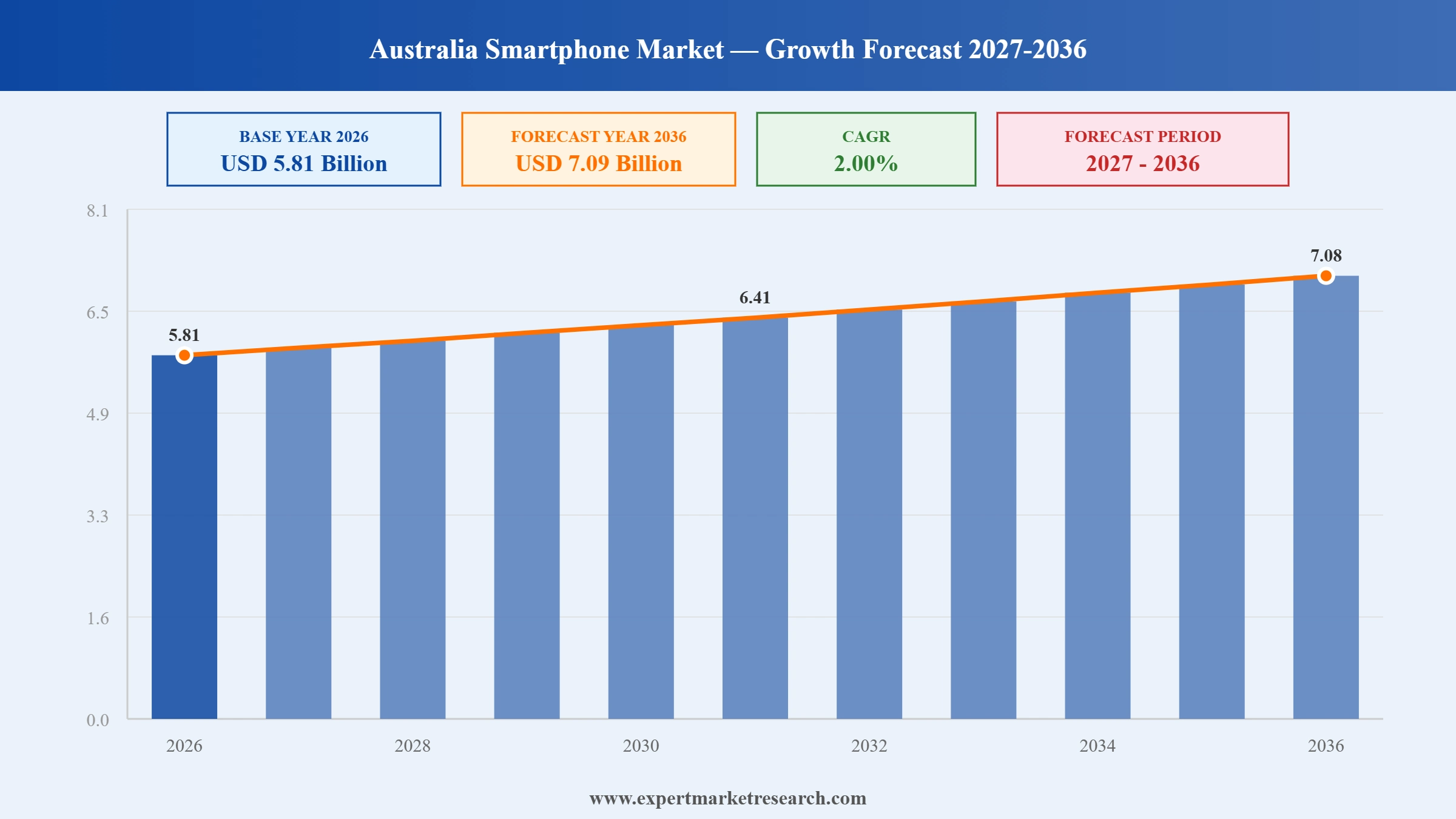
The Australia smartphone market attained a value of USD 5.70 Billion in 2025 and is projected to expand at a CAGR of 2.00% through 2035. The market is further expected to achieve USD 6.95 Billion by 2035. Australia's progressive network technology transitions are creating a niche replacement opportunity for smartphone manufacturers. The 3G network shutdown completed in 2024, requiring some consumers to replace older or incompatible handsets, particularly devices unable to support emergency calls over available 4G networks. ACMA has continued highlighting compatibility requirements for consumers purchasing phones online or from overseas. This environment encourages consumers to prioritise newer 4G and 5G-compatible devices, supporting replacement demand and creating opportunities for retailers and manufacturers offering compliant smartphones.
The Australian smartphone market is aided by the presence of ubiquitous use of mobile internet connectivity alongside an existing process towards better mobile connectivity systems. According to ACMA, 97 percent of all adult Australians used the internet on mobile phones in 2025 compared to 95 percent in 2024, which makes a strong business case for smartphones suitable for mobile internet connectivity. On the other hand, the complete closure of Australia’s 3G network system has created more demand for smartphones that work well within 4G and 5G mobile networks. These developments create opportunities for manufacturers, telecommunications operators, and retailers to target replacement demand, bundle devices with connectivity plans, and expand compatible handset portfolios, thereby boosting the Australia smartphone market value.
The use of satellite connectivity as an innovation for the Australian smart phone market is a possibility that could take hold for users who may be in remote locations where network coverage might be limited or absent. Smart phones that are able to use satellite connectivity can provide selected communication services via satellite in situations where cell towers are unable to offer coverage. This will be especially useful for a nation like Australia, with its widespread population and remote regions. Apple has included satellite connectivity for emergencies in recent iPhones while other smart phone makers are looking at satellite partnerships. The technology gives premium smartphone brands another differentiation avenue beyond cameras, processors and displays, while supporting demand among outdoor users, remote workers and travellers. Its expansion can also strengthen the value proposition of high-end smartphones by providing an additional layer of connectivity in network coverage gaps.
The high cost of replacing smartphones may limit the growth of the market in Australia especially due to the fact that high-end phones are now fitted with processors, AI technology, high-end cameras, and even folding screens. High prices may make consumers keep their phones for a longer period instead of upgrading their phones each time a new model becomes available. Such a situation may become more pronounced if older models still work sufficiently well. Accessories, repair and replacement costs can also impact consumer buying behavior. Apple's iPhone 18 Pro series, Samsung's Galaxy S26 Ultra and premium foldable models illustrate the concentration of advanced features in higher-value devices. Consequently, manufacturers must balance technological innovation with pricing, trade-in programmes and financing options to encourage replacement demand across Australia's price-sensitive consumer segments, thereby boosting the Australia smartphone market developments.
Read more about this report - REQUEST FREE SAMPLE COPY IN PDF
| Australia Smartphone Market Report Summary | Description | Value |
| Base Year | USD Billion | 2025 |
| Historical Period | USD Billion | 2019-2025 |
| Forecast Period | USD Billion | 2026-2035 |
| Market Size 2025 | USD Billion | 5.70 |
| Market Size 2035 | USD Billion | 6.95 |
| CAGR 2019-2025 | Percentage | XX% |
| CAGR 2026-2035 | Percentage | 2.00% |
| CAGR 2026-2035 - Market by Region | New South Wales | 2.4% |
| CAGR 2026-2035 - Market by Region | Victoria | 2.1% |
| CAGR 2026-2035 - Market by Operating System | Android | 2.2% |
| CAGR 2026-2035 - Market by Price Range | High-End (More than $800) | 3.4% |
| 2025 Market Share by Region | Victoria | 24.5% |
Apple made the iPhone 18 Pro and iPhone 18 Pro Max available in Australia from 18 September 2026, following preorders from 12 September. The models feature the A20 Pro chip, 48MP Fusion Main camera with variable aperture, improved battery performance, Apple Intelligence and enhanced Siri capabilities. Apple also introduced Afterpay Pay Monthly financing for Australian customers. These developments can support market growth by encouraging premium-device upgrades, increasing financing and trade-in activity, and strengthening demand for accessories and connected services.
Google introduced the Pixel 11, Pixel 11 Pro and Pixel 11 Pro XL in Australia, featuring the Tensor G6 processor, upgraded cameras, enhanced durability and expanded Gemini capabilities. The range strengthens competition in Australia's premium Android segment by combining advanced hardware with AI-focused software experiences. Its launch can support market growth by encouraging consumers to replace older devices with AI-enabled smartphones while increasing competition among premium manufacturers. Greater availability of Pixel devices can also stimulate demand for compatible accessories and related digital services.
Samsung launched the Galaxy Z Fold8, Z Fold8 Ultra and Z Flip8 in Australia on 14 August 2026, expanding its premium foldable portfolio. Samsung reported its strongest Australian foldable preorder performance to date, with double-digit year-on-year growth. The Fold8 led the Australian preorder mix, while Samsung also recorded increased switching from other smartphone brands. The development can boost market growth by increasing consumer awareness and adoption of foldable smartphones, encouraging premium upgrades and supporting demand for foldable-compatible accessories and connected Samsung products.
Samsung made the Galaxy S26, S26+ and S26 Ultra available in Australia on 11 March 2026, introducing its latest flagship smartphones with expanded Galaxy AI capabilities. The range combines AI functions with upgraded performance, imaging and productivity features, strengthening Samsung's premium Android portfolio. The launch can support market growth by encouraging replacement purchases among consumers seeking newer AI-enabled capabilities and flagship hardware. It can also increase demand for accessories, device financing, trade-ins and other services associated with premium smartphone upgrades.
On-device AI is becoming an important point of differentiation in Australia's premium smartphone market. Features such as contextual assistance, image editing, real-time translation, and automated content processing can support higher-value device positioning. Samsung's Galaxy S26 series, available in Australia from March 2026, integrates its third-generation Galaxy AI experience. For vendors, the commercial opportunity lies in demonstrating practical productivity benefits rather than relying on processor specifications alone. Enterprise resellers can also develop use cases around mobile workflows, while operators can use AI-capable handsets to encourage upgrades among customers seeking longer device lifecycles.
Foldable smartphones are creating a differentiated premium category for Australian consumers seeking larger displays without carrying a conventional tablet. Samsung's August 2026 Australian availability announcement for its Galaxy Z Fold8 and Z Flip8 range reported its strongest local foldable preorder performance to date, with double-digit year-on-year growth. The trend creates opportunities for retailers to offer demonstrations, trade-in programs, and financing options that reduce the perceived cost of adopting unfamiliar form factors. Component suppliers and distributors can benefit from demand for advanced hinges, flexible displays, and specialized protective accessories, thus shaping the Australia smartphone market dynamics and trends.
Smartphones are increasingly central to Australians' everyday digital activity, supporting demand for reliable performance, high-quality displays, and efficient mobile data use. ACMA's 2025 research found that 92% of Australian adults used mobile internet daily, compared with 90% in 2024. This pattern supports opportunities across multiple price tiers, from affordable devices designed for everyday communication to premium handsets supporting intensive content consumption. Manufacturers can differentiate through battery optimization, display readability, and dependable software, while distributors can align device portfolios with usage intensity and customer upgrade requirements.
Australia's 3G shutdown has made network compatibility and emergency-call functionality critical considerations in handset sourcing. Certain older 4G devices and imported models may not support required emergency calling arrangements on Australian networks. ACMA advises consumers to verify compatibility and regulatory compliance before purchasing devices online or from overseas. For manufacturers and importers, this creates a commercial incentive to prioritize locally compatible stock, transparent product specifications, and after-sales support. Retailers can strengthen customer confidence by verifying device compatibility before sale and reducing the risk of returns or service disruptions.
Smartphones increasingly function as the central interface for connected services, applications, wearables, and digital content. This creates opportunities for vendors to build customer retention through integrated ecosystems rather than relying exclusively on annual handset launches. Australia's high internet participation and increasing use of multiple connected devices support this shift. Vendors can develop complementary revenue streams through accessories, cloud services, device protection, and compatible wearables. Telecommunications operators and retailers can use ecosystem-based bundles to increase customer lifetime value, while enterprise suppliers can focus on secure device management and consistent software support across employee fleets.
The Expert Market Research’s report titled "Australia Smartphone Market Report and Forecast 2026-2035” offers a detailed analysis of the market based on the following segments:
Market Breakup by Operating System
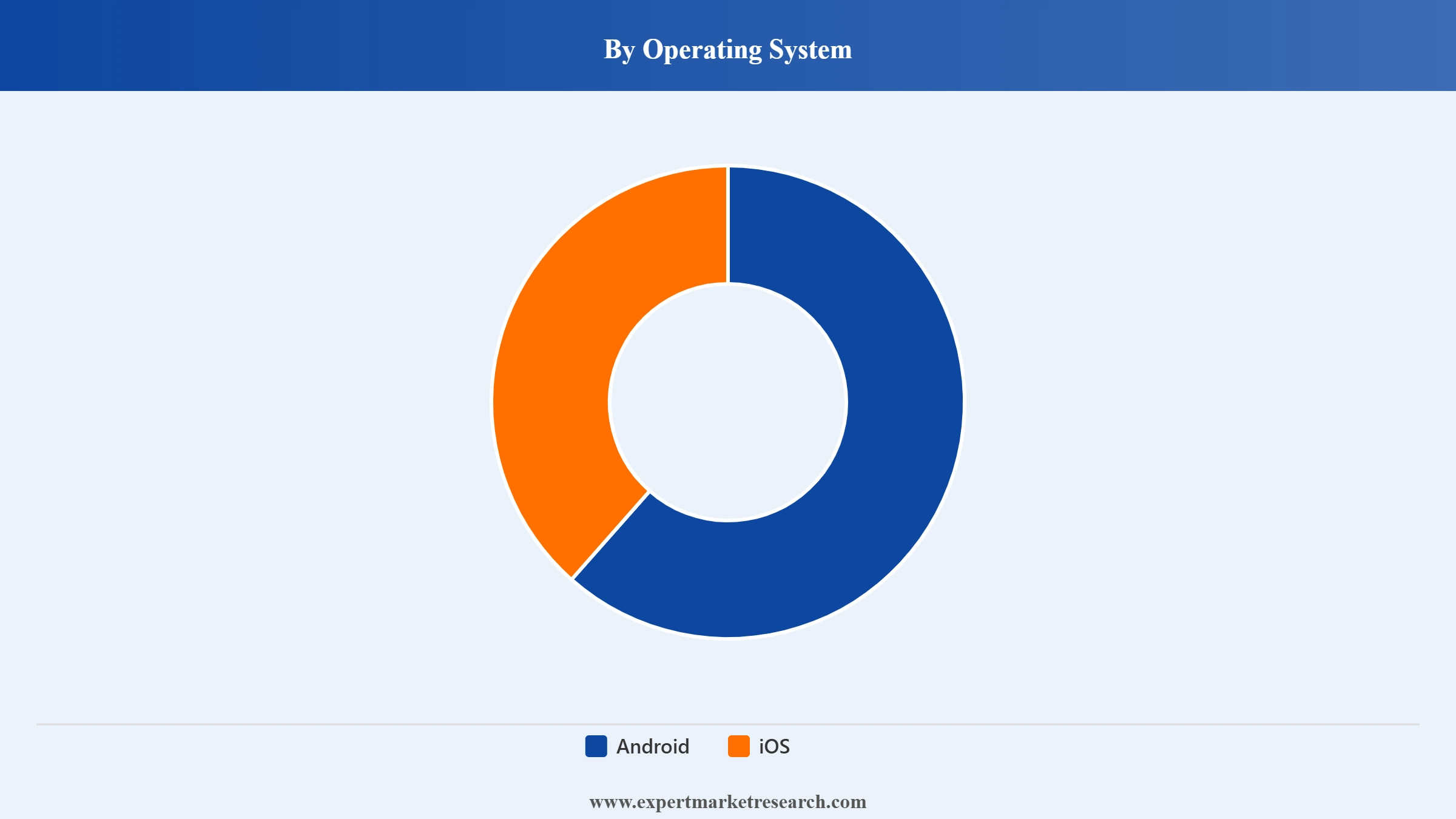
Key Insight: iOS and Android account for virtually the entire commercially relevant smartphone operating-system landscape in Australia, but their positions differ depending on the metric used. StatCounter recorded iOS at 65.33% of Australia's mobile operating-system market in August 2026, compared with 34.66% for Android. This is a usage-based measure derived from web traffic rather than handset shipments, but it demonstrates the strength of Apple's installed ecosystem in the country. Android remains strategically important because it spans Samsung, Google, Xiaomi, Motorola, OPPO and other manufacturers across multiple price bands. For B2B suppliers, OS segmentation directly influences application compatibility, enterprise device management, accessories, cloud integration and customer retention.
Market Breakup by Display Technology
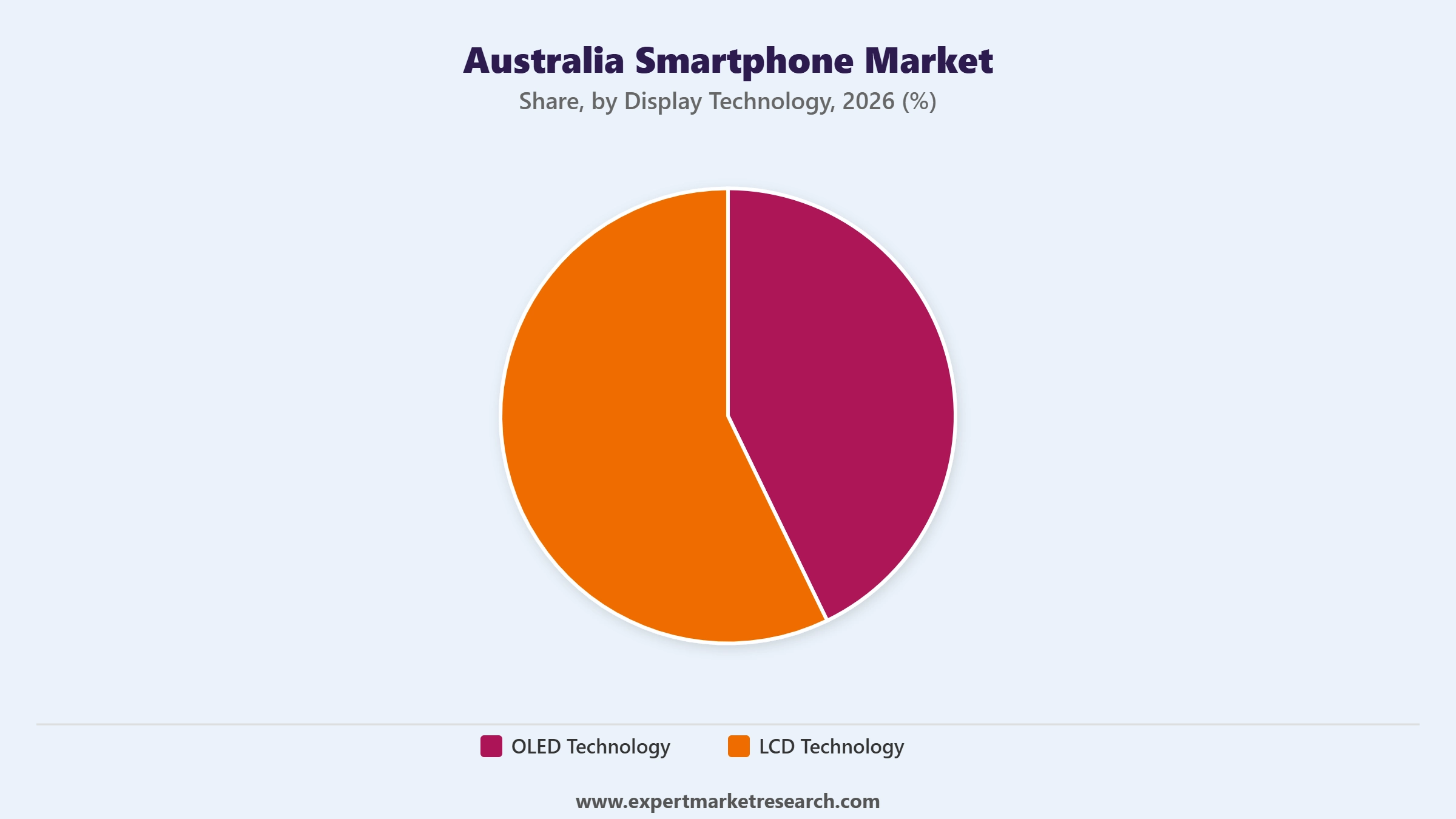
Key Insight: OLED technology is gaining increasing commercial relevance as Australian handset portfolios move toward premium displays, flagship cameras, foldable designs and AI-intensive use cases. OLED panels enable higher contrast, thinner device architectures and flexible form factors, making them particularly relevant to premium and foldable smartphones. LCD technology continues to support entry-level and selected mid-range models where manufacturers prioritize affordability and component-cost control. The commercial significance of this segmentation is therefore closely connected with pricing strategy: OLED allows brands to justify higher average selling prices through display quality and design differentiation, while LCD helps maintain competitive price points. For retailers and distributors, the technology split also affects product positioning, merchandising and accessory compatibility.
Market Breakup by RAM Capacity
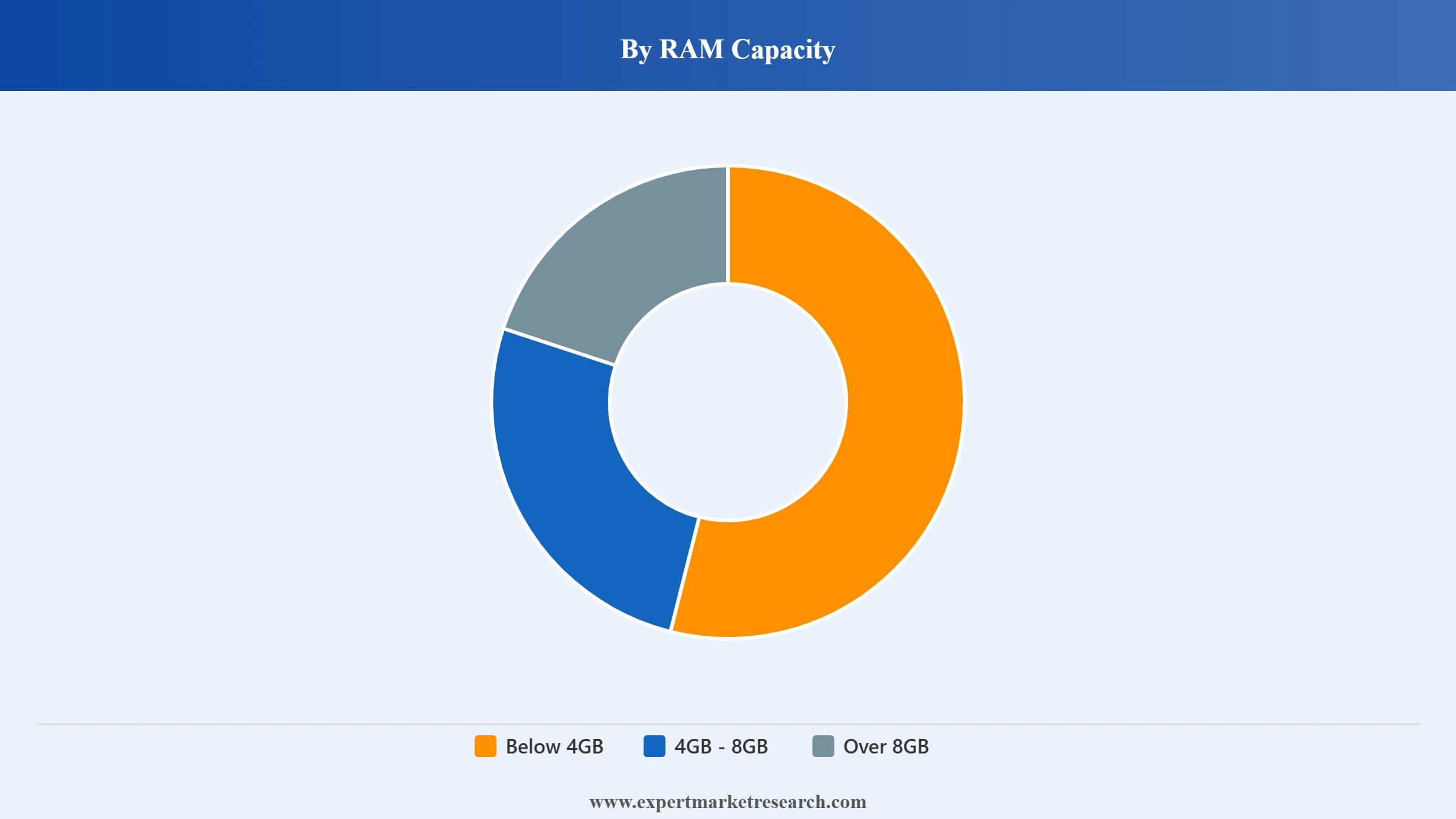
Key Insight: The RAM structure of Australia's smartphone market is shifting toward higher-capacity configurations as manufacturers integrate generative AI, advanced image processing, gaming functions and increasingly sophisticated multitasking into handsets. Below-4GB devices remain concentrated around basic communication and highly price-sensitive applications, while 4GB-8GB models address mainstream productivity, social media, streaming and business requirements. Over-8GB configurations are increasingly associated with premium smartphones where AI processing and intensive applications require greater memory headroom. This transition provides manufacturers with an opportunity to differentiate models through performance rather than screen size alone. Enterprise buyers can also use RAM capacity when establishing minimum specifications for managed smartphone fleets and longer device replacement cycles.
Market Breakup by Price Range
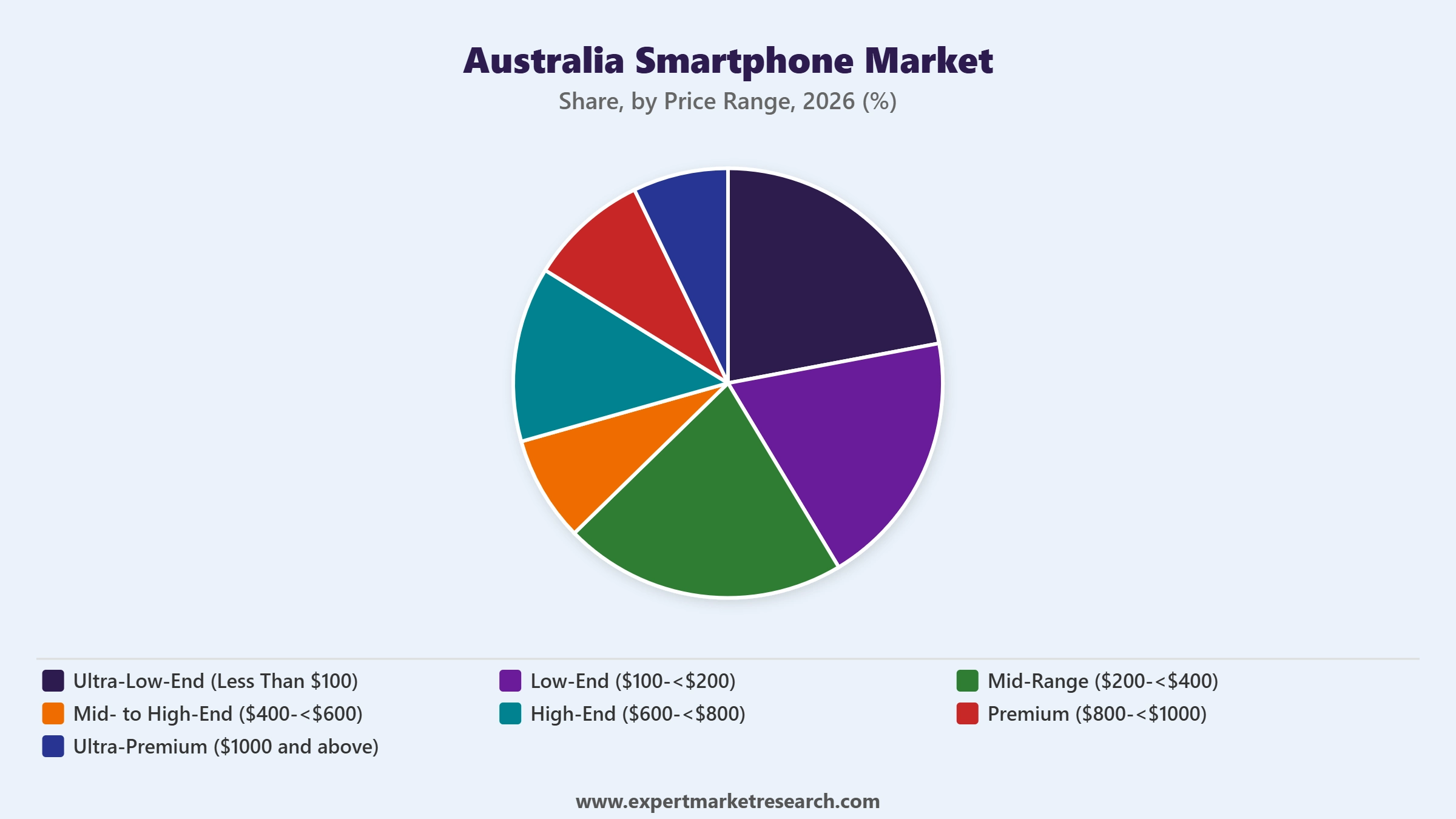
Key Insight: Australia's smartphone price structure is unusually relevant to portfolio planning because the market accommodates both highly price-sensitive devices and premium handsets exceeding $1,000. The lower bands provide manufacturers with volume opportunities through prepaid customers, secondary-device purchases and replacement of older handsets, while the $400-$800 categories provide a bridge between affordability and advanced specifications. Premium and ultra-premium products are increasingly differentiated through AI, advanced cameras, foldable displays, high-end processors and ecosystem integration. Trade-in programs and carrier financing also reduce the upfront cost of premium devices. Consequently, manufacturers can use tiered portfolios rather than a single flagship product to capture different replacement budgets and usage requirements.
Market Breakup by Distribution Channel
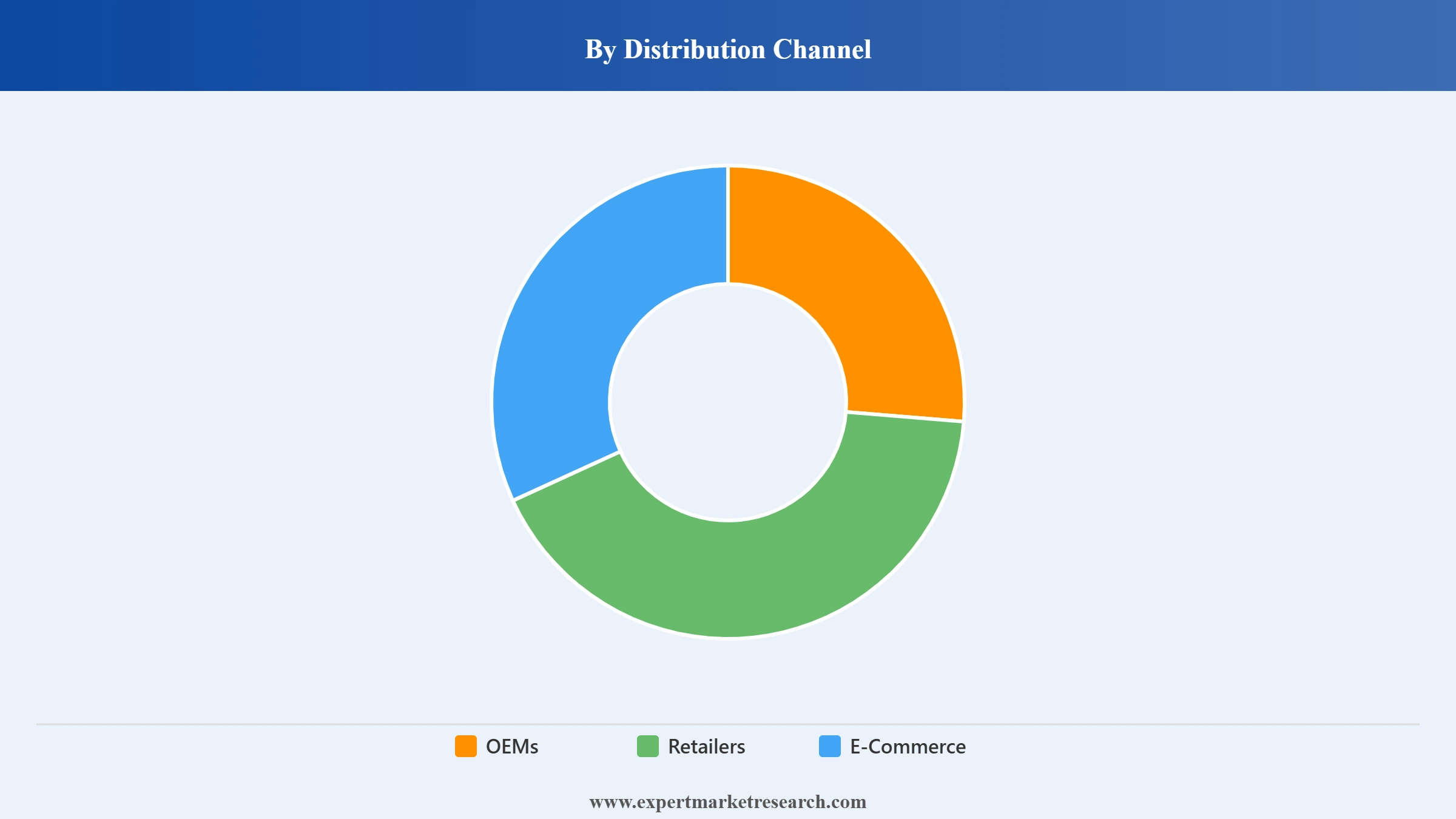
Key Insight: Australia's smartphone distribution landscape combines manufacturer-controlled sales, physical retail and increasingly sophisticated online purchasing. OEM channels allow brands to control product presentation, promotions and customer relationships, while retailers provide broader comparison across competing ecosystems and price points. E-commerce is particularly valuable for consumers researching specifications and comparing prices before purchase, although Australia's network-compatibility requirements make authorized distribution increasingly important. The 3G shutdown also demonstrated the commercial importance of accurate compatibility information because ACMA warned that some older or overseas-purchased handsets could be unable to make emergency calls after network closures. This increases the value of knowledgeable retail and online channels that can verify Australian network compatibility before purchase.
Market Breakup by Region
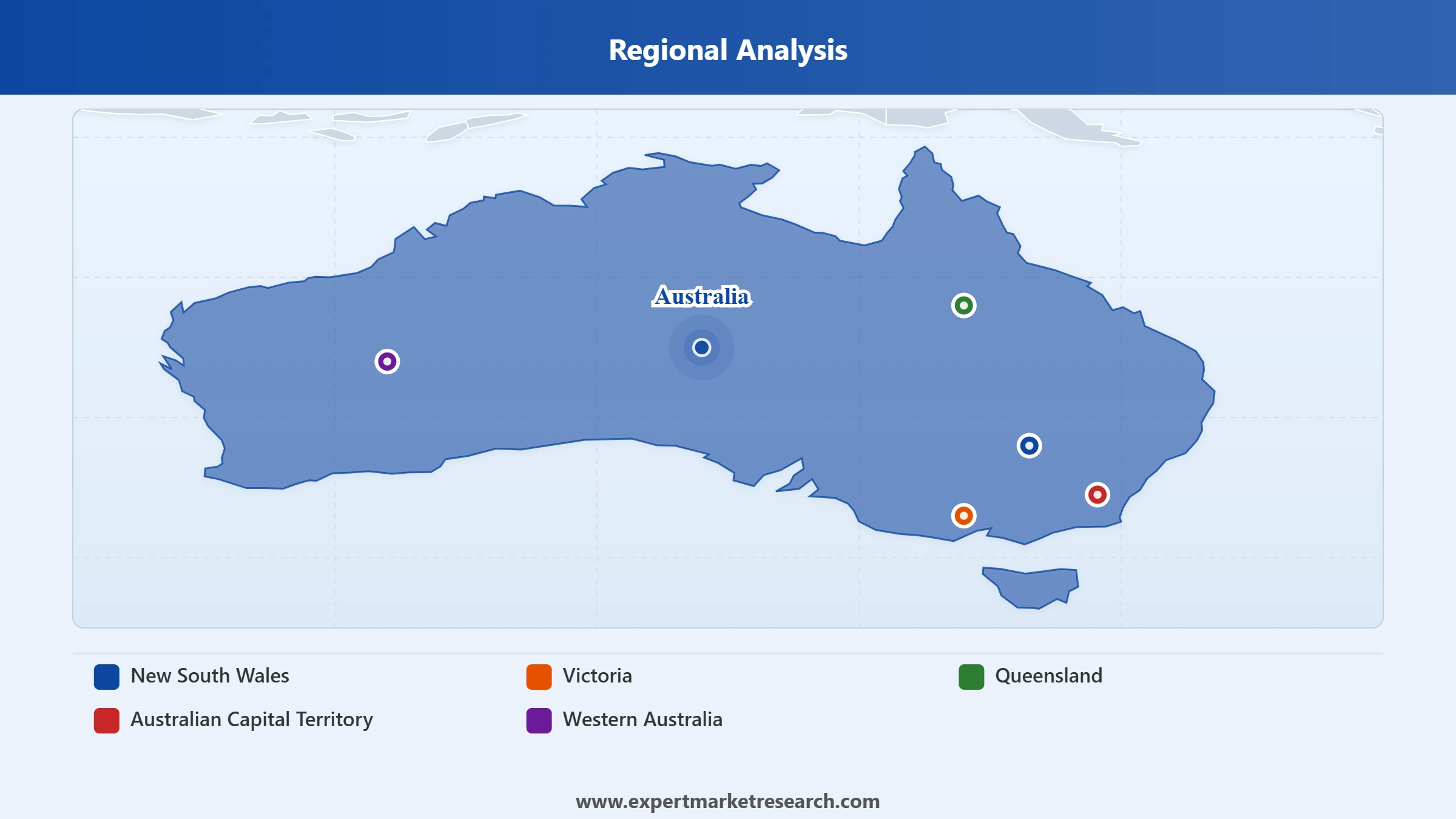
Key Insight: Regional smartphone demand broadly follows Australia's population distribution, but population growth provides additional signals for future handset replacement and new-user demand. In September 2025, NSW had 8.6245 million residents, Victoria 7.1043 million, Queensland 5.6926 million, and Western Australia 3.0617 million. Western Australia recorded the country's fastest state population growth at 2.2%, while Victoria and Queensland each grew by 1.7%. NSW therefore represents the largest addressable population base, whereas WA offers an important expansion opportunity because of its faster population growth. The ACT, Tasmania, South Australia and Northern Territory collectively add smaller but commercially distinct markets requiring targeted channel coverage, thus driving the demand in the Australia smartphone market.
Read more about this report - REQUEST FREE SAMPLE COPY IN PDF
iOS represents the dominant mobile operating-system segment in Australia, accounting for 65.33% of mobile operating-system usage in August 2026, compared with 34.66% for Android, according to industry reports. This sizeable installed base strengthens Apple's position across smartphones, applications, wearables, accessories and digital services. For B2B stakeholders, the distribution highlights the importance of iOS-compatible enterprise applications, device-management platforms and connected-device ecosystems when developing solutions for Australian smartphone users. Such developments will thus boost Australia smartphone market trends in the long run.
Read more about this report - REQUEST FREE SAMPLE COPY IN PDF
Android provides Australia's smartphone market with a broad multi-brand ecosystem covering entry-level, mid-range, premium and foldable devices. Manufacturers use the platform to introduce products across multiple price points while incorporating 5G connectivity, artificial intelligence and advanced camera capabilities. However, publicly available Australian data does not establish a comparable shipment-growth percentage for Android during the forecast period. Therefore, its expansion should be discussed through ecosystem breadth rather than an unsupported CAGR.
OLED represents the dominant display technology across premium smartphones because it provides high contrast, slim construction, efficient illumination and support for curved or flexible designs. These characteristics make it particularly suitable for flagship and foldable smartphones. Manufacturers are increasingly using OLED panels to differentiate higher-value devices through brighter displays, higher refresh rates and immersive viewing experiences. Samsung's latest Australian foldable portfolio demonstrates continued investment in flexible OLED-based smartphone designs, including the Galaxy Z Fold8 and Galaxy Z Flip8, reinforcing OLED's importance in premium device development.
Read more about this report - REQUEST FREE SAMPLE COPY IN PDF
LCD displays retain expansion opportunities in Australia's affordable and mainstream smartphone categories because they enable manufacturers to control device costs while providing adequate performance for everyday applications. The technology remains relevant for consumers prioritising affordability, battery efficiency and basic smartphone functionality over premium display characteristics. Manufacturers can therefore use LCD panels in competitively priced models targeting cost-conscious customers. However, publicly available Australian sources do not provide a reliable year-on-year growth percentage for smartphone display technologies, meaning a numerical CAGR should not be assigned without independent shipment data.
The 4GB-8GB RAM category addresses a broad range of everyday smartphone requirements, including messaging, social media, video streaming, browsing, mobile banking and standard business applications. Manufacturers can incorporate this memory range into mainstream devices while balancing performance and affordability. The category is also suitable for consumers who do not require intensive gaming, professional editing or extensive AI workloads. Its broad application across mid-range portfolios makes it commercially relevant to retailers and enterprise buyers seeking capable smartphones without the specifications and acquisition costs associated with premium flagship devices, thus bolstering the Australia smartphone market growth.
Read more about this report - REQUEST FREE SAMPLE COPY IN PDF
Smartphones equipped with more than 8GB of RAM are gaining importance as manufacturers introduce increasingly sophisticated AI, gaming, photography and multitasking capabilities. Higher memory configurations can support demanding applications and multiple processes while helping premium smartphones differentiate themselves through enhanced performance. The segment is particularly relevant to flagship and foldable devices where manufacturers combine advanced cameras, AI functions, high-resolution displays and productivity tools. Nevertheless, publicly available Australian statistics do not provide a sufficiently reliable RAM-specific shipment-growth percentage, so the segment should be described qualitatively rather than assigned an unsupported CAGR.
The $200-$400 price category serves consumers seeking capable smartphones at accessible prices. Devices in this range increasingly incorporate 5G connectivity, capable camera systems, large displays, fast charging and improved processing performance. The category provides manufacturers with an opportunity to combine competitive pricing with features previously concentrated in higher-priced smartphones. It is also relevant to retailers because consumers can compare multiple brands and models within a relatively broad affordability range. However, publicly available Australian sources do not provide comprehensive unit-share data for the requested smartphone price bands.
Read more about this report - REQUEST FREE SAMPLE COPY IN PDF
Premium smartphones are attracting increasing attention as manufacturers concentrate advanced processors, artificial intelligence, imaging systems, displays and connectivity features within higher-value devices. The development of foldable smartphones is also strengthening premium product differentiation, with manufacturers using flexible displays and sophisticated software experiences to justify higher price points. Samsung's 2026 Australian Galaxy Z portfolio illustrates this approach, combining foldable hardware with AI capabilities. Samsung reported double-digit year-on-year growth in Australian foldable preorders for its latest generation, although this does not represent growth across the entire premium price category.
Retailers remain an important distribution channel because physical stores allow consumers to compare smartphone designs, displays, cameras, operating systems and specifications before purchasing. Retail staff can additionally support device setup, data migration, trade-ins and network compatibility. This role is particularly relevant in Australia because ACMA warns that some smartphones purchased online or from overseas may not comply with Australian standards or operate correctly on local networks. Devices supplied in Australia must meet applicable technical requirements and carry the regulatory compliance mark.
Read more about this report - REQUEST FREE SAMPLE COPY IN PDF
E-commerce is expanding the accessibility of smartphones by allowing consumers to compare specifications, prices and promotions without visiting physical stores. Online channels also enable manufacturers and retailers to reach customers across metropolitan and regional Australia while reducing dependence on physical outlets. The channel is supported by Australians' extensive use of mobile internet, with ACMA reporting that 97% of adults accessed the internet through mobile phones in 2025. However, online sellers must provide clear information about Australian network compatibility and compliance requirements, particularly for imported devices.
New South Wales and Victoria represent major commercial centers for the Australia smartphone market, supported by large metropolitan populations, retail networks, and enterprise demand. Sydney and Melbourne provide extensive opportunities for OEMs, telecommunications operators, and distributors to sell premium handsets, manage trade-in programs, and develop business mobility contracts. The Australian Capital Territory offers a more specialized opportunity through government and professional services, where device security, lifecycle management, and standardized procurement can influence purchasing decisions. Regional comparisons should account for population size and handset replacement activity rather than treating total state demand as a direct measure of consumer preference, thereby directly boosting the Australia smartphone market regional growth.
Read more about this report - REQUEST FREE SAMPLE COPY IN PDF
Queensland and Western Australia offer opportunities across metropolitan, regional, and resource-sector markets, where reliable connectivity and device durability can influence purchasing decisions. Tasmania, South Australia, and the Northern Territory contribute to the remaining regional demand, with channel reach and service availability particularly relevant outside major cities. The national 3G shutdown also highlighted the importance of compatible handsets and dependable emergency-call functionality, creating a need for effective customer communication and replacement support. For manufacturers and distributors, regional expansion strategies can focus on carrier partnerships, authorized retail coverage, and locally relevant product portfolios.
Leading Australia smartphone market players are targeting premiumisation, AI integration, advanced photography, foldable designs, and stronger device ecosystems. Companies are investing in on-device artificial intelligence to deliver personalised assistance, enhanced productivity, smarter photography, and improved user experiences. They are also focusing on high-performance processors, brighter displays, longer battery life, faster charging, and advanced connectivity to differentiate products. Greater integration between smartphones, wearables, tablets, computers, and other connected devices is another key focus area.
Australia smartphone companies are also targeting wider consumer coverage through diversified portfolios, competitive pricing, trade-in programmes, financing options, and stronger retail and online distribution. Mid-range and value-oriented models increasingly incorporate features previously associated with premium smartphones, including 5G connectivity, high-refresh-rate displays, advanced cameras, and AI capabilities. Manufacturers are additionally focusing on software support, cybersecurity, privacy, after-sales services, and sustainable product development to strengthen customer relationships and encourage upgrades across Australia's competitive smartphone landscape.
Established in 1976 and headquartered in Cupertino, California, Apple offers the iPhone range, supported by iOS, Apple services, and a connected-device ecosystem. Its Australian business spans premium smartphones, accessories, trade-in options, and direct and partner-led distribution. The company competes through hardware-software integration, long-term customer relationships, and differentiated user experiences, while its ecosystem supports opportunities in accessories, services, and enterprise device deployment.
Established in 1969 and headquartered in Suwon, South Korea, Samsung offers Galaxy S, Galaxy Z, and Galaxy A smartphones across premium, foldable, and mainstream categories. Its portfolio supports a wide range of customer budgets and usage requirements. In Australia, Samsung combines retail and carrier distribution with ecosystem products, software capabilities, and device innovation to serve both consumer and business mobility markets.
Huawei Technologies Co., Ltd., established in 1987 and headquartered at Huawei Base in Shenzhen, China, offers smartphone products under its Mate, Pura, nova and foldable Mate X families. In Australia, Huawei maintains smartphone product support covering Mate, P, nova and Y series, while its broader Australian consumer portfolio includes connected devices and wearables. Its smartphone portfolio is positioned around premium design, advanced photography, high-capacity batteries, fast charging and foldable form factors.
Motorola Mobility LLC, established in 2011 following the separation of Motorola Mobility from Motorola, is headquartered in Chicago, Illinois, United States, and operates as a wholly owned subsidiary of Lenovo. In Australia, the company offers smartphones across the motorola razr, motorola edge, moto g and moto e families. Current Australian offerings include the razr 60, edge 60 pro, edge 60 fusion, moto g86 power 5G, moto g56 5G, moto g35 5G and moto e14, spanning foldable, premium, mid-range and value segments.
Other key players in the Australia smartphone market include Cell8 Pty Limited, among others.
*Please note that this is only a partial list; the complete list of key players is available in the full report. Additionally, the list of key players can be customized to better suit your needs.*
Explore the Australia Smartphone Market through Expert Market Research's detailed industry analysis. Request a sample report to understand Australia Smartphone Market trends 2026, competitive dynamics, emerging product opportunities, and distribution strategies. Gain insights into the Australia Smartphone Market forecast 2026-2035 to support portfolio planning, market entry, and business growth. Access relevant market intelligence to strengthen your understanding of Australia's evolving smartphone industry.


Upto 15% Off
USD
$2499 $2249
$3999 $3599
$4999 $4249
$5999 $5099


*While we strive to always give you current and accurate information, the numbers depicted on the website are indicative and may differ from the actual numbers in the main report. At Expert Market Research, we aim to bring you the latest insights and trends in the market. Using our analyses and forecasts, stakeholders can understand the market dynamics, navigate challenges, and capitalize on opportunities to make data-driven strategic decisions.*
In 2025, the market reached an approximate value of USD 5.70 Billion.
The market is projected to grow at a CAGR of 2.00% between 2026 and 2035.
The revenue generated from the market is expected to reach USD 6.95 Billion in 2035.
The smartphone market is categorised according to operating systems, which include android, iOS, and others.
Key players in the market are Apple Inc., Samsung Electronics Australia Pty Limited, Huawei Technologies Co., Ltd, Motorola Mobility LLC, and Cell8 Pty Limited, among others.
Based on smartphones, the market is divided into OEMs, retailers, and e-commerce.
The market is broken down into New South Wales, Victoria, Queensland, Australian Capital Territory, Western Australia, and others.
Key challenges in the Australia smartphone market include intense competition, premium device affordability, rising consumer replacement cycles, supply chain disruptions, currency fluctuations, electronic waste management, and growing demand for frequent technological upgrades, alongside data privacy concerns and evolving consumer expectations for advanced features.
Key strategies supporting the Australia smartphone market include product innovation, premium smartphone launches, competitive pricing, trade-in programmes, flexible financing, expansion of online sales channels, enhanced after-sales services, 5G integration, AI-powered features, and sustainability-focused initiatives to strengthen customer retention and market penetration.
Explore our key highlights of the report and gain a concise overview of key findings, trends, and actionable insights that will empower your strategic decisions.
| REPORT FEATURES | DETAILS |
| Base Year | 2025 |
| Historical Period | 2019-2025 |
| Forecast Period | 2026-2035 |
| Scope of the Report |
Historical and Forecast Trends, Industry Drivers and Constraints, Historical and Forecast Market Analysis by Segment:
|
| Breakup by Operating System |
|
| Breakup by Display Technology |
|
| Breakup by RAM Capacity |
|
| Breakup by Price Range |
|
| Breakup by Distribution Channel |
|
| Breakup by Region |
|
| Market Dynamics |
|
| Competitive Landscape |
|
| Companies Covered |
|
Datasheet
One User
USD 2,499
USD 2,249
tax inclusive*
Single User License
One User
USD 3,999
USD 3,599
tax inclusive*
Five User License
Five User
USD 4,999
USD 4,249
tax inclusive*
Corporate License
Unlimited Users
USD 5,999
USD 5,099
tax inclusive*
*Please note that the prices mentioned below are starting prices for each bundle type. Kindly contact our team for further details.*
Flash Bundle
Small Business Bundle
Growth Bundle
Enterprise Bundle
*Please note that the prices mentioned below are starting prices for each bundle type. Kindly contact our team for further details.*
Flash Bundle
Number of Reports: 3
20%
tax inclusive*
Small Business Bundle
Number of Reports: 5
25%
tax inclusive*
Growth Bundle
Number of Reports: 8
30%
tax inclusive*
Enterprise Bundle
Number of Reports: 10
35%
tax inclusive*
How To Order

Select License Type
Choose the right license for your needs and access rights.

Click on ‘Buy Now’
Add the report to your cart with one click and proceed to register.

Select Mode of Payment
Choose a payment option for a secure checkout. You will be redirected accordingly.
Strategic Solutions for Informed Decision-Making
Gain insights to stay ahead and seize opportunities.

Get insights & trends for a competitive edge.

Track prices with detailed trend reports.

Analyse trade data for supply chain insights.

Leverage cost reports for smart savings

Enhance supply chain with partnerships.

Connect For More Information
Our expert team of analysts will offer full support and resolve any queries regarding the report, before and after the purchase.
Our expert team of analysts will offer full support and resolve any queries regarding the report, before and after the purchase.
We employ meticulous research methods, blending advanced analytics and expert insights to deliver accurate, actionable industry intelligence, staying ahead of competitors.
Our skilled analysts offer unparalleled competitive advantage with detailed insights on current and emerging markets, ensuring your strategic edge.
We offer an in-depth yet simplified presentation of industry insights and analysis to meet your specific requirements effectively.




