

Consumer Insights
Uncover trends and behaviors shaping consumer choices today
Procurement Insights
Optimize your sourcing strategy with key market data
Industry Stats
Stay ahead with the latest trends and market analysis.
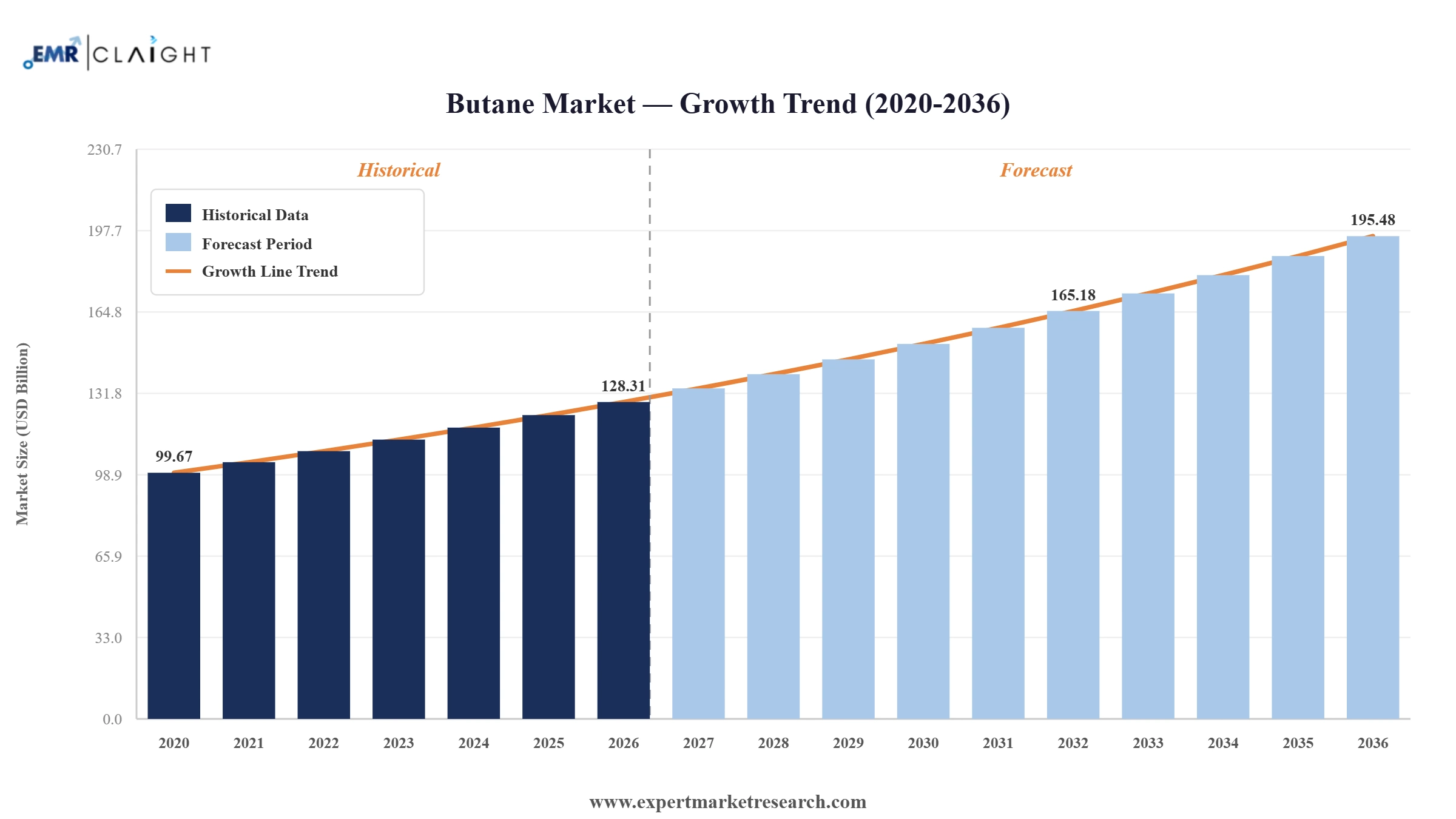
The global butane market attained a value of USD 123.02 Billion in 2025 and is projected to expand at a CAGR of 4.30% through 2035. The market is further expected to achieve USD 187.42 Billion by 2035, supported by sustained liquefied petroleum gas demand for residential and commercial fuel, expanding petrochemical cracker feedstock consumption, and continued natural-gas-processing and refinery-derived supply growth. Growth spans natural gas, gasoline crude oil, and isobutane sourcing routes across LPG, petrochemical, and refinery end uses, with major integrated energy companies competing on NGL infrastructure scale, export logistics, and feedstock-flexible refining capacity across North America, Asia Pacific, and other producing and consuming regions.
Sustained NGL infrastructure investment continues to anchor supply growth across the global butane market, as major producers expand pipeline and fractionation capacity to serve rising Permian Basin output. ExxonMobil disclosed in November 2025 that it agreed to acquire a 40% undivided joint interest in Enterprise Products Partners' Bahia NGL pipeline, which will expand capacity from 600,000 to 1 million barrels per day of NGLs, including butane, from the Midland and Delaware basins to the Mont Belvieu fractionation complex, addressing Permian NGL output projected to grow more than 30% between 2024 and 2030. This build-out is further reinforced by Devon Energy's commitment of over 60% of its USD 4.9 billion 2026 capital budget to Permian Basin development.
The market is witnessing further developments as governments pursue new cross-border LPG supply arrangements to diversify import sources. Reporting updated in March 2026 confirmed that Chevron Corporation and TotalEnergies SE, alongside Phillips 66, had partnered with Indian state refiners to supply approximately 2 million metric tons of United States liquefied petroleum gas across 48 very large gas carriers starting in 2026, as India targets roughly 10% of its cooking-gas imports from the United States that year. In parallel, suppliers are retaining flexibility to source from alternative origins on roughly one in four shipments under the arrangement.
In addition, established integrated energy producers are reporting strong refining and upstream liquids performance on the back of favorable margins. Valero Energy Corporation reported in July 2026 that its second-quarter refining margin reached USD 23.62 per barrel on throughput of 3.0 million barrels per day, up sharply from USD 12.35 per barrel a year earlier, underscoring robust refined-product and NGL-linked demand across its system. This performance was echoed in the company's second-quarter net income of USD 3.7 billion, up sharply from USD 714 million in the prior-year period.
Read more about this report - Request a Free Sample
| Global Butane Market Report Summary | Description | Value |
| Base Year | USD Billion | 2025 |
| Historical Period | USD Billion | 2019-2025 |
| Forecast Period | USD Billion | 2026-2035 |
| Market Size 2025 | USD Billion | 123.02 |
| Market Size 2035 | USD Billion | 187.42 |
| CAGR 2019-2025 | Percentage | XX% |
| CAGR 2026-2035 | Percentage | 4.30% |
| CAGR 2026-2035 - Market by Region | Latin America | 4.6% |
| CAGR 2026-2035 - Market by Country | India | 4.9% |
| CAGR 2026-2035 - Market by Country | Brazil | 4.8% |
| CAGR 2026-2035 - Market by Type | Isobutane | 5.0% |
| CAGR 2026-2035 - Market by Application | Petrochemicals | 5.2% |
| Market Share by Country 2025 | Brazil | 2.4% |
Valero reported on July 30, 2026 that its second-quarter 2026 net income reached USD 3.7 billion, up from USD 714 million a year earlier, as refining margin nearly doubled to USD 23.62 per barrel on throughput of 3.0 million barrels per day. The results reflect strengthening refined-product and NGL-linked demand across the company's North American and international refining network. Companies can leverage strong refining-margin cycles to fund NGL fractionation and export-logistics capacity that supports butane supply growth. Sustained utilization rates across its refining network continue to support margin capture amid favorable product-crack spread economics industry-wide.
Devon Energy, having completed its merger with Coterra Energy on May 7, 2026, issued updated 2026 guidance projecting combined natural gas liquids output of 315,000 to 330,000 barrels per day, approximately 23% of total company production, with more than 60% of its USD 4.9 billion capital budget directed toward Permian Basin development. Companies can leverage upstream consolidation to scale NGL output and capture operational synergies across combined acreage positions. This trajectory is consistent with broader forecasts of Permian NGL output growing more than 30% between 2024 and 2030 across the basin.
CNPC's listed unit PetroChina disclosed on March 30, 2026 that full-year 2025 ethylene production exceeded 10 million tonnes for the first time, following the completion of expansion projects at its Jilin and Guangxi petrochemical facilities, while chemical commodity output rose 2.7% to 40.03 million tonnes. Companies can leverage integrated refining-to-petrochemical platforms to convert growing butane and other NGL feedstock volumes into higher-value chemical output. This scale reflects the standing CNPC has built since its 1988 founding in Beijing as China's largest integrated oil and gas company.
Exxon Mobil Corporation agreed on November 20, 2025 to acquire a 40% undivided joint interest in Enterprise Products Partners' Bahia NGL pipeline, with plans to expand capacity from 600,000 to 1 million barrels per day and extend the system to Exxon Mobil's Cowboy gas processing plant in New Mexico by the fourth quarter of 2027. Companies can leverage joint-interest pipeline acquisitions to secure long-term NGL takeaway capacity ahead of projected Permian Basin production growth. Producers are positioning this infrastructure ahead of rising feedstock volumes expected across the broader NGL and LPG supply chain in coming years.
Reporting updated in March 2026, and first disclosed in November 2025, confirmed that Chevron Corporation and TotalEnergies SE, together with Phillips 66, had partnered with Indian state refiners Indian Oil, Bharat Petroleum, and Hindustan Petroleum to supply roughly 2 million metric tons of United States LPG across 48 very large gas carriers beginning in 2026, with flexibility for suppliers to source from alternative origins on one in every four shipments. Companies can leverage long-term supply corridors with flexible-origin clauses to secure durable export volumes while managing feedstock-availability risk. India is aiming to source approximately 10% of its cooking-gas imports from the United States over the course of that year.
bp reported on August 4, 2026 second-quarter underlying replacement-cost profit of USD 5.7 billion, up USD 2.5 billion from the first quarter, with refining throughput of 1,467 thousand barrels per day, even as it continued divesting non-core assets including its North Sea business and Archaea biogas unit to sharpen focus on its core oil, gas, and refined-products portfolio. Companies can leverage disciplined portfolio simplification to concentrate capital on higher-return refining and NGL-linked operations. This approach is consistent with the company's positioning, since its 1909 founding in London, as one of the world's diversified integrated energy majors.
Shell reported on July 30, 2026 second-quarter adjusted earnings of USD 9.8 billion, up from USD 6.9 billion in the first quarter, with its Integrated Gas segment contributing USD 2.7 billion and operating cash flow surging to USD 4.6 billion, supporting continued investment across the company's global gas, refining, and trading operations. Companies can leverage strong integrated-gas cash generation to fund downstream refining and NGL trading capacity through commodity price cycles. The company continues balancing near-term cash returns with longer-term investment across its diversified upstream, integrated gas, and downstream businesses.
ConocoPhillips reported record second-quarter Permian Basin production in its August 6, 2026 earnings release, building on fourth-quarter and full-year 2025 results and 2026 guidance issued earlier in the year, as the company continues to scale output across its multi-basin US unconventional portfolio. Companies can leverage record unconventional-basin production growth to expand associated NGL and butane-rich liquids output alongside crude and natural gas volumes. Sustained drilling efficiency and well-productivity gains across the Permian continue to support rising associated-gas and liquids output industry-wide.
This Expert Market Research Report titled "Global Butane Market Report and Forecast 2026-2035" offers a detailed analysis of the market based on the following segments:
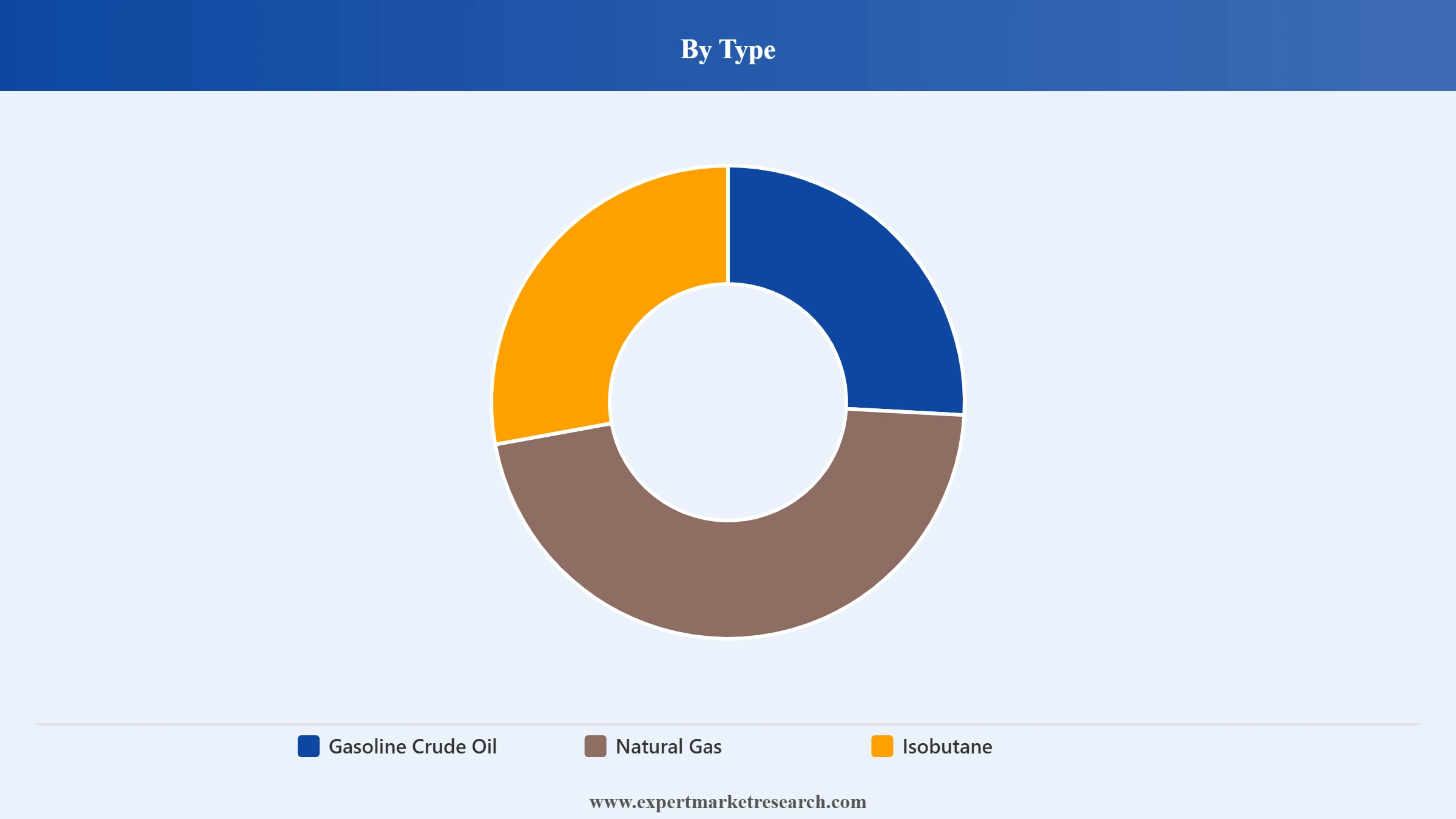
Market Breakup by Type
Key Insight: Natural Gas accounts for the largest share of butane supply, reflecting its established role as a byproduct of natural gas processing across major producing basins including the Permian. Isobutane is the fastest-growing type segment at an estimated CAGR of 5.00%, as refiners scale isomerization capacity, reinforced by ExxonMobil's November 2025 agreement to acquire a 40% interest in the Bahia NGL pipeline to expand Permian NGL takeaway capacity. Gasoline Crude Oil continues to represent a substantial refinery-derived supply source, while Others captures smaller natural-gasoline and condensate-derived streams. Devon Energy's June 2026 post-merger guidance further projects NGL output equal to roughly 23% of its total company production, underscoring this supply base's scale.
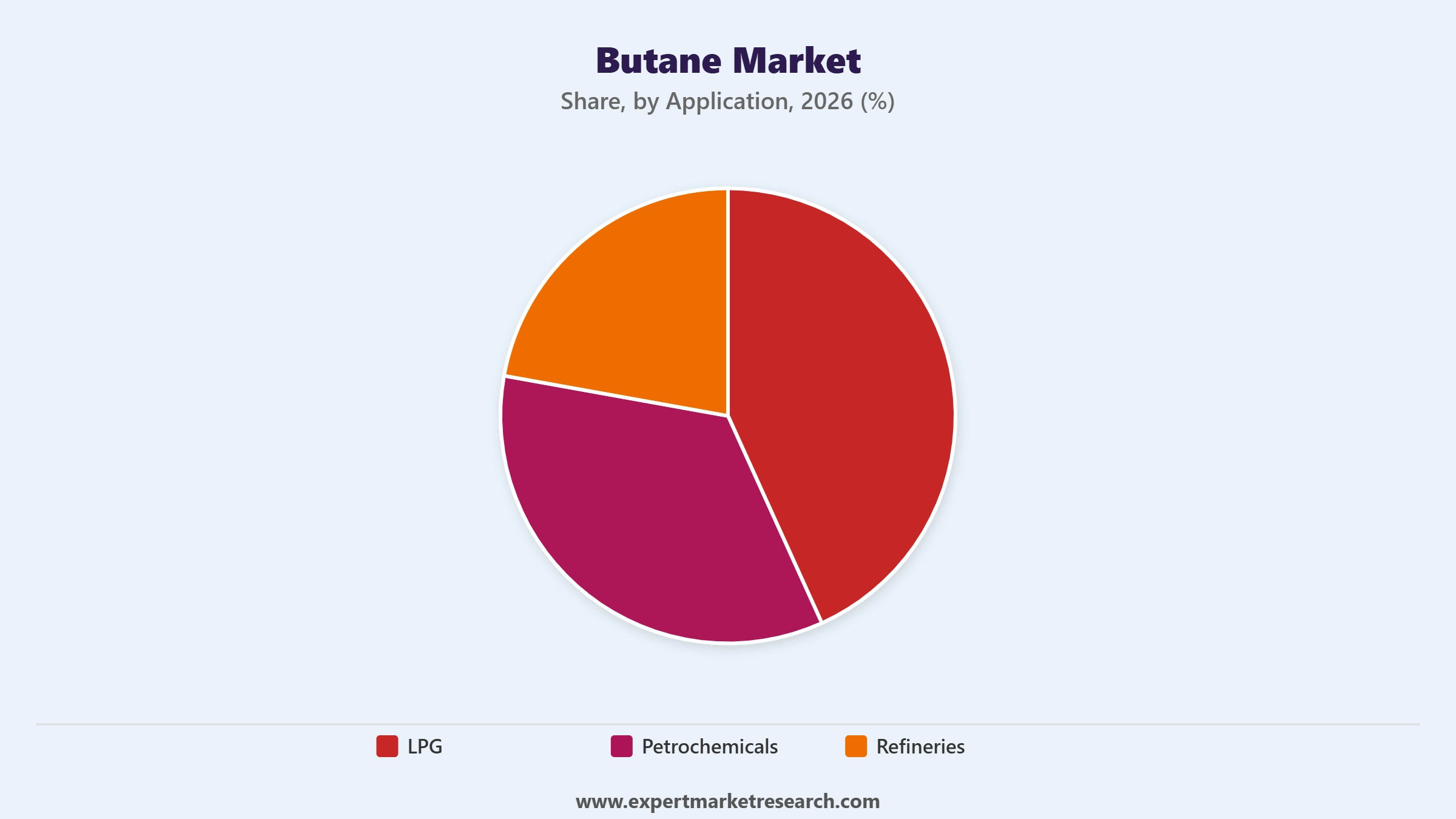
Market Breakup by Application
Key Insight: LPG accounts for the largest share of butane demand, supported by its established role as a residential, commercial, and autogas fuel blend component worldwide. Petrochemicals is the fastest-growing application segment at an estimated CAGR of 5.20%, illustrated by CNPC's PetroChina unit surpassing 10 million tonnes of annual ethylene output in its March 2026 full-year 2025 disclosure. Refineries continue to consume butane for gasoline blending and alkylation, while Others reflects smaller aerosol-propellant and specialty-solvent uses. India's LPG import strategy alone is targeting roughly a tenth of its cooking-gas supply from United States sources by the end of 2026.
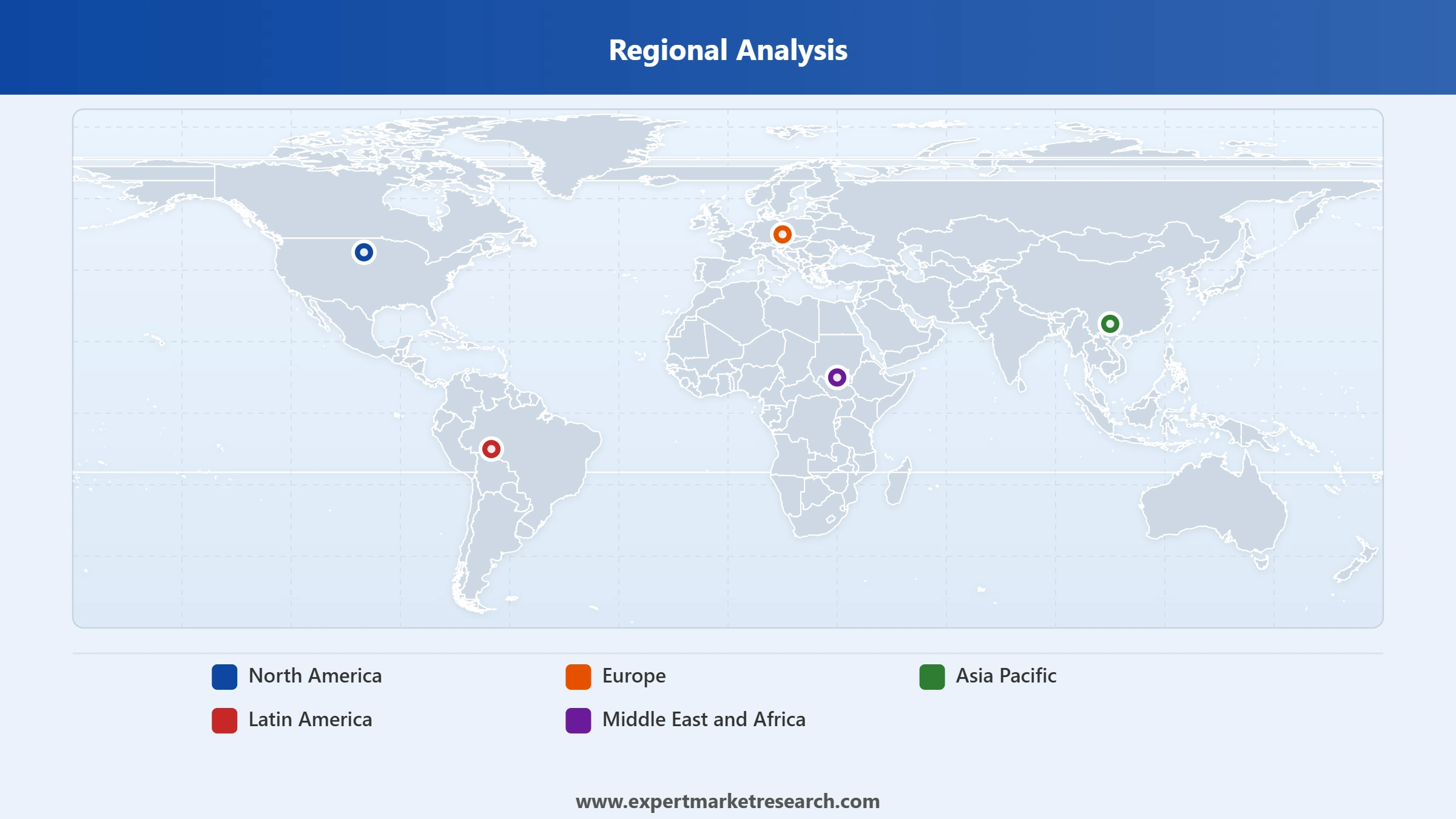
Market Breakup by Region
Key Insight: Asia Pacific accounts for the largest share of the global butane market at approximately 34.80%, anchored by China's large-scale refining and petrochemical processing capacity, illustrated by CNPC's PetroChina unit reporting a record 10-million-tonne ethylene milestone in its March 2026 full-year 2025 results. Latin America is the fastest-growing region at an estimated CAGR of 4.60%, led by Brazil's expanding LPG import infrastructure. North America represents substantial demand tied to Permian Basin NGL production growth, reinforced by ExxonMobil's and Enterprise's November 2025 Bahia pipeline expansion agreement, while Europe and the Middle East and Africa serve steady demand linked to established refining and export infrastructure. This growth also underscores how Latin America's rising petrochemical feedstock consumption aligns with the Petrochemicals segment's broader 5.20% projected growth rate.
Read more about this report - Request a Free Sample
By Type, Natural Gas leads the market while Isobutane grows fastest given accelerating isomerization capacity investment
Natural Gas continues to account for the largest share of butane supply, reflecting its established role as a byproduct stream from natural gas processing plants across major producing basins. Devon Energy Corporation's June 2026 updated guidance, issued after completing its merger with Coterra Energy, projects combined natural gas liquids output of 315,000 to 330,000 barrels per day, underscoring the scale of natural-gas-processing-derived NGL supply feeding the broader butane value chain. This supply base is further reinforced by the Bahia pipeline's planned expansion from 600,000 to 1 million barrels per day of NGLs.
Read more about this report - Request a Free Sample
Isobutane is growing at a fast pace across the market at a projected CAGR of 5.00%, as refiners and petrochemical producers scale isomerization units to meet high-octane blending and alkylate feedstock demand. ExxonMobil's November 2025 agreement to acquire a 40% interest in the Bahia NGL pipeline, expanding Permian NGL takeaway capacity toward 1 million barrels per day, reflects the broader infrastructure build-out supporting isobutane-rich NGL stream growth. This complements Devon Energy's guidance for combined natural gas liquids output of 315,000 to 330,000 barrels per day following its Coterra merger.
By Application, LPG leads the market while Petrochemicals grows fastest given rising cracker feedstock substitution
LPG continues to account for the largest share of butane demand, supported by its established use as a residential and commercial heating and cooking fuel blend across both developed and developing markets. The confirmed United States-to-India LPG supply corridor, involving Chevron Corporation and TotalEnergies SE alongside Phillips 66 and reported in March 2026, illustrates the continued scale of LPG demand anchoring butane consumption across import-dependent markets. This is reinforced by the arrangement's scope, covering roughly 2 million metric tons of United States LPG shipped across 48 very large gas carriers.
Read more about this report - Request a Free Sample
Petrochemicals is growing at a fast pace across the market at a projected CAGR of 5.20%, as crackers increasingly favor butane-rich feedstock slates to optimize ethylene and propylene yields amid shifting feedstock economics. CNPC's PetroChina unit disclosed in March 2026 that full-year 2025 ethylene output exceeded 10 million tonnes for the first time, following Jilin and Guangxi facility expansions, reflecting the scale of petrochemical demand growth pulling on butane-rich feedstock supply. This mirrors a broader industry shift as crackers worldwide recalibrate feedstock slates toward higher-margin, butane-derived output amid evolving cost structures.
Read more about this report - Request a Free Sample
Asia Pacific commands the largest share of the global butane market at approximately 34.80%, anchored by China's large-scale refining and petrochemical processing capacity.
This is supported by CNPC's PetroChina unit's March 2026 disclosure that full-year 2025 ethylene production surpassed 10 million tonnes for the first time, following the completion of expansion projects at its Jilin and Guangxi facilities. The company's broader chemical commodity output also rose 2.7% to 40.03 million tonnes over the same reporting period.
Latin America is emerging as the fastest-growing region at an estimated CAGR of 4.60%, led by Brazil's expanding LPG import and distribution infrastructure and rising petrochemical feedstock consumption. North America continues to represent substantial demand tied to Permian Basin NGL production growth, reinforced by ExxonMobil's and Enterprise Products Partners' November 2025 agreement to expand Bahia NGL pipeline capacity toward 1 million barrels per day, while Europe and the Middle East and Africa serve steady demand linked to established refining and export infrastructure. ExxonMobil is also extending the pipeline system to its Cowboy gas processing plant in New Mexico, set for completion by fourth quarter 2027.
The industry is consolidated, with global butane market companies ranging from large integrated oil and gas majors to national oil companies and specialty industrial gas suppliers competing across type, application, and region segments. Established players operate across the full hydrocarbon value chain, from upstream NGL production and natural gas processing through refining, isomerization, and petrochemical cracking for LPG, petrochemical, and refinery customers.
Competitive dynamics among global butane market players are increasingly shaped by the scale of NGL pipeline and export-logistics investment, the depth of integrated refining-to-petrochemical capacity, and the strength of long-term cross-border supply relationships. Major producers are investing in pipeline capacity expansions, upstream consolidation, and diversified supply corridors to secure long-term relationships with LPG distributors and petrochemical customers.
Founded in 1909 and headquartered in London, United Kingdom, bp is a diversified integrated energy major producing crude oil, natural gas, NGLs, and refined products worldwide. The company reported second-quarter 2026 underlying replacement-cost profit of USD 5.7 billion in its August 2026 results, alongside refining throughput of 1,467 thousand barrels per day and continued divestment of non-core assets to sharpen its core portfolio.
Founded in 1879 and headquartered in Houston, Texas, Chevron is a leading integrated energy company with upstream, midstream, and downstream operations spanning crude oil, natural gas, and NGL production. The company, together with TotalEnergies SE and Phillips 66, was confirmed in March 2026 reporting to be supplying approximately 2 million metric tons of United States LPG to Indian state refiners beginning in 2026.
Founded in 1988 and headquartered in Beijing, China, CNPC is China's largest integrated oil and gas company, with operations spanning exploration, refining, and petrochemicals through its listed unit PetroChina. The company disclosed on March 30, 2026 that full-year 2025 ethylene production exceeded 10 million tonnes for the first time, following expansion projects at its Jilin and Guangxi petrochemical facilities.
Founded in 1980 and headquartered in San Antonio, Texas, Valero is one of the world's largest independent petroleum refiners, producing transportation fuels, petrochemical feedstocks, and other refined products. The company reported second-quarter 2026 net income of USD 3.7 billion in its July 2026 results, with refining margin reaching USD 23.62 per barrel on throughput of 3.0 million barrels per day.
Other key players in the global butane market include ConocoPhillips Inc., Devon Energy Corporation, Exxon Mobil Corporation, Shell plc, TotalEnergies SE, and Proton Gases India Pvt. Ltd., among others.
*Please note that this is only a partial list; the complete list of key players is available in the full report. Additionally, the list of key players can be customized to better suit your needs.*
Unlock the latest insights with our global butane market trends 2026 report. Discover regional growth patterns, type and application trends, and key industry players. Stay ahead of competition with trusted data and expert analysis. Download your free sample report today and drive informed decisions in the market.


Upto 15% Off
USD
$2499 $2249
$3999 $3599
$4999 $4249
$5999 $5099


*While we strive to always give you current and accurate information, the numbers depicted on the website are indicative and may differ from the actual numbers in the main report. At Expert Market Research, we aim to bring you the latest insights and trends in the market. Using our analyses and forecasts, stakeholders can understand the market dynamics, navigate challenges, and capitalize on opportunities to make data-driven strategic decisions.*
In 2025, the market reached an approximate value of USD 123.02 Billion.
The market is projected to grow at a CAGR of 4.30% between 2026 and 2035.
The market is estimated to witness a healthy growth in the forecast period of 2026-2035 to reach about USD 187.42 Billion by 2035.
Expanding NGL pipeline and export-logistics capacity, pursuing diversified cross-border LPG supply corridors, and scaling isomerization and petrochemical cracking capacity to capture higher-value butane derivative demand.
The different applications of butane are LPG, petrochemicals, and refineries, among others.
The major regions considered in the market are North America, Europe, the Asia Pacific, Latin America, and the Middle East and Africa.
The key players in the market include bp plc, Chevron Corporation, China National Petroleum Corporation (CNPC), Valero Energy Corporation, ConocoPhillips Inc., Devon Energy Corporation, Exxon Mobil Corporation, Shell plc, TotalEnergies SE, and Proton Gases India Pvt. Ltd., among others.
Producers face volatile crude oil and natural gas feedstock pricing, the capital-intensive complexity of scaling NGL pipeline and fractionation infrastructure, and exposure to shifting cross-border trade and energy-policy dynamics.
Explore our key highlights of the report and gain a concise overview of key findings, trends, and actionable insights that will empower your strategic decisions.
| REPORT FEATURES | DETAILS |
| Base Year | 2025 |
| Historical Period | 2019-2025 |
| Forecast Period | 2026-2035 |
| Scope of the Report |
Historical and Forecast Trends, Industry Drivers and Constraints, Historical and Forecast Market Analysis by Segment:
|
| Breakup by Type |
|
| Breakup by Application |
|
| Breakup by Region |
|
| Market Dynamics |
|
| Competitive Landscape |
|
| Companies Covered |
|
Datasheet
One User
USD 2,499
USD 2,249
tax inclusive*
Single User License
One User
USD 3,999
USD 3,599
tax inclusive*
Five User License
Five User
USD 4,999
USD 4,249
tax inclusive*
Corporate License
Unlimited Users
USD 5,999
USD 5,099
tax inclusive*
*Please note that the prices mentioned below are starting prices for each bundle type. Kindly contact our team for further details.*
Flash Bundle
Small Business Bundle
Growth Bundle
Enterprise Bundle
*Please note that the prices mentioned below are starting prices for each bundle type. Kindly contact our team for further details.*
Flash Bundle
Number of Reports: 3
20%
tax inclusive*
Small Business Bundle
Number of Reports: 5
25%
tax inclusive*
Growth Bundle
Number of Reports: 8
30%
tax inclusive*
Enterprise Bundle
Number of Reports: 10
35%
tax inclusive*
How To Order

Select License Type
Choose the right license for your needs and access rights.

Click on ‘Buy Now’
Add the report to your cart with one click and proceed to register.

Select Mode of Payment
Choose a payment option for a secure checkout. You will be redirected accordingly.
Strategic Solutions for Informed Decision-Making
Gain insights to stay ahead and seize opportunities.

Get insights & trends for a competitive edge.

Track prices with detailed trend reports.

Analyse trade data for supply chain insights.

Leverage cost reports for smart savings

Enhance supply chain with partnerships.

Connect For More Information
Our expert team of analysts will offer full support and resolve any queries regarding the report, before and after the purchase.
Our expert team of analysts will offer full support and resolve any queries regarding the report, before and after the purchase.
We employ meticulous research methods, blending advanced analytics and expert insights to deliver accurate, actionable industry intelligence, staying ahead of competitors.
Our skilled analysts offer unparalleled competitive advantage with detailed insights on current and emerging markets, ensuring your strategic edge.
We offer an in-depth yet simplified presentation of industry insights and analysis to meet your specific requirements effectively.




