

Consumer Insights
Uncover trends and behaviors shaping consumer choices today
Procurement Insights
Optimize your sourcing strategy with key market data
Industry Stats
Stay ahead with the latest trends and market analysis.
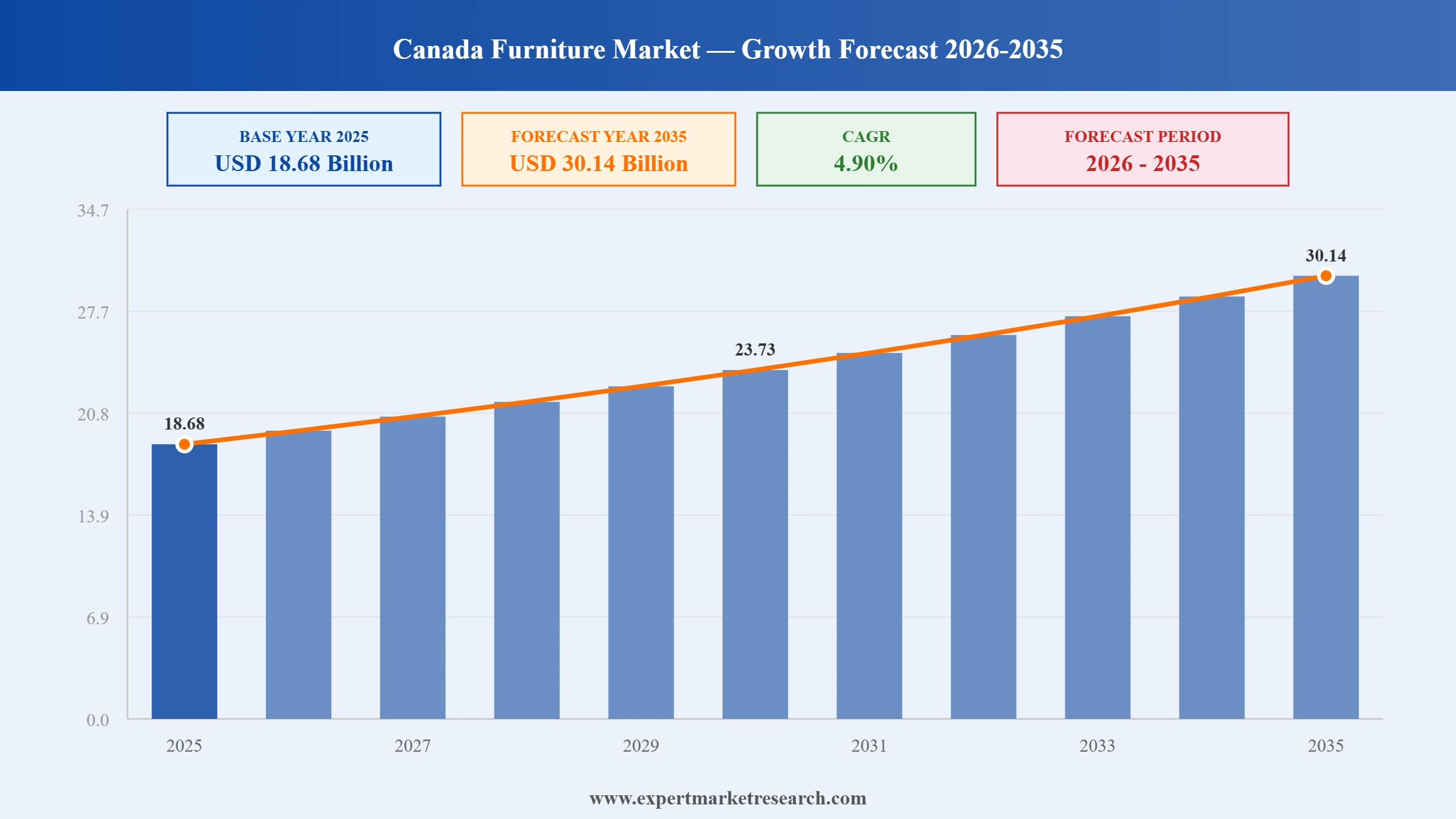
The Canada furniture market attained a value of USD 18.68 Billion in 2025 and is projected to expand at a CAGR of 4.90% through 2035. The market is further expected to reach USD 30.14 Billion by 2035. Rising demand for sustainable materials, multifunctional designs suited to urban living and expanding e-commerce penetration are driving overall growth in the market, with personalisation and modular product formats reshaping how manufacturers and retailers approach residential and commercial furniture design.
The Canada furniture market encompasses beds, tables, sofas, chairs and stools, and shelves and cabinets crafted from metal, wood, and plastic materials for residential and commercial applications nationwide. Demand continues to be shaped by rising urbanisation, evolving workplace design standards, and growing consumer preference for sustainable and personalised furniture, with wood remaining the dominant material choice given its durability and widespread use across both traditional and contemporary product lines.
Established office furniture manufacturers are increasingly consolidating through large scale acquisitions rather than pursuing organic growth alone, reflecting intensifying competition for scale advantages across the contract furniture segment. In December 2025, HNI completed its acquisition of Steelcase, creating a combined conglomerate with approximately 5.8 billion dollars in projected annual revenue following the 22-billion-dollar deal first announced in August.
The Canada furniture market is increasingly directing investment toward showroom expansion and digital sales tools rather than relying solely on traditional wholesale distribution, reflecting a strategic shift toward direct customer engagement as competition intensifies across contract and residential segments. Companies are pursuing parallel investment across sustainable materials, ergonomic seating, and healthcare focused product lines rather than remaining narrowly focused on conventional office furniture, while strengthening regional manufacturing partnerships to shorten delivery timelines. Consolidation of this scale gives combined groups broader product portfolios while drawing renewed competitive pressure toward smaller independent Canadian manufacturers.
Read more about this report - REQUEST FREE SAMPLE COPY IN PDF
KI expanded its product portfolio into outdoor furniture with the introduction of the Outspan Outdoor Collection, building on back-to-back record-breaking years and a recent 33,400 square foot facility expansion in Green Bay, Wisconsin. Entering adjacent furniture categories allows established manufacturers across the Canada furniture market to capture new demand pockets without requiring entirely new distribution relationships, sales teams, or dedicated marketing budgets for the expansion.
Haworth acquired a majority shareholding in Tayco, a Toronto based manufacturer of office furniture and casegoods, with Tayco continuing to operate independently under the agreement to retain its established regional identity. Acquiring established regional manufacturers across the Canada furniture market while preserving their operating identity helps larger groups expand Canadian production capacity without disrupting existing customer relationships built over decades of regional trust and local expertise.
Keilhauer unveiled four new product families, Agyl, Fyord, Unifi, and Weve, at NeoCon 2025 in Chicago, expanding its contract seating and casegoods portfolio across multiple price tiers and healthcare-oriented configurations. Launching several product families together at a major industry trade show lets manufacturers across the Canada furniture market capture concentrated buyer attention while showcasing design range in a single presentation to design specifiers and procurement teams.
Artopex acquired Trica, expanding the contract furniture manufacturer's presence into the high-end residential furniture market beyond its traditional commercial and institutional focus and customer base. Acquisitions that extend contract manufacturers into residential categories let companies diversify revenue while applying existing manufacturing scale and supply chain relationships to entirely new customer segments and retail channels nationwide.
Established contract furniture manufacturers across the Canada furniture market are increasingly expanding their showroom footprints, rather than maintaining static display space, to strengthen brand presence within key design markets. This is helping manufacturers showcase broader product ranges to visiting designers and buyers. In February 2025, MillerKnoll opened a new Design Within Reach showroom in Palm Springs, timed to coincide with the city's annual Modernism Week design festival, showcasing furnishings from Herman Miller, Knoll, and Fritz Hansen alongside newer independent design studios featured throughout the venue.
Established furniture groups across the Canada furniture market are increasingly consolidating production facilities following major acquisitions, rather than operating acquired plants independently, to capture manufacturing efficiencies across combined operations. This is helping groups reduce redundant capacity while preserving core production capabilities. In January 2026, HNI announced plans to close its Gunlocke plant in 2027 and consolidate production into other North American facilities, affecting hundreds of workers as operations shift to existing sites across the group's broader North American manufacturing network.
Established contract furniture brands across the Canada furniture market are increasingly launching specialised healthcare product lines, rather than adapting general office seating for clinical use, to meet growing demand from care focused environments. This is helping brands capture growth in a resilient vertical beyond traditional office and home furnishing segments. In June 2025, Herman Miller launched the Gemma Seating Family, a new collection of modular healthcare seating, complementing a dedicated healthcare showcase space at MillerKnoll's new Fulton Market facility in Chicago and beyond.
Established furniture retailers across the Canada furniture market are increasingly increasing new store openings, rather than pausing expansion, even as broader industry sales growth remains modest across the wider furniture sector. This is helping retailers capture market share from smaller competitors facing margin pressure. In April 2025, Ashley Furniture announced the closure of its Mesquite, Texas manufacturing facility, consolidating production at other company plants while continuing to open new retail locations throughout the year across several major North American metropolitan markets nationwide.
Established furniture manufacturers are increasingly reporting modest quarterly sales growth, rather than steep gains, as companies plan around potential new tariffs affecting cross border trade. This is helping manufacturers maintain steady performance despite an uncertain trade policy environment. In September 2025, MillerKnoll reported first quarter fiscal 2026 results alongside continued planning for potential tariff impacts across its North American Contract and Global Retail segments, reflecting the broader industry's cautious approach to cross border trade policy uncertainty this fiscal year.
The Expert Market Research's report titled “Canada Furniture Market Report and Forecast 2026-2035” offers a detailed analysis of the market based on the following segments:
Market Breakup by Product
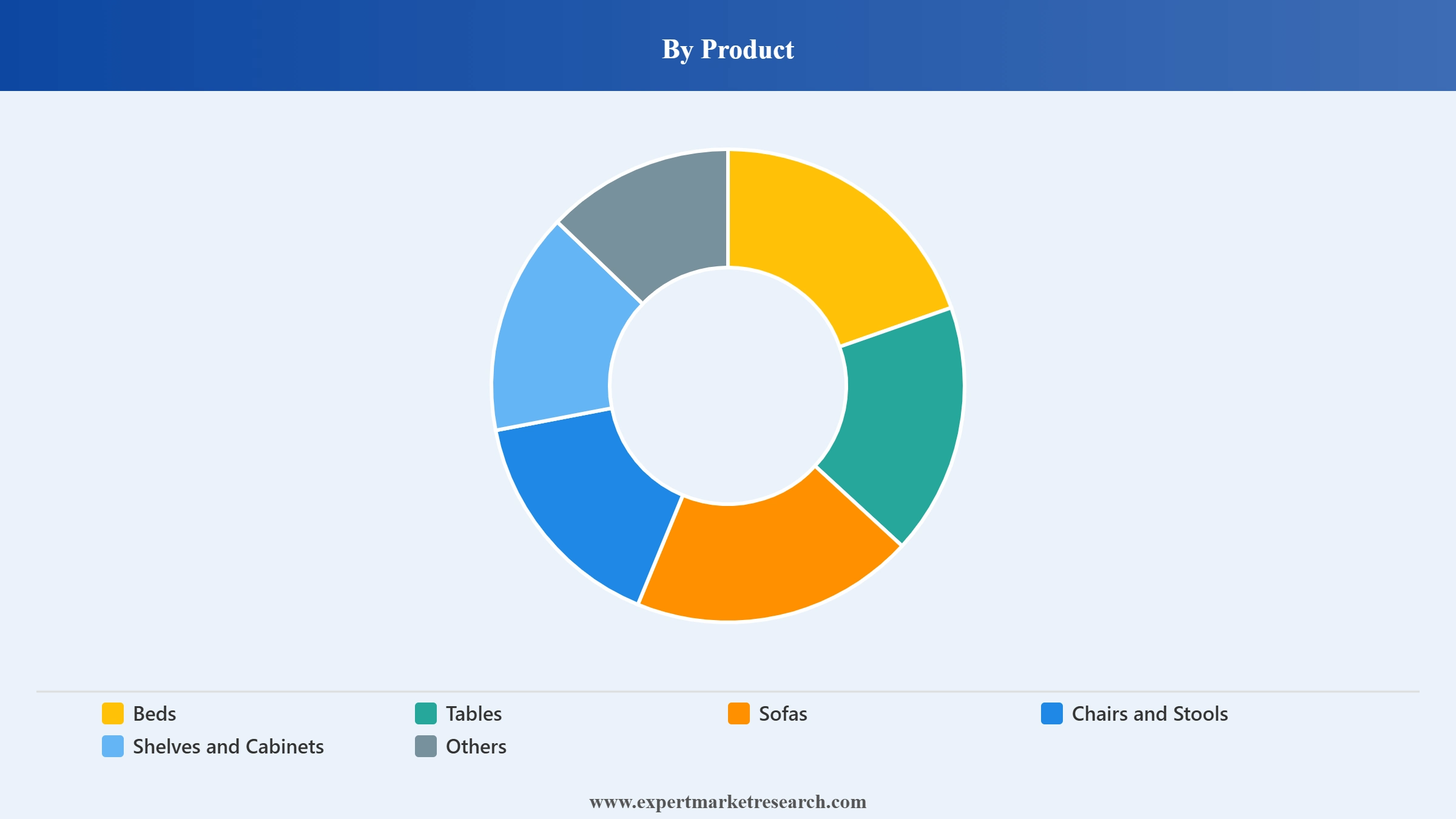
Key Insight: Consistent replacement cycles and universal household necessity keep beds and sofas among the largest product categories across the Canada furniture market, spanning every bedroom and living space configuration. Tables continue supporting both dining and home office setups, while chairs and stools are registering some of the fastest growth as remote and hybrid work arrangements sustain demand for ergonomic seating. Shelves and cabinets support organisational needs across kitchens and living areas, and the others category, spanning outdoor and specialised furniture, continues to benefit from rising patio seating demand.
Market Breakup by Material
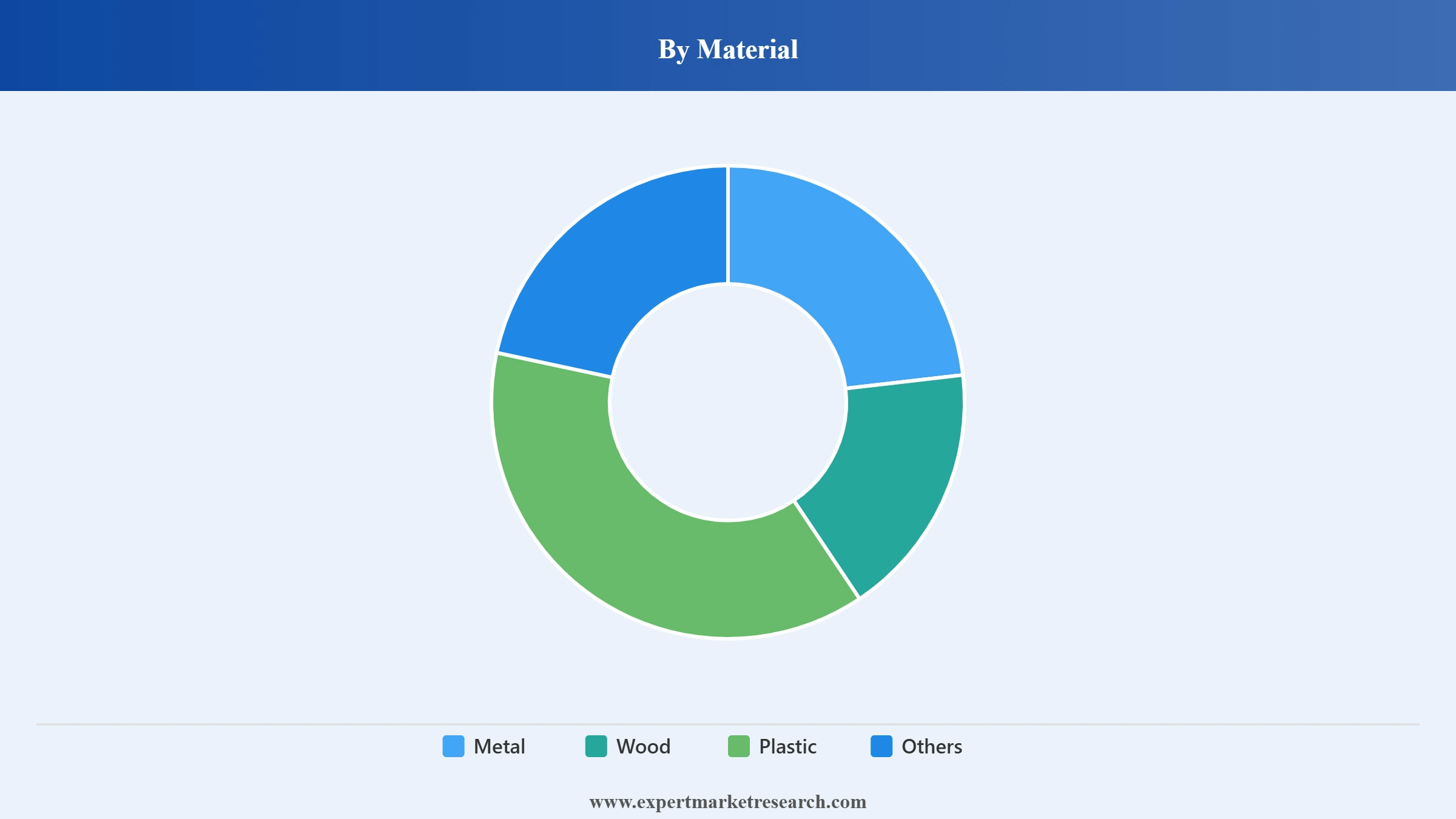
Key Insight: Durability, widespread availability, and broad aesthetic appeal keep wood as the dominant material choice across the Canada furniture market. Metal continues supporting contract and outdoor furniture applications where structural strength matters most, while plastic serves budget conscious and lightweight furniture categories, and demand for recycled and composite material blends is registering the fastest growth as sustainability becomes a stronger purchasing consideration.
Market Breakup by Application
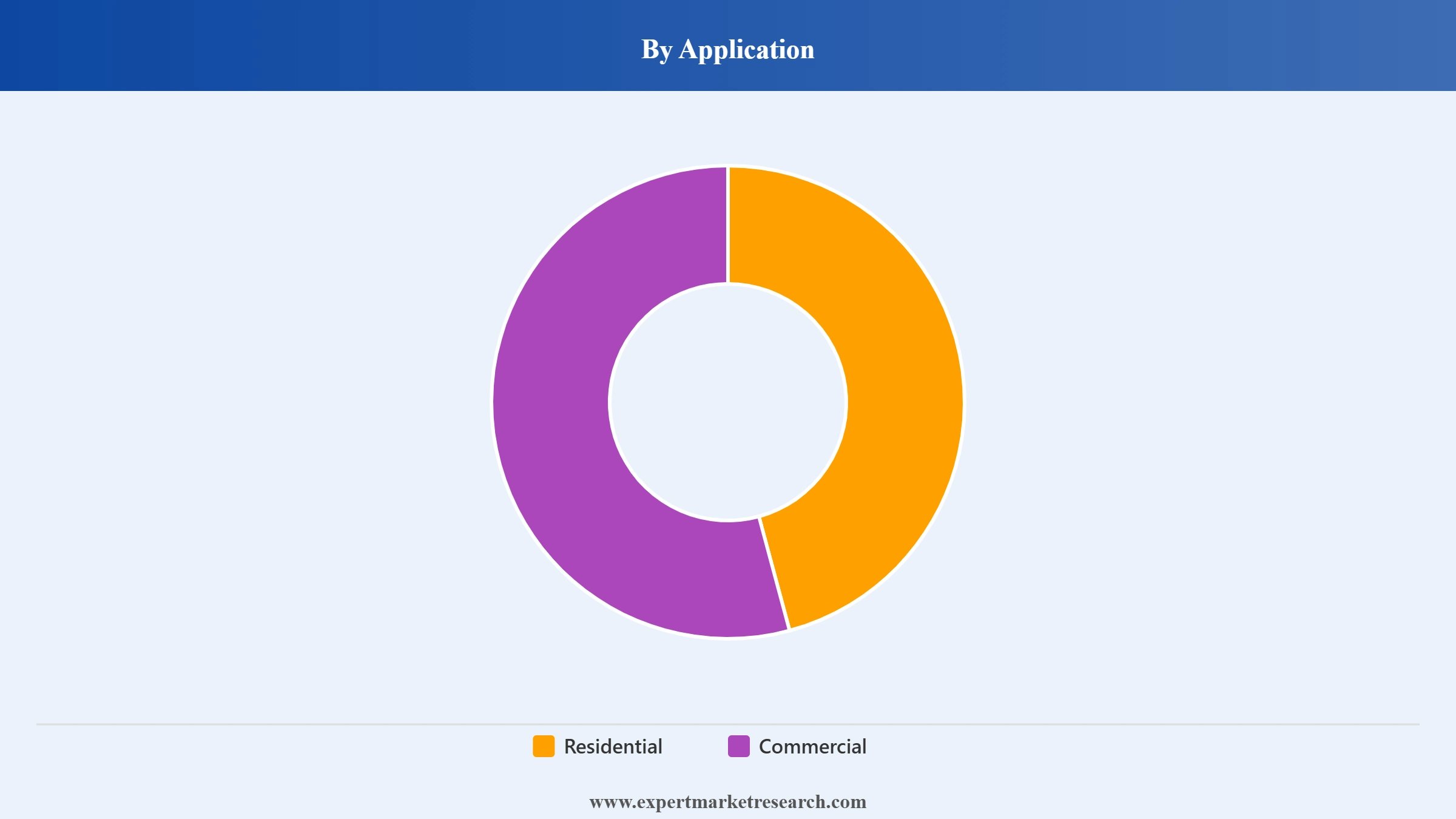
Key Insight: Sustained household formation and renovation activity keep residential applications as the largest end use category across the Canada furniture market. In August 2026, the Canadian Real Estate Association forecast approximately 463,336 residential property transactions nationally for the year, supporting continued residential furniture demand. Commercial applications continue expanding through office, healthcare, and hospitality furnishing projects, with demand increasingly shaped by evolving workplace design standards following widespread adoption of hybrid work arrangements.
Market Breakup by Distribution Channel
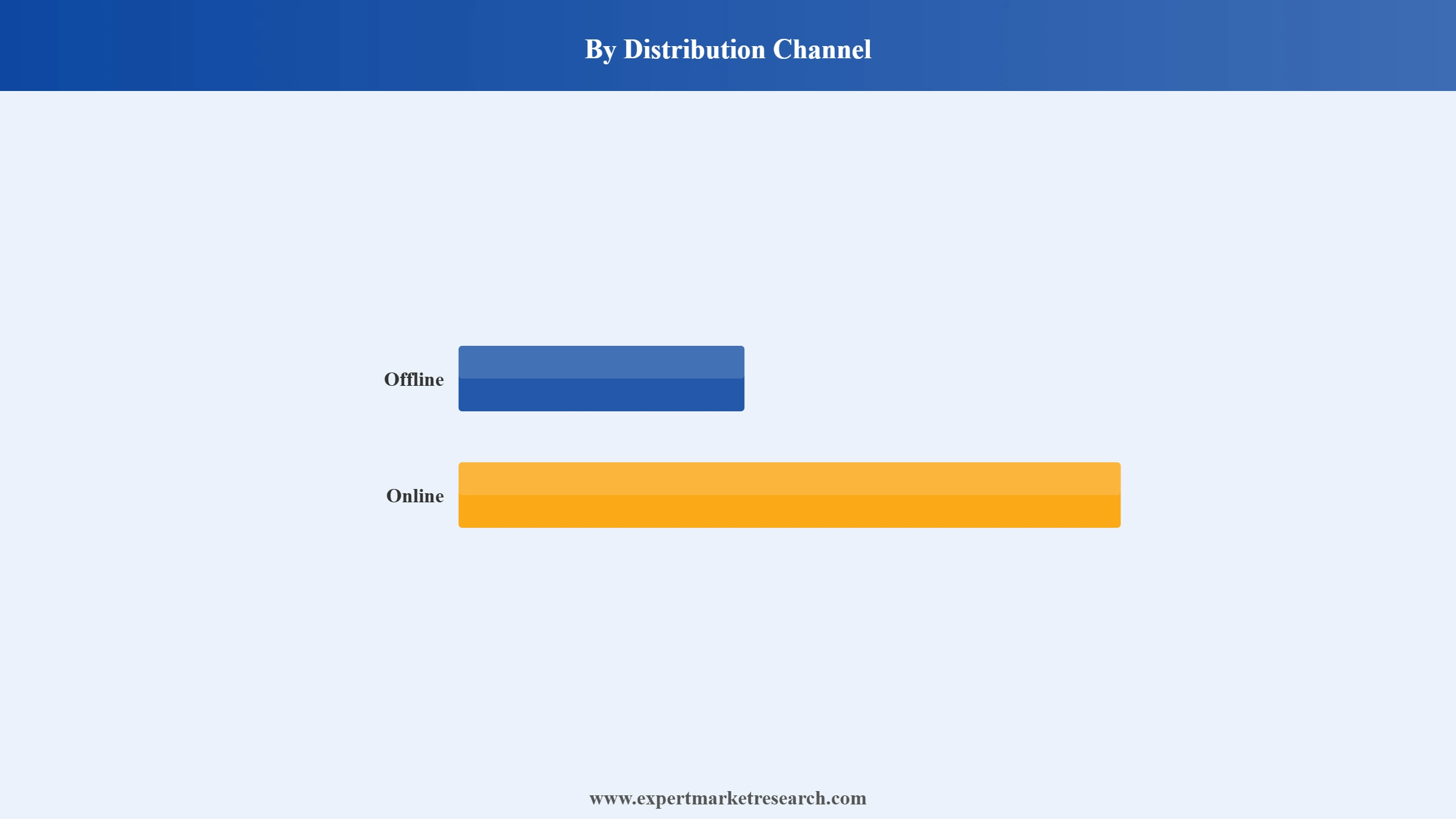
Key Insight: Established showroom networks and in person consultation needs keep offline channels as the leading distribution route across the Canada furniture market. Online channels are registering the fastest growth as digital marketplaces expand product visualisation tools and direct to consumer shipping capabilities, though in August 2026 Wayfair executives noted that consumer sentiment in Canada remained under continued pressure compared to stronger United States performance.
Market Breakup by Region
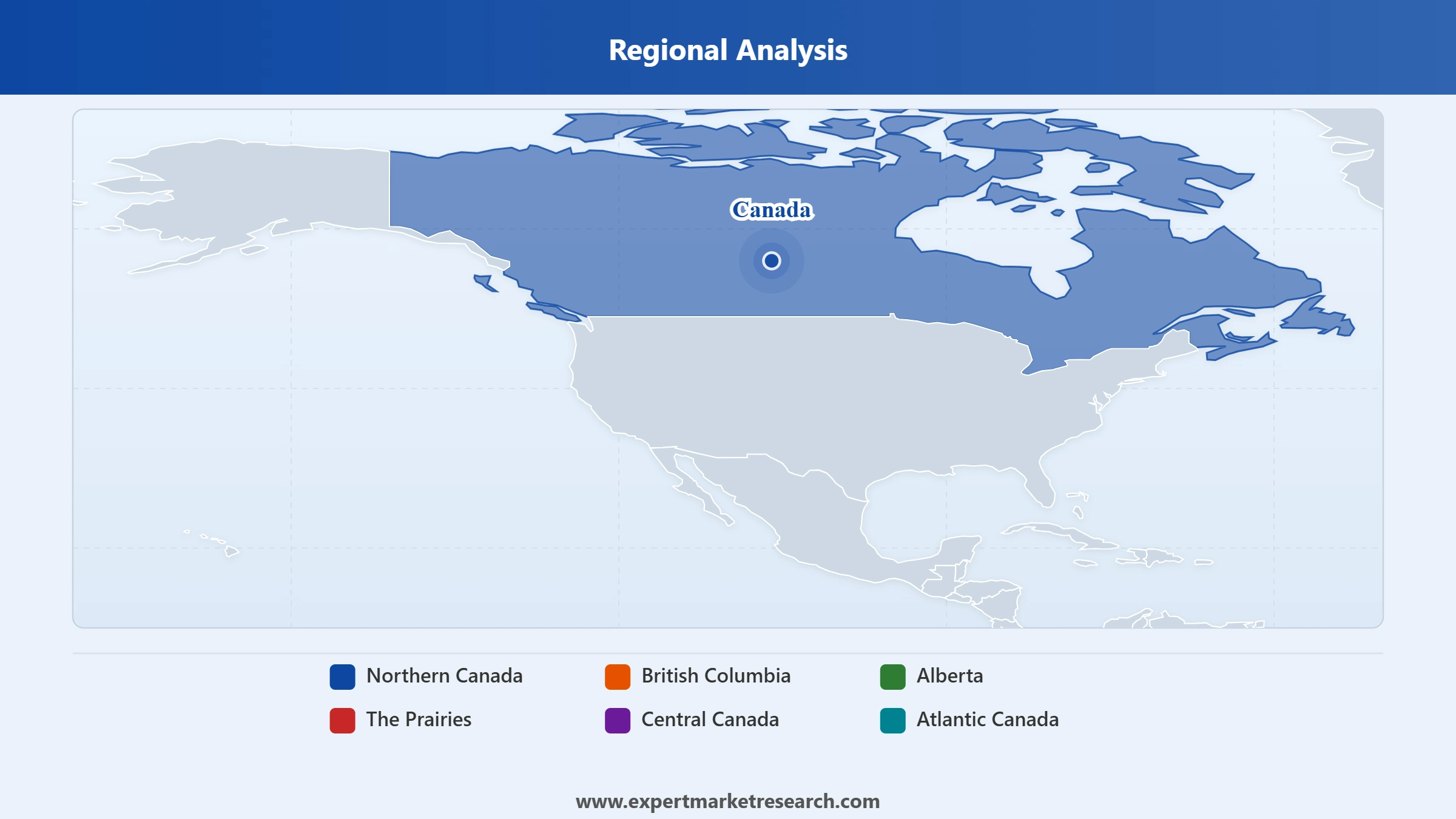
Key Insight: Regional dynamics in the Canada furniture market continue to shape competitive strategies. Dense population centres and established manufacturing bases keep Central Canada at the front of regional demand, while Alberta benefits from steady resource sector income supporting furniture purchases. The Prairies and Atlantic Canada contribute smaller but stable regional demand bases, Northern Canada remains a limited but specialised market given its remote geography, and rising population growth combined with strong housing activity is propelling British Columbia toward the fastest regional growth.
Read more about this report - REQUEST FREE SAMPLE COPY IN PDF
By product, sofas and beds dominate the market through consistent household replacement cycles and universal necessity
Sofas and beds account for the largest product share of the Canada furniture market, supported by consistent household replacement cycles and universal necessity across every home nationwide. Established Canada furniture companies continue to expand product pipelines across seating and bedroom categories, serving this consistent, high volume demand base while introducing modular designs suited to smaller urban living spaces and multi-generational households seeking flexible, space efficient furniture arrangements that adapt easily to changing family needs and living situations over time.
Read more about this report - REQUEST FREE SAMPLE COPY IN PDF
Tables continue to serve dining and home office functions as multifunctional furniture gains popularity in space constrained urban households. Chairs and stools are growing quickly as hybrid work arrangements sustain demand for ergonomic seating, illustrated by Allseating's July 2026 expanded partnership with Material Bank, giving designers digital access to more than 6,500 finishes across 66 seating solutions. Shelves and cabinets support organisational needs, while the others category, spanning outdoor and specialised furniture, benefits from rising patio and garden seating demand.
By material, wood dominates the market while recycled composite blends register the fastest growth through sustainability focused demand
Wood accounts for the largest material share of the Canada furniture market, anchored by durability, widespread availability, and broad aesthetic appeal across furniture categories nationwide. Established Canada furniture companies continue to expand wood based product pipelines, serving this consistent, high volume demand base while sourcing increasingly from certified sustainable forestry operations across the country to meet growing environmental compliance requirements and consumer sustainability expectations, particularly among buyers renovating older residential properties across both established urban neighbourhoods and newer suburban developments nationwide.
Read more about this report - REQUEST FREE SAMPLE COPY IN PDF
Metal supports contract, outdoor, and structural furniture applications where durability and load bearing strength matter most across commercial and institutional settings. Plastic serves budget conscious and lightweight categories, offering an accessible entry point, illustrated by BESTAR's June 2026 resumption of ready to assemble furniture production at its Quebec facility under new ownership following a brief closure. The Others category, including recycled and composite blends, is registering the fastest growth as sustainability becomes a stronger purchasing consideration across residential and institutional furniture buyers alike.
By application, residential dominates the market while commercial applications continue expanding through evolving workplace standards
Residential applications account for the largest end use share of the Canada furniture market, anchored by sustained household formation and renovation activity across the country nationwide. Established Canada furniture companies continue to expand residential product pipelines, serving this consistent, high volume demand base across urban and suburban housing markets, particularly within growing multi-unit and condominium developments concentrated across major metropolitan centres and their expanding suburban commuter belts stretching well beyond traditional city boundaries into surrounding regions nationwide.
Read more about this report - REQUEST FREE SAMPLE COPY IN PDF
Commercial applications continue expanding through office, healthcare, and hospitality furnishing projects, with demand increasingly shaped by evolving workplace design standards following widespread adoption of hybrid work arrangements. In January 2026, Groupe Lacasse continued expanding its brand and marketing leadership team, reflecting sustained investment in its institutional and business furniture portfolio nationwide, supporting continued growth across corporate, educational, and healthcare furnishing categories throughout the country, particularly among post-secondary institutions, regional healthcare networks, and expanding municipal government offices.
By distribution channel, offline dominates the market while online registers the fastest growth through expanding digital visualisation tools
Offline channels account for the largest distribution share of the Canada furniture market, supported by established showroom networks and in person consultation needs for larger furniture purchases nationwide. Established Canada furniture companies continue to invest in physical retail experiences, serving this consistent, high touch demand base across major metropolitan shopping destinations, particularly for premium, custom order, and large format furniture categories that benefit most from hands on evaluation before a significant household purchase decision.
Read more about this report - REQUEST FREE SAMPLE COPY IN PDF
Online channels are registering the fastest growth as digital marketplaces expand product visualisation tools and direct to consumer shipping capabilities, narrowing the gap with traditional retail for standardised furniture categories. In February 2026, Wayfair reported annual sales growth of 5.1 percent to 12.5 billion dollars, its first full year of growth since 2020, driven by rising order volumes and stronger customer acquisition across North America, including growing traction within the Canadian market specifically this year.
Read more about this report - REQUEST FREE SAMPLE COPY IN PDF
Central Canada dominates the market through dense population centres and established manufacturing infrastructure
Central Canada leads the Canada furniture market, anchored by dense population centres and established manufacturing infrastructure across Ontario and Quebec. Established Canada furniture companies continue to expand production and distribution networks across Central Canada, reinforcing the region's position as the country's primary furniture manufacturing hub and largest single demand centre for both residential and contract categories, supported by proximity to major North American transportation corridors that keep freight and logistics costs comparatively low for regional producers and distributors alike.
British Columbia is registering the fastest regional growth as rising population growth and strong housing activity drive demand across the province nationwide. In May 2026, Vancouver based direct to consumer brand Article reported that its debut physical store had driven 47 percent local revenue growth, prompting plans for additional Canadian and United States locations to capture similar momentum in other high density Canadian and American metropolitan markets over the next several years.
The Canada furniture companies are becoming increasingly competitive as majority of them invest in modular design, sustainable materials, and digital sales tools to differentiate their portfolios across residential and commercial categories. They are prioritising showroom expansion, ergonomic product innovation, and healthcare focused seating lines to appeal to increasingly design conscious and hybrid work-oriented consumers. These companies are also deepening trade show presence, sustainable material sourcing, and direct to consumer platforms to strengthen market positioning, while investing in production consolidation to defend market share against rising acquisition driven competition.
Major Canada furniture market players are also focusing on scale building acquisitions and outdoor category expansion to capture growing demand across evolving product segments. Strategic emphasis on healthcare focused seating and sustainable sourcing is allowing established companies to capture market share as consumer expectations around ergonomic, environmentally responsible furniture evolve. The market players continue to pursue partnerships with regional manufacturers and material suppliers, particularly across Ontario and the western provinces, to diversify production capacity beyond core eastern manufacturing hubs while smaller specialist brands compete on design led differentiation to retain premium contract customers.
Founded in 1905 and headquartered in Zeeland, Michigan, United States, MillerKnoll is a global design company formed through the merger of Herman Miller and Knoll, offering furniture across office, healthcare, education, and residential categories. The company operates through North America Contract, International Contract, and Global Retail segments, including its Design Within Reach retail brand.
Founded in 1912 and headquartered in Grand Rapids, Michigan, United States, Steelcase is a global manufacturer of office furniture and workplace solutions serving corporate, healthcare, and educational environments. The company's portfolio spans desking, seating, and space planning systems designed to support evolving hybrid work arrangements across its established North American and Canadian customer base.
Founded in 1981 and headquartered in Toronto, Ontario, Canada, Keilhauer is a privately owned, design focused contract furniture manufacturer specialising in seating and tables for commercial and healthcare environments. The company has maintained a long-standing presence at major North American design trade shows, exhibiting at THE MART in Chicago since 1998.
Founded in 1984 and headquartered in Vaughan, Ontario, Canada, Allseating designs and manufactures ergonomic task and specialty seating solutions for commercial, education, and healthcare markets. The company distributes its products through an extensive North American representative network supporting workplace, hospitality, and patient care seating applications.
Other key players in the market include Ashley Furniture Industries, LLC, Global Furniture Group, Teknion Group, BESTAR Inc., Groupe Lacasse Inc., and Durham Furniture Inc., among others.
*Please note that this is only a partial list; the complete list of key players is available in the full report. Additionally, the list of key players can be customized to better suit your needs.*
Unlock the latest insights with our Canada furniture market trends 2026 report. Discover regional growth patterns, product and material economics, and key industry players. Stay ahead of competition with trusted data and expert analysis. Download your free sample report today and drive informed decisions in the market.


Upto 15% Off
USD
$2499 $2249
$3999 $3599
$4999 $4249
$5999 $5099


*While we strive to always give you current and accurate information, the numbers depicted on the website are indicative and may differ from the actual numbers in the main report. At Expert Market Research, we aim to bring you the latest insights and trends in the market. Using our analyses and forecasts, stakeholders can understand the market dynamics, navigate challenges, and capitalize on opportunities to make data-driven strategic decisions.*
In 2025, the market reached an approximate value of USD 18.68 Billion.
The market is projected to grow at a CAGR of 4.90% between 2026 and 2035.
The market is estimated to witness a healthy growth in the forecast period of 2026-2035 to reach USD 30.14 Billion by 2035.
The market is being driven due to growing residential sector, rising disposable income, and rising demand for comfortable furniture in offices or commercial sector.
Key trends aiding the market expansion include demand for ergonomic furniture by offices, rising adoption of minimalistic style, emergence of multipurpose furniture, and introduction of DIY furniture that is also travel friendly.
Regions considered in the market are Northern Canada, British Columbia, Alberta, The Prairies, Central Canada, Atlantic Canada.
Furniture is made with different materials, such as metal, wood, and plastic, among others.
Based on product, the market segmentations include beds, tables, sofas, chairs and stools, shelves and cabinets, among others.
Residential and commercial applications are considered in the report.
The key players in the market include MillerKnoll Inc., Ashley Furniture Industries, LLC, Steelcase Inc., Global Furniture Group, Teknion Group, BESTAR Inc., Groupe Lacasse Inc., Keilhauer Ltd., Allseating Corporation, and Durham Furniture Inc., among others.
Central Canada dominates the market, supported by dense population centres and established manufacturing infrastructure.
Sofas and beds hold the largest share, supported by consistent household replacement cycles and universal necessity.
Explore our key highlights of the report and gain a concise overview of key findings, trends, and actionable insights that will empower your strategic decisions.
| REPORT FEATURES | DETAILS |
| Base Year | 2025 |
| Historical Period | 2019-2025 |
| Forecast Period | 2026-2035 |
| Scope of the Report |
Historical and Forecast Trends, Industry Drivers and Constraints, Historical and Forecast Market Analysis by Segment:
|
| Breakup by Product |
|
| Breakup by Material |
|
| Breakup by Application |
|
| Breakup by Distribution Channel |
|
| Breakup by Region |
|
| Market Dynamics |
|
| Competitive Landscape |
|
| Companies Covered |
|
Datasheet
One User
USD 2,499
USD 2,249
tax inclusive*
Single User License
One User
USD 3,999
USD 3,599
tax inclusive*
Five User License
Five User
USD 4,999
USD 4,249
tax inclusive*
Corporate License
Unlimited Users
USD 5,999
USD 5,099
tax inclusive*
*Please note that the prices mentioned below are starting prices for each bundle type. Kindly contact our team for further details.*
Flash Bundle
Small Business Bundle
Growth Bundle
Enterprise Bundle
*Please note that the prices mentioned below are starting prices for each bundle type. Kindly contact our team for further details.*
Flash Bundle
Number of Reports: 3
20%
tax inclusive*
Small Business Bundle
Number of Reports: 5
25%
tax inclusive*
Growth Bundle
Number of Reports: 8
30%
tax inclusive*
Enterprise Bundle
Number of Reports: 10
35%
tax inclusive*
How To Order

Select License Type
Choose the right license for your needs and access rights.

Click on ‘Buy Now’
Add the report to your cart with one click and proceed to register.

Select Mode of Payment
Choose a payment option for a secure checkout. You will be redirected accordingly.
Strategic Solutions for Informed Decision-Making
Gain insights to stay ahead and seize opportunities.

Get insights & trends for a competitive edge.

Track prices with detailed trend reports.

Analyse trade data for supply chain insights.

Leverage cost reports for smart savings

Enhance supply chain with partnerships.

Connect For More Information
Our expert team of analysts will offer full support and resolve any queries regarding the report, before and after the purchase.
Our expert team of analysts will offer full support and resolve any queries regarding the report, before and after the purchase.
We employ meticulous research methods, blending advanced analytics and expert insights to deliver accurate, actionable industry intelligence, staying ahead of competitors.
Our skilled analysts offer unparalleled competitive advantage with detailed insights on current and emerging markets, ensuring your strategic edge.
We offer an in-depth yet simplified presentation of industry insights and analysis to meet your specific requirements effectively.




