Consumer Insights
Uncover trends and behaviors shaping consumer choices today
Procurement Insights
Optimize your sourcing strategy with key market data
Industry Stats
Stay ahead with the latest trends and market analysis.
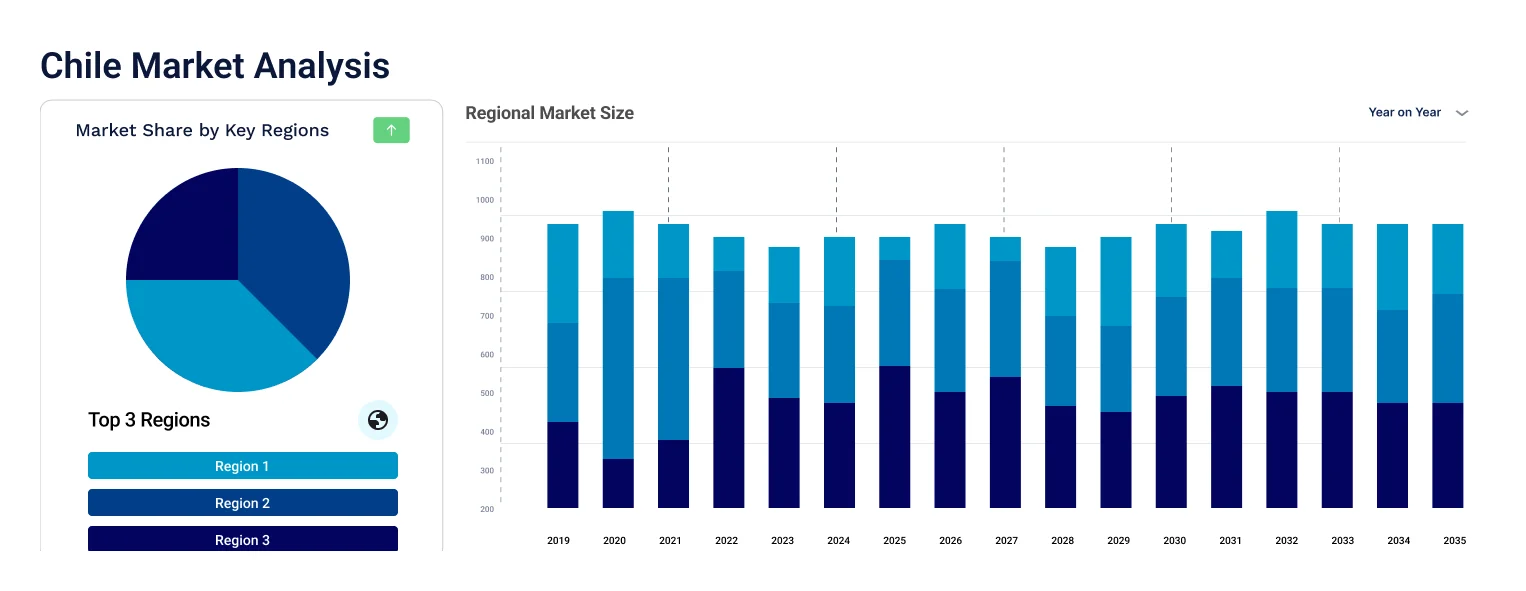
The Chile cosmetics market attained a value of USD 442.60 Million in 2025 and is projected to expand at a CAGR of 10.90% through 2035. The market is further expected to achieve USD 1245.45 Million by 2035. Increasing focus on high-end fragrances as well as prestige items at an affordable price is leading to an expansion of the assortments which provides opportunities for specialty brands with unique aromas and packaging and effective local distribution.
The Chile cosmetics market is becoming an interesting prospect for beauty product companies, distributors, and brands who are seeking to build their presence in Latin America with unique products. The competitive edge can be achieved via the production of skincare solutions designed to solve consumers’ problems such as exposure to the sun, lack of moisture in skin, and other signs of skin aging, as well as the development of color cosmetics and hair products via pharmacies, hypermarkets, speciality stores, and online channels. International suppliers have an opportunity to penetrate the market with high-end products, dermocosmetics, and affordable beauty lines without exclusive focus on department stores. For example, in April 2026, Seppic launched MACRO-AGE, a blue biotechnology-derived active ingredient designed to address inflamm-aging and support healthier-looking skin.
Product innovation and regulatory issues are among the key factors that should be considered by businesses for Chile cosmetics market penetration. Companies should evaluate requirements of the Chile Institute of Public Health (ISP), which is responsible for the sanitary registration of cosmetic products. In this way, product documentation, composition, labeling, and abilities of importers become key aspects of market entrance strategy. Manufacturers can benefit from cooperation with distributors and adaptation of packaging and product information in accordance with the requirements of the country. In July 2026, AORA became Sephora’s first plastic-free brand, highlighting growing beauty industry efforts to reduce packaging waste and improve sustainability.
There are two other aspects that could assist in boosting the overall demand in the Chile cosmetics market. First, gifting occasions as well as fragrance-driven sales might lead to the introduction of discovery packs, travel-sized packs, as well as premium packaging at different price levels. Secondly, increasing involvement of men in personal grooming creates demand for face cleansers, moisturizers, deodorants, and hair styling products with the premise of convenience. These products can be introduced by working together with pharmacies, department stores, and Internet retailers.
Compound Annual Growth Rate
10.9%
Value in USD Million
2026-2035
Read more about this report - REQUEST FREE SAMPLE COPY IN PDF
APR started distributing the Medicube skin boosters in Latin America, planning for a launch in Chile in November 2026 after a pre-launch event. Beauty brands can penetrate the high-end skincare market in Chile using local distributors and partnering with professionals along with science-based product lines.
Galderma decided to purchase ZO Skin Health for USD 1.5 billion, strengthening its science-based skincare products line as well as physician-dispensed dermatology products internationally. Beauty brands can distinguish themselves using science-based formulations, partnering with dermatologists, and selling a high-end skincare regimen to customers, boosting demand in the Chile cosmetics market.
MercadoLibre intended to offer its online-only in-house pharmacy in Chile on the condition that there would be some regulatory changes after its trial of over-the-counter medicine in Brazil. The cosmetics companies may boost their e-commerce through collaboration, convenient delivery, e-discovery of products and proper distribution of dermocosmetics.
LIFOCOLOR developed new effects for packaging of cosmetics like soft touch PET, recyclable metallized finishes, and holographic finish while considering the requirements of sustainability. Companies in the Chile cosmetics market can therefore choose to develop the sustainable packaging options along with tactile and visual effects.
Brands are enhancing their skincare portfolio by focusing on different aspects like hydration, pigmentation, acne, and anti-aging with distinct formulas. In August 2026, Galderma expanded Cetaphil’s Nourishing line with hydrating body lotions and creams featuring skin barrier-supporting ingredients for sensitive skin. This trend in the Chile cosmetics market indicates that manufacturers should create light sunscreen, moisturizers containing barrier ingredients, and simple kits for pharmacies and e-commerce sites. Claims need to be evidence-based and comply with Chilean regulations.
South Korean beauty brands are going beyond being visible online to distributing their products in Chile. This includes beauty brands such as LG Cosmetics, Beauty&Health that were launched in Chile via Novagroup with Belif, The Face Shop, Tpsy, and FMGT, covering skincare and cosmetics categories. Both Belif's botanical proposition and skincare offerings of The Face Shop provide a good starting point for distributors. Following this Chile cosmetics market trend, in September 2026, L’Oréal and COSMAX signed an agreement to co-develop K-beauty-inspired products, innovative cosmetic ingredients and sensory experiences for global markets.
Retailers are creating engaging beauty spaces that enable consumers to learn about new products in all categories. Beauty.F, an initiative by Falabella, was launched at Parque Arauco in November 2025, which combines makeup, skincare, hair care, and fragrances, including exclusive brand launches and activations. Ripley is creating a beauty section where it offers makeup by Dolce & Gabbana and Korean skincare brands. For Chile cosmetics market players, these kinds of initiatives open an opportunity for launch partnerships, demonstrations, gift sets, and special assortment offerings.
Digital commerce provides cosmetics manufacturers with avenues to efficiently reach customers outside expanding urban centers, but there must be synergy between logistics and product discovery. For example, in May 2026, Natura partnered with Mercado Libre Chile to launch an official online store and claims deliveries within 48 hours as part of its offer. This is one way for brands to complement their sales through marketplace and direct partnerships in addition to beauty counters, broadening the Chile cosmetics market scope.
In accordance with the cosmetic regulations in Chile, it is necessary to do regulatory preparation prior to entering the market. In accordance with the Institute of Public Health, cosmetics require sanitary approval, which must comply with certain requirements regarding allowed substances, microbiology control, authorized manufacture, and substantiation of the promotional claims. Foreign companies are recommended to prepare a formulation sheet, safety information, Spanish label and packaging and substantiation of promoted claims before launching their product in the Chile cosmetics market. For example, in January 2026, Global CosIng 2.0 launched with multilingual support, ingredient tracking, and lower subscription costs, simplifying international cosmetic regulatory compliance.
The Expert Market Research's report titled “Chile Cosmetics Market Report and Forecast 2026-2035” offers a detailed analysis of the market based on the following segments:
Market Breakup by Category
Key Insight: As per the Chile cosmetics market report, skin care and sun care products address the needs of people requiring hydrating products, pigment control products, anti-aging products, and UV protection. The market for hair care products comprises those customers who require cleansing products, conditioning products, scalp treatment products, coloring products, and styling products. In September 2026, Arkhé Cosmetics launched Density, a science-backed haircare range combining patented ingredient delivery technology and active ingredients to reduce hair loss. Further, the market is witnessing growth in sales of makeup and color cosmetics with the growing popularity of premium makeup and inclusion of various shades, designed for different customer choices. On the other hand, perfumes and deodorants are leveraging the rising awareness about personal grooming, premium perfumes, and skin-friendly products for odor protection.
Market Breakup by Gender
Key Insight: Women constitute a customer base in a broad spectrum of beauty categories like skincare, color cosmetics, fragrances, and hair care products. There is a growth opportunity for the men’s segment with regard to grooming products like facial care products, shaving products, deodorants, and styling products. Unisex products may be suitable for those customers who place a higher emphasis on the performance, scents, or ingredients used in the product rather than the marketing aimed at gender. Chile cosmetics market companies may optimize their product portfolios through identifying common needs like hydration, sun protection, and scalp care.
Market Breakup by Price Range
Key Insight: Mass products cater to the requirements of consumers looking for affordability, easy availability, and reliability of performance, accelerating growth in the Chile cosmetics market. On the other hand, premium products cater to the needs of consumers looking for specialized products, prestige fragrances, unique packaging, and better customer service. Both types of brands can do this by emphasizing the differences in their products’ benefit features rather than altering packaging and pricing.
Market Breakup by Distribution Channel
Key Insight: Supermarkets and hypermarkets offer extensive exposure to mass cosmetic products, hair care, deodorants, and products that are often refilled. Convenience stores cater to fast sales of toiletry products that are portable, accelerating the Chile cosmetics market revenue growth. Pharmacies and drug stores are appropriate for dermo-cosmetic products, skin sensitizers, and sun protection based on their usage information. Specialty stores promote exploration through carefully chosen product ranges and demonstrations. Online platforms facilitate reach of international and niche brands as well as new product testing.
Read more about this report - REQUEST FREE SAMPLE COPY IN PDF
The skin and sun care category continues to dominate the market with daily protection and targeted treatments
Companies find Chile cosmetics market opportunities in the skin and sun care category due to increasing consumer interest in the topic of hydration, preventive skin care, and protection from ultraviolet radiation. Product differentiation can be achieved via light sunscreens, moisture boosters, and serum designed for treatment of pigmentation and anti-aging. Clinically positioned formulas are becoming possible due to the presence of dermo-cosmetic brands in pharmacies, and mass retailers to enable everyday-use products. Companies can retain their customers via the formulation of complementary regimes and ingredient benefit explanations. In May 2026, Debut and Natura partnered to develop AI-discovered skin longevity ingredients, combining biotechnology with Amazonian botanicals for Latin American beauty markets.
Manufacturers of hair care products have opportunities to create specific products, thereby expanding the Chile cosmetics market scope. Products for solving scalp problems, hair thinning, coloring, frizzing, and hair damage due to thermal treatments help differentiate the brand. Leave-in treatments and professional solutions enable companies to recommend complementary regimes and sell more expensive products. The suppliers can use salons and beauty retailers to demonstrate their products' performance and provide information about usage in digital content.
Women remain the dominant customer group through broader beauty routines and category engagement
Women are a tried-and-tested customer base for products in skincare, hair care, color cosmetics, and fragrances, generating the maximum share in the Chile cosmetics market revenue. The diversity in their shopping needs provides a basis for manufacturers to craft consistent routines that include moisturizing and sunscreen products, makeup, and even hair care. Companies can divide assortments on the basis of skin issues, occasions, and price elasticity. In premium segments, there can be a focus on formulation and consultation, whereas in mass segments, convenience and accessibility should be prioritized. In January 2026, HYDRINITY celebrated Hyaluronic Acid Month with new body hydration products and advanced retinal skincare, expanding science-backed formulations across categories.
Grooming products for men offer avenues to companies looking to expand in facial cleansers, moisturizers, deodorants, shaving products, beard care products, and hair styling products. As grooming routines grow more complex, brands can transcend regular hygiene products and make formulations focused on dry skin, irritation, and other skin issues. Brands can provide clear labeling and instructions to remove any impediment for customers building their own routines, thus accelerating the Chile cosmetics market expansion.
By price range, mass-market cosmetics lead market growth owing to accessible pricing and broad retail availability
Cosmetic products in mass markets are characterized by affordable prices, wide distribution, and high frequency of repeat purchases. Supermarket and pharmacy outlets, as well as online shops, help brands attract consumers who are looking for reliable products without paying premium prices. Brands can leverage this sector with multifunctional products, convenience of packaging, and lines of products for daily skincare, hair care, and grooming needs.
The premium cosmetics market in Chile gives a chance to brands with unique formulas, reliable ingredients, premium packaging, and personalized shopping experience. Consumers looking for specialty skincare products, luxury perfumes, and highly performing products may help to justify the differentiated positioning strategy. Brands can create discovery kits, travel size, and consultation-based shopping experience to make the first purchase easier. Premium brands should justify their claims and provide consistent availability of products through official distribution channels. In June 2026, Viuty upgraded its Chilean cosmetics warehouse with AR Racking’s adjustable pallet systems, improving storage capacity, product accessibility and dispatch efficiency.
By distribution channel, specialty stores continue to lead the market through curated assortments and personalized beauty discovery
Specialty beauty stores cater to consumers looking for branded offerings, trials of products, perfumes, and recommendations for appropriate cosmetics. DBS Beauty Store is an example of how a specialized store can be helpful for customers in trying different assortments of beauty products, propelling the Chile cosmetics market expansion. Suppliers can increase their performance through proper training, sampling, unique offers, and launching. Retailers should also use the information about sales to make proper assortment decisions so that innovations receive permanent shelf space instead of getting temporary attention during their launch.
Online distribution provides cosmetics companies with opportunities to reach their potential customers beyond existing shopping centers and specialty stores. On brand websites or marketplaces, consumers can make comparisons between different brands according to ingredients used, prices, product form, and other reviews left by previous customers. Companies in the Chile cosmetics market can enhance the conversion rate through the description of products, proper shade matching, recommendations, and delivery. Online channels give even small-scale brands an opportunity to test the demand for their products. In June 2026, L’Oréal partnered with OpenAI to integrate AI into personalized beauty discovery, skincare research, virtual makeup trials and creative marketing.
Competitive conditions in the cosmetics industry are determined by international brand portfolios, specialized retail chains, pharmacy distribution, and the rise in digital product discovery. Chile cosmetics companies are focusing on specialized skincare formulas, unique fragrances, multi-task makeup and grooming products addressing specific consumer needs. While expanding all categories of cosmetics might not be the right approach, companies should concentrate on those product lines that have a defined application and a potential for repeat purchase.
The process of product development is becoming more closely related to retail execution. Branding requires the ability to give proper information about ingredients, making adequate product claims, using Spanish language labels and ensuring product availability. Chile cosmetics market players can focus on premium positioning by communicating about products.
Founded in 1909 and based in Clichy, France, L'Oréal produces products ranging from mainstream beauty goods to professional hair care, luxury cosmetics, and dermocosmetics. Such a wide range of products enables opportunities in such categories as skin care, sun care, makeup, and hair care; thus, the retailer is able to serve different consumer segments.
Founded in 1872 and based in Tokyo, Japan, Shiseido merges the development of skincare products with makeup, perfumes, and sun care. The portfolio of the firm comprises premium beauty brands with a focus on the formulation performance and uniqueness of the products. In Chile, areas such as premium retail partnerships, skincare education, and appropriate product selection can be effective for the firm.
The Estée Lauder Companies, which was established in 1946 and headquartered in New York, United States, provide prestige beauty care products for Chile in the form of skincare, make-up, fragrances, and hair care brands, such as Estée Lauder and Clinique.
Procter & Gamble Company was founded in 1837 and headquartered in Cincinnati, Ohio, United States, providing personal care brands in Chile in the form of Pantene, Head & Shoulders, Olay and Gillette.
Other key players in the market include Unilever Plc, Natura & Co., CHANEL SA, Oriflame Cosmetics SA, Beiersdorf AG, Johnson & Johnson Services, Inc., and Laboratorio Hudson SA, among others.
*Please note that this is only a partial list; the complete list of key players is available in the full report. Additionally, the list of key players can be customized to better suit your needs.*
Unlock the latest insights with our Chile cosmetics market trends 2026 report. Discover regional growth patterns, consumer preferences, and key industry players. Stay ahead of competition with trusted data and expert analysis. Download your free sample report today and drive informed decisions in the market.


Upto 15% Off
USD
$2499 $2249
$3999 $3599
$4999 $4249
$5999 $5099


*While we strive to always give you current and accurate information, the numbers depicted on the website are indicative and may differ from the actual numbers in the main report. At Expert Market Research, we aim to bring you the latest insights and trends in the market. Using our analyses and forecasts, stakeholders can understand the market dynamics, navigate challenges, and capitalize on opportunities to make data-driven strategic decisions.*
In 2025, the market reached an approximate value of USD 442.60 Million.
The market is projected to grow at a CAGR of 10.90% between 2026 and 2035.
The market is estimated to witness a healthy growth in the forecast period of 2026-2035 to reach a value of around USD 1245.45 Million by 2035.
The market is driven by factors including the increasing disposable incomes, the surging demand for anti-ageing cosmetics, and the growing popularity of men's grooming products.
The key market trends are the growing demand for organic and natural products and the increasing integration of advanced technologies in the production of cosmetic goods.
The major categories of cosmetics are hair care, skin and sun care, makeup and colour cosmetics, and fragrances and deodorants, among others.
The major categories based on gender are men, women, and unisex.
The key players in the market include L’Oréal S.A., Shiseido Co. Ltd., Estée Lauder Companies Inc., Procter & Gamble Company, Unilever Plc, Natura & Co., CHANEL SA, Oriflame Cosmetics SA, Beiersdorf AG, Johnson & Johnson Services, Inc., and Laboratorio Hudson SA, among others.
Companies are managing price-sensitive demand, regulatory documentation, imported-product costs, intense retail competition, counterfeit risks, and the challenge of converting short-lived social media interest into sustainable repeat purchases.
Companies are strengthening local distribution partnerships, refining channel-specific assortments, investing in product education, improving digital merchandising, monitoring repeat-purchase data, and developing differentiated formulations with substantiated consumer benefits.
Explore our key highlights of the report and gain a concise overview of key findings, trends, and actionable insights that will empower your strategic decisions.
| REPORT FEATURES | DETAILS |
| Base Year | 2025 |
| Historical Period | 2019-2025 |
| Forecast Period | 2026-2035 |
| Scope of the Report |
Historical and Forecast Trends, Industry Drivers and Constraints, Historical and Forecast Market Analysis by Segment:
|
| Breakup by Category |
|
| Breakup by Gender |
|
| Breakup by Price Range |
|
| Breakup by Distribution Channel |
|
| Market Dynamics |
|
| Competitive Landscape |
|
| Companies Covered |
|
Datasheet
One User
USD 2,499
USD 2,249
tax inclusive*
Single User License
One User
USD 3,999
USD 3,599
tax inclusive*
Five User License
Five User
USD 4,999
USD 4,249
tax inclusive*
Corporate License
Unlimited Users
USD 5,999
USD 5,099
tax inclusive*
*Please note that the prices mentioned below are starting prices for each bundle type. Kindly contact our team for further details.*
Flash Bundle
Small Business Bundle
Growth Bundle
Enterprise Bundle
*Please note that the prices mentioned below are starting prices for each bundle type. Kindly contact our team for further details.*
Flash Bundle
Number of Reports: 3
20%
tax inclusive*
Small Business Bundle
Number of Reports: 5
25%
tax inclusive*
Growth Bundle
Number of Reports: 8
30%
tax inclusive*
Enterprise Bundle
Number of Reports: 10
35%
tax inclusive*
How To Order

Select License Type
Choose the right license for your needs and access rights.

Click on ‘Buy Now’
Add the report to your cart with one click and proceed to register.

Select Mode of Payment
Choose a payment option for a secure checkout. You will be redirected accordingly.
Strategic Solutions for Informed Decision-Making
Gain insights to stay ahead and seize opportunities.
Get insights & trends for a competitive edge.
Track prices with detailed trend reports.
Analyse trade data for supply chain insights.

Leverage cost reports for smart savings
Enhance supply chain with partnerships.

Connect For More Information
Our expert team of analysts will offer full support and resolve any queries regarding the report, before and after the purchase.
Our expert team of analysts will offer full support and resolve any queries regarding the report, before and after the purchase.
We employ meticulous research methods, blending advanced analytics and expert insights to deliver accurate, actionable industry intelligence, staying ahead of competitors.
Our skilled analysts offer unparalleled competitive advantage with detailed insights on current and emerging markets, ensuring your strategic edge.
We offer an in-depth yet simplified presentation of industry insights and analysis to meet your specific requirements effectively.