

Consumer Insights
Uncover trends and behaviors shaping consumer choices today
Procurement Insights
Optimize your sourcing strategy with key market data
Industry Stats
Stay ahead with the latest trends and market analysis.
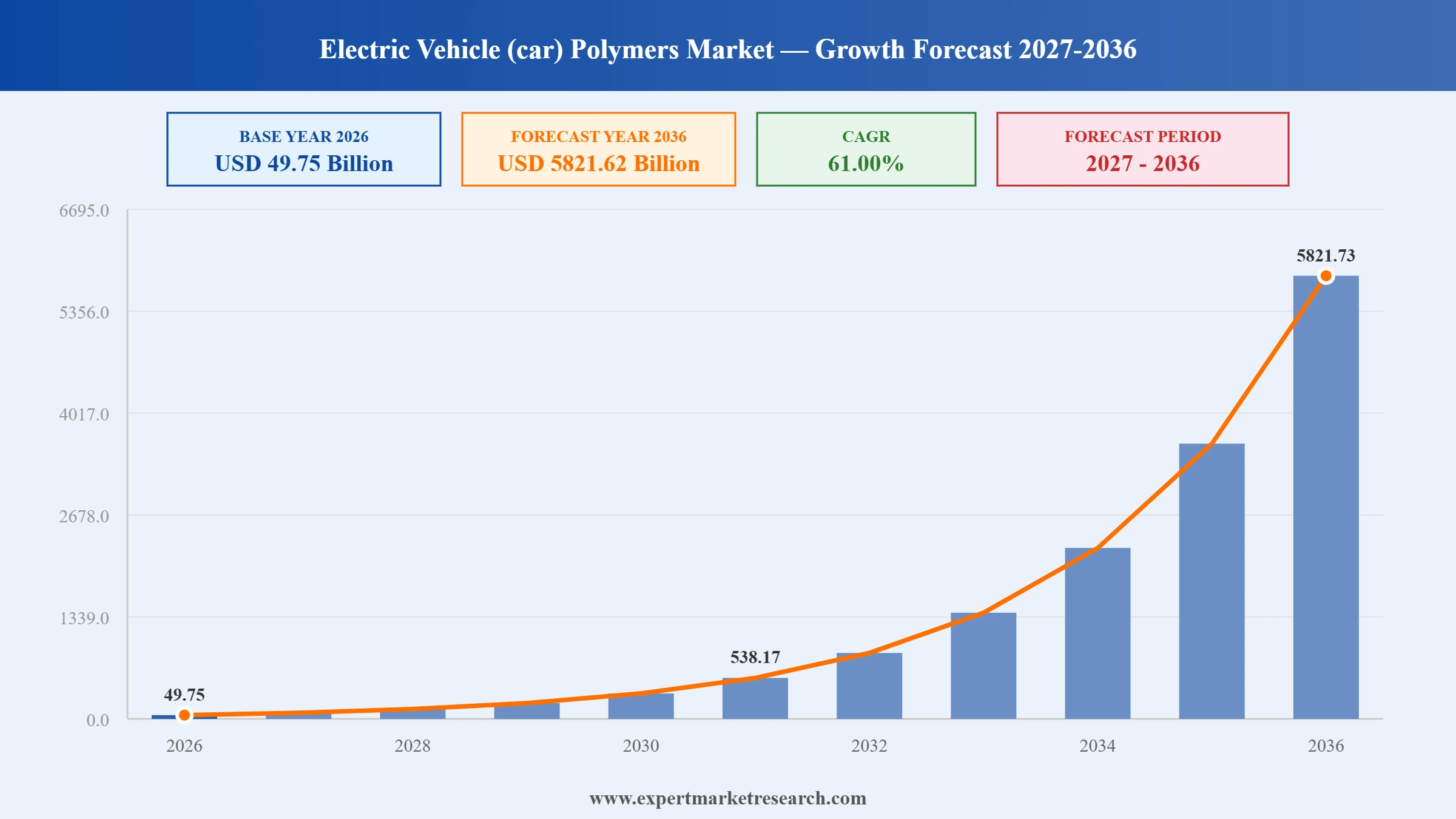
The global electric vehicle (car) polymers market attained a value of USD 30.90 Billion in 2025 and is projected to expand at a CAGR of 61.00% through 2035. The market is further expected to achieve USD 3615.91 Billion by 2035. The demand for high-voltage connectors and smaller power electronics is boosting polymer use as carmakers need insulation, fire resistance, and other properties in their denser and more powerful system designs for EVs.
One of the main factors behind the growth of the electric vehicle (car) polymers market is the battery packs design modification, where the suppliers of these components look for polymers that can substitute for metals used in cell holders, battery pack covers, and enclosures while preserving rigidity and thermal stability. Another factor is increased speed of charging that boosts thermal management needs and promotes development of heat-conducting polymer-based composites, adhesives, and insulation systems.
The electric vehicle (car) polymers market is increasingly getting influenced not only by lightweighting needs for external body parts but also requirements for battery packs, power electronics, connectors, and thermal management. BASF is working on developing polyurethane adhesives, fire-resistant coatings, thermally conductive polymers, and high-performance engineering polymers for such applications. For example, in May 2025, BASF portfolio featured an adhesive concept called “Debonding on Demand” to promote recycling of batteries. Development in such areas is putting pressure on polymer manufacturers to provide not only resins but material solutions.
Moreover, BASF is broadening its offerings for e-mobility polymers beyond structural plastics, with BASF’s 2025 Battery Show Europe program offering Ultramid Expand foamed polyamide for cylindrical cell holders. The polymer is used in a single step process and provides stiffness, strength, and heat resistance, allowing for reduced weight in batteries. BASF also claims that battery cases made of thermoplastics are able to be as much as 30% lighter compared to metal parts, illustrating the commercial benefits of using polymer components in cars and Tier 1 companies.
Read more about this report - REQUEST FREE SAMPLE COPY IN PDF
NEO Battery Materials received a purchase order worth CAD 392,000 from a Fortune 500 automobile OEM after validating battery production capabilities. Suppliers can therefore produce lightweight and heat-resistant batteries components and work alongside OEMs on advanced validation processes for EV batteries, boosting growth in the electric vehicle (car) polymers market.
Mission Efficiency was released by Volkswagen through the use of CFRP and aramid composites in addition to aerodynamic technology for low energy consumption. Polymer firms can develop lightweight composite structures, aerodynamic parts, and strong materials that enhance efficiency of EVs without undermining their structural integrity.
Honda collaborated with QuantumScape for the development of solid-state battery technology and manufacturing processes that aim at enhancing range, rapid charging, reducing costs, and ensuring safety of batteries. Manufacturers in the electric vehicle (car) polymers market can manufacture separators, encapsulation material, insulation, and thermally resistant polymers that could be used in advanced EV batteries.
Ampere and Basquevolt entered into a joint development agreement for accelerating the development of lithium-metal batteries for use in next-generation electric vehicles. Polymer manufacturers could focus on developing advanced battery separators, coating materials, dielectrics, and light-weight polymers that are used in lithium-metal batteries.
The growing need for materials providing electrical insulation, fire resistance, heat resistance, and physical strength in high voltage configurations is boosting demand in the electric vehicle (car) polymers market. For example, in January 2025, BASF introduced Ultramid T6000 grade of flame-retardant polyphthalamide used to manufacture EV terminal blocks resistant to thermal shock from -40°C to 150°C within 1,000 cycles. This new grade is developed specifically for use in 800V vehicle configurations requiring materials with a high level of protection due to increased electrical loads. In addition, BASF introduced in June 2025 non-halogenated PPA grade with UL94 V-0 rating at 0.25 mm thickness.
Automakers are turning to reinforced polymers rather than metals for construction of battery components in order to decrease the total weight of a car. According to the electric vehicle (car) polymers market analysis, the use of thermoplastic battery casing provides 30% mass reduction compared to metal components. In September 2026, Kia unveiled the PV7 electric van with up to 460 km range, 800V charging, flexible configurations, and connected fleet technologies. Such a development opens new possibilities for producers of polymer compounds for battery components.
Heat management in batteries is leading the electric vehicle (car) polymers market towards producing materials able to withstand high temperature and coolants as well as electrical stress. For example, in September 2026, TERREPOWER launched Ontility EV battery lifecycle solutions across Europe and North America, supporting reuse, remanufacturing, repurposing, and recycling. Relevant products are pumps, valves, and other heat management components as well as electrical housings. Therefore, these materials should feature not only mechanical durability but also creep resistance, chemical stability, and lack of electrical conductivity.
New technologies associated with the development of solid-state batteries open up prospects for polymers providing multifunctionality of compact battery packs. In January 2026, Chery announced a solid-state battery for its Liefeng EV, targeting a 1,500-km range and 600 Wh/kg energy density, supporting higher performance and next-generation electric mobility. This is creating opportunities in the electric vehicle (car) polymers market with enhanced thermal management, electrical insulation, structural support, and fire resistance for advanced battery architectures.
Circularity regulations are compelling companies in the electric vehicle (car) polymers market to make the materials more recyclable and traceable, along with less environmentally harmful. The EU Batteries Regulation requires that the recovered materials of cobalt, lithium, nickel, and lead be documented in covered EV batteries from 2028 onwards. These regulations are mainly for battery materials but might encourage suppliers across the entire battery chain to focus on material traceability and circular design. For example, in October 2025, RadiciGroup won an SPE award for its recycled-polyamide battery module, advancing sustainable ecodesign for electric vehicles.
The Expert Market Research's report titled “Electric Vehicle (Car) Polymers Market Report and Forecast 2026-2035” offers a detailed analysis of the market based on the following segments:
Market Breakup by Component
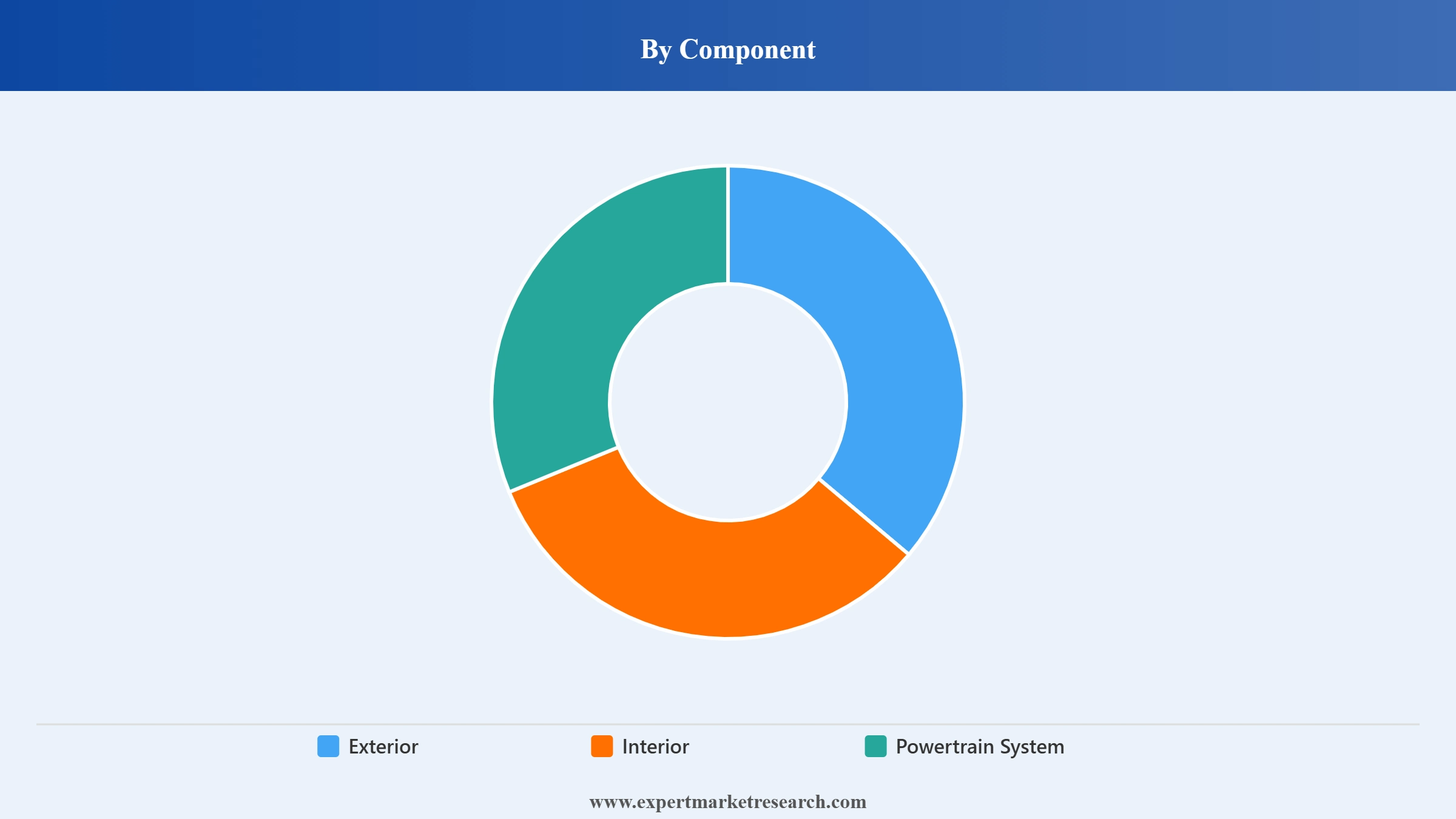
Key Insight: The powertrain system remains relevant across the electric vehicle (car) polymers market scope as polymers with well-regulated thermal, mechanical, and dielectric characteristics are needed in enclosures, connectors, cooling systems, insulations, and chargers. Interior parts are becoming increasingly popular due to the quietness of EVs, which makes it necessary to use polymers capable of acoustical management, emission reduction, light weighting, and integration of design. In January 2024, Yanfeng unveiled its EVI concept at CES 2024, integrating lightweight sustainable thermoplastics into modular EV interiors for improved efficiency and circularity. Exterior parts should be based on polymers that can decrease weight and resist UV radiation, impact, aging, and heat. In all these applications, manufacturers tend to use reinforced, recyclable, flame-retardant, and multi-functional materials.
Market Breakup by Type
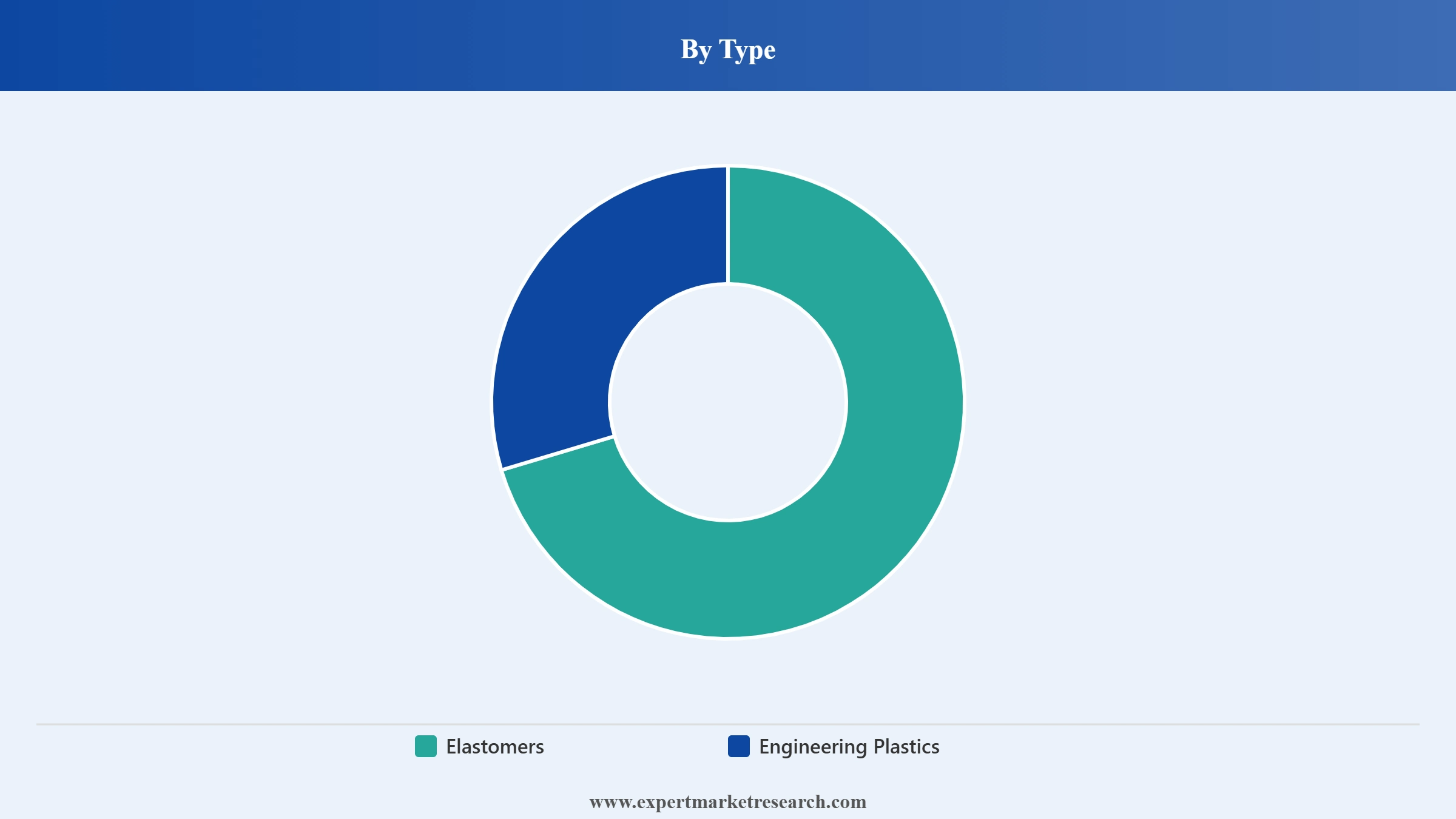
Key Insight: Engineering plastics dominate the electric vehicle (car) polymers market as high-voltage and high-temperature components of electric vehicles call for dimensional stability, mechanical strength, flame retardancy, and electrical insulating properties in small packages. Elastomers are becoming increasingly significant due to the requirement for reliable sealing, vibration dampening, flexible joining, and thermal interfaces in battery packs and e-powertrains. In August 2025, WACKER introduced silicone rubber enhancing EV traction-battery safety through improved thermal stability, electrical insulation, and protection against thermal propagation. In the case of engineering plastics, the industry is concentrating on reinforced and specialized types that allow substitution of metals and maintain safety and efficiency of the manufacturing process.
Market Breakup by Region
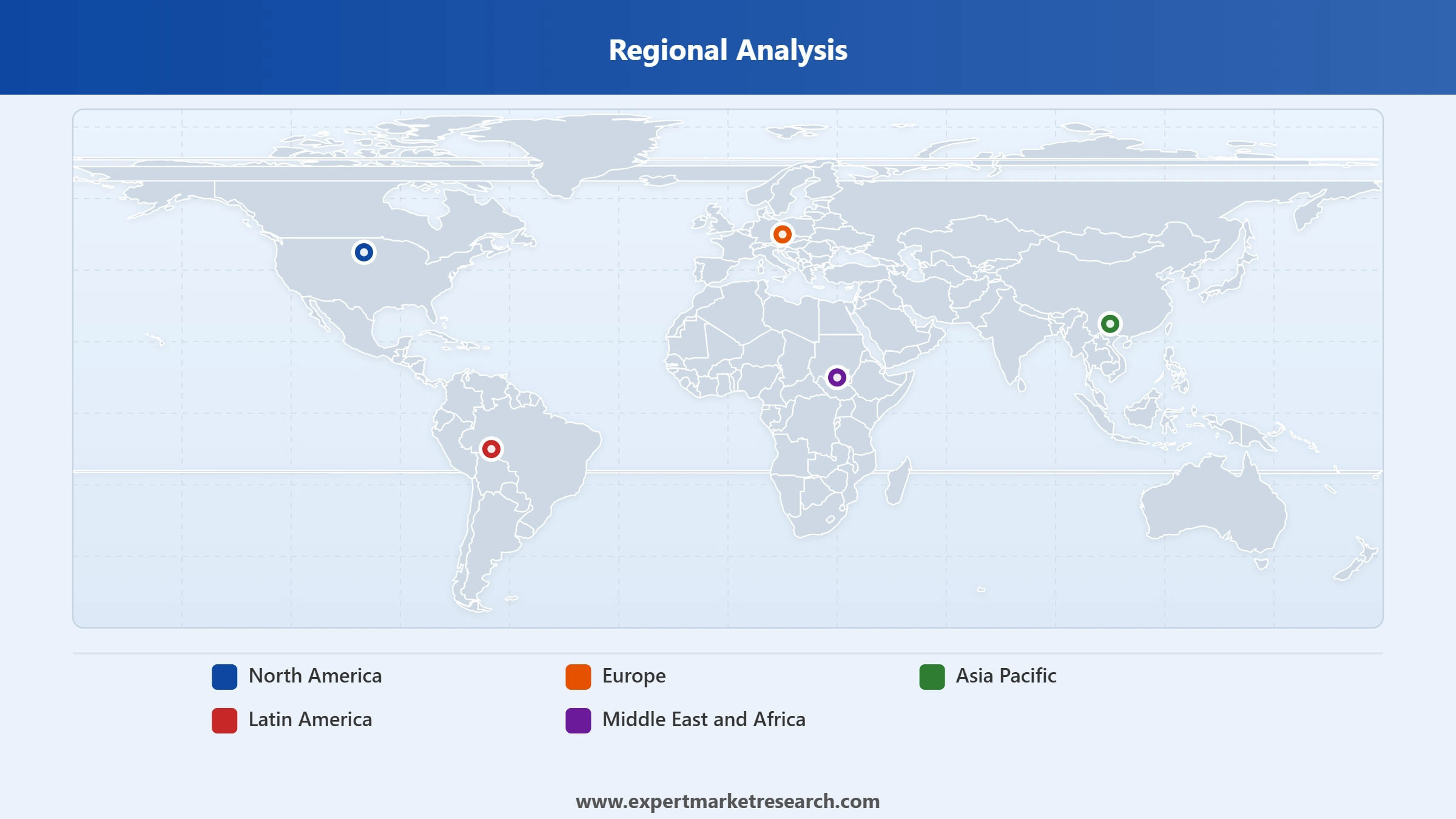
Key Insight: Asia Pacific continues to dominate the global electric vehicle (car) polymers market due to its ecosystem in manufacturing of electric vehicles, batteries, and components, which facilitate extensive use of polymers in various vehicle parts. North America is growing owing to localized production of batteries and vehicles, providing opportunities for qualification and supply of materials in the region. Europe focuses on the development of polymers meeting demanding safety and circular economy standards. Latin America presents opportunities associated with growth in vehicle assembly and localization, whereas Middle East and Africa’s demand is evolving amid its electrification efforts, imported EV platforms, and charging infrastructures. In September 2026, Gargash Motors unveiled GAC GS PHEV in UAE, offering over 1,000 km combined range with advanced electrified powertrain technology.
Read more about this report - REQUEST FREE SAMPLE COPY IN PDF
By component, powertrain systems lead growth in the market due to intensive battery applications
Powertrain systems represent the leading component segment in the electric vehicle (car) polymers market owing to the use of polymer products in batteries, connectors, cooling systems, and high voltage systems. EV designs need materials that can handle electrical loads, heat, vibrations, and chemicals in addition to light weight. Consequently, suppliers are working on reinforcing some types of polymers such as busbars, battery trays, pumps, seals, and insulation. The segment benefits from ongoing battery pack design improvements, increased voltage platforms, and increased use of thermal management systems. In July 2026, JSW MG Motor unveiled its ADAPT platform, supporting EVs and PHEVs while enabling flexible architectures and greater manufacturing efficiency.
Read more about this report - REQUEST FREE SAMPLE COPY IN PDF
Interior systems command a significant share in the electric vehicle (car) polymers market owing to the redesigning of cabins based on lightweight, software rich, and sustainable EV platforms. There is increased demand for polymer materials in interior parts such as instrument panels, consoles, door modules, seating structures, and decorative components where there is a need to achieve a balance between weight, tactile properties, sound absorption, and recycling. The redesigning of cabins will lead to increased use of low volatile organic compound polymers owing to a quieter electric drivetrain.
By type, engineering plastics dominate the market due to high-voltage component requirements
Engineering plastics command the largest share of the electric vehicle (car) polymers market revenue since manufacturers of EVs need high-performing materials for battery enclosures, connectors, structural parts, and power electronics. Materials like polyamides, polycarbonates, PBT, PPA, and other engineering plastics can give the combination of properties such as heat resistance, dimensional stability, electrical insulation, chemical resistance, and mechanical strength which conventional plastics cannot provide. In July 2026, SABIC launched high-performance compounds for EV power modules, enhancing thermal management, electrical insulation, durability, and lightweighting capabilities.
Read more about this report - REQUEST FREE SAMPLE COPY IN PDF
Elastomers observe exponential growth in the electric vehicle (car) polymers market since there is an increasing need in seals, gaskets, hoses, vibration dampeners, and thermal management interfaces due to increased EVs platform. These materials should retain their flexibility at wide range of temperatures as well as resist coolant fluids, oils, electrical influences, compression set, and mechanical cycling. Development is driven by increasing demands for battery packs sealing and liquid cooling systems. Suppliers are focusing on developing specialized silicones, fluorocarbons, thermoplastics, and other elastomers.
Asia Pacific clocks in the leading market shares due to concentrated EV and battery manufacturing
The Asia Pacific electric vehicle (car) polymers market is powered by its EV production base, battery supply chain, and automotive components manufacturing. China, Japan, South Korea, and rising manufacturing bases in Southeast Asia generate considerable demand for polymers in battery systems, electrical components, interiors, and lightweight construction. Suppliers are favored in the region due to their close relationships with automakers and battery makers that facilitate material qualification and localization. Moreover, the region’s strong cell manufacturing ecosystem leads to innovations in polymers in areas such as thermal management, insulation, fire protection, and recyclable components. In July 2025, Sanyo Chemical launched an anti-seizure polymer additive for EV drive units, improving lubrication, durability, and operational reliability.
Read more about this report - REQUEST FREE SAMPLE COPY IN PDF
North America is the fastest-growing regional electric vehicle (car) polymers market with automakers and suppliers developing localized manufacturing of EVs and batteries while redesigning vehicles based on lightweight and high-voltage architectures. There is an increasing need for polymers in battery enclosures, charging components, connectors, thermal management systems, and interior structures. In addition, there is room for material suppliers in North America as far as domestic sourcing, manufacturing, and component localization are concerned. Investment in EVs prompts automakers to qualify more engineering polymers and elastomers at the Tier 1 supplier level.
Leading electric vehicle (car) polymers market players are concentrating on high-performance materials for battery enclosures, high-voltage connectors, thermal management components, lightweight constructions, and interior systems. Competition is moving towards multifunctional polymers having flame retardant properties, insulation, thermal stability, recyclability, and reduced weight. Additionally, companies are also setting up more application development facilities and customer testing facilities in order to reduce the time taken by material qualification.
Customized materials grades, recycled and biologically attributed feedstocks, advanced compounding, and material systems for different battery chemistries and manufacturing processes are becoming differentiation factors for electric vehicle (car) polymer companies. Strategic collaboration with automakers, tier 1 manufacturers, battery manufacturers, and technology providers is vital in order to convert polymer innovations into components and improve manufacturing efficiency and safety performance.
DuPont was formed in 1802, with its headquarters in Wilmington, Delaware, United States. DuPont creates engineering materials for automotive electrification through high-performance polymers, adhesives, sealants, and thermal management products. The company offers services to EV manufacturers in terms of materials for batteries, electrical insulating materials, light weighting, and power electronics materials.
LyondellBasell, founded in 2005, is headquartered in Rotterdam, Netherlands. The firm offers polypropylene compounds and advanced polymers for automotive applications. LyondellBasell offers services in lightweight interior, batteries, electricals, and structural applications.
Covestro, which was set up as an independent company in 1937 and based in Germany, provides polycarbonate, polyurethane and specialty polymers for electric mobility. Its polymers cover applications in batteries, sensors, charging solutions, lightweight constructions, and interiors. It is also developing its circular materials and digital innovation competences in all key automotive production territories.
LANXESS was founded in 2004 in Cologne, Germany. The company provides specialty chemicals and high-performance materials for electric mobility. The materials provided by the company include engineering plastics and specialty materials solutions for lightweight construction, electrical applications, batteries, and thermal management. It functions in 32 countries, thus providing local technical expertise and material solutions for automotive industry customers.
Other key players in the market include ARLANXEO Holding B.V., among others.
*Please note that this is only a partial list; the complete list of key players is available in the full report. Additionally, the list of key players can be customized to better suit your needs.*
Unlock the latest insights with our electric vehicle (car) polymers market trends 2026 report. Discover regional growth patterns, consumer preferences, and key industry players. Stay ahead of competition with trusted data and expert analysis. Download your free sample report today and drive informed decisions in the market.


Upto 15% Off
USD
$2499 $2249
$3999 $3599
$4999 $4249
$5999 $5099


*While we strive to always give you current and accurate information, the numbers depicted on the website are indicative and may differ from the actual numbers in the main report. At Expert Market Research, we aim to bring you the latest insights and trends in the market. Using our analyses and forecasts, stakeholders can understand the market dynamics, navigate challenges, and capitalize on opportunities to make data-driven strategic decisions.*
In 2025, the market reached an approximate value of USD 30.90 Billion.
The market is projected to grow at a CAGR of 61.00% between 2026 and 2035.
The market is estimated to reach a value of about USD 3615.91 Billion by 2035.
Stakeholders are developing application-specific grades, expanding regional testing centers, partnering with battery makers, increasing recycled-content options, improving thermal performance, and accelerating material qualification with automakers.
The rapid rise in government regulations supporting the adoption of electric vehicles is expected to be a key trend guiding the growth of the industry.
North America, Europe, the Asia Pacific, Latin America, and the Middle East and Africa are the leading regions in the market.
The leading components of the product include exterior, interior, and powertrain system.
The significant types of the product in the global electric vehicle (car) polymers market are elastomers and engineering plastics.
The key players in the market include DuPont de Nemours, Inc., LyondellBasell Industries Holdings B.V., Covestro AG, LANXESS, and ARLANXEO Holding B.V., among others.
Companies face stringent material qualification, thermal-runaway safety requirements, volatile raw-material costs, recycling complexity, long automotive validation cycles, and pressure to deliver sustainable polymers without compromising performance.
Explore our key highlights of the report and gain a concise overview of key findings, trends, and actionable insights that will empower your strategic decisions.
| REPORT FEATURES | DETAILS |
| Base Year | 2025 |
| Historical Period | 2019-2025 |
| Forecast Period | 2026-2035 |
| Scope of the Report |
Historical and Forecast Trends, Industry Drivers and Constraints, Historical and Forecast Market Analysis by Segment:
|
| Breakup by Component |
|
| Breakup by Type |
|
| Breakup by Region |
|
| Market Dynamics |
|
| Competitive Landscape |
|
| Companies Covered |
|
| Report Price and Purchase Option | Explore our purchase options that are best suited to your resources and industry needs. |
| Delivery Format | Delivered as an attached PDF and Excel through email, with an option of receiving an editable PPT, according to the purchase option. |
Datasheet
One User
USD 2,499
USD 2,249
tax inclusive*
Single User License
One User
USD 3,999
USD 3,599
tax inclusive*
Five User License
Five User
USD 4,999
USD 4,249
tax inclusive*
Corporate License
Unlimited Users
USD 5,999
USD 5,099
tax inclusive*
*Please note that the prices mentioned below are starting prices for each bundle type. Kindly contact our team for further details.*
Flash Bundle
Small Business Bundle
Growth Bundle
Enterprise Bundle
*Please note that the prices mentioned below are starting prices for each bundle type. Kindly contact our team for further details.*
Flash Bundle
Number of Reports: 3
20%
tax inclusive*
Small Business Bundle
Number of Reports: 5
25%
tax inclusive*
Growth Bundle
Number of Reports: 8
30%
tax inclusive*
Enterprise Bundle
Number of Reports: 10
35%
tax inclusive*
How To Order

Select License Type
Choose the right license for your needs and access rights.

Click on ‘Buy Now’
Add the report to your cart with one click and proceed to register.

Select Mode of Payment
Choose a payment option for a secure checkout. You will be redirected accordingly.
Strategic Solutions for Informed Decision-Making
Gain insights to stay ahead and seize opportunities.

Get insights & trends for a competitive edge.

Track prices with detailed trend reports.

Analyse trade data for supply chain insights.

Leverage cost reports for smart savings

Enhance supply chain with partnerships.

Connect For More Information
Our expert team of analysts will offer full support and resolve any queries regarding the report, before and after the purchase.
Our expert team of analysts will offer full support and resolve any queries regarding the report, before and after the purchase.
We employ meticulous research methods, blending advanced analytics and expert insights to deliver accurate, actionable industry intelligence, staying ahead of competitors.
Our skilled analysts offer unparalleled competitive advantage with detailed insights on current and emerging markets, ensuring your strategic edge.
We offer an in-depth yet simplified presentation of industry insights and analysis to meet your specific requirements effectively.




