

Consumer Insights
Uncover trends and behaviors shaping consumer choices today
Procurement Insights
Optimize your sourcing strategy with key market data
Industry Stats
Stay ahead with the latest trends and market analysis.
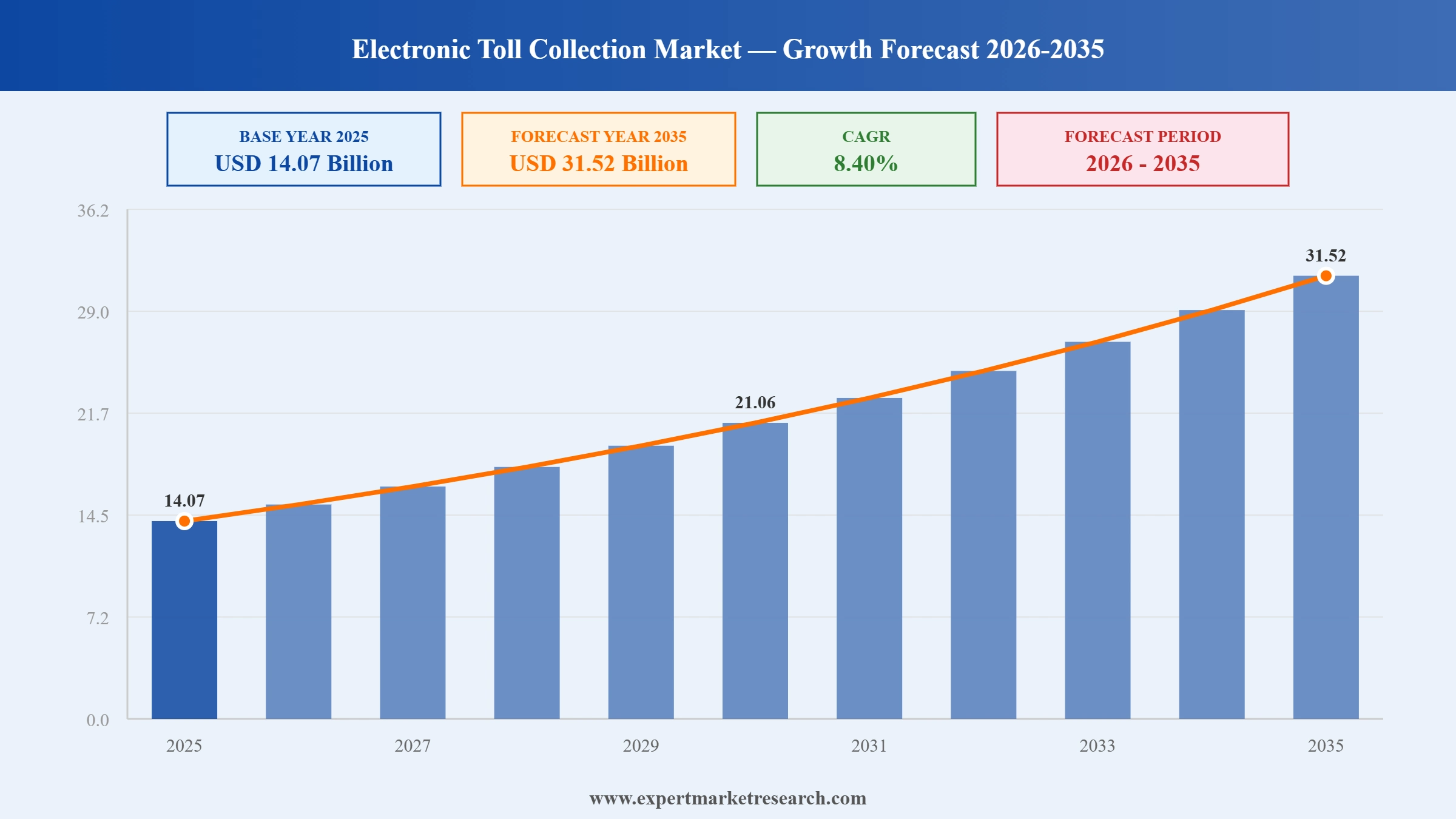
The global electronic toll collection market was valued at USD 14.07 Billion in 2025 and is projected to reach USD 31.52 Billion by 2035, growing at a CAGR of 8.40% between 2026and 2035, according to Expert Market Research. This sustained growth trajectory reflects the global transportation sector's accelerating transition from manual, cash-dependent toll infrastructure toward automated, contactless, and increasingly satellite-enabled tolling ecosystems that serve both congestion management and revenue optimization objectives simultaneously.
Electronic toll collection has become a foundational component of intelligent transportation systems worldwide. Governments, transportation authorities, road concessionaires, and private infrastructure operators are investing in ETC infrastructure not merely to streamline toll operations but to generate real-time vehicle flow data, enforce dynamic congestion pricing, support green road pricing frameworks, and integrate tolling into broader smart mobility platforms. The market encompasses a sophisticated value chain spanning hardware including transponders, antennae, communication arrays, scanners, and cameras through software platforms for transaction processing and account management, and through managed services covering system operation, maintenance, and customer service.
Read more about this report - REQUEST FREE SAMPLE COPY IN PDF
The electronic toll collection market encompasses the products, systems, software, and services that enable automated, cashless, and contactless toll collection on highways, urban road networks, bridges, and tunnels globally. ETC systems eliminate the need for vehicles to stop at physical toll booths by using wireless communication technologies including Radio-Frequency Identification (RFID), Dedicated Short-Range Communications (DSRC), Global Navigation Satellite Systems (GNSS), and Automatic Number Plate Recognition (ANPR) to identify vehicles, calculate applicable toll charges, and debit linked payment accounts at highway speeds.
The market encompasses the full spectrum of tolling architectures, from barrier-based systems in which vehicles pass through gantries with transponder readers while continuing at low speeds, to fully open road tolling (also known as All-Electronic Tolling or Multi-Lane Free Flow) in which vehicles pass through tolling zones at unreduced highway speeds without any infrastructure requiring deceleration. Advanced ETC deployments integrate account-based tolling platforms, cross-network interoperability frameworks, real-time payment settlement systems, and vehicle violation enforcement technologies into comprehensive intelligent transportation ecosystems that serve multiple traffic management and revenue collection functions.
Read more about this report - REQUEST FREE SAMPLE COPY IN PDF
Government investment in smart transportation infrastructure is the foundational demand driver of the global electronic toll collection market. National and regional governments worldwide are allocating substantial capital toward intelligent highway development programmes that treat automated tolling as an essential component of modern road infrastructure rather than a supplementary convenience. In the United States, the Infrastructure Investment and Jobs Act has directed significant federal funding toward intelligent transportation systems including ETC modernisation across interstate corridors. India's NHAI is implementing satellite-based GNSS tolling in parallel with its existing FASTag network, with the Ministry of Road Transport and Highways formally amending National Highway Fee Rules to incorporate GNSS On-Board Units as an official toll collection mechanism. The European Commission's European Electronic Tolling Services regulation, requiring interoperability between tolling systems across all EU member states, has created a coordinated regulatory framework that accelerates technology investment across the continent. These government mandates create durable, multi-year procurement cycles for ETC hardware, software, and managed service providers.
The structural consumer and institutional preference for contactless, cashless payment transactions which accelerated significantly during the pandemic period and has since become a permanent feature of payment behaviour globally is a significant tailwind for ETC adoption. Road users who have adopted digital payment habits across retail, transit, and financial services increasingly expect equivalent convenience at toll points. This preference creates political will among transport authorities to eliminate cash lanes and mandate electronic payment, as demonstrated by India's Zero-Cash policy implemented on April 10, 2026, which removed cash lanes from all national highway plazas entirely. The integration of ETC accounts with mobile payment wallets, UPI platforms, and digital banking infrastructure is expanding accessibility for new users while reinforcing the convenience advantage of electronic tolling over manual alternatives.
Traffic congestion at toll plazas imposes measurable economic costs on road users, freight operators, and national economies through fuel waste, emissions, and time loss. The transition to open road tolling architectures, in which vehicles pass through tolling zones at full highway speed without any reduction in velocity, eliminates the congestion bottleneck created by barrier-based systems entirely. Published transport authority data from the UAE indicates that ETC deployment reduced off-peak travel times on monitored corridors by 13 to 30%. In the UK, the Dartford Crossing's transition to license plate-based tolling reduced wait times by 40%, according to transport authority records. Beyond congestion, ETC systems contribute directly to national greenhouse gas emissions reduction targets by eliminating the idling fuel consumption of vehicles queuing at toll booths making ETC deployment alignment with environmental regulatory frameworks an increasingly important procurement justification for governments pursuing net-zero transport commitments.
Emerging economies in Asia Pacific, the Middle East, Latin America, and Africa are expanding their tolled highway networks at rates that significantly exceed developed market infrastructure growth, creating large and rapidly expanding addressable markets for ETC technology. These markets benefit structurally from the ability to deploy next-generation ETC architecture including MLFF and satellite-based systems on newly constructed highways without the legacy infrastructure constraints that require phased upgrades in established markets. India, China, Saudi Arabia, Brazil, and several Southeast Asian economies are concurrently building new highway capacity and deploying ETC from inception, enabling leapfrog adoption of advanced tolling technologies.
The technological sophistication of ETC systems continues to advance on multiple simultaneous dimensions: GNSS satellite precision is enabling distance-based tolling that is both more accurate and more equitable than fixed-point systems; AI-powered ANPR is reducing transponder dependency and enabling tag-free tolling; cloud-connected back-office platforms are improving transaction throughput and fraud detection capabilities; and interoperability frameworks are enabling single transponders to function across multiple toll networks and national borders. Kapsch TrafficCom's March 2026 integration of TomTom Traffic data into its intelligent mobility platform represents the market's direction toward data-enriched tolling ecosystems that serve real-time traffic management functions beyond revenue collection. These advances simultaneously improve the performance proposition of ETC for government buyers and expand the addressable market by enabling tolling on road classes and in geographies where earlier-generation technology was economically or technically impractical.
Read more about this report - REQUEST FREE SAMPLE COPY IN PDF
The global next-generation electronic toll collection systems market is in an accelerating transition from legacy RFID transponder-and-gantry infrastructure toward satellite-coordinated, app-based, and fully tagless tolling architectures that eliminate physical toll infrastructure requirements entirely. This transition is the most commercially significant structural shift in the ETC industry since the introduction of RFID-based E-ZPass in North America in the 1990s, and it is generating substantial incremental investment across every regional market.
Multi-Lane Free Flow (MLFF) represents the most advanced tolling architecture currently deployed at commercial scale. In an MLFF system, overhead gantries equipped with RFID readers, DSRC transceivers, ANPR cameras, and in some deployments GNSS verification sensors span the full width of highway lanes. Vehicles pass beneath gantries at unreduced highway speed typically 120 km/h or above without any requirement to slow down, change lanes, or interact with physical infrastructure. The gantry identifies the vehicle through transponder communication, license plate recognition, or a combination of both, calculates the applicable toll, and debits the linked account in real time. The commercial case for MLFF is compelling: it eliminates toll plaza land footprint, removes congestion chokepoints, reduces operational staffing requirements, and enables toll collection on all lanes simultaneously rather than dedicating specific lanes to electronic payment.
GNSS-based tolling represents the most technically advanced and geographically flexible next-generation ETC architecture. In a GNSS tolling system, an On-Board Unit installed in the vehicle continuously tracks the vehicle's GPS coordinates. When the vehicle travels on a tolled road section, the OBU records the distance covered and transmits this data to a central system for toll calculation and payment processing without any roadside infrastructure required beyond occasional verification points. Lithuania became the world's first nation to deploy a mandatory nationwide satellite-based truck toll system via smartphone application in February 2026, with Kapsch TrafficCom awarded the design and operations contract. India is deploying GNSS OBU-based tolling progressively across commercial vehicles from 2025 to 2027. Germany integrated carbon-based pricing into its truck toll framework from January 2026, with zero-emission trucks receiving a 75% toll reduction, demonstrating how satellite-based distance tolling enables dynamic, policy-aligned pricing that RFID transponder systems cannot efficiently support.
ANPR-based tolling uses high-definition camera systems and AI-powered optical character recognition to identify vehicles by license plate at highway speeds, enabling toll collection without any transponder or OBU requirement. Modern ANPR systems achieve recognition accuracy rates exceeding 98% under normal operating conditions, making them viable as primary tolling mechanisms. TransCore's deployment at Sydney's Western Harbour Tunnel in December 2025 established Australia's first tagless, video-only tolling system demonstrating ANPR's viability as a standalone tolling mechanism without transponder infrastructure. Kapsch TrafficCom launched an updated ANPR engine for the North American market in February 2025, with improved recognition rates, expanded output options, and reduced per-transaction costs. ANPR is particularly valuable for managing toll violations, processing rental vehicle transactions, and serving international visitors who lack account-registered transponders.
Tagless tolling systems which rely entirely on ANPR rather than requiring any vehicle-mounted electronic device represent the most frictionless tolling architecture for end users. Tagless systems eliminate transponder distribution, account pre-registration requirements, and the customer service overhead associated with transponder activation, balance management, and replacement. The trade-off is higher per-transaction processing costs and modest accuracy limitations in adverse conditions. TransCore's Infinity platform, deployed on the West Virginia Turnpike in January 2025 and powering Sydney's Western Harbour Tunnel's tagless system in December 2025, represents the commercial frontier of this approach. As ANPR accuracy improves through AI model refinement and camera hardware advances, tagless systems are expected to expand from supplementary to primary tolling mechanisms on an increasing proportion of new toll road deployments.
The structural market transition from barrier-based ETC systems in which vehicles must decelerate to pass through gated lanes to open road tolling architectures is driving the fastest-growing segment within the ETC market. While barrier-based systems retained 51% market share in 2025, open road tolling is projected to register the highest CAGR through the forecast period as new road deployments adopt MLFF architecture and legacy systems undergo infrastructure modernisation programs. The Bay Area Toll Authority's project to remove toll booths and toll plazas from seven San Francisco Bay bridges, transitioning to open road tolling using FasTrak, exemplifies the scale of legacy infrastructure conversion underway across mature markets.
The ability for a single transponder or account to function across all toll roads within a national network and ultimately across international borders is an increasingly important competitive differentiator for ETC system operators and a regulatory priority for transport authorities. In the United States, Electronic Transaction Consultants' interoperability expansion connecting the Central US Interoperability (CUSIOP) hub with the Southeastern Interoperability (SEIOP) hub expanded the TollTag, K-Tag, PikePass, and SunPass transponder compatibility network. In Europe, the European Electronic Tolling Services regulation mandates full interoperability across all EU member states, creating a continental single tolling space for commercial vehicle operators. These interoperability frameworks increase the network value of ETC systems significantly, reduce friction for road users, and create larger addressable market opportunities for system integrators capable of delivering multi-network compatible solutions.
The integration of environmental pricing signals into road tolling frameworks is an emerging but structurally significant trend, driven by national net-zero commitments and urban air quality management programmes. Germany's truck toll framework, which from January 2026 provides a 75% toll reduction for zero-emission trucks, demonstrates how ETC infrastructure can serve as the technical backbone for differentiated carbon-based pricing rather than purely distance-based or fixed-rate collection. Denmark's transport minister publicly supported long-term implementation of vehicle road pricing based on route and vehicle type in 2026. The UK's ongoing expansion of Low Emission Zone and Ultra Low Emission Zone schemes in London and other cities relies on ANPR camera networks that share technological architecture with ETC infrastructure. As governments pursue net-zero transport policies, ETC systems are increasingly positioned as revenue-neutral infrastructure tools that price mobility based on environmental impact as well as road use.
The migration of toll back-office operations from on-premise systems to cloud-native, API-connected platforms is improving transaction processing scalability, fraud detection capability, and cross-network interoperability. TransCore's launch of a new cloud-based back-office tolling system for the Delaware Department of Transportation in January 2026 demonstrates the commercial momentum of cloud adoption in government tolling operations. Cloud platforms enable real-time account management, automated violation processing, dynamic pricing implementation, and data analytics capabilities that legacy on-premise systems cannot cost-effectively deliver. Software represents the fastest-growing offering segment within the ETC market, driven by back-office platform modernisation, analytics tool investment, and the subscription-based revenue model that cloud deployments enable for system integrators.
The convergence of electronic toll collection infrastructure with Vehicle-to-Everything (V2X) communication networks is creating a new generation of intelligent road pricing and traffic management capability. DSRC communication technology which underpins many ETC transponder systems shares frequency bands and protocol architecture with emerging V2X deployment standards, creating infrastructure reuse opportunities. As connected vehicle penetration expands through the forecast period, tolling infrastructure will increasingly function as a real-time data collection network for vehicle flow, speed, classification, and origin-destination analysis, generating intelligence that transportation authorities can use for infrastructure planning, emissions monitoring, and dynamic congestion management far beyond toll revenue collection alone.

Read more about this report - REQUEST FREE SAMPLE COPY IN PDF
The global electronic toll collection market faces a layered set of challenges that system operators, technology vendors, and public-sector buyers must navigate simultaneously. The high capital expenditure required for initial ETC infrastructure deployment particularly for MLFF gantry networks, GNSS OBU distribution programmes, and ANPR camera arrays creates significant procurement barriers in developing economy markets where toll road revenue may not generate sufficient early cash flows to service infrastructure debt. Cybersecurity risk represents an escalating operational challenge: ETC systems process millions of daily transactions linked to personal vehicle and payment account data, creating high-value targets for fraud, data theft, and system disruption. Hardware failures, communication outages, and software errors in ETC systems create immediate service disruptions that damage user trust and generate liability exposure, as demonstrated by periodic outage events affecting major North American toll operators. Regulatory complexity compounds these challenges: data privacy regulations including GDPR in Europe, sector-specific toll data retention requirements, and evolving standards for interoperability create compliance obligations that add cost and extend implementation timelines for both system deployers and technology vendors.
Several structural dynamics constrain the pace of ETC market expansion in specific geographies and segments. Legacy cash-based tolling infrastructure which remains prevalent in parts of Latin America, South and Southeast Asia, and Sub-Saharan Africa represents a significant inertia force: existing physical infrastructure has been depreciated, toll agencies have operational processes built around manual collection, and road users in lower-income markets may lack the banking infrastructure required for account-based electronic payment. The transponder distribution challenge in markets transitioning from barrier-based to open road tolling creates short-term user acquisition friction and customer service overhead that can slow adoption velocity and generate negative public sentiment. Political resistance to tolling expansion on the basis of regressive economic impact on lower-income drivers, privacy concerns about vehicle tracking, or opposition to road pricing as a form of taxation has slowed MLFF deployment in several European and North American markets despite technical readiness. Vendor lock-in risk in long-term government contracts, where proprietary technology architectures create dependency on single suppliers for system maintenance and upgrades, is increasingly recognised as a procurement risk that some agencies are addressing through open-standard technology requirements.
The global ETC market presents substantial, diversifying, and structurally durable opportunity across every tier of the value chain. The worldwide conversion of legacy barrier-based toll roads to open road MLFF architecture represents a multi-billion dollar infrastructure upgrade cycle that will extend throughout the forecast decade, with North American, European, and Asia Pacific projects already underway. GNSS satellite-based tolling is creating an entirely new segment for OBU hardware manufacturers, software platform developers, and system integration specialists, with India's multi-year GNSS deployment programme representing one of the largest single-country ETC modernisation projects in history. Carbon-based road pricing integration as demonstrated by Germany's zero-emission truck toll discount and Denmark's advancing road pricing policy is creating new software and data analytics product categories within the ETC market. The Middle East, particularly Saudi Arabia and the GCC, represents a high-growth emerging market opportunity: Saudi Arabia's NEOM smart city project, giga-project highway construction, and Vision 2030 transportation modernisation goals are creating significant ETC infrastructure procurement demand with minimal legacy constraint. For technology vendors, the emergence of cloud-connected back-office platforms, AI-driven ANPR systems, and interoperability middleware creates commercially attractive software and services revenue streams with superior margin profiles relative to hardware sales.
“Electronic Toll Collection Market Report and Forecast 2026-2035” offers a detailed analysis of the market based on the following segments:
Market Breakup by Technology
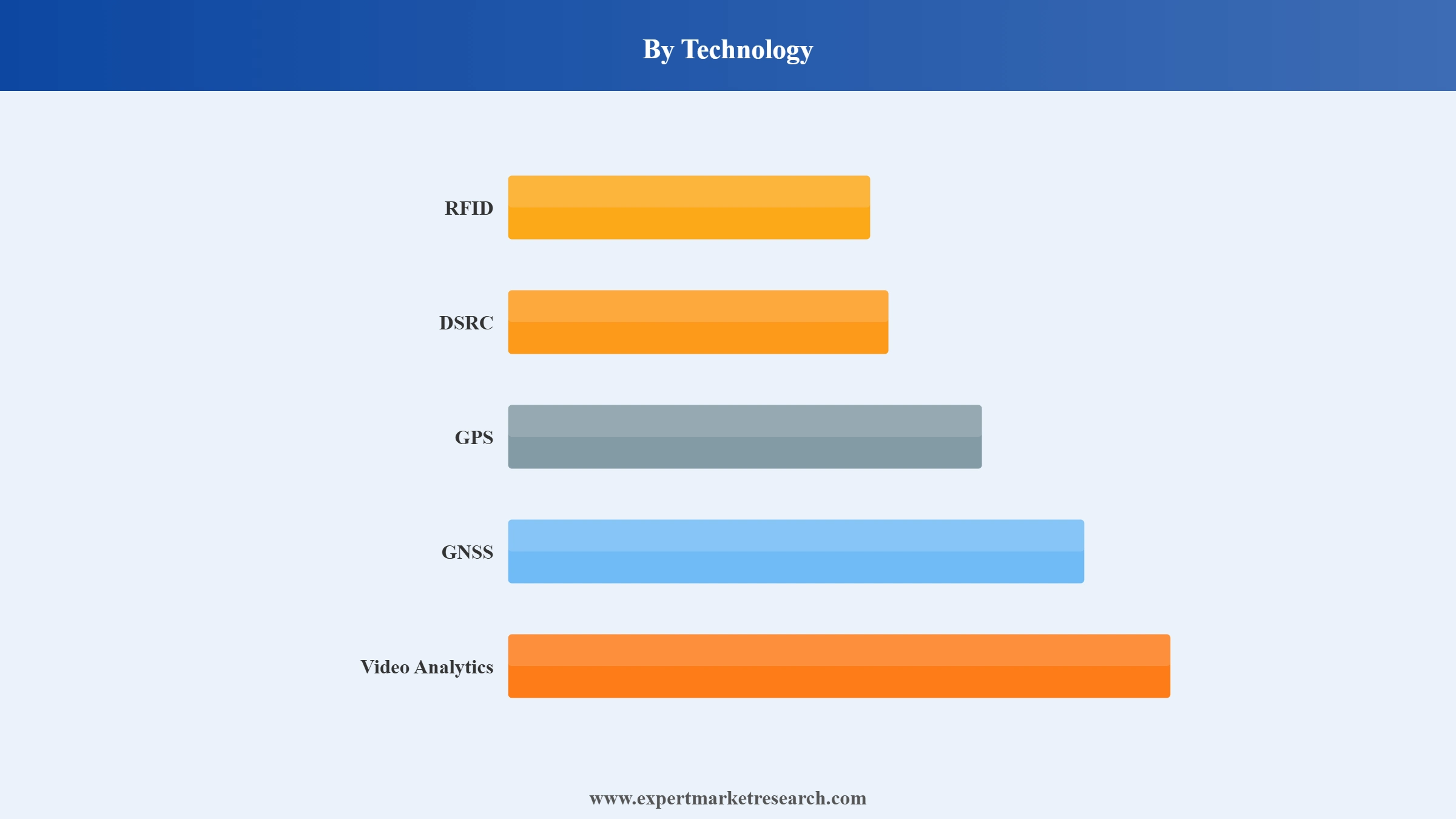
RFID remains the dominant technology segment within the global ETC market, projected to account for approximately 35% of total technology segment revenue, driven by its proven reliability at high vehicle speeds, widespread existing transponder installation base, and the cost efficiency of RFID reader infrastructure relative to alternative technologies. RFID-based systems including E-ZPass in North America, FASTag in India, Hi-Pass in South Korea, and ETC in Japan have established deeply entrenched user habits and payment account ecosystems that support recurring transaction volumes.
DSRC (Dedicated Short-Range Communications) operates at 5.8 to 5.9 GHz and enables high-speed, low-latency communication between vehicle-mounted transponders and roadside readers within a narrow beam range. DSRC provides superior transaction accuracy and anti-fraud capability compared to RFID, and its shared protocol architecture with V2X communication standards positions it for expanded deployment as connected vehicle infrastructure matures. DSRC is the technology standard mandated by the European Union for interoperable tolling systems.
GNSS and Satellite-Based Tolling is the fastest-growing technology segment, driven by its ability to enable distance-based tolling without fixed roadside infrastructure, support free-flow tolling on new road classes, and integrate carbon-based pricing mechanisms. Germany's truck toll system, Lithuania's Kapsch-deployed satellite app tolling, and India's progressive GNSS OBU rollout are the most commercially significant current deployments.
Video Analytics and ANPR serves as both a primary tolling mechanism in tagless deployments and a supplementary enforcement tool in transponder-based systems. ANPR accuracy improvements driven by deep learning AI models are expanding the viability of video-only tolling on new infrastructure deployments.
Market Breakup by Application
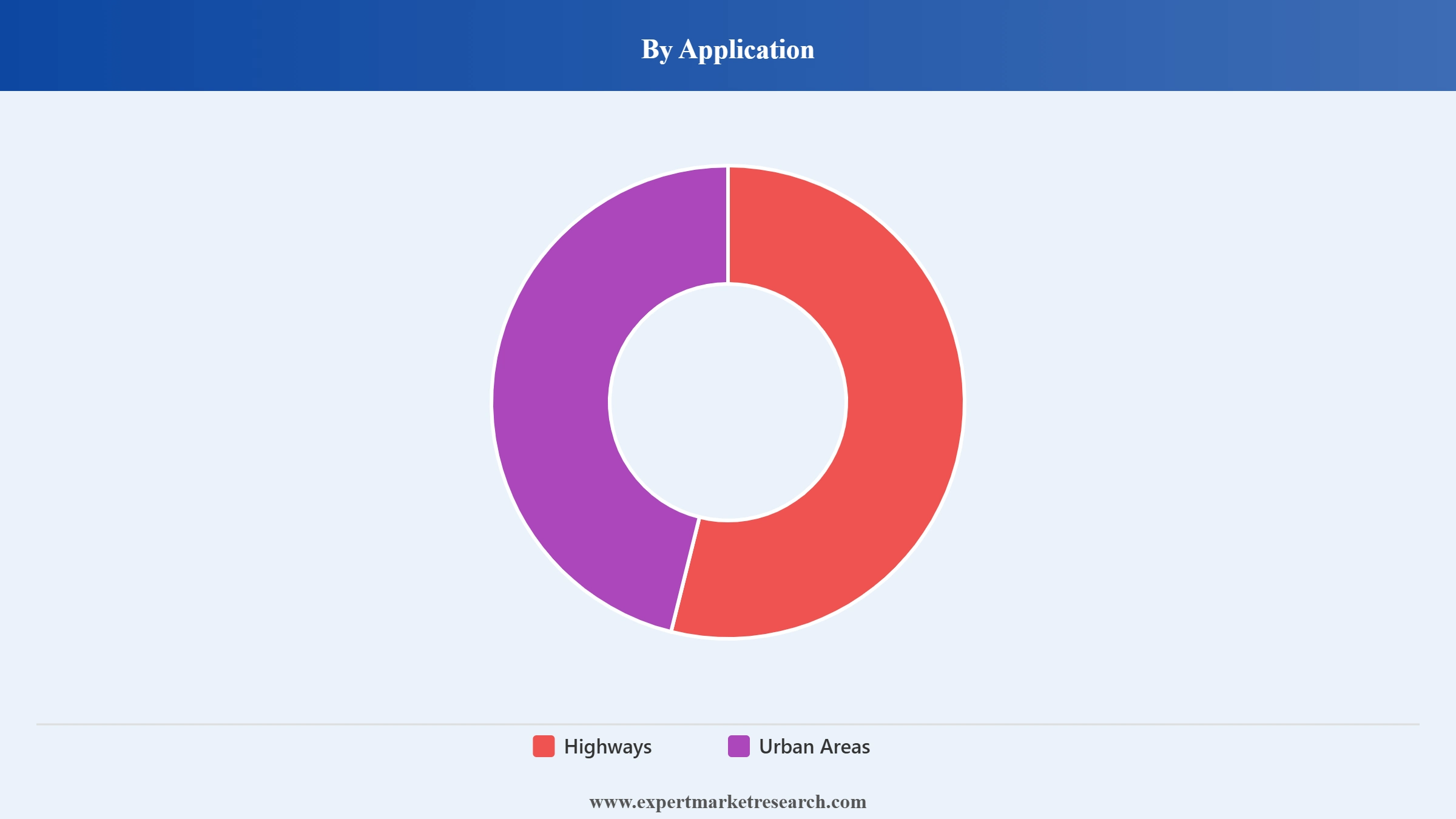
Highways command the dominant application revenue share at approximately 58% of the global ETC market, reflecting the concentration of toll infrastructure investment on inter-urban expressway and motorway networks where vehicle volumes and per-transaction revenue justify ETC capital deployment.
Urban Roads represent the fastest-growing application segment, driven by city-level congestion charging schemes, low emission zone enforcement, and urban road pricing programmes that require vehicle detection and payment processing infrastructure architecturally similar to highway ETC systems.
Bridges and Tunnels constitute a significant sub-segment, with major tolled crossing infrastructure in North America, Europe, and Asia Pacific operating under long-term ETC concession arrangements.
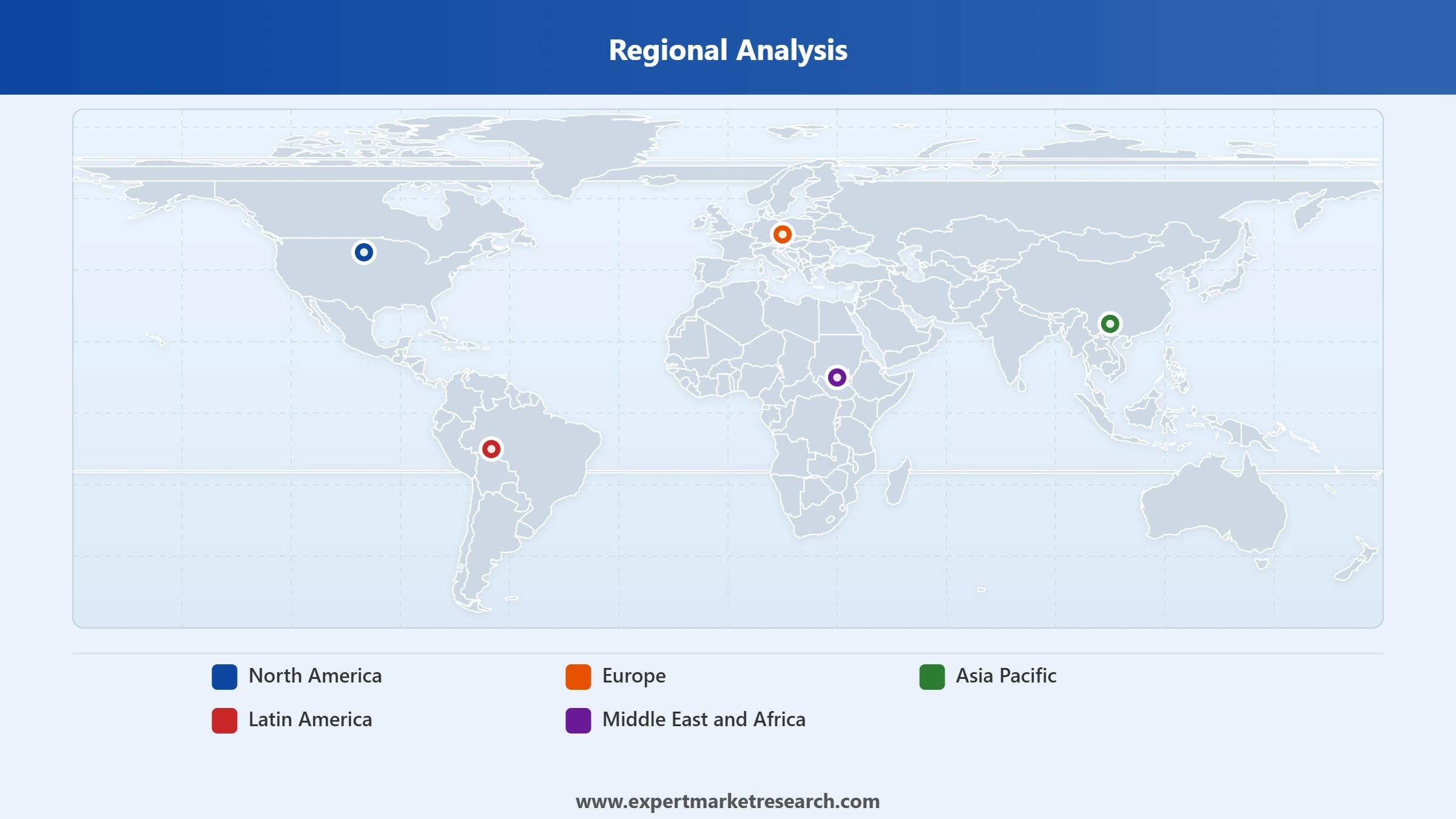
Market Breakup by Region
Read more about this report - REQUEST FREE SAMPLE COPY IN PDF
North America is the largest regional market in the global ETC landscape, anchored by the mature, high-density toll infrastructure of the United States and Canada. The United States operates the world's most extensive national interoperability framework, with transponder schemes including E-ZPass in the Northeast and Mid-Atlantic, SunPass in Florida, TxTag in Texas, and FasTrak in California serving tens of millions of registered account holders. The Infrastructure Investment and Jobs Act has sustained federal co-investment in intelligent transportation system upgrades, maintaining robust procurement pipelines for ETC hardware, software, and services providers. GSC data for the Expert Market Research ETC page confirms sustained US search interest with 2,234 impressions from the United States over the reporting period.
United States The US ETC market is supported by ongoing back-office modernisation projects TransCore launched a new system for the Delaware Department of Transportation in January 2026 alongside the Bay Area Toll Authority's multi-year project to convert seven toll bridges to open road tolling. Q-Free secured contracts from major US toll agencies in April 2025 to deploy its Kinetic Mobility Advanced Traffic Management System, further expanding the competitive landscape for next-generation ETC platforms.
Europe's ETC market is shaped by the European Commission's EETS regulation mandating cross-border interoperability, strict environmental regulation driving integration of carbon pricing into toll frameworks, and a competitive landscape that includes global leaders Kapsch TrafficCom, Thales Group, and Siemens Mobility alongside strong regional specialists. Germany expanded its truck toll scheme in January 2026 to cover 3.5 to 7.5 tonne vehicles with a 75% zero-emission vehicle discount, integrating carbon-based pricing into one of Europe's most advanced tolling frameworks. Lithuania's February 2026 deployment of Kapsch TrafficCom's nationwide satellite app-based truck tolling system established the world's first mandatory all-smartphone tolling programme. France's VINCI Autoroutes network is testing GNSS-based tolling for heavy vehicles, aligned with the country's climate action programme.
Asia Pacific is the fastest-growing regional ETC market globally, driven by simultaneous highway network expansion, rapid urbanisation, rising vehicle ownership, and aggressive government technology deployment timelines across China, India, South Korea, Japan, and Southeast Asia. Japan's ETC 2.0 system provides one of the world's highest transponder penetration rates among passenger vehicles. South Korea is deploying full RFID-based ETC coverage on all national highways by 2027. GSC data shows 68 impressions for "Asia Pacific electronic toll collection market" and 51 impressions for "Australia electronic toll collection market," confirming regional research demand.
India is implementing the most ambitious ETC transformation programme globally in terms of simultaneous scale and technology scope. Over 95% of national highway toll transactions are processed electronically via FASTag. The Zero-Cash policy enacted April 10, 2026 eliminated cash payment lanes entirely. GNSS OBU-based distance tolling is progressively rolling out for commercial vehicles. India's new e-notice framework (March 17, 2026) strengthens violation enforcement. Over 80 million FASTag users and 1,150+ integrated toll plazas constitute the world's largest single-nation RFID toll network by user count.
Australia TransCore's December 2025 contract award for Sydney's Western Harbour Tunnel established Australia's first tagless, video-only tolling system, marking a significant milestone in ANPR technology viability for primary tolling deployment.
The Middle East is an emerging and rapidly expanding ETC market, characterised by large-scale infrastructure investment programmes, high-income Gulf state economies with strong appetite for smart transportation technology, and newly constructed highway networks that provide greenfield MLFF deployment opportunities unconstrained by legacy infrastructure.
Saudi Arabia is among the most commercially significant emerging ETC markets globally, supported by Vision 2030 transportation modernisation investment, NEOM and giga-project highway construction programmes, and the kingdom's established track record in digital infrastructure deployment. GSC data confirms Saudi Arabia as the highest-opportunity regional sub-market in the page's existing query base, with 56 impressions at position 38 the closest any regional query sits to Page 1 making dedicated coverage of the Saudi Arabia ETC market a priority content element for ranking improvement.
GCC The broader Gulf Cooperation Council ETC market encompassing the UAE's Salik and RTA systems processing approximately 1.5 million daily transactions, Qatar's smart mobility investment aligned with post-2022 infrastructure, and Kuwait and Bahrain's developing tolling frameworks represents one of the most financially capable and technologically receptive regional ETC investment environments globally. GCC-specific queries generate 49 impressions in GSC data, confirming active research demand for Gulf market intelligence.
Latin America is a growth market for ETC, anchored by Brazil and Mexico's large highway concession networks and supported by regional infrastructure investment programmes in Colombia, Chile, and Argentina. Brazil generates 202 impressions in the Expert Market Research ETC page's GSC country data the second-highest country volume after the United States confirming the region's commercial research interest in ETC market intelligence. The market faces structural challenges including payment infrastructure gaps in lower-income demographics and the complexity of concession contract frameworks, but greenfield highway construction in the region is increasingly specifying ETC from inception.
The electronic toll collection market players are increasingly focusing on developing advanced, interoperable systems that allow seamless, cashless payments across regions. Moreover, electronic toll collection companies are working towards improving efficiency, reducing congestion and integrating smart transportation solutions powered by data analytics for better traffic management.
Kapsch TrafficCom AG Kapsch TrafficCom AG is a Vienna-based global leader in intelligent transportation systems and tolling technology, operating across more than 50 countries with a portfolio spanning RFID transponders, DSRC systems, ANPR cameras, and managed back-office services. In February 2026, Kapsch was awarded the contract to design and operate Lithuania's nationwide satellite-based truck e-tolling system, the world's first mandatory smartphone-app tolling programme, while its March 2026 integration of TomTom Traffic data further strengthens its next-generation intelligent mobility platform.
TransCore, a subsidiary of Singapore's ST Engineering, is one of North America's largest toll system integrators, with market positions across transponder manufacturing, back-office software, and systems integration. Recent milestones include its Infinity platform deployment on the West Virginia Turnpike in January 2025, Australia's first tagless video-only tolling system at Sydney's Western Harbour Tunnel in December 2025, and a new back-office system for the Delaware Department of Transportation in January 2026.
Thales Group Thales Group is a French multinational defence and technology company whose intelligent transportation systems division provides ETC solutions, access control, and traffic management services across European and international markets. Its heritage in secure communications and mission-critical systems provides competitive strength in the reliability and security dimensions that government toll infrastructure buyers prioritise.
Established in 1906 and headquartered in Charlotte, North Carolina, Honeywell International, Inc. specializes in tolling solutions through intelligent infrastructure and sensor technologies to ensure proper traffic management and mobility across global networks.
Other major players in the market are EFKON GmbH, among others.
*Please note that this is only a partial list; the complete list of key players is available in the full report. Additionally, the list of key players can be customized to better suit your needs.*


Upto 15% Off
USD
$2999 $2699
$4399 $3959
$5599 $4759
$6659 $5660


*While we strive to always give you current and accurate information, the numbers depicted on the website are indicative and may differ from the actual numbers in the main report. At Expert Market Research, we aim to bring you the latest insights and trends in the market. Using our analyses and forecasts, stakeholders can understand the market dynamics, navigate challenges, and capitalize on opportunities to make data-driven strategic decisions.*
In 2025, the market reached an approximate value of USD 14.07 Billion.
The electronic toll collection market is assessed to grow at a CAGR of 8.40% between 2026 and 2035.
The market is estimated to witness healthy growth in the forecast period of 2026-2035 to reach a value of around USD 31.52 Billion by 2035.
The major drivers of the market are government initiatives supporting smart city development and sustainable transportation solutions, demand for smart transportation infrastructure and urbanization, and the global push for contactless payment and cashless transactions.
The key trends of the market include multi-lane free flow systems, integration of vehicle telematics, security of blockchain, and the use of eco-friendly tolling solutions improving efficiency and sustainability.
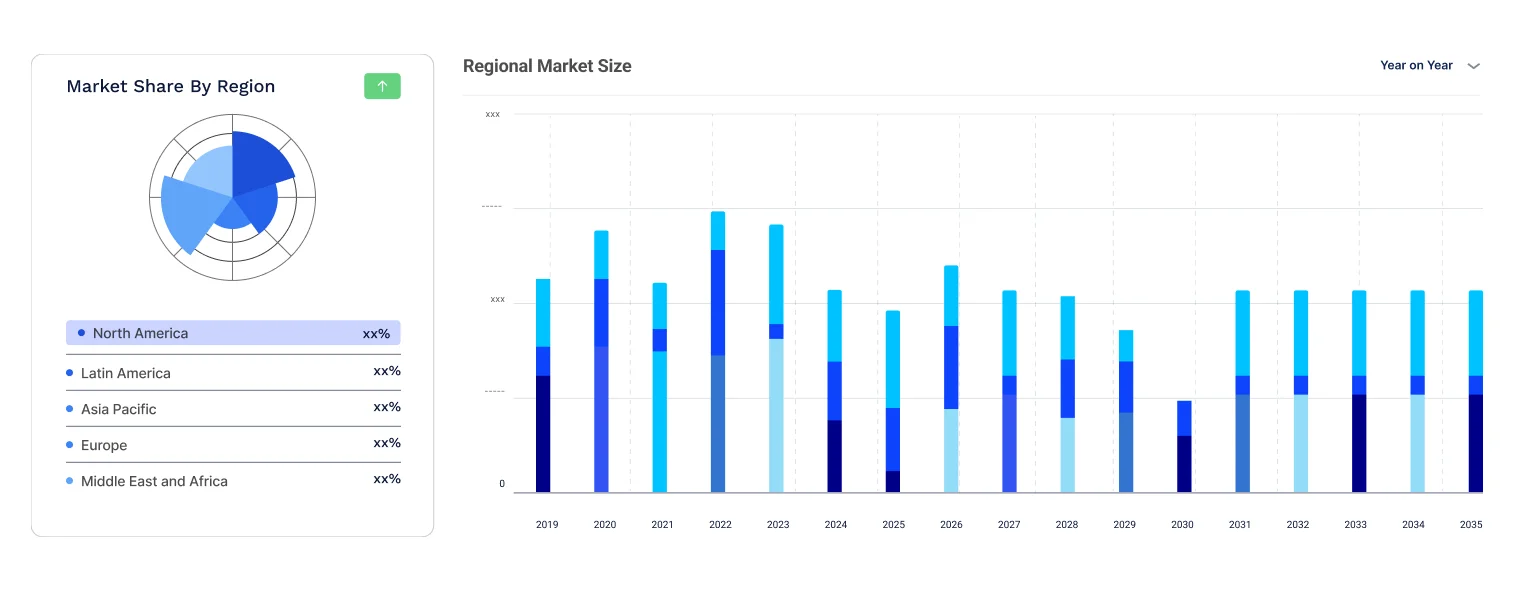
The major regions in the market are North America, Europe, Asia Pacific, Latin America, and Middle East and Africa.
The various technologies considered in the market report are RFID, DSRC, GPS, GNSS, and video analytics.
The various applications considered in the market report are highways and urban areas.
The major players in the market are Kapsch TrafficCom AG, TransCore Holdings, Inc., Thales Group, Honeywell International, Inc., and EFKON GmbH, among others.
Explore our key highlights of the report and gain a concise overview of key findings, trends, and actionable insights that will empower your strategic decisions.
| REPORT FEATURES | DETAILS |
| Base Year | 2025 |
| Historical Period | 2019-2025 |
| Forecast Period | 2026-2035 |
| Scope of the Report |
Historical and Forecast Trends, Industry Drivers and Constraints, Historical and Forecast Market Analysis by Segment:
|
| Breakup by Technology |
|
| Breakup by Application |
|
| Breakup by Region |
|
| Market Dynamics |
|
| Competitive Landscape |
|
| Companies Covered |
|
Datasheet
One User
USD 2,999
USD 2,699
tax inclusive*
Single User License
One User
USD 4,399
USD 3,959
tax inclusive*
Five User License
Five User
USD 5,599
USD 4,759
tax inclusive*
Corporate License
Unlimited Users
USD 6,659
USD 5,660
tax inclusive*
*Please note that the prices mentioned below are starting prices for each bundle type. Kindly contact our team for further details.*
Flash Bundle
Small Business Bundle
Growth Bundle
Enterprise Bundle
*Please note that the prices mentioned below are starting prices for each bundle type. Kindly contact our team for further details.*
Flash Bundle
Number of Reports: 3
20%
tax inclusive*
Small Business Bundle
Number of Reports: 5
25%
tax inclusive*
Growth Bundle
Number of Reports: 8
30%
tax inclusive*
Enterprise Bundle
Number of Reports: 10
35%
tax inclusive*
How To Order

Select License Type
Choose the right license for your needs and access rights.

Click on ‘Buy Now’
Add the report to your cart with one click and proceed to register.

Select Mode of Payment
Choose a payment option for a secure checkout. You will be redirected accordingly.
Strategic Solutions for Informed Decision-Making
Gain insights to stay ahead and seize opportunities.

Get insights & trends for a competitive edge.

Track prices with detailed trend reports.

Analyse trade data for supply chain insights.

Leverage cost reports for smart savings

Enhance supply chain with partnerships.

Connect For More Information
Our expert team of analysts will offer full support and resolve any queries regarding the report, before and after the purchase.
Our expert team of analysts will offer full support and resolve any queries regarding the report, before and after the purchase.
We employ meticulous research methods, blending advanced analytics and expert insights to deliver accurate, actionable industry intelligence, staying ahead of competitors.
Our skilled analysts offer unparalleled competitive advantage with detailed insights on current and emerging markets, ensuring your strategic edge.
We offer an in-depth yet simplified presentation of industry insights and analysis to meet your specific requirements effectively.




