

Consumer Insights
Uncover trends and behaviors shaping consumer choices today
Procurement Insights
Optimize your sourcing strategy with key market data
Industry Stats
Stay ahead with the latest trends and market analysis.
The Europe automotive chip market size reached around USD 10.16 Billion in 2025. The market is projected to grow at a CAGR of 10.60% between 2026 and 2035 to reach nearly USD 27.83 Billion by 2035. The market growth can be attributed to rising EV adoption, semi-autonomous vehicle advancements, and favourable government sustainability initiatives. Moreover, the rising popularity of ADAS in electric vehicles is also contributing to the market growth.
Compound Annual Growth Rate
10.6%
Value in USD Billion
2026-2035
|
Europe Automotive Chip Market Report Summary |
Description |
Value |
|
Base Year |
USD Billion |
2025 |
|
Historical Period |
USD Billion |
2019-2025 |
|
Forecast Period |
USD Billion |
2026-2035 |
|
Market Size 2025 |
USD Billion |
10.16 |
|
Market Size 2035 |
USD Billion |
27.83 |
|
CAGR 2019-2025 |
Percentage |
XX% |
|
CAGR 2026-2035 |
Percentage |
10.60% |
|
CAGR 2026-2035- Market by Country |
United Kingdom |
11.3% |
|
CAGR 2026-2035 - Market by Country |
France |
10.9% |
|
CAGR 2026-2035 - Market by Vehicle |
Passenger |
11.6% |
|
CAGR 2026-2035 - Market by Application |
Telematics and Infotainment |
11.7% |
|
Market Share by Country 2025 |
Germany |
19.2% |
As per industry reports, the automotive semiconductor industry is expected to witness a substantial growth in the coming years. While modern powertrain designs have 2x the number of semiconductors as in ICE vehicles, autonomous EVs equipped with image-recognition systems, LiDAR sensors, and 5G communication capabilities are expected to have 8x-10x more semiconductors. As European nations bolster their investments in automotive semiconductor production, the Europe automotive chip market revenue is expected to increase significantly.
Based on industry analysis, the automotive sector accounts for nearly 30% of the annual R&D spending of the European Union at around EUR 60 billion. Around 30% of the world’s total number of automotive patents originated in Europe in 2023. The industry accounts for 10% of the region’s exports and is considered a major component of the European economic system. This is expected to lead to a significant demand for semiconductors in the coming years, which is creating a favourable Europe automotive chip market outlook.
The software content of modern vehicles has consistently tripled since 2015. Advanced connectivity systems, including advanced driver assistance systems, are becoming increasingly popular in new vehicles, which has prompted automotive manufacturers to install nearly 150 control units in new cars. As software and hardware rapidly decouple from each other, European automotive chip companies are expected to develop new capabilities for manufacturing advanced semiconductors.
Increasing competition from Chinese automotive players; integration of artificial intelligence; growing focus on cybersecurity; and rising trend of energy efficiency and miniaturisation are the major factors driving the Europe automotive chip market growth.
Bosch began supplying its third-generation silicon carbide chips from its Reutlingen fab in Germany, delivering around 20% higher performance in significantly smaller packages. Backed by roughly €3 billion in European IPCEI funding, the move strengthens Europe's wide-bandgap manufacturing base and reinforces rising demand for efficient power semiconductors across electric-vehicle powertrains.
STMicroelectronics implemented price increases across Europe effective April 26, citing higher material, energy and manufacturing capacity costs. The adjustments spanned power devices and microcontrollers deeply embedded in automotive designs, tightening European OEM bills of materials and shortening quote-validity windows amid a broader industry-wide semiconductor repricing wave.
Major European-headquartered suppliers including NXP and Infineon, alongside Texas Instruments, enacted price increases effective April 1, citing rising raw material, energy, labour and logistics costs. The synchronized adjustments across power switches and related ICs signalled tightening supply conditions in the mature-node automotive semiconductors that underpin European vehicle production.
Germany-based Infineon and Subaru announced a collaboration to develop next-generation advanced driver-assistance systems, integrating Infineon's AURIX TC4x microcontroller into Subaru's electronic control unit. The chip, supporting functional safety up to ASIL-D, will process real-time camera and radar data, enabling faster, more reliable automated-driving performance for future connected vehicles.
During 2020-22, Chinese companies expanded their automotive market share by 8x in Europe. This has prompted European companies to introduce ambitious electrification plans for the transportation industry, such as the introduction of over 150 new EVs by 2030. This is expected to favourably impact the Europe automotive chip market dynamics.
Automotive chip designs in Europe are increasingly integrating AI to handle the growing demands of advanced vehicle systems. AI-powered chips process data from multiple sources to support features like object detection, predictive analytics, and traffic pattern recognition.
The rise of connected and autonomous vehicles has made cybersecurity a critical focus in automotive chip design. Chips are now being built with advanced encryption technologies, secure boot mechanisms, and intrusion detection systems to safeguard vehicle data and communication. European regulations, like the UNECE WP.29 cybersecurity guidelines, are also driving innovation in secure chip designs, thereby leading to the market growth.
The demand for compact and energy-efficient automotive chips is rising as vehicle designs evolve to include more electronics without increasing weight or power consumption. Miniaturised chips free up excessive space in hybrid and electric vehicles for batteries and other critical components. Simultaneously, energy-efficient chips help extend battery life and reduce power consumption, aligning with Europe’s sustainability goals.
In 2022, Mercedes-Benz became the first company to certify and launch a Level 3 autonomy vehicle, which enables consumers to drive without wheels. This indicates that technological advancements in vehicle operation are expected to witness sustained demand in the coming years, with European consumers shifting towards cars equipped with advanced driver assistance systems.
Based on industry analysis, market players are expected to invest nearly EUR 190 billion into the development of 37 new chip manufacturing plants over the forecast period, with the European Chips Act subsidising a sum of EUR 43 billion. Moreover, the implementation of dual-sourcing strategies and expansion of production capabilities are expected to favour the Europe automotive chip market outlook in the coming years.
The EMR’s report titled “Europe Automotive Chip Market Report and Forecast 2026-2035” offers a detailed analysis of the market based on the following segments:
Breakup by Type
Breakup by Vehicle
Breakup by Application
Breakup by Country
Based on vehicle, the market is segmented into passenger and commercial. Over the forecast period of 2026-2035, passenger vehicles are expected to grow at a CAGR of 11.6% due to the growing adoption of advanced driver-assistance systems such as automatic emergency braking, adaptive cruise control, and lane departure warning, among others. The rising demand for passenger vehicles with in-car connectivity, cloud-based features, and entertainment systems, coupled with the growing emphasis on safety and efficiency, is creating lucrative Europe automotive chip market opportunities.
Meanwhile, commercial vehicles are estimated to witness a healthy growth in the coming years amid the growing adoption of GPS tracking, telematics, and vehicle health monitoring systems in sectors such as transportation and logistics. The rising focus on fuel efficiency, the increasing demand for electric commercial vehicles, and the growing demand for autonomous driving technologies are further aiding the segment’s growth.
The Europe automotive chip market expansion is being driven by increasing cross-industry collaboration among automotive players. To cut costs and improve design, car makers are focusing on standardising middleware and sensor communication protocols to simplify the installation and integration of new sensors. This is propelling the demand for advanced semiconductors to meet the challenging demands of in-vehicle experience, thereby leading to the market growth.
Rohm Co. Ltd. was founded in 1958 and is headquartered in Kyoto, Japan. It specialises in producing LSI and discrete chips for various applications, including consumer goods and automotive.
Intel Corp. was founded in July 1968 and is headquartered in California, United States. It is engaged in manufacturing chipsets, microprocessors, and GPUs to ensure seamless connectivity between businesses and consumers alike.
Qualcomm Technologies, Inc. was founded in 1985 and is headquartered in California, United States. It develops and supplies semiconductor components and system-on-chip products that power a wide range of devices, including smartphones, tablets, automotive systems, and connected IoT products.
STMicroelectronics NV was founded in was founded in 1987 and is headquartered in Geneva, Switzerland. It is a global semiconductor company that designs and manufactures a broad portfolio of electronic components. Its products include microcontrollers, sensors, power devices, and integrated circuits used in a wide range of applications such as automotive systems, industrial equipment, consumer electronics, and IoT devices.
Other players included in the Europe automotive chip market report are Renesas Electronics Corporation, Infineon Technologies AG, Texas Instruments Incorporated, Broadcom Inc., NXP Semiconductors NV, and Micron Technology, Inc., among others.
*Please note that this is only a partial list; the complete list of key players is available in the full report. Additionally, the list of key players can be customized to better suit your needs.*
The Europe automotive chip market faces persistent structural challenges rooted in the region's heavy reliance on external foundries for advanced-node production, leaving European automakers exposed to supply disruptions and geopolitical tensions across global semiconductor trade. Recurring shortages have repeatedly slowed vehicle assembly, while the growing electronic complexity of electric and connected vehicles intensifies pressure on validation, functional-safety certification and long qualification cycles that stretch time-to-market for critical automotive silicon.
Several restraints continue to temper the pace of expansion across the region. Rising input costs spanning raw materials, energy and labour have driven successive price increases from major suppliers, tightening automotive bills of materials and squeezing margins for original equipment manufacturers. Additionally, the substantial capital and engineering investment required to develop sophisticated processors for autonomous and electric platforms limits participation by smaller players and lengthens return horizons on new capacity.
Opportunity, however, remains considerable. Europe's electrification agenda, stringent emissions regulation and expanding advanced driver-assistance adoption are elevating semiconductor content per vehicle, while investment in regional wide-bandgap manufacturing and power-device capacity strengthens local supply resilience. Deepening collaboration between chipmakers and automakers, alongside growth in software-defined vehicles, positions the region to capture rising demand for high-performance, energy-efficient automotive chips.


Upto 15% Off
USD
$2499 $2249
$3999 $3599
$4999 $4249
$5999 $5099


*While we strive to always give you current and accurate information, the numbers depicted on the website are indicative and may differ from the actual numbers in the main report. At Expert Market Research, we aim to bring you the latest insights and trends in the market. Using our analyses and forecasts, stakeholders can understand the market dynamics, navigate challenges, and capitalize on opportunities to make data-driven strategic decisions.*
In 2025, the market reached an approximate value of USD 10.16 Billion.
The market is projected to grow at a CAGR of 10.60% between 2026 and 2035.
The market is estimated to witness healthy growth in the forecast period of 2026-2035 to reach a value of around USD 27.83 Billion by 2035.
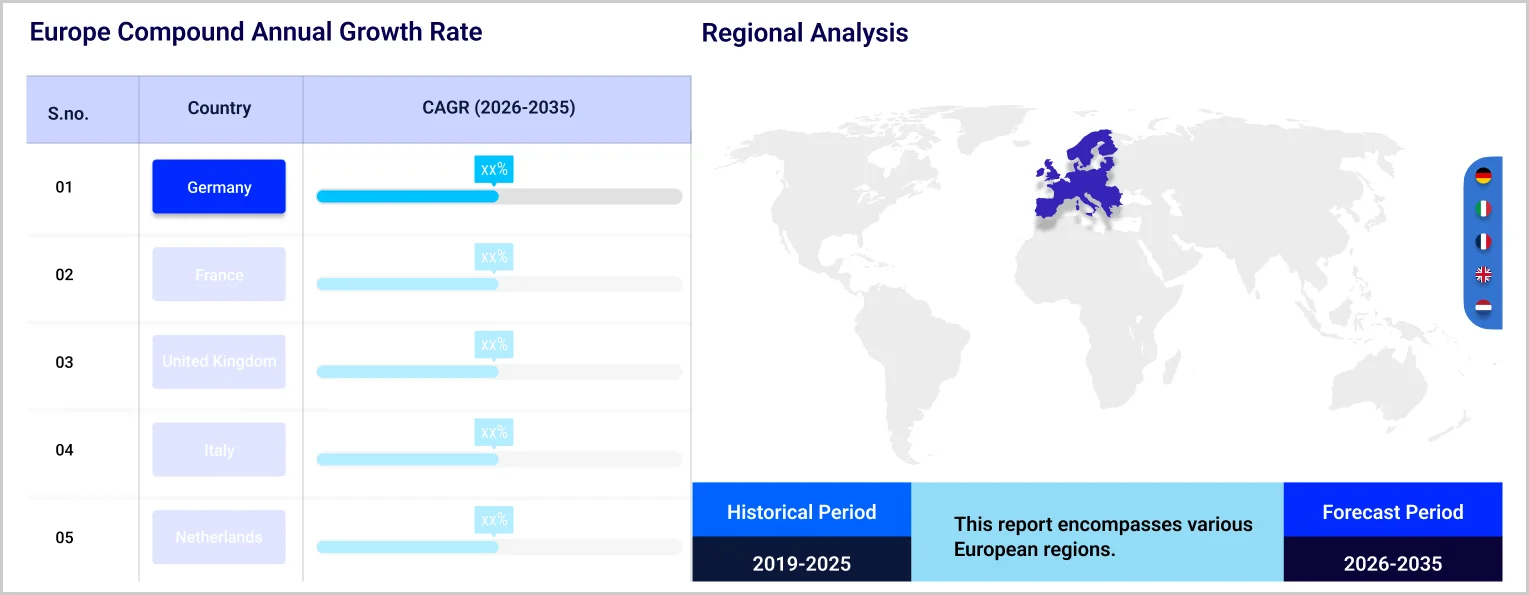
The different countries considered in the market report include the United Kingdom, Germany, France, and Italy, among others.
The different types of automotive chips are analog ICs, logic ICs, and microcontrollers and microprocessors.
The different vehicles that require automotive chips are commercial and passenger.
The different applications of automotive chips include chassis, powertrain, safety, telematics and infotainment, and body electronics.
Key players in the market are Qualcomm Technologies, Inc., Renesas Electronics Corporation, Infineon Technologies AG, STMicroelectronics NV, Texas Instruments Incorporated, Broadcom Inc., NXP Semiconductors NV, Micron Technology, Inc., Intel Corp., and Rohm Co. Ltd., among others.
Explore our key highlights of the report and gain a concise overview of key findings, trends, and actionable insights that will empower your strategic decisions.
| REPORT FEATURES | DETAILS |
| Base Year | 2025 |
| Historical Period | 2019-2025 |
| Forecast Period | 2026-2035 |
| Scope of the Report |
Historical and Forecast Trends, Industry Drivers and Constraints, Historical and Forecast Market Analysis by Segment:
|
| Breakup by Type |
|
| Breakup by Vehicle |
|
| Breakup by Application |
|
| Breakup by Region |
|
| Market Dynamics |
|
| Competitive Landscape |
|
| Companies Covered |
|
Datasheet
One User
USD 2,499
USD 2,249
tax inclusive*
Single User License
One User
USD 3,999
USD 3,599
tax inclusive*
Five User License
Five User
USD 4,999
USD 4,249
tax inclusive*
Corporate License
Unlimited Users
USD 5,999
USD 5,099
tax inclusive*
*Please note that the prices mentioned below are starting prices for each bundle type. Kindly contact our team for further details.*
Flash Bundle
Small Business Bundle
Growth Bundle
Enterprise Bundle
*Please note that the prices mentioned below are starting prices for each bundle type. Kindly contact our team for further details.*
Flash Bundle
Number of Reports: 3
20%
tax inclusive*
Small Business Bundle
Number of Reports: 5
25%
tax inclusive*
Growth Bundle
Number of Reports: 8
30%
tax inclusive*
Enterprise Bundle
Number of Reports: 10
35%
tax inclusive*
How To Order

Select License Type
Choose the right license for your needs and access rights.

Click on ‘Buy Now’
Add the report to your cart with one click and proceed to register.

Select Mode of Payment
Choose a payment option for a secure checkout. You will be redirected accordingly.
Strategic Solutions for Informed Decision-Making
Gain insights to stay ahead and seize opportunities.

Get insights & trends for a competitive edge.

Track prices with detailed trend reports.

Analyse trade data for supply chain insights.

Leverage cost reports for smart savings

Enhance supply chain with partnerships.

Connect For More Information
Our expert team of analysts will offer full support and resolve any queries regarding the report, before and after the purchase.
Our expert team of analysts will offer full support and resolve any queries regarding the report, before and after the purchase.
We employ meticulous research methods, blending advanced analytics and expert insights to deliver accurate, actionable industry intelligence, staying ahead of competitors.
Our skilled analysts offer unparalleled competitive advantage with detailed insights on current and emerging markets, ensuring your strategic edge.
We offer an in-depth yet simplified presentation of industry insights and analysis to meet your specific requirements effectively.




