

Consumer Insights
Uncover trends and behaviors shaping consumer choices today
Procurement Insights
Optimize your sourcing strategy with key market data
Industry Stats
Stay ahead with the latest trends and market analysis.
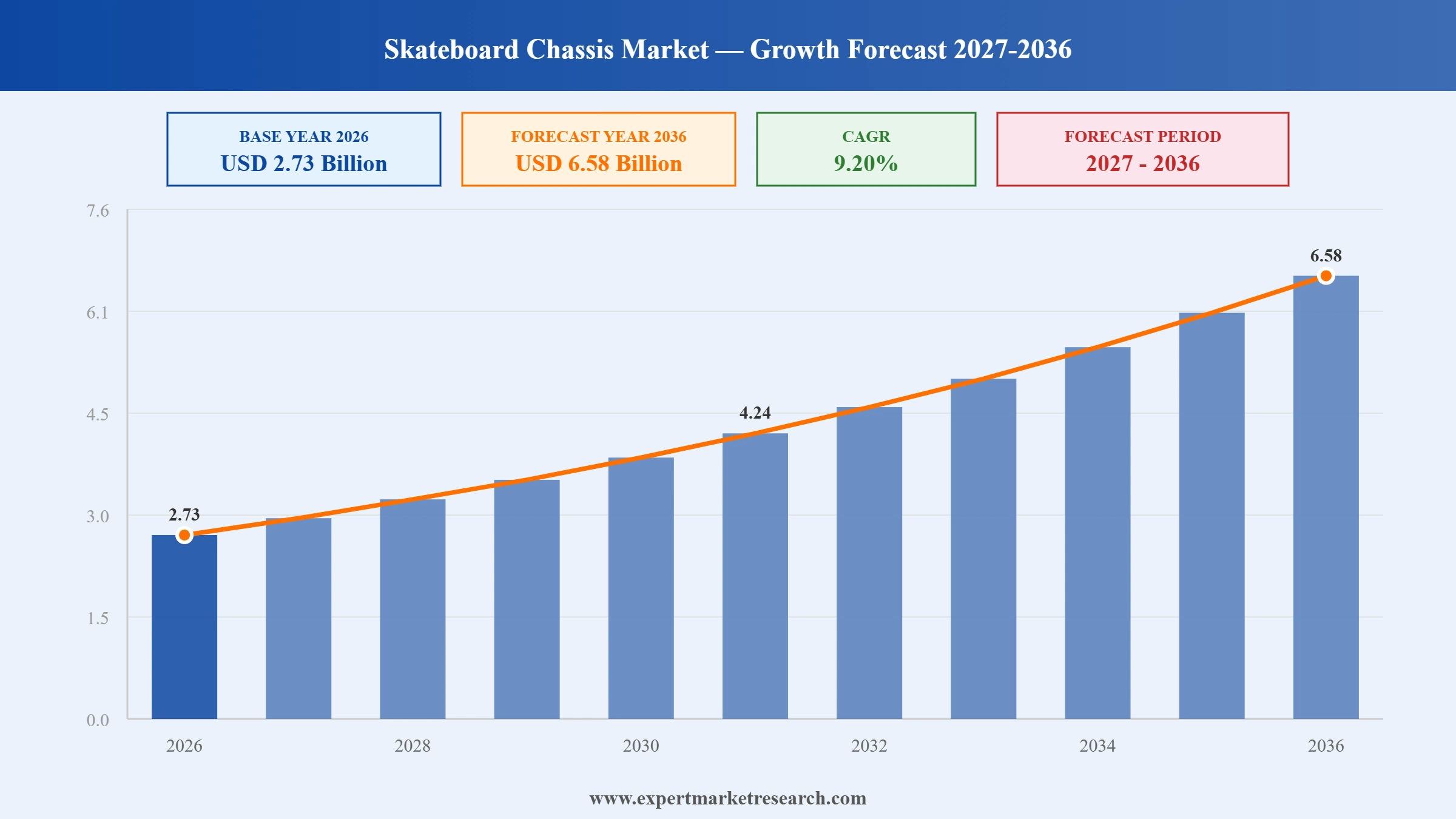
The skateboard chassis market was valued at USD 2.50 Billion in 2025. The market is expected to grow at a CAGR of 9.20% during the forecast period of 2026-2035 to reach a value of USD 6.03 Billion by 2035. Rising electrification of commercial fleets, growing OEM adoption of modular platform architectures, and increasing investment in scalable, multi-vehicle chassis designs are collectively driving market growth.
The skateboard chassis market is shaped by accelerating electrification of commercial fleets and growing OEM demand for scalable, multi-vehicle platform architectures that reduce development complexity. Asia Pacific dominated the market in 2025, supported by China's leading position in global EV production and sales, strong domestic OEMs, and established battery manufacturing capacity. Aluminum accounts for the largest share by material, reflecting its favorable strength-to-weight ratio relative to steel and its cost advantage over emerging composite alternatives.
Established chassis and platform suppliers are reinforcing their market presence through continued technology partnerships, OEM contract wins, and modular architecture development rather than relying on a single growth lever. At CES 2026, for example, Hyundai Mobis unveiled its X-by-Wire integrated chassis solution, which combines electronic steering and braking control into a single controller without mechanical connections, including built-in dual safety redundancy in case of a steering malfunction. This multi-pronged approach is helping leading suppliers scale modular platform production even as OEMs accelerate the shift toward software-defined, electrified vehicle architectures, with by-wire technologies and intelligent actuators emerging as key competitive differentiators across the industry.
The competitive landscape remains moderately consolidated, with supply concentrated among established automotive Tier 1 suppliers such as ZF Friedrichshafen, Magna International, and Continental alongside specialized EV platform developers including Rivian, Canoo, and REE Automotive that maintain deep systems engineering expertise and long-standing OEM relationships. In December 2025, for example, REE Automotive signed a non-binding memorandum of understanding with Cascadia Motion, a BorgWarner subsidiary, to jointly develop a compact electric drive unit integrating REEcorner technology for global OEM electrification programs. Participation requires sustained investment in modular architecture design, battery integration engineering, and by-wire control systems, creating meaningful entry barriers and reinforcing the position of long-established players across passenger, commercial, and autonomous delivery vehicle categories.
Read more about this report - Request a Free Sample
|
Skateboard Chassis Market Report Summary |
Description |
Value |
|
Base Year |
USD Billion |
2025 |
|
Historical Period |
USD Billion |
2019-2025 |
|
Forecast Period |
USD Billion |
2026-2035 |
|
Market Size 2025 |
USD Billion |
2.50 |
|
Market Size 2035 |
USD Billion |
6.03 |
|
CAGR 2019-2025 |
Percentage |
XX% |
|
CAGR 2026-2035 |
Percentage |
9.20% |
|
CAGR 2026-2035 - Market by Region |
Asia Pacific |
14% |
|
CAGR 2026-2035 - Market by Vehicle Type |
Commercial Vehicles |
7.2% |
|
CAGR 2026-2035 - Market by Material |
Composite Materials |
15.5% |
|
2025 Market Share by Region |
North America |
35% |
The skateboard chassis market is being reshaped by expanding OEM platform contracts, growing in-wheel motor and by-wire technology integration, and strategic business realignment among major Tier 1 suppliers. Increasing electrification of commercial fleets is further reshaping the competitive landscape.
WATT Electric Vehicle Company and Donut Lab partnered to integrate in-wheel motor technology with WATT's lightweight aluminum PACES skateboard platform, debuting the collaboration at CES 2026. The partnership combined direct-drive precision control with lightweight chassis engineering for vehicles ranging from beach buggies to delivery vehicles. Other companies can pursue similar in-wheel motor integrations to differentiate platforms on handling agility.
HARMAN, a Samsung subsidiary, agreed to acquire ZF's ADAS business, with approximately 3,750 ZF employees expected to transition to HARMAN upon closing. The deal allowed HARMAN to integrate ZF's ADAS capabilities into its digital cockpit roadmap. Other companies can also, alognwith the one mentioned, pursue similar divestitures to sharpen focus on core chassis engineering while software domains are absorbed by specialized acquirers.
Magna Steyr agreed to assemble XPENG electric vehicles for the European market starting in the third quarter of 2025, extending its contract manufacturing relationship to a major Chinese EV entrant. The agreement expanded Magna role as a flexible assembly partner for the various global OEMs. Other companies can pursue similar contract assembly partnerships to help EV entrants scale European production.
ZF Friedrichshafen secured a chassis technology contract from Mercedes-Benz, with a series production scheduled to begin in 2026 as part of ZF's Chassis 2.0 portfolio spanning intelligent actuators and by-wire technologies. The contract reinforced ZF's position as global market leader in passenger car chassis technology. Other companies can too pursue similar by-wire development to capture the premium OEM contracts.
Growing investment in autonomous robotaxi fleets is creating new demand for flexible, high-volume assembly capacity that established contract manufacturers are positioned to serve. This is drawing skateboard chassis suppliers into partnerships with autonomy developers that would previously have built vehicles independently. In May 2025, for example, Waymo partnered with Magna International to build a new vehicle factory in Arizona, doubling robotaxi production capacity using Magna's contract assembly expertise.
In-wheel motor systems are increasingly being explored as a complement to conventional skateboard platforms, offering finer control over individual wheel speeds and reducing drivetrain mass compared with centrally mounted motor configurations. This is expanding the range of handling characteristics achievable on flat, modular chassis designs. In February 2026, for example, Japan's EXEDY Corporation agreed to acquire UK-based in-wheel motor developer Protean Electric from BEDEO Group, aiming to strengthen its electrification technology portfolio.
China's large-scale domestic electric vehicle production base, supported by strong OEM investment and established battery manufacturing capacity, continues to accelerate adoption of dedicated skateboard platforms across passenger and commercial vehicle segments. In May 2026, for example, CATL entered a mass-production partnership with Turkish automaker Togg for its Bedrock skateboard chassis, marking the first time a Chinese integrated intelligent chassis has been supplied to an overseas passenger vehicle program.
Major automotive suppliers are increasingly divesting adjacent business units to concentrate capital and engineering resources on core chassis and platform technology, reflecting the capital intensity of developing next-generation skateboard architectures. In April 2026, for example, Bosch Limited's board approved a roughly $981 million acquisition of full ownership of Bosch Chassis Systems India, describing the move as a portfolio realignment shifting from individual components toward integrated platform solutions.
Demand for electric conversions of classic and vintage vehicles is drawing specialized conversion companies into skateboard chassis development, adapting flat, modular platforms to fit under existing vintage vehicle bodies. This is extending skateboard architecture beyond purpose-built EVs into the growing classic vehicle electrification niche. In March 2026, for example, UK-based Electric Classic Cars introduced a modular skateboard chassis fitted with a Tesla Model 3 drivetrain, designed for classic trucks and SUVs including the Ford Bronco and F-150.
The Expert Market Research's report titled "Skateboard Chassis Market Report and Forecast 2026-2035" offers a detailed analysis of the market based on the following segments:
Market Breakup by Vehicle Type
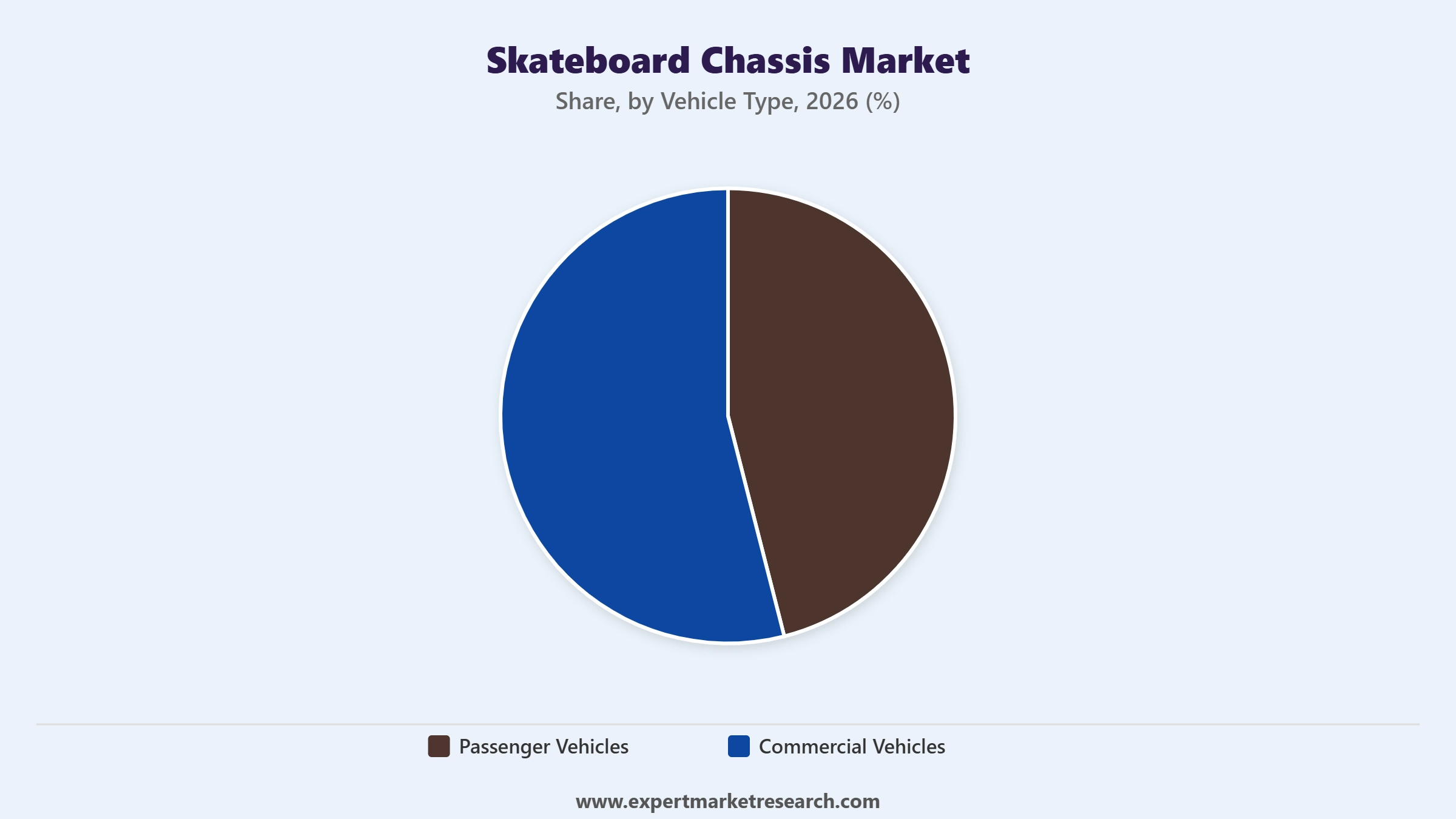
Key Insight: Passenger vehicles account for the largest share of the market by vehicle type, reflecting widespread OEM adoption of skateboard architectures for electric sedans, SUVs, and crossovers seeking to maximize interior space and simplify multi-model development. Commercial vehicles are the fastest-growing vehicle type, forecast to grow at a CAGR of 7.2%, as fleet operators increasingly adopt skateboard platforms for delivery vans and last-mile logistics vehicles requiring high payload capacity and durability. In its Q4 2025 shareholder letter, Rivian confirmed Amazon now operates more than 30,000 custom-built Rivian Electric Delivery Vans across thousands of U.S. cities, with new all-wheel-drive, larger-battery variants under development to expand route coverage. Others, including specialty and off-road configurations, represent a smaller, application-specific share of overall demand.
Market Breakup by Material
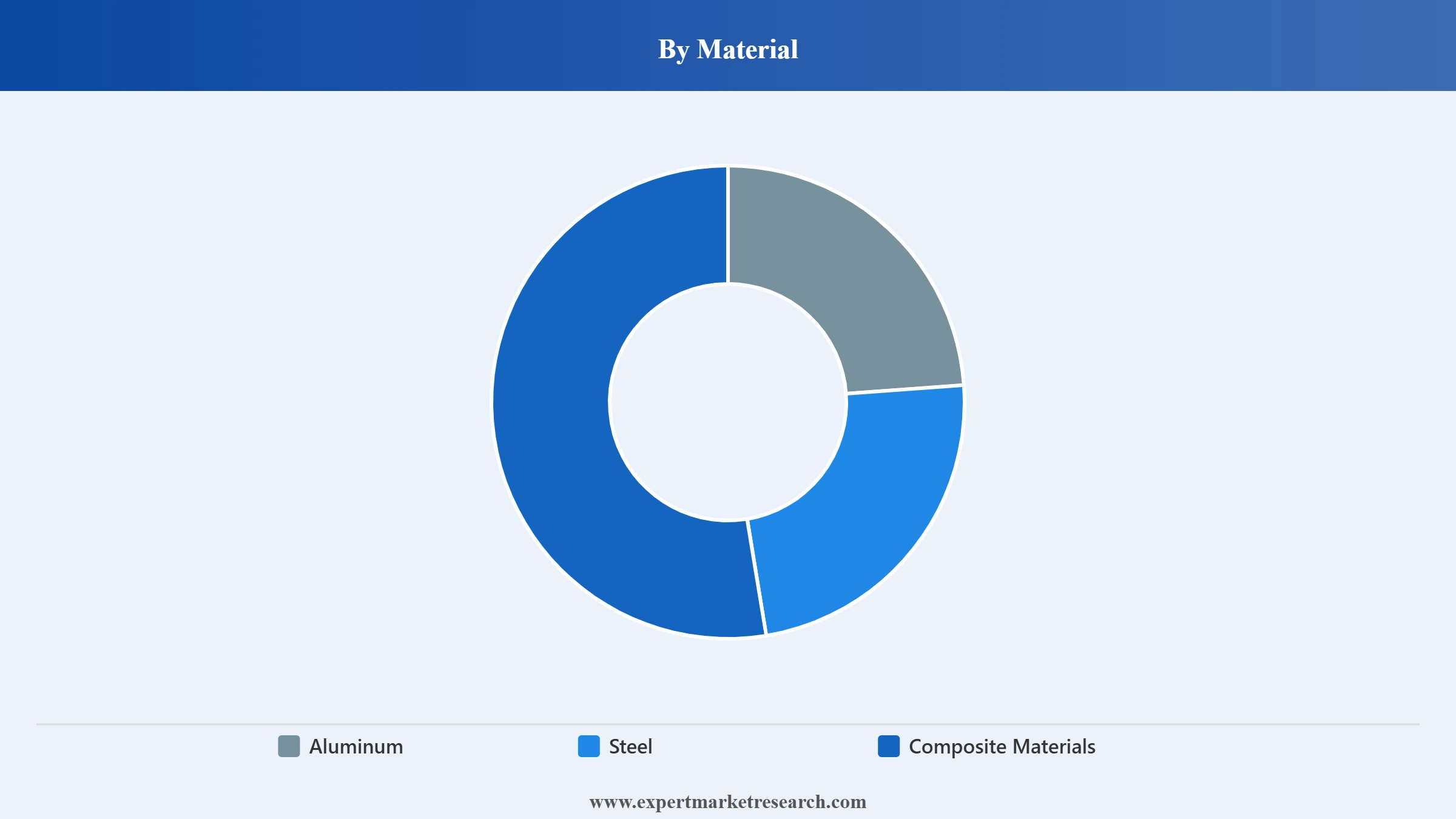
Key Insight: Aluminum accounts for the largest share of the market by material, reflecting its favorable strength-to-weight ratio and established, cost-effective manufacturing processes relative to steel and emerging composite alternatives. Volvo's upcoming EX60, for example, replaces 60 to 100 welded steel components with a single aluminum megacasting, delivering a 15 to 20% section weight reduction and a 35% cost reduction compared with a mixed steel-aluminum structure. Steel continues to serve cost-sensitive commercial and heavy-duty applications where structural load-bearing capacity outweighs weight considerations. Composite materials, including carbon fiber, are a fast-growing category as manufacturers pursue ultra-lightweight structures for premium and performance-oriented electric vehicle segments. Others, including hybrid multi-material constructions, round out the category as manufacturers balance cost, weight, and structural performance.
Market Breakup by Application
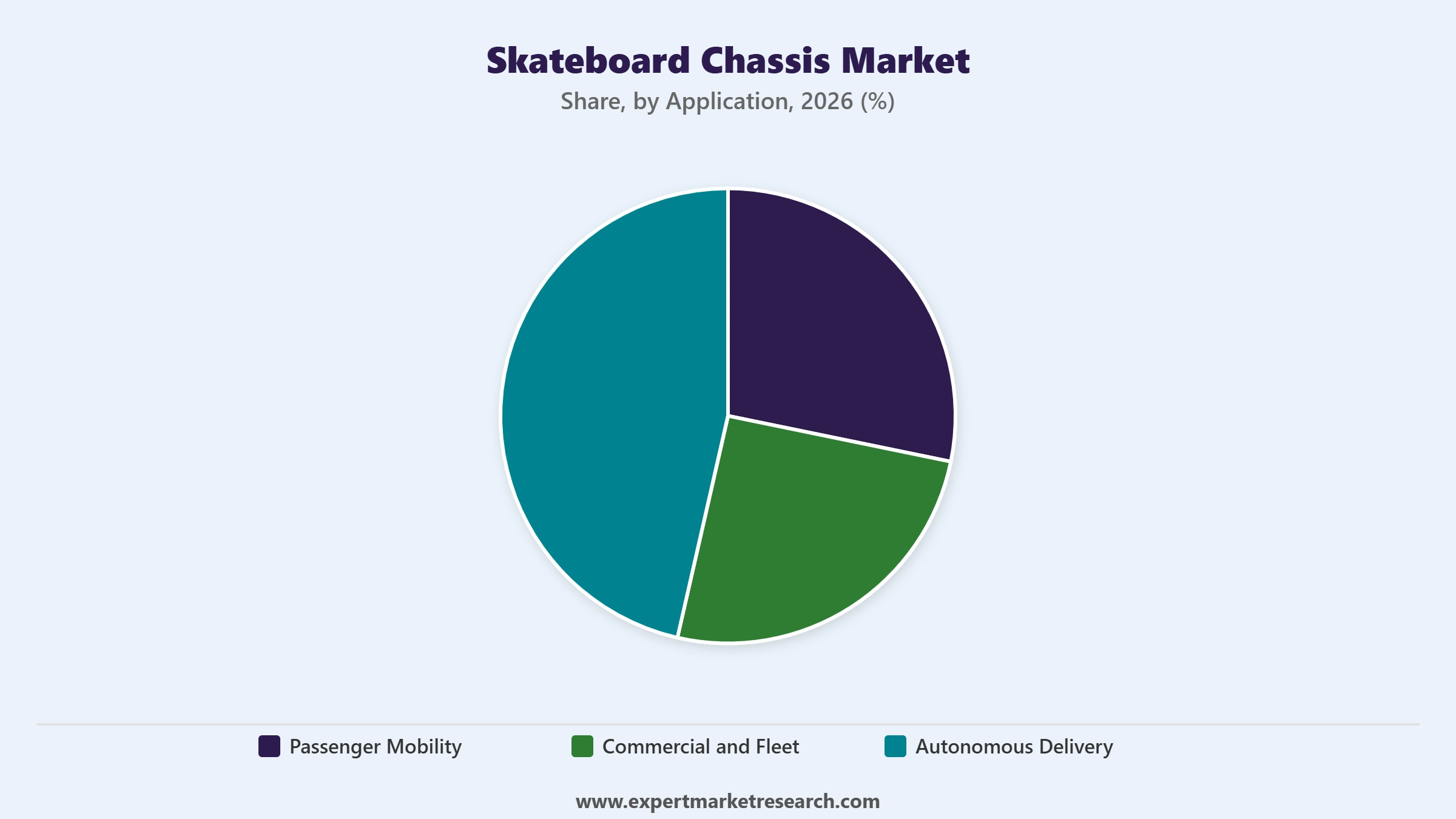
Key Insight: Passenger mobility accounts for the largest share of the market by application, driven by growing consumer adoption of electric sedans, SUVs, and crossovers built on shared skateboard platforms. Commercial and fleet applications continue to see strong adoption as delivery and logistics operators electrify last-mile vehicle fleets using purpose-built commercial skateboard chassis. Autonomous delivery is a fast-growing application as technology companies and mobility providers develop purpose-built platforms for driverless logistics and robotaxi services; at CES 2026, for example, Lucid, Nuro, and Uber unveiled a purpose-built global robotaxi, with plans to build and deploy more than 20,000 units integrated on Lucid's production line in Casa Grande, Arizona. Others, including specialty and experimental vehicle applications, represent a smaller share of overall demand.
Market Breakup by Region
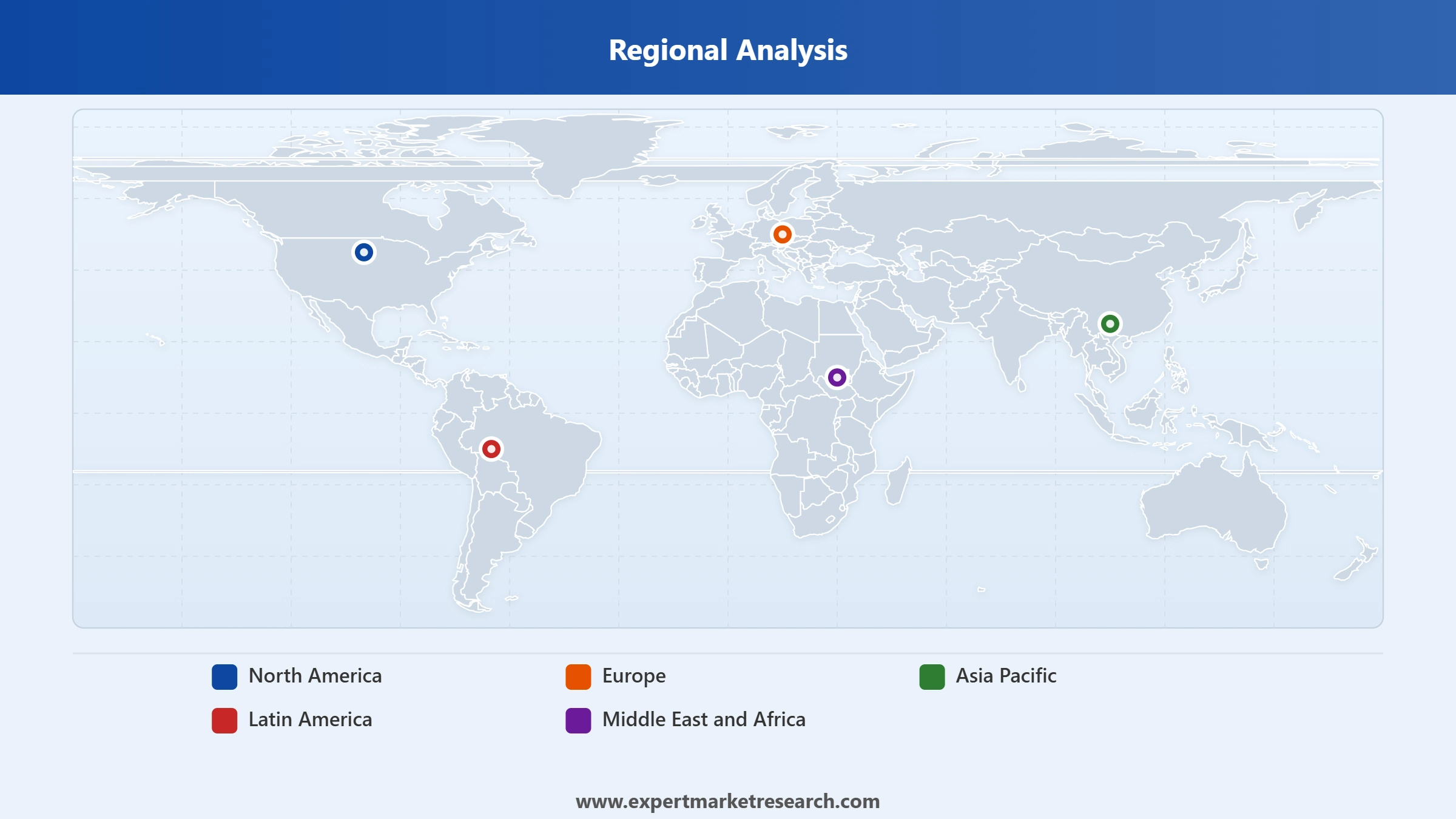
Key Insight: North America dominates the skateboard chassis market, supported by the strong presence of established EV platform developers, favorable regulatory support for electrification, and significant OEM investment in modular architecture development. Asia Pacific is the fastest-growing region, driven by China's leading position in global EV production and sales, strong domestic OEMs, and established battery manufacturing capacity. Europe remains a significant market supported by stringent emission standards and growing OEM investment in electrified platform architectures, while Latin America and the Middle East and Africa continue to see steadier growth tied to expanding automotive manufacturing capacity.

Read more about this report - Request a Free Sample
By vehicle type, passenger vehicles dominate the market due to widespread OEM adoption of shared platforms
Passenger vehicles account for the largest share of the market by vehicle type, reflecting widespread OEM adoption of skateboard architectures for electric sedans, SUVs, and crossovers. Sharing a common platform reduces engineering costs. Mercedes-Benz, for example, is building its new electric C-Class on its MB.EA skateboard platform, shared with the electric GLC SUV, with production starting mid-2026 in Hungary.
Read more about this report - Request a Free Sample
Commercial vehicles are those fastest-growing vehicle type, forecast to grow at a CAGR of 7.2%, as fleet operators increasingly adopt skateboard platforms for delivery vans and last-mile logistics vehicles. In 2026, for example, Farizon launched its V7E electric van on a skateboard chassis with drive-by-wire architecture, offering a low cargo floor and 1,338kg payload for urban logistics operators.
By material, aluminum leads the market due to its favorable strength-to-weight ratio and cost-effective manufacturing
Aluminum accounts for the largest share of the market by material, reflecting its favorable strength-to-weight ratio and established, cost-effective manufacturing processes relative to steel and composite alternatives. This balance of performance and affordability continues to make aluminum the default choice for mainstream platform production.
Read more about this report - Request a Free Sample
Composite materials are the fastest-growing material category as manufacturers pursue ultra-lightweight structures for premium and performance-oriented electric vehicle segments. HRC's hybrid monocoque technology, used in China's Yangwang U9 supercar, integrates more than 110 kilograms of aerospace-grade carbon fiber, reducing structural weight by 30% compared with traditional steel-aluminum designs.
By application, passenger mobility leads the market due to growing consumer adoption of shared electric vehicle platforms
Passenger mobility accounts for the largest share of the market by application, driven by growing consumer adoption of electric sedans, SUVs, and crossovers built on shared skateboard platforms. Suzuki, for example, launched its e Vitara crossover SUV in India in February 2026, built on the company's new Heartect-e skateboard platform designed to improve structural integrity and lower the vehicle's center of gravity. Continued OEM investment in dedicated EV architectures is reinforcing this segment's leading position across established and emerging automotive markets.
Read more about this report - Request a Free Sample
Autonomous delivery is the fastest-growing application as technology companies and mobility providers develop purpose-built platforms for driverless logistics and robotaxi services. At the 2026 IAA Transportation show in Hannover, for example, Stellantis unveiled its BOW (Box on Wheels) autonomous delivery concept, developed with robotics specialist UQI for urban, low-emission, and restricted-access delivery environments. Growing investment in in-wheel motor technology and sensor-integrated chassis designs continues to widen the range of vehicle configurations achievable on flat, modular platforms.
North America dominates the market due to strong EV platform developer presence and significant OEM investment
North America dominates the skateboard chassis market, supported by the strong presence of established EV platform developers, favorable regulatory support for electrification, and significant OEM investment in modular architecture development. In April 2026, for example, Volkswagen ended ID.4 assembly on its MEB skateboard platform at its Chattanooga, Tennessee plant, consolidating the line to focus on its second-generation Atlas, illustrating how North American OEMs continue to actively reassess platform allocation amid shifting regulatory and demand conditions. The region's early leadership in pioneering skateboard platform design continues to anchor its position as the largest contributor to global demand.
Read more about this report - Request a Free Sample
Asia Pacific is the fastest-growing region, driven by China's leading position in global EV production and sales, strong domestic OEMs, and established battery manufacturing capacity. According to the International Energy Agency's Global EV Outlook 2026, China's ten largest automakers have set combined overseas sales targets exceeding 7 million vehicles for 2026, nearly double their 2025 targets. High demand for SUVs and commercial EVs, alongside government incentives and export growth, continues to strengthen the region's above-average growth trajectory.
|
CAGR 2026-2035 - Market by |
Region |
|
North America |
7% |
|
Europe |
6.5% |
|
Asia Pacific |
14% |
|
Latin America |
10% |
|
Middle East and Africa |
9% |
The global market features a moderately consolidated competitive structure led by established automotive Tier 1 suppliers alongside dedicated EV platform developers. skateboard chassis companies like ZF Friedrichshafen, Magna International, and Rivian are competing primarily through platform engineering depth and OEM contract relationships, while REE Automotive and other developers focus on flat, wheel-integrated architectures for commercial applications.
Leading skateboard chassis market players are focusing on modular platform standardization, by-wire technology development, and contract manufacturing partnerships to strengthen their competitive position. Increasing emphasis on battery integration engineering and autonomous vehicle compatibility is also enabling suppliers to diversify their customer base while supporting long-term market growth.
ZF Friedrichshafen, headquartered in Friedrichshafen, Germany, and founded in 1915, is the global market leader in chassis technology, supplying transmissions, steering, and driveline systems to passenger and commercial vehicle manufacturers worldwide. The company's Chassis 2.0 portfolio spans intelligent actuators, active damping systems, and by-wire technologies supporting next-generation electrified vehicle platforms.
Magna International, headquartered in Aurora, Ontario, and founded in 1957, is a diversified automotive supplier offering body exteriors, chassis systems, and complete vehicle contract manufacturing services. The company's vertically integrated manufacturing model, including its Magna Steyr assembly operations, allows it to support automakers from platform design through full vehicle production.
Rivian Automotive, headquartered in Irvine, California, and founded in 2009, is an American electric vehicle manufacturer known for pioneering the modern skateboard platform architecture used across its R1 consumer lineup and commercial Electric Delivery Van business. The company operates its primary manufacturing hub in Normal, Illinois, alongside a significant commercial vehicle partnership supplying delivery vans to Amazon.
REE Automotive, headquartered in Tel Aviv, Israel, and founded in 2013, develops flat, fully modular skateboard platforms that house virtually all mechanical components within the wheel arches, an approach distinct from conventional skateboard designs. The company's technology targets commercial and light-duty electric vehicle applications, with platform partnerships extending to automakers including Mahindra.
Other key players in the market report include Canoo Inc., Dana Incorporated, Hyundai Mobis Co., Ltd., Continental AG, and Hon Hai Precision Industry Co., Ltd. (Foxconn), among others.
*Please note that this is only a partial list; the complete list of key players is available in the full report. Additionally, the list of key players can be customized to better suit your needs.*
Explore the latest trends shaping the skateboard chassis market 2026-2035 with our in-depth report. Gain strategic insights, future forecasts, and key market developments that can help you stay competitive. Download a free sample report or contact our team for customized consultation on the market trends 2026.


Upto 15% Off
USD
$2499 $2249
$3999 $3599
$4999 $4249
$5999 $5099


*While we strive to always give you current and accurate information, the numbers depicted on the website are indicative and may differ from the actual numbers in the main report. At Expert Market Research, we aim to bring you the latest insights and trends in the market. Using our analyses and forecasts, stakeholders can understand the market dynamics, navigate challenges, and capitalize on opportunities to make data-driven strategic decisions.*
In 2025, the Skateboard Chassis market reached an approximate value of USD 2.50 Billion.
The market is projected to grow at a CAGR of 9.20% between 2026 and 2035.
The key players in the market include Rivian Automotive, Inc., Canoo Inc., REE Automotive Ltd., ZF Friedrichshafen AG, Magna International Inc., Dana Incorporated, Hyundai Mobis Co., Ltd., Continental AG, and Hon Hai Precision Industry Co., Ltd. (Foxconn), among others.
Leading suppliers are pursuing modular platform standardization, by-wire technology development, and OEM contract expansion to strengthen market position.
Key challenges include high development costs for advanced materials, complexity of battery integration engineering, and price competition from established vehicle architectures.
Explore our key highlights of the report and gain a concise overview of key findings, trends, and actionable insights that will empower your strategic decisions.
|
Report Features |
Details |
|
Base Year |
2025 |
|
Historical Period |
2019-2025 |
|
Forecast Period |
2026-2035 |
|
Scope of the Report |
Historical and Forecast Trends, Industry Drivers and Constraints, Historical and Forecast Market Analysis by Segment:
|
|
Breakup by Vehicle Type |
|
|
Breakup by Material |
|
|
Breakup by Application |
|
|
Breakup by Region |
|
|
Market Dynamics |
|
|
Competitive Landscape |
|
|
Companies Covered |
|
Datasheet
One User
USD 2,499
USD 2,249
tax inclusive*
Single User License
One User
USD 3,999
USD 3,599
tax inclusive*
Five User License
Five User
USD 4,999
USD 4,249
tax inclusive*
Corporate License
Unlimited Users
USD 5,999
USD 5,099
tax inclusive*
*Please note that the prices mentioned below are starting prices for each bundle type. Kindly contact our team for further details.*
Flash Bundle
Small Business Bundle
Growth Bundle
Enterprise Bundle
*Please note that the prices mentioned below are starting prices for each bundle type. Kindly contact our team for further details.*
Flash Bundle
Number of Reports: 3
20%
tax inclusive*
Small Business Bundle
Number of Reports: 5
25%
tax inclusive*
Growth Bundle
Number of Reports: 8
30%
tax inclusive*
Enterprise Bundle
Number of Reports: 10
35%
tax inclusive*
How To Order

Select License Type
Choose the right license for your needs and access rights.

Click on ‘Buy Now’
Add the report to your cart with one click and proceed to register.

Select Mode of Payment
Choose a payment option for a secure checkout. You will be redirected accordingly.
Strategic Solutions for Informed Decision-Making
Gain insights to stay ahead and seize opportunities.

Get insights & trends for a competitive edge.

Track prices with detailed trend reports.

Analyse trade data for supply chain insights.

Leverage cost reports for smart savings

Enhance supply chain with partnerships.

Connect For More Information
Our expert team of analysts will offer full support and resolve any queries regarding the report, before and after the purchase.
Our expert team of analysts will offer full support and resolve any queries regarding the report, before and after the purchase.
We employ meticulous research methods, blending advanced analytics and expert insights to deliver accurate, actionable industry intelligence, staying ahead of competitors.
Our skilled analysts offer unparalleled competitive advantage with detailed insights on current and emerging markets, ensuring your strategic edge.
We offer an in-depth yet simplified presentation of industry insights and analysis to meet your specific requirements effectively.




