

Consumer Insights
Uncover trends and behaviors shaping consumer choices today
Procurement Insights
Optimize your sourcing strategy with key market data
Industry Stats
Stay ahead with the latest trends and market analysis.
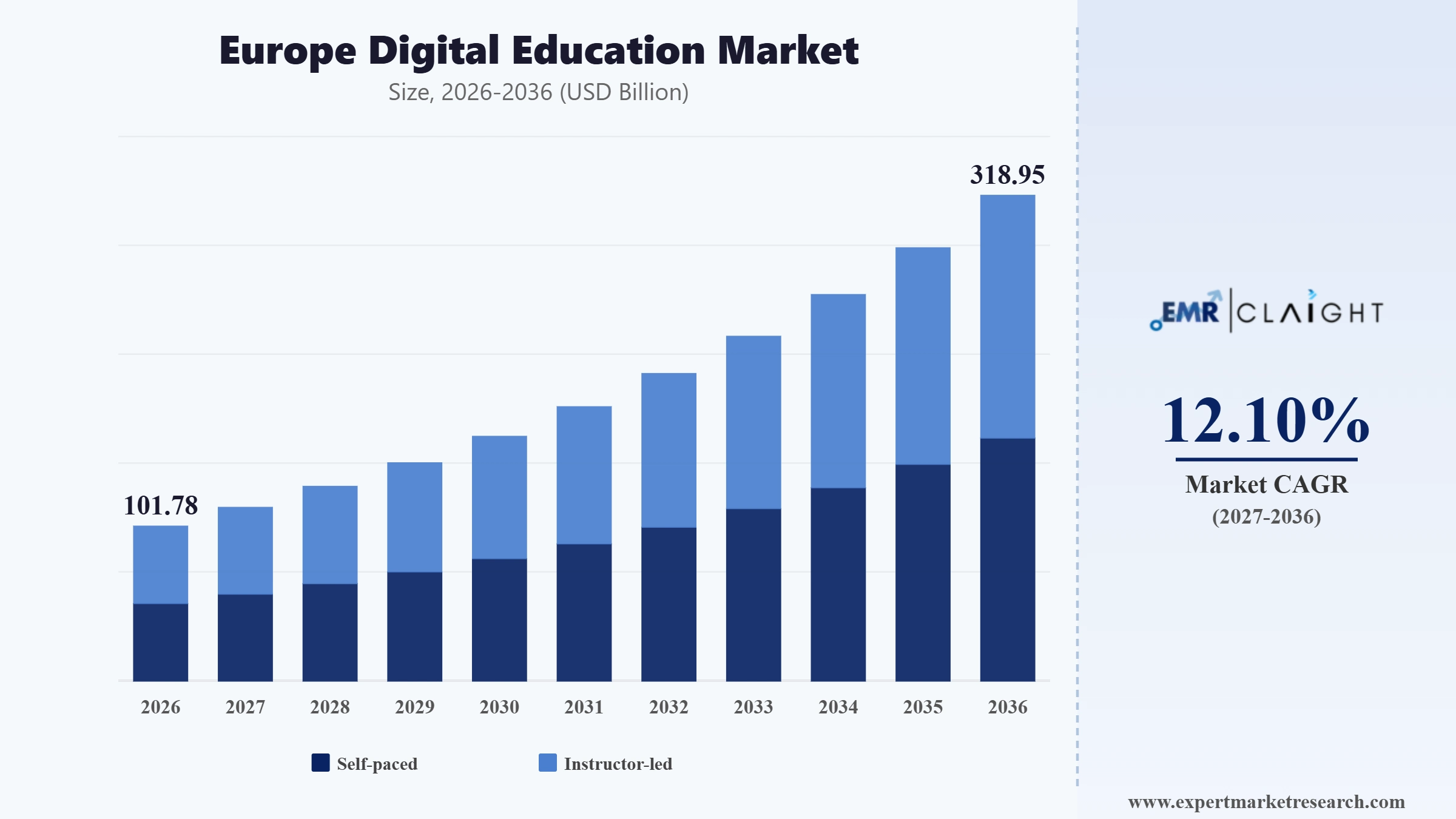
The Europe digital education market attained a value of USD 90.79 Billion in 2025 and is projected to expand at a CAGR of 12.10% through 2035. The market is further expected to achieve USD 284.51 Billion by 2035. Providers of digital education within the EU are building AI-powered platforms to facilitate personalized learning, automated evaluation, digital skill enhancement, and compliance with interoperability and data governance standards among heterogeneous learners.
Two particular factors driving the demand in the Europe digital education industry include the need to upskill workforces in order to move towards digital platforms which can provide tangible skills development as well as the need for interoperability platforms linking LMSs with assessment and analytics. Moreover, the Erasmus+ funding allows for the planning of digital transformation within educational institutions of different levels.
The integration of AI into digital education is encouraging providers in the Europe digital education market to develop more interactive, personalised, and accessible learning solutions. Complement, an EdTech company based in France, is building a conversational e-learning platform by developing AI avatars which convert PDFs and PowerPoints to interactive modules, including quizzes and feedback. The firm has raised EUR 660,000 to fund its product development for conversational e-learning platform. This strategy helps fill one of the gaps in capabilities, as 43% of the European students have low level of digital skills according to the results of 2023 ICILS survey from European Commission.
The Europe digital education market observes an increasing focus on institutional buyers who want solutions integrated into the current learning ecosystem rather than standalone content libraries. Complement is supporting LMS integration using LTI 1.3 and single sign-on as part of the requirements of the institution buyers. In this connection, Digital Education Action Plan from the European Commission keeps providing support to digital transformations of schools, vocational education, higher education and adult learning institutions. Moreover, in September 2025, UNESCO’s UIL launched an open-source course helping adult educators build digital skills and navigate AI-enabled teaching environments.
Read more about this report - REQUEST FREE SAMPLE COPY IN PDF
The European Commission opened academies for quantum computing, AI, and virtual worlds, increasing specialized training for the regional technological workforce. Firms can design specialized courses for AI, quantum, and virtual worlds based on the skills required by the future workforce, accelerating demand in the Europe digital education industry.
The European Commission issued guidelines for responsible use of AI, digital literacy, informatics, and quality content in digital education. The digital education providers can design digital education platforms that comply with European guidelines.
By integrating E-Learning Group with specialized educational establishments, Sefera managed to create a scalable digital and hybrid higher-education system for more than 15,000 students. EdTech firms may seek collaboration and consolidation opportunities to increase the number of cross-border online programs and future skills courses offered by them.
The Commission introduced practical resources addressing AI, data, disinformation, digital content and informatics to support responsible technology use in classrooms. Companies in the Europe digital education market can develop teacher-focused AI tools, digital literacy platforms and classroom content with built-in safety, quality and transparency features.
AI is currently being developed as a product development area in the Europe digital education market, where vendors are offering adaptive learning, assessment automation, AI tutorships and content generation to educational institutions. In June 2026, the European Commission and OECD presented an AI Literacy Framework for primary and secondary education along with classroom examples that can be used by teachers to responsibly use AI. The initiative will help EdTech companies to have a better understanding of their AI learning tool products. For example, in September 2026, ICARUS AI launched Pathwise Universities, an AI-guided platform matching students with universities based on programs, study preferences, and destinations.
Interoperability is turning into an increasingly significant competitive consideration for European schools and universities looking for digital platforms that will enable them to connect learning management systems, assessment tools, credentials and student services. In June 2025, the European Digital Education Hub called for universities and European Universities alliances to implement and scale up the European Higher Education Interoperability Framework created between June 2023 and January 2025. It offers an opportunity for providers in the Europe digital education market to create products on the basis of data exchange standardization and cross-border learning. In September 2026, INSEAD launched immersive AI cases, expanding its AI-powered learning portfolio beyond 40 experiences for interactive, personalized management education.
Developers are progressing from regular video courses into virtual reality, XR and simulations for technical education and workforce training, thereby boosting demand in the Europe digital education market. For instance, the European MASTER project uses mixed reality to prepare learners to work with industrial robots, whereas XR4ED develops a European platform for extended reality education and training. In December 2025, the European Commission started the European Partnership for Virtual Worlds involving the industry, research organizations, academia, and end-users for the purpose of promoting innovation in immersive applications.
With the high-speed connectivity being introduced, a whole new product layer is emerging for the European digital education companies, especially those who develop remote laboratories, collaborative classrooms and immersive learning environments. Aligning with such trends in the Europe digital education market, in September 2026, Capgemini joined EURO-3C, advancing secure, interoperable and sovereign digital infrastructure through AI, edge computing, cloud and telecommunications technologies. With the help of interconnected private 5G networks, the project will test advanced learning, collaborative research, and digital education solutions by 2028. This technological advance helps the technology vendors find an opportunity in low-latency learning applications, connected classrooms, and cross-border education platforms requiring real-time connectivity.
The growing emphasis on digital and AI literacy skills is creating an increased need for training programs focused on students, educators, and professional workers, broadening the Europe digital education market scope. In March 2025, the European Commission launched its Union of Skills Strategy, which ties education, basic skills, STEM skills, and lifelong learning to the needs of the European labor market. The Commission is also creating specialized guidelines for informatics, with the aim of publishing the guidelines in all EU languages in 2026, while Erasmus+, European Social Fund Plus, Digital Europe Programme, and Horizon Europe contribute to the development of digital skills.
The Expert Market Research's report titled “Europe Digital Education Market Report and Forecast 2026-2035” offers a detailed analysis of the market based on the following segments:
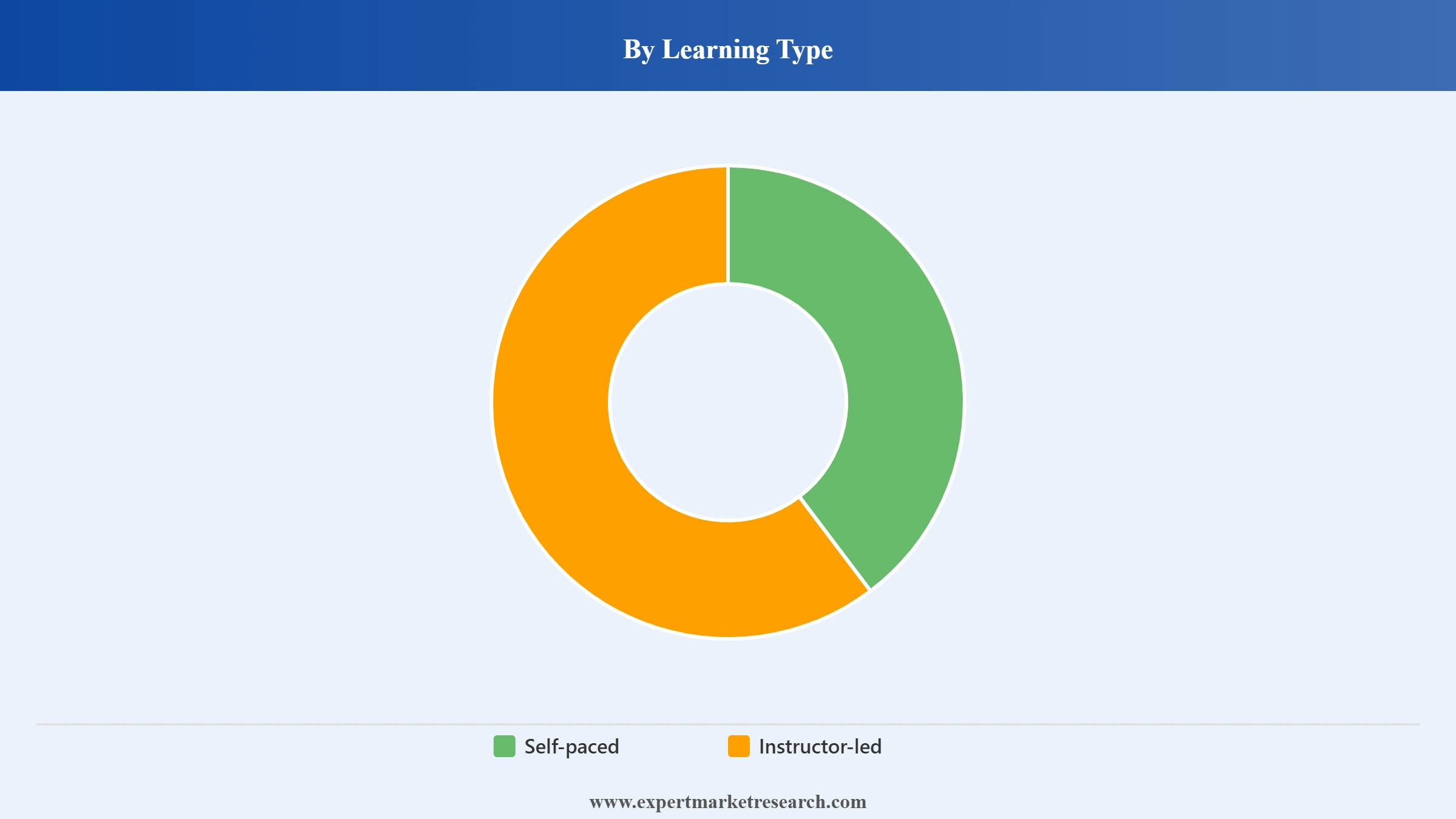
Market Breakup by Learning Type
Key Insight: Self-paced learning is characterized by the features of asynchronous nature and scalability of content, while instructor-based learning is enabled through interactivity and guidance. Both systems can help cover different institutional procurement requirements. Self-paced learning solutions increasingly feature adaptivity of paths, analytics, modularity of content, and learner control, creating new Europe digital education market opportunities. Instructor-based learning solutions are focused on virtual classroom, collaboration, evaluation, and assistance to instructors. In April 2026, Microsoft and VTC expanded AI-powered learning, deploying virtual tutors across 220 modules to support 18,000 students across seven disciplines.
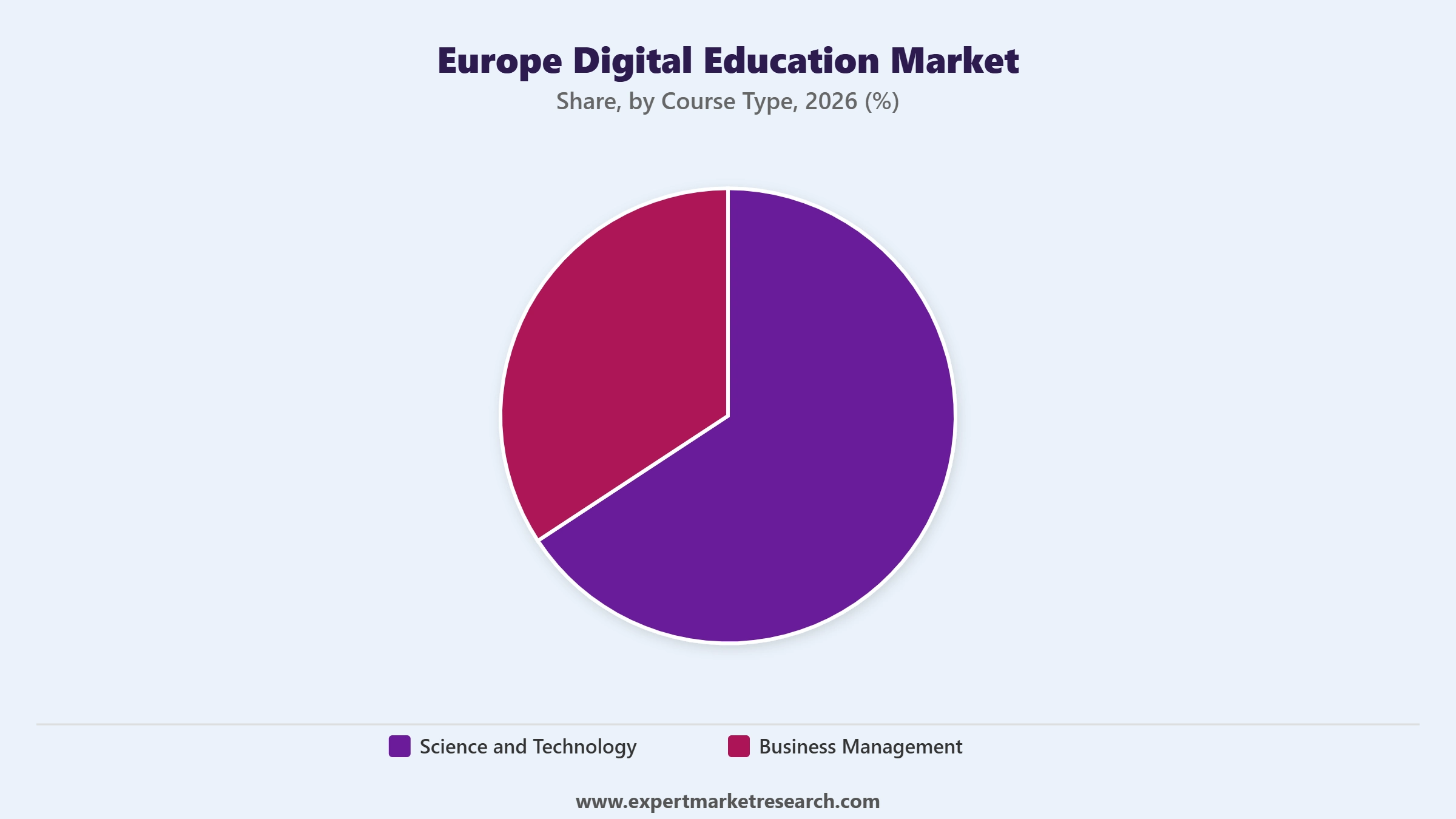
Market Breakup by Course Type
Key Insight: Science and technology courses benefit from the need for specific technical skill development, whereas the business management field is served by enterprise reskilling, leadership training, and digital transformation initiatives. Other courses including language education, arts, humanities, social sciences, personal development, and vocational education are driven by the need of learners to learn skills flexibly outside of formal degree courses. Providers in the Europe digital education market are distinguishing their courses through the use of simulations, project work, AI tutoring, certifications, and competency testing.
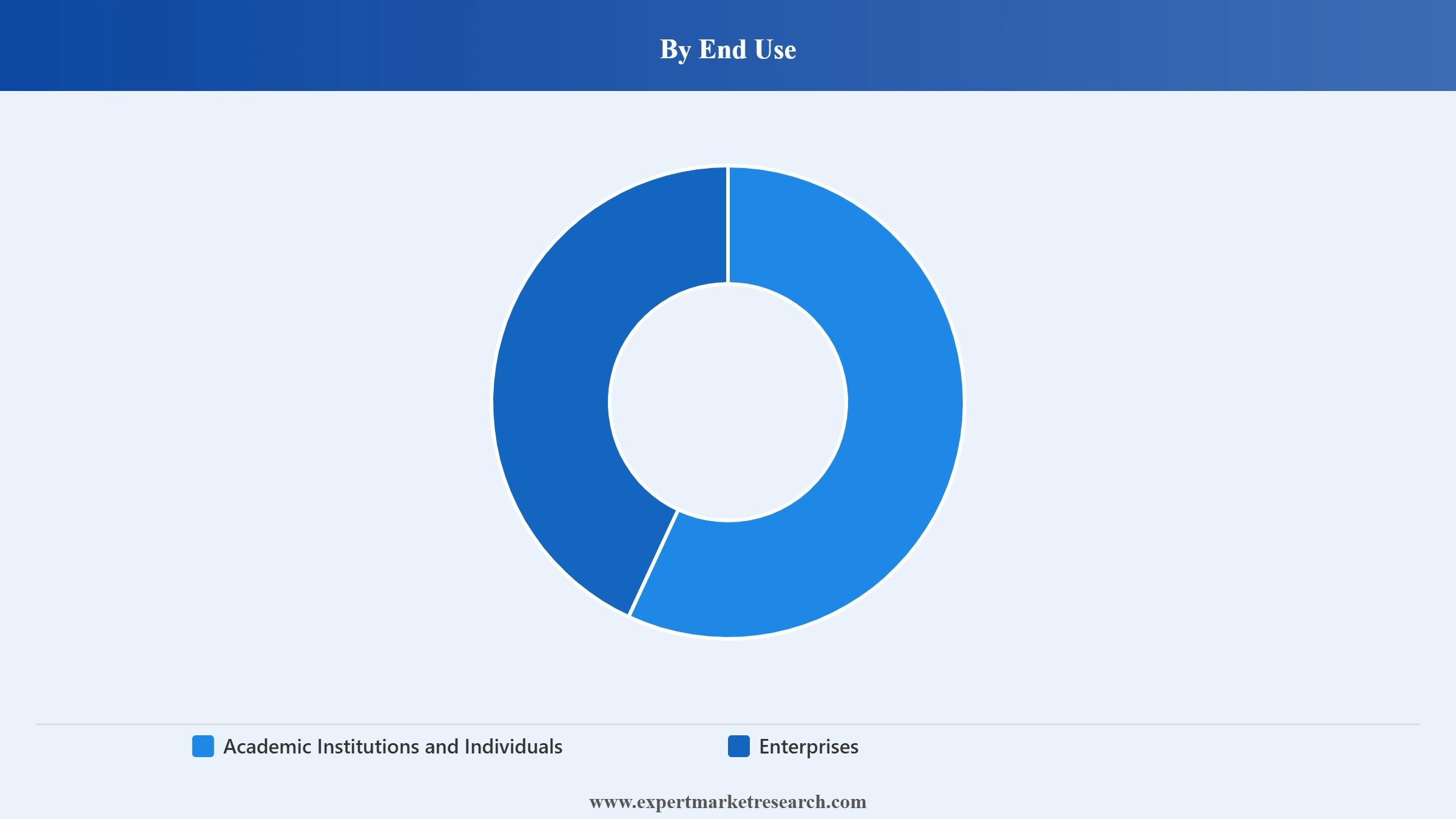
Market Breakup by End Use
Key Insight: As per the Europe digital education market report, the focus of the academic institutions and individual category continues to revolve around curriculum delivery, flexibility of study, accessibility of learners, and additional education, whereas the focus of Enterprises includes skill building of employees, productivity, compliance, and role-based training. The academic customers are becoming more demanding of integrated platforms that enable teacher management and learner engagement, while enterprise customers value analytics, centralization, certification, and integration with HR technologies more.
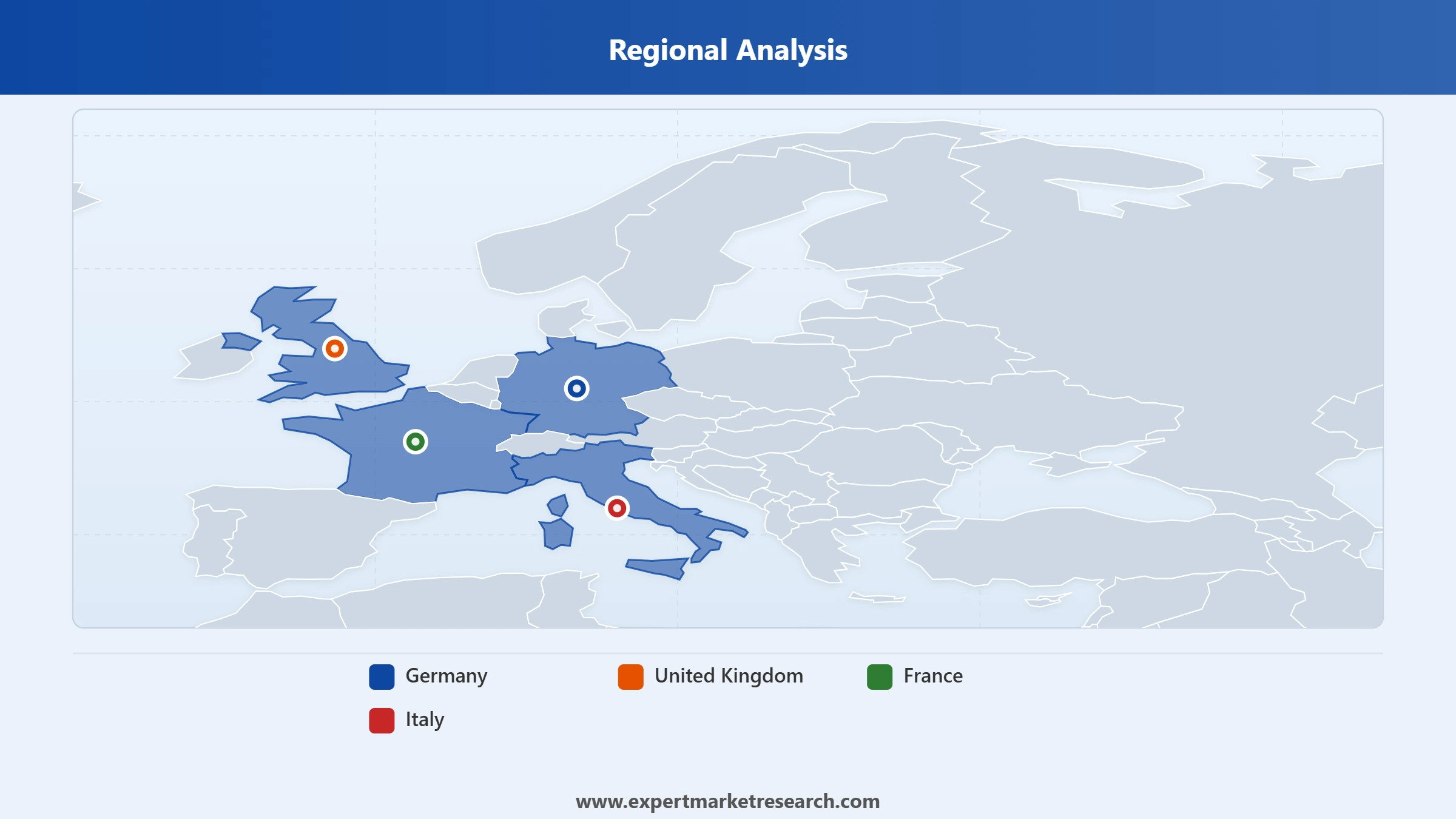
Market Breakup by Country
Key Insight: There are opportunities in Germany owing to industrial training requirements, vocational education system, and technical education demand, whereas the United Kingdom is benefitted by innovation in EdTech, digitization of higher education, and professional learning. There are opportunities in France because of modernizing the public education system, developing digital skills, and technological adoption within institutions. Italy is expanding its share in the Europe digital education market owing to increasing demands for flexible learning, workforce training, and modernizing education delivery. There are other countries like Nordic and Central European nations that provide opportunities because of high connectivity, digital literacy programs, and cross-border education.
Read more about this report - REQUEST FREE SAMPLE COPY IN PDF
Self-paced learning registers the dominant position in the market due to flexible access, personalized progression, and scalable content delivery
Self-paced learning is currently dominating the Europe digital education market, as learners prefer flexibility in accessing recorded classes, digital libraries, adaptive assessment tools, and modular learning paths. Digital education platforms are developing in such a way that learners can stop, restart and adapt their coursework based on their skill gaps. Self-paced learning works best in higher education and professional development, as learners have to balance education and work. In June 2026, RUN-EU launched a Future Study Skills MOOC, helping students develop intercultural, learning, wellbeing, and career skills through flexible online education.
Read more about this report - REQUEST FREE SAMPLE COPY IN PDF
Instructor-led learning is the fastest-growing sub-segment in the Europe digital education market, fueled by increased demand for live virtual classrooms, expert-led training, collaborative assignments and timely feedback from the instructors. Digital education platforms are becoming more sophisticated in incorporating not only synchronous teaching but also breakout rooms, whiteboards, attendance tracking, transcription, and post-class assessments. Universities and corporate training platforms are adopting these features to replicate the interaction of the classroom while expanding their reach. Vendors are incorporating AI assistants that help instructors in preparing classes and monitoring learner performance.
Science and technology courses dominate the market due to digital skills shortages and technology-focused workforce requirements
Science and technology form the most dominant sub-segment in the Europe digital education market as providers focus on offering classes that cover artificial intelligence, cyber security, programming, data science, engineering technologies, and advanced digital technologies. Demand for this service is boosted by businesses looking for tech-savvy individuals and institutions looking at updating their curriculum based on new technical areas of study. The digital educational platforms offer interactive coding programs, virtual laboratories, simulation learning, assessment automation, and even AI tutors. In September 2026, the University of Limerick led an EUR 107 million program advancing responsible AI development, training researchers in trustworthy and ethical AI.
Read more about this report - REQUEST FREE SAMPLE COPY IN PDF
The business management sub-segment observes significant demand in the Europe digital education market due to companies looking for flexible digital learning related to leadership, project management, finance, marketing, strategy, and organizational change. Digital educational providers are working on offering modular executive education, simulation programs, collaborative case studies, and AI-enabled coaching services so that professional learning would be more suitable for real-life situations.
By end use, academic institutions and individuals dominate the market due to curriculum digitization, flexible learning, and broader learner access
Academic institutions and individuals contribute to the Europe digital education market revenue with solutions being developed in digital courseware, assessments, virtual classroom, learner dashboard, and content repository. Solution providers are increasingly developing software that caters to both faculty and learners without altering the traditional academic processes. On the other hand, individual users prefer flexibility in course availability and personalized progression. In May 2026, Quotanda and EIF launched a EUR 55 million education financing initiative, expanding flexible tuition access for students across five European countries.
Read more about this report - REQUEST FREE SAMPLE COPY IN PDF
Enterprises are the fastest-growing segment in the Europe digital education market where firms use digital education platforms to cater for job change and workforce development. Enterprise buyers need learning software capable of aligning course offerings to jobs, developing competencies, automating compliance learning, and measuring achievements against organizational goals. Solution providers are addressing this need through artificial intelligence-based skills recommendation, enterprise dashboards, microlearning, simulation-based training, and integration with HRM systems. Technology, cybersecurity, leadership, and operations training are highly demanded.
Read more about this report - REQUEST FREE SAMPLE COPY IN PDF
Germany dominates the market due to strong industrial digitization, vocational training, and institutional technology adoption
Germany stands out as the most prominent region of the European digital education market due to the availability of its massive education ecosystem, manufacturing capabilities, vocational training facilities, and the need for workforce development. Vendors are developing solutions that will address the needs of educational institutions and businesses in Germany in such areas as technical training, digital skills, corporate training programs, and hybrid learning environments. In June 2025, Knowunity raised Series B funding to scale its AI-powered learning platform, expanding personalized education and international student reach.
The United Kingdom emerges to be the fastest-growing region of the Europe digital education market owing to the existence of an established ecosystem for EdTech, higher education sector, need for professional education, and adoption of online and blended learning methodologies. Digital education companies target universities, training firms, businesses, and even individual learners in the country using AI tutors, virtual classrooms, skills platforms, assessment solutions, and professional certification courses.
The market is characterized by increasing competition that is moving from the provision of basic online courses to AI-based personalization, skills assessment, immersive learning, and corporate learning ecosystems. It is worth noting that Europe digital education companies are concentrating on developing strong relationships with universities and employers, while expanding professional certifications, and integrating AI in tutoring, content creation, learner support, and analytics.
Another potential opportunity for Europe digital education market players is in interoperability as providers are looking for solutions that can integrate with learning management systems and student information systems. Technical training, micro credentials, virtual laboratories, as well as workforce role programs, can be viewed as some ways of addressing Europe's digital skills gap. The localization of products, multilingualism, privacy features, and compliance with European education standards represent another differentiator.
Founded in 2012 and headquartered in Mountain View, California, United States, Coursera is an online learning platform that offers courses, professional certificates, degrees, and enterprise learning services through university and industry partnerships. The platform makes use of advanced technology such as AI-powered personalization, Role Play, Course Builder, and Skills Tracks.
Founded in 2008 and headquarters in the United States, 2U is an online education company that specializes in providing technology-enabled education solutions for universities and other educational institutions. 2U offers its partner universities and other educational organizations online degree programs, certificate programs, boot camps, and short courses. Through its unique business model, 2U allows partner institutions to offer online educational programs without having to build their own full-scale digital education operation.
Founded in 2012 and with its headquarters in the United Kingdom, FutureLearn is a joint venture between The Open University and offers online courses from universities, cultural organizations, and professional bodies. It also focuses on social learning, mobility, professional development, and digital credentialing. Additionally, FutureLearn partners with employers and public sector organizations to offer digital learning to audiences beyond the traditional university setting.
Founded in 2011 and with its headquarters in Mountain View, California, United States, Udacity specializes in tech-focused professional education. It offers a range of courses in the form of projects, which include artificial intelligence, data, cloud computing, cybersecurity, and programming.
Other key players in the market include LinkedIn Corporation, Springer-Verlag GmbH, Udemy, Inc., Capernaum Ltd. (Alison), Federica Weblearning, and EDFLEX SAS (My Mooc), among others.
*Please note that this is only a partial list; the complete list of key players is available in the full report. Additionally, the list of key players can be customized to better suit your needs.*
Unlock the latest insights with our Europe digital education market trends 2026 report. Discover regional growth patterns, consumer preferences, and key industry players. Stay ahead of competition with trusted data and expert analysis. Download your free sample report today and drive informed decisions in the market.


Upto 15% Off
USD
$2499 $2249
$3999 $3599
$4999 $4249
$5999 $5099


*While we strive to always give you current and accurate information, the numbers depicted on the website are indicative and may differ from the actual numbers in the main report. At Expert Market Research, we aim to bring you the latest insights and trends in the market. Using our analyses and forecasts, stakeholders can understand the market dynamics, navigate challenges, and capitalize on opportunities to make data-driven strategic decisions.*
The market was valued at USD 90.79 Billion in 2025.
The market is projected to grow at a CAGR of 12.10% between 2026 and 2035.
The revenue generated from the digital education market is expected to reach USD 284.51 Billion in 2035.
The digital education market is categorised according to learning type, which includes self-paced, and instructor led.
The market key players are Coursera Inc., 2U, Inc., FutureLearn Limited, Udacity, Inc., LinkedIn Corporation, Springer-Verlag GmbH, Udemy, Inc., Capernaum Ltd., Federica Weblearning, and EDFLEX SAS among others.
Based on the end use, the market is divided into science and technology, business management and Others.
The market is broken down into Germany, the United Kingdom, France, and Italy among others.
Companies face fragmented education systems, strict data requirements, uneven digital infrastructure, AI governance concerns, high content-development costs, teacher adoption barriers, and difficulty proving measurable learning outcomes across institutions.
Stakeholders are expanding AI-enabled learning, strengthening university partnerships, integrating interoperable systems, developing skills-based credentials, improving analytics, localizing content, and demonstrating measurable employment outcomes.
Explore our key highlights of the report and gain a concise overview of key findings, trends, and actionable insights that will empower your strategic decisions.
| REPORT FEATURES | DETAILS |
| Base Year | 2025 |
| Historical Period | 2019-2025 |
| Forecast Period | 2026-2035 |
| Scope of the Report |
Historical and Forecast Trends, Industry Drivers and Constraints, Historical and Forecast Market Analysis by Segment:
|
| Breakup by Learning Type |
|
| Breakup by Course Type |
|
| Breakup by End Use |
|
| Breakup by Region |
|
| Market Dynamics |
|
| Competitive Landscape |
|
| Companies Covered |
|
Datasheet
One User
USD 2,499
USD 2,249
tax inclusive*
Single User License
One User
USD 3,999
USD 3,599
tax inclusive*
Five User License
Five User
USD 4,999
USD 4,249
tax inclusive*
Corporate License
Unlimited Users
USD 5,999
USD 5,099
tax inclusive*
*Please note that the prices mentioned below are starting prices for each bundle type. Kindly contact our team for further details.*
Flash Bundle
Small Business Bundle
Growth Bundle
Enterprise Bundle
*Please note that the prices mentioned below are starting prices for each bundle type. Kindly contact our team for further details.*
Flash Bundle
Number of Reports: 3
20%
tax inclusive*
Small Business Bundle
Number of Reports: 5
25%
tax inclusive*
Growth Bundle
Number of Reports: 8
30%
tax inclusive*
Enterprise Bundle
Number of Reports: 10
35%
tax inclusive*
How To Order

Select License Type
Choose the right license for your needs and access rights.

Click on ‘Buy Now’
Add the report to your cart with one click and proceed to register.

Select Mode of Payment
Choose a payment option for a secure checkout. You will be redirected accordingly.
Strategic Solutions for Informed Decision-Making
Gain insights to stay ahead and seize opportunities.

Get insights & trends for a competitive edge.

Track prices with detailed trend reports.

Analyse trade data for supply chain insights.

Leverage cost reports for smart savings

Enhance supply chain with partnerships.

Connect For More Information
Our expert team of analysts will offer full support and resolve any queries regarding the report, before and after the purchase.
Our expert team of analysts will offer full support and resolve any queries regarding the report, before and after the purchase.
We employ meticulous research methods, blending advanced analytics and expert insights to deliver accurate, actionable industry intelligence, staying ahead of competitors.
Our skilled analysts offer unparalleled competitive advantage with detailed insights on current and emerging markets, ensuring your strategic edge.
We offer an in-depth yet simplified presentation of industry insights and analysis to meet your specific requirements effectively.




