

Consumer Insights
Uncover trends and behaviors shaping consumer choices today
Procurement Insights
Optimize your sourcing strategy with key market data
Industry Stats
Stay ahead with the latest trends and market analysis.
The global golf clothing market reached a value of USD 1868.83 Million in 2025 and is projected to grow at a compound annual growth rate (CAGR) of 6.70% during the forecast period of 2026 to2035, reaching USD 3574.49 Million by 2035. This growth trajectory reflects the convergence of rising global golf participation, the deepening influence of athleisure culture on sports fashion, and sustained innovation in performance fabric technology.
Golf clothing encompasses a broad range of apparel and footwear designed for on-course performance and off-course style, including polo shirts, performance tees, trousers, shorts, outerwear, golf shoes, and accessories such as gloves, hats, and belts. The category has evolved significantly from its traditional, conservative aesthetic toward a modern, versatile wardrobe segment that seamlessly transitions from the fairway to the restaurant, driven by the growing consumer preference for lifestyle sportswear that delivers both technical performance and contemporary style.
The market is served by a combination of heritage golf brands, major global sportswear companies, and a growing cohort of premium and luxury golf apparel specialists. Key participants include Nike, Adidas, Under Armour, Puma, TaylorMade, Callaway Golf, FootJoy, Mizuno, Lululemon Athletica, Ralph Lauren, and emerging brands such as G/FORE and Greyson Clothiers. A notable structural shift occurred in June 2025 when Centroid finalized its acquisition of TaylorMade from KPS Capital Partners, signalling a new phase of cross-segment consolidation that reflects the growing strategic importance of golf apparel within the broader sports equipment and lifestyle industry.
Compound Annual Growth Rate
6.7%
Value in USD Million
2026-2035
The golf clothing market is undergoing a significant structural evolution, driven by sustainability imperatives, performance technology advances, demographic shifts, and the growing influence of fashion culture on sport-specific apparel design.
Sustainability has become a defining trend in the golf clothing market, with approximately 37 per cent of new apparel launches incorporating recycled or eco-friendly fabrics as of 2025. This shift is driven by consumer demand for environmentally responsible products across premium sportswear categories, as well as by regulatory pressure on brands operating in European and North American markets to reduce textile waste and carbon intensity in manufacturing.
In August 2025, Nike launched a new line of golf apparel made from recycled materials, reinforcing its positioning as a sustainability leader within the sportswear sector. Adidas has similarly expanded its golf apparel range using recycled polyester, and the brand reported that over 25 million golf apparel units were manufactured with recycled materials in recent years, reflecting a sustained commitment to circular production models. Smaller specialist brands including G/FORE are exploring bio-based and biodegradable fabrics, positioning sustainability as a premium differentiator rather than a compliance exercise.
Technological advancements in fabric engineering are reshaping the performance expectations of golf clothing consumers. Innovations including moisture-wicking construction, four-way stretch materials, UV protection coatings, temperature-regulating technology, and anti-odour treatments are now standard across premium golf apparel lines. The integration of these features is particularly significant in tropical and high-sunlight golf markets such as Southeast Asia, Australia, and the southern United States.
In September 2025, Adidas unveiled a strategic partnership with a leading technology firm to develop smart golf clothing capable of monitoring player performance metrics in real time. The collaboration targets the growing cohort of data-driven, technology-engaged golfers who seek quantified performance feedback from every aspect of their equipment and apparel. This development signals a broader industry trajectory toward connected sportswear within the golf category, with wearable technology integration expected to become a meaningful segment differentiator through the forecast period.
The blurring of the boundary between golf-specific and everyday fashion is the most commercially impactful trend reshaping the golf clothing market in 2025 and 2026. According to industry retail analysis, the single biggest force in golf apparel in 2026 is the convergence of on-course performance and off-course lifestyle wear. Consumers are increasingly selecting golf apparel that functions equally well as casual weekend clothing, and brands that offer course-to-clubhouse versatility are winning shelf space at pro shops, department stores, and online platforms.
This trend is driving brand collaborations with fashion designers, lifestyle influencers, and cultural figures that extend golf apparel's reach beyond the traditional golfer demographic. Jordan Brand debuted the Air Rev golf shoe in May 2025, accompanied by a Summer 2025 apparel capsule featuring cargo pants and mock-neck tops that represent a deliberate crossover between golf performance and streetwear culture. Brands leveraging influencer and endorsement marketing in this fashion-adjacent space are reporting more than 20 per cent higher engagement with younger demographics compared to traditional advertising.
The expansion of women's golf apparel represents the most structurally significant demographic shift in the market. According to the National Golf Foundation, the number of on-course female golfers in the United States increased by 45 per cent between 2020 and 2025, reaching a record 8.1 million participants. Women now account for 26 per cent of all golfers globally, with female participation rising by 25 per cent over the same period. This demographic expansion is translating directly into retail demand.
Retailers across North America and Europe are expanding women's golf apparel assortments significantly, with buyers actively sourcing performance-led, style-forward women's ranges that match the quality and variety expectations these consumers bring from the broader athleisure market. Leading brands including Nike, Adidas, Lululemon Athletica, and Callaway Golf have all reported strong double-digit growth in their women's golf categories in 2024 and 2025, driven by both new customer acquisition and increased repeat purchase frequency.

Read more about this report - REQUEST FREE SAMPLE COPY IN PDF
The golf clothing market growth is sustained by a set of structural demand drivers spanning demographic expansion, cultural convergence, distribution innovation, and global sports development. These factors are expected to support consistent investment in golf apparel.
The expansion of the global golfer population is the foundational driver of golf clothing market growth. Golf has experienced a broad participation resurgence, with millions of new players taking up the sport annually across North America, Europe, and Asia Pacific. The demographic profile of this growth is particularly significant: millennials and younger consumers are increasingly drawn to golf due to its evolving image as a modern, inclusive, and aspirational lifestyle activity. Participation by youth golfers, women, and non-traditional demographics is expanding the addressable market for golf apparel beyond its historically narrow consumer base.
Golf tourism and destination travel represent an additional participation driver with direct apparel implications. Golfers participating in resort and travel rounds typically require multiple complete apparel outfits per trip, increasing per-consumer spend on golf clothing during travel periods. As international golf tourism infrastructure continues to expand across Asia Pacific, the Middle East, and Latin America, this travel-linked demand channel will become an increasingly important growth contributor.
The integration of golf clothing into mainstream fashion culture is expanding the revenue base and average selling price of the category. As golf apparel becomes more integrated into everyday wardrobes, consumers are demonstrating greater willingness to invest in premium product that reflects personal style as well as technical performance. Market data indicates that approximately 28 per cent of golf apparel consumers now prefer hybrid performance-lifestyle designs, and premium and luxury golf apparel brands are capturing a disproportionate share of category growth.
Fashion trend influence is reshaping design language across the category, with brands collaborating with fashion designers and cultural figures to create collections that appeal to consumers who may be new to golf or who prioritise style alongside sport. This dynamic is particularly pronounced in the women's segment, where fashion-forward design is a critical purchase driver, and in Asian markets where branded premium sportswear carries strong lifestyle status signalling.
E-commerce has become the largest distribution channel for golf clothing, driven by consumer preference for wide product selection, convenient size comparison, and competitive pricing available through digital retail. Online platforms allow brands to reach golf consumers in geographies where physical golf retail infrastructure is limited, expanding the total addressable market particularly in emerging regions.
Direct-to-consumer strategies are gaining traction among both established brands and premium specialists. The adoption of DTC business models has improved average brand profit margins by approximately 15 per cent by eliminating intermediary costs. In October 2025, Under Armour launched a digital platform allowing golfers to customise their apparel based on individual performance needs and style preferences, reflecting the broader industry shift toward personalisation and digital engagement in golf retail. Subscription-based models for seasonal golf apparel delivery represent an emerging DTC opportunity being explored by several brands.
The expansion of professional golf events and the growth of golf tourism infrastructure are creating sustained demand for golf apparel across both participant and spectator segments. Major international tournaments including The Open Championship, the US Open, and the Ryder Cup generate significant short-term demand spikes for branded and licensed golf apparel, while also elevating the aspirational appeal of premium golf clothing brands for aspirational consumers globally.
The globalisation of professional golf through the PGA Tour, DP World Tour, and LIV Golf has expanded the sport's media footprint significantly, increasing the visibility of golf clothing brands through player sponsorships and broadcast exposure. This media visibility is a critical driver of brand equity and consumer aspiration in the golf clothing category, particularly for reaching younger and non-traditional golf audiences who engage with the sport through digital media platforms.
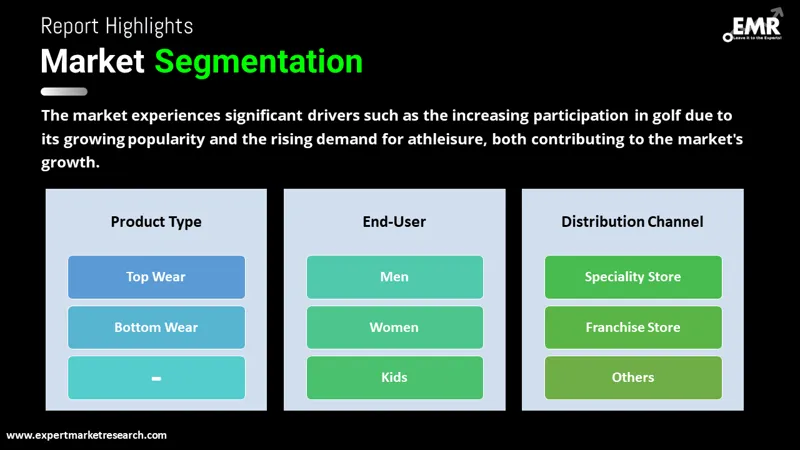
The global golf clothing market is segmented by product type, gender, material, and distribution channel. Each segment presents distinct growth profiles, consumer dynamics, and competitive opportunities for brands operating in this space.
Market Breakup by Product Type
Key Insisghts: The top wear holds the largest share, encompassing polo shirts, performance tees, mock-neck tops, and outerwear, driven by the centrality of the golf shirt in on-course dress codes and the growing adoption of golf tops as everyday casual clothing supported by moisture-wicking, UV protection, and four-way stretch fabric innovations. Bottom wear, including golf trousers, shorts, and skirts, is a growing segment driven by demand for versatile performance apparel that transitions from the course to casual settings, with the women's sub-segment expanding particularly fast on the back of rising female golf participation and greater retail investment in fashion-forward, well-fitted designs.
Market Breakup by End-User
Key Insisghts: The men's segment holds the largest share, reflecting the sport's historically male-dominant participation base, with growing athleisure and streetwear influence expanding the average wardrobe size per consumer and driving stronger repeat purchase behaviour among millennial and Gen Z golfers. The women's segment is the fastest-growing end-user category, underpinned by a 45 per cent increase in female golfers in the United States between 2020 and 2025, as brands including Nike, Adidas, and Lululemon Athletica report strong double-digit growth in women's golf categories driven by demand for performance-led, fashion-forward apparel. The kids' segment is gaining consistent growth momentum, driven by rising family-oriented golf participation and expanding junior development programmes across North America, Europe, and Asia Pacific that are creating steady demand for age-appropriate, durable, and affordable golf clothing.
Market Breakup by Distribution Channel
Key Insisghts: Online stores represent the largest channel, driven by consumer preference for convenience and broad product selection, with the direct-to-consumer shift improving average brand profit margins by approximately 15 per cent through reduced intermediary costs. Specialty stores command higher transaction values by offering expert fitting guidance and curated assortments that digital channels cannot replicate. Franchise stores provide consistent brand presence across secondary cities and emerging regions, particularly across Asia Pacific markets such as Japan, South Korea, and China. The others channel, encompassing department stores, golf club outlets, and sports goods chains, extends market reach into everyday retail environments beyond dedicated golf contexts.
Market Breakup by Region
Read more about this report - REQUEST FREE SAMPLE COPY IN PDF
The golf clothing market faces several structural and competitive challenges that brands and retailers must navigate to maintain growth momentum. Seasonal demand concentration represents a persistent operational challenge, as golf apparel sales peak sharply during warmer months in northern hemisphere markets, creating significant inventory management complexity and revenue volatility. Brands must maintain broad product portfolios across multiple price tiers to address the needs of both recreational and avid golfers, while simultaneously managing the rising cost of sustainable material inputs and advanced fabric technologies that are now expected by performance-conscious consumers. Intense competition across the market, from mass-market sportswear giants to premium golf specialists and emerging lifestyle brands, compounds pricing pressure and constrains margin expansion for mid-tier brands without differentiated product or strong brand equity. Additionally, approximately 39 per cent of potential consumers cite cost as a barrier to golf clothing purchases, limiting volume growth in price-sensitive markets where disposable income for discretionary sportswear spending remains constrained.
From a structural restraint perspective, the golf clothing market is partially limited by golf's ongoing geographic and demographic concentration. Despite significant participation growth in younger and female demographics, the sport remains more prominent in high-income markets such as North America, Europe, Japan, and South Korea, which constrains the total addressable market relative to broader sportswear categories. Infrastructure limitations in emerging markets, where approximately 28 per cent of geographies face a shortage of golf courses and facilities, restrain the development of domestic golf apparel markets even in countries with rising sports participation and growing disposable incomes. The premium price positioning of many performance golf clothing brands creates a natural adoption ceiling in markets where value sportswear competes effectively for the same consumer budget, and counterfeit goods in price-sensitive markets further erode revenue potential for authentic brands.
Despite these constraints, the golf clothing market presents substantial and expanding opportunities for brands, retailers, and investors across the value chain. The continuing demographic expansion of the golf participant base, particularly among women, millennials, and Asian consumers, is creating addressable market opportunities that did not exist at scale five years ago. Brands that develop comprehensive women's golf apparel ranges with genuine style and performance credentials are positioned to capture outsized growth relative to the overall market. The integration of smart textiles and wearable performance monitoring technology into golf apparel represents a high-margin product innovation frontier that is beginning to materialise through brand partnerships and technology collaborations. Golf tourism, which drives concentrated apparel demand in destination markets across Asia Pacific, the Middle East, and Latin America, offers an additional growth channel that is expanding with the globalisation of the sport. For comprehensive analysis of these opportunities across all market segments, product categories, and geographies, explore the full Expert Market Research golf clothing market report.




The golf clothing market exhibits distinct regional growth profiles shaped by golf participation rates, income levels, fashion culture, climate conditions, and the maturity of golf infrastructure.
North America is the largest regional market for golf clothing, accounting for approximately 42 to 45 per cent of global market revenue. The United States is the dominant national market, underpinned by an estimated 26 million active golfers, a well-developed golf course infrastructure of over 15,000 courses, and a strong culture of sports apparel spending that extends beyond the sport itself. Canada contributes an additional share driven by a growing golfer population and strong brand affinity for premium golf apparel.
The North American market is characterised by the presence of the world's largest golf apparel brands, including Nike, Under Armour, and Callaway Golf, all headquartered in the region. The athleisure trend is particularly pronounced in the United States, where golf apparel is increasingly worn as casual lifestyle clothing, expanding the frequency of purchase and the number of items in the average golfer's wardrobe. Smart textiles, temperature-regulating fabrics, and odour-control technology are finding strong adoption among performance-oriented US consumers.
Europe holds approximately 28 to 30 per cent of the global golf clothing market, with the United Kingdom, Germany, France, Sweden, and Spain as the leading national markets. The UK is the single largest European market, supported by a deep golfing tradition, a high density of golf courses, and a consumer culture that values both performance and heritage aesthetics in sports apparel. Germany and France contribute significant volumes driven by growing leisure sport participation and increasing female golf engagement.
The European market is strongly influenced by sustainability considerations, with GDPR-adjacent product transparency requirements and growing consumer scrutiny of supply chain ethics shaping brand procurement and marketing strategies. Brands with credible sustainability credentials, including recycled material content, ethical manufacturing documentation, and transparent carbon footprint reporting, command pricing premiums in the European market. Adidas and Puma, both headquartered in Germany, are well positioned to serve European consumers with locally developed sustainability messaging.
Asia Pacific is the fastest-growing regional market for golf clothing, accounting for approximately 20 to 21 per cent of global market revenue. Japan and South Korea are the two most developed national markets within the region, with deep golfing cultures, sophisticated retail infrastructure, and high per-capita spending on premium sports apparel. Australia represents a significant and growing market, supported by year-round golfing conditions and strong participation among both established and new golfer demographics.
China, India, and Southeast Asian markets including Indonesia, Thailand, and Vietnam represent high-potential emerging markets where rising disposable incomes, golf tourism investment, and government sports infrastructure programmes are creating the foundational conditions for sustained golf clothing market growth. TaylorMade introduced the Qi4D driver family in January 2026 with features specifically designed to support fitting and performance optimisation for Asia Pacific golfers, reflecting the growing strategic importance of this region for major golf brands.
Latin America represents an emerging golf clothing market with high longer-term potential, led by Brazil, Mexico, Argentina, and Chile. Golf participation in the region is relatively concentrated among upper-income demographics, but growing middle-class wealth, increasing exposure to international golf media, and expanding golf tourism infrastructure are gradually broadening the consumer base. Brands operating in Latin America are focusing on online retail as the primary distribution channel given the limited density of specialty golf retail across most of the region.
The Middle East and Africa region holds approximately five to nine per cent of the global golf clothing market, with the United Arab Emirates, Saudi Arabia, and South Africa as the primary national markets. The UAE and Saudi Arabia are deploying golf infrastructure as part of broader tourism diversification strategies, with multiple premium golf resort developments and international tournament hosting creating demand for high-end golf apparel among both residents and visiting golf tourists.
South Africa is a particularly significant market within the Africa sub-region, with a well-established golfing culture, strong domestic golf participation, and growing demand for both international premium brands and performance apparel suited to the country's warm and varied climate conditions. South Africa's golf tourism industry attracts international visitors to renowned courses, generating additional demand for premium and branded golf clothing. The broader African golf market is at an early stage of development but is expected to grow as sports participation infrastructure investment expands across the continent.
The golf clothing market is moderately concentrated, with a small number of large global sportswear companies controlling the majority of market revenue, alongside a growing segment of premium golf specialists and lifestyle brands capturing significant share in high-value consumer segments.
Nike holds approximately 18 per cent of the global golf apparel market and leads the competitive landscape through brand equity, professional player sponsorships, and continuous performance innovation. Nike Golf collaborates with over 200 professional golfers globally and distributes through 190 countries, leveraging its Dri-FIT moisture-management technology platform as a core performance differentiation. In August 2025, Nike launched a new golf apparel collection made from recycled materials, reinforcing its sustainability positioning. In July 2025, Nike Golf introduced a premium footwear pack for The Open Championship featuring the Victory Tour 4, Air Zoom Infinity Tour 2, and Air Max 90 Golf models, illustrating its ability to combine performance engineering with event-driven fashion storytelling.
Adidas accounts for approximately 14 per cent of the global golf apparel market, competing through performance-focused product development, broad European market presence, and a strong sustainability narrative. In September 2025, Adidas unveiled a partnership with a leading technology company to develop smart golf clothing capable of monitoring player performance metrics in real time, positioning itself at the intersection of wearable technology and premium golf apparel. The brand's CODECHAOS and Ultimate365 product lines serve different segments of the golf apparel consumer spectrum from performance to lifestyle.
Under Armour competes in the golf clothing market through advanced fabric technology integration and a growing digital strategy. The brand's Iso-Chill technology and UA RUSH fabric innovations have established strong performance credentials among serious golfers seeking technical apparel. In October 2025, Under Armour launched a digital customisation platform enabling golfers to personalise apparel based on performance requirements and style preferences, reflecting the broader market shift toward personalised digital shopping experiences and consumer co-creation in sports apparel.
TaylorMade and Callaway Golf (operating as Topgolf Callaway Brands) represent the golf equipment brands with the most significant apparel market presence. TaylorMade underwent a major ownership transition in June 2025 when Centroid finalized its acquisition from KPS Capital Partners, signalling potential expansion of its apparel ambitions under new strategic direction. In January 2026, TaylorMade introduced the Qi4D driver family, reinforcing its technology leadership in the performance golf segment. Callaway's apparel division benefits from the Topgolf brand integration, creating an end-to-end golf experience ecosystem that naturally drives apparel purchasing across entertainment, performance, and lifestyle consumer segments.
Other significant participants include Puma SE (strong APAC and European presence through golf-specific lines), FootJoy (dominant in golf footwear with deep professional tour exposure), Ping Inc. (performance apparel alongside equipment), Mizuno Corporation (strong Japanese and Asian market presence), Lululemon Athletica (fast-growing premium player leveraging athleisure brand equity), Ralph Lauren (heritage golf aesthetic with strong course-to-clubhouse positioning), G/FORE (premium golf fashion specialist with significant retail expansion), and Greyson Clothiers (luxury golf lifestyle brand). The emergence of direct-to-consumer golf apparel brands through e-commerce and social media channels is further diversifying the competitive landscape.
*Please note that this is only a partial list; the complete list of key players is available in the full report. Additionally, the list of key players can be customized to better suit your needs.*


Upto 15% Off
USD
$2499 $2249
$3999 $3599
$4999 $4249
$5999 $5099


*While we strive to always give you current and accurate information, the numbers depicted on the website are indicative and may differ from the actual numbers in the main report. At Expert Market Research, we aim to bring you the latest insights and trends in the market. Using our analyses and forecasts, stakeholders can understand the market dynamics, navigate challenges, and capitalize on opportunities to make data-driven strategic decisions.*
The market reached a value of approximately USD 1868.83 Million in 2025.
The market is projected to grow at a CAGR of 6.70% between 2026 and 2035.
The market is estimated to witness a healthy growth in the forecast period of 2026-2035 to reach USD 3574.49 Million by 2035.
The major market drivers include rising participation in golf due to increasing popularity of the sport and the growing popularity of athleisure.
The key trends fuelling the growth of the market include growing popularity of golf tourism, increasing emphasis on physical appearance while playing golf, and rising accessibility of golf clothing.
The major regions in the market are North America, Europe, the Asia Pacific, Latin America, and the Middle East and Africa.
The various product types available in the market are top wear and bottom wear.
The key players in the global golf clothing market are Adidas AG, The Antigua Group, Inc., Topgolf Callaway Brands Corp., Linksoul, Nike, Inc., PING Inc., Puma SE, TaylorMade Golf Company, Under Armour, Inc., and Ralph Lauren Corporation, among others.
Explore our key highlights of the report and gain a concise overview of key findings, trends, and actionable insights that will empower your strategic decisions.
| REPORT FEATURES | DETAILS |
| Base Year | 2025 |
| Historical Period | 2019-2025 |
| Forecast Period | 2026-2035 |
| Scope of the Report |
Historical and Forecast Trends, Industry Drivers and Constraints, Historical and Forecast Market Analysis by Segment:
|
| Breakup by Product Type |
|
| Breakup by End-User |
|
| Breakup by Distribution Channel |
|
| Breakup by Region |
|
| Market Dynamics |
|
| Competitive Landscape |
|
| Companies Covered |
|
Datasheet
One User
USD 2,499
USD 2,249
tax inclusive*
Single User License
One User
USD 3,999
USD 3,599
tax inclusive*
Five User License
Five User
USD 4,999
USD 4,249
tax inclusive*
Corporate License
Unlimited Users
USD 5,999
USD 5,099
tax inclusive*
*Please note that the prices mentioned below are starting prices for each bundle type. Kindly contact our team for further details.*
Flash Bundle
Small Business Bundle
Growth Bundle
Enterprise Bundle
*Please note that the prices mentioned below are starting prices for each bundle type. Kindly contact our team for further details.*
Flash Bundle
Number of Reports: 3
20%
tax inclusive*
Small Business Bundle
Number of Reports: 5
25%
tax inclusive*
Growth Bundle
Number of Reports: 8
30%
tax inclusive*
Enterprise Bundle
Number of Reports: 10
35%
tax inclusive*
How To Order

Select License Type
Choose the right license for your needs and access rights.

Click on ‘Buy Now’
Add the report to your cart with one click and proceed to register.

Select Mode of Payment
Choose a payment option for a secure checkout. You will be redirected accordingly.
Strategic Solutions for Informed Decision-Making
Gain insights to stay ahead and seize opportunities.

Get insights & trends for a competitive edge.

Track prices with detailed trend reports.

Analyse trade data for supply chain insights.

Leverage cost reports for smart savings

Enhance supply chain with partnerships.

Connect For More Information
Our expert team of analysts will offer full support and resolve any queries regarding the report, before and after the purchase.
Our expert team of analysts will offer full support and resolve any queries regarding the report, before and after the purchase.
We employ meticulous research methods, blending advanced analytics and expert insights to deliver accurate, actionable industry intelligence, staying ahead of competitors.
Our skilled analysts offer unparalleled competitive advantage with detailed insights on current and emerging markets, ensuring your strategic edge.
We offer an in-depth yet simplified presentation of industry insights and analysis to meet your specific requirements effectively.




