

Consumer Insights
Uncover trends and behaviors shaping consumer choices today
Procurement Insights
Optimize your sourcing strategy with key market data
Industry Stats
Stay ahead with the latest trends and market analysis.
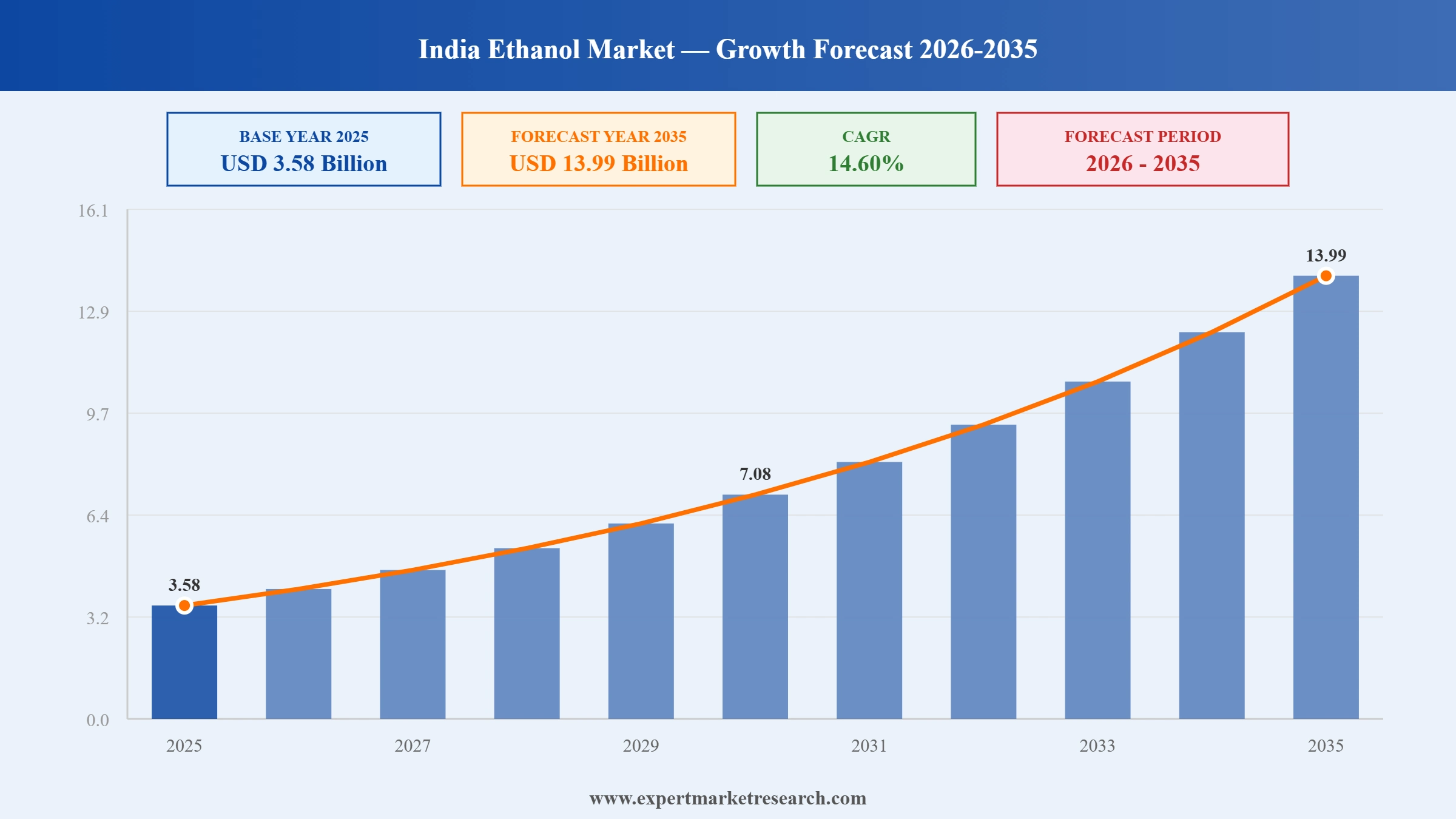
The India Ethanol Market reached a value of USD 3.58 Billion at 2025 and is projected to expand at a CAGR of around 14.60% during the forecast period of 2026-2035. With rapid advancement of the Ethanol Blending Programme toward E20 and beyond, diversification of feedstock sources, large-scale distillery expansions by integrated sugar companies, and growing multi-sector ethanol demand, the market is expected to reach USD 13.99 Billion by 2035.
Read more about this report - REQUEST FREE SAMPLE COPY IN PDF
| India Ethanol Market Report Summary |
Description |
Value |
|
Base Year |
USD Billion |
2025 |
|
Historical Period |
USD Billion |
2019-2025 |
|
Forecast Period |
USD Billion |
2026-2035 |
|
Market Size 2025 |
USD Billion |
3.58 |
|
Market Size 2035 |
USD Billion |
13.99 |
|
CAGR 2019-2025 |
Percentage |
XX% |
|
CAGR 2026-2035 |
Percentage |
14.60% |
|
CAGR 2026-2035- Market by Region |
South India |
16.1% |
|
CAGR 2026-2035 - Market by Region |
East India |
15.5% |
|
CAGR 2026-2035 - Market by Type |
Bio Ethanol |
15.4% |
|
CAGR 2026-2035 - Market by Purity |
Denatured |
15.8% |
| 2025 Market Share by Region | North India |
26.4% |
India reached its E20 milestone ahead of the original 2030 target and mandated a nationwide rollout of 20% ethanol-blended petrol from April 1, 2026. The achievement represents one of the world's most ambitious and fastest-executed ethanol blending programs, with blending levels rising from 1.5% in 2014 to 20% within a decade. The E20 rollout is now available across more than 15,600 fuel outlets nationwide, and the government is already scoping a roadmap for E30 blending between 2028 and 2030, including discussions on higher blend flex-fuel vehicles with automakers.
Bharat Petroleum Corporation Limited (BPCL) commissioned a commercial-scale second-generation ethanol refinery in Bargarh, Odisha, processing rice straw into 100 kiloliters of ethanol daily. This facility marks a significant milestone in India's shift toward non-food feedstock-based ethanol production, addressing two challenges simultaneously: reducing agricultural waste from stubble burning and producing sustainable fuel. The plant supports the government's broader initiative to commission multiple 2G ethanol bio-refineries, with three new plants adding 350 million liters of annual capacity commissioned in early 2025.
Advanta Seeds and Baidyanath Biofuels Private Ltd announced a strategic partnership to advance India's ethanol production pipeline, with a specific focus on achieving the National Biofuels Policy goal of 20% ethanol blending with petrol. The partnership leverages Advanta's seed technology capabilities alongside Baidyanath Biofuels' production infrastructure to create an integrated feedstock-to-fuel value chain. The collaboration signals the growing involvement of agricultural input companies in India's biofuel ecosystem, reinforcing both supply security and rural livelihood creation.
India's Minister of Petroleum and Natural Gas Hardeep Singh Puri confirmed that India had met its 20% ethanol blending goal, originally set for 2030 but achieved by mid-2025. The accomplishment is the result of a decade-long coordinated effort involving distillery capacity expansion, feedstock policy reforms, OMC procurement contracts, and vehicle compatibility upgrades. Between FY2015 and FY2025, the Ethanol Blending Programme saved India over Rs 1.4 lakh crore in foreign exchange and reduced CO2 emissions by 544 lakh metric tons.
Godavari Biorefineries Limited, India's largest biofuels company, proposed investing approximately USD 15.6 million to develop a new 200 KLPD ethanol distillery based on corn and grain feedstocks. The investment aligns with the company's commitment to India's green energy transition and its goal of diversifying ethanol production beyond sugarcane-based routes. The proposed facility reinforces the broader trend of grain-based ethanol capacity expansion among Indian producers, which forms a key pillar of India's plan to sustain E20 and advance toward higher blending targets.
India's successful achievement of 20% ethanol blending by mid-2025, five years ahead of the original 2030 timeline, has transformed the Ethanol Blending Programme into one of the world's most cited biofuel policy success stories. The E20 milestone generated savings of over Rs 1.4 lakh crore in crude oil imports between FY2015 and FY2025, while cutting CO2 emissions by hundreds of lakh metric tons. The government is now actively scoping E30 and higher blend frameworks for 2028-2030, and discussions on flex-fuel vehicles capable of running on blends from E20 to E100 are underway with Maruti Suzuki, Toyota, and Bajaj Auto. This milestone provides India ethanol market growth with a durable policy foundation well beyond the current forecast period.
India is scaling second-generation ethanol production that uses agricultural residues such as rice straw and wheat stubble rather than food crops, resolving the long-standing tension between biofuel targets and food security. The Indian Oil Corporation commissioned India's first 2G plant in Panipat with 100 KLPD capacity, while BPCL commissioned a commercial 2G refinery in Bargarh, Odisha processing rice straw. Three new 2G plants adding 350 million liters of annual capacity were commissioned in early 2025. The technology simultaneously addresses the ecological damage of stubble burning in North India, creating dual policy benefits for the government and new revenue streams for farmers.
North India, particularly Uttar Pradesh, has consolidated its position as the heart of India's ethanol production ecosystem. As of April 2025, UP's ethanol production capacity reached 2 billion liters per year, with a target of 2.5 billion liters annually. The state's vast sugarcane cultivation base provides a consistent and scalable feedstock supply, while the concentration of major integrated sugar-ethanol producers, including Balrampur Chini Mills, Triveni Engineering, and Dwarikesh Sugar, creates significant economies of scale. Policy measures allowing rice sales for ethanol production have further expanded feedstock options and are stimulating new distillery investments across the state, widening UP's lead as India's top ethanol-producing region.
India's ethanol sector is actively diversifying its feedstock base beyond traditional sugarcane and molasses to include maize, damaged rice, surplus grains, sugarcane juice, and increasingly lignocellulosic biomass. This diversification is driven by two factors: the government's explicit policy support for grain-based ethanol to balance food security with fuel needs, and the operational incentive for distillers to maintain year-round operations rather than being limited to the sugarcane crushing season. Major producers including Shree Renuka Sugars, Triveni Engineering, and Balrampur Chini have adopted multi-feedstock distilleries that switch between sugarcane juice, B-heavy and C-heavy molasses, and maize depending on seasonal availability, reducing earnings volatility and improving plant utilization.
The India ethanol market value will grow with the rising infrastructure growth. Dedicated ethanol pipelines, blending terminals, and ethanol-compatible dispensing units are largely developed in the country. In February 2023, the Indian Government launched the roll-out of petroleum blended with 20% ethanol from 84 pumps across 11 states and union territories. IndianOil and HPCL are also upgrading their fuel stations and logistics chains for ethanol handling. This ensures that ethanol-blended petrol is accessible even in tier-2 and rural areas.
The report of the Expert Market Research's Report titled "India Ethanol Market Report and 2026 to 2035" offers a detailed analysis of the market based on the following segments:
Market Breakup by Type
Key Insight: Bio ethanol dominates the India ethanol market, produced primarily through fermentation of sugarcane, molasses, and grain-based feedstocks under the government's Ethanol Blending Programme. India produced over 6 billion liters of bio ethanol in 2024, with the bio ethanol segment expected to register a CAGR of 15.4% during the forecast period. The segment's dominance is reinforced by Oil Marketing Companies securing long-term supply contracts with distilleries, while government price support through administered pricing mechanisms ensures producer profitability. Synthetic ethanol, produced via ethylene hydration from petrochemical feedstocks, serves industrial and pharmaceutical applications but faces cost disadvantages relative to bio ethanol and is expected to grow at a comparatively modest pace.
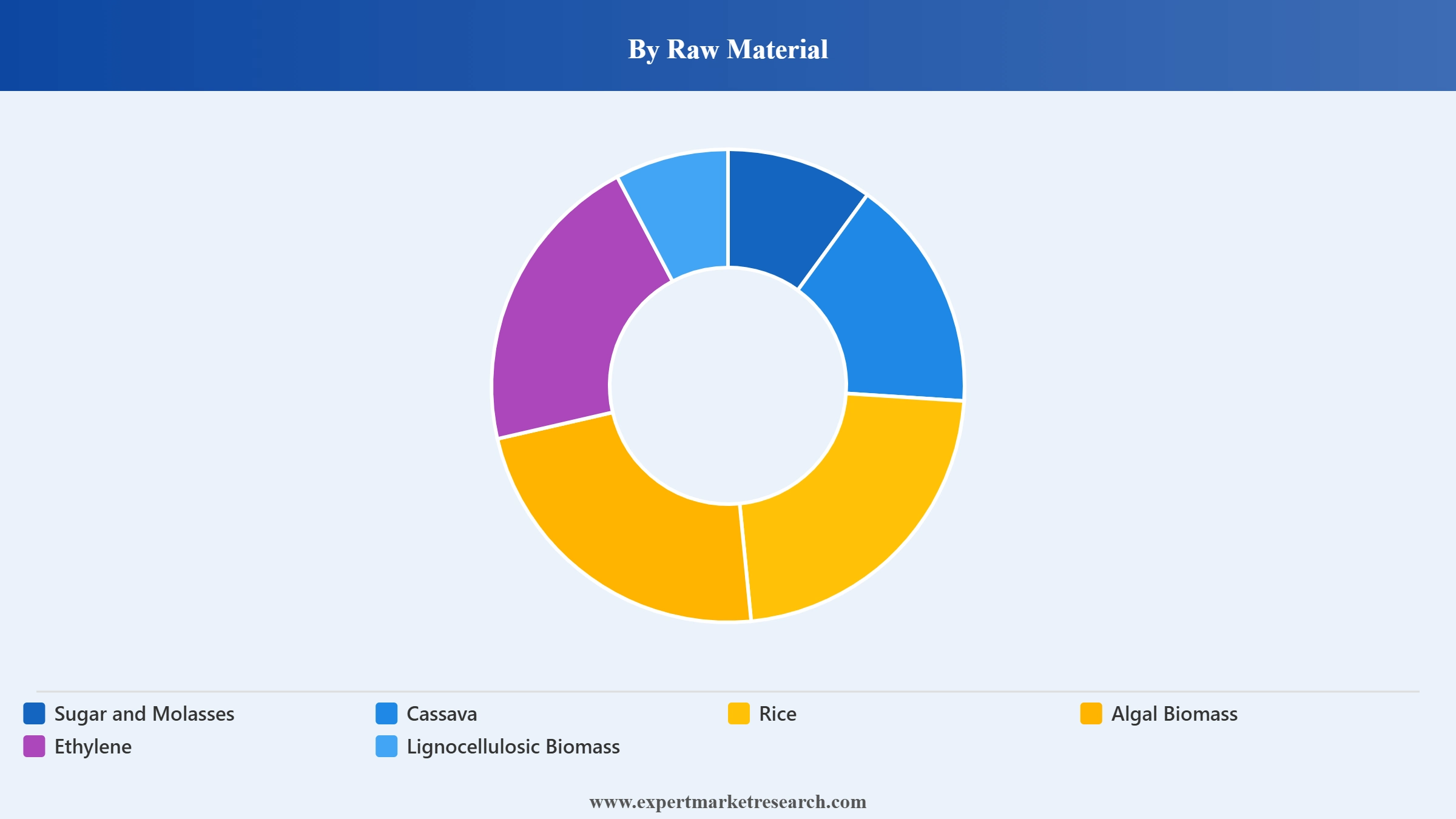
Market Breakup by Raw Material
Key Insight: Sugar and Molasses is the backbone of India's ethanol supply chain, accounting for the dominant share of production. As a by-product of sugar manufacturing, molasses offers cost-effective feedstock that integrates naturally into existing sugar mill operations. Companies such as Balrampur Chini Mills, Shree Renuka Sugars, and Triveni Engineering leverage their sugar processing operations to produce ethanol from both C-heavy and B-heavy molasses. Rice-based ethanol is gaining ground following government policies permitting rice diversion for ethanol use, while lignocellulosic biomass from rice straw and wheat stubble is the focus of second-generation ethanol investments, supported by government viability gap funding for advanced bio-refineries.
Market Breakup by Purity
Key Insight: Denatured ethanol accounts for the majority of India's ethanol consumption, primarily used in fuel blending under the EBP programme, industrial solvents, and personal care products. Denaturation, which involves adding substances to render ethanol unfit for human consumption, is a regulatory requirement for non-beverage industrial use. Undenatured ethanol, which includes neutral and extra neutral alcohol, serves the beverages sector and some pharmaceutical applications. The beverages segment remains a significant off-taker of undenatured ethanol, particularly as India's alcoholic beverage industry grows alongside rising urban disposable incomes and premiumization trends.
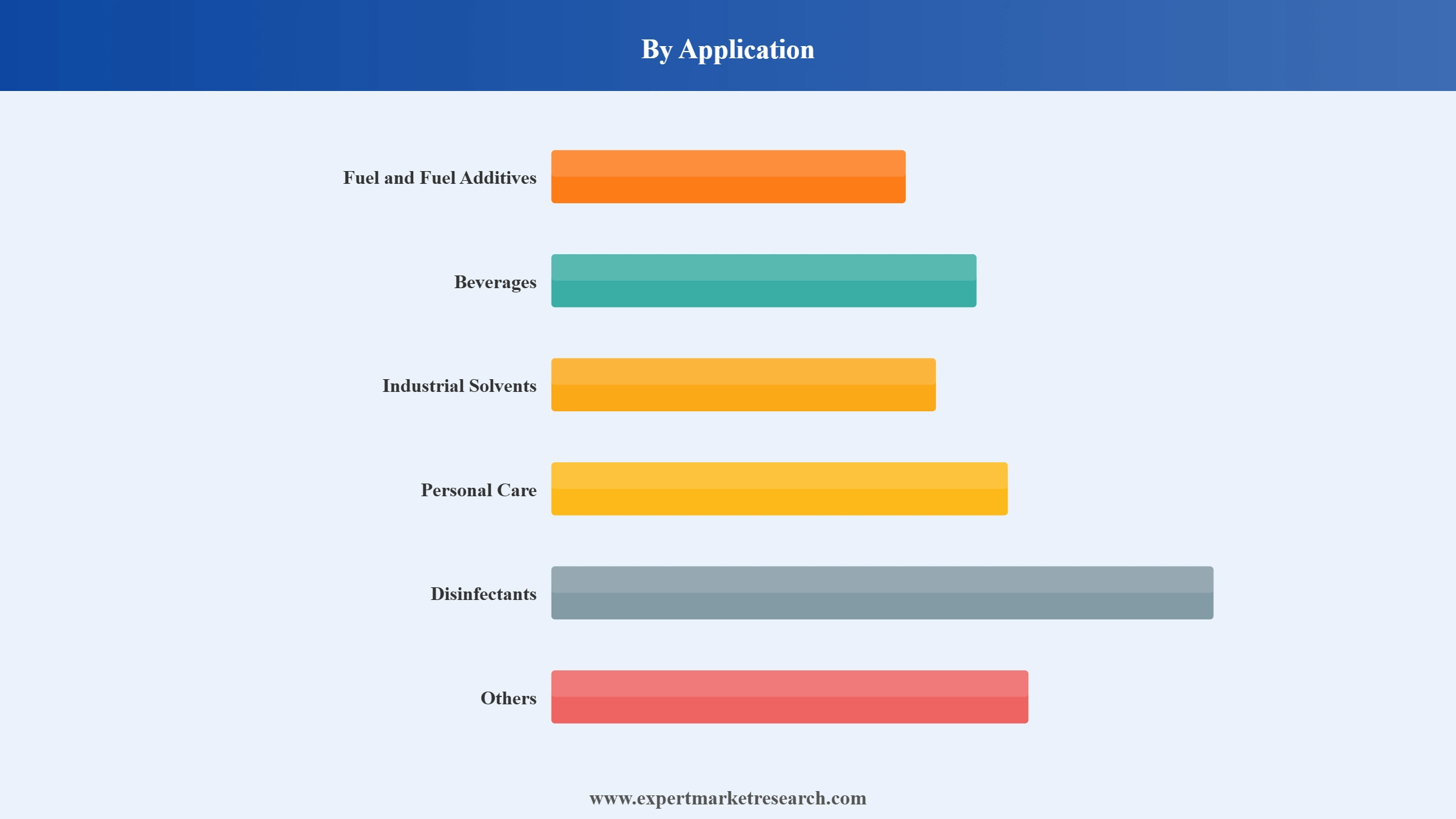
Market Breakup by Application
Key Insight: Fuel and Fuel Additives is the dominant application for ethanol in India, driven by the government's Ethanol Blending Programme and the rapid scale-up to E20 by 2025. OMCs secure ethanol supply through centralized procurement contracts, creating a predictable and growing demand channel for producers. The beverages sector is the second-largest application, benefiting from India's growing alcoholic beverage market and shifting consumer preferences toward premium spirits. Disinfectants emerged as a significant application following the COVID-19 pandemic, while industrial solvents, personal care products, and pharmaceuticals contribute stable demand across the remaining applications.
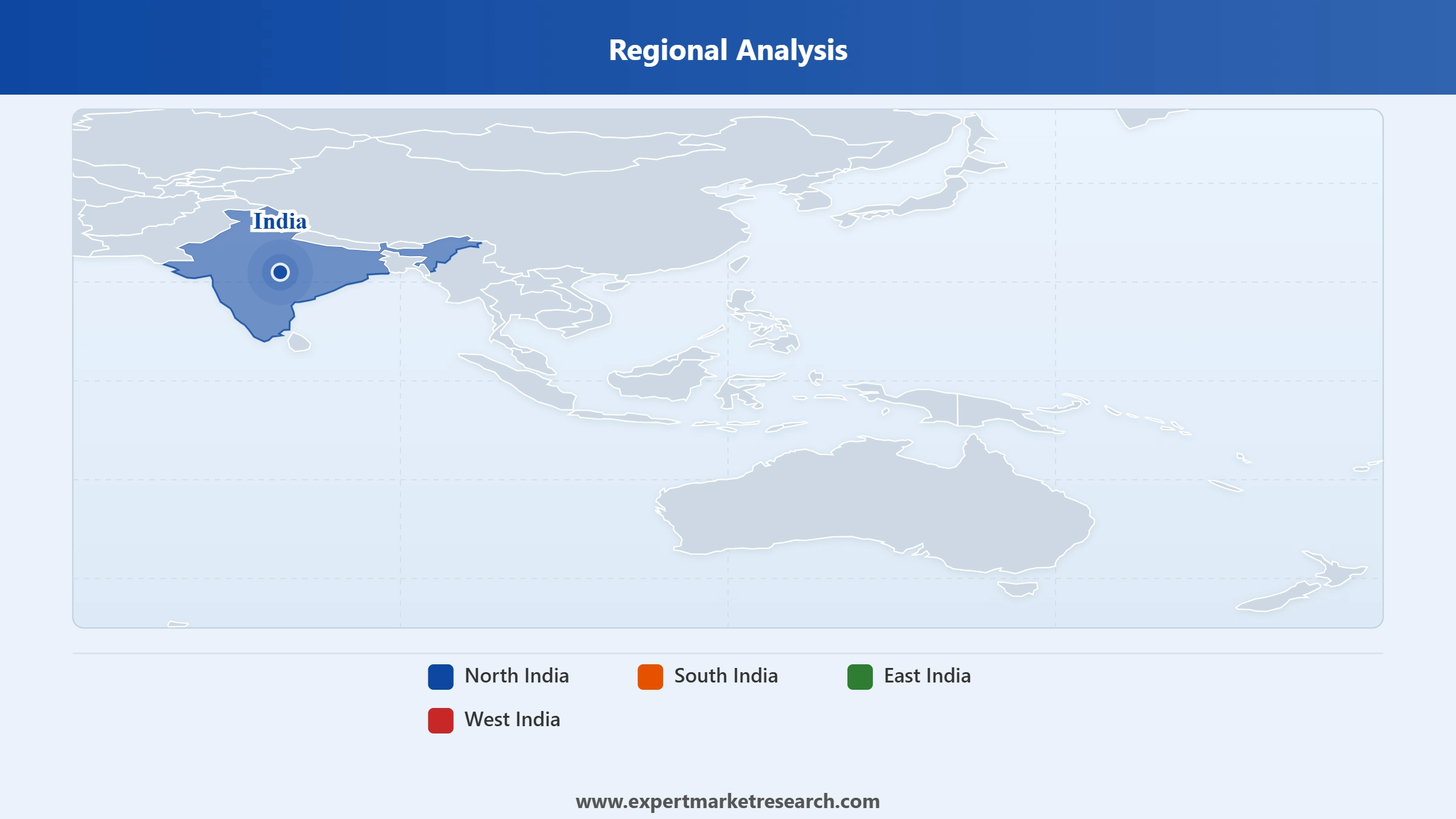
Market Breakup by Region
Key Insight: North India, particularly Uttar Pradesh and its neighboring states, is the epicenter of India's ethanol production with UP alone commanding 2 billion liters per year of installed capacity. The region's dominance reflects both its extensive sugarcane cultivation and the concentration of large integrated sugar-ethanol companies. South India, led by Maharashtra and Karnataka, contributes significantly to sugar-based ethanol production through players like Shree Renuka Sugars. West India maintains strong participation through Maharashtra's sugarcane belt, while East India is emerging on the back of rice-based ethanol production and new second-generation plants targeting agricultural residue conversion.
Read more about this report - REQUEST FREE SAMPLE COPY IN PDF
By Type
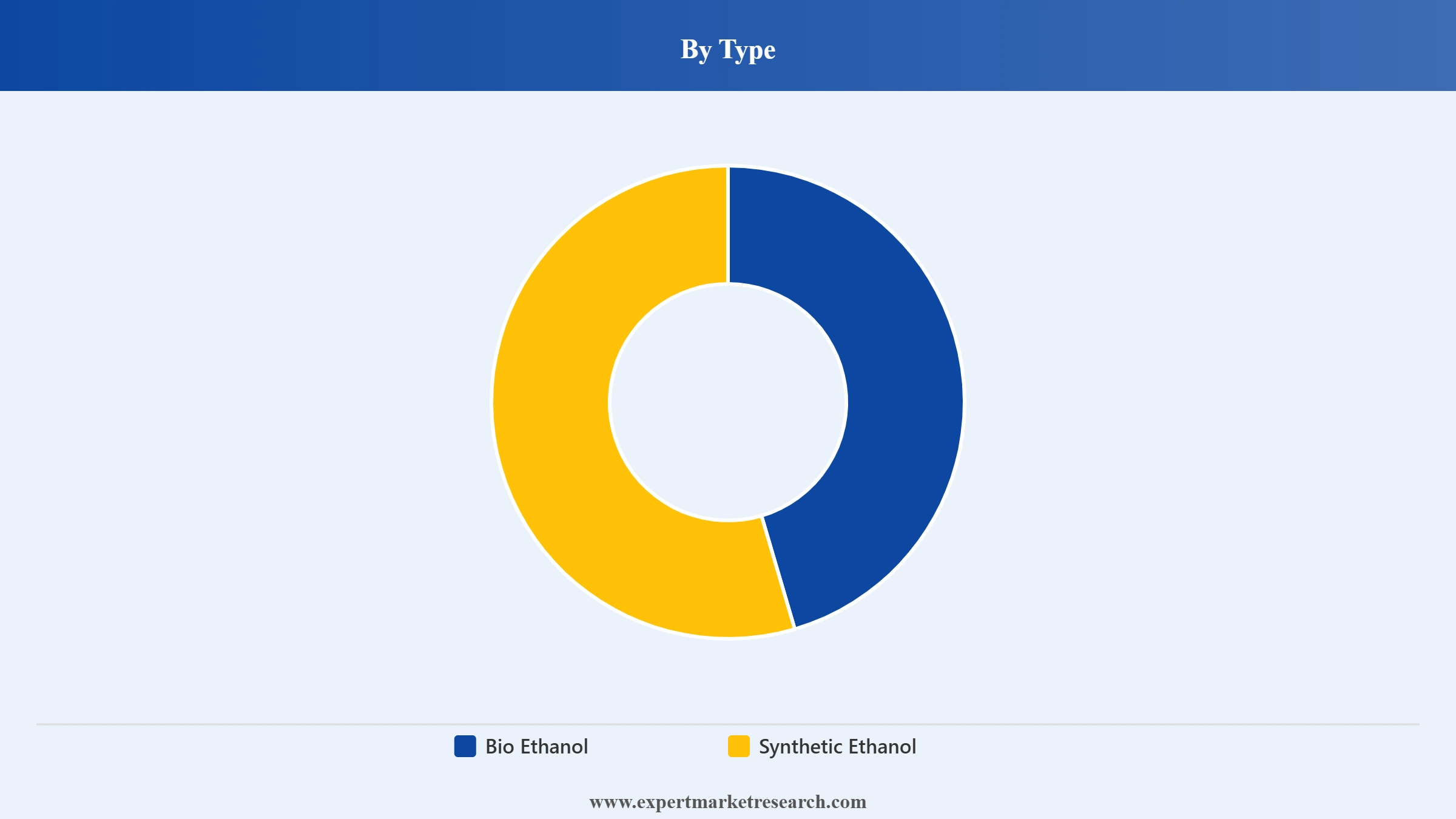
Bio Ethanol holds the dominant position in the India Ethanol Market, accounting for the overwhelming majority of production volumes due to its cost advantages, government policy support, and well-established supply chains linking sugar mills and grain processors to OMC procurement networks. The segment's dominance is self-reinforcing: as the government advances blending targets, more capital investment flows into bio ethanol distilleries, further consolidating its share. Synthetic Ethanol serves niche industrial and pharmaceutical applications where specific purity requirements justify higher production costs, but its overall market share is limited and is expected to remain constrained relative to bio ethanol's policy-driven expansion.
Read more about this report - REQUEST FREE SAMPLE COPY IN PDF
By Raw Material
Sugar and Molasses commands the largest share of India's ethanol raw material mix, primarily as a by-product of the country's massive sugar industry. The government's administered pricing mechanism for molasses-based ethanol and the feedstock's natural availability at existing sugar mills make it the most accessible and cost-effective production route. Rice is rapidly gaining importance as a feedstock following government authorization for its use in ethanol production, particularly as rice surpluses accumulate in government warehouses. The lignocellulosic biomass segment is nascent but strategically important, receiving government support through viability gap funding for second-generation bio-refineries that convert rice straw and wheat stubble into ethanol.
Read more about this report - REQUEST FREE SAMPLE COPY IN PDF
By Application
Fuel and Fuel Additives is the largest application segment, absorbing the bulk of India's ethanol output through the Ethanol Blending Programme. With E20 fully implemented nationwide from April 2026 and future E30 targets under discussion, this segment's dominance is expected to continue and intensify over the forecast period. The beverages segment, while smaller in volume terms, is significant in value terms due to the premium pricing of alcohol-grade neutral spirit and extra neutral alcohol. Disinfectants saw a structural uplift in demand post-pandemic, and while volumes have moderated, health awareness continues to support steady off-take in the institutional and retail hygiene segments.
Read more about this report - REQUEST FREE SAMPLE COPY IN PDF
North India, led by Uttar Pradesh, is the primary production region for India's ethanol market and is expected to maintain and expand its lead over the forecast period. UP's ethanol capacity of 2 billion liters per year positions it as the most significant contributor to India's national supply, and the state government's active support for distillery investment, combined with its extensive farmer network of over 3 lakh sugarcane growers linked to companies like Triveni Engineering, creates a robust integrated supply chain. Companies including Balrampur Chini Mills and Dwarikesh Sugar Industries are headquartered in UP and continue to expand capacity. Policy support for grain-based ethanol, including lifting restrictions on rice use, has further broadened North India's feedstock options and reduced seasonal supply gaps.
Read more about this report - REQUEST FREE SAMPLE COPY IN PDF
South and West India together represent the second major ethanol production cluster, anchored by Maharashtra's sugarcane belt and Karnataka's large sugar industry. Maharashtra is home to some of India's largest integrated sugar companies, while Karnataka hosts Shree Renuka Sugars with 1,250 KLPD distillery capacity. These regions benefit from proximity to coastal port facilities for raw material imports and from diversified sugarcane variety cultivation that extends the crushing season. The South is also positioned to benefit from government support for grain-based ethanol, particularly maize, as an alternative feedstock. West India's growing petrochemical and industrial base also supports synthetic ethanol demand from industrial and pharmaceutical end-users
The India Ethanol Market is dominated by integrated sugar companies that leverage their sugarcane processing operations to produce ethanol alongside sugar, molasses, and co-generated power. The top producers, including Balrampur Chini Mills, Triveni Engineering, Shree Renuka Sugars, and Dwarikesh Sugar, benefit from feedstock synergies, government-administered pricing, and long-term supply agreements with Oil Marketing Companies. These advantages create structural barriers to entry for standalone ethanol producers without access to established sugarcane supply networks.
The competitive landscape is being reshaped by feedstock diversification, with grain-based distilleries growing in importance and attracting both greenfield investment and capacity additions by existing producers. Second-generation ethanol technologies, championed by companies like Praj Industries on the technology side and Indian Oil Corporation on the production side, represent the next major differentiator in the competitive environment. Capital discipline, feedstock flexibility, and alignment with government blending policy are the key strategic factors determining market positioning.
Founded in 1975 and headquartered in Kolkata, Balrampur Chini Mills is India's second-largest integrated sugar company, operating 10 sugar factories in Uttar Pradesh. With a total distillation capacity of 1,050 KLPD across multiple distilleries in Balrampur, Babhnan, Mankapur, Gularia, and Maizapur, the company is one of India's leading ethanol suppliers. Its multi-feedstock capability, covering C-heavy and B-heavy molasses, sugarcane juice, and grain, ensures year-round operations. Balrampur Chini is a key supplier to Oil Marketing Companies under the EBP programme.
Established in 1932 and headquartered in Noida, Uttar Pradesh, Triveni Engineering operates eight sugar mills and seven co-located distilleries across Uttar Pradesh with a total ethanol capacity of 860 KLPD. The company serves over 3 lakh sugarcane farmers, providing a stable and extensive feedstock network. Triveni has a diversified business spanning sugar, ethanol, engineering, water treatment, and defence, with gross revenues of Rs 6,808 crore in FY2025. Its multi-feedstock distillery setup and efficiency-focused operations make it among the most efficient ethanol producers in India.
Dwarikesh Sugar Industries, headquartered in Bijnor, Uttar Pradesh, operates integrated sugar and ethanol production facilities across its Bundki and Bareilly units with a combined ethanol capacity of 337.5 KLPD. The company is a consistent ethanol supplier to OMCs and benefits from proximity to UP's sugarcane growing belt. Dwarikesh has invested steadily in capacity upgrades and feedstock flexibility to align with India's advancing blending targets, supporting its role as a mid-tier but important contributor to North India's ethanol supply infrastructure.
Headquartered in Belagavi, Karnataka, and owned by Singapore-based Wilmar Group, Shree Renuka Sugars is among India's largest ethanol producers with an installed distillation capacity of 1,250 KLPD across its Munoli, Athani, and Havalga distilleries. In FY2025, the company produced 159 million liters of ethanol, with 94% classified as premium grade, generating Rs 1,009.5 crore in distillery revenue representing 17% year-on-year growth. Its multi-feedstock flexibility across sugarcane juice, B-heavy molasses, C-heavy molasses, and maize ensures operational continuity throughout the year.
Other key players in the market are Dhampur Sugar Mills Ltd, Dalmia Bharat Sugar and Industries Limited, and Others.
*Please note that this is only a partial list; the complete list of key players is available in the full report. Additionally, the list of key players can be customized to better suit your needs.*
India's ethanol sector is one of the fastest-moving renewable energy markets in the world, and the window to capture early-mover advantages is narrowing. Our comprehensive India Ethanol Market Report for 2026 covers every major development from E20 achievement to second-generation ethanol scale-up, feedstock policy shifts, and regional production dynamics. Whether you are a distillery operator, an agribusiness investor, an engineering technology supplier, or a financial analyst covering India's clean energy transition, this report delivers the depth of intelligence your strategy demands. Download your free sample today and explore the opportunities in India's thriving ethanol economy.


Upto 15% Off
USD
$2499 $2249
$3999 $3599
$4999 $4249
$5999 $5099


*While we strive to always give you current and accurate information, the numbers depicted on the website are indicative and may differ from the actual numbers in the main report. At Expert Market Research, we aim to bring you the latest insights and trends in the market. Using our analyses and forecasts, stakeholders can understand the market dynamics, navigate challenges, and capitalize on opportunities to make data-driven strategic decisions.*
At 2025, the market reached an approximate value of USD 3.58 Billion.
The market is projected to grow at a CAGR of 14.60% between 2026 and 2035.
The market is projected to grow significantly during the forecast period 2026 to 2035 to reach USD 13.99 Billion by 2035.
The India Ethanol Market is primarily driven by the government's Ethanol Blending Programme and its landmark achievement of 20% ethanol blending in petrol by 2025, five years ahead of the original 2030 deadline. Additional drivers include feedstock diversification across sugarcane, grains, rice, and second-generation agricultural residues; large-scale distillery capacity expansions by integrated sugar companies; and growing multi-sector demand spanning fuel, beverages, industrial solvents, disinfectants, and personal care. The government's energy security objective of reducing crude oil import dependency, combined with rural income enhancement through guaranteed ethanol procurement pricing for farmers, underpins the market's structural growth trajectory.
By type, the India Ethanol Market is divided into Bio Ethanol and Synthetic Ethanol. Bio ethanol dominates with over 90% of production volumes, driven by government mandates, feedstock availability from India's sugar and grain industries, and long-term offtake contracts from Oil Marketing Companies. Bio ethanol is expected to grow at a CAGR of 15.4% over the forecast period. Synthetic ethanol, produced via ethylene hydration from petrochemical feedstocks, serves niche industrial and pharmaceutical applications where specific purity and consistency requirements justify its higher production costs. Its overall market share remains modest relative to bio ethanol.
The India Ethanol Market is shaped by India's E20 achievement and the active planning for E30 and beyond, the rapid scale-up of second-generation ethanol from agricultural residues such as rice straw and wheat stubble, the increasing feedstock diversification among major producers toward grain-based ethanol for year-round operations, and North India's emergence as the dominant production hub led by Uttar Pradesh's 2 billion liter annual capacity. Flex-fuel vehicle adoption and advanced 2G bio-refinery commissioning represent the next frontier of growth.
The key players in the market include Balrampur Chini Mills Limited, Triveni Engineering & Industries Limited, Dwarikesh Sugar Industries Ltd., Shree Renuka Sugars Ltd., Dhampur Sugar Mills Ltd, and Dalmia Bharat Sugar, Industries Limited and others.
Explore our key highlights of the report and gain a concise overview of key findings, trends, and actionable insights that will empower your strategic decisions.
| REPORT FEATURES | DETAILS |
| Base Year | 2025 |
| Historical Period | 2019-2025 |
| Forecast Period | 2026-2035 |
| Scope of the Report |
Historical and Forecast Trends, Industry Drivers and Constraints, Historical and Forecast Market Analysis by Segment:
|
| Breakup by Type |
|
| Breakup by Raw Material |
|
| Breakup by Purity |
|
| Breakup by Application |
|
| Breakup by Region |
|
| Market Dynamics |
|
| Competitive Landscape |
|
| Companies Covered |
|
Datasheet
One User
USD 2,499
USD 2,249
tax inclusive*
Single User License
One User
USD 3,999
USD 3,599
tax inclusive*
Five User License
Five User
USD 4,999
USD 4,249
tax inclusive*
Corporate License
Unlimited Users
USD 5,999
USD 5,099
tax inclusive*
*Please note that the prices mentioned below are starting prices for each bundle type. Kindly contact our team for further details.*
Flash Bundle
Small Business Bundle
Growth Bundle
Enterprise Bundle
*Please note that the prices mentioned below are starting prices for each bundle type. Kindly contact our team for further details.*
Flash Bundle
Number of Reports: 3
20%
tax inclusive*
Small Business Bundle
Number of Reports: 5
25%
tax inclusive*
Growth Bundle
Number of Reports: 8
30%
tax inclusive*
Enterprise Bundle
Number of Reports: 10
35%
tax inclusive*
How To Order

Select License Type
Choose the right license for your needs and access rights.

Click on ‘Buy Now’
Add the report to your cart with one click and proceed to register.

Select Mode of Payment
Choose a payment option for a secure checkout. You will be redirected accordingly.
Strategic Solutions for Informed Decision-Making
Gain insights to stay ahead and seize opportunities.

Get insights & trends for a competitive edge.

Track prices with detailed trend reports.

Analyse trade data for supply chain insights.

Leverage cost reports for smart savings

Enhance supply chain with partnerships.

Connect For More Information
Our expert team of analysts will offer full support and resolve any queries regarding the report, before and after the purchase.
Our expert team of analysts will offer full support and resolve any queries regarding the report, before and after the purchase.
We employ meticulous research methods, blending advanced analytics and expert insights to deliver accurate, actionable industry intelligence, staying ahead of competitors.
Our skilled analysts offer unparalleled competitive advantage with detailed insights on current and emerging markets, ensuring your strategic edge.
We offer an in-depth yet simplified presentation of industry insights and analysis to meet your specific requirements effectively.




