

Consumer Insights
Uncover trends and behaviors shaping consumer choices today
Procurement Insights
Optimize your sourcing strategy with key market data
Industry Stats
Stay ahead with the latest trends and market analysis.


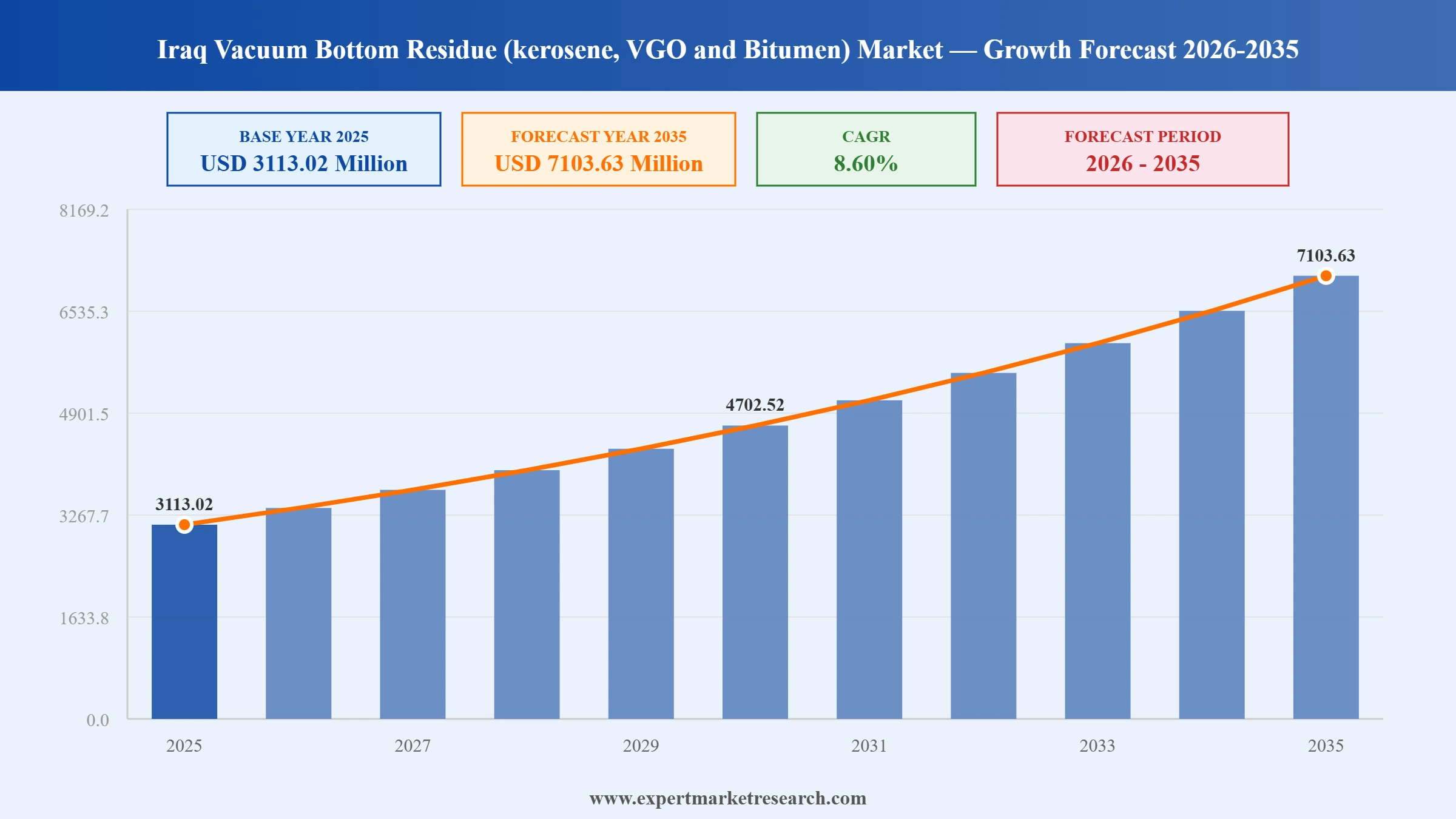
The Iraq vacuum bottom residue (kerosene, VGO and bitumen) market reached a value of USD 3113.02 Million at 2025 and is projected to expand at a CAGR of around 8.60% during the forecast period of 2026-2035. With large-scale post-conflict infrastructure reconstruction demanding heavy bitumen volumes, stricter fuel quality regulations driving refinery upgrading investment, rising vehicular demand for VGO-derived gasoline and diesel, and Iraq's sustained expansion of domestic refining capacity, the market is expected to reach USD 7103.63 Million by 2035.
Read more about this report - REQUEST FREE SAMPLE COPY IN PDF
The Iraq vacuum bottom residue (kerosene, VGO and bitumen) market is being shaped by a convergence of refinery capacity expansion, tightening fuel quality regulations, and sustained infrastructure investment. Iraq's ambition to reduce dependence on imported petroleum products is driving significant refinery upgrading, while rising domestic transport fuel demand and construction activity are creating durable demand for all three product segments across the forecast period.
Iraq signed a contract with China National Chemical Engineering Company in May 2024 to develop the Fao refinery, the country's largest planned refinery project at 300,000 barrels per day. The project will materially increase Iraq's domestic refining capacity, producing kerosene, VGO, and bitumen derivatives, significantly reshaping the Iraq vacuum bottom residue market structure.
Iraq reopened the North Baiji refinery complex with a crude oil distillation unit capacity of 150,000 barrels per day in early 2024, following its closure since 2013. The restoration of Baiji, historically Iraq's largest refinery, is a landmark event restoring meaningful kerosene, VGO, and bitumen production volumes to the northern part of the country.
The South Refining Company commissioned its fourth 70,000 barrels per day expansion unit at the Basra refinery in January 2024, continuing a multi-phase capacity upgrade programme. Basra remains Iraq's most strategically important refinery complex, producing the majority of the country's bitumen output for both domestic road building and export markets.
French technology firm Axens was confirmed as the provider of a comprehensive technology package for the Basra Refinery Upgrading Project in March 2024, covering VGO hydrotreating, VGO fluid catalytic cracking, and oligomerisation. The technology adoption marks a significant upgrade in conversion capability, improving product quality to meet emerging Euro 5 fuel standards.
Iraq's ongoing post-conflict infrastructure reconstruction programme is generating sustained bitumen demand in the Iraq vacuum bottom residue market. Government-funded road paving, motorway expansion, and urban development projects are consuming large bitumen volumes across southern, central, and northern governorates each construction season.
Growing vehicular demand and the expansion of Iraq's marine sector are sustaining strong vacuum gas oil demand in the Iraq vacuum bottom residue market growth trajectory. VGO serves as the primary feedstock for fluid catalytic cracking units that produce gasoline and diesel, aligning with Iraq's rising domestic transport fuel consumption from a growing population and vehicle fleet.
Iraq's progressive alignment with Euro 5 emissions and sulphur standards is compelling refiners to invest in bottom residue conversion technologies. This regulatory shift is reducing low-grade fuel oil production and increasing higher-value kerosene and VGO output, structurally upgrading Iraq's vacuum bottom residue market product mix toward more commercially valuable fractions.
Kerosene demand in Iraq remains structurally stable across aviation fuel, domestic heating, cooking, and lighting applications. Iraq's growing aviation sector, driven by increased commercial air travel, is a particular demand anchor, sustaining consistent kerosene offtake and supporting the viability of Iraq's kerosene production investment across multiple refinery sites.
Foreign investment in Iraq's refinery infrastructure is accelerating through Chinese engineering contracts and European technology partnerships. The Fao refinery contract with China National Chemical Engineering and Axens' technology agreements for Basra demonstrate how international capital is actively supporting Iraq vacuum bottom residue market development.
The Expert Market Research’s report titled “Iraq Vacuum Bottom Residue (Kerosene, VGO and Bitumen) Market Report and Forecast 2026-2035” offers a detailed analysis of the market based on the following segments:
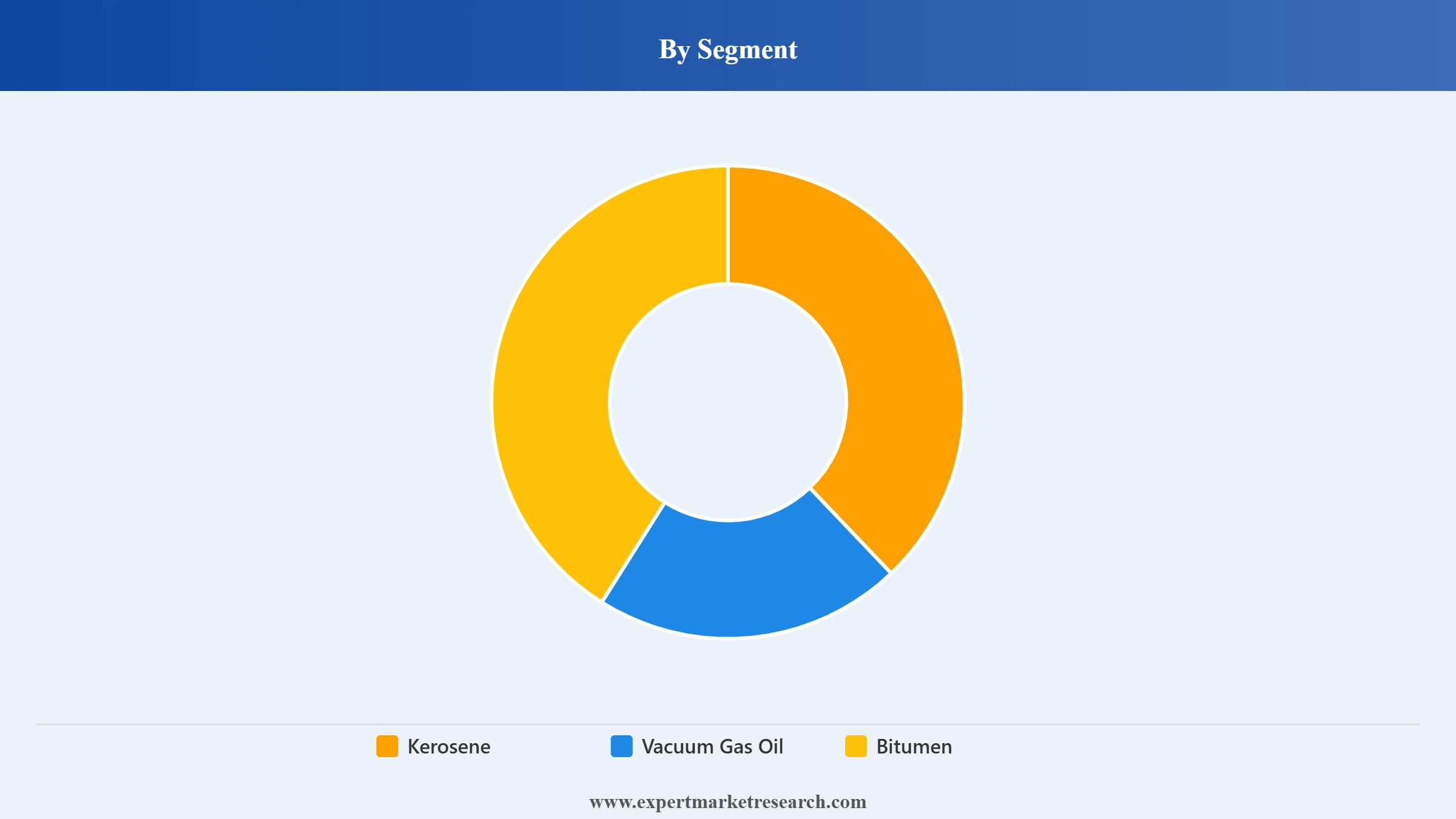
Market Breakup by Segment
Key Insight: Bitumen is the dominant segment in Iraq's vacuum bottom residue market, driven by massive and sustained demand from road construction and infrastructure projects. Iraq's extensive post-conflict road reconstruction requirements and plans for new motorway networks create persistent bitumen demand that is among the highest per-capita construction material needs in the Middle East. VGO is the second most significant segment given its direct role as feedstock for producing gasoline and diesel through fluid catalytic cracking, aligning with Iraq's growing vehicular fuel demand.
Read more about this report - REQUEST FREE SAMPLE COPY IN PDF
By Segment, bitumen dominates the market due to sustained infrastructure reconstruction and road building demand
Bitumen commands the dominant share of Iraq's vacuum bottom residue market, driven by the country's extensive infrastructure reconstruction requirements. Iraq's post-conflict rebuilding programmes have generated persistent demand for high-grade bitumen across road paving, motorway construction, roofing applications, and waterproofing. The 60/70 penetration grade bitumen is the most commercially significant grade in Iraq, preferred for its workability properties in the country's hot climate conditions. Majd Al Iraq's daily production of 1,000 metric tonnes and the Basra refinery's expanding output capacity reflect the scale of commercial investment dedicated to meeting this structural bitumen demand.
Read more about this report - REQUEST FREE SAMPLE COPY IN PDF
VGO is the second most strategically significant segment in Iraq's vacuum bottom residue market, serving as the primary feedstock for fluid catalytic cracking operations that produce gasoline and diesel. Iraq's rapidly growing vehicle fleet and rising domestic fuel consumption are sustaining strong VGO demand growth. HVGO accounts for the larger portion of VGO output due to its compatibility with existing FCC configurations at Iraqi refineries. The Basra Refinery Upgrading Project's adoption of Axens' VGO hydrotreating and FCC technology in 2024 represents a major commercial investment in optimising VGO conversion quality.
The Iraq vacuum bottom residue (kerosene, VGO and bitumen) market is characterised by a mix of domestic production facilities and trading operations operating within Iraq's refinery ecosystem. State-owned Iraqi refineries dominate overall production volumes, while private operators like Majd Al Iraq and the Halabja Group handle significant bitumen volumes for domestic and export distribution. The market is benefiting from growing foreign investment in refinery technology and capacity expansion, with Chinese and European companies actively involved in major upgrading projects.
Competition among private-sector participants centres on product quality, pricing, grades, and export market access. Companies with access to conversion technologies that produce lower-sulphur, higher-grade bitumen and VGO products are gaining competitive advantage as both domestic regulations tighten and export market quality requirements increase. The Fao refinery development and Basra upgrades are expected to reshape the competitive landscape significantly by the end of the forecast period.
Wataniya Group was founded in 2012 and has offices in Iraq and the United Arab Emirates. The company operates across multiple segments of the cement and oil and gas industries, specialising in oil trading, distribution, and transportation as well as naphtha treating units, bitumen refining units, and other advanced oil industry sectors. Wataniya Group has agreements with significant global firms particularly in the oil and gas field, making it a commercially significant participant in Iraq's vacuum bottom residue distribution and trading market.
Majd Al Iraq Company is a bitumen and barrel production facility located in the Kurdistan Region of Iraq. The company produces approximately 1,000 metric tonnes of bitumen daily for the global market, representing one of Iraq's most significant private-sector bitumen production operations. Majd Al Iraq sells high-quality bitumen of various grades and specifications with the goal of addressing supply gaps in the global bitumen market. The company's Kurdistan location provides operational advantages including relative infrastructure stability and proximity to regional export routes.
Phoenix International A/S is a Denmark-based company engaged in international operations across the petroleum and energy sector with active operations in Iraq. The company participates in refinery operations and petroleum product distribution in Iraq, leveraging its international experience and technical expertise to support the country's refinery development. Phoenix International operates within the broader Middle East and North Africa petroleum sector, positioning itself as an internationally connected player in the Iraq vacuum bottom residue (kerosene, VGO and bitumen) market.
Halabja Group is an Iraqi conglomerate with operations spanning petroleum refining, distribution, and related industrial activities. The group operates in the Kurdistan Region of Iraq and participates in the production and distribution of vacuum bottom residue products including bitumen grades for both domestic construction markets and international export. Halabja Group's integrated operations in the region provide logistical advantages for reaching construction projects across northern Iraq and neighbouring export markets.
Other key players in the market are Lanaz Refinery, and others.
*Please note that this is only a partial list; the complete list of key players is available in the full report. Additionally, the list of key players can be customized to better suit your needs.*
Discover the latest insights on the Iraq vacuum bottom residue (kerosene, VGO and bitumen) market 2026 with our comprehensive report. Stay ahead with valuable data on refinery expansion developments, product quality trends, and infrastructure demand drivers. Whether you're a petroleum trader, infrastructure investor, or refinery technology provider, this report gives you the clarity you need. Download your free sample now and discover key opportunities in Iraq's growing vacuum bottom residue industry.


Upto 15% Off
USD
$4839 $4355
$2999 $2699
$5999 $5099
$7259 $6170


*While we strive to always give you current and accurate information, the numbers depicted on the website are indicative and may differ from the actual numbers in the main report. At Expert Market Research, we aim to bring you the latest insights and trends in the market. Using our analyses and forecasts, stakeholders can understand the market dynamics, navigate challenges, and capitalize on opportunities to make data-driven strategic decisions.*
The market is projected to grow at a CAGR of 8.60% between 2026 and 2035.
Key strategies driving the market include include large-scale refinery upgrades that expand deep-conversion capacity, increased collaboration with global technology licensors for FCC, hydrotreating and VDU systems, adoption of digital and operational efficiency tools, and strengthened partnerships with international EPCC contractors to accelerate project execution and improve residue-to-distillate yields.
Growing use of kerosene to power jet engines of aircraft and the expanding automotive industry are the key industry trends propelling the growth of the market.
The key players in the market include Wataniya Group, Majd al-Iraq Company, Phoenix International A/S, Halabja Group, Lanaz Refinery, and others.
Kerosene is less refined and is more similar to diesel fuel. Higher temperatures won't cause it to evaporate due to which combustion is more difficult than it is with gasoline. As a result, kerosene is not used as an automobile fuel.
The substance acquired during vacuum distillation is known as vacuum residue. Vacuum distillation is the process of separating chemicals with different boiling points while lowering pressure below atmospheric pressure. Under low pressure, crude oil is distilled to produce vacuum residue, which is a solid.
Vacuum distillation residue (VR) is the by-product of crude oil distillation that contains high molecular weight PAH, asphaltene components, and waxes.
The primary applications of bitumen are road building and roofing, among others.
In 2025, the Iraq vacuum bottom residue (kerosene, VGO And bitumen) market reached an approximate value of USD 3113.02 Million.
The Iraq vacuum bottom residue (kerosene, VGO And bitumen) market faces challenges such as ageing refinery infrastructure, delays in project execution, limited storage and transport logistics for heavy residues, high capital requirements for deep-conversion units, and persistent dependence on external financing and foreign technology, which can slow the pace of modernisation and reduce operational flexibility.
Explore our key highlights of the report and gain a concise overview of key findings, trends, and actionable insights that will empower your strategic decisions.
| REPORT FEATURES | DETAILS |
| Base Year | 2025 |
| Historical Period | 2019-2025 |
| Forecast Period | 2026-2035 |
| Scope of the Report |
Historical and Forecast Trends, Industry Drivers and Constraints, Historical and Forecast Market Analysis by Segment:
|
| Breakup by Segment |
|
| Market Dynamics |
|
| Competitive Landscape |
|
| Companies Covered |
|
Single User License
One User
USD 4,839
USD 4,355
tax inclusive*
Datasheet
One User
USD 2,999
USD 2,699
tax inclusive*
Five User License
Five User
USD 5,999
USD 5,099
tax inclusive*
Corporate License
Unlimited Users
USD 7,259
USD 6,170
tax inclusive*
*Please note that the prices mentioned below are starting prices for each bundle type. Kindly contact our team for further details.*
Flash Bundle
Small Business Bundle
Growth Bundle
Enterprise Bundle
*Please note that the prices mentioned below are starting prices for each bundle type. Kindly contact our team for further details.*
Flash Bundle
Number of Reports: 3
20%
tax inclusive*
Small Business Bundle
Number of Reports: 5
25%
tax inclusive*
Growth Bundle
Number of Reports: 8
30%
tax inclusive*
Enterprise Bundle
Number of Reports: 10
35%
tax inclusive*
How To Order

Select License Type
Choose the right license for your needs and access rights.

Click on ‘Buy Now’
Add the report to your cart with one click and proceed to register.

Select Mode of Payment
Choose a payment option for a secure checkout. You will be redirected accordingly.
Strategic Solutions for Informed Decision-Making
Gain insights to stay ahead and seize opportunities.

Get insights & trends for a competitive edge.

Track prices with detailed trend reports.

Analyse trade data for supply chain insights.

Leverage cost reports for smart savings

Enhance supply chain with partnerships.

Connect For More Information
Our expert team of analysts will offer full support and resolve any queries regarding the report, before and after the purchase.
Our expert team of analysts will offer full support and resolve any queries regarding the report, before and after the purchase.
We employ meticulous research methods, blending advanced analytics and expert insights to deliver accurate, actionable industry intelligence, staying ahead of competitors.
Our skilled analysts offer unparalleled competitive advantage with detailed insights on current and emerging markets, ensuring your strategic edge.
We offer an in-depth yet simplified presentation of industry insights and analysis to meet your specific requirements effectively.




