

Consumer Insights
Uncover trends and behaviors shaping consumer choices today
Procurement Insights
Optimize your sourcing strategy with key market data
Industry Stats
Stay ahead with the latest trends and market analysis.
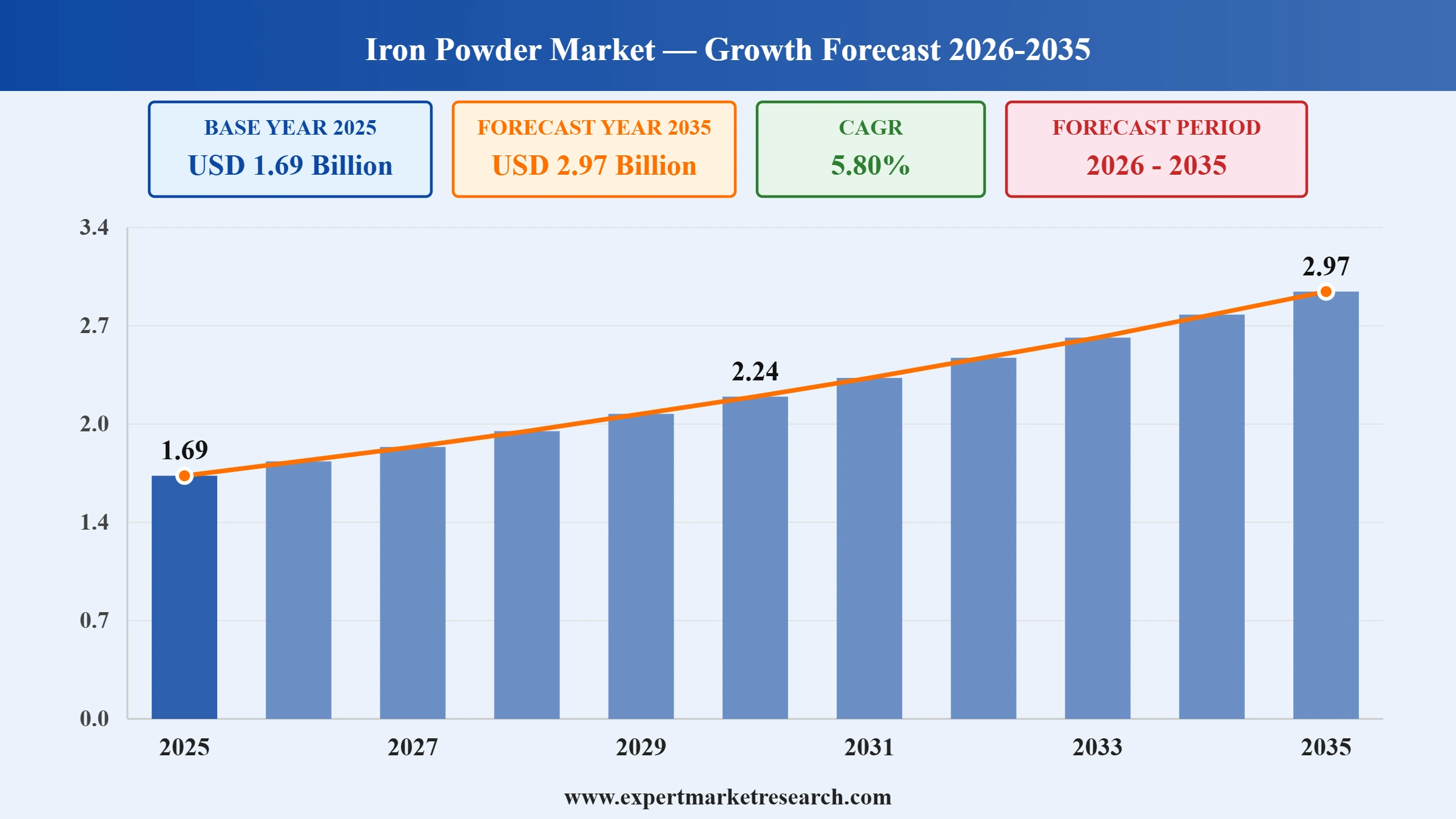
The global iron powder market attained a value of USD 1.69 Billion in 2025 and is projected to expand at a CAGR of 5.80% through 2035. The market is further expected to achieve USD 2.97 Billion by 2035. Rising automotive powder metallurgy demand, expanding metal additive manufacturing adoption, and growing use of iron powder in soft magnetic and electronics applications are encouraging producers to expand atomisation and reduction capacity.
Growing vehicle production across Asia Pacific, combined with rising adoption of powder metallurgy techniques that reduce material waste relative to conventional machining, continues to anchor steady demand across the iron powder market. Producers are also directing research investment toward powders with improved compressibility, oxidation resistance, and magnetic properties to serve increasingly demanding automotive and electronics customers.
The iron powder market is witnessing further developments as major producers secure upstream raw material supply to support long-term powder production capacity. In October 2025, Rio Tinto, Mitsui, and Nippon Steel agreed to invest 733 million dollars to extend the West Angelas iron ore mine in Western Australia, sustaining the hub's 35 million tonne annual production capacity that ultimately feeds downstream metal powder operations. Producers with secure, vertically integrated iron ore supply continue to hold a structural cost advantage over powder makers reliant on external ore purchases.
In addition, iron powder players are competing increasingly on specialty capacity, investing in dedicated atomisation lines rather than adapting existing reduction infrastructure to capture higher-margin additive manufacturing and electronics business. Carpenter Technology Corporation, a Philadelphia-based specialty alloy powder producer serving aerospace, defense, and medical customers, has continued directing capital toward high-performance powder capacity as buyers increasingly qualify suppliers on technical support rather than price per kilogram alone. Manufacturers that move first to purpose-built, specialty-grade capacity continue to strengthen their position with premium customers who are less willing to switch suppliers once qualified.
Read more about this report - REQUEST FREE SAMPLE COPY IN PDF
SSAB launched Armox® 500 AM Powder, which the company describes as the world’s first armor steel powder developed for additive manufacturing. The iron-based steel powder offers properties comparable with Armox protection plates and enables 3D-printed protective components with complex geometries. The development expands opportunities in the iron powder market across defence, advanced engineering, and high-performance additive manufacturing applications. Companies can develop application-specific iron-based powders for sectors where conventional steel plate designs face weight or geometry limitations.
IIT Hyderabad, Defence Metallurgical Research Laboratory, and Innomet Advanced Materials announced a collaboration to develop an indigenous large-scale gas atomizer for producing high-purity spherical metal powders. The facility is planned at Innomet’s Hyderabad premises and will support aerospace, defence, and additive manufacturing applications, including production of special steel and other iron-based powders. Companies operating in the iron powder market can invest in localized atomization capacity to reduce import dependence and address demand for high-purity powders used in advanced manufacturing.
RIFT secured EUR 113.8 million in financing, including an EUR 83.1 million Series B investment and EUR 30.7 million under the EU Innovation Fund, to advance its iron fuel technology toward commercial deployment. The technology uses iron powder as a reusable energy carrier for generating high-temperature industrial heat without direct carbon dioxide emissions during combustion. The investment could create a new demand avenue for the iron powder market beyond conventional powder metallurgy, particularly in industrial heating and renewable energy storage applications.
GMH Gruppe launched ProMateria, a new business focused on metal powder production and additive manufacturing using high-nitrogen alloyed steels and other iron-based materials. ProMateria can manufacture powder volumes ranging from 25 kilograms to 10,000 kilograms and targets applications across aerospace, mechanical engineering, energy, medical technology, and other industrial sectors. Companies in the iron powder market can pursue integrated business models combining specialty powder production, additive manufacturing, and finished-component capabilities.
The iron powder market is witnessing further developments as major iron ore producers navigate shifting global supply and demand dynamics that directly affect powder producers' raw material costs. In December 2025, Vale SA, one of the world's largest iron ore suppliers, lowered its 2026 production forecast as cooling global demand and new supply entering the market from West African projects reshape competitive dynamics across the sector. Producers with secure, vertically integrated iron ore supply continue to hold a structural cost advantage over powder makers reliant on external ore purchases.
Major metal powder producers are increasingly highlighting sustainability performance as a competitive differentiator across the iron powder market, alongside traditional product breadth and technical capability. In April 2026, Höganäs AB published its Sustainability Report 2025, confirming it had reached its 2030 Science Based Targets for Scope 1 and 2 emissions five years ahead of schedule, while increasing the share of secondary raw materials used in production from 48 percent in 2021 to 59 percent in 2025. The company's continued investment in circularity and emissions reduction reinforces its position as the reference producer against which regional competitors are typically benchmarked.
Japanese steelmakers with integrated iron ore and manufacturing operations continue to expand their Asian industrial footprint to secure long-term growth beyond a maturing domestic market. In March 2026, JFE Steel completed a 50:50 joint venture with JSW Steel in India, transferring an integrated steelworks with 4.5 million tonnes of annual crude steel capacity following a 270 billion yen investment agreement reached in December 2025. The company's position within this expanding integrated industrial base gives it structural raw material and logistics advantages over standalone powder producers competing for the same automotive and industrial customers.
Diversified chemical groups continue to apply advanced manufacturing techniques developed for their broader specialty chemicals business to iron powder-adjacent product lines. In March 2026, BASF started up the world's first production plant for catalysts manufactured using its X3D additive manufacturing technology at its Ludwigshafen site, scaling 3D-printed catalyst production to an industrial level. The company's diversified end-market exposure across catalysts, pharmaceuticals, and food fortification differentiates it from steel-integrated competitors that remain more heavily weighted toward automotive and industrial powder metallurgy demand.
Smaller regional suppliers across the iron powder market continue to differentiate on responsiveness rather than production scale, positioning themselves as flexible partners for customers that larger integrated producers consider too small to prioritise. Reade International Corp., a specialty chemical solids and advanced materials distributor, has continued serving customers requiring smaller-volume, closely specified powder grades alongside its broader materials portfolio spanning metals, ceramics, and composites. Such regional specialists continue to compete alongside the largest global suppliers by offering faster technical support and more customised particle size and purity specifications.
This Expert Market Research's report titled "Global Iron Powder Market Report and Forecast 2026-2035" offers a detailed analysis of the market based on the following segments:
Market Breakup by Type
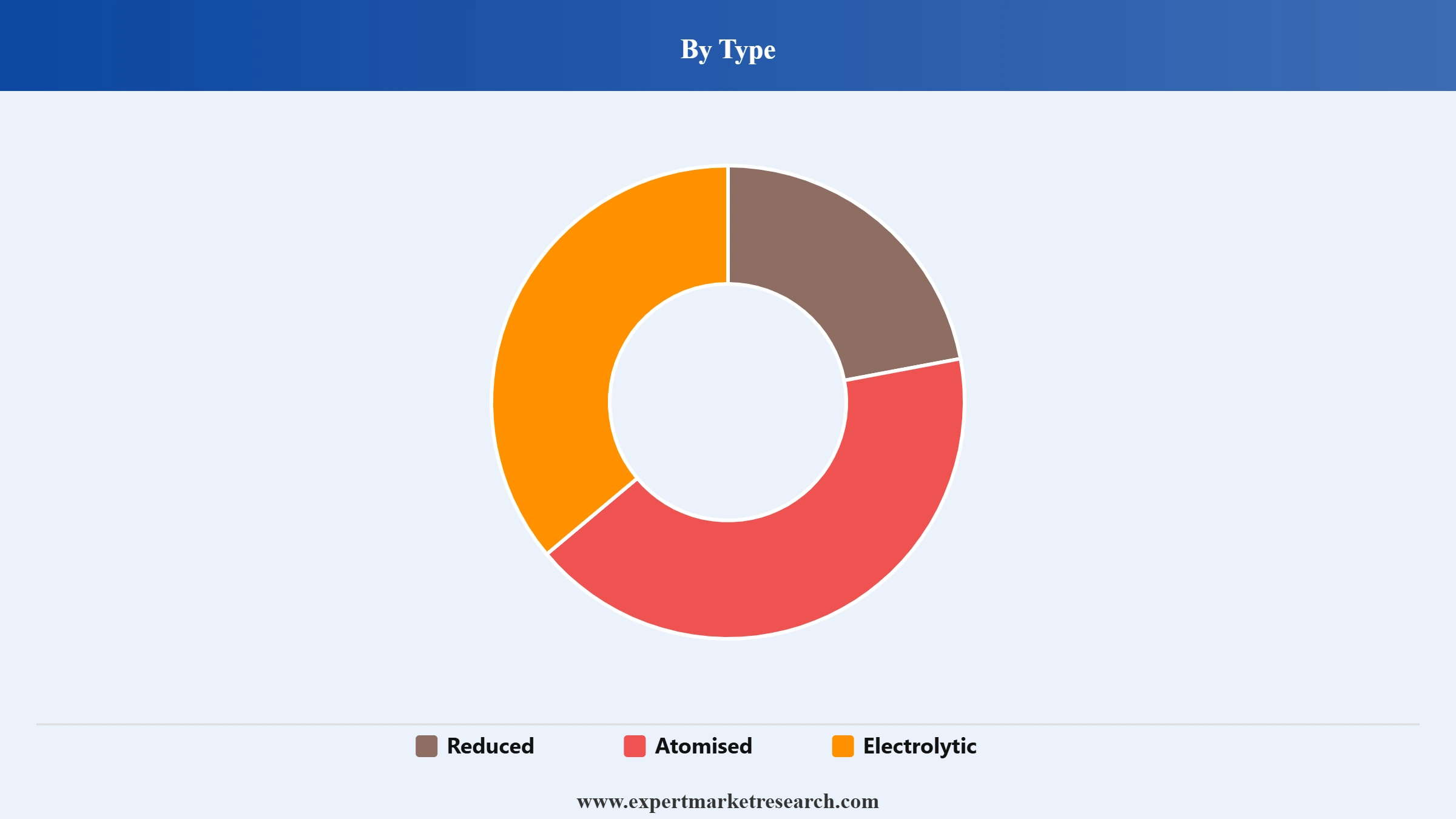
Key Insight: Reduced iron powder accounts for a sizable share of the iron powder market, valued for its high purity and consistent quality across powder metallurgy, welding material, and soil decontamination applications. Atomised iron powder is growing at the fastest pace as metal additive manufacturing and electronics customers demand the uniform, high-density particle characteristics that atomisation delivers; in 2025, Kobe Steel advanced new atomised powder grades with improved flowability and particle size distribution, targeting expanding 3D printing customers. Electrolytic iron powder remains a smaller, high-purity niche serving electronics and specialty chemical processes requiring extreme chemical purity.
Market Breakup by End User
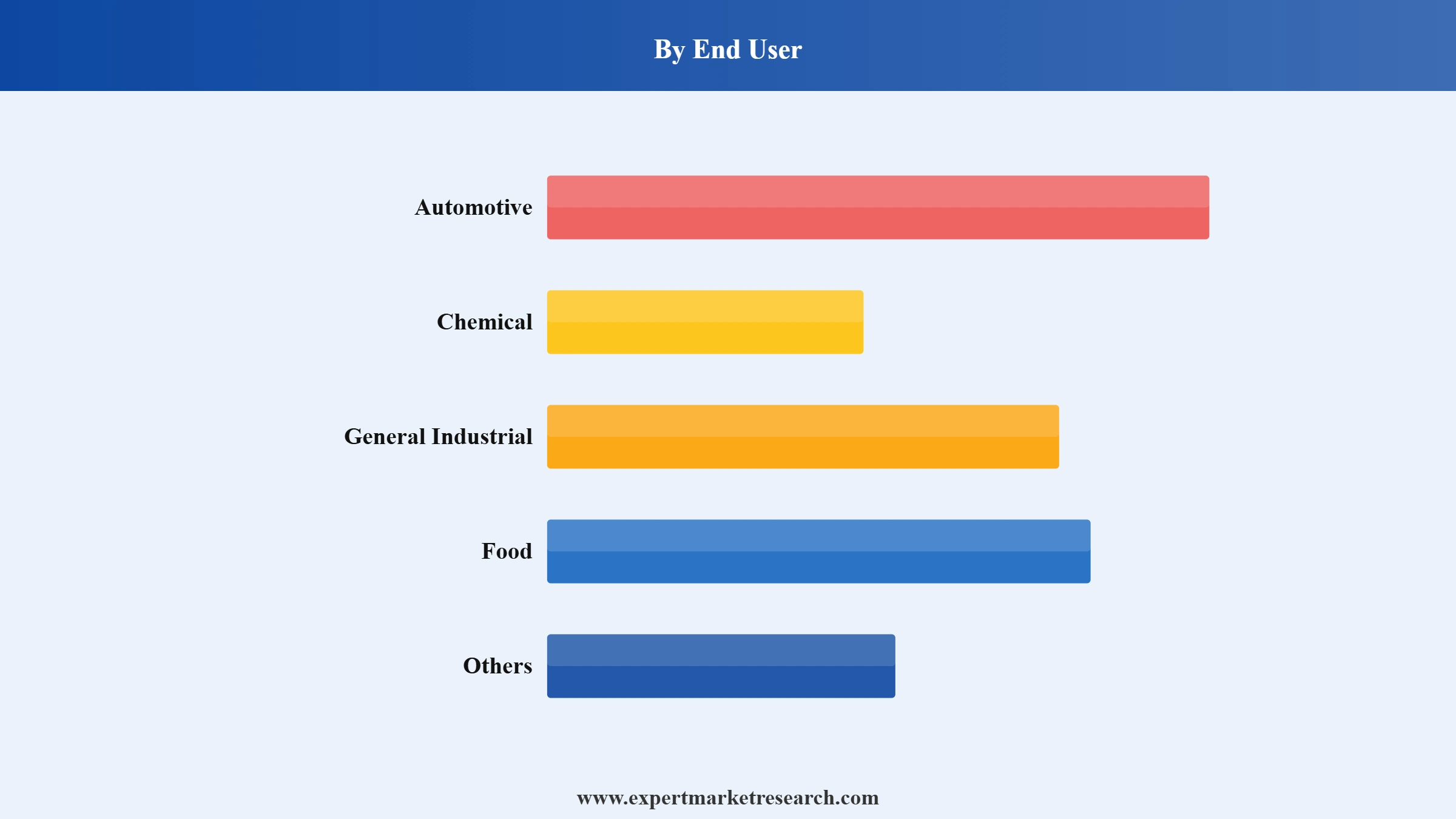
Key Insight: Automotive accounts for the largest share of the iron powder market, reflecting widespread use of iron powder in braking pads, drum brake linings, and sintered engine and transmission components. Chemical applications are growing at a fast pace as iron powder finds expanding use in catalysts, water treatment, and specialty chemical processes; in February 2026, Nagoya University researchers published a redesigned iron catalyst in the Journal of the American Chemical Society that cut chiral ligand use by two-thirds in asymmetric photocatalytic reactions, illustrating iron's growing role as a lower-cost alternative to rare-metal catalysts. General industrial and food applications, including iron fortification, continue to represent smaller but steadily growing end uses.
Market Breakup by Region
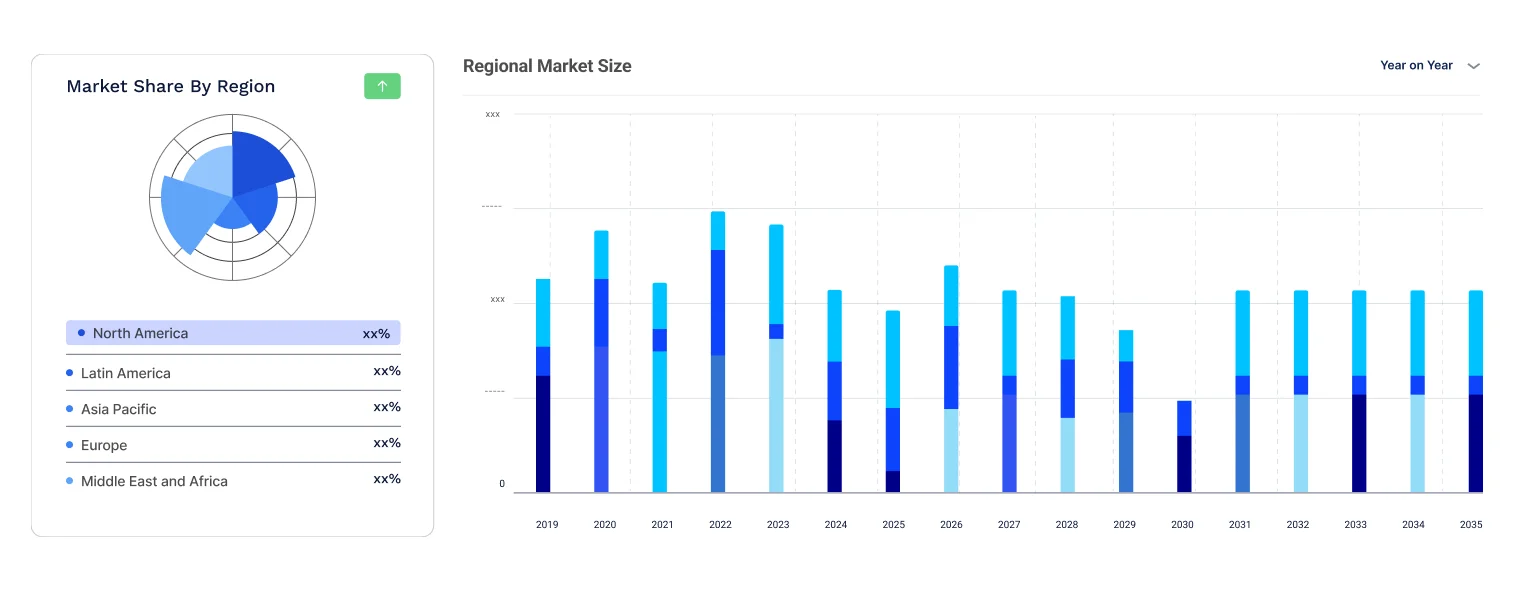
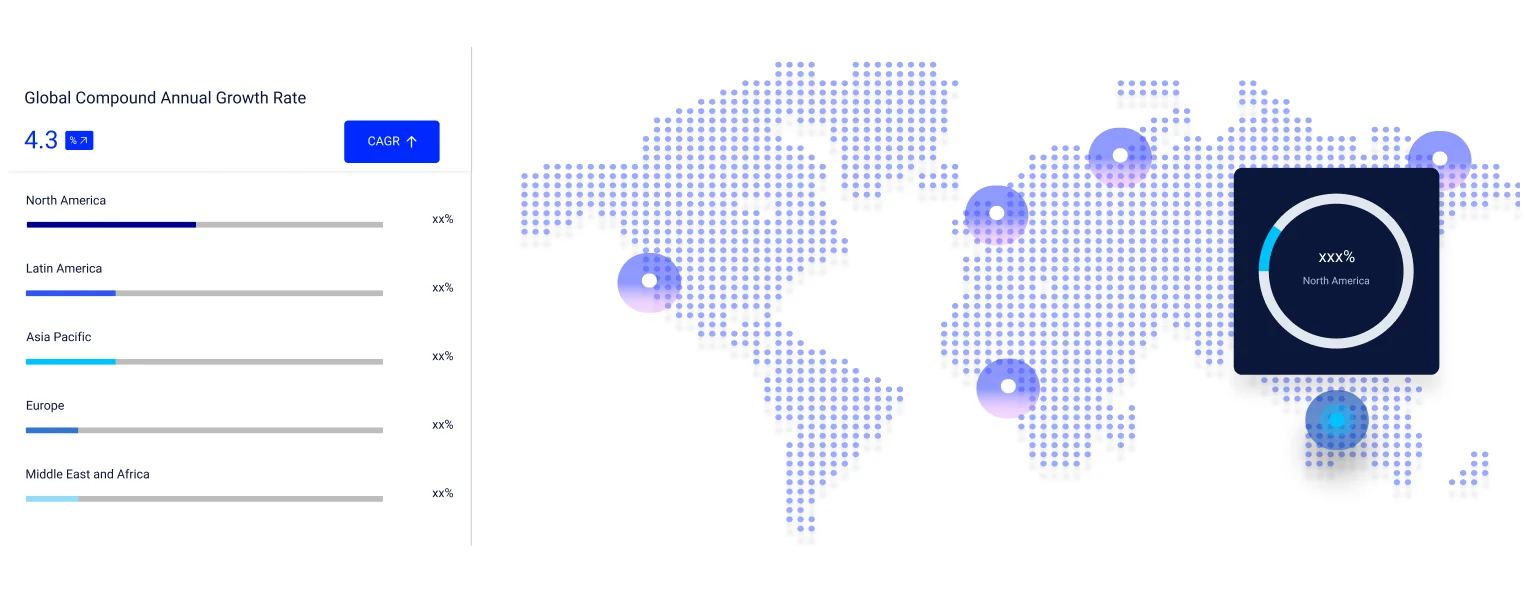
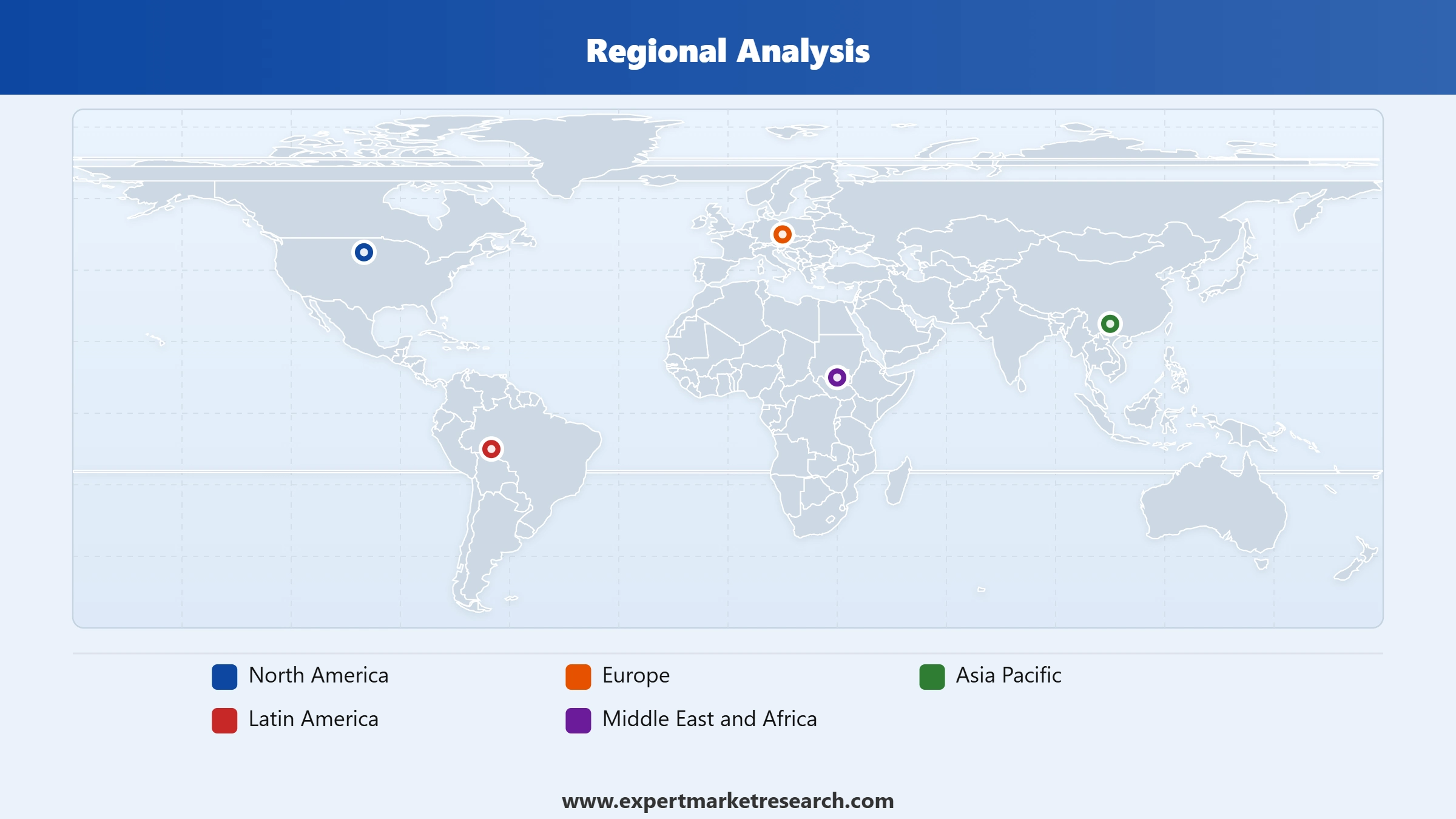
Key Insight: Asia Pacific accounts for the largest share of the iron powder market, driven by rapid industrialisation and strong automotive, electronics, and manufacturing demand across China, Japan, and India. The Middle East and Africa region is expected to grow at the fastest pace as expanding industrial and automotive component manufacturing capacity across the region drives new powder metallurgy adoption. North America and Europe continue to see steady demand from established automotive and aerospace supply chains, while Latin America gradually scales adoption alongside expanding regional manufacturing capacity.
Read more about this report - REQUEST FREE SAMPLE COPY IN PDF
By type, reduced iron powder leads the market owing to its high purity and consistent quality across established applications
Reduced iron powder continues to account for a sizable share of the market, valued for its high purity and consistent quality across powder metallurgy, welding material, and soil decontamination applications. Established production relationships with automotive and welding consumables customers continue to anchor steady replacement demand for this segment, with long-standing reduction facilities across Europe and North America continuing to serve as the primary supply base for conventional powder metallurgy component manufacturers who prioritise supply continuity over switching to newer atomised grades.
Read more about this report - REQUEST FREE SAMPLE COPY IN PDF
Atomised iron powder is growing at the fastest pace across the iron powder market as metal additive manufacturing and electronics customers demand the uniform, high-density particle characteristics that atomisation delivers over conventional reduction processes. At Formnext 2025 in November, atomisation equipment maker ATO premiered its next-generation Sparq and Pure ultrasonic metal atomiser platforms, engineered to produce stable, repeatable, low-oxygen spherical powders with improved flowability for additive manufacturing feedstock production.
By end user, automotive leads the market given widespread use across braking, engine, and transmission components
Automotive continues to account for the largest end-user share, reflecting decades of established use in braking pads, drum brake linings, and sintered engine and transmission components. Long-standing supplier relationships with automotive original equipment manufacturers continue to anchor steady replacement demand as vehicle production volumes grow. In March 2025, Samvardhana Motherson Group announced a strategic partnership with Jiangsu Sifang to co-develop and manufacture high-precision automotive sintered parts for electric vehicle platforms, spanning joint production facilities and technology transfer across Asia.
Read more about this report - REQUEST FREE SAMPLE COPY IN PDF
Chemical applications are growing at the fastest pace as iron powder finds expanding use in catalysts, water treatment, and specialty chemical processes requiring consistent particle characteristics. Producers are directing new atomisation capacity toward these higher-purity requirements as chemical customers increasingly compete with automotive customers for available high-grade powder supply, with several producers reporting that chemical-grade orders now require the same particle consistency historically reserved for premium electronics applications.
Asia Pacific commands the largest share of the market through rapid industrialisation and automotive manufacturing scale
Asia Pacific holds the largest share of the iron powder market, driven by rapid industrialisation and strong automotive, electronics, and manufacturing demand across China, Japan, and India. In the atomised powder segment specifically, the region accounted for roughly 60 percent of global market share in 2025, supported by extensive automotive and electronics manufacturing capacity, with China's automotive production base alone underpinning nearly half of regional demand according to industry estimates published in 2026.
Read more about this report - REQUEST FREE SAMPLE COPY IN PDF
The Middle East and Africa region is expected to grow at the fastest pace as expanding industrial and automotive component manufacturing capacity drives new powder metallurgy adoption across the region. In February 2026, ArcelorMittal announced the launch of its third steel plant at Sharjah's Hamriyah Free Zone in the UAE, a 1.4 million square foot facility adding steel pipe manufacturing and specialised coating capacity, with operations scheduled to commence later in the year. Regional governments have prioritised industrial diversification programmes that include downstream metals processing, encouraging both local and international powder producers to evaluate new capacity.
The global industry is moderately consolidated, with iron powder companies ranging from vertically integrated mining and steel groups to specialised powder metallurgy producers competing across type, end-user, and regional segments. Established players operate across the full value chain, from iron ore extraction and reduction or atomisation processing to finished powder supply for automotive, chemical, and additive manufacturing customers.
Competitive dynamics among iron powder market players are increasingly shaped by upstream raw material security, additive manufacturing driven demand for high-purity atomised grades, and sustainability pressure around production emissions. Manufacturers are investing in dedicated atomisation capacity, recycled powder production methods, and vertically integrated ore supply to differentiate their offering and secure long-term relationships with automotive and industrial customers.
Founded in 1797 and headquartered in Höganäs, Sweden, Höganäs traces its origins to a coal mining operation before pivoting to metal powder production, making it one of the oldest continuously operating companies in the powder metallurgy industry. The company operates production facilities across multiple continents and maintains an extensive metallurgical research programme, employing thousands of staff worldwide to support customers ranging from major automakers to specialty electronics manufacturers requiring highly customised powder grades within the Iron Powder Market.
Founded in 2003 through the integration of Kawasaki Steel and NKK Corporation, and headquartered in Tokyo, Japan, JFE Steel operates state-of-the-art atomisation lines producing iron powder for both domestic and export customers across the iron powder market. JFE Steel's parent group also spans engineering and shipbuilding businesses, giving the powder division access to substantial in-house research and quality assurance infrastructure not typically available to standalone powder producers. This diversified industrial base supports continued investment in powder metallurgy research even during periods of softer automotive demand.
Part of Rio Tinto, founded in 1873 and headquartered in London, United Kingdom, Rio Tinto Metal Powders operates high-volume atomisation plants in Canada, leveraging the parent company's raw material security to supply North American welding and powder metallurgy customers across the iron powder market. The division benefits directly from Rio Tinto's extensive global iron ore mining operations across Australia and Canada, giving it a cost and supply-continuity advantage over powder producers that must purchase iron ore on the open market.
Founded in 1865 and headquartered in Ludwigshafen, Germany, BASF operates the world's largest integrated chemical production complex at its home site, spanning agricultural solutions, coatings, and materials businesses well beyond its iron powder product line. The company's scale gives it purchasing and logistics advantages that smaller, single-product powder producers cannot replicate, alongside research infrastructure originally built for BASF's much larger core chemicals operations.
Other key players in the market include Reade International Corp., Kobe Steel, Ltd., Pometon S.p.A., Sagwell USA Inc., and Industrial Metal Powders (India) Pvt. Ltd., among others.
*Please note that this is only a partial list; the complete list of key players is available in the full report. Additionally, the list of key players can be customized to better suit your needs.*
Unlock the latest insights with our iron powder market trends 2026 report. Discover regional growth patterns, type and end-user trends, and key industry players. Stay ahead of competition with trusted data and expert analysis. Download your free sample report today and drive informed decisions in the market.


Upto 15% Off
USD
$2499 $2249
$3999 $3599
$4999 $4249
$5999 $5099


*While we strive to always give you current and accurate information, the numbers depicted on the website are indicative and may differ from the actual numbers in the main report. At Expert Market Research, we aim to bring you the latest insights and trends in the market. Using our analyses and forecasts, stakeholders can understand the market dynamics, navigate challenges, and capitalize on opportunities to make data-driven strategic decisions.*
The market is estimated to grow at a CAGR of 5.80% in the forecast period of 2026 and 2035.
The thriving automotive, chemical, and food sector, increasing popularity of sustainable fossil fuel alternatives, and growing applications of iron powder in heating components are the major drivers of the market.
The key trends in the market include the growing innovations in powder metallurgy techniques and progressive product innovations in the industrial sector.
Reduced, atomised, and electrolytic are the different types of iron powder in the market.
Automotive, chemical, general industrial, and food, among others, are the various end users of the market.
Iron powder is considered to be slightly hazardous if it comes into contact with skin or eyes, but is largely non-hazardous when inhaled, although chronic inhalation of fine powder may cause health concerns.
Iron powder contains aggregate of iron particles with varying size ranging from 20 to 200 micro metres.
Iron powder is made up of approximately 99.5% iron, which makes it one of the purest forms of iron.
North America, Europe, the Asia Pacific, Latin America, and the Middle East and Africa, are the major regions in the market.
JFE Steel Corporation, Reade International Corp., Hoganas AB, BASF SE, Kobe Steel Ltd., Rio Tinto Metal Powders, Pometon S.p.A, Sagwell USA Inc., and Industrial Metal Powders (India) Pvt. Ltd., among others, are the key players in the iron powder market, according to the report.
In 2025, the iron powder market reached an approximate value of USD 1.69 Billion.
The market is projected to achieve approximately USD 2.97 Billion by 2035, supported by expanding industrial applications.
Manufacturers face volatile iron ore and energy prices, high capital requirements for dedicated atomisation capacity, and the technical complexity of matching powder characteristics to increasingly specialised customer requirements.
Expanding dedicated atomisation capacity for additive manufacturing customers, securing vertically integrated iron ore supply, and developing recycled and lower-carbon production methods to meet tightening sustainability requirements.
Explore our key highlights of the report and gain a concise overview of key findings, trends, and actionable insights that will empower your strategic decisions.
| REPORT FEATURES | DETAILS |
| Base Year | 2025 |
| Historical Period | 2019-2025 |
| Forecast Period | 2026-2035 |
| Scope of the Report |
Historical and Forecast Trends, Industry Drivers and Constraints, Historical and Forecast Market Analysis by Segment:
|
| Breakup by Type |
|
| Breakup by End User |
|
| Breakup by Region |
|
| Market Dynamics |
|
| Competitive Landscape |
|
| Companies Covered |
|
Datasheet
One User
USD 2,499
USD 2,249
tax inclusive*
Single User License
One User
USD 3,999
USD 3,599
tax inclusive*
Five User License
Five User
USD 4,999
USD 4,249
tax inclusive*
Corporate License
Unlimited Users
USD 5,999
USD 5,099
tax inclusive*
*Please note that the prices mentioned below are starting prices for each bundle type. Kindly contact our team for further details.*
Flash Bundle
Small Business Bundle
Growth Bundle
Enterprise Bundle
*Please note that the prices mentioned below are starting prices for each bundle type. Kindly contact our team for further details.*
Flash Bundle
Number of Reports: 3
20%
tax inclusive*
Small Business Bundle
Number of Reports: 5
25%
tax inclusive*
Growth Bundle
Number of Reports: 8
30%
tax inclusive*
Enterprise Bundle
Number of Reports: 10
35%
tax inclusive*
How To Order

Select License Type
Choose the right license for your needs and access rights.

Click on ‘Buy Now’
Add the report to your cart with one click and proceed to register.

Select Mode of Payment
Choose a payment option for a secure checkout. You will be redirected accordingly.
Strategic Solutions for Informed Decision-Making
Gain insights to stay ahead and seize opportunities.

Get insights & trends for a competitive edge.

Track prices with detailed trend reports.

Analyse trade data for supply chain insights.

Leverage cost reports for smart savings

Enhance supply chain with partnerships.

Connect For More Information
Our expert team of analysts will offer full support and resolve any queries regarding the report, before and after the purchase.
Our expert team of analysts will offer full support and resolve any queries regarding the report, before and after the purchase.
We employ meticulous research methods, blending advanced analytics and expert insights to deliver accurate, actionable industry intelligence, staying ahead of competitors.
Our skilled analysts offer unparalleled competitive advantage with detailed insights on current and emerging markets, ensuring your strategic edge.
We offer an in-depth yet simplified presentation of industry insights and analysis to meet your specific requirements effectively.




