

Consumer Insights
Uncover trends and behaviors shaping consumer choices today
Procurement Insights
Optimize your sourcing strategy with key market data
Industry Stats
Stay ahead with the latest trends and market analysis.
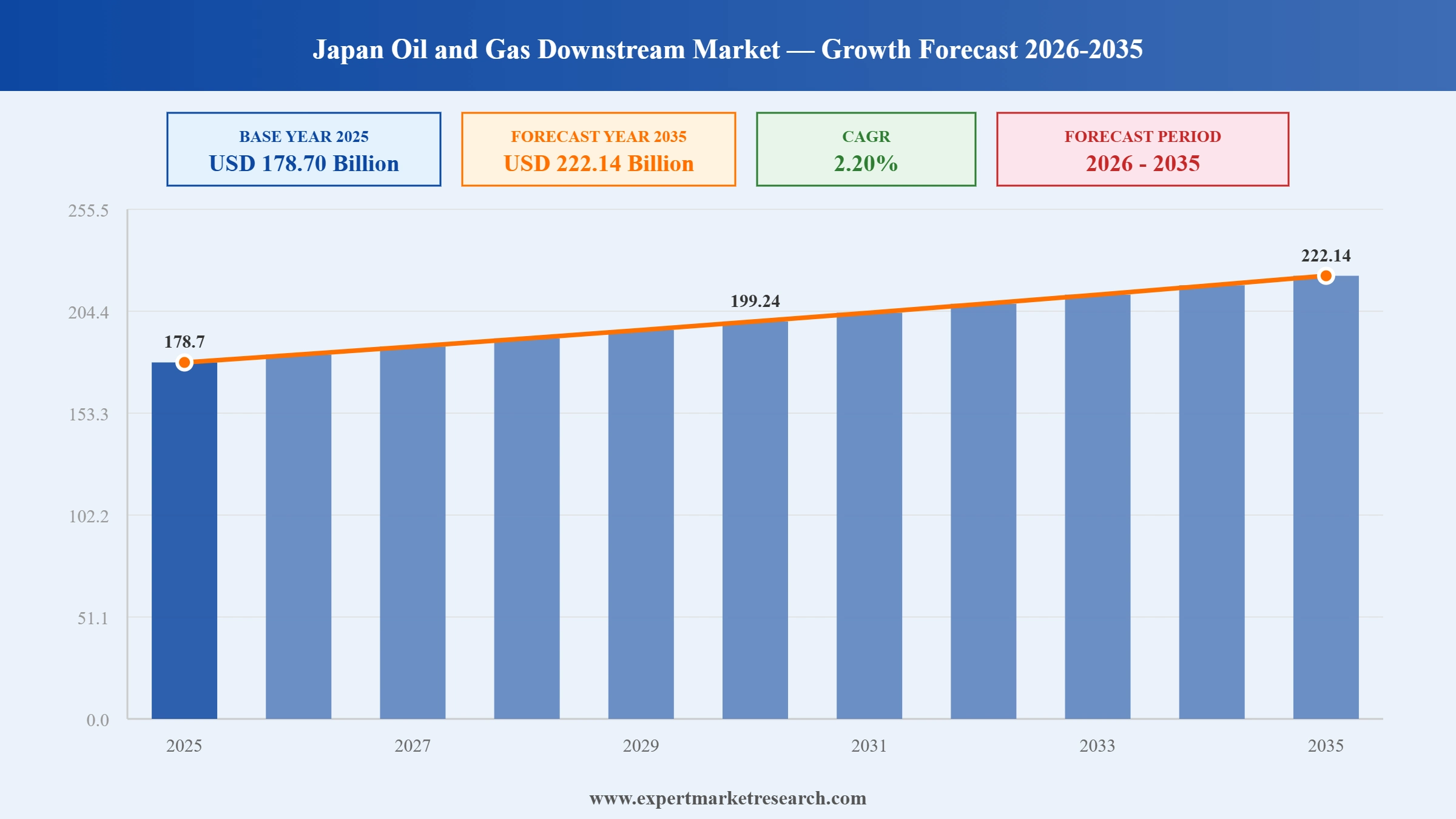
The Japan Oil and Gas Downstream Market reached a value of USD 178.70 Billion at 2025 and is projected to expand at a CAGR of around 2.20% during the forecast period of 2026-2035. With growing LNG demand as a transitional fuel, the emergence of sustainable aviation fuel as a commercially viable downstream segment, ongoing refinery upgrades to improve utilization rates and cleaner fuel output, and steady industrial sector demand for petroleum products and petrochemical feedstocks, the market is expected to reach USD 222.14 Billion by 2035.
Read more about this report - REQUEST FREE SAMPLE COPY IN PDF
| Japan Oil and Gas Downstream Market Report Summary |
Description |
Value |
|
Base Year |
USD Billion |
2025 |
|
Historical Period |
USD Billion |
2019-2025 |
|
Forecast Period |
USD Billion |
2026-2035 |
|
Market Size 2025 |
USD Billion |
178.70 |
|
Market Size 2035 |
USD Billion |
222.14 |
|
CAGR 2019-2025 |
Percentage |
XX% |
|
CAGR 2026-2035 |
Percentage |
2.20% |
|
CAGR 2026-2035 - Market by Type |
Petrochemical |
2.4% |
|
CAGR 2026-2035 - Market by End User |
Industrial |
2.6% |
The Japan oil and gas downstream sector is navigating a deliberate but careful energy transition, balancing the imperative of near-term energy security with long-term decarbonization commitments. Refiners are recalibrating investment priorities away from unproven hydrogen and ammonia pathways toward scalable, commercially ready options like LNG and sustainable aviation fuel. Structural demand decline from an ageing domestic population is prompting meaningful capacity consolidation alongside this strategic reorientation.
ENEOS Holdings, Japan’s largest oil refiner, announced a new three-year business plan running through March 2028, committing 1.56 trillion yen (approximately USD 10.7 billion) toward energy transition and core refinery operations. Of this, 740 billion yen is earmarked for strategic low-carbon and decarbonized energy initiatives, with a notable focus on LNG expansion and sustainable aviation fuel development at its Wakayama plant. ENEOS simultaneously announced the removal of its previous target to supply 4 million metric tonnes of hydrogen by 2040, citing rising costs and slower-than-expected global decarbonization momentum. The company aims to raise its refinery utilization rate to 90% by fiscal 2027, up from 78% in fiscal 2024.
Cosmo Oil Marketing commenced the first commercial supply of domestically produced sustainable aviation fuel in Japan in April 2025, marking the operational launch of the Saffaire Sky Energy SAF plant at the Sakai Refinery. The SAF, produced entirely from domestically collected used cooking oil, carries ISCC CORSIA certification and reduces lifecycle CO2 emissions by approximately 60 to 80% compared to conventional jet fuel. The inaugural supply included a partnership with Finnair, signed in March 2025, and subsequent distribution through Japan’s domestic airline network. This development marks the formal commercialisation of Japan’s first homegrown large-scale SAF supply chain, a critical milestone in the country’s aviation decarbonization strategy.
ENEOS Holdings announced plans to gradually cease lubricant and certain petroleum product manufacturing at its Yokohama plant by March 2028, as part of a broader effort to rationalize its domestic production network in response to structural decline in domestic fuel demand. The Yokohama decision reflects the wider industry reality facing Japanese downstream operators: an ageing and shrinking population is steadily reducing overall petroleum product consumption, pushing refiners to consolidate underutilised capacity. By retiring lower-margin production lines, ENEOS aims to streamline its cost base, redirect investment toward higher-growth segments like SAF and LNG, and maintain competitiveness as the domestic market undergoes a gradual structural contraction.
NEOS Corporation and Mitsubishi Corporation announced the commencement of a Front End Engineering Design (FEED) study for a large-scale sustainable aviation fuel production facility at ENEOS’s Wakayama Plant in Arida City, Japan. The FEED builds on a joint feasibility study the two companies initiated in 2022, combining ENEOS’s refining capabilities, established sales network, and feedstock procurement expertise with Mitsubishi Corporation’s global feedstock sourcing and supply chain management capabilities. A commercial SAF production unit at Wakayama would represent a significant addition to Japan’s domestic SAF manufacturing capacity, aligned with Japan’s government target of achieving 10% SAF usage in aviation by 2030.
Saffaire Sky Energy LLC, a joint venture of Cosmo Oil, JGC Holdings, and Revo International, completed construction of Japan’s first large-scale sustainable aviation fuel production facility at Cosmo Oil’s Sakai Refinery in Osaka Prefecture on December 25, 2024. The plant, designed to produce approximately 30,000 kiloliters of SAF annually from domestically sourced used cooking oil, also obtained ISCC CORSIA and ISCC EU certifications in December 2024, becoming the first SAF production base in Japan to earn both internationally recognised sustainability standards. Trial operations commenced in January 2025, with commercial SAF supply to airlines beginning in April 2025.
Japan’s downstream energy sector is undergoing a significant recalibration of its decarbonization roadmap, shifting investment away from hydrogen and ammonia, which have faced cost and policy headwinds, toward LNG and sustainable aviation fuel as more commercially viable near-term transition fuels. LNG is increasingly viewed as a practical bridge fuel through approximately 2040, while SAF is gaining traction as a regulated, government-backed product with clear airline demand. This strategic shift reflects a broader industry acknowledgment that the transition to a carbon-neutral energy system is progressing more slowly than previously assumed. In May 2025, ENEOS Holdings unveiled a three-year business plan allocating 1.56 trillion yen including a substantial focus on LNG expansion and SAF production at its Wakayama facility, while formally dropping its 2040 hydrogen supply target.
The commercialisation of domestically produced sustainable aviation fuel marks a structural addition to Japan’s downstream sector, opening a new product segment that did not previously exist at commercial scale. Japan’s government has mandated that SAF must account for at least 10% of aviation fuel use by 2030, creating a robust long-term demand signal for domestic producers and incentivising downstream investment in SAF production infrastructure. The Japan oil and gas downstream market growth is being supported by these new SAF-related capital flows, particularly as refiners repurpose existing infrastructure at coastal refineries to produce cleaner fuel products. In December 2024, Japan’s first large-scale SAF facility at Cosmo Oil’s Sakai Refinery completed construction and obtained ISCC CORSIA and ISCC EU certifications, commencing commercial supply in April 2025.
Japan’s downstream operators are accelerating the rationalisation of refinery capacity and product portfolios in response to sustained structural decline in domestic petroleum demand. An ageing and shrinking population, rising fuel efficiency standards across the automotive fleet, and the gradual penetration of electric vehicles are all contributing to a steady multi-year reduction in gasoline and diesel consumption. Rather than maintaining excess capacity, major refiners are consolidating production at fewer, more efficient facilities and redirecting capital toward growth segments like SAF, LNG, and petrochemicals. This operational restructuring is improving overall sector margins while enabling refiners to meet tightening environmental standards. In March 2025, ENEOS announced the planned cessation of lubricant manufacturing at its Yokohama plant by March 2028, consistent with this industry-wide consolidation trend.
Environmental scrutiny on LNG’s climate credentials has intensified, driving Japan’s major energy companies to formalise commitments to reduce methane emissions across the full LNG supply chain, from production to delivery. Methane, a potent greenhouse gas, is a key area of focus as Japan works to position LNG as a credible transitional fuel in its carbon neutrality strategy. Industry coalitions are forming to document, benchmark, and systematically reduce methane leakage, lending greater environmental credibility to LNG as a bridge fuel. This trend strengthens the downstream market’s regulatory and reputational positioning at a time when investors and governments are scrutinising fossil fuel investments more closely. The Coalition for LNG Emission Abatement Toward Net Zero (CLEAN), comprising major Japanese LNG buyers including Mitsubishi Corp. and Mitsui and Co., was established to lead this methane reduction effort.
The report of the Expert Market Research report titled “Japan Oil and Gas Downstream Market Report and Forecast 2026 to 2035" offers a detailed analysis of the market based on the following segments:
Market Breakup by Type
Key Insight: Japan’s refining segment remains the backbone of the downstream sector, processing imported crude oil into a wide range of refined products including gasoline, diesel, kerosene, jet fuel, and low-sulfur fuel oil for industrial and marine use. Major refiners including ENEOS are investing in refinery upgrades to raise utilization rates and shift output toward cleaner fuel streams like sustainable aviation fuel and low-sulfur diesel, aligning operations with Japan’s tightening environmental standards. The petrochemical segment is growing steadily, underpinned by Japan’s advanced manufacturing base in automotive, electronics, and packaging industries that require a constant supply of ethylene, propylene, and other chemical feedstocks. Petrochemical producers are increasingly integrating their operations with refinery units to maximise feedstock efficiency and capture margin from both fuels and chemicals in a single refinery complex.
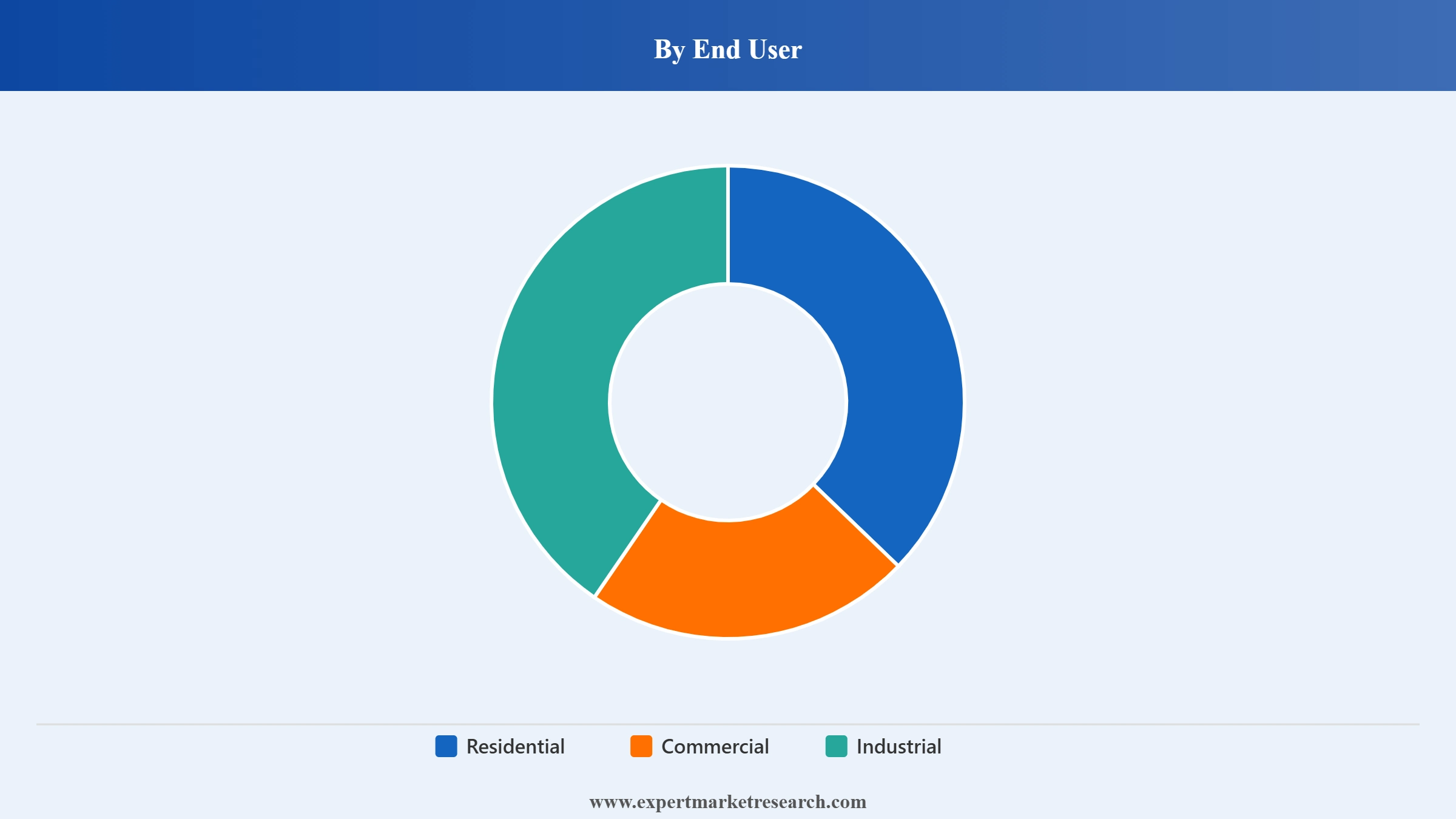
Market Breakup by End User
Key Insight: The industrial end-use segment is the dominant consumer of downstream oil and gas products in Japan, representing the largest and fastest-growing category. Energy-intensive sectors including steel production, chemical manufacturing, cement, and food processing rely on petroleum products and LPG for heat and power. The commercial segment, encompassing hospitality, retail, food service, and office buildings, uses LPG and kerosene extensively for space heating, cooking, and hot water systems, with continued stable demand despite broader energy efficiency improvements. The residential segment, while facing gradual contraction as newer homes adopt heat pump and electric systems, maintains a meaningful base of LPG and kerosene consumers particularly in rural regions and colder northern prefectures, supported by government subsidies and disaster preparedness policies that encourage household energy reserves.
Read more about this report - REQUEST FREE SAMPLE COPY IN PDF
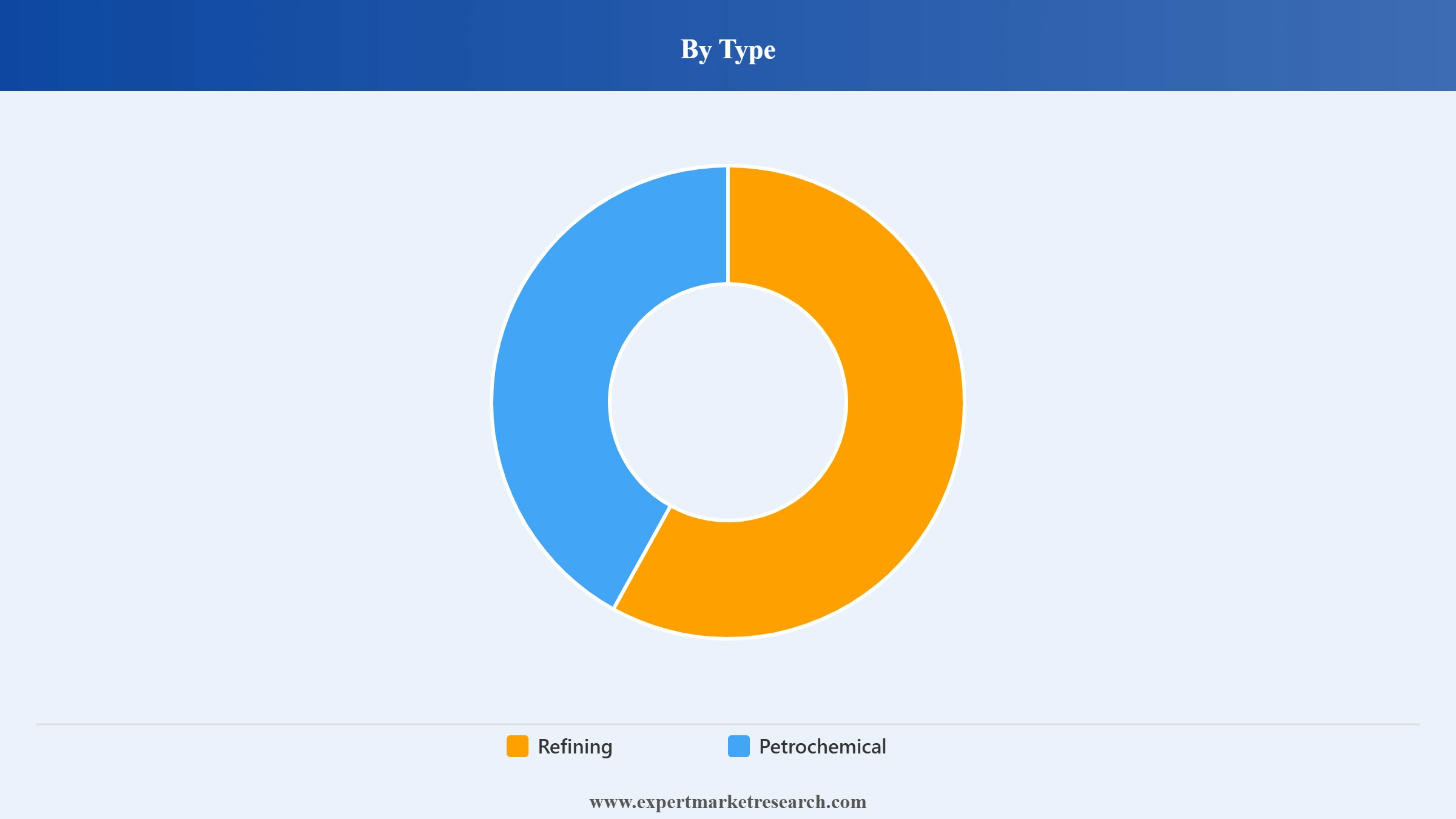
By Type: The refining segment continues to account for the dominant share of Japan’s downstream market, though its long-term trajectory is one of gradual contraction as domestic fuel consumption declines. ENEOS’s strategy of raising refinery utilization from 78% to 90% by fiscal 2027 reflects the industry’s push for operational efficiency rather than capacity expansion, focusing on squeezing greater yield from existing infrastructure. The petrochemical segment, while smaller in absolute market value, is more structurally resilient and is growing at a faster rate. Japan’s industrial base provides a stable domestic off-take for petrochemical products, while export demand across Asia provides an additional growth lever. Companies are increasingly co-locating refining and petrochemical operations to share feedstocks and maximize overall facility margin, particularly as refinery-to-chemicals conversion becomes a strategic priority.
Read more about this report - REQUEST FREE SAMPLE COPY IN PDF
By End User: Industrial end users are the dominant consumers of downstream products, accounting for the largest share of petroleum product and LPG demand. Japan’s manufacturing-heavy economy, with major clusters in automotive, steel, chemicals, and electronics, generates consistent baseload demand for refined fuels and petrochemical feedstocks. Commercial sector demand is steady, supported by the country’s extensive hospitality, food service, and retail base that relies on LPG for cooking and heating. Residential demand, while declining structurally as energy efficiency standards tighten and electric systems replace gas-fired appliances in new housing, remains supported by Japan’s large stock of older housing that depends on kerosene and LPG for heating, particularly in prefectures with harsh winters such as Hokkaido and Tohoku.
Read more about this report - REQUEST FREE SAMPLE COPY IN PDF
Kansai/Kinki is Japan’s second-largest downstream market and is emerging as a focal point for the country’s sustainable fuel transition. Osaka’s Sakai Refinery, operated by Cosmo Oil, is now home to Japan’s first large-scale commercial SAF production facility operated by Saffaire Sky Energy, making Kansai a strategically important region for cleaner downstream product development. The Keihin and Hanshin industrial belts continue to generate robust demand for refined fuels and petrochemical products from manufacturing, chemical, and logistics operations. The region’s strong port infrastructure at Osaka and Kobe facilitates both LNG imports and finished product distribution across western Japan. Government-backed initiatives promoting used cooking oil recycling and SAF adoption are creating new supply chain linkages between local municipalities and downstream producers in this
Japan’s oil and gas downstream market features a mix of domestic refiners and petrochemical producers alongside international energy companies that participate through marketing, trading, and strategic joint ventures. ENEOS Holdings stands as the clear domestic market leader by refining capacity, commanding a dominant share of Japan’s refined fuel output. The competitive landscape is being reshaped by the energy transition, as companies differentiate increasingly on their ability to produce or supply cleaner fuels including SAF and low-sulfur marine fuel, invest in LNG infrastructure, and manage refinery consolidation without sacrificing supply reliability.
International players like TotalEnergies, Shell, and BP participate primarily through marketing, trading, and joint development arrangements rather than large-scale domestic refinery ownership. Their global expertise in cleaner fuel technologies, LNG supply chains, and carbon management tools is highly valued by Japanese partners navigating the complex transition from conventional refined products toward a more diversified and lower-carbon downstream product portfolio.
Japan Petroleum Exploration Co., Ltd. (JAPEX) was founded in 1955 and is headquartered in Tokyo, Japan. JAPEX is engaged in the exploration, development, and production of oil and natural gas domestically and internationally, while also playing a supporting role in Japan’s LNG import infrastructure and downstream energy supply chain. The company is actively pursuing carbon capture and storage initiatives and renewable energy investments as part of its carbon neutrality strategy. JAPEX operates upstream assets across Canada, Japan, and the Middle East, and its downstream-adjacent activities in LNG supply and distribution make it a meaningful participant in Japan’s evolving energy landscape.
Aramco Asia Japan K.K. is a wholly owned subsidiary of Saudi Aramco, headquartered in Tokyo, Japan. The company manages Saudi Aramco’s commercial relationships, crude oil sales, and marketing activities in Japan, one of Saudi Arabia’s most important oil export destinations. Japan relies on the Middle East for approximately 90% of its crude oil imports, making Aramco’s Japan operations strategically significant for both parties. Aramco Asia Japan also supports exploration of downstream investment and partnerships in Japan, including participation in refining, petrochemical, and low-carbon energy initiatives that align with Saudi Aramco’s global portfolio diversification strategy.
Mitsui and Co., Ltd. was founded in 1947 and is headquartered in Tokyo, Japan. As one of Japan’s largest trading and investment companies, Mitsui is deeply involved across the oil and gas value chain, including LNG trading, upstream project investments, and downstream energy marketing. The company is a key participant in multiple international LNG supply agreements and is working with ENEOS on the development of a commercial SAF production facility at the ENEOS Wakayama plant, combining its global feedstock procurement capabilities with ENEOS’s refining expertise. Mitsui is also a founding member of the CLEAN coalition working to reduce methane emissions across the LNG supply chain, reflecting its active engagement in the environmental performance of Japan’s downstream energy sector.
TotalEnergies SE was founded in 1924 and is headquartered in Courbevoie, France. The company operates across the full energy value chain and is active in Japan through LNG supply partnerships, fuel marketing, and collaborative research on sustainable fuel technologies. TotalEnergies and ENEOS have a track record of joint feasibility work on SAF production, including a 2022 study exploring SAF manufacturing at the ENEOS Negishi Refinery in Yokohama. TotalEnergies contributes global expertise in feedstock procurement for SAF, carbon management, and cleaner fuel technology development, making it a valued strategic partner for Japanese downstream operators navigating the transition from conventional refined products toward a lower-carbon product portfolio.
Other key players in the market are Shell International B.V., BP plc, Chiyoda Corporation, Sumitomo Chemical Co., Ltd., and Others.
*Please note that this is only a partial list; the complete list of key players is available in the full report. Additionally, the list of key players can be customized to better suit your needs.*
Gain a clear understanding of where Japan oil and gas downstream market is headed through 2026 to 2035. Our comprehensive report covers refining and petrochemical dynamics, LNG transition strategies, sustainable aviation fuel investment, regional demand patterns, and profiles of the companies shaping Japan’s downstream energy future. Whether you are an energy company assessing Japan’s refinery landscape, an investor evaluating downstream assets, or a government agency tracking energy security policy, this report gives you the data and insight you need. Download your free sample now and explore the key opportunities in Japan’s evolving downstream energy sector.


Upto 15% Off
USD
$2499 $2249
$3999 $3599
$4999 $4249
$5999 $5099


*While we strive to always give you current and accurate information, the numbers depicted on the website are indicative and may differ from the actual numbers in the main report. At Expert Market Research, we aim to bring you the latest insights and trends in the market. Using our analyses and forecasts, stakeholders can understand the market dynamics, navigate challenges, and capitalize on opportunities to make data-driven strategic decisions.*
At 2025, the market reached an approximate value of USD 178.70 Billion.
The market is projected to grow at a CAGR of 2.20% between 2026 and 2035.
The market is projected to grow steadily during the forecast period 2026 to 2035 to reach USD 222.14 Billion by 2035.
The Japan oil and gas downstream market is supported by several structural drivers. Japan’s status as one of the world’s largest crude oil importers ensures continued operation of its refining infrastructure to meet domestic fuel demand across industrial, commercial, and residential sectors. The industrial sector, particularly energy-intensive manufacturing in steel, chemicals, and automotive, provides a stable demand base for refined fuels and petrochemical feedstocks. Government-mandated SAF adoption targets and investments by leading refiners in sustainable fuel production are creating a new commercially viable downstream product segment. Strategic investment in LNG infrastructure, as refiners reposition their portfolios away from conventional hydrocarbons, supports market value growth alongside core refining operations. Ongoing refinery upgrades to improve operational efficiency, including ENEOS’s target of raising its utilization rate to 90% by fiscal 2027, also contribute to productivity-driven revenue growth.
The Japan oil and gas downstream market is segmented by type into Refining and Petrochemical. The Refining segment dominates by market value, encompassing the production of gasoline, diesel, jet fuel, kerosene, and LPG from imported crude oil. The Petrochemical segment is growing at a faster CAGR of 2.4%, driven by sustained demand for plastics, fertilizers, and industrial chemicals from Japan’s advanced manufacturing base. Refiners are increasingly integrating petrochemical operations with refinery infrastructure to improve feedstock utilization and margin capture.
Four key trends are shaping Japan’s downstream oil and gas market. First, refiners are strategically pivoting from hydrogen and ammonia investment toward LNG and sustainable aviation fuel, reflecting commercial realism about the pace of energy transition. Second, Japan’s first large-scale domestic SAF production facility has commenced commercial operations at Cosmo Oil’s Sakai Refinery, opening a new downstream product segment aligned with aviation decarbonization mandates. Third, operational consolidation is accelerating as refiners rationalise capacity at older, less efficient facilities to improve margins and redirect capital toward growth segments. Fourth, methane emission reduction across the LNG supply chain is becoming a formal industry commitment, strengthening LNG’s environmental credibility as a transitional fuel.
The key players in the market include Japan Petroleum Exploration Co., Ltd. (JAPEX), Aramco Asia Japan K.K., Mitsui and Co., Ltd., TotalEnergies SE, Shell International B.V., BP plc, Chiyoda Corporation, Sumitomo Chemical Co., Ltd., and others.
Explore our key highlights of the report and gain a concise overview of key findings, trends, and actionable insights that will empower your strategic decisions.
| REPORT FEATURES | DETAILS |
| Base Year | 2025 |
| Historical Period | 2019-2025 |
| Forecast Period | 2026-2035 |
| Scope of the Report |
Historical and Forecast Trends, Industry Drivers and Constraints, Historical and Forecast Market Analysis by Segment:
|
| Breakup by Type |
|
| Breakup by End User |
|
| Market Dynamics |
|
| Competitive Landscape |
|
| Companies Covered |
|
Datasheet
One User
USD 2,499
USD 2,249
tax inclusive*
Single User License
One User
USD 3,999
USD 3,599
tax inclusive*
Five User License
Five User
USD 4,999
USD 4,249
tax inclusive*
Corporate License
Unlimited Users
USD 5,999
USD 5,099
tax inclusive*
*Please note that the prices mentioned below are starting prices for each bundle type. Kindly contact our team for further details.*
Flash Bundle
Small Business Bundle
Growth Bundle
Enterprise Bundle
*Please note that the prices mentioned below are starting prices for each bundle type. Kindly contact our team for further details.*
Flash Bundle
Number of Reports: 3
20%
tax inclusive*
Small Business Bundle
Number of Reports: 5
25%
tax inclusive*
Growth Bundle
Number of Reports: 8
30%
tax inclusive*
Enterprise Bundle
Number of Reports: 10
35%
tax inclusive*
How To Order

Select License Type
Choose the right license for your needs and access rights.

Click on ‘Buy Now’
Add the report to your cart with one click and proceed to register.

Select Mode of Payment
Choose a payment option for a secure checkout. You will be redirected accordingly.
Strategic Solutions for Informed Decision-Making
Gain insights to stay ahead and seize opportunities.

Get insights & trends for a competitive edge.

Track prices with detailed trend reports.

Analyse trade data for supply chain insights.

Leverage cost reports for smart savings

Enhance supply chain with partnerships.

Connect For More Information
Our expert team of analysts will offer full support and resolve any queries regarding the report, before and after the purchase.
Our expert team of analysts will offer full support and resolve any queries regarding the report, before and after the purchase.
We employ meticulous research methods, blending advanced analytics and expert insights to deliver accurate, actionable industry intelligence, staying ahead of competitors.
Our skilled analysts offer unparalleled competitive advantage with detailed insights on current and emerging markets, ensuring your strategic edge.
We offer an in-depth yet simplified presentation of industry insights and analysis to meet your specific requirements effectively.




