

Consumer Insights
Uncover trends and behaviors shaping consumer choices today
Procurement Insights
Optimize your sourcing strategy with key market data
Industry Stats
Stay ahead with the latest trends and market analysis.
The Latin America smart glass market is witnessing remarkable growth owing to the rising adoption of energy-efficient retrofitting in historic colonial buildings, where smart glass preserves aesthetics while improving thermal insulation and reducing reliance on air conditioning in warm climates. As of 2025, the market size was estimated at USD 520.16 Million and is projected to grow at a CAGR of around 10.80% through 2035. Furthermore, the growing adoption of electrochromic glass in luxury eco-resorts across Costa Rica provides dynamic shading and enhanced privacy. This technology improves energy efficiency by reducing cooling loads, aligning with the resorts’ sustainability goals while elevating guest comfort in these environmentally sensitive tourist destinations. This growing emphasis is expected to drive the market to reach USD 1450.56 Million by 2035.
The Latin America smart glass market is witnessing tremendous growth owing to growing demand for energy-efficient building technology and innovative architectural designs. Brazil and Mexico are spearheading this growth by adopting smart glass technologies like electrochromic and thermochromic glass in commercial and residential buildings. For example, in 2023, Brazil's Sao Paulo International Airport incorporated electrochromic smart glass in terminal expansions, which saved energy by approximately 25%. The market is further driven by strict government regulations regarding energy efficiency and increasing investments in green infrastructure in urban areas, thereby bolstering the growth of the Latin America smart glass market.
Recent innovations emphasize smart glass’s role in the automotive and hospitality sectors. In 2024, one of Costa Rica's top hotel chains installed dynamic smart glass panels in 50 rooms, maximizing the privacy of guests while reducing HVAC energy consumption by 18%. Moreover, Latin American automobile producers have started integrating switchable smart glass into luxury car models, providing enhanced climate comfort and passenger convenience. All these developments reflect the increasing uses and technology progress catapulting the smart glass market in the region.
Compound Annual Growth Rate
10.8%
Value in USD Million
2026-2035
Read more about this report - REQUEST FREE SAMPLE COPY IN PDF
| Latin America Smart Glass Market Report Summary |
Description |
Value |
|
Base Year |
USD Million |
2025 |
|
Historical Period |
USD Million |
2019-2025 |
|
Forecast Period |
USD Million |
2026-2035 |
|
Market Size 2025 |
USD Million |
520.16 |
|
Market Size 2035 |
USD Million |
1450.56 |
|
CAGR 2019-2025 |
Percentage |
XX% |
|
CAGR 2026-2035 |
Percentage |
10.80% |
|
CAGR 2026-2035- Market by Country |
Mexico |
11.9% |
|
CAGR 2026-2035 - Market by Country |
Brazil |
11.4% |
|
CAGR 2026-2035 - Market by Type |
Electrochromic |
12.2% |
|
CAGR 2026-2035 - Market by End Use |
Automotive |
11.6% |
| 2025 Market Share by Country | Argentina |
10.4% |
Gauzy Ltd. unveiled its smart glass facade with transparent displays, at the inauguration of the new MSC Terminal in Miami, Florida. The freshly finished Miami landmark, which has reshaped the city's skyline, is the world's largest and most technologically advanced cruise terminal.
Guardian Glass developed a brand-new factory to make solar panel glass in response to rising United States market demand. The company opened the production facility to support the increasing solar energy market, which demands high-quality PV module glass.
Saint-Gobain increased its high-performance glass market footprint with the acquisition of a European specialty glass business. The acquisition growth is expected to boost Saint-Gobain's products while also expanding its European business market footprint.
AGC Inc.'s smart glass technology was launched to improve thermal insulation as well as energy-efficient adaptive transparency features. The new breakthrough is expected to boost smart glass usage in commercial and residential buildings, particularly in North America and Europe.
In Latin America, buildings consume 21% of treated water [DM5] and 42% of electricity, while producing 25% of CO2 emissions and 65% of waste. To reduce this, governments have announced provisions for energy-efficient technologies in construction. For instance, the grants in Brazil encourage building methods for energy efficiency regarding smart glass application, boosting the overall growth of Latin America smart glass market. Likewise, the green building certification program in Mexico called LEED (Leadership in Energy and Environmental Design) encourages the use of sustainable materials such as smart glass.
Cities have gradually adopted the smart city concept with the integration of advanced technology for urban living improvements, accelerating further demand in the Latin America smart glass market. Smart glass with their innate energy efficiency features have ushered in sustainable urban development. In public buildings and transportation sector systems, smart glass regulates the temperature of internal environments and reduces energy consumption.
Technological advancements have propelled smart glass adoption in Latin America due to innovations such as nanotechnology-based smart glass development and Internet of Things (IoT) embedding smart functions, augmenting functionality and attractiveness of smart glass products. These technologies permit increased customization and control, wherein users can customize light and heat transmission as per real-time conditions.
As per the Latin America smart glass market analysis, there has been a burgeoning demand for sustainable architecture, tending toward green building materials from consumers and developers alike. Smart glasses are constructive options that can meet this demand as these offer energy-efficient aspects with minimum environmental disturbance. The capacity of the material to control light and heat transmission indicates lesser reliance on artificial heating and cooling systems, further reducing energy usage.
The automotive industry has also added to the Latin America smart glass market value. Owing to its comfort and energy efficiency aspects, smart glass is rapidly gaining broader acceptance in the automotive domain. Adjustable tinting and UV protection are among the key features that are appealing to consumers who seek comfort while driving. Increased acceptance of smart glass in vehicles by car manufacturers is expected to push higher demand for innovation, thus enhancing overall growth.
The EMR’s report titled “Latin America Smart Glass Market Report and Forecast 2026-2035” offers a detailed analysis of the market based on the following segments:
Market Breakup by Type
Key Insight: Electrochromic smart glass remains the largest category of the smart glass market in Latin America as it saves energy and has variety for unique uses. Their capability to control real-time light transmission results in lesser use of energy. This feature complements the increased emphasis on sustainability and green building practices in construction. Moreover, the dynamic visual effects produced by electrochromic glass often enhance the aesthetic beauty of the building's architecture.
Market Breakup by End Use
Key Insight: The growing consumer interest in energy efficiency and advanced in-car experience has inspired the automotive segment to take the dominant position as per the Latin America smart glass market share. Smart glass capabilities, including tint adjustability and UV protection, are attractive to consumers who seek better driving experiences. Car manufacturers are addressing this demand by integrating smart glass into their car designs, meeting contemporary consumer expectations.
Market Breakup by Country
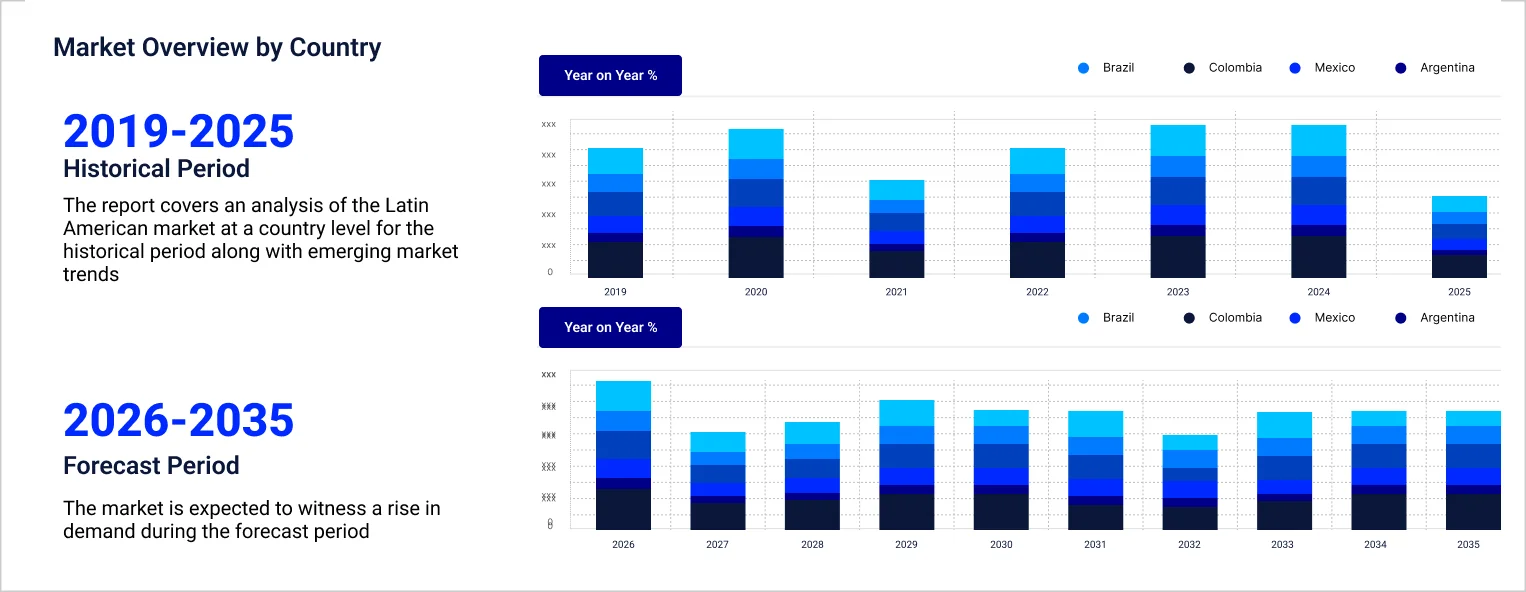
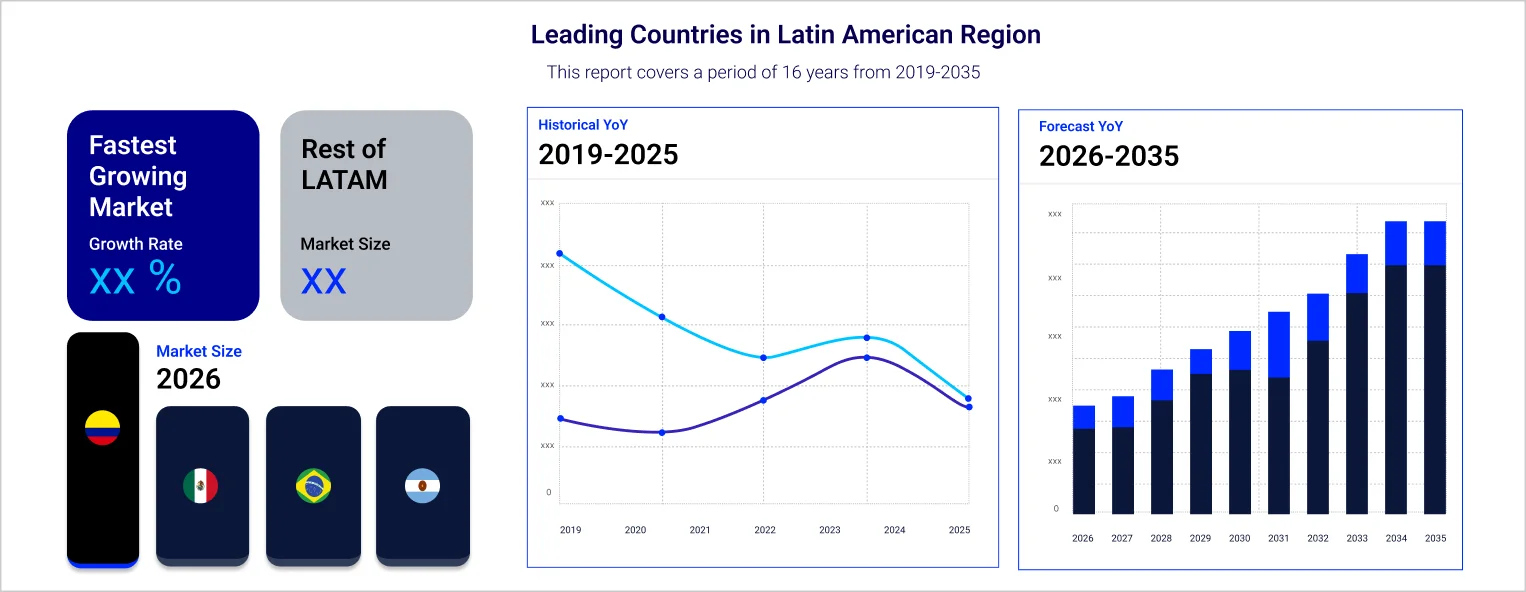
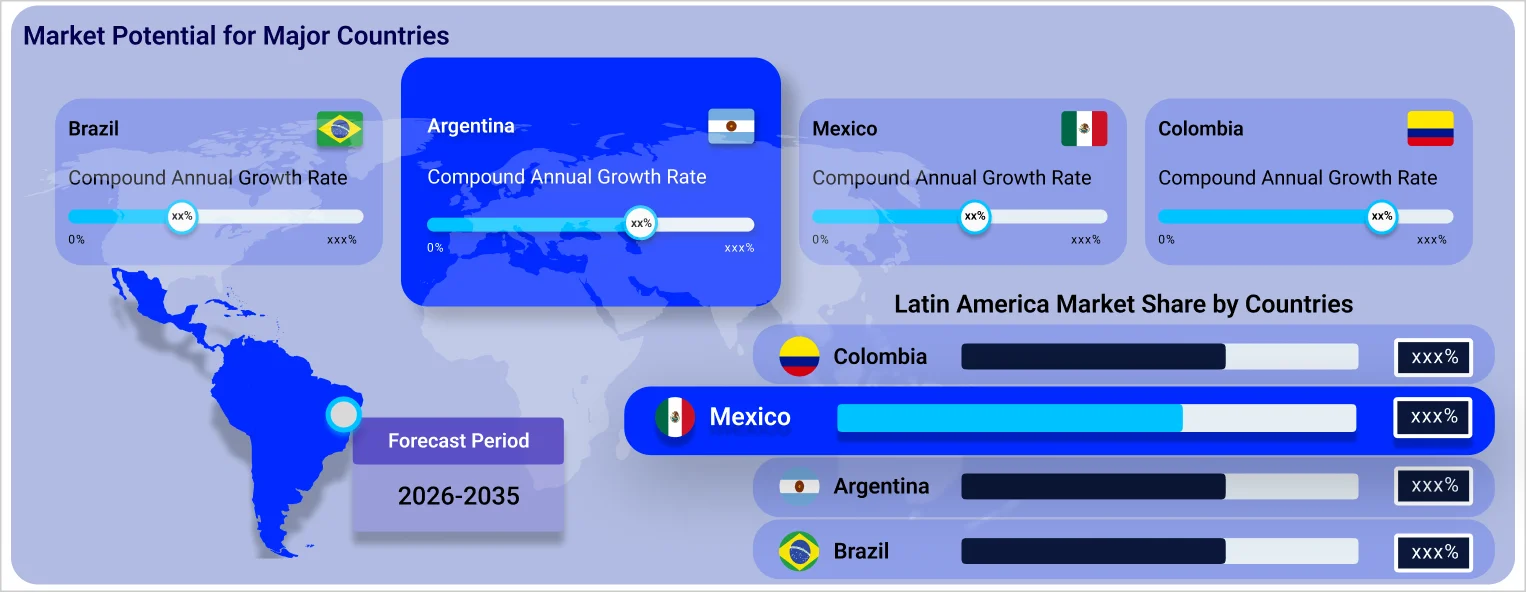
Key Insight: Brazil accounts for the biggest share in the Latin America smart glass market owing to emerging sustainability mandates and modern infrastructure projects. Smart glass has become a popular choice as practical solutions to extreme heat. These glasses help balance the intensity of sunlight while improving control over indoor climates and the effects on HVAC use. Moreover, electrochromic glass has been widely applied in commercial towers and eco-luxury housing in the country. Brazilian automotive manufacturers are also adopting smart glazing in sunroofs and windows to improve fuel economy.
Read more about this report - REQUEST FREE SAMPLE COPY IN PDF
|
CAGR 2026-2035 - Market by |
Country |
|
Mexico |
11.9% |
|
Brazil |
11.4% |
|
Argentina |
XX% |
| Others |
XX% |
By Type, Electrochromic Smart Glasses Registers the Strongest Hold in the Market
Electrochromic glass remains the largest segment in the smart glass market in Latin America. This type of glass can change light transmission properties under applied voltage, controlling the amount of light and heat entering space. Electrochromic glass has been used quite thoroughly in architectural applications, especially in commercial buildings for energy conservation and occupant comfort. The ability of the glass to transform dynamically and adjust transparency makes it a primary component in modern building designs that are meant for sustainability and energy conservation.
Suspended Particle Device (SPD) smart glass is the fastest-growing segment in the Latin America smart glass industry. Activated by an electric current, suspended particles in SPD glass control the amount of light that passes through. With fast response time and high optical clarity, SPD smart glasses are becoming highly popular in automotive and architectural applications. An increase in demand for energy-efficient solutions coupled with comfort for users is driving the adoption of SPD smart glass within the region.
By End Use, the Automotive Segment Accounts for the Dominant Share in the Market
Smart glasses find extensive applications in the automotive industry for purposes like solar control, UV defence for adaptive tinting. The expanding automotive domain has directly influenced the Latin America smart glass market growth. SPD glass has been widely adopted by companies, such as Volkswagen and Ford, for use in panoramic sunroofs as well as side windows, enhancing comfort levels in the passenger cabin and limiting air conditioning load. Along with such trends, luxury car manufacturers are further integrating voice or sensor controlled dimming features, matching the region's rising demand for connected energy-efficient vehicles.
The architecture segment which comprises residential and commercial buildings, is the fastest-growing end-use category that is propelling the Latin America smart glass market development. With increasing urbanization and more stringent green building codes, developers now opt for smart glass on energy-efficient façades and dynamic daylighting. Major projects in São Paulo and Mexico City are showcasing smart glass installations in office towers and luxury buildings, contributing to the reduction of HVAC load and sustainability. Furthermore, electrochromic glass provides both comfort and aesthetic appeal, hence their adoption in upscale urban buildings is rapidly accelerating.
Read more about this report - REQUEST FREE SAMPLE COPY IN PDF
By Country, Brazil Accounts for the Largest Market Share Due to Rapid Infrastructure Development
Growth in the Brazil smart glass market is supported by rapid infrastructure development and government-imposed energy efficiency policies. Within commercial skyscrapers and green-certified buildings across major cities like São Paulo and Rio de Janeiro, smart glass is expected to become an integral part. Additionally, the adoption of smart glazing in the automotive domain is triggered as consumers increasingly seek climate-adaptive technologies.
Mexico has emerged to be the fastest developing smart glass market in Latin America. Rising income levels and foreign investment in commercial real estate and automotive assembly plants have driven Mexican market dynamics. Plans by the government such as the "National Energy Strategy 2013-2027" include incentives on energy-saving materials, including smart glass. High-rise developments in Mexico City now boast electrochromic façades. Further, luxury carmakers are equipping their locally assembled models with SPD technology, accelerating the market growth.
The Latin America smart glass market players are majorly focused on innovations in terms of energy efficiency and rapid infrastructure development projects. In addition, Latin America smart glass companies are increasingly focusing on hybrid technologies by means of IoT sensor dynamic tinting. Companies can find opportunities in architectural collaboration. Local customization, reduced energy consumption, and low-cost retrofitting solutions serve as key focus areas. In addition, strategic partnership with construction and automotive OEMs also helps the companies reach urban markets across Brazil and Mexico. In 2024, Gentex Corporation unveiled next-generation electrochromic sunroof glass specifically designed for Latin America’s luxury vehicle market. This innovative solution uses film-based dimmable technology that automatically adjusts tint based on sunlight intensity, enhancing thermal comfort and reducing glare. It not only improves passenger experience but also supports energy efficiency by reducing the need for air conditioning. This aligns with the rising demand in Latin America for sustainable, high-tech automotive features. The launch reflects a strategic push to cater to the region’s growing environmentally conscious and tech-savvy consumer base.
Founded in 1665 and based in France, Saint-Gobain develops AI-integrated electrochromic glass. The company collaborates with green building developers to create energy-positive commercial façades in São Paulo and Buenos Aires.
Founded in 1932 and based in Michigan, United States, Guardian Industries focuses on manufacturing bases in Latin America and smart glass lines ready for retrofitting. The company takes advantage of the booming commercial retrofitting activities in Brazil and collaboration with mid-rise residential developers in Mexico.
Founded in 2009 and headquartered in Tel Aviv, Israel, Gauzy works with SPD and LC technologies while partnering with Latin American OEMs to provide smart glass for high-end cars and retail storefronts which require privacy features.
Established in 2007 and based in Michigan, United States, Pleotint deals in thermochromic self-tinting glass. Pleotint collaborates with Latin American green builders and glass distributors to deliver passive smart glass that can adapt to temperature, best suited for cities with limited energy infrastructure.
*Please note that this is only a partial list; the complete list of key players is available in the full report. Additionally, the list of key players can be customized to better suit your needs.*
Other key players in the market are Schott AG, and AGC Inc., among others.
Unlock strategic insights with our expertly curated report on the Latin America smart glass market trends 2026. Download your free sample today to explore the Latin America smart glass market 2026 and 2035, key growth drivers, and competitive landscape. Stay ahead with data-driven insights from a trusted source. Ideal for investors, policymakers, and manufacturers eyeing Southeast Asia’s rising electronics hub.


Upto 15% Off
USD
$2499 $2249
$3999 $3599
$4999 $4249
$5999 $5099


*While we strive to always give you current and accurate information, the numbers depicted on the website are indicative and may differ from the actual numbers in the main report. At Expert Market Research, we aim to bring you the latest insights and trends in the market. Using our analyses and forecasts, stakeholders can understand the market dynamics, navigate challenges, and capitalize on opportunities to make data-driven strategic decisions.*
In 2025, the Latin America smart glass market reached an approximate value of USD 520.16 Million.
The market is projected to grow at a CAGR of 10.80% between 2026 and 2035.
The key players in the market include Saint-Gobain SA, Guardian Industries Holdings, Gauzy Ltd., Pleotint LLC, Schott AG, and AGC Inc., among others.
Key strategies driving the market include leveraging local manufacturing facilities, IoT integration into smart glass, collaborating for green construction projects, customizing tint control for climate zones, and pushing smart mobility applications through Mexico and Brazil's urban development sectors.
The major types considered in the market report are electrochromic, suspended particle device (SPD), liquid crystal, passive (thermochromic and photochromic).
Explore our key highlights of the report and gain a concise overview of key findings, trends, and actionable insights that will empower your strategic decisions.
| REPORT FEATURES | DETAILS |
| Base Year | 2025 |
| Historical Period | 2019-2025 |
| Forecast Period | 2026-2035 |
| Scope of the Report |
Historical and Forecast Trends, Industry Drivers and Constraints, Historical and Forecast Market Analysis by Segment:
|
| Breakup by Type |
|
| Breakup by End Use |
|
| Breakup by Region |
|
| Market Dynamics |
|
| Competitive Landscape |
|
| Companies Covered |
|
Datasheet
One User
USD 2,499
USD 2,249
tax inclusive*
Single User License
One User
USD 3,999
USD 3,599
tax inclusive*
Five User License
Five User
USD 4,999
USD 4,249
tax inclusive*
Corporate License
Unlimited Users
USD 5,999
USD 5,099
tax inclusive*
*Please note that the prices mentioned below are starting prices for each bundle type. Kindly contact our team for further details.*
Flash Bundle
Small Business Bundle
Growth Bundle
Enterprise Bundle
*Please note that the prices mentioned below are starting prices for each bundle type. Kindly contact our team for further details.*
Flash Bundle
Number of Reports: 3
20%
tax inclusive*
Small Business Bundle
Number of Reports: 5
25%
tax inclusive*
Growth Bundle
Number of Reports: 8
30%
tax inclusive*
Enterprise Bundle
Number of Reports: 10
35%
tax inclusive*
How To Order

Select License Type
Choose the right license for your needs and access rights.

Click on ‘Buy Now’
Add the report to your cart with one click and proceed to register.

Select Mode of Payment
Choose a payment option for a secure checkout. You will be redirected accordingly.
Strategic Solutions for Informed Decision-Making
Gain insights to stay ahead and seize opportunities.

Get insights & trends for a competitive edge.

Track prices with detailed trend reports.

Analyse trade data for supply chain insights.

Leverage cost reports for smart savings

Enhance supply chain with partnerships.

Connect For More Information
Our expert team of analysts will offer full support and resolve any queries regarding the report, before and after the purchase.
Our expert team of analysts will offer full support and resolve any queries regarding the report, before and after the purchase.
We employ meticulous research methods, blending advanced analytics and expert insights to deliver accurate, actionable industry intelligence, staying ahead of competitors.
Our skilled analysts offer unparalleled competitive advantage with detailed insights on current and emerging markets, ensuring your strategic edge.
We offer an in-depth yet simplified presentation of industry insights and analysis to meet your specific requirements effectively.




