

Consumer Insights
Uncover trends and behaviors shaping consumer choices today
Procurement Insights
Optimize your sourcing strategy with key market data
Industry Stats
Stay ahead with the latest trends and market analysis.
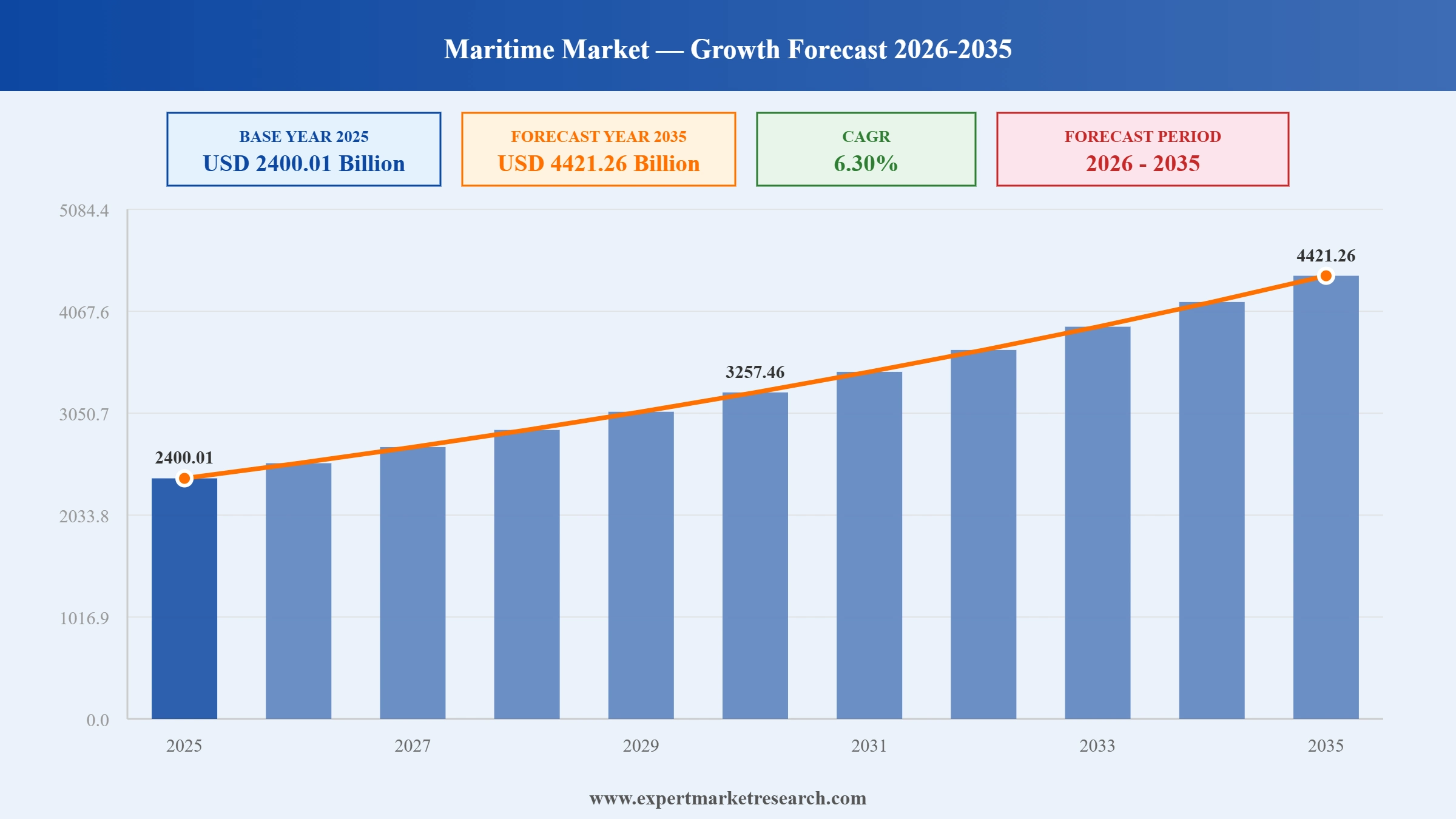
The global maritime market reached a value of USD 2400.01 Billion at 2025 and is projected to expand at a CAGR of around 6.30% during the forecast period of 2026-2035. Rising global trade volumes, major shipping line consolidation, the accelerating transition to alternative-fuel vessels, growing defence procurement, and port and cargo handling digitalisation are shaping market growth. The market is expected to reach USD 4421.26 Billion by 2035.
Read more about this report - REQUEST FREE SAMPLE COPY IN PDF
| Global Maritime Market Report Summary | Description | Value |
| Base Year | USD Billion | 2025 |
| Historical Period | USD Billion | 2019-2025 |
| Forecast Period | USD Billion | 2026-2035 |
| Market Size 2025 | USD Billion | 2400.01 |
| Market Size 2035 | USD Billion | 4421.26 |
| CAGR 2019-2025 | Percentage | XX% |
| CAGR 2026-2035 | Percentage | 6.30% |
| CAGR 2026-2035 - Market by Region | Asia Pacific | 7.6% |
| CAGR 2026-2035 - Market by Country | India | 8.7% |
| CAGR 2026-2035 - Market by Country | China | 7.2% |
| CAGR 2026-2035 - Market by Vessel Type | Container Ships | 6.9% |
| CAGR 2026-2035 - Market by End Use | Commercial | 6.9% |
| Market Share by Country 2025 | USA | XX% |
The global maritime market is in a period of rapid structural consolidation. Major carriers are executing significant M&A transactions to strengthen fleet scale, terminal access, and trade lane coverage, while geopolitical route disruptions and alliance restructuring are reshaping competitive dynamics.
ZIM shareholders approved the proposed USD 4.2 billion acquisition by Hapag-Lloyd in May 2026, advancing toward a targeted late 2026 close. Completion will lift Hapag-Lloyd's global market share to approximately 9.2% and expand its fleet to over 400 vessels with capacity exceeding 3 million TEU.
Hapag-Lloyd announced a USD 4.2 billion agreement to acquire 100% of ZIM Integrated Shipping in February 2026, one of the most significant container shipping mergers in years. The transaction would cement Hapag-Lloyd as the world's fifth-largest liner operator, strengthening its network on Transpacific, Intra-Asia, and Latin America trade lanes.
The Suez Canal Authority confirmed the return of Maersk and CMA CGM traffic to the Suez Canal in November 2025 following a partnership deal with both carriers. The resumption normalised Asia-Europe routing and reduced voyage distances after an extended period of Cape of Good Hope diversions due to Red Sea security concerns.
The Maersk and Hapag-Lloyd Gemini Cooperation went live in January 2025, dissolving the 2M partnership and establishing a joint service network targeting schedule reliability above 90% through a hub-and-spoke model. The cooperation positions both carriers to differentiate on reliability against MSC, which began operating independently with close to 20% of global capacity.
Port and cargo handling is the dominant service segment in the global maritime market, underpinned by growing containerised trade volumes. Major investments in automated terminal equipment and AI-based logistics platforms are improving throughput efficiency at the world's busiest container terminals.
Global shipbuilding and repair is experiencing a significant upturn, driven by large orders for LNG-powered, methanol-ready, and dual-fuel vessels. COSCO, MSC, Evergreen, and Hapag-Lloyd were all active in the newbuilding market in late 2025 and early 2026, accelerating fleet modernisation ahead of IMO decarbonisation targets.
Container ships are the dominant vessel type in the global maritime market, serving the majority of global manufactured goods trade. The top 10 carriers control approximately 85% of global container shipping capacity, with MSC alone commanding over 21% of global TEU capacity.
Commercial maritime is the dominant end-use segment, encompassing container shipping, bulk commodity transport, tanker operations, and passenger services. The segment is undergoing major structural transformation driven by green shipping investment, digital logistics integration, and the rapid consolidation of container shipping capacity among fewer but larger carriers.
Defence maritime spending is a growing segment, supported by elevated naval procurement budgets across the US, UK, China, India, and NATO member states. Geopolitical tensions in the Red Sea and Indo-Pacific are sustaining defence maritime investment above historical baseline levels.
The "Global Maritime Market Report and Forecast 2026-2035" by Expert Market Research offers detailed analysis based on the following segments:
Market Breakup by Services
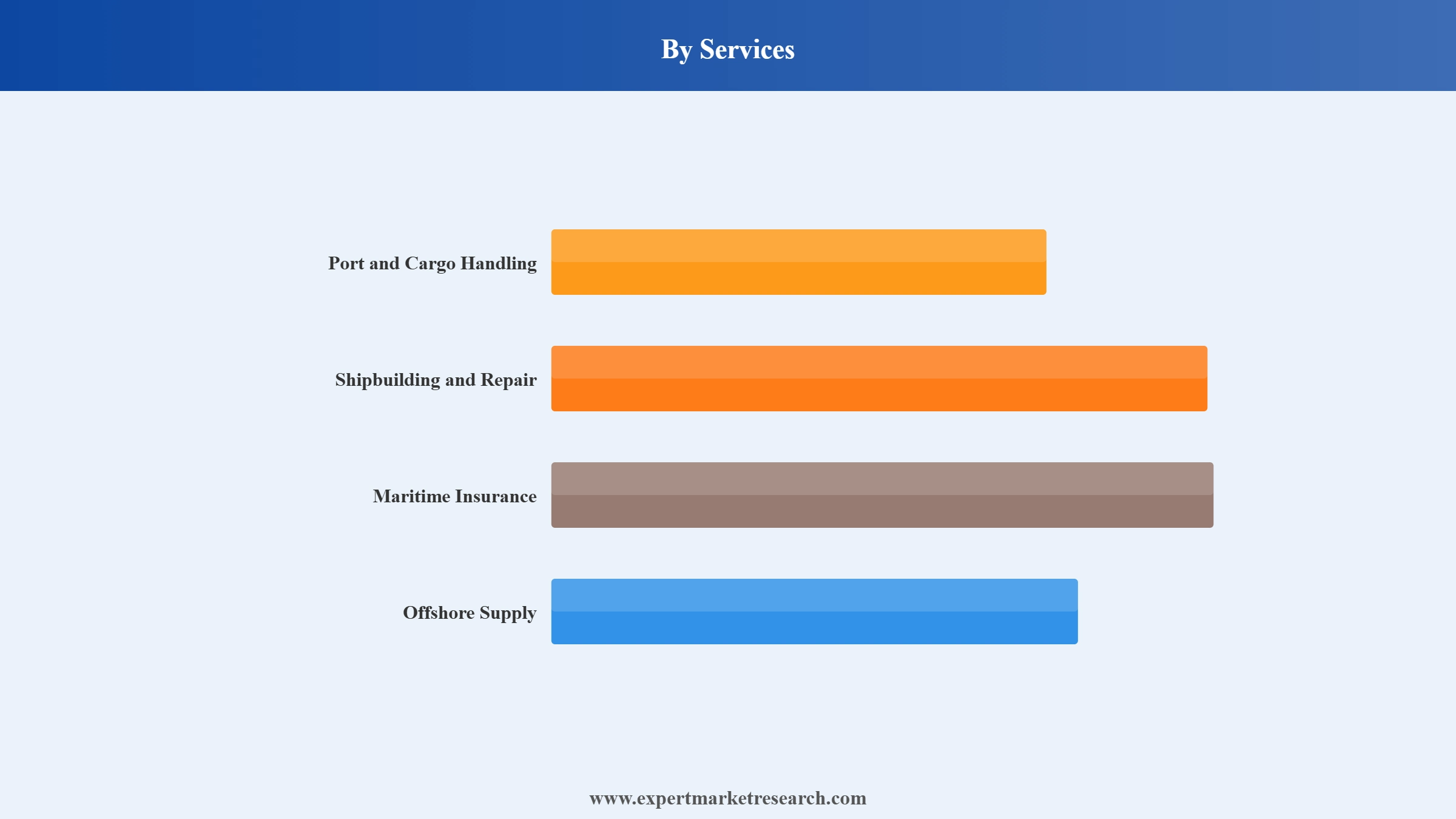
Key Insight: Port and cargo handling commands the dominant service share. Shipbuilding and repair is in a high-investment cycle through alternative-fuel vessel orders. Maritime insurance is growing via war risk premium increases. Offshore supply benefits from energy exploration and offshore wind installation demand.
Market Breakup by Vessel Type
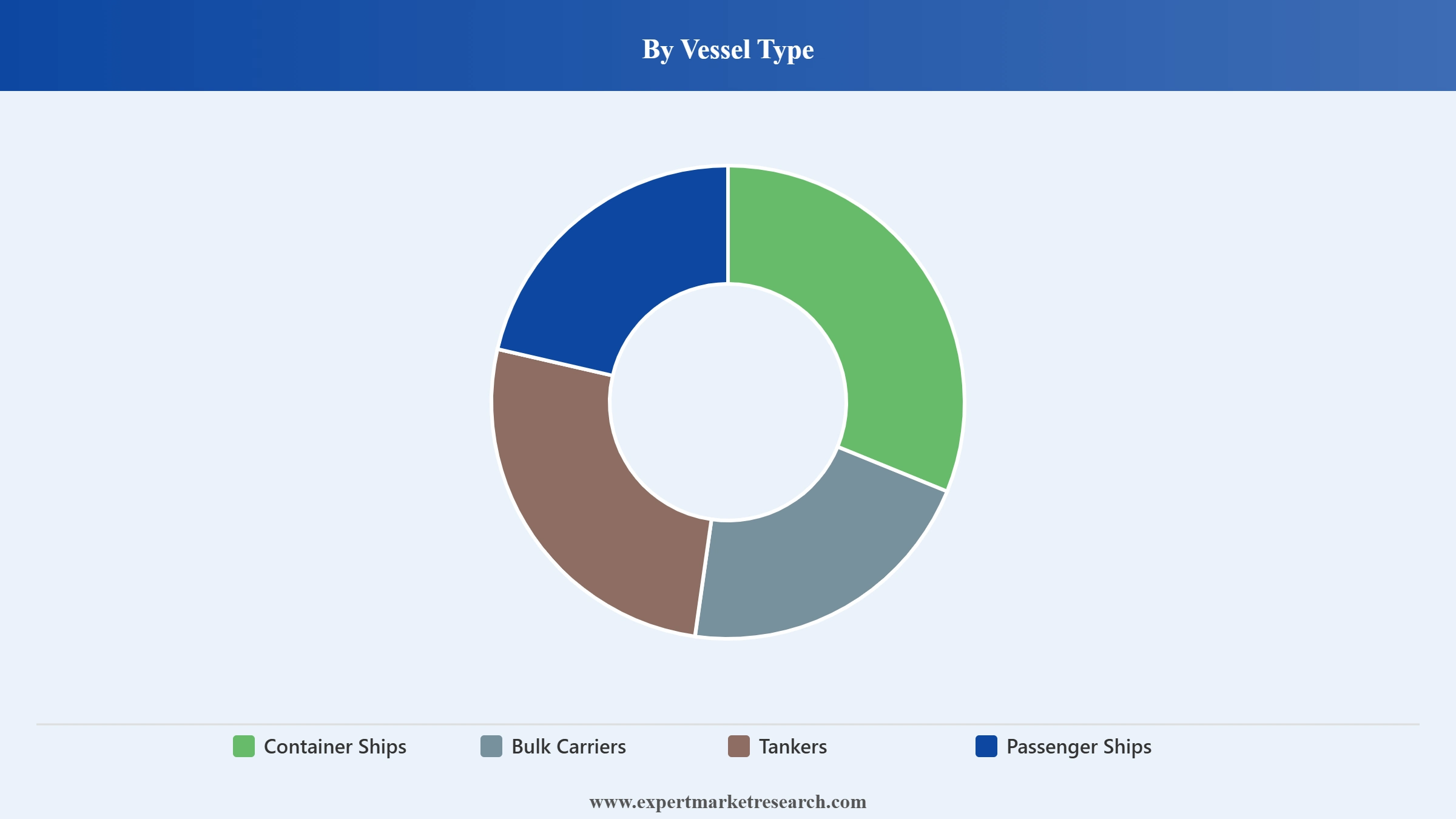
Key Insight: Container ships dominate by value and fleet investment. Bulk carriers are the second-largest category serving commodity trades. Tankers serve crude oil and LNG routes. Passenger ships are the fastest-recovering type through the post-COVID cruise demand rebound.
Market Breakup by End Use
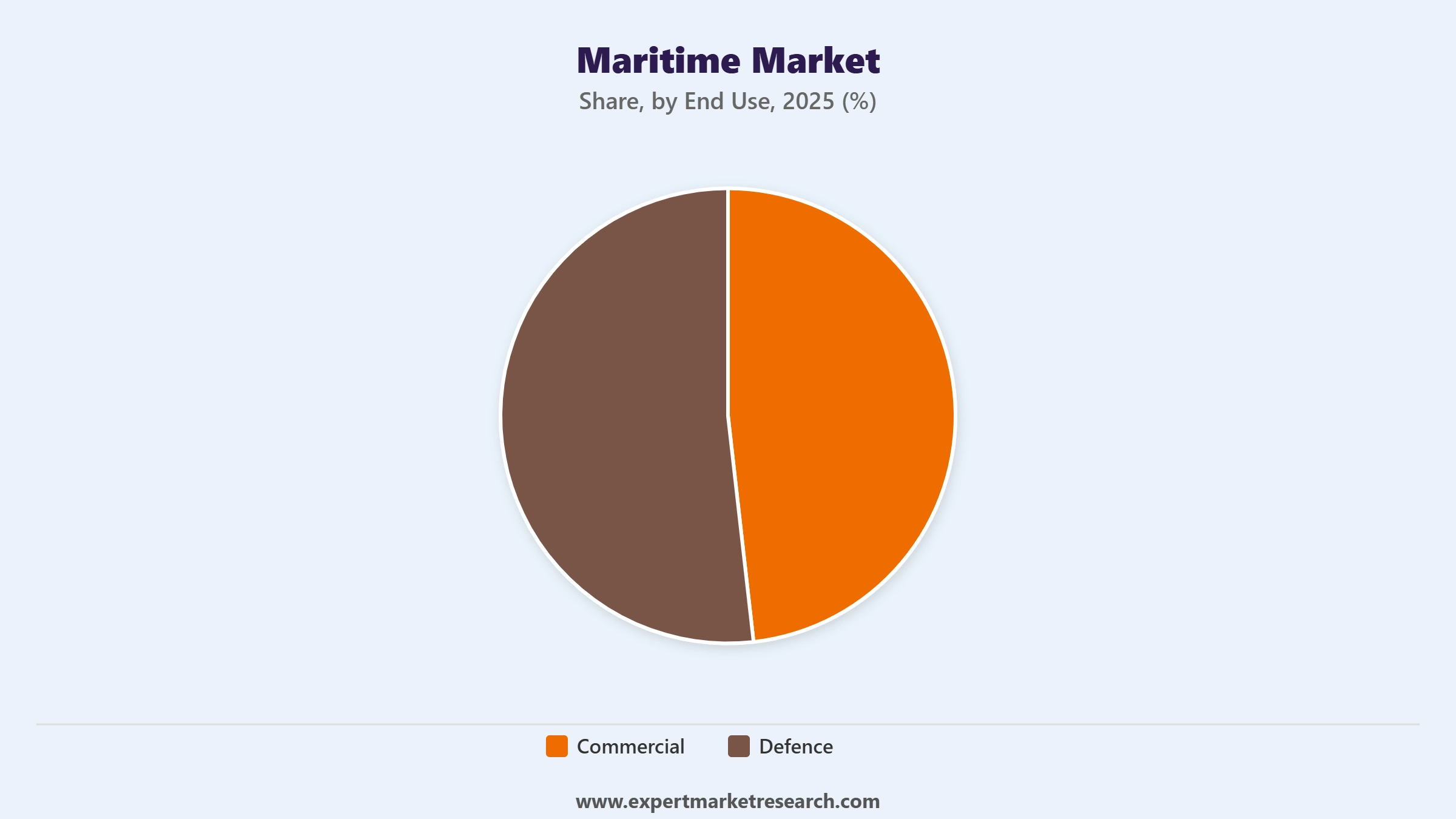
Key Insight: Commercial maritime accounts for the dominant share, encompassing cargo shipping, port operations, and passenger services. Defence is a smaller but growing segment through elevated naval procurement and expanding coast guard programs.
Market Breakup by Region
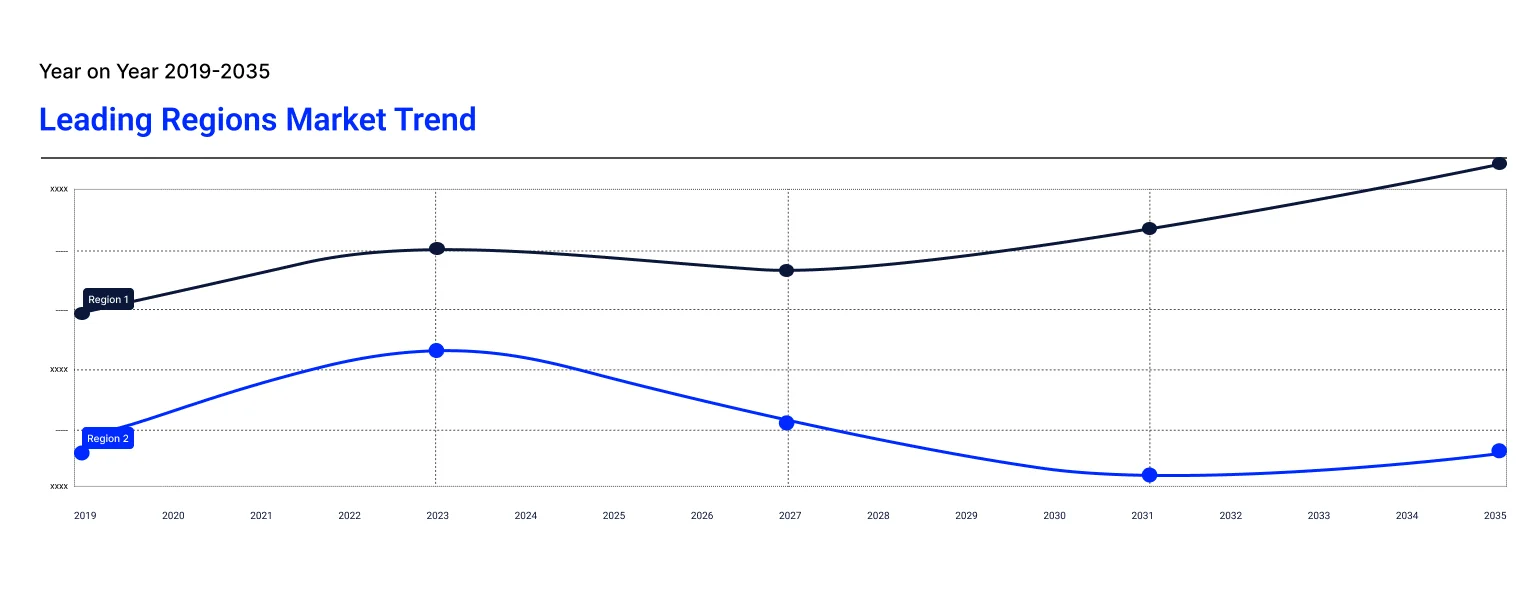
Key Insight: Asia Pacific dominates through China's shipbuilding industry and its major container hub ports. Europe is a high-value market through London's maritime insurance hub and shipbuilding in Germany and Italy. The remaining regions are growing through port investment and offshore energy demand.
| CAGR 2026-2035 - Market by | Services |
| Port and Cargo Handling | 7.0% |
| Shipbuilding and Repair | 6.6% |
| Maritime Insurance | 6.3% |
| Offshore Supply | 5.9% |
Read more about this report - REQUEST FREE SAMPLE COPY IN PDF
By Services, Port and Cargo Handling dominates the global maritime market due to its central role in processing the majority of global seaborne trade volumes
Port and cargo handling is the foundational service segment of the global maritime market. MSC's Hutchison Ports acquisition added 51 million TEU of annual handling capacity. Terminal digitisation through automated equipment and AI-based logistics is improving throughput per berth globally.
Shipbuilding and repair is in a significant investment cycle driven by LNG-powered and dual-fuel vessel orders. Maritime insurance is growing in premium value through war-risk coverage for Red Sea and Persian Gulf security incidents. Offshore supply is benefiting from growing offshore wind installation vessel demand.
Read more about this report - REQUEST FREE SAMPLE COPY IN PDF
By Vessel Type, Container Ships dominate the market as the primary vessel category serving global manufactured goods trade
Container ships account for the largest share of the global maritime market by value. The top five carriers together control more than 70% of global container shipping capacity. Ultra-large container vessels exceeding 20,000 TEU are the new standard for Asia-Europe routes, generating per-voyage cost advantages over older vessel classes.
Bulk carriers serve commodity trades for iron ore, coal, and grain, with China's steel cycle as the primary volume driver. Tankers are undergoing fleet renewal for crude oil and LNG cargo. Passenger ships are recovering strongly, with cruise bookings surpassing pre-COVID levels in North America and Europe.
Read more about this report - REQUEST FREE SAMPLE COPY IN PDF
By End Use, Commercial maritime activities account for the dominant share through cargo shipping and offshore supply services globally
Commercial maritime activities encompass cargo shipping, port operations, tanker trade, offshore supply, and passenger cruise services. The segment is being transformed by decarbonisation investment, digital logistics integration, and rapid capacity consolidation among the top five container carriers.
Defence maritime spending is growing above the overall market average. Elevated naval procurement budgets in the US, UK, China, India, and NATO nations, and expanding coast guard programs, are sustaining multi-year order cycles at major naval shipbuilders globally.
Read more about this report - REQUEST FREE SAMPLE COPY IN PDF
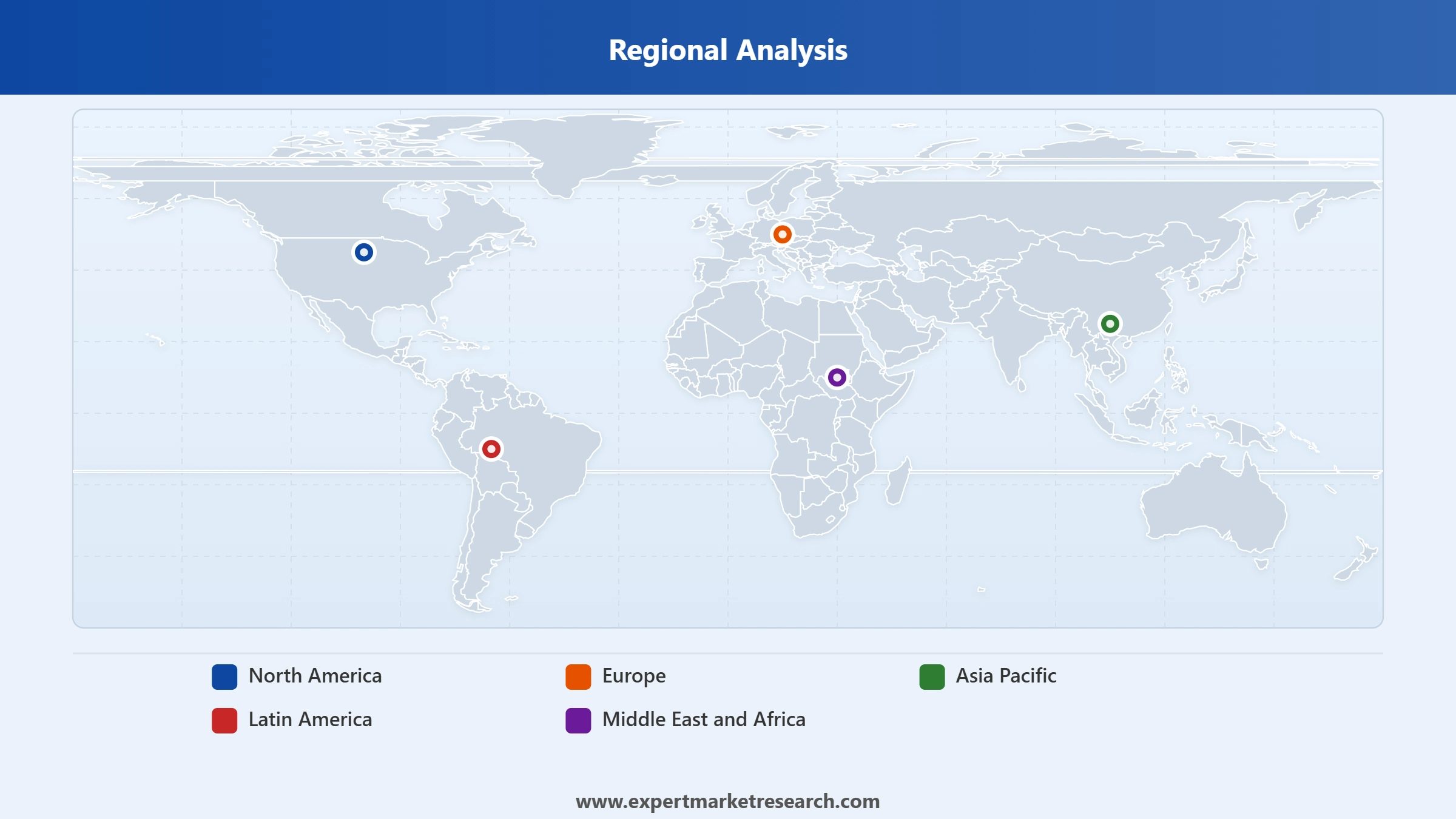
Asia Pacific dominates the global maritime market due to China's dominant shipbuilding industry, the region's major container hub ports, and the vast seaborne trade volumes generated by Asia's manufacturing and commodity economies
Asia Pacific commands the dominant share of the global maritime market. China accounts for approximately 55% of global new vessel output, and its hub ports at Singapore, Shanghai, Busan, and Ningbo rank among the world's busiest. India is the fastest-growing national market through the Sagarmala modernisation program, with Asia Pacific growing at 7.5% CAGR.
Europe is the second-most valuable region, anchored by London's maritime insurance and finance hub, shipbuilding in Germany and Italy, and container throughput through Rotterdam, Antwerp, and Hamburg. North America is driven by US naval procurement and cruise market recovery. Latin America and the Middle East and Africa are growing through port investment and offshore energy exploration.
Read more about this report - REQUEST FREE SAMPLE COPY IN PDF
The global maritime market at the container shipping level is highly consolidated, with the top 10 carriers controlling approximately 85% of deployed capacity. The landscape is undergoing rapid structural change through M&A, alliance restructuring, and vertical integration into terminal operations.
Decarbonisation and digital transformation are the defining strategic battlegrounds. Carriers investing early in LNG, methanol, and ammonia-ready vessel newbuilds are establishing long-term competitive advantages as IMO emissions regulations tighten through 2030 and 2050.
Founded in 1904 and headquartered in Copenhagen, Denmark, A.P. Moller-Maersk is the world's second-largest container shipping company with a fleet of approximately 4 million TEUs. In January 2025, Maersk launched the Gemini Cooperation with Hapag-Lloyd targeting 90%+ schedule reliability, and in November 2025 returned to the Suez Canal route following a partnership deal with the Canal Authority.
Founded in 1970 and headquartered in Geneva, Switzerland, MSC is the world's largest container shipping company, commanding over 21.6% of global capacity with a fleet exceeding 7.32 million TEUs. MSC operates independently outside the major carrier alliances and has expanded its terminal infrastructure through the acquisition of Hutchison Ports assets.
Founded in 1978 and headquartered in Marseille, France, CMA CGM is the world's third-largest container shipping group, operating 4.31 million TEUs across 723 ships as a member of the Ocean Alliance. In January 2025, CMA CGM acquired majority control of Santos Brasil, operator of Tecon Santos, the largest South American container terminal at 2.5 million TEU capacity, and operates the Ceva Logistics 3PL platform as part of its integrated supply chain strategy.
Founded in 1847 and headquartered in Hamburg, Germany, Hapag-Lloyd is the world's fifth-largest container shipping line with approximately 2.38 million TEUs of capacity. In February 2026, Hapag-Lloyd announced a USD 4.2 billion agreement to acquire ZIM Integrated Shipping. Approved by ZIM shareholders in May 2026, the transaction is targeted for late 2026 close and would lift Hapag-Lloyd's fleet to over 400 vessels and market share to approximately 9.2%.
Other key players in the market are COSCO Shipping and others.
*Please note that this is only a partial list; the complete list of key players is available in the full report. Additionally, the list of key players can be customized to better suit your needs.*
Our full report for 2026-2035 delivers the market data, segmentation analysis, and competitive intelligence to navigate the global maritime market's transformation with confidence. Reach out to access the complete report or request a customised version.


Upto 15% Off
USD
$2499 $2249
$3999 $3599
$4999 $4249
$5999 $5099


*While we strive to always give you current and accurate information, the numbers depicted on the website are indicative and may differ from the actual numbers in the main report. At Expert Market Research, we aim to bring you the latest insights and trends in the market. Using our analyses and forecasts, stakeholders can understand the market dynamics, navigate challenges, and capitalize on opportunities to make data-driven strategic decisions.*
Explore our key highlights of the report and gain a concise overview of key findings, trends, and actionable insights that will empower your strategic decisions.
| REPORT FEATURES | DETAILS |
| Base Year | 2025 |
| Historical Period | 2019-2025 |
| Forecast Period | 2026-2035 |
| Scope of the Report |
Historical and Forecast Trends, Industry Drivers and Constraints, Historical and Forecast Market Analysis by Segment:
|
| Breakup by Services |
|
| Breakup by Vessel Type |
|
| Breakup by End Use |
|
| Breakup by Region |
|
| Market Dynamics |
|
| Competitive Landscape |
|
| Companies Covered |
|
Datasheet
One User
USD 2,499
USD 2,249
tax inclusive*
Single User License
One User
USD 3,999
USD 3,599
tax inclusive*
Five User License
Five User
USD 4,999
USD 4,249
tax inclusive*
Corporate License
Unlimited Users
USD 5,999
USD 5,099
tax inclusive*
*Please note that the prices mentioned below are starting prices for each bundle type. Kindly contact our team for further details.*
Flash Bundle
Small Business Bundle
Growth Bundle
Enterprise Bundle
*Please note that the prices mentioned below are starting prices for each bundle type. Kindly contact our team for further details.*
Flash Bundle
Number of Reports: 3
20%
tax inclusive*
Small Business Bundle
Number of Reports: 5
25%
tax inclusive*
Growth Bundle
Number of Reports: 8
30%
tax inclusive*
Enterprise Bundle
Number of Reports: 10
35%
tax inclusive*
How To Order

Select License Type
Choose the right license for your needs and access rights.

Click on ‘Buy Now’
Add the report to your cart with one click and proceed to register.

Select Mode of Payment
Choose a payment option for a secure checkout. You will be redirected accordingly.
Strategic Solutions for Informed Decision-Making
Gain insights to stay ahead and seize opportunities.

Get insights & trends for a competitive edge.

Track prices with detailed trend reports.

Analyse trade data for supply chain insights.

Leverage cost reports for smart savings

Enhance supply chain with partnerships.

Connect For More Information
Our expert team of analysts will offer full support and resolve any queries regarding the report, before and after the purchase.
Our expert team of analysts will offer full support and resolve any queries regarding the report, before and after the purchase.
We employ meticulous research methods, blending advanced analytics and expert insights to deliver accurate, actionable industry intelligence, staying ahead of competitors.
Our skilled analysts offer unparalleled competitive advantage with detailed insights on current and emerging markets, ensuring your strategic edge.
We offer an in-depth yet simplified presentation of industry insights and analysis to meet your specific requirements effectively.




