

Consumer Insights
Uncover trends and behaviors shaping consumer choices today
Procurement Insights
Optimize your sourcing strategy with key market data
Industry Stats
Stay ahead with the latest trends and market analysis.
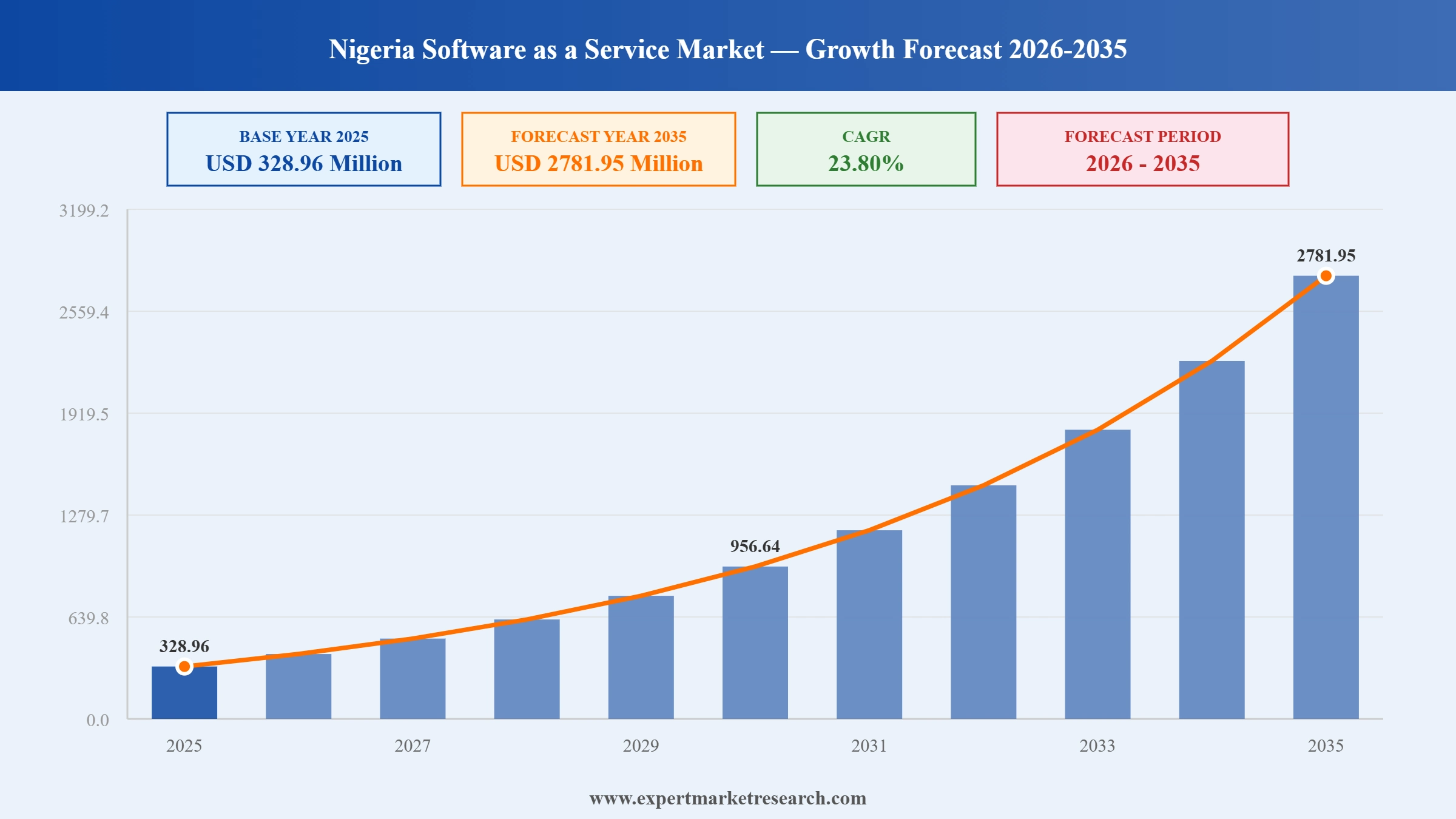
The Nigeria Software as a Service Market reached a value of USD 328.96 Million at 2025 and is projected to expand at a CAGR of around 23.80% during the forecast period of 2026-2035. With accelerating enterprise digital transformation, a growing startup ecosystem delivering locally tailored SaaS solutions, government policy driving cloud adoption across public institutions, and increasing adoption of CRM and ERP tools across Nigeria's BFSI, retail, and manufacturing sectors, the market is expected to reach USD 2781.95 Million by 2035.
Read more about this report - REQUEST FREE SAMPLE COPY IN PDF
|
Nigeria Software-as-a-Services Market Report Summary |
Description |
Value |
|
Base Year |
USD Million |
2025 |
|
Historical Period |
USD Million |
2019-2025 |
|
Forecast Period |
USD Million |
2026-2035 |
|
Market Size 2025 |
USD Million |
328.96 |
|
Market Size 2035 |
USD Million |
2781.95 |
|
CAGR 2019-2025 |
Percentage |
XX% |
|
CAGR 2026-2035 |
Percentage |
23.80% |
|
CAGR 2026-2035 - Market by Solution Type |
Supply Chain Management |
26.9% |
|
CAGR 2026-2035 - Market by End Use |
Retail |
26.9% |
Nigeria's SaaS market is at a genuinely exciting stage, moving from early adoption in large enterprises to broad-based penetration across SMEs, startups, and government institutions. Four trends are defining the shape of this expansion.
In November 2025, UniCloud Africa introduced a sovereign cloud platform specifically designed to meet Nigeria's emerging data localisation requirements and help enterprises comply with the country's National Cloud Policy framework. The platform offers locally hosted cloud infrastructure that enables businesses in finance, education, and government to migrate their operations to SaaS and cloud-based solutions while keeping data within Nigerian borders. UniCloud Africa's launch signals a maturing local cloud supply chain and reflects growing institutional awareness of the strategic and regulatory importance of data sovereignty, a factor that international SaaS providers cannot easily address without significant local infrastructure investment.
In March 2025, Nigeria's National Information Technology Development Agency (NITDA) partnered with the Japan International Cooperation Agency (JICA) to establish the Abuja Start-up Hub, a dedicated incubation facility designed to support cloud-driven tech innovation and SaaS development. The hub provides Nigerian tech startups with infrastructure support, mentorship, and connectivity resources specifically oriented toward building scalable cloud-native and SaaS-based solutions for local and regional markets. The initiative reflects the government's growing recognition of SaaS startups as core contributors to Nigeria's digital economy, and it complements the broader National Digital Economy Policy and Strategy framework that is driving institutional demand for locally developed software platforms.
In August 2024, Nigeria's National Data Protection Commission (NDPC) levied a record fine of NGN 555.8 million, equivalent to approximately USD 358,580, against Fidelity Bank for processing customers' personal data without obtaining informed consent during an account opening process. The penalty was the largest issued by the NDPC since the commission's establishment and served as a clear signal of Nigeria's increasingly serious approach to enforcing data privacy obligations. For the SaaS market, this enforcement action is significant: it is compelling financial institutions and enterprises in other regulated sectors to urgently adopt compliant, audit-ready data processing software, directly accelerating uptake of cloud-hosted SaaS platforms that offer built-in consent management and data governance capabilities.
In May 2024, MTN Nigeria entered into a partnership with Microsoft to deliver advanced data hosting solutions and Microsoft Business Licenses to Nigerian small and medium enterprises, with the explicit goal of accelerating digital transformation across the SME sector. The partnership combined MTN Nigeria's extensive telecommunications infrastructure and nationwide network coverage with Microsoft's cloud and enterprise software portfolio, including Microsoft 365 and Azure-based tools. This collaboration addressed a critical access barrier for Nigerian SMEs, which have historically faced high cost and connectivity challenges in adopting enterprise-grade SaaS platforms, and it directly widened the addressable market for cloud-delivered business software beyond large corporations into the broader SME segment.
In 2024, SeamlessHR, one of Nigeria's leading homegrown HR SaaS companies, launched a unified mobile dashboard integrating payroll processing, statutory compliance management, and employee self-service capabilities into a single platform. The launch addressed a long-standing operational gap in Nigeria's formal private sector, where payroll administration and compliance reporting have traditionally been fragmented across disconnected systems or managed manually. By combining these workflows in a mobile-first environment, SeamlessHR's product update catered directly to the scale and infrastructure realities of Nigerian businesses, offering an example of how locally built SaaS platforms are increasingly competing with global vendors by designing specifically around local regulatory and connectivity requirements.
Nigeria's National Digital Economy Policy and Strategy, running from 2020 through 2030, has positioned cloud adoption as a strategic infrastructure priority, and its effects are increasingly visible in public sector SaaS procurement. The Nigerian government has committed to digitizing public services across health, education, and administration, creating a substantial institutional demand pipeline for ERP, HRM, and document management SaaS platforms. Smart city developments such as Eko Atlantic in Lagos are accelerating enterprise software adoption by establishing technology-ready commercial environments that attract multinational tenants who bring cloud-native workflows. In March 2025, NITDA's partnership with JICA to establish the Abuja Start-up Hub further cemented government intent to build a sustainable local SaaS development ecosystem, contributing directly to Nigeria software as a service market growth across both supply and demand dimensions.
One of the most distinctive dynamics in Nigeria's SaaS market is the rise of locally built platforms specifically designed around the country's regulatory environment, naira billing preferences, mobile-first infrastructure, and SME operating realities. Companies including SeamlessHR, Kippa, and Termii are gaining rapid adoption by offering integrated payroll, accounting, inventory, and communication SaaS tools calibrated to Nigeria's business environment in ways that large global vendors struggle to replicate. Kippa's suite of SME tools, covering accounting, inventory management, and payment processing, exemplifies how local SaaS developers are expanding the market's addressable base well beyond the large enterprises and banks that initially anchored cloud adoption. This localization advantage is sustaining strong double-digit growth in SME SaaS adoption even as macroeconomic headwinds and naira volatility constrain some discretionary IT investment.
Nigeria's data protection landscape has transformed since the NDPC began active enforcement of the Nigeria Data Protection Act. The record fine of NGN 555.8 million issued to Fidelity Bank in August 2024 for unauthorized data processing sent a clear compliance signal to Nigerian enterprises across all regulated sectors. Banks, insurance companies, healthcare providers, and telecommunications operators are now under material regulatory pressure to adopt SaaS platforms with built-in consent management, audit trails, and data governance dashboards. This is creating a compliance-driven migration pathway toward cloud-hosted SaaS that is distinct from, and additive to, the cost and efficiency motivations that typically drive adoption. International SaaS vendors including SAP SE, Oracle Corp., and IBM Corp. are well-positioned to capitalize on this trend by offering enterprise compliance toolkits compatible with Nigerian data localization requirements.
Nigeria's SaaS market has historically been concentrated in Lagos and Abuja, where broadband connectivity is relatively reliable and affordable. A combination of ongoing telecom infrastructure investment, the MTN Nigeria and Microsoft partnership announced in May 2024, and increasing mobile data affordability is expanding meaningful SaaS access into secondary cities including Kano, Port Harcourt, Ibadan, and Kaduna. The emergence of mobile-first and low-bandwidth-compatible SaaS designs, such as the tools offered by Zoho and local platforms like Termii, is making cloud software viable for businesses in areas where traditional enterprise deployments remain impractical. This geographic expansion of the addressable user base represents one of the most significant medium-term growth drivers for Nigeria's SaaS market, given that the majority of Nigeria's nearly 220 million population resides outside the primary business hubs.
The Expert Market Research's report titled "Nigeria Software as a Service Market Report and Forecast 2026 to 2035" offers a detailed analysis of the market based on the following segments:
Market Breakup by Solution
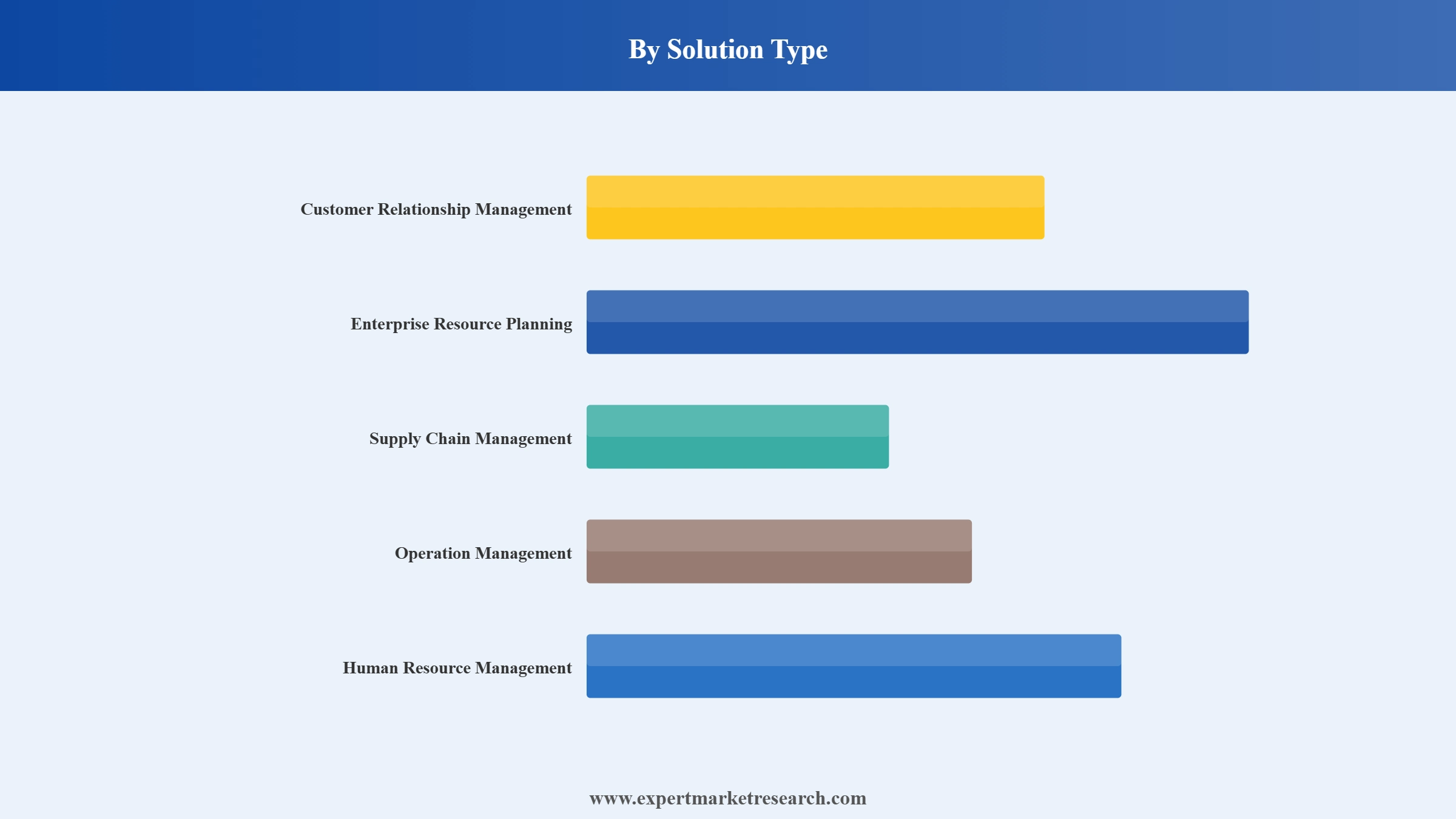
Key Insight: CRM solutions currently command the dominant market share in Nigeria's SaaS landscape, driven by their critical role in customer acquisition, retention, and engagement across high-growth sectors including retail, telecommunications, banking, and insurance. Nigerian enterprises are deploying CRM platforms from providers including Salesforce, Zoho, and Microsoft Dynamics to manage growing customer bases in a competitive marketplace where service differentiation is a primary competitive lever. ERP adoption is growing rapidly as large enterprises in manufacturing and logistics seek to modernize legacy procurement and operations systems, while HRM SaaS is gaining traction as Nigeria's formal private sector expands and statutory compliance requirements around payroll and employee data grow more complex. Local SaaS players including SeamlessHR are competing effectively in the HRM segment by offering compliant, mobile-first solutions designed specifically for Nigerian regulatory requirements.
Market Breakup by Deployment
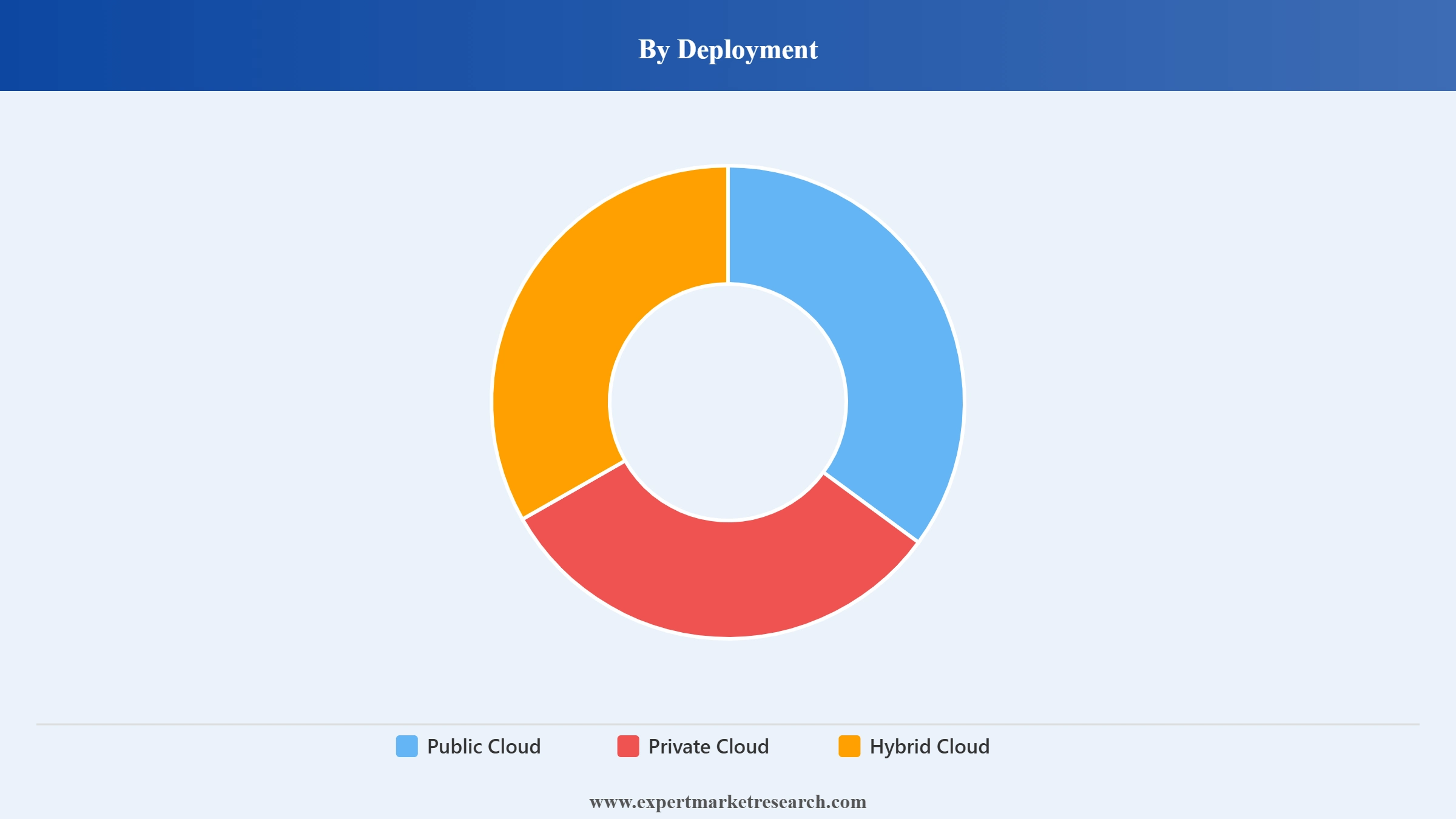
Key Insight: Public Cloud deployment commands the largest share of Nigeria's SaaS market due to its low entry cost, rapid deployment capability, and minimal infrastructure requirements, which align with the resource constraints of many Nigerian businesses adopting cloud software for the first time. Major hyperscalers including Microsoft Azure and Google Cloud provide the underlying public cloud backbone for a significant portion of SaaS solutions operating in Nigeria. Private Cloud is favored by government agencies and financial institutions handling sensitive data, where compliance with the National Data Protection Act and sector-specific regulations requires controlled data hosting environments. Hybrid Cloud is the fastest-growing deployment model, offering the flexibility to run sensitive workloads on private infrastructure while accessing public cloud resources for non-sensitive functions, a balance that regulated industries are increasingly seeking as their data governance obligations intensify.
Market Breakup by Enterprise Size
Key Insight: Large Enterprises were the first movers in Nigerian SaaS adoption and continue to account for the majority of current market value, anchored by banks, insurance companies, telecoms operators, and multinational manufacturing firms that have the IT budgets and governance structures to manage enterprise SaaS contracts with global vendors. However, the SME segment is now the fastest-growing category, driven by the emergence of affordable, mobile-first SaaS platforms such as Kippa, SeamlessHR, and Zoho's small business offerings that are designed to operate efficiently on limited bandwidth and in naira-denominated billing structures. The MTN Nigeria and Microsoft partnership, which specifically targeted SME cloud adoption, is a direct indicator of institutional recognition that SMEs represent the largest untapped SaaS opportunity in Nigeria.
Market Breakup by End Use
Key Insight: IT and Telecom and BFSI are the two largest end-use sectors in Nigeria's SaaS market, both characterized by high cloud readiness, significant regulatory compliance obligations, and large per-enterprise software budgets. BFSI institutions are deploying SaaS for CRM, risk management, and compliance reporting at scale, with enforcement actions from the NDPC creating additional urgency around data-compliant cloud migration. The Retail sector is the fastest-growing end use at a projected 26.9% CAGR, fueled by the expansion of e-commerce, the need for real-time inventory and supply chain visibility, and growing consumer expectations for personalized digital shopping experiences. Healthcare is emerging as a significant growth segment as hospital groups and health insurance providers invest in patient management and claims processing SaaS platforms, with Nigeria's National Health Insurance Authority expansion creating a demand pipeline for compliant digital health software.
Read more about this report - REQUEST FREE SAMPLE COPY IN PDF
In the solution type segmentation, CRM and ERP platforms collectively account for the largest share of Nigeria's SaaS revenue. CRM dominates primarily because Nigerian enterprises across banking, insurance, retail, and telecom treat customer relationship management as a core competitive capability rather than a back-office function. The shift from transactional customer interactions to data-driven personalization and retention management has driven adoption of global CRM suites including Salesforce and Microsoft Dynamics, alongside more affordable alternatives from Zoho that serve mid-market Nigerian businesses. ERP's share is growing as Nigeria's manufacturing sector modernizes under the government's industrialization agenda and as larger conglomerates seek integrated procurement, inventory, and financial reporting tools to operate more efficiently amid currency and supply chain pressures.
Read more about this report - REQUEST FREE SAMPLE COPY IN PDF
In the deployment segmentation, Public Cloud currently holds the dominant revenue share, reflecting the cost advantages and accessibility that make it the default starting point for most Nigerian enterprises beginning their cloud journey. However, the Hybrid Cloud segment is expanding fastest, and its growth is being led by banks and insurance companies that face strict data residency and sovereignty obligations under Nigeria's data protection framework. As local data centre capacity expands through investments by providers including UniCloud Africa and established colocation facilities in Lagos and Abuja, the hybrid model is becoming more commercially viable for a broader range of Nigerian organizations, enabling them to meet regulatory requirements without sacrificing the agility advantages of cloud-delivered software.
Read more about this report - REQUEST FREE SAMPLE COPY IN PDF
Nigeria's SaaS market features a competitive mix of global enterprise software giants and locally grown platform developers, each serving distinct segments of the market with different value propositions. Global players including SAP SE, Microsoft Corp., Oracle Corp., and IBM Corp. dominate large enterprise and regulated sector contracts through their established brand credibility, comprehensive product portfolios, and compliance-ready infrastructure. Zoho Corporation and Atlassian Corp. occupy the mid-market space, offering more accessible pricing and simpler deployment models that appeal to Nigeria's growing base of professional services firms, tech companies, and emerging enterprise buyers. Local SaaS companies including SeamlessHR, Kippa, and Termii are disrupting specific verticals by offering mobile-first, locally compliant solutions designed specifically around Nigerian business practices and regulatory requirements.
The competitive landscape is evolving as data localization requirements make local infrastructure investment a prerequisite for capturing regulated sector opportunities, narrowing the cost advantage of global vendors operating from overseas data centres. At the same time, the growing venture capital interest in Nigerian tech is accelerating the development of local SaaS platforms that can compete more broadly with international alternatives. Partnerships between global vendors and local telecoms operators, exemplified by the MTN Nigeria and Microsoft collaboration, are emerging as a key go-to-market model for expanding SaaS access into the SME and secondary city segments.
SAP SE, founded in 1972 and headquartered in Walldorf, Germany, is one of the world's leading enterprise software companies with a significant presence in Nigeria's corporate and public sector SaaS market. SAP's cloud-based ERP and HCM solutions serve Nigerian banks, oil and gas companies, telecommunications operators, and government entities seeking integrated enterprise management software with global compliance capabilities. SAP's localization of its platforms for African regulatory and accounting requirements, combined with its extensive partner network in Nigeria, positions it as a primary choice for large enterprise SaaS procurement in the country.
Microsoft Corp., founded in 1975 and headquartered in Redmond, Washington, is the leading provider of productivity and enterprise SaaS in Nigeria through its Microsoft 365 and Dynamics 365 suites. Its May 2024 partnership with MTN Nigeria to deliver Business Licenses and cloud hosting solutions to Nigerian SMEs demonstrated a deliberate strategy to expand beyond large enterprise into the wider business market. Microsoft Azure's cloud infrastructure underpins a significant share of SaaS workloads operating in Nigeria, and the company's investments in African data center capacity are improving the compliance profile of its offerings for Nigerian regulated sector customers.
Zoho Corporation Pvt. Ltd., founded in 1996 and headquartered in Chennai, India, has built a strong position in Nigeria's mid-market and SME SaaS segment through its comprehensive suite of over 55 cloud-based business applications covering CRM, accounting, HR, marketing, and project management. Zoho's competitive advantage in Nigeria lies in its self-deployable, mobile-compatible design and its significantly lower price point relative to Salesforce and SAP, making enterprise-grade SaaS accessible to a much broader range of Nigerian businesses. Its focus on integrated, affordable CRM and accounting tools has seen particular traction among professional services firms and growing retail businesses seeking to formalize their operations.
Oracle Corp., founded in 1977 and headquartered in Austin, Texas, serves Nigeria's large enterprise and public sector SaaS market through its Oracle Cloud Applications portfolio covering ERP, HCM, supply chain, and customer experience management. Oracle's Fusion Cloud ERP is deployed by major Nigerian banks and conglomerates seeking integrated financial management and compliance reporting capabilities. The company's investments in cloud infrastructure for emerging markets and its compliance-oriented cloud architecture make it a competitive option for Nigerian regulated sector enterprises that require data governance tooling alongside core enterprise software functionality.
Other key players in the market are IBM Corp., Atlassian Corp., and Others.
*Please note that this is only a partial list; the complete list of key players is available in the full report. Additionally, the list of key players can be customized to better suit your needs.*
Nigeria's SaaS market is growing at nearly 24% annually, making it one of the fastest-expanding enterprise software markets on the African continent. Whether you are a global vendor assessing market entry, an investor evaluating the SaaS startup opportunity, or an enterprise IT leader planning your cloud roadmap, our 2026 report delivers the depth of data and analysis you need to move with confidence. From segment forecasts to regulatory landscape insights and competitive benchmarking, everything is here. Download your free sample today and explore the opportunities in Nigeria's thriving software as a service sector.


Upto 15% Off
USD
$2499 $2249
$3999 $3599
$4999 $4249
$5999 $5099


*While we strive to always give you current and accurate information, the numbers depicted on the website are indicative and may differ from the actual numbers in the main report. At Expert Market Research, we aim to bring you the latest insights and trends in the market. Using our analyses and forecasts, stakeholders can understand the market dynamics, navigate challenges, and capitalize on opportunities to make data-driven strategic decisions.*
In 2025, the Nigeria software as a service market reached an approximate value of USD 328.96 Million.
The market is projected to grow at a CAGR of 23.80% between 2026 and 2035.
The key players in the market include SAP SE, IBM Corp., Microsoft Corp., Oracle Corp., Zoho Corporation Pvt. Ltd., and Atlassian Corp., among others.
Key strategies driving the market include focusing on localizing solutions, enhancing cybersecurity protocols, using AI for automation, expanding into lesser-known industries, and creating partnerships with Nigerian tech incubators and government agencies.
The retail end use is gaining traction and anticipated to expand with a 26.9% CAGR through 2035.
Explore our key highlights of the report and gain a concise overview of key findings, trends, and actionable insights that will empower your strategic decisions.
| REPORT FEATURES | DETAILS |
| Base Year | 2025 |
| Historical Period | 2019-2025 |
| Forecast Period | 2026-2035 |
| Scope of the Report |
Historical and Forecast Trends, Industry Drivers and Constraints, Historical and Forecast Market Analysis by Segment:
|
| Breakup by Solution Type |
|
| Breakup by Deployment |
|
| Breakup by Enterprise |
|
| Breakup by End Use |
|
| Market Dynamics |
|
| Competitive Landscape |
|
| Companies Covered |
|
Datasheet
One User
USD 2,499
USD 2,249
tax inclusive*
Single User License
One User
USD 3,999
USD 3,599
tax inclusive*
Five User License
Five User
USD 4,999
USD 4,249
tax inclusive*
Corporate License
Unlimited Users
USD 5,999
USD 5,099
tax inclusive*
*Please note that the prices mentioned below are starting prices for each bundle type. Kindly contact our team for further details.*
Flash Bundle
Small Business Bundle
Growth Bundle
Enterprise Bundle
*Please note that the prices mentioned below are starting prices for each bundle type. Kindly contact our team for further details.*
Flash Bundle
Number of Reports: 3
20%
tax inclusive*
Small Business Bundle
Number of Reports: 5
25%
tax inclusive*
Growth Bundle
Number of Reports: 8
30%
tax inclusive*
Enterprise Bundle
Number of Reports: 10
35%
tax inclusive*
How To Order

Select License Type
Choose the right license for your needs and access rights.

Click on ‘Buy Now’
Add the report to your cart with one click and proceed to register.

Select Mode of Payment
Choose a payment option for a secure checkout. You will be redirected accordingly.
Strategic Solutions for Informed Decision-Making
Gain insights to stay ahead and seize opportunities.

Get insights & trends for a competitive edge.

Track prices with detailed trend reports.

Analyse trade data for supply chain insights.

Leverage cost reports for smart savings

Enhance supply chain with partnerships.

Connect For More Information
Our expert team of analysts will offer full support and resolve any queries regarding the report, before and after the purchase.
Our expert team of analysts will offer full support and resolve any queries regarding the report, before and after the purchase.
We employ meticulous research methods, blending advanced analytics and expert insights to deliver accurate, actionable industry intelligence, staying ahead of competitors.
Our skilled analysts offer unparalleled competitive advantage with detailed insights on current and emerging markets, ensuring your strategic edge.
We offer an in-depth yet simplified presentation of industry insights and analysis to meet your specific requirements effectively.




