

Consumer Insights
Uncover trends and behaviors shaping consumer choices today
Procurement Insights
Optimize your sourcing strategy with key market data
Industry Stats
Stay ahead with the latest trends and market analysis.
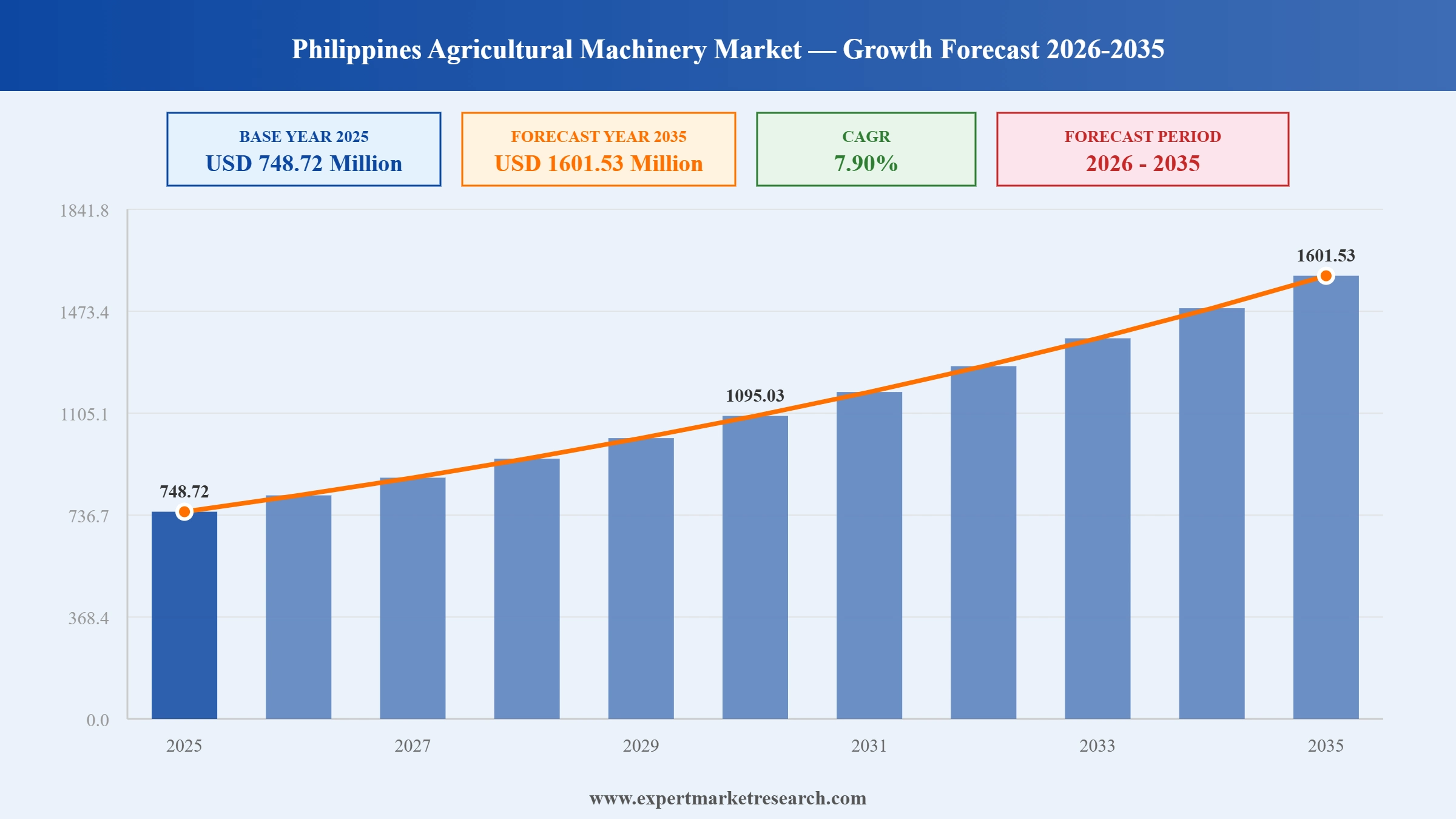
The Philippines Agricultural Machinery Market reached a value of USD 748.72 Million at 2025 and is projected to expand at a CAGR of around 7.90% during the forecast period of 2026-2035. With government-backed mechanization programs expanding smallholder access, growing precision agriculture technology adoption, large-scale investments in post-harvest and agro-processing infrastructure, and rising demand for rice transplanters and harvesting machinery in key grain-producing provinces, the market is expected to reach USD 1601.53 Million by 2035.
Read more about this report - REQUEST FREE SAMPLE COPY IN PDF
|
Philippines Agricultural Machinery Market Report Summary |
Description |
Value |
|
Base Year |
USD Million |
2025 |
|
Historical Period |
USD Million |
2019-2025 |
|
Forecast Period |
USD Million |
2026-2035 |
|
Market Size 2025 |
USD Million |
748.72 |
|
Market Size 2035 |
USD Million |
1601.53 |
|
CAGR 2019-2025 |
Percentage |
XX% |
|
CAGR 2026-2035 |
Percentage |
7.90% |
|
CAGR 2026-2035 - Market by Type |
Rice Transplanters |
8.9% |
|
CAGR 2026-2035 - Market by Application |
Land Development and Seed Bed Preparation |
8.4% |
The Philippines Agricultural Machinery Market is being shaped by a convergence of government-led mechanization policy, agricultural labor shortages, smart farming technology adoption, and investments in post-harvest infrastructure. These trends are collectively accelerating the transformation of Filipino farming from predominantly manual, smallholder-led practices to increasingly mechanized, technology-assisted systems.
The Department of Agriculture announced an expansion of its agricultural mechanization subsidy program in July 2025, enabling more smallholder farmers to access tractors, harvesters, and power tillers at subsidized cost. The initiative included extended financing terms and localized dealer support to ensure effective equipment distribution, operation training, and maintenance coverage across provincial and rural areas. The expanded program reflects the government's sustained commitment to bridging the affordability gap that has historically prevented smaller farm operators from investing in labor-saving machinery, particularly as agricultural labor shortages intensify across the country's major farming provinces.
The Philippine Rice Research Institute (PhilRice), under the Department of Agriculture, presented agricultural drones to 50 farmer-cooperators at a PalaySikatan caravan in Quezon Province, in collaboration with AgriDOM Solutions. The showcase demonstrated the drones' capabilities in seed broadcasting and fertilizer application over a 26-hectare area, showcasing the practical benefits of smart agriculture in modern rice farming. The distribution of drones to farming cooperatives reflects the government's strategy to accelerate precision agriculture adoption at the grassroots level by providing hands-on technology access to organized farmer groups.
A delegation from the Philippines Department of Agriculture, led by Secretary Francisco P. Tiu Laurel Jr., visited the Korea Agricultural Machinery Industry Cooperative (KAMICO) to explore investment opportunities and policy alignment for a proposed 20-hectare Agriculture Machinery Industry Complex in Nueva Ecija. The initiative is designed to make the Philippines an exporter of farm equipment while simultaneously boosting domestic food production. The project would draw foreign investment, create employment in Central Luzon, and facilitate the transfer of advanced agricultural machinery manufacturing technologies from Korea to the Philippines.
The Department of Science and Technology launched the ELEV8PH program incorporating a Smart Agriculture component that leverages drones, sensors, and data analytics platforms to enhance agricultural productivity across the Philippines. The program targets the integration of Internet of Things-enabled machinery and AI-powered crop monitoring tools into mainstream farming practices, addressing challenges including pest identification, soil health assessment, and precision water management. ELEV8PH forms part of a broader government strategy to digitally transform Philippine agriculture and close the technology adoption gap between large commercial farms and smallholder operations.
The International Rice Research Institute (IRRI) and XAG, a leading agricultural technology company, signed a Memorandum of Understanding to advance agricultural automation and precision farming in the Philippines using drone technology. The partnership aims to test smart agricultural technologies in rice-based cropping systems through collaborative research and field experimentation, with the goal of validating the scalability of drone-assisted farming for rice production. The IRRI-XAG collaboration brings significant global expertise in rice agronomy and agricultural drone applications to the Philippine context, strengthening the country's precision agriculture knowledge base.
Government-backed mechanization initiatives remain the primary structural driver of the Philippines agricultural machinery market. Programs including the Philippine Mechanization Program, the Rice Competitiveness Enhancement Fund Mechanization component, and Department of Agriculture subsidy expansions are systematically reducing the cost barrier for smallholder farmers to acquire modern equipment. As of July 2025, the DA expanded its subsidy program with extended financing terms and localized dealer support. The Department of Agriculture also launched a USD 30 million agri-machinery assembly center project in collaboration with KAMICO, aimed at making the Philippines both a domestic machinery user and an exporter of farm equipment, which would further strengthen supply availability and reduce import dependence for the sector.
Smart agriculture technologies, including drone-based crop monitoring, GPS-enabled machinery, IoT sensors for soil and weather data collection, and AI-powered farm management platforms, are gaining traction across the Philippines as the government and private sector invest in digital agriculture transformation. In February 2025, the DOSt launched ELEV8PH incorporating smart agriculture components, while the IRRI-XAG drone partnership in January 2025 brought internationally validated precision farming methods to Philippine rice systems. The Philippines' AI Readiness Index improved from 65th to 56th globally between 2023 and 2024, reflecting a broader digital infrastructure improvement that is enabling more rapid integration of smart technologies into agricultural machinery and farm operations.
A persistent and widening agricultural labor shortage is one of the most powerful structural catalysts for Philippines agricultural machinery market growth. Rural-to-urban migration continues to drain the agricultural workforce, particularly among younger workers who prefer urban employment opportunities, leaving farming operations increasingly dependent on mechanized alternatives for land preparation, planting, and harvesting tasks. This labor gap is especially acute during peak planting and harvesting seasons, where delayed operations can directly reduce crop yields and farm income. Government mechanization programs that subsidize machinery for farming cooperatives and smallholder groups are increasingly framed as both productivity tools and labor substitutes, reinforcing the long-term demand trajectory for tractors, rice transplanters, and combine harvesters across the country.
Post-harvest losses remain a significant challenge in Philippine agriculture, with estimates suggesting substantial rice and corn losses annually due to inadequate threshing, drying, and storage equipment. Investment in post-harvest and agro-processing machinery is expanding across Luzon and Mindanao, driven by a combination of government-funded post-harvest centers, private agribusiness investments, and cooperative machinery acquisition programs. The Department of Agriculture's collaboration with KAMICO for the proposed Agriculture Machinery Industry Complex in Nueva Ecija includes a focus on post-harvest equipment manufacturing. Modern post-harvest machinery reduces food waste, improves grain quality and marketability, and strengthens farm income at the cooperative and community level, making it a high-priority investment category for both public and private stakeholders in Philippine agriculture.
Read more about this report - REQUEST FREE SAMPLE COPY IN PDF
The report of the Expert Market Research report titled "Philippines Agricultural Machinery Market Report and Forecast 2026 to 2035" offers a detailed analysis of the market based on the following segments:
Market Breakup by Product Type
Key Insight: Tractors are the foundational product category in the Philippines agricultural machinery market, essential for land preparation, seedbed creation, and general power transmission across rice, corn, sugarcane, and vegetable farming systems. Both compact utility tractors for smallholder farms and larger four-wheel-drive models for commercial operations are in demand. Rice transplanters have seen significant growth driven by government subsidies under the RCEF Mechanization Program, which prioritizes rice production efficiency. Harvesting machinery, including combine harvesters and threshing equipment, is central to reducing post-harvest losses and processing efficiency. Haying and forage machinery serves the livestock feed production sector, which is expanding alongside growing domestic demand for animal protein.
Market Breakup by Application
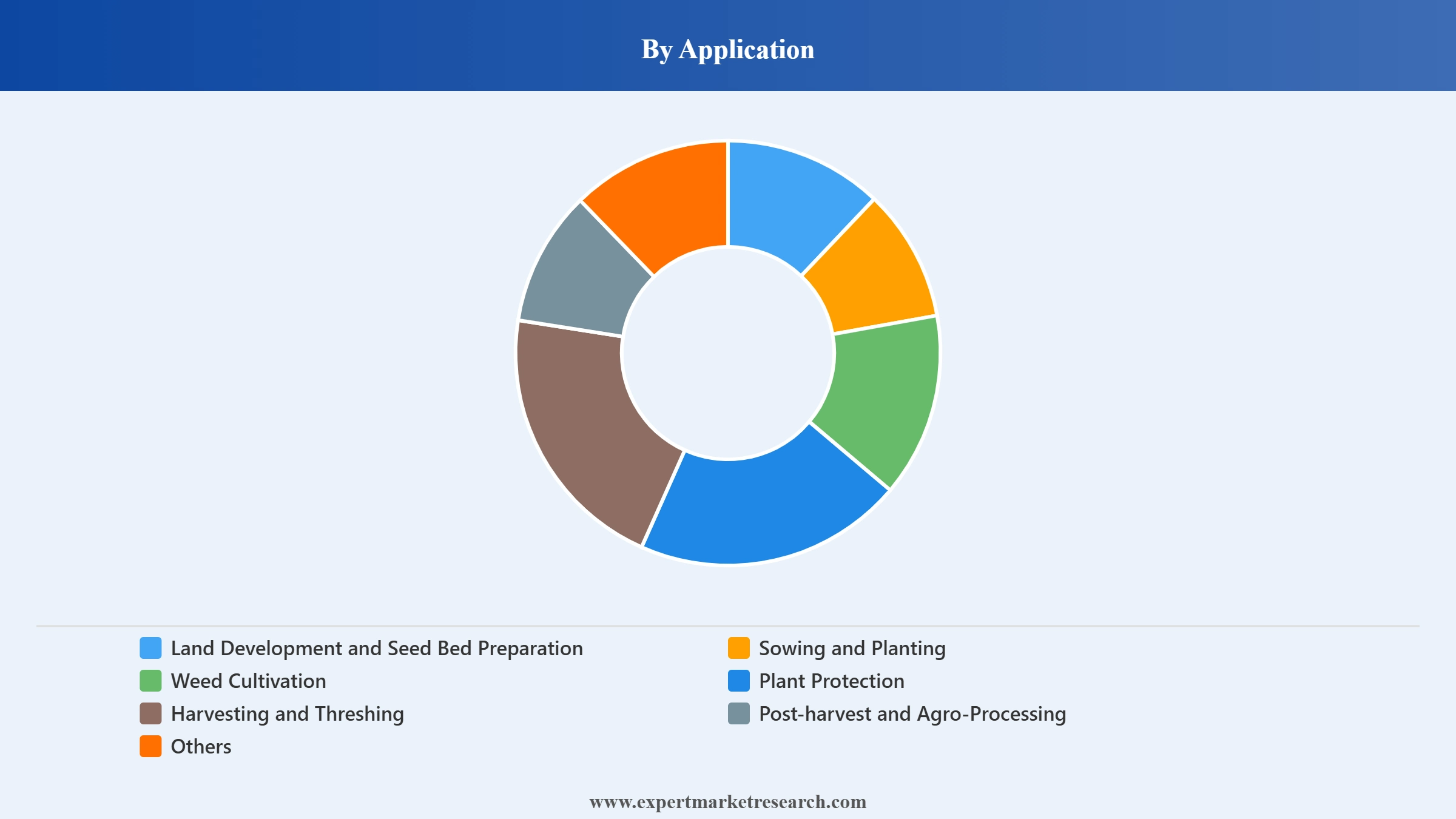
Key Insight: Land Development and Seed Bed Preparation is among the foundational application segments, with tractor-driven implements central to initial field preparation for seasonal crops. Harvesting and Threshing is one of the highest-priority mechanization areas, as reducing post-harvest losses is a national food security objective. The government's focus on improving combine harvester availability through subsidy programs directly targets this segment. Post-harvest and Agro-Processing machinery investment is expanding rapidly as the government and private sector invest in grain dryers, milling equipment, and cold chain storage. Sowing and Planting, particularly rice transplanting, has received significant government investment through the RCEF program, making rice transplanters one of the fastest-growing product categories.
By Product Type
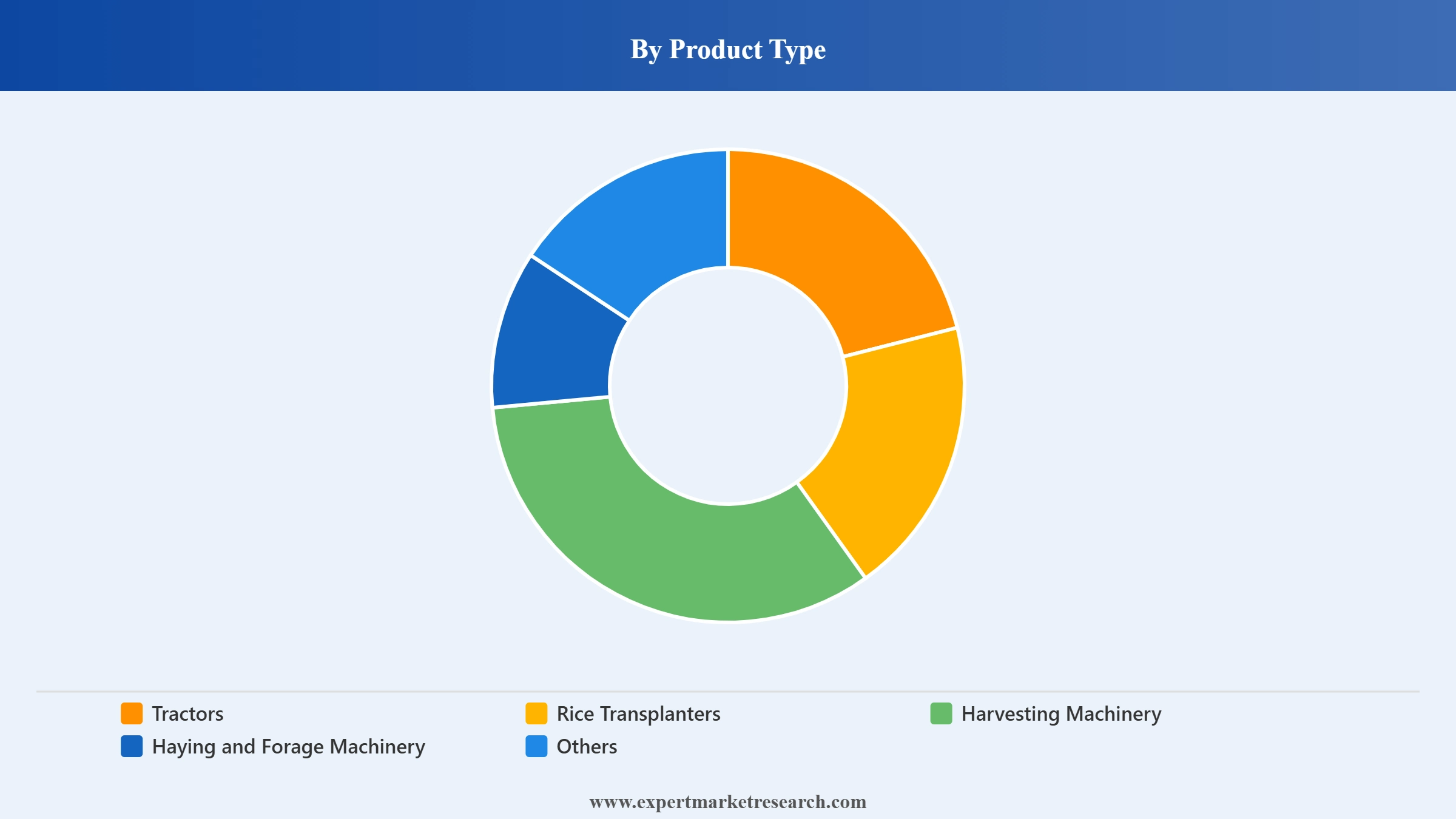
Tractors command the largest share of the Philippines agricultural machinery market, driven by their versatility across the full crop production cycle and their central role in government mechanization subsidy programs. The availability of compact and sub-compact tractor models from manufacturers like Kubota Philippines has expanded tractor access to smallholder farms with small land parcels, which represent the majority of Philippine farm units. Rice Transplanters are the second-fastest growing product category, receiving targeted support through the RCEF Mechanization Program's annual funding of PHP 30 billion from 2026. Harvesting Machinery, including combine harvesters and threshers, is the third key category by value, with the PhilMech initiative specifically focused on improving locally manufactured harvesting equipment to support rice and corn production.
Read more about this report - REQUEST FREE SAMPLE COPY IN PDF
By Application
Harvesting and Threshing is the most strategically important application segment given the Philippines' focus on reducing post-harvest losses in its staple rice and corn crops. Government programs including the RCEF and the DA's post-harvest centers are directing machinery investment into this segment. Land Development and Seed Bed Preparation, led by tractor adoption, forms the largest application segment by volume as it underpins all subsequent farming activities. Post-harvest and Agro-Processing is the fastest-growing application, with investments in grain drying, milling, and cold storage equipment rising significantly as the government prioritizes food quality, shelf life, and value-added processing for domestic consumption and export markets.
Read more about this report - REQUEST FREE SAMPLE COPY IN PDF
The Philippines Agricultural Machinery Market is led by major Japanese and international manufacturers with established local subsidiaries and distribution networks, alongside a small number of domestic players and regional importers. The market is shaped by government procurement programs that favor machinery brands with proven local service networks and spare parts availability, making dealer presence and after-sales support critical competitive factors.
Competition is intensifying around precision agriculture capabilities, as the government's push for smart farming technologies creates demand for machinery integrated with GPS, telematics, and data analytics. Companies that can combine reliable traditional machinery with digital add-ons such as yield monitoring and predictive maintenance are positioned to capture premium segments. Leasing and rental models are also emerging as a competitive front as manufacturers and dealers work with cooperatives and financial institutions to create flexible acquisition pathways for smallholder farmers.
Ford Tractor Philippines Inc. is the authorized distributor of Ford and New Holland tractors and agricultural machinery in the Philippines, serving the country's diverse farming sectors from smallholder rice operations to large commercial farms. The company offers a range of tractor models across power categories suited to Philippine farm conditions, along with related implements and precision farming attachments. Its established dealer network across major agricultural provinces supports after-sales service and spare parts availability, which are critical factors in machinery adoption decisions by Philippine farmers.
Kubota Philippines, Inc. is the local subsidiary of Japan-based Kubota Corporation, one of the world's leading manufacturers of agricultural machinery and equipment. Kubota has a deep history in the Philippine market, particularly in rice production mechanization, with a comprehensive product lineup covering compact tractors, rice transplanters, combine harvesters, and threshers specifically designed for Philippine paddy farming conditions. Kubota's extensive dealer and service network across the archipelago, combined with government recognition of its machinery for RCEF subsidy programs, makes it one of the most influential players in the country's agricultural mechanization drive.
CLAAS is a Germany-based global leader in agricultural machinery, founded in 1913, specializing in combine harvesters, forage harvesters, tractors, and hay equipment. In the Philippines, CLAAS equipment is relevant for commercial-scale farming operations involving rice, corn, and forage crops, offering high-capacity harvesting solutions that smaller domestic machinery manufacturers cannot match. CLAAS's global engineering excellence, combined with precision farming integrations such as GPS-guided operation and yield mapping, positions it as a technology partner for the Philippines' larger agribusiness sector seeking to maximize operational efficiency and data-driven farm management.
Yanmar, founded in 1912 and headquartered in Osaka, Japan, is a global manufacturer of compact agricultural machinery, diesel engines, and energy solutions with a strong presence in Southeast Asian rice farming markets. In the Philippines, Yanmar's compact tractors, rice transplanters, and small combine harvesters are particularly well-suited to the country's predominantly small and fragmented farm plots. Yanmar's products are recognized by the Philippine government for inclusion in mechanization subsidy programs, and the company maintains an active dealer network that provides farmer training and technical support across key agricultural provinces.
Other key players in the market are KUHN Group, Adamco, and Others.
*Please note that this is only a partial list; the complete list of key players is available in the full report. Additionally, the list of key players can be customized to better suit your needs.*
The Philippines agricultural machinery sector is transforming at an unprecedented pace, driven by government ambition, technological innovation, and the fundamental need to feed a growing population more efficiently. Our comprehensive Philippines Agricultural Machinery Market Report for 2026 covers every critical development from RCEF-funded rice mechanization to drone-enabled precision farming, post-harvest investment trends, and competitive positioning by major global and domestic players. Whether you are a machinery manufacturer, a dealer network building regional presence, an agribusiness investor, or a development finance institution supporting agricultural modernization, this report gives you the evidence base you need to act decisively. Download your free sample today.


Upto 15% Off
USD
$2499 $2249
$3999 $3599
$4999 $4249
$5999 $5099


*While we strive to always give you current and accurate information, the numbers depicted on the website are indicative and may differ from the actual numbers in the main report. At Expert Market Research, we aim to bring you the latest insights and trends in the market. Using our analyses and forecasts, stakeholders can understand the market dynamics, navigate challenges, and capitalize on opportunities to make data-driven strategic decisions.*
At 2025, the market reached an approximate value of USD 748.72 Million.
The market is projected to grow at a CAGR of 7.90% between 2026 and 2035.
The market is projected to grow significantly during the forecast period 2026 to 2035 to reach USD 1601.53 Million by 2035.
The Philippines Agricultural Machinery Market is driven by comprehensive government mechanization programs, most notably the RCEF Mechanization Program with PHP 30 billion in annual funding from 2026, which has dramatically expanded smallholder access to tractors, transplanters, and harvesters. A persistent agricultural labor shortage is accelerating mechanization across all crop categories as farmers seek alternatives to declining farm labor availability. Growing integration of precision agriculture technologies, including drones, IoT sensors, and GPS-guided machinery, is creating premium demand within the machinery segment. Large-scale investments in post-harvest and agro-processing infrastructure are reducing food losses and creating new equipment demand. International partnerships, including the DA-KAMICO collaboration for a machinery industry complex in Nueva Ecija, are also expected to expand local machinery availability and reduce import costs over the forecast period.
By product type, the Philippines agricultural machinery market is divided into Tractors, Rice Transplanters, Harvesting Machinery, Haying and Forage Machinery, and Others. Tractors are the dominant category, essential for land preparation and general farm mechanization across crop types and farm sizes. Rice Transplanters have seen strong growth driven by government rice mechanization programs, while Harvesting Machinery including combine harvesters and threshers is central to the government's post-harvest loss reduction agenda. Haying and Forage Machinery serves the livestock sector's growing feed production needs, while other categories include irrigation equipment and specialty implements for vegetable and export crop farming.
The market is shaped by government mechanization subsidy expansion making modern equipment accessible to smallholder farmers, rapid adoption of precision agriculture technologies including drones and smart sensors, persistent agricultural labor shortages accelerating machinery demand across all crop types, and growing investment in post-harvest and agro-processing machinery to reduce food losses and improve agricultural value chains. The proposed Agriculture Machinery Industry Complex in Nueva Ecija represents a strategic shift toward domestic machinery production and export capability.
The key players in the market include Ford Tractor Philippines Inc., Kubota Philippines Inc., CLAAS KGaA mbH, Yanmar Holdings Co. Ltd., KUHN Group, Adamco and others.
Explore our key highlights of the report and gain a concise overview of key findings, trends, and actionable insights that will empower your strategic decisions.
| REPORT FEATURES | DETAILS |
| Base Year | 2025 |
| Historical Period | 2019-2025 |
| Forecast Period | 2026-2035 |
| Scope of the Report |
Historical and Forecast Trends, Industry Drivers and Constraints, Historical and Forecast Market Analysis by Segment:
|
| Breakup by Product Type |
|
| Breakup by Application |
|
| Market Dynamics |
|
| Competitive Landscape |
|
| Companies Covered |
|
Datasheet
One User
USD 2,499
USD 2,249
tax inclusive*
Single User License
One User
USD 3,999
USD 3,599
tax inclusive*
Five User License
Five User
USD 4,999
USD 4,249
tax inclusive*
Corporate License
Unlimited Users
USD 5,999
USD 5,099
tax inclusive*
*Please note that the prices mentioned below are starting prices for each bundle type. Kindly contact our team for further details.*
Flash Bundle
Small Business Bundle
Growth Bundle
Enterprise Bundle
*Please note that the prices mentioned below are starting prices for each bundle type. Kindly contact our team for further details.*
Flash Bundle
Number of Reports: 3
20%
tax inclusive*
Small Business Bundle
Number of Reports: 5
25%
tax inclusive*
Growth Bundle
Number of Reports: 8
30%
tax inclusive*
Enterprise Bundle
Number of Reports: 10
35%
tax inclusive*
How To Order

Select License Type
Choose the right license for your needs and access rights.

Click on ‘Buy Now’
Add the report to your cart with one click and proceed to register.

Select Mode of Payment
Choose a payment option for a secure checkout. You will be redirected accordingly.
Strategic Solutions for Informed Decision-Making
Gain insights to stay ahead and seize opportunities.

Get insights & trends for a competitive edge.

Track prices with detailed trend reports.

Analyse trade data for supply chain insights.

Leverage cost reports for smart savings

Enhance supply chain with partnerships.

Connect For More Information
Our expert team of analysts will offer full support and resolve any queries regarding the report, before and after the purchase.
Our expert team of analysts will offer full support and resolve any queries regarding the report, before and after the purchase.
We employ meticulous research methods, blending advanced analytics and expert insights to deliver accurate, actionable industry intelligence, staying ahead of competitors.
Our skilled analysts offer unparalleled competitive advantage with detailed insights on current and emerging markets, ensuring your strategic edge.
We offer an in-depth yet simplified presentation of industry insights and analysis to meet your specific requirements effectively.




