

Consumer Insights
Uncover trends and behaviors shaping consumer choices today
Procurement Insights
Optimize your sourcing strategy with key market data
Industry Stats
Stay ahead with the latest trends and market analysis.
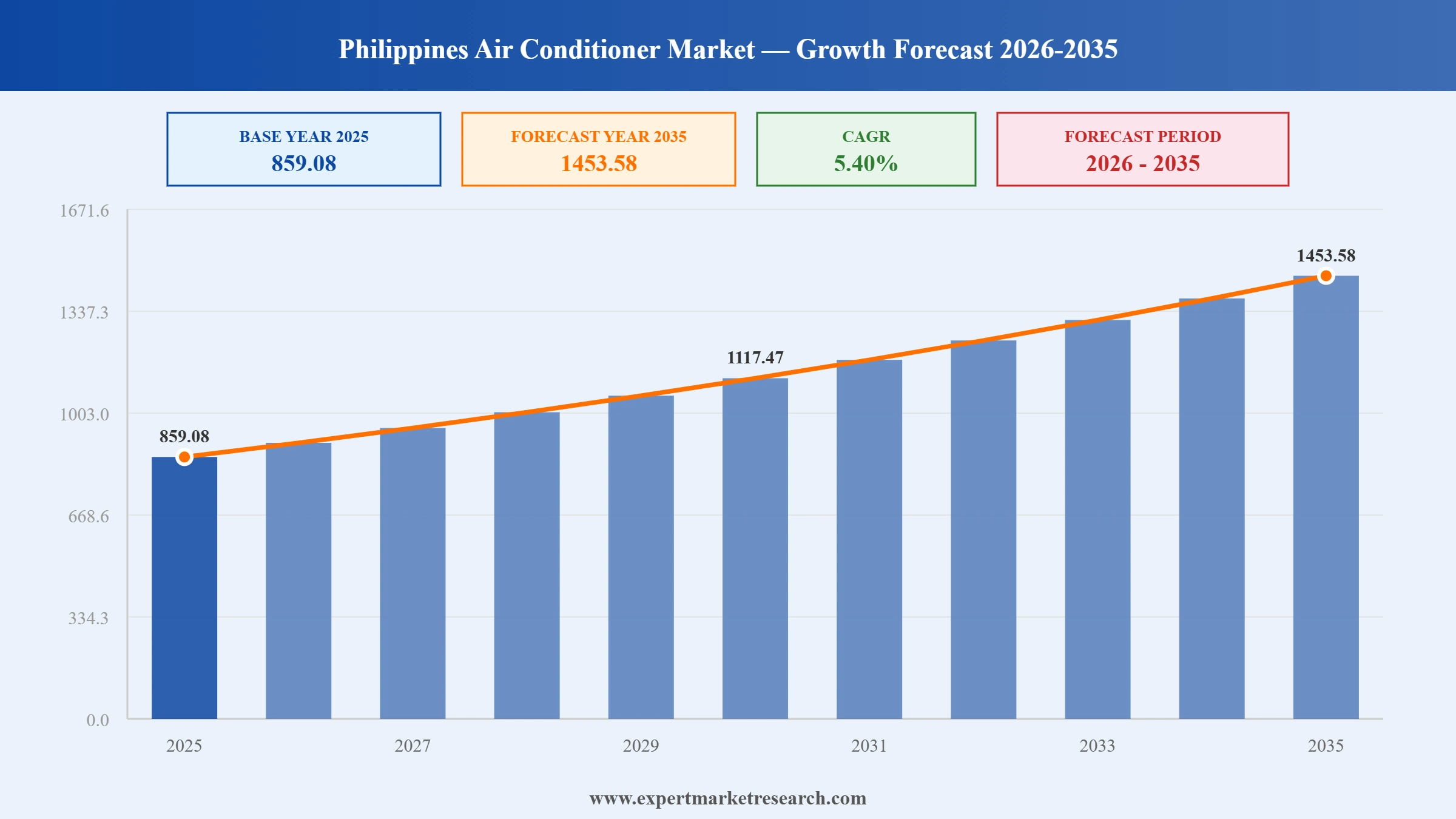
The Philippines Air Conditioner Market reached a value of USD 859.08 Million at 2025 and is projected to expand at a CAGR of around 5.40% during the forecast period of 2026-2035. With rising urban construction activity, growing consumer awareness of energy-efficient inverter technology, the expansion of the hospitality and retail sectors, and the deepening integration of smart and IoT-enabled controls, the market is expected to reach USD 1453.58 Million by 2035.
Read more about this report - REQUEST FREE SAMPLE COPY IN PDF
|
Philippines Air Conditioner Market Report Summary |
Description |
Value |
|
Base Year |
USD Million |
2025 |
|
Historical Period |
USD Million |
2019-2025 |
|
Forecast Period |
USD Million |
2026-2035 |
|
Market Size 2025 |
USD Million |
859.08 |
|
Market Size 2035 |
USD Million |
1453.58 |
|
CAGR 2019-2025 |
Percentage |
XX% |
|
CAGR 2026-2035 |
Percentage |
5.40% |
|
CAGR 2026-2035 - Market by Type |
Central AC |
6.1% |
|
CAGR 2026-2035 - Market by Technology |
Inverter |
6.3% |
The Philippines Air Conditioner Market is shaped by accelerating demand for smart, health-oriented, and energy-efficient cooling solutions. Rapid urbanisation, rising disposable incomes, and the country's tropical climate profile remain the bedrock drivers, while product innovation and evolving distribution models are redefining how Filipinos engage with the cooling category.
In March 2025, Turkish consumer electronics brand Beko introduced the BPVOE Inverter Split-Type Air Conditioner series to the Philippine market. Available in four capacity variants ranging from 1.0 HP to 2.5 HP, the lineup targets both residential apartments and mid-sized commercial spaces. Prices starting at PHP 33,990 position the brand competitively within the growing mid-tier inverter segment. The launch reflects the intensifying competition among global brands seeking to capitalise on shifting Filipino consumer preferences toward energy-saving cooling solutions.
In July 2024, Cold Front Technologies Asia, a leading refrigeration and air-conditioning contractor operating in the Philippines, became a silver partner of NaturalRefrigerants.com, a globally recognised platform connecting HVAC professionals with natural refrigerant solutions. The move signals the Philippine industry's gradual shift toward more sustainable, low-global-warming-potential refrigerants. It also reflects growing regulatory and corporate pressure to align local HVAC operations with international environmental standards under the Kigali Amendment framework.
In April 2024, Haier Philippines unveiled the UV Cool Connect Pro, a Split Type Deluxe Inverter air conditioner series available in four capacity options from 1.0 HP to 2.5 HP. The product features UVC sterilisation technology to neutralise airborne pathogens, smart Wi-Fi controls compatible with mobile applications, and DC inverter compressor technology that reportedly reduces energy consumption by up to 63% relative to conventional fixed-speed models. The launch directly targets health-conscious urban households and is a clear response to post-pandemic consumer demand for cleaner indoor environments.
In March 2024, TCL introduced the CoolPro FreshIN 2.0 Breathe+, Live Cool Inverter Air Conditioner at a media event held at Ascott Hotel in Taguig City, Metro Manila. The product line incorporates advanced air filtration capabilities and inverter-powered cooling optimised for the Philippines' tropical climate conditions. TCL's growing retail and online presence in the archipelago has positioned the brand as a notable challenger in the budget-to-mid-range inverter segment, with the new launch targeting both residential buyers and small commercial operators seeking affordable, healthier cooling options.
In January 2024, Panasonic Air Conditioning Philippines (PACPH) held a major product unveiling event at the Grand Hyatt Ballroom, showcasing its latest range of air conditioning and ventilation systems for the Philippine market. The event highlighted Japanese-quality engineering standards and featured presentations from PACPH leadership on the brand's commitment to sustainable, smart indoor climate solutions for Filipino homes and businesses. Panasonic's continued product investment in the Philippines underscores the premium segment's resilience amid intensifying competition from Chinese and Korean brands.
Air conditioner manufacturers are progressively embedding Wi-Fi connectivity, app-based controls, and voice-assistant compatibility into their product lines for the Philippine market. This trend is gaining real traction as urban Filipino consumers seek convenient, remote-control options that also optimise electricity consumption. In March 2025, Panasonic expanded its Matter-enabled smart AC portfolio targeting the residential segment in the Philippines, with the new lineup engineered to withstand extreme temperature conditions and integrated into the Miraie smart home application, enabling automatic sleep profile adjustments.
The post-pandemic environment has left a lasting imprint on how Filipino consumers evaluate air conditioners. Clean air features including UVC sterilisation, multi-layer filtration, and pathogen-neutralising capabilities have moved from optional extras to active selling points. This shift is particularly visible among urban households and healthcare facilities where infection control is a priority. Driving Philippines Air Conditioner Market growth, in April 2024, Haier Philippines introduced the UV Cool Connect Pro series featuring embedded UVC sterilisation technology designed to eliminate airborne bacteria and viruses, with demand flowing from households prioritising safer indoor environments.
The Philippines' revitalized tourism sector is among the most consequential demand drivers for commercial air conditioning installations. Hotels, resorts, and hospitality-adjacent commercial spaces are investing heavily in advanced cooling infrastructure to meet guest comfort expectations and regulatory compliance standards. In 2024, the Philippine Department of Tourism recorded approximately 4.88 million visitor arrivals between January and October, a 9.76% increase compared to the same pe
Filipino households are increasingly switching to inverter-type air conditioners as electricity tariffs remain among the highest in Southeast Asia, making long-term running cost a decisive purchase factor. Government energy-efficiency labelling schemes have reinforced this shift by making energy consumption comparisons straightforward at point of sale. In 2025, the Philippine residential AC market saw sustained volume growth of approximately 9%, with sales reaching 1.7 million units, predominantly driven by energy-efficient and inverter-based products, as households with penetration rates of just 15-25% represent a vast untapped addressable market for brands competing in this space.
The Expert Market Research's report titled "Philippines Air Conditioner Market Report and Forecast 2026 to 2035" offers a detailed analysis of the market based on the following segments:
Market Breakup by Type
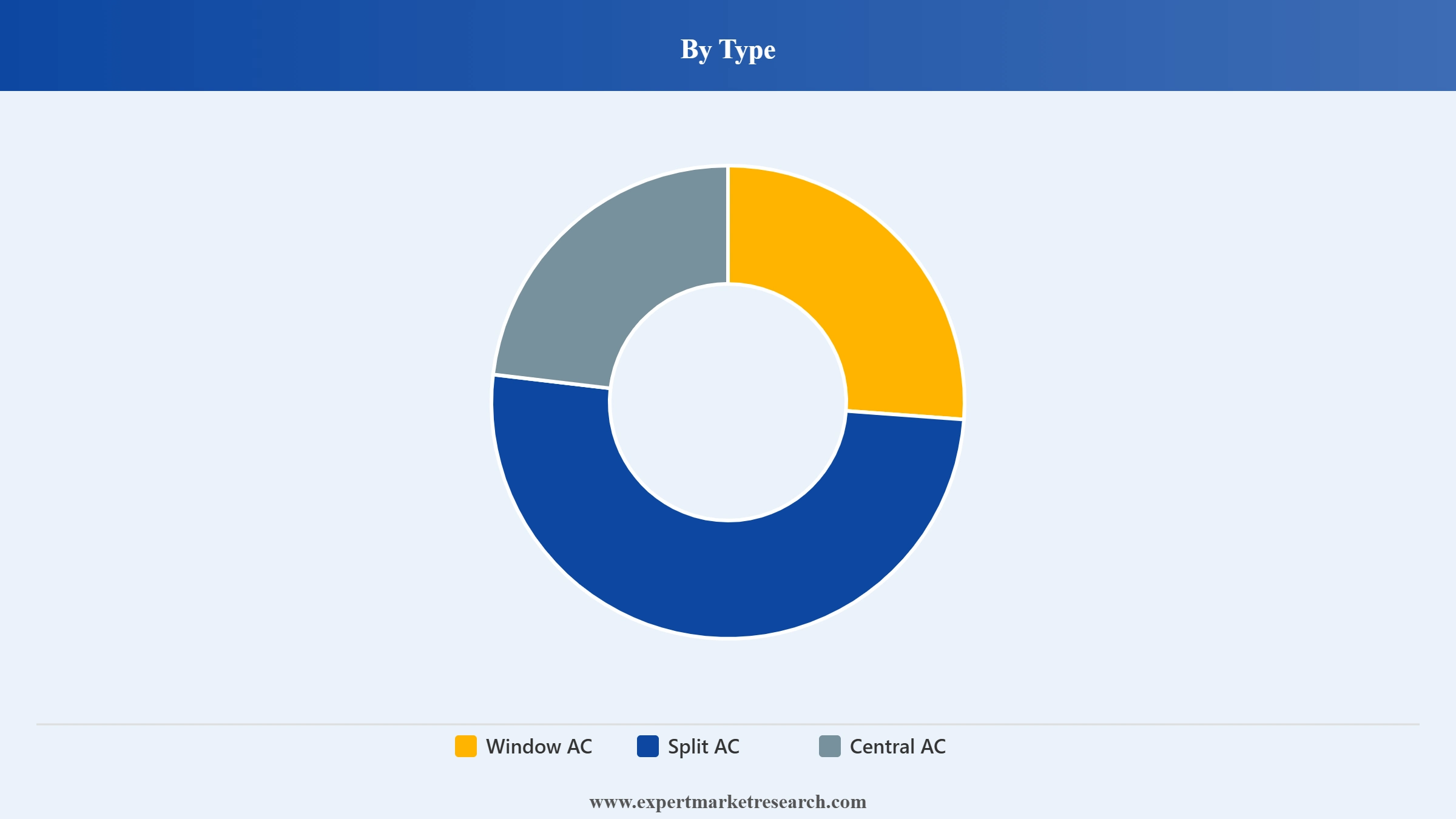
Key Insight: Split-type air conditioners are the dominant category within the Philippines market, a position reinforced by their superior energy efficiency, quieter operation, and aesthetic appeal compared to window units. Urban apartments and residential developments across Metro Manila and other major urban centres are overwhelmingly fitted with split-type systems. Central AC commands a smaller but growing share, particularly in large commercial venues, and is expanding at a CAGR of 6.1% through 2035 as mixed-use property development accelerates. Window AC retains its footing in budget-conscious and older building stock. Key players such as LG, Carrier, and Daikin have invested in localising their split and central AC product offerings to meet the Philippines' high-humidity operational conditions.
Market Breakup by Technology
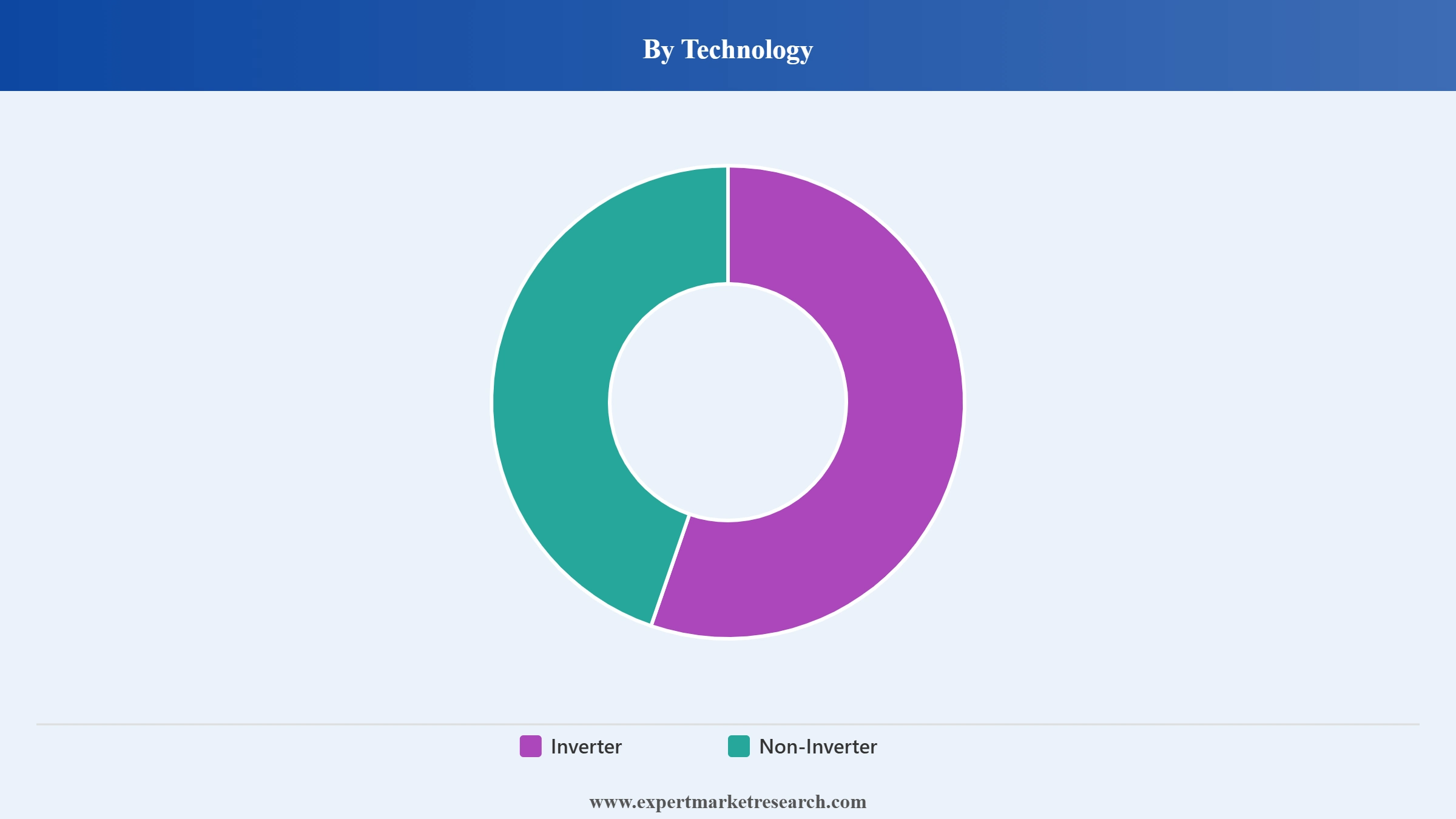
Key Insight: Inverter technology has established a decisive foothold in the Philippines, growing at a projected CAGR of 6.3% over the 2026-2035 forecast period. The primary driver is electricity cost sensitivity: Philippine households face some of the steepest power tariffs in the ASEAN bloc, making the energy savings from inverter compressors economically compelling even at a higher upfront cost. Manufacturers including Daikin, Midea, and Samsung have expanded their inverter portfolios at increasingly accessible price points, eroding the traditional premium gap. Non-inverter units retain a presence in rental properties and seasonal-use applications but are expected to gradually cede share as consumer awareness and financing accessibility improve.
Market Breakup by End Use
Key Insight: The residential segment currently anchors the Philippines AC market, powered by urbanisation, a growing middle class with rising disposable incomes, and a country population that surpassed 114 million in 2024 according to IMF figures. Ongoing condominium and horizontal housing construction across Metro Manila, Cebu, and Davao provides a structural tailwind. The commercial segment, while smaller in unit volume, carries higher average transaction values and is expanding at a healthy pace driven by the hospitality, retail, healthcare, and data centre sub-verticals. Carrier and Mitsubishi Electric are particularly well-positioned in large-format commercial installations due to their VRF and central system product ranges.
Market Breakup by Distribution Channel
Read more about this report - REQUEST FREE SAMPLE COPY IN PDF
The Split AC category holds the dominant share of the Philippines market by type, a position driven by its energy-efficiency credentials and alignment with urban lifestyle needs. Residential condominiums and standalone houses in cities such as Manila, Quezon City, and Makati rely heavily on split systems, making it the de facto standard for new residential construction. Key players including LG, Samsung, and Carrier have structured much of their Philippines product and promotional investment around this segment. The commercial proliferation of split multi-systems in boutique hotels and retail outlets further consolidates its lead. Central AC, while representing a smaller share, is gaining ground in large commercial projects where unified climate management is both a regulatory expectation and an operational necessity.
Read more about this report - REQUEST FREE SAMPLE COPY IN PDF
Inverter technology commands the largest share within the technology segmentation, with adoption driven by the Philippines' structural electricity cost challenge and consumer financial literacy around energy savings. Government energy-labelling requirements have made it progressively harder for retailers to push non-inverter units at comparable price points, accelerating the migration. Daikin and Mitsubishi Electric anchor the premium inverter tier, while Midea and TCL compete aggressively in the accessible mid-range. The residential segment's dominance in end-use share is underpinned by a rapidly urbanising population that increasingly treats air conditioning as an essential rather than a luxury, particularly as PAGASA continues to record record-high heat indices across major Philippine cities during the extended summer season.
Read more about this report - REQUEST FREE SAMPLE COPY IN PDF
Metro Manila and greater Luzon account for the largest concentration of Philippines air conditioner demand and investment activity. As the country's commercial and economic engine, Metro Manila draws sustained infrastructure investment across business process outsourcing campuses, shopping mall expansions, and high-rise residential projects, all of which require reliable, high-capacity cooling systems. The government's Build, Better, More infrastructure programme has further stimulated construction activity in peri-urban areas of Luzon, extending commercial AC procurement beyond the National Capital Region. According to the Philippine Statistics Authority, urban population growth in Luzon continues to outpace the national average, providing a durable tailwind for residential AC penetration as household incomes rise and aspiration for thermal comfort grows.
The Visayas region, centred on Cebu City, has emerged as the Philippines' second-fastest-growing air conditioner market, with the hospitality and tourism sectors serving as primary demand anchors. Cebu's role as a major international and domestic tourism hub has driven consistent hotel and resort development, requiring ongoing procurement of commercial cooling systems. Several global brands have expanded their dealer and service networks in Cebu in response to this demand. Mindanao, while currently at lower penetration rates, is attracting increasing attention from distributors and brands as urbanisation accelerates in Davao City and Cagayan de Oro. The region's economic development, supported by government agribusiness and infrastructure investment programmes, is expected to generate meaningful incremental air conditioner demand through the forecast period.
The Philippines air conditioner market players are largely focused on energy efficiency and eco-friendliness, smart technology integration, and improved after-sales services. Most of the Philippines air conditioner companies aim to cater to the varying budgets, performances, and sustainable needs of consumers while being ever-present in their online business as well as in regional distribution networks.
Founded in 1947 and headquartered in Seoul, South Korea, LG is a global giant in the air conditioning field that offers energy-efficient, smart innovative cooling solutions. In the Philippines, the company’s high-end products specially in residential and commercial ACs are highly sought after.
Established in 1969, in South Korea, Samsung is among the most technologically advanced air conditioning brands, including inverter technology and smart systems. They specialize in energy-saving and green units and enjoy a good market presence in the Philippines.
Established in 1915 and based in New York, United States, Carrier has become a major industry player. With a reputation for durable, sustainable, and high-performance cooling solutions, Carrier has built a solid presence in the Philippines' residential and commercial markets.
Established in 1968, Midea Group Co. Ltd. is one of the world's largest manufacturers of air conditioning products. Their competitively priced energy-efficient products range from split and window units and aim to serve both the residential and commercial segments in the Philippines.
Other key players in the market are Kolin Philippines Int'l., Inc, Haier Inc., Hitachi Ltd., Fujidenzo, Mitsubishi Electric Corporation, Daikin Industries, Ltd., and Others.
*Please note that this is only a partial list; the complete list of key players is available in the full report. Additionally, the list of key players can be customized to better suit your needs.*
Explore the latest intelligence on the Philippines Air Conditioner Market 2026 with our in-depth research report. Stay ahead of the competition with data-backed insights on inverter technology adoption, smart cooling innovation, and the market segments generating the strongest growth. Whether you are a manufacturer evaluating product localisation, a distributor planning channel expansion, or an investor assessing the Philippines cooling sector, this report equips you with the clarity you need. Download your free sample today and unlock the key opportunities in the thriving Philippines air conditioning industry.


Upto 15% Off
USD
$2499 $2249
$3999 $3599
$4999 $4249
$5999 $5099


*While we strive to always give you current and accurate information, the numbers depicted on the website are indicative and may differ from the actual numbers in the main report. At Expert Market Research, we aim to bring you the latest insights and trends in the market. Using our analyses and forecasts, stakeholders can understand the market dynamics, navigate challenges, and capitalize on opportunities to make data-driven strategic decisions.*
In 2025, the Philippines air conditioner market reached an approximate value of USD 859.08 Million.
The market is projected to grow at a CAGR of 5.40% between 2026 and 2035.
The market is estimated to witness healthy growth in the forecast period of 2026-2035 to reach a value of around USD 1453.58 Million by 2035.
The major drivers of the market are the rising consumer consciousness about thermal comfort and productivity, rapid digitalization in retail and financing options, and growth in the construction industry.
The key trends of the market include the growing integration of smart technology and IoT, rise in solar-powered air conditioning systems, increased focus on health and air quality, and adoption growth in the hospitality sector.
The various types considered in the market report are window AC, split AC, and central AC.
The various technologies considered in the market report are inverter and non-inverter.
The end uses considered in the Philippines air conditioner market report are residential and commercial.
The major players in the market are LG Corp., Samsung Electronics Co. Ltd., Carrier Global Corporation, Midea Group Co. Ltd, Kolin Philippines Int'l., Inc, Haier Inc., Hitachi Ltd., Fujidenzo, Mitsubishi Electric Corporation, and Daikin Industries, Ltd., among others.
Explore our key highlights of the report and gain a concise overview of key findings, trends, and actionable insights that will empower your strategic decisions.
| REPORT FEATURES | DETAILS |
| Base Year | 2025 |
| Historical Period | 2019-2025 |
| Forecast Period | 2026-2035 |
| Scope of the Report |
Historical and Forecast Trends, Industry Drivers and Constraints, Historical and Forecast Market Analysis by Segment:
|
| Breakup by Type |
|
| Breakup by Technology |
|
| Breakup by End Use |
|
| Breakup by Distribution Channel |
|
| Market Dynamics |
|
| Competitive Landscape |
|
| Companies Covered |
|
Datasheet
One User
USD 2,499
USD 2,249
tax inclusive*
Single User License
One User
USD 3,999
USD 3,599
tax inclusive*
Five User License
Five User
USD 4,999
USD 4,249
tax inclusive*
Corporate License
Unlimited Users
USD 5,999
USD 5,099
tax inclusive*
*Please note that the prices mentioned below are starting prices for each bundle type. Kindly contact our team for further details.*
Flash Bundle
Small Business Bundle
Growth Bundle
Enterprise Bundle
*Please note that the prices mentioned below are starting prices for each bundle type. Kindly contact our team for further details.*
Flash Bundle
Number of Reports: 3
20%
tax inclusive*
Small Business Bundle
Number of Reports: 5
25%
tax inclusive*
Growth Bundle
Number of Reports: 8
30%
tax inclusive*
Enterprise Bundle
Number of Reports: 10
35%
tax inclusive*
How To Order

Select License Type
Choose the right license for your needs and access rights.

Click on ‘Buy Now’
Add the report to your cart with one click and proceed to register.

Select Mode of Payment
Choose a payment option for a secure checkout. You will be redirected accordingly.
Strategic Solutions for Informed Decision-Making
Gain insights to stay ahead and seize opportunities.

Get insights & trends for a competitive edge.

Track prices with detailed trend reports.

Analyse trade data for supply chain insights.

Leverage cost reports for smart savings

Enhance supply chain with partnerships.

Connect For More Information
Our expert team of analysts will offer full support and resolve any queries regarding the report, before and after the purchase.
Our expert team of analysts will offer full support and resolve any queries regarding the report, before and after the purchase.
We employ meticulous research methods, blending advanced analytics and expert insights to deliver accurate, actionable industry intelligence, staying ahead of competitors.
Our skilled analysts offer unparalleled competitive advantage with detailed insights on current and emerging markets, ensuring your strategic edge.
We offer an in-depth yet simplified presentation of industry insights and analysis to meet your specific requirements effectively.




