

Consumer Insights
Uncover trends and behaviors shaping consumer choices today
Procurement Insights
Optimize your sourcing strategy with key market data
Industry Stats
Stay ahead with the latest trends and market analysis.
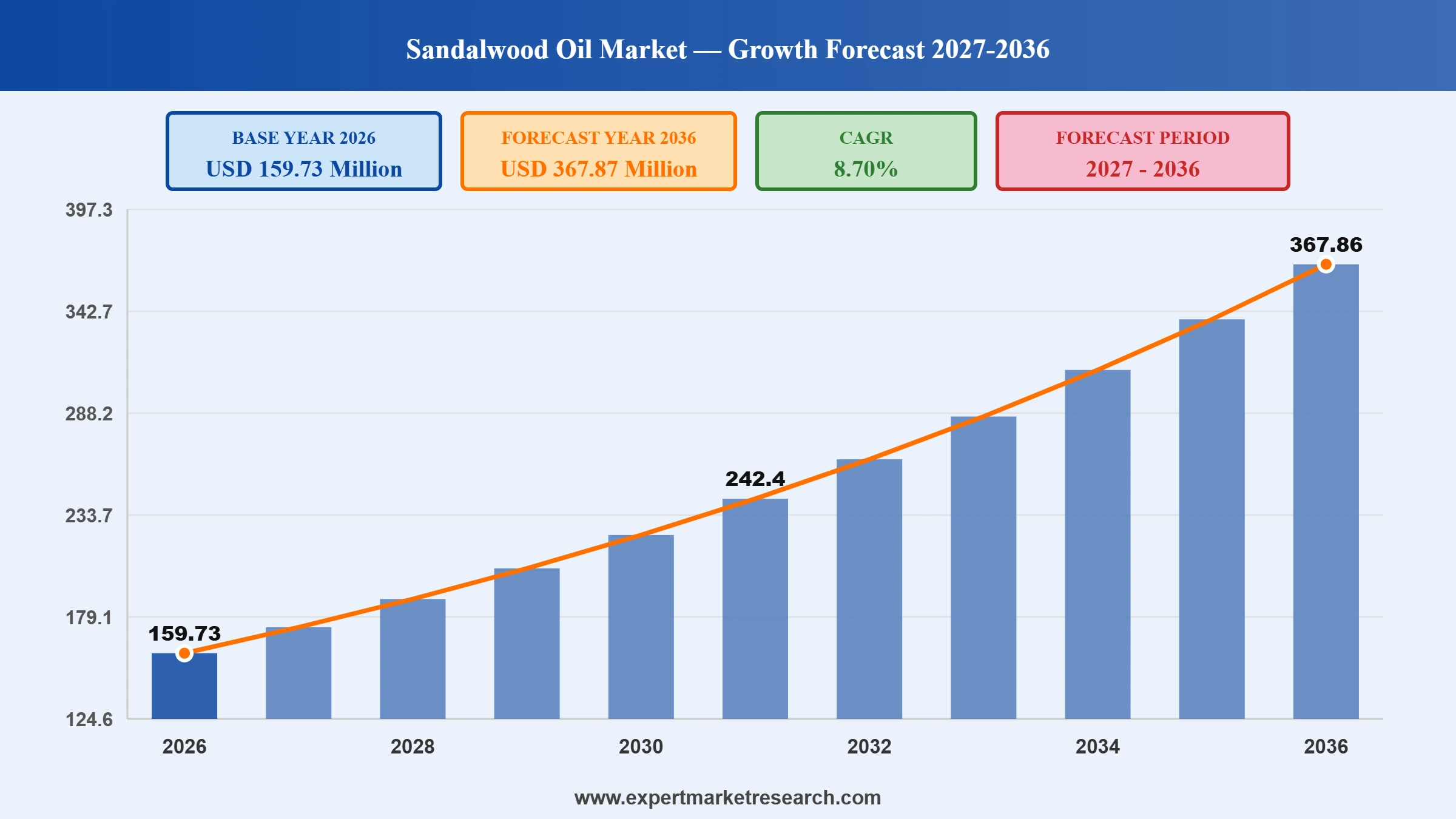
The global sandalwood oil market attained a value of USD 146.95 Million in 2025 and is projected to expand at a CAGR of 8.70% through 2035. The market is further expected to reach USD 338.43 Million by 2035. Expanding plantation-based sandalwood supply, rising demand for premium fragrance and aromatherapy products, and supportive policy reforms in India and Australia are helping producers strengthen sustainable sourcing and meet growing consumer demand.
Rising consumer preference for natural, plant-based fragrance and skincare ingredients is encouraging producers to expand plantation-based sandalwood cultivation, strengthen traceability, and diversify product applications across personal care and aromatherapy. At the same time, easing regulatory restrictions in key producing regions are allowing companies to plan long-term cultivation investment with greater confidence.
The sandalwood oil market is witnessing further developments as India moves to support domestic cultivation and processing capacity. The Federation of Indian Plywood and Panel Industry launched the Report of the Sandalwood Development Committee in New Delhi in October 2025, chaired by former Finance Secretary Ratan Prakash Watal, with the committee including representatives from the Ministry of Environment, Forests and Climate Change and the Ministry of Ayush recommending measures to restore India's sandalwood production and expand rural employment.
In addition, sandalwood oil market players are allocating greater investment toward sustainable plantation development, traceable supply chains, and premium product innovation to strengthen their competitive position. For instance, Santanol and Quintis continue to operate large-scale Indian sandalwood plantations in Australia, while Plant Therapy Essential Oils and doTERRA International expand their sandalwood product offerings for global consumers.
Read more about this report - Request a Free Sample
| Global Sandalwood Oil Market Report Summary | Description | Value |
| Base Year | USD Million | 2025 |
| Historical Period | USD Million | 2019-2025 |
| Forecast Period | USD Million | 2026-2035 |
| Market Size 2025 | USD Million | 146.95 |
| Market Size 2035 | USD Million | 338.43 |
| CAGR 2019-2025 | Percentage | XX% |
| CAGR 2026-2035 | Percentage | 8.70% |
| CAGR 2026-2035 - Market by Region | Asia Pacific | 9.9% |
| CAGR 2026-2035 - Market by Country | India | 10.5% |
| CAGR 2026-2035 - Market by Country | Saudi Arabia | 10.1% |
| CAGR 2026-2035 - Market by Nature | Organic | 10.2% |
| CAGR 2026-2035 - Market by Distribution Channel | Online | 12.3% |
| Market Share by Country 2025 | UK | 4.2% |
The Indian government committed to partnering with state governments to promote focused sandalwood cultivation and post-harvest processing, easing restrictions on cutting, sale, and marketing of sandalwood. Companies can benefit from expanding domestic supply as regulatory barriers to farmer-led sandalwood cultivation continue to ease across India.
Balmain Beauty debuted its inaugural prestige fragrance, Destin de Balmain Eau de Parfum, built around a "creamy sandalwood" note that perfumer Quentin Bisch designed to anchor the scent's strength and luminosity alongside ripe strawberry and peony accords. Companies can capitalize on rising demand for sandalwood-forward prestige fragrances as luxury beauty brands continue to position sandalwood as a signature ingredient in new product launches.
Dr. Blossom Kochhar, founder of the Blossom Kochhar Group and its Aroma Magic aromatherapy brand, received the ELLE Beauty Legacy Award for her four-decade contribution to India's beauty, skincare, and wellness industry. Companies can build long-term brand equity through sustained investment in aromatherapy education and natural personal care innovation in the sandalwood oil market.
A member of parliament from Bengaluru Rural publicly called for the creation of a National Sandalwood Board to support Indian sandalwood farmers, noting Karnataka accounts for roughly sixty-five percent of India's total sandalwood production. Companies can support such policy initiatives to strengthen supply chain access to planting material, credit, and protection against illegal logging.
Governments are strengthening regulatory enforcement and incentivizing legal sandalwood cultivation to improve supply chain transparency, protect growers' incomes, and ensure sustainable raw material availability for the sandalwood oil market. In July 2026, Karnataka's Forest Department reported that auctions of seized sandalwood at its Mysuru depot have generated over Rs. 7.12 crore in cumulative revenue since 2022, with 2025 alone contributing Rs. 4.76 crore from nearly 19.28 metric tons sold, much of its timber recovered after theft from private farmlands. Proceeds are eventually passed on to the rightful farmers following legal proceedings, reinforcing government support for legitimate cultivation over illegal trade. Companies can build farmer trust in formal supply chains as recovered sandalwood value continues flowing back to growers rather than smugglers.
Producers are shifting away from endangered wild-harvested sandalwood toward structured, traceable plantation-based supply chains, predominantly across Australia and India. This transition is helping the sandalwood oil market address long-term sustainability concerns tied to overharvesting of wild Santalum album trees. Santanol operates a large Indian-sandalwood plantation and processing estate in Western Australia, while Quintis remains one of the world's largest owners of Indian sandalwood plantations, together anchoring the shift toward sustainably sourced sandalwood oil. This shift toward localized, traceable processing is also extending to smaller Pacific sandalwood-producing nations: in May 2026, Natural Treasures Vanuatu Ltd announced a new AUD 250,000 sandalwood oil distillation and wood-processing facility in Port Vila, aiming to process sandalwood locally rather than export raw material, support direct and transparent purchasing from local growers, and strengthen Vanuatu's position in the premium finished sandalwood products market.
The sandalwood oil market continues to see strong demand from the premium perfumery and personal care industries, where its natural and sustainable positioning commands a premium pricing over synthetic alternative. Fragrance houses are prioritizing traceable natural ingredients to meet rising consumer expectations for clean-label formulations. Albert Vieille SAS, presently a part of Givaudan's natural-ingredients division, continues to supply natural specialty ingredients including sandalwood-related raw materials to the global fragrance industry. On the other hand, in February 2025, Pura launched ethically sourced Western Australian sandalwood fragrances, promoting Indigenous partnerships, sustainable sourcing, and premium fragrance innovation.
Aromatherapy applications continue to expand as consumers increasingly seek natural wellness and stress-relief products, with sandalwood oil regarded as a premium aromatherapy ingredient. Companies are broadening their sandalwood-based wellness product lines to capture this growing demand. Blossom Kochhar Beauty Products' Aroma Magic brand, described as India's largest aromatherapy brand, continues to expand its natural skincare and wellness portfolio, while doTERRA International promotes Indian and Hawaiian sandalwood oils through its global wellness advocate network. In March 2026, The Estée Lauder Companies announced the extension of its long-term partnership with Forest Essentials, India's Ayurvedic luxury wellness brand known for its Mysore sandalwood-based skincare and body care lines, signaling continued global beauty industry investment in sandalwood-centered natural wellness products.
Synthetic sandalwood aroma-chemicals continue to capture a growing share of lower-cost fragrance and household product applications, presenting ongoing competition for natural sandalwood oil producers. However, natural oil retains a durable advantage in premium perfumery segments where authenticity and sustainability credentials are highly valued. This dynamic is encouraging natural sandalwood oil producers to emphasize traceability and certification to differentiate their offerings from synthetic substitutes. For example, BASF offers Isobionics Santalol since July 2020, while expanding sustainable biotechnology-based sandalwood fragrance ingredients for premium personal care applications.
The EMR’s report titled “Global Sandalwood Oil Market Report and Forecast 2026-2035” offers a detailed analysis of the market based on the following segments:
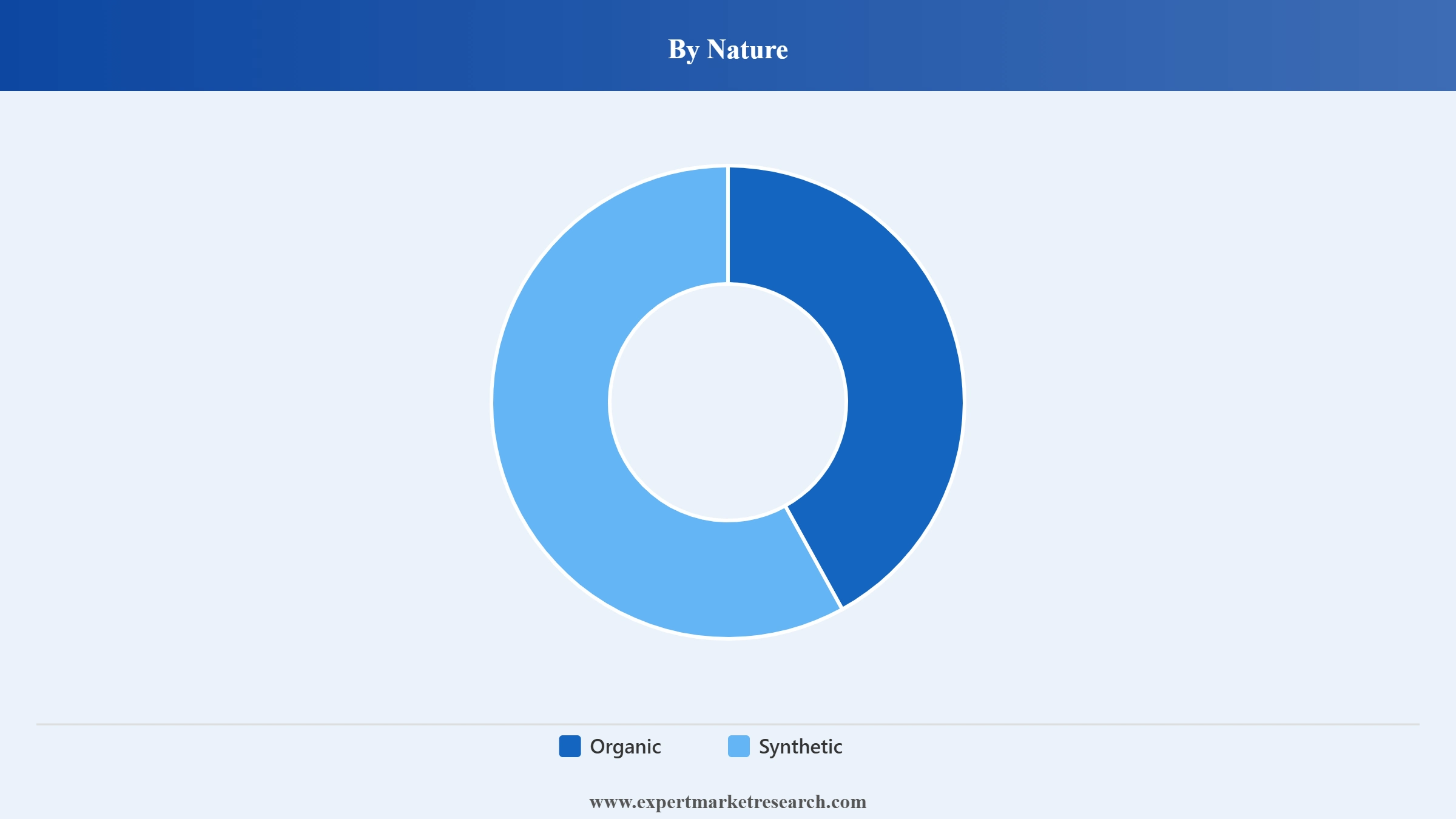
Market Breakup by Nature
Key Insight: Organic sandalwood oil holds a strong premium position in the global sandalwood oil market as consumers and fragrance houses increasingly seek natural, sustainably sourced ingredients with traceable origins. Synthetic sandalwood alternatives continue to capture share in lower-cost fragrance and household applications, offering cost and supply consistency advantages, though natural oil retains a durable edge within premium perfumery and personal care segments. In Western Australia, the Department of Biodiversity, Conservation and Attractions regulates wild sandalwood extraction through the Sandalwood Order, valid through December 31, 2026.
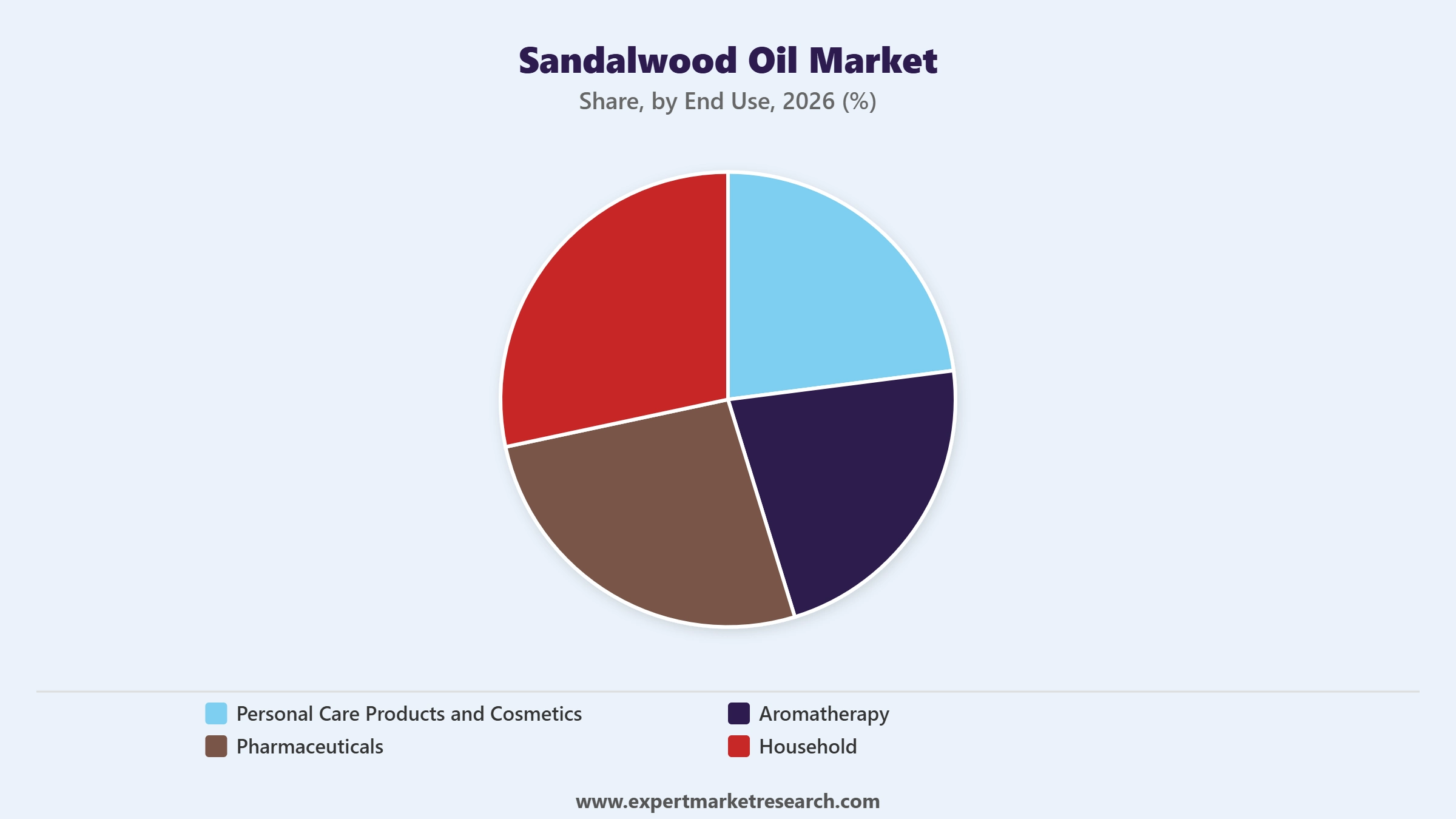
Market Breakup by End Use
Key Insight: Personal care products and cosmetics account for the largest end-use share in global sandalwood oil market as brands incorporate sandalwood oil into premium skincare, haircare, and fragrance formulations. Aromatherapy continues to grow rapidly alongside rising consumer interest in natural wellness and stress relief, while pharmaceuticals and household applications remain smaller but stable segments supported by sandalwood's traditional therapeutic and fragrance uses. The United States Food and Drug Administration classifies such products based on intended use, regulating fragrance-only formulations as cosmetics while products carrying therapeutic claims, such as relieving pain or anxiety, are treated as drugs requiring separate safety and effectiveness review.
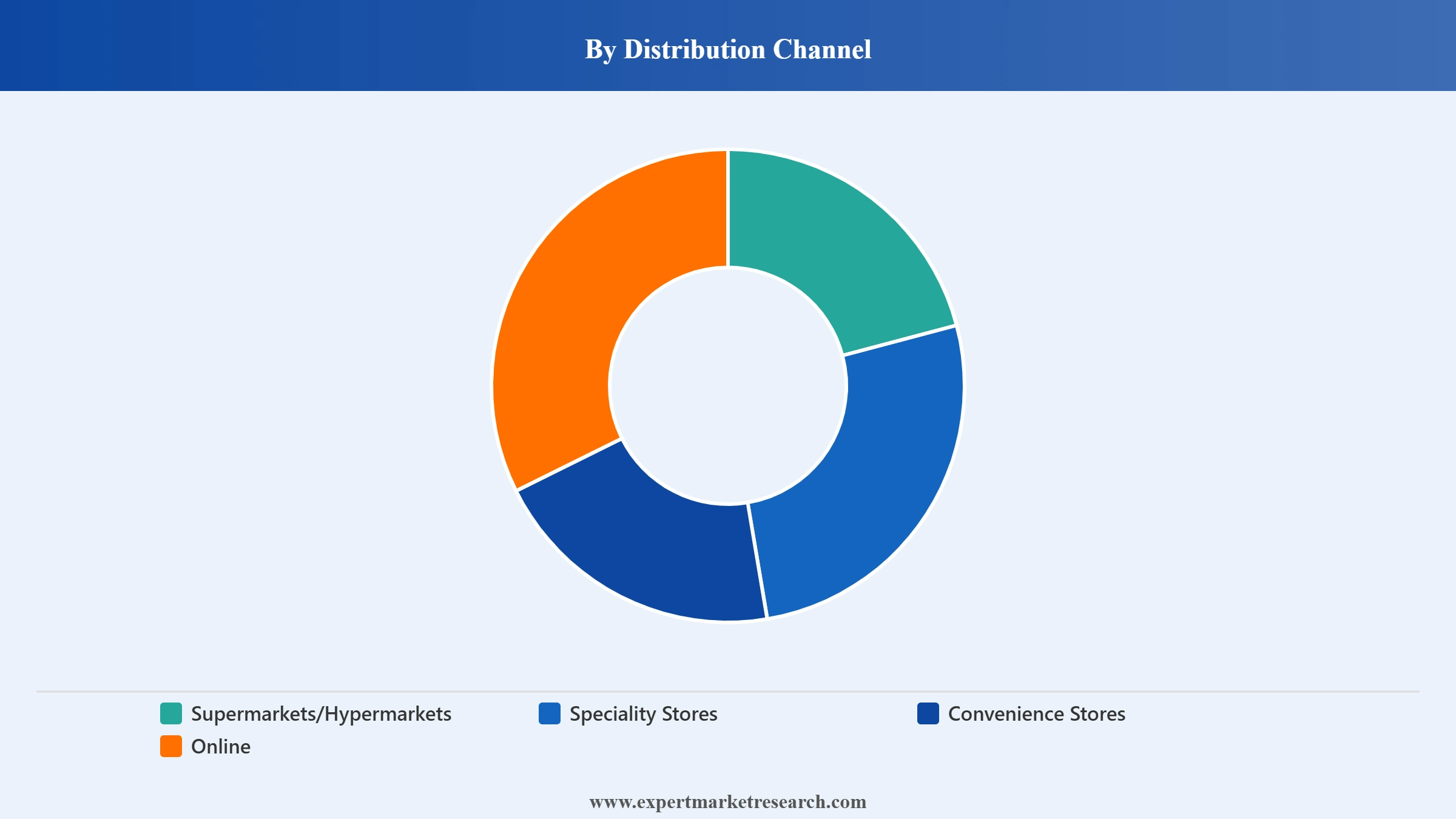
Market Breakup by Distribution Channel
Key Insight: Specialty stores continue to play an important role in sandalwood oil distribution, offering consumers expert guidance and curated natural product assortments. Supermarkets and hypermarkets provide broad accessibility for mainstream personal care products, while the online channel is emerging as the fastest-growing distribution route in sandalwood oil market as consumers increasingly research and purchase natural wellness products through e-commerce platforms and direct-to-consumer brand websites. Illustrating this online expansion, Yves Rocher announced a partnership with Nykaa in December 2025 to enter the Indian market in 2026, leveraging Nykaa's e-commerce platform to distribute its natural, botanically formulated personal care range, including sandalwood-featured products, directly to Indian consumers.
Market Breakup by Region
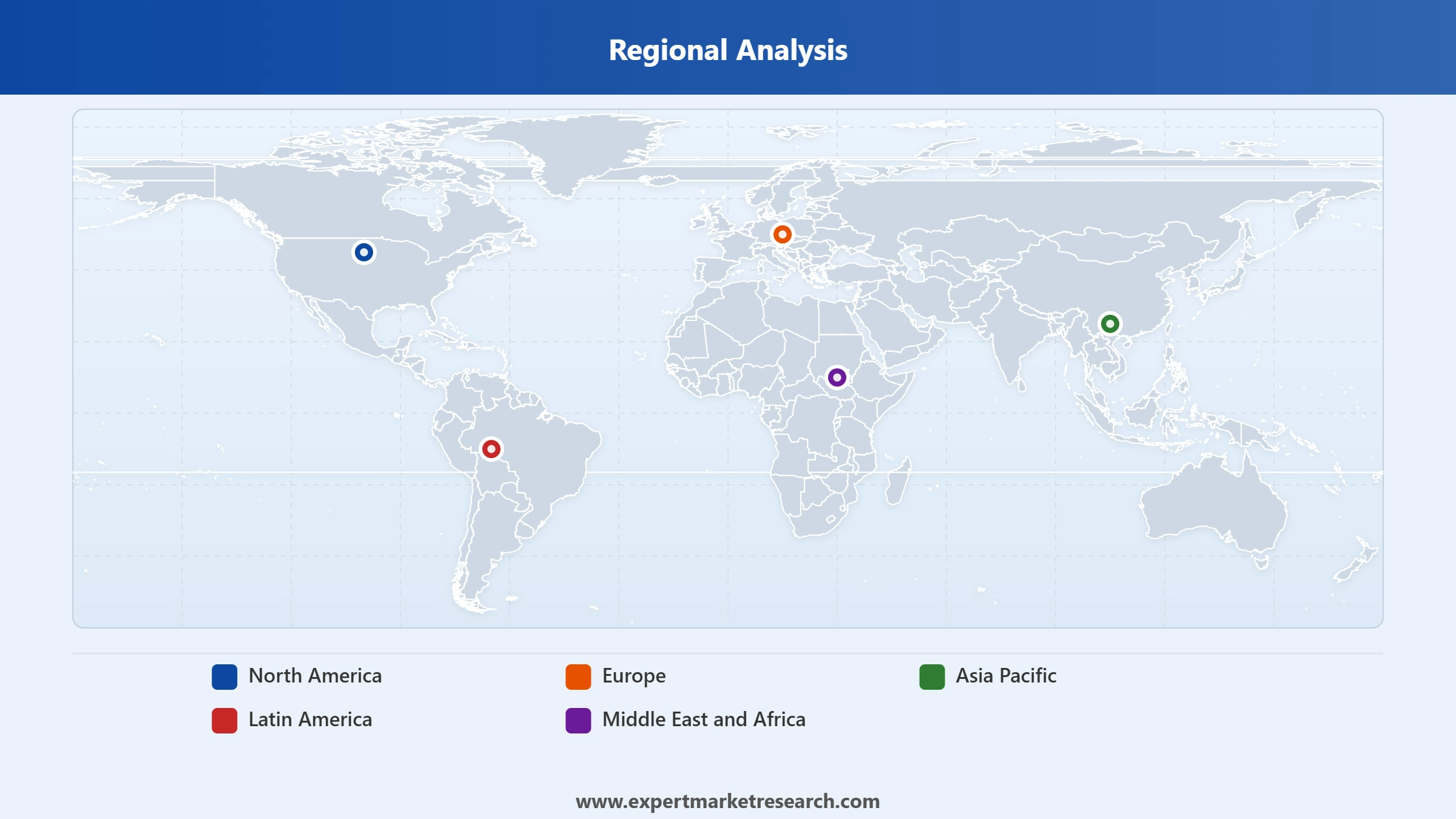
Key Insight: Asia Pacific holds a significant share of the sandalwood oil market, supported by India's long-standing sandalwood cultivation heritage and strong domestic aromatherapy and personal care demand. According to a scheme document from India's National Compensatory Afforestation Fund Management and Planning Authority, operating under the Ministry of Environment, Forest and Climate Change, sandalwood plantations across Karnataka, Tamil Nadu, and Kerala span approximately 20,725 hectares, reflecting the scale of India's cultivation base underpinning Asia Pacific's market position. Europe continues to lead in premium fragrance applications, while North America is expanding through wellness and aromatherapy product adoption. Latin America and the Middle East and Africa remain smaller but gradually growing markets for natural sandalwood-based products.
By nature, organic sandalwood oil dominates the market through sustainably sourced, traceable plantation supply
Organic sandalwood oil holds the leading position in premium fragrance and personal care applications, supported by rising consumer preference for sustainably sourced, traceable natural ingredients. Producers are investing in plantation certification and supply chain transparency to reinforce their premium positioning in the sandalwood oil market. Following such trends, Santanol and Quintis continue to expand traceable Indian sandalwood plantation operations across Australia.
Read more about this report - Request a Free Sample
Synthetic sandalwood alternatives represent the fastest-growing category within lower-cost fragrance and household product applications, offering manufacturers greater cost consistency and supply reliability. Fragrance houses are increasingly blending synthetic aroma-chemicals with natural oils to balance cost and premium positioning. This growing synthetic segment is reinforcing the importance of certification and sustainability credentials for natural sandalwood oil market players. Underscoring tightening oversight of fragrance ingredients generally, the European Union's Regulation 2023/1545 requires individual labeling of 56 newly identified fragrance allergens above set concentration thresholds, with compliance mandatory for products placed on the market from July 2026.
By end use, personal care and cosmetics dominate the sandalwood oil market through premium skincare and haircare formulation demand
Personal care products and cosmetics account for the largest end-use share of the sandalwood oil market as brands continue to incorporate sandalwood into premium skincare, haircare, and fragrance formulations. Companies are prioritizing natural, clean-label positioning to differentiate their personal care offerings in competitive retail markets.
Read more about this report - Request a Free Sample
Aromatherapy is the fastest-growing end-use segment as consumers increasingly seek natural wellness and stress-relief products, with wellness brands continuing to broaden their natural product portfolios to meet this demand. Reflecting rising government support for natural wellness exports, India's Agricultural and Processed Food Products Export Development Authority showcased essential oils among its organic product portfolio at Natural Products Expo West 2025 in Anaheim, California, held in March 2025, alongside thirteen leading Indian exporters.
By distribution channel, specialty stores dominate the market through expert guidance and curated premium product assortments
Specialty stores account for the largest distribution share of the sandalwood oil market, offering consumers expert guidance and curated assortments of premium natural and aromatherapy products. Retailers in this channel are strengthening in-store product education and sourcing transparency to sustain their position among quality-conscious buyers of natural sandalwood oil.
Read more about this report - Request a Free Sample
Online sales represent the fastest-growing distribution channel as consumers increasingly research and purchase natural wellness and personal care products through e-commerce platforms and direct-to-consumer brand websites. Underscoring this broader shift toward digital retail, the United States Census Bureau reported that first-quarter 2026 e-commerce retail sales reached an estimated USD 326.7 billion, up 9.8 percent year on year and accounting for 16.9 percent of total retail sales, reinforcing online growth as a durable channel trend supporting natural product categories such as sandalwood oil.




Read more about this report - Request a Free Sample
Asia Pacific registers a significant share of the market through India's sandalwood cultivation heritage
Asia Pacific holds a significant share of the sandalwood oil market, anchored by India's long-standing sandalwood cultivation heritage and strong domestic demand for personal care and aromatherapy products. Policy reforms easing cultivation and marketing restrictions are further strengthening the region's supply base and encouraging farmer investment in sandalwood plantations. India's National Medicinal Plants Board, operating under the Ministry of Ayush, maintains sandalwood among its prioritized medicinal plant species eligible for central cultivation support, reflecting its established role in the country's traditional aromatic and therapeutic industries.
Read more about this report - Request a Free Sample
Europe emerges to be the fastest-growing regional sandalwood oil market, supported by established fragrance houses that source natural specialty ingredients for luxury perfumery. According to France's Direction generale du Tresor, the country's beauty and perfumery sector generated a trade surplus of EUR 17.3 billion in 2024, the second largest of any French industry after aeronautics, underscoring the region's continued dominance in premium fragrance manufacturing.
The global market is becoming increasingly competitive as producers expand sustainable plantation capacity, strengthen supply chain traceability, and diversify product applications across personal care and aromatherapy. Sandalwood oil companies are investing in certification, quality documentation, and direct-to-consumer distribution to differentiate their offerings within a market that continues to balance premium natural positioning against synthetic alternatives.
Producers are prioritizing plantation maturation, sustainable sourcing credentials, and premium product innovation to strengthen their competitive position. Opportunities continue to grow in areas such as aromatherapy and wellness products, clean-label personal care formulations, and online direct-to-consumer distribution. Sandalwood oil market players that combine sustainable supply chain investment with strong brand positioning are expected to gain a stronger competitive edge in the coming years.
Founded in 2011 and headquartered in Twin Falls, Idaho, United States, Plant Therapy Essential Oils supports the sandalwood oil market through its online-first retail platform offering pure, undiluted Indian and Australian sandalwood essential oils. The company continues to expand its natural product catalog for wellness and aromatherapy consumers.
Founded in 1963 and headquartered in New Delhi, India, Khadi Natural manufactures and exports herbal body-care products, including sandalwood essential oil, sandalwood face packs, and sandalwood soap ranges. The company continues to build on its natural and herbal positioning within the Indian personal care market.
Founded in 2005 and headquartered in West Leederville, Western Australia, Santanol operates a large-scale Indian sandalwood plantation and processing estate near Kununurra, controlling the full seed-to-oil supply chain. Owned by Mercer International since 2018, the company cultivates approximately 2,500 hectares of Indian sandalwood plantations and operates a dedicated oil distillation and refining facility in Perth.
Founded in the 1920s and headquartered in Grasse, France, Albert Vieille SAS supplies essential oils and natural specialty ingredients, including sandalwood-related raw materials, to the global fragrance and aromatherapy industries. Acquired by Givaudan in 2019, the company continues to operate within Givaudan's natural-ingredients division, supporting the fragrance house's vertically integrated natural supply chain.
Other key players in the market include doTERRA International, LLC, Quintis (Australia) Pty Ltd., Essential Oils Company, Blossom Kochhar Beauty Products Pvt. Ltd., Kanta Enterprises Private Limited, and Aditi Essentials, among others.
*Please note that this is only a partial list; the complete list of key players is available in the full report. Additionally, the list of key players can be customized to better suit your needs.*
Unlock the latest insights with our sandalwood oil market trends 2026 report. Discover segment-wise growth patterns, regional dynamics, and key industry players. Stay ahead of competition with trusted data and expert analysis. Download your free sample report today and drive informed decisions in the market.
Plant Based Botanical Extract Supply
Natural Cosmetic Ingredient Industry Insights
Therapeutic Aromatherapy Oils Supply Chain


Upto 15% Off
USD
$2499 $2249
$3999 $3599
$4999 $4249
$5999 $5099


*While we strive to always give you current and accurate information, the numbers depicted on the website are indicative and may differ from the actual numbers in the main report. At Expert Market Research, we aim to bring you the latest insights and trends in the market. Using our analyses and forecasts, stakeholders can understand the market dynamics, navigate challenges, and capitalize on opportunities to make data-driven strategic decisions.*
The market reached a value of approximately USD 146.95 Million in 2025.
The market is estimated to grow at a CAGR of 8.70% between 2026 and 2035.
The market is estimated to witness healthy growth in the forecast period of 2026-2035 to reach about USD 338.43 Million by 2035.
Expanding sustainable plantation-based cultivation, strengthening supply chain traceability and certification, growing product applications across aromatherapy and personal care, and supporting favorable policy reforms in key producing regions.
The key trends fuelling the growth of the market include increasing popularity of massages and aromatherapy and rising utilisation of personal and skin care products.
The market is broken down into North America, Europe, Asia Pacific, Latin America, the Middle East, and Africa.
The distribution channels for sandalwood oil include supermarkets/ hypermarkets, speciality stores, convenience stores, and online, among others.
The market's key players are Plant Therapy Essential Oils, Khadi Natural, Santanol, Albert Vieille SAS, doTERRA International, LLC, Quintis (Australia) Pty Ltd., Essential Oils Company, Blossom Kochhar Beauty Products Pvt. Ltd., Kanta Enterprises Private Limited, and Aditi Essentials, among others.
Based on the nature, the market is divided into organic and synthetic.
Companies face long cultivation cycles of fifteen to twenty years for mature sandalwood heartwood, competition from lower-cost synthetic alternatives, historical overharvesting concerns tied to wild sandalwood sources, and regulatory complexity across producing regions.
Explore our key highlights of the report and gain a concise overview of key findings, trends, and actionable insights that will empower your strategic decisions.
| REPORT FEATURES | DETAILS |
| Base Year | 2025 |
| Historical Period | 2019-2025 |
| Forecast Period | 2026-2035 |
| Scope of the Report |
Historical and Forecast Trends, Industry Drivers and Constraints, Historical and Forecast Market Analysis by Segment:
|
| Breakup by Nature |
|
| Breakup by End Use |
|
| Breakup by Distribution Channel |
|
| Breakup by Region |
|
| Market Dynamics |
|
| Competitive Landscape |
|
| Companies Covered |
|
Datasheet
One User
USD 2,499
USD 2,249
tax inclusive*
Single User License
One User
USD 3,999
USD 3,599
tax inclusive*
Five User License
Five User
USD 4,999
USD 4,249
tax inclusive*
Corporate License
Unlimited Users
USD 5,999
USD 5,099
tax inclusive*
*Please note that the prices mentioned below are starting prices for each bundle type. Kindly contact our team for further details.*
Flash Bundle
Small Business Bundle
Growth Bundle
Enterprise Bundle
*Please note that the prices mentioned below are starting prices for each bundle type. Kindly contact our team for further details.*
Flash Bundle
Number of Reports: 3
20%
tax inclusive*
Small Business Bundle
Number of Reports: 5
25%
tax inclusive*
Growth Bundle
Number of Reports: 8
30%
tax inclusive*
Enterprise Bundle
Number of Reports: 10
35%
tax inclusive*
How To Order

Select License Type
Choose the right license for your needs and access rights.

Click on ‘Buy Now’
Add the report to your cart with one click and proceed to register.

Select Mode of Payment
Choose a payment option for a secure checkout. You will be redirected accordingly.
Strategic Solutions for Informed Decision-Making
Gain insights to stay ahead and seize opportunities.

Get insights & trends for a competitive edge.

Track prices with detailed trend reports.

Analyse trade data for supply chain insights.

Leverage cost reports for smart savings

Enhance supply chain with partnerships.

Connect For More Information
Our expert team of analysts will offer full support and resolve any queries regarding the report, before and after the purchase.
Our expert team of analysts will offer full support and resolve any queries regarding the report, before and after the purchase.
We employ meticulous research methods, blending advanced analytics and expert insights to deliver accurate, actionable industry intelligence, staying ahead of competitors.
Our skilled analysts offer unparalleled competitive advantage with detailed insights on current and emerging markets, ensuring your strategic edge.
We offer an in-depth yet simplified presentation of industry insights and analysis to meet your specific requirements effectively.




