

Consumer Insights
Uncover trends and behaviors shaping consumer choices today
Procurement Insights
Optimize your sourcing strategy with key market data
Industry Stats
Stay ahead with the latest trends and market analysis.
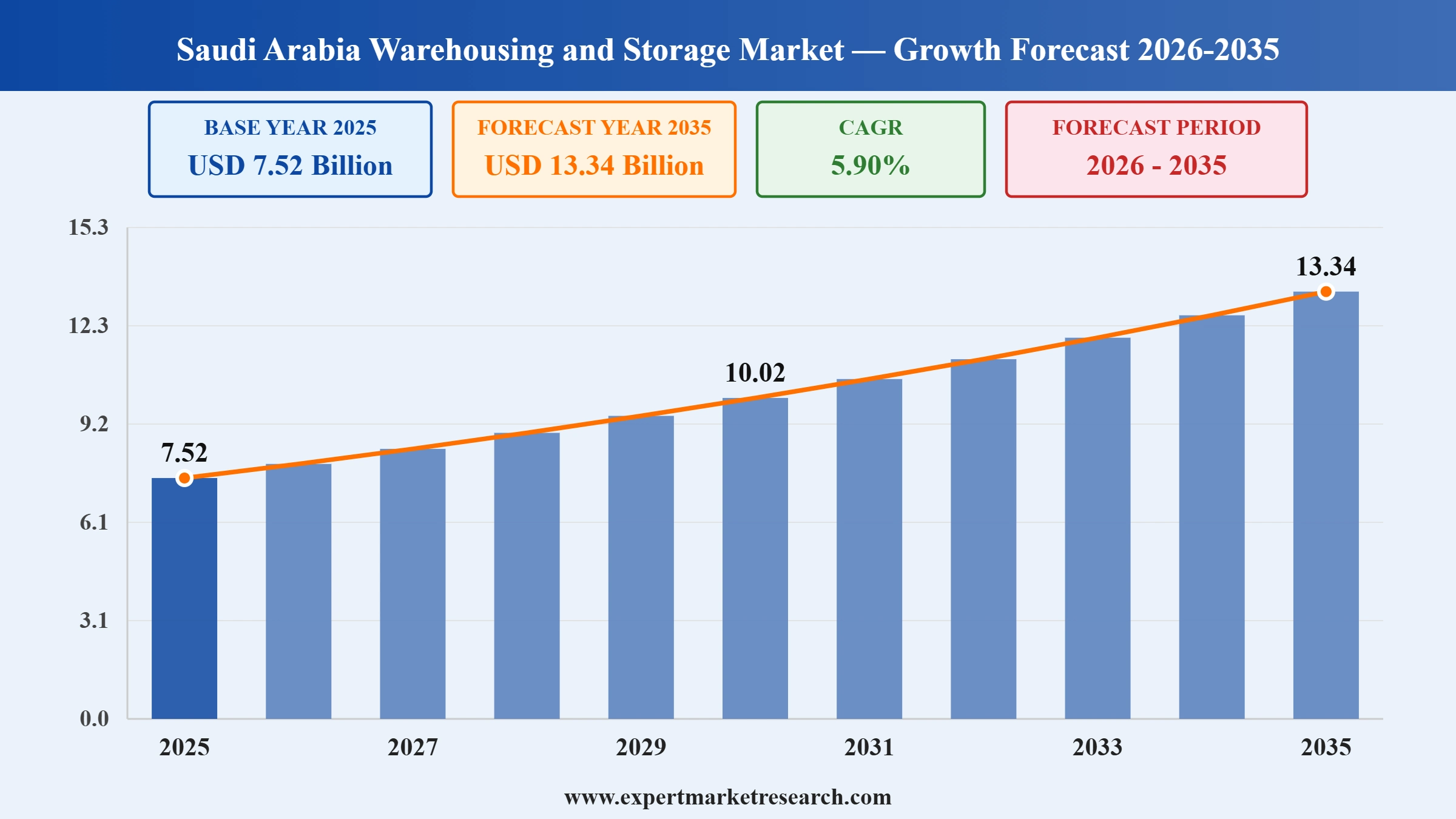
The Saudi Arabia warehousing and storage market size attained a value of USD 7.52 Billion in 2025 and is projected to expand at a CAGR of 5.90% through 2035. The market is further expected to achieve USD 13.34 Billion by 2035. Rapid expansion of giga projects, defense manufacturing, and food security programs is increasing demand for compliant, temperature-controlled, and high-security warehousing infrastructure across Saudi Arabia supporting industrial localization and supply chains.
Foreign direct investment incentives and logistics-focused free zones are accelerating the overall Saudi Arabia warehousing and storage market growth. Long-term land leases and tax benefits attract international developers. Simultaneously, rising pharmaceutical and food import volumes are increasing demand for regulated storage environments. Operators are investing in quality certifications, monitoring systems, and specialized handling. These factors are reshaping warehouse specifications, encouraging higher capital deployment, and strengthening partnerships between developers, logistics providers, and end-user industries.
Companies are focusing on robotics integrations, temperature zoning, and real-time inventory analytics. For example, in October 2024, Agility Logistics expanded its automated cold and dry storage complex in Riyadh, targeting e-commerce and pharmaceutical clients. According to the Saudi Arabia warehousing and storage market analysis, In December 2024, the country ports saw a 9.27% increase in cargo volume, reaching 27.46 million tons, pressuring inventory turnaround times. Hence, such investments reflect how operators are prioritizing higher throughput, compliance readiness, and margin expansion through technology-led warehouse formats rather than storage capacity.
Structural shifts in retail, manufacturing, and life sciences are reshaping warehouse product strategies across Saudi Arabia. Operators are moving beyond conventional racking toward multi-client, sector-specific facilities. For example, In May 2024, SAL announced the launch of its Fulfillment Business Unit to revolutionize the logistics and supply chain industry in the Kingdom. Players like SAL Logistics and Aramex are emphasizing bonded zones, pharma-grade compliance, and value-added services. These enhancements allow premium pricing while locking in long-term contracts, accelerating the Saudi Arabia warehousing and storage market value. Vision 2030-linked industrial clusters are also driving demand for regional fulfillment hubs, pushing developers to design scalable assets that support automation, cross-docking, and faster order processing across retail and industrial supply chains.
Read more about this report - REQUEST FREE SAMPLE COPY IN PDF
Al Muhaidib Group and noon launched the largest MENA logistics center in Riyadh, featuring climate-controlled warehousing to support e commerce growth, faster fulfillment, and distribution under Saudi Vision 2030. Such developments in the Saudi Arabia warehousing and storage market highlight rising demand for climate controlled, high output warehouses, encouraging developers and logistics firms to fund large scale fulfillment hubs supporting e commerce and fast delivery models.
AJEX Logistics Services launched the first and sole GMP (Good Manufacturing Practices)-GxP certified logistics depot in Saudi Arabia. Operators can tap these opportunities in pharmaceutical compliance needs and invest in regulated, audit ready warehouses serving healthcare and life sciences supply chains.
Agility announced intentions for the final stage of growth at the Agility Logistics Parks (ALP) warehouse complex in Riyadh. Such developments in the Saudi Arabia warehousing and storage market signals strong tenant demand for automation ready logistics parks, prompting other players to fund modular warehouses, value added services, and long term leasing models in urban corridors.
DP World and Saudi Ports Authority Mawani began construction on a USD 250 million logistics park featuring a 100,000 sqm warehouse and inland container depot, boosting multimodal trade and storage capacity aligned with Vision 2030. These Saudi Arabia warehousing and storage market trends encourage warehouse investors to fund bonded facilities, cross docking hubs, and port adjacent storage aligned with Vision 2030 trade growth.
Saudi Arabia’s Vision 2030 is directly accelerating warehouse and storage development across logistics corridors. Government-backed programs under the Ministry of Transport and Logistics Services are prioritizing integrated logistics zones near ports, airports, and industrial cities. These initiatives are encouraging private operators to invest in grade A warehouses with automation readiness. In June 2025, Swisslog became key partner in the development of Chalhoub Group’s new state-of-the-art logistics hub for fashion and beauty products in Riyadh. Developers are further aligning assets with long lease terms and multi-tenant formats, accelerating the Saudi Arabia warehousing and storage market growth.
E-commerce growth is redefining warehouse location strategy in Saudi Arabia. Retailers and logistics firms are building fulfillment centers closer to urban demand clusters like Riyadh and Jeddah. For example, in November 2025, SMSA announced the launch of its cutting-edge micro fulfillment service, a first-of-its-kind network that transforms existing retail branches into intelligent fulfillment centers. Warehouses now prioritize fast picking, sorting automation, and real time inventory systems. Operators are monetizing value-added services such as returns handling and packaging. This Saudi Arabia warehousing and storage market trend favors flexible, high output facilities rather than large static storage, improving margins and tenant retention.
Cold storage demand is rising sharply due to food security programs and pharmaceutical localization. The Saudi Food and Drug Authority’s stricter handling regulations are pushing operators to upgrade temperature-controlled facilities. Government focus on healthcare resilience and local drug manufacturing is supporting this trend in the Saudi Arabia warehousing and storage market. In November 2023, DP World and RSA Cold Chain agreed to build a state-of-the-art 40,000-pallet cold chain logistics facility in Jebel Ali Free Zone, enhancing temperature-controlled storage and distribution networks across the Middle East. Warehouse players are also investing in validated cold rooms, monitoring sensors, and compliance certifications.
Saudi Arabia’s push toward industrial localization is increasing demand for raw material and component storage. National programs supporting defense, automotive, and advanced manufacturing require secure, high-capacity warehouses. For example, AJEX Logistics partnered with MODON to expand industrial logistics services from Dammam, strengthening supply chain support across the Kingdom’s growing industrial zones in November 2023, stimulating Saudi Arabia warehousing and storage market opportunities. These facilities support just in time inventory and inbound logistics. Warehouse operators benefit from stable volumes and predictable demand cycles tied to manufacturing output and long-term supply contracts.
Technology adoption is becoming central to competitiveness in Saudi warehousing. Operators are deploying warehouse management systems, robotics, and energy optimization tools to improve efficiency. Government sustainability targets encourage smart energy use and digital tracking. For example, Huawei launched its SMART Logistics & Warehousing Solution at HUAWEI CONNECT 2025, integrating AI, cloud, and intelligent operations to boost efficiency in September 2025. Smart warehouses enable better space utilization and labor efficiency, widening the Saudi Arabia warehousing and storage market scope. This trend favors operators with capital strength and technical partnerships, while pushing traditional storage providers to modernize or risk losing enterprise clients.
The EMR’s report titled “Saudi Arabia Warehousing and Storage Market Report and Forecast 2026-2035” offers a detailed analysis of the market based on the following segments:
Market Breakup by Type of Warehouse
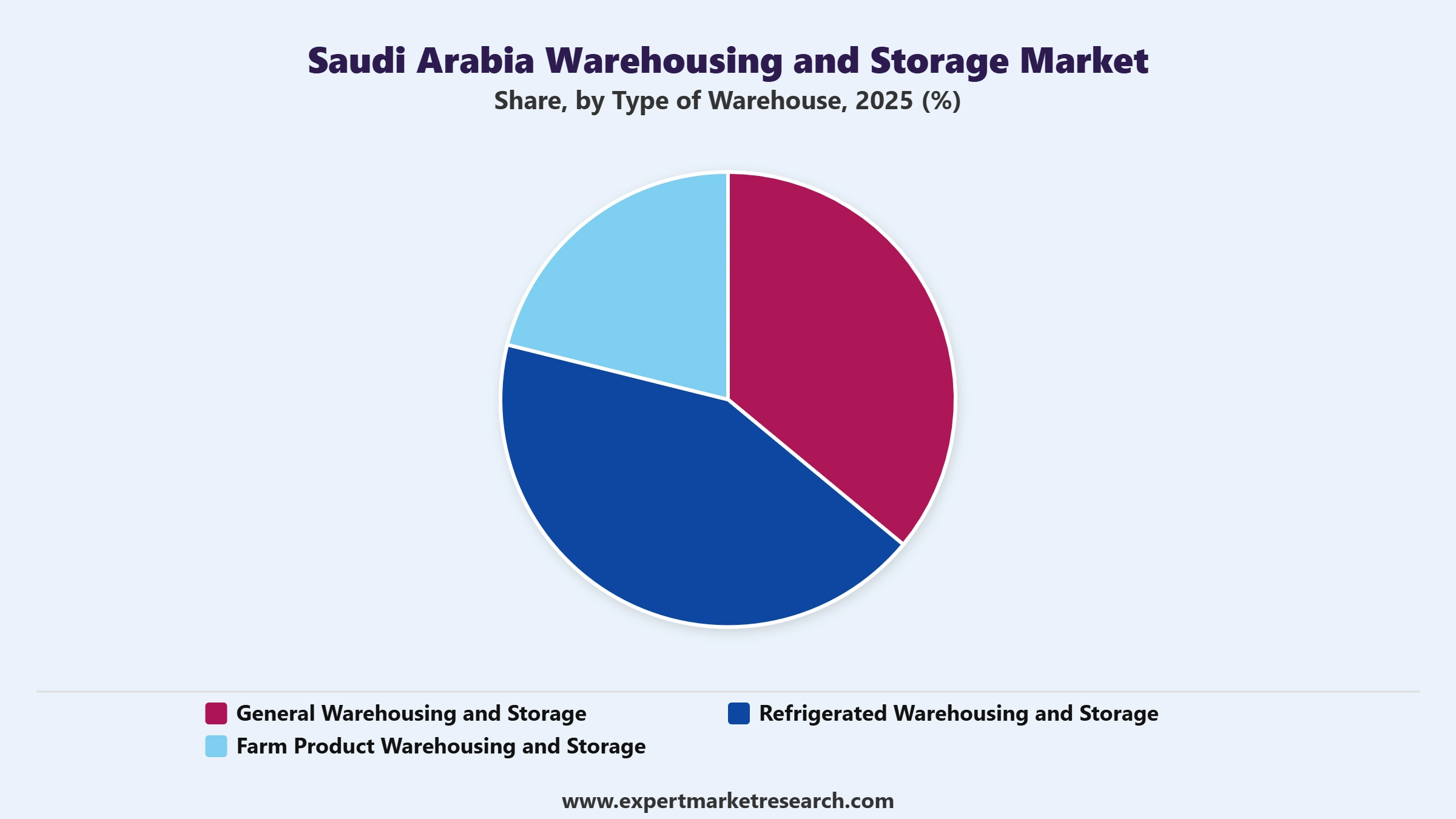
Key Insight: As per the Saudi Arabia warehousing and storage market report, general warehousing supports broad industrial activity and volume storage. Refrigerated facilities address regulated and temperature sensitive goods. Farm product warehouses serve agricultural supply chains and seasonal storage. Operators align facility design with tenant needs and compliance standards. All the categories reflect Saudi Arabia’s evolving logistics ecosystem driven by industrial growth, food security priorities, and healthcare expansion.
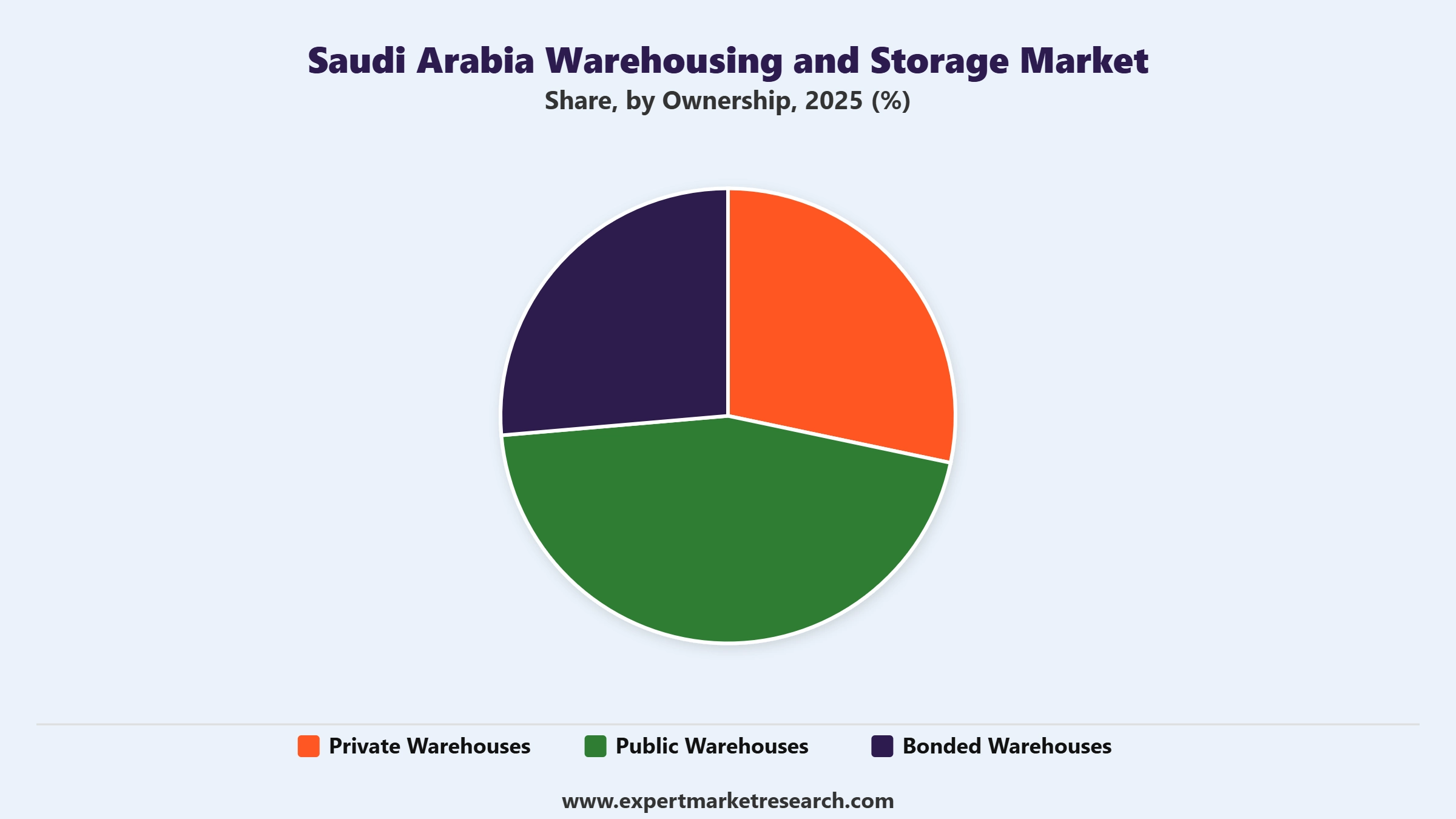
Market Breakup by Ownership
Key Insight: Ownership choices in the Saudi Arabia warehousing and storage market reflect operational control and trade requirements. Private warehouses serve enterprises prioritizing customization and integration, while public warehouses offer flexibility for smaller users. Bonded warehouses support trade and re-export efficiency. Operators tailor ownership models to tenant scale and supply chain complexity. These segments collectively strengthen Saudi Arabia’s warehousing ecosystem.
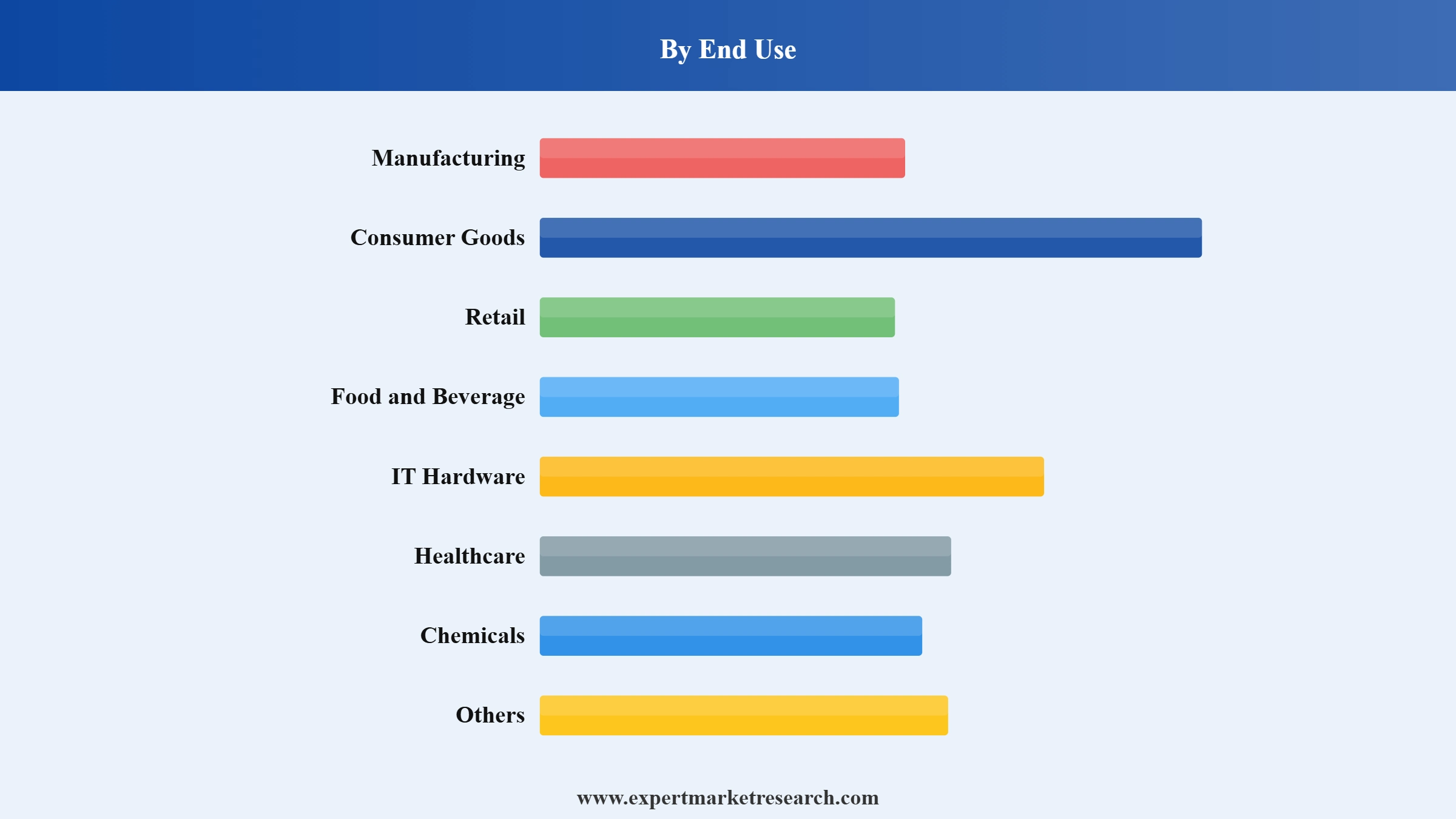
Market Breakup by End Use
Key Insight: End use demand in the Saudi Arabia warehousing and storage market is shaped by industry maturity, regulation, and supply chain complexity. Manufacturing leads overall volume requirements due to raw material intake and finished goods storage. Food and beverage is driving growth in specialized facilities, particularly cold and hygienic storage. In December 2025, Saudi Arabia announced plans to expand food logistics capacity at King Abdulaziz Port after signing a SR200 million (USD 53.2 million) agreement with Arabian Agricultural Services Co., or Arasco. Retail and consumer goods prioritize urban distribution centers to support faster replenishment cycles. Healthcare and chemicals require compliance focused warehouses with strict handling protocols.
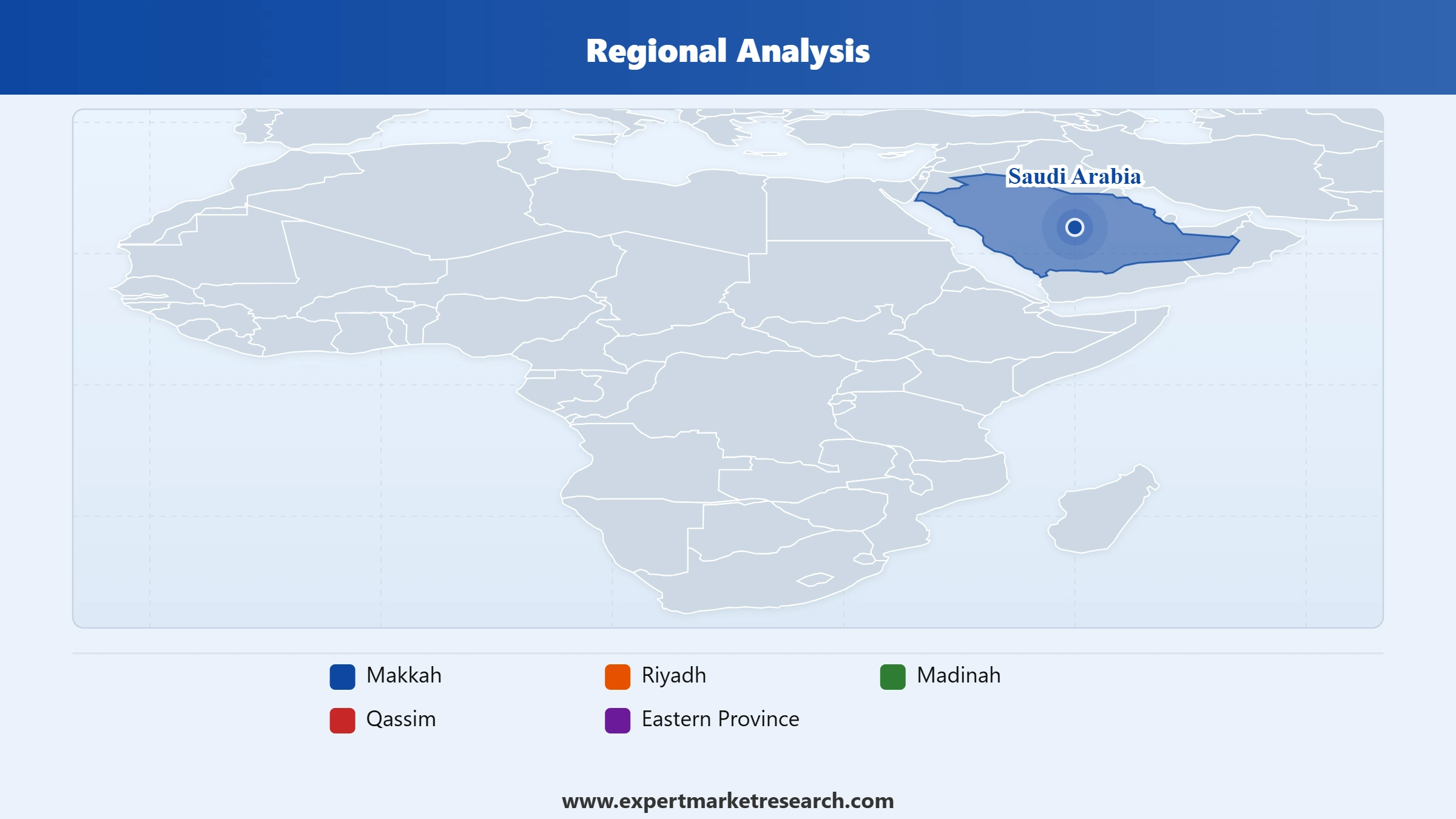
Market Breakup by Region
Key Insight: Regional warehousing demand in Saudi Arabia mirrors infrastructure quality industry clustering and consumption patterns. Riyadh anchors national distribution due to scale and connectivity. Eastern Province supports trade heavy and industrial storage needs. On the other hand, Makkah and Madinah generate demand from retail food and pilgrimage related supply chains. Qassim contributes to agricultural storage and regional redistribution. Each region considered in the Saudi Arabia warehousing and storage market report attracts different warehouse formats and lease structures. Developers align investments with tenant profiles and logistics flows.
Read more about this report - REQUEST FREE SAMPLE COPY IN PDF
By type of warehouse, general warehousing dominates the market due to diversified storage demand across industries
General warehousing and storage holds the largest share of the Saudi Arabia warehousing and storage market due to its flexibility across industries. Manufacturing, retail, and consumer goods companies rely on these facilities for bulk inventory, raw materials, and finished products. Operators design multi-purpose warehouses supporting palletized storage, cross docking, and value-added services. In February 2023, Maersk and Saudi Ports Authority Mawani began construction of a 225,000 sqm integrated logistics park at Jeddah Islamic Port, combining warehousing, cold storage, e-commerce fulfilment and multimodal distribution to simplify supply chains.
Read more about this report - REQUEST FREE SAMPLE COPY IN PDF
Refrigerated warehousing is the fastest growing category as Saudi Arabia expands food security and healthcare infrastructure. Cold storage supports pharmaceuticals, dairy, meat, and fresh produce supply chains. Operators invest in temperature zoning, monitoring systems, and compliance certifications. Logistics providers are developing specialized cold facilities near ports and airports. These warehouses command premium pricing due to high capital intensity. Growth in this category is supported by rising imports, local food processing, and stricter quality regulations driving modernization of cold storage capacity across the nation.
By ownership, private warehouses lead the market due to enterprise control and operational customization
Private warehouses largely contribute to the Saudi Arabia warehousing and storage market revenue as large enterprises seek control over inventory and operations. Manufacturers, retailers, and distributors prefer dedicated facilities aligned with internal workflows. These warehouses support customized layouts, automation investments, and security protocols. Saudi companies favor private ownership to reduce dependency on third parties. In November 2025, DHL Supply Chain agreed to develop a USD 150 million in a facility in the Kingdom.
Read more about this report - REQUEST FREE SAMPLE COPY IN PDF
Bonded warehouses are rapidly gaining popularity due to trade facilitation and re-export activity. These facilities allow goods to be stored without immediate customs duties. Logistics operators near ports and airports invest in bonded capacity. Government initiatives promoting Saudi Arabia as a regional logistics hub support this trend. Bonded warehouses attract importers and exporters seeking cash flow efficiency. This segment benefits from trade diversification and growing cross border flows under Vision 2030.
By end use, manufacturing dominates warehouse demand driven by industrial localization initiatives
Manufacturing is the largest end use category as Saudi Arabia expands industrial output. Factories require storage for raw materials, components, and finished goods. Warehouses support just-in-time production and inbound logistics. Government incentives for local manufacturing increase demand for adjacent storage. In May 2025, Emirates Stallions Group acquired 16-year usufruct rights for 13,000 square meters of warehouse space in Saudi Arabia, expanding its regional logistics footprint. This category benefits from predictable demand cycles and integration with production schedules across automotive, defense, and industrial equipment sectors across the nation.
Read more about this report - REQUEST FREE SAMPLE COPY IN PDF
The food and beverage category is rapidly expanding its share in the Saudi Arabia warehousing and storage market scope due to consumption growth and food security goals. Warehouses support processing, distribution, and imports, while operators invest in compliance and traceability systems. Government focus on local food production is also accelerating storage needs. This segment offers strong growth driven by population expansion and changing consumption patterns.
Riyadh dominates warehousing demand due to central logistics positioning
Riyadh remains the dominant warehousing region because of its role as Saudi Arabia’s primary distribution center. The city connects eastern ports western consumption markets and southern industrial zones. Large population density drives steady retail replenishment. Operators benefit from high occupancy predictable cash flows and multi-year leases. Public investment in roads, metro, freight corridors, and dry ports continues improving connectivity, stimulating growth in the Saudi Arabia warehousing and storage market.
Read more about this report - REQUEST FREE SAMPLE COPY IN PDF
Eastern Province is emerging as the fastest growing warehousing region supported by port led trade and industrial concentration. The province’s proximity to Dammam Jubail and Ras Al Khair ports also accelerates cargo throughput. Energy petrochemical and metals industries require large scale storage. Developers are investing in export-oriented warehouses near ports and industrial cities. These facilities handle bulk materials, equipment, and finished goods. Saudi Ports Authority Mawani contracted Q Saudi to develop a SAR 29 million integrated logistics center at Yanbu Commercial Port, enhancing cargo handling efficiency and logistics capacity along Saudi Arabia’s western coast in December 2025. Cold storage bonded facilities and customs efficient zones are increasingly prioritized by investors and operators seeking scalable long-term returns across eastern corridors.
The market is becoming increasingly competitive as operators shift from basic space providers toward integrated logistics partners. Leading Saudi Arabia warehousing and storage market players are prioritizing automation ready facilities, cold chain expansion, and build to suit assets aligned with Vision 2030 supply chains. Demand is strongest from e commerce, manufacturing, pharmaceuticals, and giga project contractors requiring secure, compliant storage.
Opportunities are emerging in bonded warehousing, temperature-controlled logistics, and value-added services such as kitting and inventory analytics. Saudi Arabia warehousing and storage companies are investing in strategic port adjacencies, energy efficient designs, and long-term leasing models. Local firms gain advantage by tailoring pricing structures, workforce models, and service flexibility to regulatory expectations, climatic conditions, and fluctuating demand cycles across industrial, retail, and government driven logistics contracts nationwide expansion.
DHL Saudi Arabia was established in 1969 and is headquartered in Bonn, Germany. The company operates extensive warehousing across major Saudi cities. DHL focuses on contract logistics, automation, and sector specific facilities. It serves e-commerce, healthcare, and industrial clients. DHL invests in temperature-controlled warehouses and digital visibility tools. Its solutions emphasize reliability, compliance, and scalable capacity.
Wared Logistics, founded in 2009 and headquartered in Jeddah, Saudi Arabia, specializes in modern warehousing, cold storage, and transportation services. Wared supports food, retail, and pharmaceutical supply chains. It invests in compliance certifications and smart warehouse systems. The firm’s growth aligns with rising demand for regulated and temperature sensitive warehousing across the Kingdom driven by Vision 2030 logistics expansion plans.
ATC-logistics was established in 1995 and is headquartered in Kolkata, India. The company provides warehousing, freight forwarding, and supply chain solutions. ATC-logistics supports import export and industrial clients. Its services appeal to exporters seeking efficient storage and customs aligned operations supporting regional distribution and international shipping requirements across western Saudi corridors today rapidly evolving market.
A.P. Moller - Maersk, founded in 1904 and headquartered in Copenhagen, Denmark, operates integrated logistics and warehousing in Saudi Arabia. Maersk develops large scale logistics parks and storage hubs. It targets e commerce, manufacturing, and trade flows. Maersk invests in digital supply chain platforms and its Saudi projects support port centric distribution.
*Please note that this is only a partial list; the complete list of key players is available in the full report. Additionally, the list of key players can be customized to better suit your needs.*
Other key players in the market include Arabian Logistics Solutions, BSL Logistics, Diggipacks, Almajdouie Logistics, Advanced Storage Co., and Aiduk, among others.
Unlock the latest insights with our Saudi Arabia warehousing and storage market trends 2026 report. Discover regional growth patterns, consumer preferences, and key industry players. Stay ahead of competition with trusted data and expert analysis. Download your free sample report today and drive informed decisions in the market.


Upto 15% Off
USD
$2499 $2249
$3999 $3599
$4999 $4249
$5999 $5099


*While we strive to always give you current and accurate information, the numbers depicted on the website are indicative and may differ from the actual numbers in the main report. At Expert Market Research, we aim to bring you the latest insights and trends in the market. Using our analyses and forecasts, stakeholders can understand the market dynamics, navigate challenges, and capitalize on opportunities to make data-driven strategic decisions.*
In 2025, the market reached an approximate value of USD 7.52 Billion.
The market is projected to grow at a CAGR of 5.90% between 2026 and 2035.
The market is estimated to witness a healthy growth in the forecast period of 2026-2035, reaching a value of around USD 13.34 Billion by 2035.
Stakeholders are investing in automation, expanding cold storage, forming port partnerships, developing build to suit assets, adopting energy efficient designs, and aligning warehouse services with e commerce government requirements nationwide.
The key trends of the market include the rising popularity of green warehousing solutions, expansion of smart warehousing and storage facilities, and government proposals to develop automated warehousing facilities.
The major regions in the market are Makkah, Riyadh, Madinah, Qassim, and Eastern Province.
Different types are general warehousing and storage, refrigerated warehousing and storage, and farm product warehousing and storage.
The key players in the market include DHL Saudi Arabia, Wared Logistics, ATC-logistics, A.P. Moller – Maersk, Arabian Logistics Solutions, BSL Logistics, Diggipacks, Almajdouie Logistics, Advanced Storage Co., and Aiduk, among others.
Key challenges include land costs, skilled labor shortages, regulatory compliance complexity, rising energy expenses, and pressure to modernize facilities while maintaining occupancy, margins, and service reliability across competitive logistics corridors.
Explore our key highlights of the report and gain a concise overview of key findings, trends, and actionable insights that will empower your strategic decisions.
| REPORT FEATURES | DETAILS |
| Base Year | 2025 |
| Historical Period | 2019-2025 |
| Forecast Period | 2026-2035 |
| Scope of the Report |
Historical and Forecast Trends, Industry Drivers and Constraints, Historical and Forecast Market Analysis by Segment:
|
| Breakup by Type of Warehouse |
|
| Breakup by Ownership |
|
| Breakup by End Use |
|
| Breakup by Region |
|
| Market Dynamics |
|
| Competitive Landscape |
|
| Companies Covered |
|
Datasheet
One User
USD 2,499
USD 2,249
tax inclusive*
Single User License
One User
USD 3,999
USD 3,599
tax inclusive*
Five User License
Five User
USD 4,999
USD 4,249
tax inclusive*
Corporate License
Unlimited Users
USD 5,999
USD 5,099
tax inclusive*
*Please note that the prices mentioned below are starting prices for each bundle type. Kindly contact our team for further details.*
Flash Bundle
Small Business Bundle
Growth Bundle
Enterprise Bundle
*Please note that the prices mentioned below are starting prices for each bundle type. Kindly contact our team for further details.*
Flash Bundle
Number of Reports: 3
20%
tax inclusive*
Small Business Bundle
Number of Reports: 5
25%
tax inclusive*
Growth Bundle
Number of Reports: 8
30%
tax inclusive*
Enterprise Bundle
Number of Reports: 10
35%
tax inclusive*
How To Order

Select License Type
Choose the right license for your needs and access rights.

Click on ‘Buy Now’
Add the report to your cart with one click and proceed to register.

Select Mode of Payment
Choose a payment option for a secure checkout. You will be redirected accordingly.
Strategic Solutions for Informed Decision-Making
Gain insights to stay ahead and seize opportunities.

Get insights & trends for a competitive edge.

Track prices with detailed trend reports.

Analyse trade data for supply chain insights.

Leverage cost reports for smart savings

Enhance supply chain with partnerships.

Connect For More Information
Our expert team of analysts will offer full support and resolve any queries regarding the report, before and after the purchase.
Our expert team of analysts will offer full support and resolve any queries regarding the report, before and after the purchase.
We employ meticulous research methods, blending advanced analytics and expert insights to deliver accurate, actionable industry intelligence, staying ahead of competitors.
Our skilled analysts offer unparalleled competitive advantage with detailed insights on current and emerging markets, ensuring your strategic edge.
We offer an in-depth yet simplified presentation of industry insights and analysis to meet your specific requirements effectively.




