

Consumer Insights
Uncover trends and behaviors shaping consumer choices today
Procurement Insights
Optimize your sourcing strategy with key market data
Industry Stats
Stay ahead with the latest trends and market analysis.
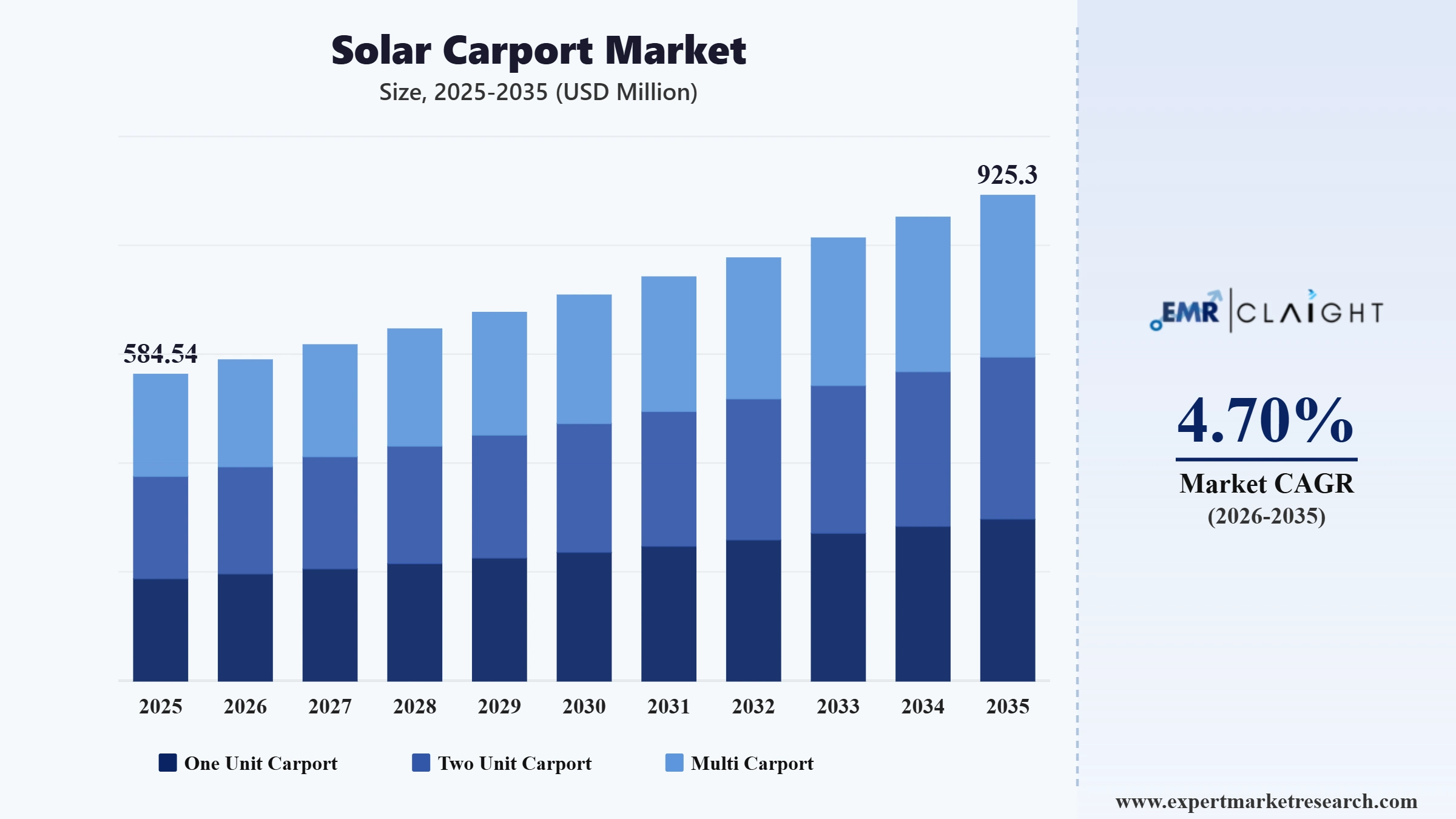
The global solar carport market attained a value of USD 584.54 Million in 2025 and is projected to expand at a CAGR of 4.70% through 2035. The market is further expected to achieve USD 925.30 Million by 2035. Rising electrification of corporate vehicle fleets is accelerating demand for solar carports designed around EV charging, load management, and onsite power balancing capabilities.
Solar carports are being embraced by commercial buildings for two primary reasons. First, grid reliability concerns are pushing enterprises to deploy onsite generation closer to consumption points. Second, city zoning rules are limiting the installation of ground-mounted solar panel systems. Both, these pressures are making carports to be one of the few scalable options available for adding capacity at developed sites, accelerating the overall solar carport market growth. This is leading to supplier agreements for the long run rather than individual purchases, thus enhancing the visibility of the whole value chain.
Targeted product innovations are playing a key role in changing the solar carport market dynamics. These innovations are mainly aimed at commercial and institutional buyers who are looking for faster deployment and predictable returns. One of the significant innovations in the field happened when Nextracker came up with a modular solar carport system in September 2024, that was specifically designed for large parking assets having complex ground conditions. Companies are now focusing on prefabrication and standardized foundation. Projects that utilize prefabricated carport systems generally have commissioning timelines nearly one quarter less than those built with conventional steel, thus improving the internal rate assumptions for EPCs and asset owners.
Land-use efficiency and infrastructure optimization strategies are also driving demand in the solar carport market. Mainly commercial property owners, airports, logistics parks, and schools are prioritizing carports as assets that can generate solar energy while preserving land for core operations. Suppliers are inclining their product development strategies towards features that support higher wind, load, compatibility with EV chargers, and bifacial module installation. These improvements are enabling manufacturers to break free from the single fabrication work contract mode and move towards standardized, repeatable deployments in multi-site portfolios which in turn deepen long-term supplier relationships.
Read more about this report - REQUEST FREE SAMPLE COPY IN PDF
Gamme Telco France launched an all-aluminium solar carport targeting durability, lightweight structures, and faster installations for large commercial parking projects. Leveraging such solar carport market developments, competitors can invest in aluminum-based designs to reduce structural load, speed approvals, and appeal to space-constrained commercial buyers.
GoodWe introduced new residential solar carport applications in Australia, enabling integrated inverters, simplified wiring, and flexible designs for homeowners. Manufacturers can thus bundle inverters and carport structures to offer turnkey residential solutions with shorter installation timelines.
Prime Minister Modi inaugurated CESL’s solar-powered carport at Statue of Unity, in India, signaling public-sector adoption of renewable parking infrastructure. Such developments in the solar carport market encourage EPCs and developers to target government-backed public infrastructure projects where visibility and long-term contracts improve project bankability.
Schletter launched a new modular carport system optimizing parking space usage, structural efficiency, and scalability for commercial solar deployments globally. Players can, hence, focus on modular engineering to support phased deployments and secure multi-location commercial framework agreements.
Solar carports are increasingly specified as EV infrastructure assets rather than passive generation systems. Corporate campuses, retail chains, and logistics operators are issuing tenders that require integrated charging hardware, energy management software, and future expansion capability. In several states in the United States, EV incentive programs are tied to renewable sourcing, indirectly favoring solar-backed charging deployments. Manufacturers are responding by partnering with charging technology firms to deliver pre-certified solutions. This solar carport market trend is raising project complexity and favoring suppliers with systems integration capabilities over traditional steel fabricators. In May 2025, French startup Closura introduced aluminum solar carports that combine renewable energy generation with durable, lightweight construction.
Government directives are playing a decisive role in accelerating solar carport deployment. France’s regulation requiring solar installations over large parking areas has triggered structured procurement programs across retail and industrial properties. Similar policy discussions are advancing in other European markets. In the United States, federal incentives linked to domestic manufacturing and labor compliance continue to improve project feasibility. These regulatory signals are encouraging enterprises to secure suppliers ahead of enforcement deadlines, reshaping the entire solar carport market dynamics. In August 2025, Godrej Enterprises commissioned the first solar carport in Noida, India, advancing sustainable infrastructure goals.
Labor availability and construction risk are leading to a demand for prefabricated solar carport designs. To reduce onsite variability, manufacturers are standardizing electrical layouts and anchoring systems. Modular approaches enable phased rollouts that allow asset owners to align capacity additions with their operational growth. Airports and stadium operators are increasingly turning to these designs due to building operating restrictions, propelling the solar carport market value. For example, 3ti offers a pop-up mini solar car park, dubbed Papilio3, since May 2022. The modular unit combines solar PV with battery energy storage, and can be used to power up to 12 fast electric vehicle (EV) charging points.
Battery-ready solar carports are becoming popular with facilities that have high demand charges or reliability requirements. Data centers, healthcare facilities, and cold storage operators are utilizing carports to help with strategies for peak shaving and backup power. Storage compatibility is now emerging in commercial tenders, especially for penetration in grid-congested regions. This is pushing carport manufacturers to partner with battery suppliers, which on the one hand expands the solution scope and on the other hand increases the average contract duration. In July 2025, Fortified Solar and Sol-Ark announced a new strategic partnership, leveraging this particular solar carport market trend.
Ownership models in the market are changing with long-term power purchase agreements. Many corporations prefer off-balance, sheet structures that allow them to achieve their sustainability goals. Developers take advantage of stable and predictable revenue streams as well as increased portfolio scale, creating new solar carport market opportunities. In August 2025, LHN Energy Resources announced the completion of solar carport installation at Goldhill Plaza’s open space car park. This change is beneficial for those players who have the capability to structure, finance, and operate multi-site solar carport projects.
The EMR’s report titled “Global Solar Carport Market Report and Forecast 2026-2035” offers a detailed analysis of the market based on the following segments:
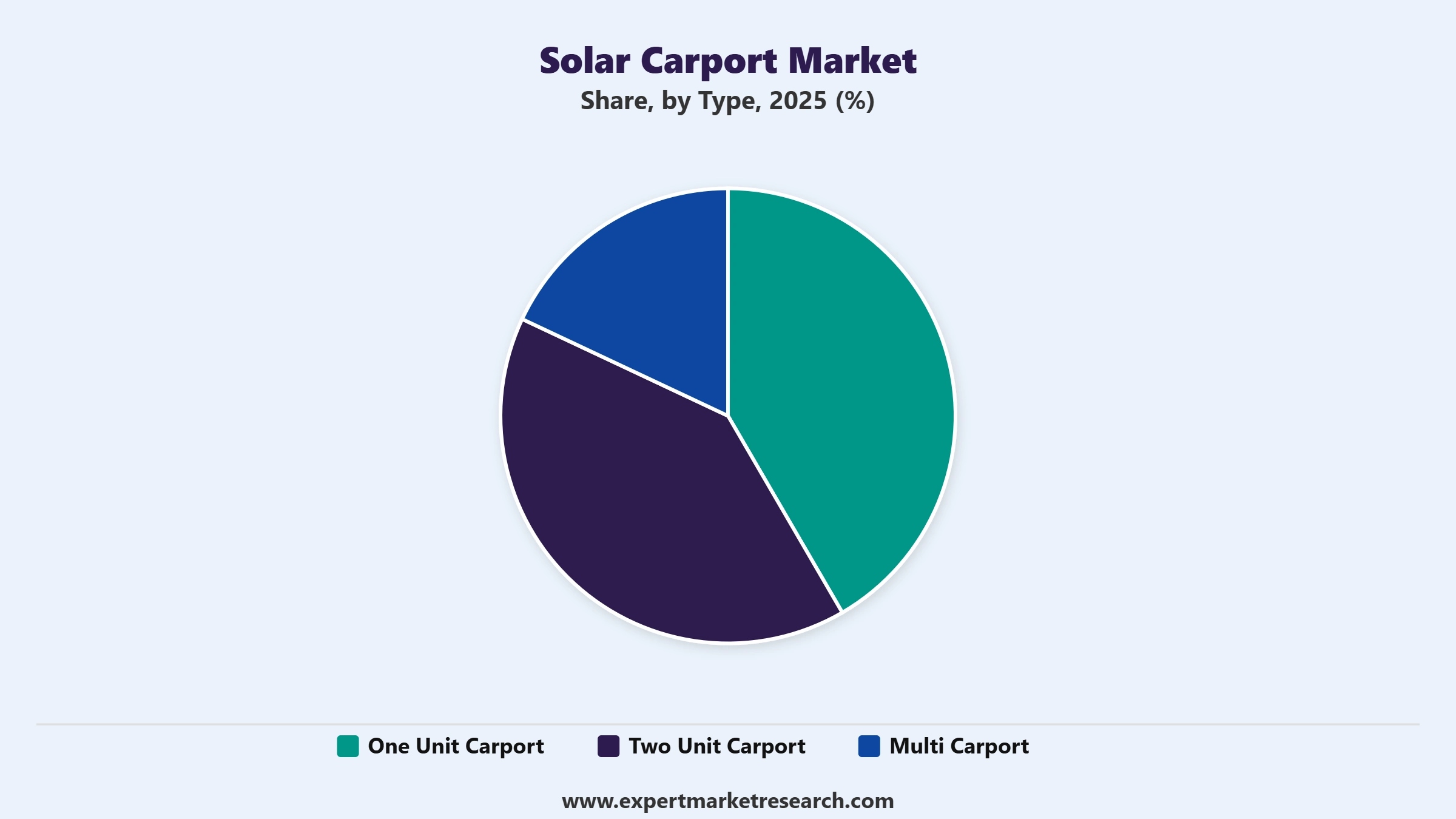
Market Breakup by Type
Key Insight: Single carport units mainly cover individual parking spaces and attractive installations. Double-unit carports strike a balance between adaptability and standardization, making them well-suited for mid-sized assets that require repeatable yet flexible parking and energy solutions. Multi carports allow more operational efficiencies, leading to the growth of the solar carport market. Demand depends on the size of the location, capital planning, and integration requirements.
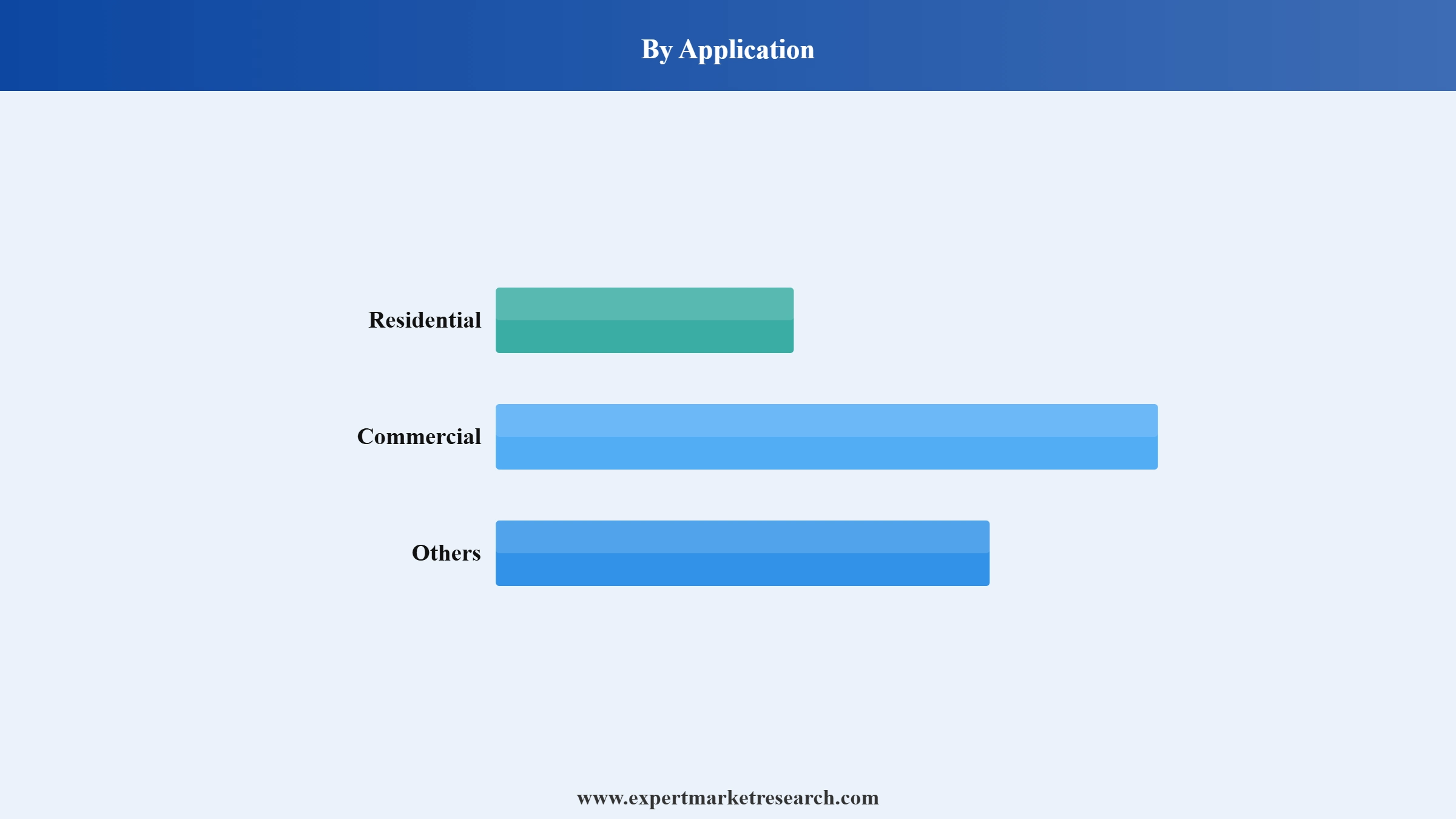
Market Breakup by Application
Key Insight: Commercial installations are all about scale, reliability, and integration. Residential ones, on the other hand, concentrate more on design, making efficient use of space, and keeping the installation simple. Lithuania-based Solitek launched a carport product line featuring 370 W glass-glass frameless modules in December 2023, for both commercial and residential applications. Each application segment as considered in the solar carport industry report changes the procurement priorities. Suppliers who are adapting their product engineering and service models accordingly are retaining customers.
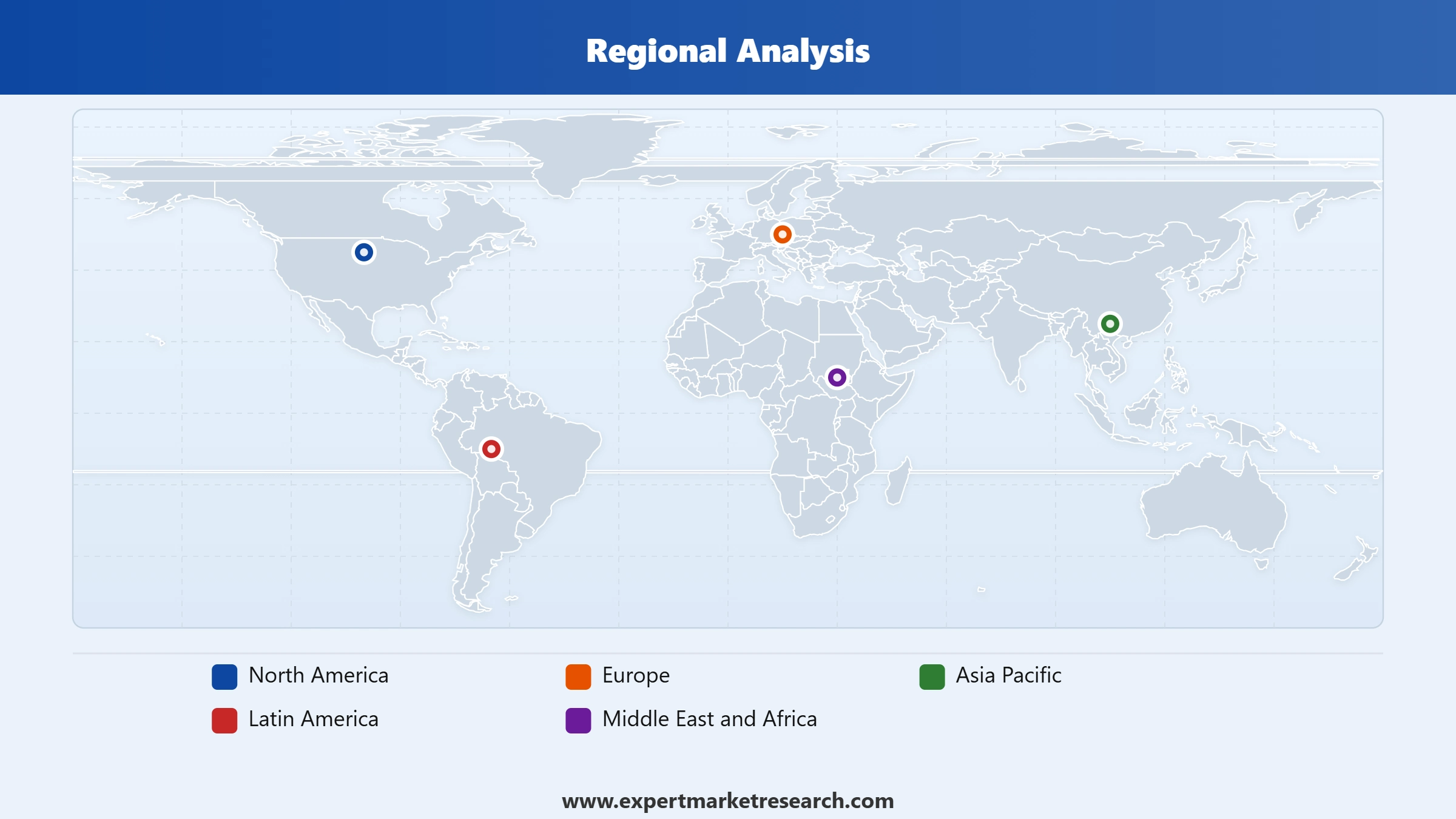
Market Breakup by Region
Key Insight: According to the solar carport market report, North America focuses on corporate sustainability and EV readiness. Europe benefits from regulatory enforcement while Asia Pacific emphasizes scalability and urban efficiency. The market in Latin America is driven by commercial energy independence. The Middle East and Africa prioritize heat-resilient structures and long-term reliability. Regional diversity influences design, procurement, and pricing strategies. Suppliers aligning offerings to local priorities gain faster adoption.
Market Breakup by Type
Key Insight: Single carport units mainly cover individual parking spaces and attractive installations. Double-unit carports strike a balance between adaptability and standardization, making them well-suited for mid-sized assets that require repeatable yet flexible parking and energy solutions. Multi carports allow more operational efficiencies, leading to the growth of the solar carport market. Demand depends on the size of the location, capital planning, and integration requirements.
Market Breakup by Application
Key Insight: Commercial installations are all about scale, reliability, and integration. Residential ones, on the other hand, concentrate more on design, making efficient use of space, and keeping the installation simple. Lithuania-based Solitek launched a carport product line featuring 370 W glass-glass frameless modules in December 2023, for both commercial and residential applications. Each application segment as considered in the solar carport industry report changes the procurement priorities. Suppliers who are adapting their product engineering and service models accordingly are retaining customers.
Market Breakup by Region
Key Insight: According to the solar carport market report, North America focuses on corporate sustainability and EV readiness. Europe benefits from regulatory enforcement while Asia Pacific emphasizes scalability and urban efficiency. The market in Latin America is driven by commercial energy independence. The Middle East and Africa prioritize heat-resilient structures and long-term reliability. Regional diversity influences design, procurement, and pricing strategies. Suppliers aligning offerings to local priorities gain faster adoption.
Read more about this report - REQUEST FREE SAMPLE COPY IN PDF
By type, multi-carport systems dominate the market due to scalable designs and commercial parking integration
Standardized engineering largely helps multi-carport systems to lead the overall solar carport market growth. Airports, logistics parks, retail chains, and universities which boast high parking density and predictable energy demand are the main users of such systems. Companies are making multi-carports even more uniform for easy access while also simplifying electrical layouts. Buyers appreciate these systems because they enable phased expansions without having to redesign the foundations. Moreover, multi carports facilitate the integration of EV charging rows and centralized inverters.
Read more about this report - REQUEST FREE SAMPLE COPY IN PDF
Two-unit carports are gaining rapid popularity, especially among small commercial and premium residential setups. Such systems provide a balance of customization and scale which makes them appealing for office parks, healthcare facilities, and gated communities. To keep the process and costs as low as possible while still retaining architectural features, manufacturers are coming up with pre-engineered two-unit designs for local installations. In November 2024, GoodWe developed a residential solar carport that features its Polaris building-integrated PV (BIPV) panels.
By application, the commercial sector lead adoption driven by ESG mandates and energy cost control
Commercial use cases account for the largest share of the solar carport market revenue, mainly because of orderly procurement cycles and the existence of long-term energy strategies. Corporates are increasingly installing solar carports at their offices, warehouses, airports, and retail centers to reduce electricity costs, use clean energy, generate additional energy revenue, and meet sustainability goals. Decision-makers want solutions to be integrated with EV charging and centralized monitoring. For example, in January 2026, DMEGC Solar installed a 1.2 MW solar system at China’s largest local hospital, cutting costs, emissions and boosting renewable energy use.
Read more about this report - REQUEST FREE SAMPLE COPY IN PDF
Residential applications are rapidly expanding their solar carport market share, especially through high-end housing developments and gated communities. Developers are using carports as value-added infrastructure instead of an optional add-on feature. Homeowners have a preference for carports in situations where rooftop solar is limited by design constraints. Manufacturers are responding with architecturally refined structures and simplified wiring systems. Residential buyers prefer shorter installation timelines and minimal civil work.
Europe retains its market dominance supported by regulatory enforcement and parking solar mandates
Europe continues to be the leading solar carport market by a large margin because of enforceable parking solar regulations and strong local government participation. Nations like France and Germany are pushing solar usage in large parking lots. Buyers in Europe prefer standardized designs that comply with strict safety and durability standards. Manufacturers serving this market focus on steel structures that are certified, have a long service life, and allow for predictable maintenance.
Read more about this report - REQUEST FREE SAMPLE COPY IN PDF
Asia Pacific emerges to be the fastest-growing regional solar carport industry due to continuous urbanization and rising commercial infrastructure development. Solar carports are being installed in industrial parks, IT campuses, and transit hubs to meet growing energy needs without the use of land. Buyers are putting emphasis on quick execution and modular upscaling. Local manufacturers are teaming up with global technology providers to raise engineering standards. In July 2024, India-based Servotech Power Systems inaugurated Delhi’s first grid-connected Solar-Powered EV Charging Carport, in association with the National Solar Energy Federation of India.
The global market is moderately concentrated where competition is mainly focused on engineering reliability, deployment speed, and integration capability. Leading solar carport market players continue to focus on prefabrication, standardized designs, and EPC-friendly systems. They are finding prospects in marketing bundled solutions that include EV charging, monitoring software, and maintenance services.
Solar carport companies also aim to secure long-term power purchase agreements and multi-site frameworks. Innovation is less about new materials and more about reducing installation risk and lifecycle costs. By investing in modular engineering and regional partnerships, players are enhancing their competitive positioning. The market favors companies that deliver predictable performance over highly customized, heavy-duty designs.
Located in Japan and established in 1974, Nichiei Intec is a specialist in structural solutions made of aluminum and steel. The company serves the market by providing precisely engineered systems that are durable and have a long service life. Nichiei is concentrating on standardizing components that facilitate efficient installations.
Established in 2003 and headquartered in Japan, SankyoAlumi is a recognized manufacturer of lightweight aluminum structural systems. In the market, the company emphasizes corrosion resistance and design compatibility with building architecture. Its strategy focuses on modular configurations and repeatable deployment across large-scale housing projects.
Schletter, established in 1968 and headquartered in Germany, is a prominent supplier of solar mounting and carport systems. The company serves large-scale commercial and industrial projects with high-load, certified structures. Schletter’s strength lies in compliance-driven engineering and EPC-ready solutions. It supports multi-site deployments across Europe and North America. The company focuses on long-term performance, wind-load stability, and compatibility with advanced solar modules.
Founded in 2005 and based in Japan, GC Story provides steel-based structural solutions for renewable infrastructure. In the market, the company targets large-scale parking facilities and industrial clients. GC Story emphasizes cost-efficient steel fabrication and rapid manufacturing cycles. Its offerings are suited for projects requiring scalability and structural strength. The firm is expanding its presence through partnerships and regional EPC collaborations.
*Please note that this is only a partial list; the complete list of key players is available in the full report. Additionally, the list of key players can be customized to better suit your needs.*
Other key players in the market include AG Japan, Yumesolar, and Ecolohas Japan, among others.
Unlock the latest insights with our solar carport market trends 2026 report. Discover regional growth patterns, consumer preferences, and key industry players. Stay ahead of competition with trusted data and expert analysis. Download your free sample report today and drive informed decisions in the market.


Upto 15% Off
USD
$2499 $2249
$3999 $3599
$4999 $4249
$5999 $5099


*While we strive to always give you current and accurate information, the numbers depicted on the website are indicative and may differ from the actual numbers in the main report. At Expert Market Research, we aim to bring you the latest insights and trends in the market. Using our analyses and forecasts, stakeholders can understand the market dynamics, navigate challenges, and capitalize on opportunities to make data-driven strategic decisions.*
In 2025, the market reached an approximate value of USD 584.54 Million.
The market is projected to grow at a CAGR of 4.70% between 2026 and 2035.
The market is estimated to witness a healthy growth in the forecast period of 2026-2035 to reach nearly USD 925.30 Million by 2035.
Stakeholders are standardizing designs, forming EPC partnerships, integrating EV readiness, optimizing prefabrication, and pursuing long-term contracts to improve margins and deployment certainty.
Increasing awareness of solar energy and the rising production of electric cars are the key industry trends propelling the growth of the market.
The major regions in the industry are North America, Latin America, the Middle East and Africa, Europe, and the Asia Pacific.
The different types of solar carports are one unit carport, two unit carport, and multi carport.
The significant applications of solar carport are residential and commercial, among others.
The key players in the market include Nichiei Intec, SankyoAlumi, Schletter, GC Story, AG Japan, Yumesolar, and Ecolohas Japan, among others.
High upfront installation costs, complex permitting processes, site-specific engineering constraints, and coordination between solar, structural, and EV charging stakeholders continue to challenge project execution.
Explore our key highlights of the report and gain a concise overview of key findings, trends, and actionable insights that will empower your strategic decisions.
| REPORT FEATURES | DETAILS |
| Base Year | 2025 |
| Historical Period | 2019-2025 |
| Forecast Period | 2026-2035 |
| Scope of the Report |
Historical and Forecast Trends, Industry Drivers and Constraints, Historical and Forecast Market Analysis by Segment:
|
| Breakup by Type |
|
| Breakup by Application |
|
| Breakup by Region |
|
| Market Dynamics |
|
| Competitive Landscape |
|
| Companies Covered |
|
| Report Price and Purchase Option | Explore our purchase options that are best suited to your resources and industry needs. |
| Delivery Format | Delivered as an attached PDF and Excel through email, with an option of receiving an editable PPT, according to the purchase option. |
Datasheet
One User
USD 2,499
USD 2,249
tax inclusive*
Single User License
One User
USD 3,999
USD 3,599
tax inclusive*
Five User License
Five User
USD 4,999
USD 4,249
tax inclusive*
Corporate License
Unlimited Users
USD 5,999
USD 5,099
tax inclusive*
*Please note that the prices mentioned below are starting prices for each bundle type. Kindly contact our team for further details.*
Flash Bundle
Small Business Bundle
Growth Bundle
Enterprise Bundle
*Please note that the prices mentioned below are starting prices for each bundle type. Kindly contact our team for further details.*
Flash Bundle
Number of Reports: 3
20%
tax inclusive*
Small Business Bundle
Number of Reports: 5
25%
tax inclusive*
Growth Bundle
Number of Reports: 8
30%
tax inclusive*
Enterprise Bundle
Number of Reports: 10
35%
tax inclusive*
How To Order

Select License Type
Choose the right license for your needs and access rights.

Click on ‘Buy Now’
Add the report to your cart with one click and proceed to register.

Select Mode of Payment
Choose a payment option for a secure checkout. You will be redirected accordingly.
Strategic Solutions for Informed Decision-Making
Gain insights to stay ahead and seize opportunities.

Get insights & trends for a competitive edge.

Track prices with detailed trend reports.

Analyse trade data for supply chain insights.

Leverage cost reports for smart savings

Enhance supply chain with partnerships.

Connect For More Information
Our expert team of analysts will offer full support and resolve any queries regarding the report, before and after the purchase.
Our expert team of analysts will offer full support and resolve any queries regarding the report, before and after the purchase.
We employ meticulous research methods, blending advanced analytics and expert insights to deliver accurate, actionable industry intelligence, staying ahead of competitors.
Our skilled analysts offer unparalleled competitive advantage with detailed insights on current and emerging markets, ensuring your strategic edge.
We offer an in-depth yet simplified presentation of industry insights and analysis to meet your specific requirements effectively.




