

Consumer Insights
Uncover trends and behaviors shaping consumer choices today
Procurement Insights
Optimize your sourcing strategy with key market data
Industry Stats
Stay ahead with the latest trends and market analysis.
The South Africa conveyor belt market attained a value of USD 36.23 Million in 2025 and is projected to expand at a CAGR of 4.10% through 2035. The market is further expected to achieve USD 54.15 Million by 2035. Rising adoption of energy efficient conveyor belts by South African mining firms is lowering power consumption per ton, while supporting ESG targets and long-term operational cost discipline.
Port modernization and cement capacity optimization are creating consistent demand in the South Africa conveyor belt market. Transnet port upgrades are increasing conveyor automation requirements. Cement producers are investing in heat resistant belts to support higher kiln utilization. These two sectors favor long-term supply contracts. Suppliers responding with customized compounds and faster onsite servicing are capturing stable, non-cyclical revenue opportunities.
Mining operators are pushing for longer belt life as unplanned conveyor downtime costs large underground mines. Companies like Transvaal Rubber Company (Truco) are responding to this South Africa conveyor belt market trend by introducing steel cord conveyor belts engineered for deep-level platinum and manganese mines. Such developments reflect how suppliers are shifting from volume sales toward performance-linked contracts and lifecycle pricing models.
The South Africa conveyor belt industry is shaped by replacement demand and specification upgrades rather than greenfield installations. Aging conveyor infrastructure across gold, coal, and iron ore operations is compelling operators to invest in higher grade rubber compounds, fire resistant covers, and energy efficient belt designs. Leading manufacturers are repositioning portfolios toward abrasion resistant and low rolling resistance belts to support cost control targets. At the same time, OEMs are integrating condition monitoring layers within belts to improve predictive maintenance accuracy. For example, in September 2025, Razor Labs announced a strategic partnership with Process Automation (Pty) Ltd to offer DataMind AI, Razor Labs' flagship AI-based Predictive Maintenance platform.
Compound Annual Growth Rate
4.1%
Value in USD Million
2026-2035
Mato Products displayed its newest product lineup and advancements in conveyor belt fasteners and cleaning systems at Electra Mining Africa. Such developments in the South Africa conveyor belt market underline rising demand for faster belt maintenance solutions, creating opportunities for belt suppliers to bundle fastening, cleaning, and servicing tools into higher-margin aftermarket contracts.
Tru-Trac introduced an entirely new selection of belt trackers within its innovative products at the Electra Mining Africa. South Africa conveyor belt market players are thus shifting toward misalignment prevention. Manufacturers can partner with tracker specialists and offer integrated uptime-focused conveyor packages.
Luna Innovations secured a significant contract to conduct heat detection monitoring for 40 kilometers of conveyor belt across 11 mines in South Africa. This deployment shows how monitoring technology is becoming essential, opening avenues for belt makers to embed sensor compatibility and co-sell predictive maintenance solutions.
LKAB granted ABB a contract to implement two ABB Gearless Conveyor Drives (GCDs) on the current conveyor belt system at its Malmberget mine located near Gällivare. Such installation updates signal growing emphasis on energy-efficient conveyor systems, encouraging belt suppliers to design products optimized for low-resistance and high-power transmission setups.
Mining remains the core demand engine for the market. Deep-level gold, platinum, and manganese operations are pushing belt suppliers to redesign products for higher tensile loads and longer service cycles. Companies like MATO are offering leading-edge belt fastener/clip to the industry, which has the capability to fasten conveyor belts above 18mm thick, since August 2024. These pressures are pushing manufacturers to launch steel cord belts with improved splice integrity and heat resistance, accelerating the South Africa conveyor belt market value. Suppliers positioning around performance warranties are gaining preference in long-term mining contracts.
Logistics recovery programs are directly influencing conveyor belt demand in South Africa. Companies like Transnet are executing phased upgrades across Richards Bay and Durban ports to ease bulk material congestion. Conveyor systems are being replaced rather than repaired, especially in coal and iron ore terminals. This has increased demand for fire resistant and low rolling resistance belts that can operate continuously with fewer shutdowns. Government-backed infrastructure spend under Operation Vulindlela is accelerating these projects. Conveyor belt suppliers offering rapid installation kits and localized fabrication are securing framework agreements tied to port output expansion targets. For example, in August 2025, DHL Supply Chain launched a Superlink electric truck pilot in partnership with Unilever and Volvo Trucks South Africa.
Rising electricity costs are reshaping conveyor belt specifications across industrial sites. Eskom tariff hikes have made energy losses from conveyor systems more visible to plant operators. As a result, demand is shifting toward low energy loss belts designed to reduce power draw per ton conveyed. Manufacturers are launching rubber compounds engineered for lower indentation rolling resistance, propelling the overall South Africa conveyor belt market growth. These products are increasingly included in RFPs from mines, cement plants, and aggregate operators. Firms like BEKA Schréder are supplying the LED lighting solution for a Rustenburg mine's conveyor belts in South Africa.
Import delays and currency volatility are driving conveyor belt localization strategies. Several global belt manufacturers are expanding fabrication and service centers near Limpopo and Northern Cape mining corridors. This trend favors modular belt designs that allow on-site splicing and faster replacement. OEMs are investing in mobile vulcanization units to support remote operations, creating new South Africa conveyor belt market opportunities. In November 2025, VSL Manufacturing opened a new R750m automotive manufacturing facility alongside the Isuzu Motors South Africa (Imsaf) assembly plant in Struandale, strengthening localization, industrial capacity and job retention in the Eastern Cape.
Condition monitoring is emerging as a differentiator in the South African market. Mining and bulk handling operators are adopting embedded sensors to track belt wear, misalignment, and splice health. This trend aligns with South Africa’s broader push toward digital mining operations. Large producers are piloting sensor-enabled belts to reduce catastrophic failures that halt production, broadening the South Africa conveyor belt market scope. Belt manufacturers are partnering with monitoring software firms to offer integrated solutions rather than standalone products. Companies like ABB are launching new condition monitoring digital service, tailor-made for predictive maintenance of conveyor belts.
Read more about this report - REQUEST FREE SAMPLE COPY IN PDF
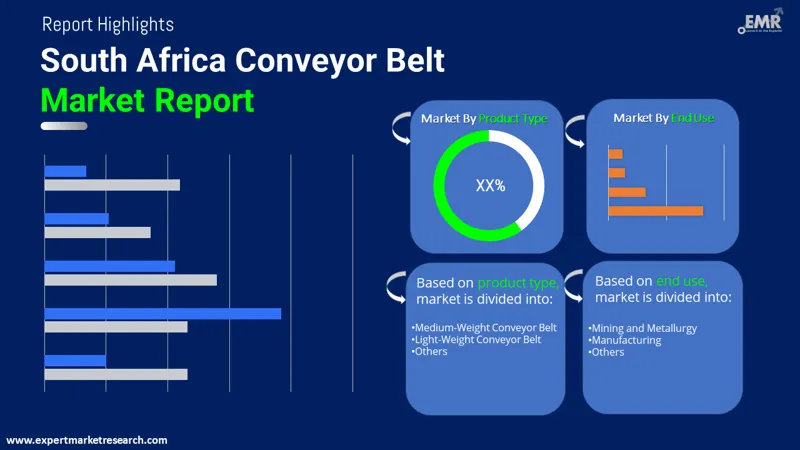
The EMR’s report titled “South Africa Conveyor Belt Market Report and Forecast 2026-2035” offers a detailed analysis of the market based on the following segments:
Market Breakup by Product Type
Key Insight: Heavy-weight conveyor belts remain essential for high-load mining and bulk export systems, where continuous operations and abrasive materials demand maximum strength and longer replacement cycles. Medium-weight belts are expanding their share in the South Africa conveyor belt market dynamics via cement plants, ports, and aggregate handling sites, as operators balance durability with easier installation and energy efficiency. Light-weight belts primarily support packaging lines, food processing, and light manufacturing environments that require flexibility and hygiene.
Market Breakup by End Use
Key Insight: Mining and metallurgy continue to drive volume demand in the South Africa conveyor belt market, as large-scale material movement depends heavily on conveyor reliability. Manufacturing supports steady growth through automation and process optimization needs. Chemicals and oils require specialized belt materials resistant to heat and corrosion. Aviation relies on conveyor systems for efficient baggage handling and sorting operations. Other sectors adopt conveyors to improve internal logistics and workflow efficiency.
Read more about this report - REQUEST FREE SAMPLE COPY IN PDF
Heavy-weight conveyor belts account for the largest share of the market due to mining intensity
Heavy-weight conveyor belts dominate the South Africa conveyor belt market due to sustained mining and bulk material handling demand. These belts are widely used in deep-level gold, platinum, coal, and manganese operations where load stress remains constant. Operators prefer heavy-weight belts because downtime directly impacts ore recovery cycles. Belt manufacturers focus on thicker covers, steel cord reinforcements, and higher splice reliability. Many suppliers are offering belts designed for extended service life to reduce replacement frequency. Firms like Rema Tip Top South Africa are partnering with Dunlop Belting, a manufacturer of heavy duty conveyor belts, to form a strategic alliance.
Medium-weight belts are gaining traction within the South Africa conveyor belt market growth dynamics across cement, aggregates, and port handling facilities. These belts offer a balance between durability and operational flexibility. Industrial operators are shifting toward medium-weight belts to support moderate loads with improved energy efficiency. Growth in this category is further supported by rising demand from logistics hubs and quarrying projects. Suppliers positioning medium-weight belts as cost-efficient performance solutions are seeing faster adoption beyond traditional mining environments.
By end use, mining and metallurgy lead significant demand in the due to continuous bulk material movement
Mining and metallurgy account for the largest share of conveyor belt demand in South Africa. Continuous material flow is critical in underground and surface mining operations. Operators prioritize reliability and reduced stoppages. Belt suppliers focus on abrasion resistance, fire retardant properties, and stronger splice systems. Mining companies prefer long-term supply agreements with guaranteed performance thresholds.
Manufacturing is emerging as the fastest-growing end-use segment for conveyor belts. Automotive, food processing, and building materials plants rely on conveyors to improve throughput consistency. Manufacturers favor belts that support automation and predictable maintenance schedules. Conveyor systems are being redesigned to reduce manual handling and improve worker safety. Firms like REMA TIP TOP are presenting MCube BRD2, since March 2025. The innovative sensor technology significantly improves the precise real-time analysis of steel cord conveyor belts and supports predictive maintenance. Demand in the South Africa conveyor belt market is also supported by plant upgrades rather than new factories.
The market is moderately consolidated and strongly service driven. Competition centers on belt durability, splice reliability, and rapid response servicing near mining corridors. South Africa conveyor belt market players are prioritizing localized manufacturing, mobile vulcanization units, and performance-based supply contracts. Mining clients increasingly prefer suppliers offering belt health monitoring and guaranteed uptime metrics.
Key opportunities for South Africa conveyor belt companies can be found in replacement demand rather than greenfield expansion. Ports, cement plants, and quarries are also opening space for mid-duty and energy efficient belts. Vendors investing in compound innovation, faster installation systems, and long-term maintenance frameworks are improving profit margins. The competitive edge is shifting from product availability to lifecycle performance and on-site technical depth.
National Conveyor Products was established in 1992 and is headquartered in South Africa. The company focuses on heavy-duty conveyor belting for mining and quarrying applications. It caters to the market through custom belt fabrication, localized stock holding, and rapid onsite installation. Its strength lies in tailored belt specifications for abrasive environments.
Oriental Rubber Industries Pvt Ltd, established in the year 1949 and headquartered in Pune, India, supplies high-performance conveyor belts to South Africa through regional distributors. It serves mining and bulk material sectors with steel cord and heat-resistant belts. Its product strategy emphasizes long service life and reduced splice failures.
Truco Africa was established in 2007 and is headquartered in Johannesburg, South Africa. The firm addresses conveyor belt demand through integrated industrial supply offerings. It supports mining and processing plants with rubber belting, hoses, and wear solutions. Truco’s advantage lies in rapid logistics and regional service reach.
Fenner Conveyor Belting South Africa, based in Johannesburg, South Africa and established in 2007, supplies engineered conveyor belts for high-load mining operations. It emphasizes belt monitoring technologies and performance-based contracts. Fenner supports the South Africa conveyor belt market through local manufacturing, strong R&D alignment, and long-term supply partnerships with major mines and ports.
*Please note that this is only a partial list; the complete list of key players is available in the full report. Additionally, the list of key players can be customized to better suit your needs.*
Other key players in the market include Conveyor & Industrial Supplies (PTY) LTD., among others.
Unlock the latest insights with our South Africa conveyor belt market trends 2026 report. Discover regional growth patterns, consumer preferences, and key industry players. Stay ahead of competition with trusted data and expert analysis. Download your free sample report today and drive informed decisions in the market.


Upto 15% Off
USD
$2499 $2249
$3999 $3599
$4999 $4249
$5999 $5099


*While we strive to always give you current and accurate information, the numbers depicted on the website are indicative and may differ from the actual numbers in the main report. At Expert Market Research, we aim to bring you the latest insights and trends in the market. Using our analyses and forecasts, stakeholders can understand the market dynamics, navigate challenges, and capitalize on opportunities to make data-driven strategic decisions.*
In 2025, the market reached an approximate value of USD 36.23 Million.
The market is projected to grow at a CAGR of 4.10% between 2026 and 2035.
The market is estimated to witness healthy growth in the forecast period of 2026-2035 to reach about USD 54.15 Million by 2035.
A conveyor belt system is made up of continuous moving strips that carry different materials from one place to another in a short period.
Conveyor belts are often made from a rubber or plastic compound combined with layers of fabric material or steel cable.
Manufacturers are expanding service hubs, strengthening localization, investing in belt monitoring systems, targeting replacement cycles, and forming multi-year performance-linked contracts with mining and logistics operators.
The key trends supporting the market growth are advancement in conveyor belt technology, development of energy-efficient conveyor belt systems, and expansion of the aviation and manufacturing sector.
The major end uses of conveyor belts are mining and metallurgy, manufacturing, chemicals, oil, and gases, and aviation, among others.
The significant product types of conveyor belts are medium-weight conveyor belt, light-weight conveyor belt, and heavy-weight conveyor belt.
The key players in the market include National Conveyor Products, Oriental Rubber Industries Pvt Ltd., Truco Africa, Fenner Conveyor Belting (SA) (Pty) Ltd., and Conveyor & Industrial Supplies (PTY) LTD., among others.
Rising input costs, power instability, long lead times, and skilled labor shortages continue to pressure margins while forcing suppliers to balance localization investments with pricing competitiveness.
Explore our key highlights of the report and gain a concise overview of key findings, trends, and actionable insights that will empower your strategic decisions.
| REPORT FEATURES | DETAILS |
| Base Year | 2025 |
| Historical Period | 2019-2025 |
| Forecast Period | 2026-2035 |
| Scope of the Report |
Historical and Forecast Trends, Industry Drivers and Constraints, Historical and Forecast Market Analysis by Segment:
|
| Breakup by Product Type |
|
| Breakup by End Use |
|
| Market Dynamics |
|
| Competitive Landscape |
|
| Companies Covered |
|
Datasheet
One User
USD 2,499
USD 2,249
tax inclusive*
Single User License
One User
USD 3,999
USD 3,599
tax inclusive*
Five User License
Five User
USD 4,999
USD 4,249
tax inclusive*
Corporate License
Unlimited Users
USD 5,999
USD 5,099
tax inclusive*
*Please note that the prices mentioned below are starting prices for each bundle type. Kindly contact our team for further details.*
Flash Bundle
Small Business Bundle
Growth Bundle
Enterprise Bundle
*Please note that the prices mentioned below are starting prices for each bundle type. Kindly contact our team for further details.*
Flash Bundle
Number of Reports: 3
20%
tax inclusive*
Small Business Bundle
Number of Reports: 5
25%
tax inclusive*
Growth Bundle
Number of Reports: 8
30%
tax inclusive*
Enterprise Bundle
Number of Reports: 10
35%
tax inclusive*
How To Order

Select License Type
Choose the right license for your needs and access rights.

Click on ‘Buy Now’
Add the report to your cart with one click and proceed to register.

Select Mode of Payment
Choose a payment option for a secure checkout. You will be redirected accordingly.
Strategic Solutions for Informed Decision-Making
Gain insights to stay ahead and seize opportunities.

Get insights & trends for a competitive edge.

Track prices with detailed trend reports.

Analyse trade data for supply chain insights.

Leverage cost reports for smart savings

Enhance supply chain with partnerships.

Connect For More Information
Our expert team of analysts will offer full support and resolve any queries regarding the report, before and after the purchase.
Our expert team of analysts will offer full support and resolve any queries regarding the report, before and after the purchase.
We employ meticulous research methods, blending advanced analytics and expert insights to deliver accurate, actionable industry intelligence, staying ahead of competitors.
Our skilled analysts offer unparalleled competitive advantage with detailed insights on current and emerging markets, ensuring your strategic edge.
We offer an in-depth yet simplified presentation of industry insights and analysis to meet your specific requirements effectively.




