

Consumer Insights
Uncover trends and behaviors shaping consumer choices today
Procurement Insights
Optimize your sourcing strategy with key market data
Industry Stats
Stay ahead with the latest trends and market analysis.
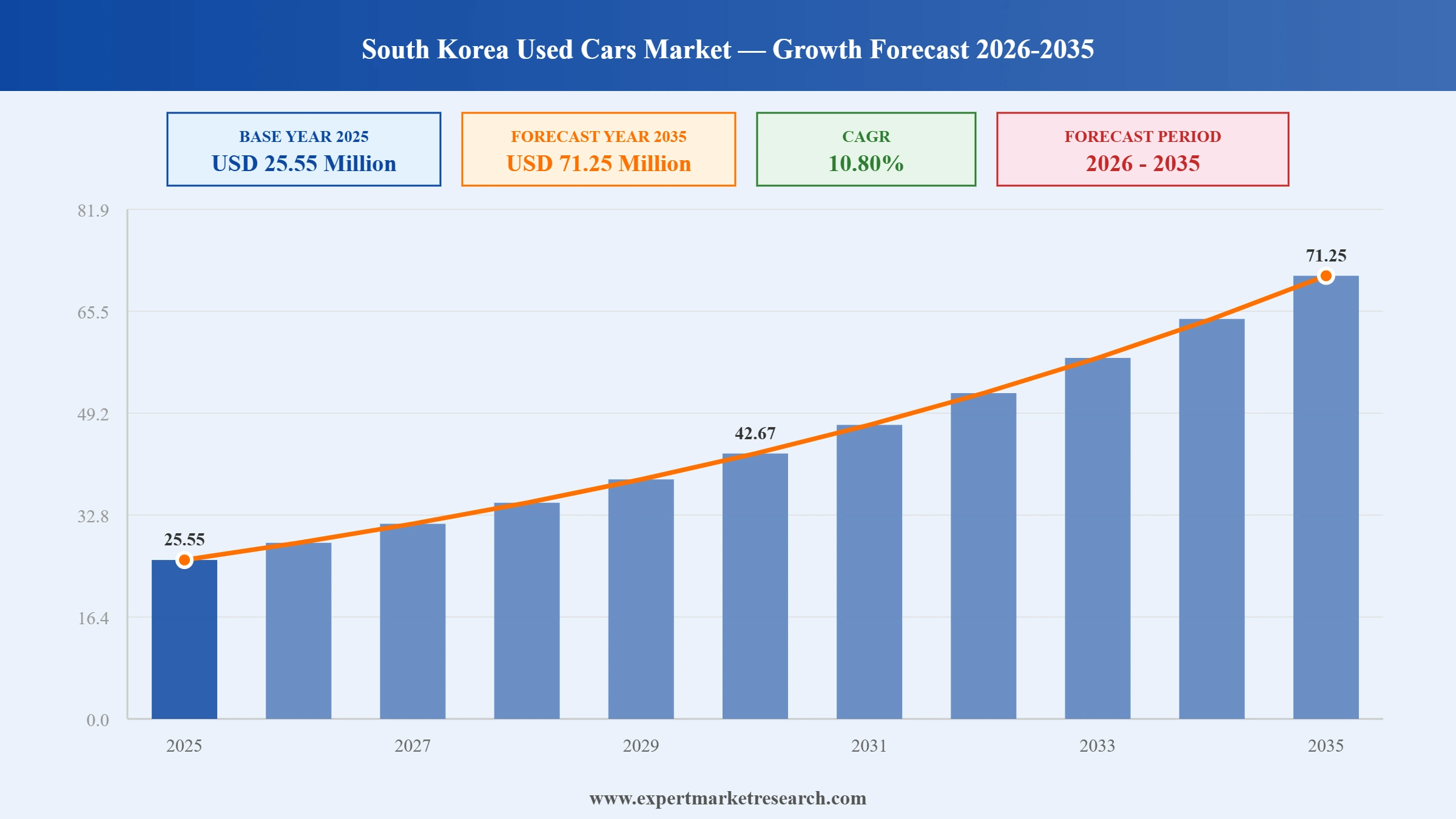
The South Korea Used Cars Market reached a value of USD 25.55 Million at 2025 and is projected to expand at a CAGR of around 10.80% during the forecast period of 2026-2035. With a consistent influx of high-quality lease-return vehicles, the rapid growth of AI-enhanced digital marketplaces, a meaningful shift toward used electric vehicles, and deepening consumer preference for the certified pre-owned segment, the market is expected to reach USD 71.25 Million by 2035.
Read more about this report - REQUEST FREE SAMPLE COPY IN PDF
|
South Korea Used Cars Market Report Summary |
Description |
Value |
|
Base Year |
USD Million |
2025 |
|
Historical Period |
USD Million |
2019-2025 |
|
Forecast Period |
USD Million |
2026-2035 |
|
Market Size 2025 |
USD Million |
25.55 |
|
Market Size 2035 |
USD Million |
71.25 |
|
CAGR 2019-2025 |
Percentage |
XX% |
|
CAGR 2026-2035 |
Percentage |
10.80% |
|
CAGR 2026-2035 - Market by Vehicle Type |
Sports Utility Vehicle (SUV) |
12.2% |
|
CAGR 2026-2035 - Market by Vendor Type |
Organized |
11.9% |
South Korea's used car market is at a genuine tipping point, shaped by the convergence of digital technology, shifting consumer values, and structural changes in vehicle supply. Here are the four trends defining the market's current direction.
In November 2025, Encar, South Korea's largest used car marketplace, launched an advanced AI chatbot powered by dynamic prompt generation technology for its Encar Trust service, which covers more than 42,600 inspected vehicles available for purchase entirely online with a seven-day refund and delivery guarantee. Within three months of launch, the platform recorded an eightfold increase in daily average users compared to its previous rule-based chatbot version. The AI chatbot accounted for 15% of all Encar Trust service applications during the period, and actual customer applications to the service jumped more than five times, demonstrating how AI-driven customer engagement is accelerating digital adoption in South Korea's organized used car segment.
In April 2025, Encar added a seven-day delivery service to its Encar MEET Go online purchase program, allowing buyers to complete a used car transaction entirely without visiting a physical showroom. The service extends Encar's trust-based transaction model, complementing its existing guaranteed inspection and seven-day refund policy. The move reflects a wider industry shift toward removing remaining friction from the online-to-ownership journey for used car buyers in South Korea, and is part of Encar's broader strategy to consolidate its position as the leading digital used car platform in the country with more than 1.2 million vehicles registered annually.
In March 2025, Car Group, the Australian parent company of Encar, reported a 10% year-on-year revenue increase for its South Korean operations to AUD 65 million for the six-month period ending December 2024, with adjusted EBITDA rising 6% to AUD 29 million. Growth was attributed to higher premium product penetration, improved yield from pricing upgrades, and a continued rise in home delivery transactions. The performance reflects the ongoing commercialization of Encar's trust-based inspection and digital transaction services, and confirms that the organized digital segment of South Korea's used car market is generating increasingly strong unit economics as consumer trust in online vehicle purchases deepens.
In 2025, KCar, South Korea's second-largest organized used car dealer with a 12.7% B2C market share and 156,290 units sold, announced its expansion into the consumer-to-consumer marketplace segment, launching a new C2C direct transaction service to support transparent private-party buying and selling. The move represents a significant strategic shift for KCar, which had previously operated primarily as an asset-heavy certified pre-owned dealer. By entering consignment and brokerage, KCar is repositioning as a full-service used car platform and directly challenging Encar's dominance in the C2B and C2C segments of South Korea's approximately 2.5-million-unit annual market.
Between January and September 2024, approximately 25,000 used electric vehicles were sold in South Korea, marking a 47% year-on-year increase. Hyundai's Ioniq 5 emerged as the top-selling used EV with unit sales doubling to 3,300 vehicles, while Kia's EV6 also saw a twofold increase in sales volume. The surge was supported by declining used EV prices, improvements to battery-life reporting on digital platforms, and growing integration of charging station location data within used car listings. This growth in used EV transactions reflects how consumer demand for affordable electric mobility is reshaping vehicle type preferences across South Korea's secondhand market.
South Korea's used car market has moved far beyond simple digital classifieds. Leading platforms are now offering end-to-end transaction capabilities, with Encar's Trust service providing over 42,600 AI-inspected vehicles available for completely online purchase with seven-day delivery and refund guarantees. The introduction of AI chatbots, as demonstrated by Encar's November 2025 launch, is dramatically improving conversion rates and expanding service uptake. In parallel, platforms like KBChaChaCha and Autowini have embedded AI-driven recommendations and vehicle history transparency tools that reduce the information asymmetry historically associated with used car purchases, directly contributing to South Korea used cars market growth and accelerating the transition from offline-dominant to digital-first consumer journeys.
The secondary market for electric vehicles in South Korea has entered a genuine growth phase. Between January and September 2024, used EV sales surged 47% year-on-year, with the Hyundai Ioniq 5 becoming the top-selling used EV and Kia's EV6 doubling in transaction volumes. This growth is being driven by falling used EV prices, which declined by an average of 21% during 2023 making previously expensive models affordable to a wider buyer base, as well as by improved battery health reporting features on digital platforms. The government's plan to phase out internal combustion engine vehicle sales by 2035 is also nudging buyers toward electric alternatives, creating a structural long-term tailwind for used EV transactions in South Korea.
South Korea's organized used car sector continues to widen its lead over unorganized dealers, driven by the rollout of manufacturer-backed certified pre-owned programs and the AI-enhanced inspection ecosystems of major platforms. Hyundai's certified pre-owned division employs 272-point inspection checklists to guarantee vehicle quality, while OEM-affiliated channels leverage brand loyalty to convert new car buyers into repeat CPO customers. Encar's 62 operational inspection centres, up by three in the most recent reporting period, underscore the scale of investment in physical quality assurance infrastructure. For buyers, certified programs mean warranties, transparent vehicle histories, and financing options, all of which raise willingness to purchase online and at higher price points.
SUVs have firmly established themselves as the preferred vehicle type in South Korea's used car market, with sales consistently outpacing sedans driven by consumer appetite for versatility, safety, and higher ground clearance. Popular models including the Hyundai Palisade, Kia Sorento, and Kia Carnival top transaction volume rankings on platforms like Encar and KBChaChaCha. This shift mirrors broader trends in South Korea's new car market, where SUV sales have grown to account for over 900,000 units annually and continue to surpass sedan volumes. As newer SUV models cycle through lease-return programs into the secondhand market, they are replenishing used car dealer inventories with comparatively young, well-maintained stock that commands strong residual values and buyer confidence.
The Expert Market Research's report titled "South Korea Used Cars Market Report and Forecast 2026 to 2035" offers a detailed analysis of the market based on the following segments:
Market Breakup by Vehicle Type
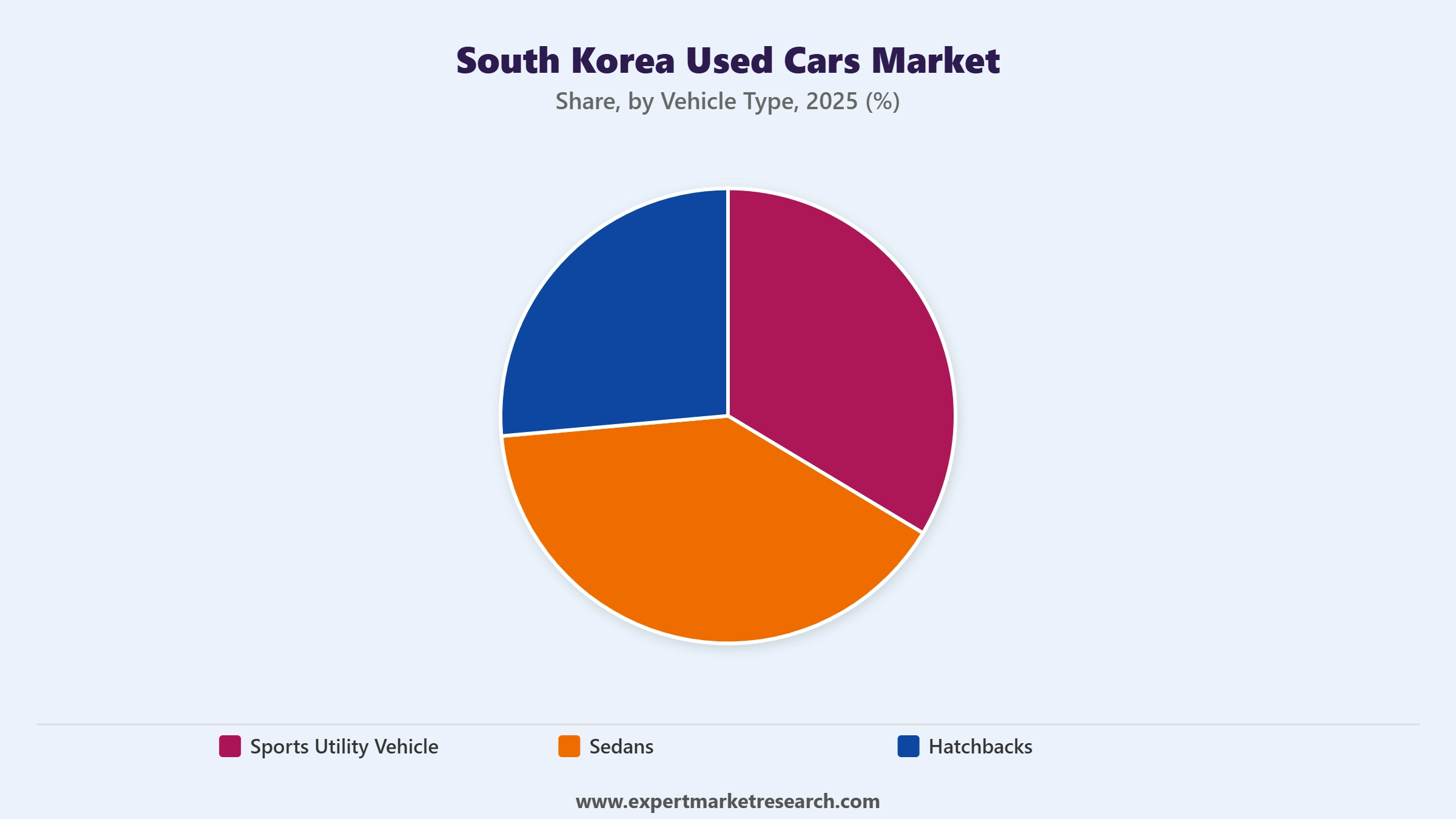
Key Insight: SUVs dominate South Korea's used car landscape, accounting for the largest and fastest-growing share of transaction volumes across organized platforms. Consumer preference for larger, more capable vehicles has shifted decisively over the past decade, with popular models such as the Hyundai Palisade and Kia Sorento consistently ranking as top sellers on platforms including Encar and KB Cha Cha Cha. SUVs are projected to grow at 12.2% CAGR through the forecast period, buoyed by a steady pipeline of lease returns delivering relatively young units into the certified pre-owned segment. Sedans retain a meaningful market share, particularly among urban commuters and value-focused buyers, though their growth rate trails that of SUVs. Hatchbacks remain popular with younger buyers and small families prioritizing maneuverability and running costs.
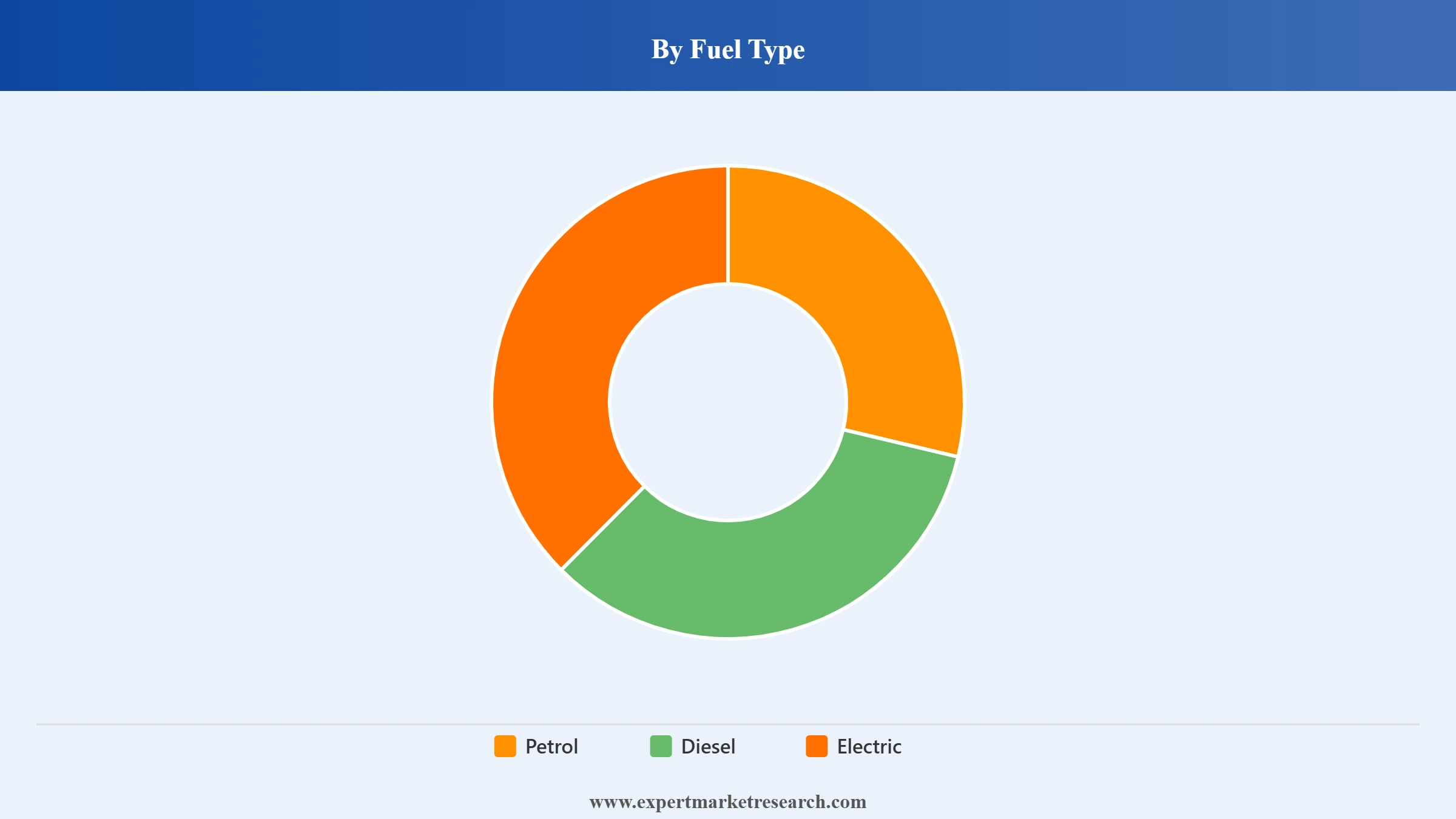
Market Breakup by Fuel Type
Key Insight: Petrol vehicles hold the dominant revenue share in South Korea's used car market, reflecting their widespread availability, lower upfront costs relative to electric alternatives, and the established service and parts ecosystem supporting the segment. Diesel vehicles, while historically popular in South Korea, are facing growing regulatory pressure, including the phasing out of Grade 4 diesel vehicles from Seoul's central districts from 2025. Electric is the fastest-growing fuel type, with used EV sales surging 47% year-on-year in January through September 2024. Declining battery prices are making EVs accessible to price-sensitive buyers, while digital platforms are improving consumer confidence through dedicated battery-health report features and charging station proximity data. The government's plan to ban new ICE vehicle sales by 2035 provides long-term structural support for the used EV segment.
Market Breakup by Vendor Type
Key Insight: The Organised segment commands South Korea's used car market, accounting for approximately 90% of market activity and continuing to expand as digital platforms, certified pre-owned programs, and OEM-affiliated dealer networks raise buyer confidence in formalized transactions. Companies including Encar, KCar, KB Cha Cha Cha, and Hyundai Glovis anchor the organized channel, offering AI-driven pricing, guaranteed inspections, and online purchase capabilities that unorganized operators cannot match. The Unorganised segment serves primarily rural and price-sensitive buyers through community dealer networks and private-party channels, though this segment faces steady erosion as digital accessibility improves nationwide.
Market Breakup by Sales Channel
Key Insight: Offline sales remain the largest channel by volume, as South Korean consumers still prefer physically inspecting vehicles and conducting face-to-face negotiations before completing a purchase. However, leading organized players have transformed their physical showrooms with digital kiosks, AI pricing screens, and 360-degree vehicle tours, narrowing the experiential gap with online alternatives. The Online channel is the fastest-growing segment, with platforms like Encar, Autobell, and KB Cha Cha Cha offering completely digital purchase journeys including AI-powered search, instant financing, and guaranteed home delivery. The seven-day delivery and refund policy introduced by Encar Trust has significantly reduced buyer hesitation around fully online transactions, and the channel is projected to grow at a CAGR of approximately 12.3% through 2035.
Read more about this report - REQUEST FREE SAMPLE COPY IN PDF
In the vehicle type segmentation, SUVs and Sedans collectively dominate South Korea's used car market. SUVs have claimed the largest and fastest-growing share, fueled by a generational preference shift toward versatile, family-friendly vehicles with strong brand recognition in the Hyundai and Kia portfolios. Their high residual values mean they retain approximately 65% of original value after three years, making them the preferred inventory for organized certified pre-owned dealers who can command premium pricing and secure repeat customers. Sedans maintain a significant base, particularly among urban professional buyers who prioritize fuel efficiency and parking convenience, and among buyers seeking affordable access to premium domestic brands like Genesis.
Read more about this report - REQUEST FREE SAMPLE COPY IN PDF
In the fuel type segmentation, Petrol vehicles hold the dominant market share, benefiting from low initial prices, mature aftermarket support, and the widest availability across all dealer channels. They remain the default choice for first-time used car buyers and price-sensitive consumers in secondary cities. Electric vehicles, while currently a small share of overall volume, are the standout growth story. Used EV sales jumped 47% year-on-year during January to September 2024, with the Hyundai Ioniq 5 and Kia EV6 leading the transaction surge. Platforms are responding by building dedicated EV sections with battery-health verification, charging locators, and government incentive calculators to capitalize on rising demand and bridge the remaining information gap that still slows some buyers' decisions.
Read more about this report - REQUEST FREE SAMPLE COPY IN PDF
South Korea's used car market is led by a small number of large-scale organized platforms and dealer networks that have invested heavily in digital infrastructure, certified inspection programs, and AI-powered transaction tools. The market structure is effectively a two-tier system: dominant digital-first platforms like Encar, KCar, and KB Cha Cha Cha that are driving the organized segment's continued market share gains, and cross-border export specialists such as Be Forward, Autowini, and Corea-Auto that serve the international resale corridor connecting South Korea with buyers in developing markets.
Competitive intensity is high within the organized domestic segment, where platforms compete primarily on transaction transparency, inspection quality, financing integration, and speed of delivery. AI investment has become a key differentiator, with companies introducing chatbots, dynamic pricing engines, and AI-assisted vehicle grading to improve buyer conversion and seller satisfaction. OEM-backed certified pre-owned programs from Hyundai and Kia are raising the quality bar across the segment, while new entrants to the C2C space, such as KCar's planned marketplace, are signaling further competitive evolution over the forecast period.
Encar, founded in 2000 and headquartered in Seoul, is South Korea's leading used car marketplace, owned by Australia's Car Group. It accounts for approximately 40% of annual domestic used car registrations, with over 1.2 million vehicles listed annually. Encar differentiates through its mobile-first platform, AI-powered recommendations, vehicle history reports, and the Encar Trust service offering guaranteed inspections and home delivery. Its 62 inspection centres across South Korea represent a significant physical infrastructure advantage over purely digital competitors.
KB Cha Cha Cha, operated by KB Capital Co., a subsidiary of KB Financial Group, is one of South Korea's largest used car platforms, integrating automotive financing directly into the car discovery and purchase process. The platform holds approximately 13% market share in the consumer facing used car segment and reported an operating profit increase of 83.3% after incorporating used-car financing into its portfolio. Its deep financial group backing gives it a structural advantage in offering seamless, competitive financing to buyers, a key purchase driver in South Korea's used car market.
Hyundai Glovis, a logistics subsidiary of Hyundai Motor Group, has expanded into used cars through the Autobell online platform, launched in January 2022. The platform draws on Hyundai Motor Group's vast lease-return vehicle pipeline and brand credibility to offer certified pre-owned vehicles with comprehensive inspection documentation. Hyundai Glovis's OEM affiliation gives it privileged access to first-generation lease returns from Hyundai and Kia, ensuring a consistent supply of relatively young, well-maintained stock that is in high demand among quality-conscious buyers.
Be Forward, headquartered in Tokyo and founded in 2004, operates a major cross-border used car export business with South Korea as a key sourcing market. The platform connects Korean used car sellers with buyers across more than 80 countries, offering integrated customs handling, multi-language support, and fleet purchase packages tailored to developing market buyers. Be Forward's global logistics network and partnerships with Korean exporters position it as the leading intermediary in the corridor connecting South Korea's organized used car supply with high-demand markets in Africa, Central Asia, and Southeast Asia.
Other key players in the market are Aj Sell Car, Autowini Inc., Car Vision, Corea-Auto, Han Sung Motor, PicknBuy24, and Others.
*Please note that this is only a partial list; the complete list of key players is available in the full report. Additionally, the list of key players can be customized to better suit your needs.*
Get ahead of South Korea's fast-evolving used car market with our detailed 2026 report. Whether you are a dealer evaluating digital investment, a platform operator assessing competitive dynamics, or an investor sizing the EV resale opportunity, this report delivers the data you need. From segment-level forecasts to profiles of the platforms reshaping how cars are bought and sold, the insights here are built for decision-making. Download your free sample today and discover what is driving South Korea's dynamic used car industry.


Upto 15% Off
USD
$2499 $2249
$3999 $3599
$4999 $4249
$5999 $5099


*While we strive to always give you current and accurate information, the numbers depicted on the website are indicative and may differ from the actual numbers in the main report. At Expert Market Research, we aim to bring you the latest insights and trends in the market. Using our analyses and forecasts, stakeholders can understand the market dynamics, navigate challenges, and capitalize on opportunities to make data-driven strategic decisions.*
In 2025, the South Korea used cars market reached an approximate value of USD 25.55 Million.
The market is projected to grow at a CAGR of 10.80% between 2026 and 2035.
The key players in the market include Aj Sell Car, Autowini Inc, Be Forward, Car Vision, Corea-Auto, Encar, Han Sung Motor, Hyundai Glovis, KB Cha Cha Cha, and PicknBuy24, among others.
Key strategies driving the market include enhancing digital diagnostics, expanding subscription plans, collaborating with fintech firms, and integrating AR-based inspections.
Sports utility vehicles (SUV) are gaining massive traction and anticipated to expand with a 12.2% CAGR through 2035.
Explore our key highlights of the report and gain a concise overview of key findings, trends, and actionable insights that will empower your strategic decisions.
| REPORT FEATURES | DETAILS |
| Base Year | 2025 |
| Historical Period | 2019-2025 |
| Forecast Period | 2026-2035 |
| Scope of the Report |
Historical and Forecast Trends, Industry Drivers and Constraints, Historical and Forecast Market Analysis by Segment:
|
| Breakup by Vehicle Type |
|
| Breakup by Fuel Type |
|
| Breakup by Vendor Type |
|
| Breakup by Sales Channel |
|
| Market Dynamics |
|
| Competitive Landscape |
|
| Companies Covered |
|
Datasheet
One User
USD 2,499
USD 2,249
tax inclusive*
Single User License
One User
USD 3,999
USD 3,599
tax inclusive*
Five User License
Five User
USD 4,999
USD 4,249
tax inclusive*
Corporate License
Unlimited Users
USD 5,999
USD 5,099
tax inclusive*
*Please note that the prices mentioned below are starting prices for each bundle type. Kindly contact our team for further details.*
Flash Bundle
Small Business Bundle
Growth Bundle
Enterprise Bundle
*Please note that the prices mentioned below are starting prices for each bundle type. Kindly contact our team for further details.*
Flash Bundle
Number of Reports: 3
20%
tax inclusive*
Small Business Bundle
Number of Reports: 5
25%
tax inclusive*
Growth Bundle
Number of Reports: 8
30%
tax inclusive*
Enterprise Bundle
Number of Reports: 10
35%
tax inclusive*
How To Order

Select License Type
Choose the right license for your needs and access rights.

Click on ‘Buy Now’
Add the report to your cart with one click and proceed to register.

Select Mode of Payment
Choose a payment option for a secure checkout. You will be redirected accordingly.
Strategic Solutions for Informed Decision-Making
Gain insights to stay ahead and seize opportunities.

Get insights & trends for a competitive edge.

Track prices with detailed trend reports.

Analyse trade data for supply chain insights.

Leverage cost reports for smart savings

Enhance supply chain with partnerships.

Connect For More Information
Our expert team of analysts will offer full support and resolve any queries regarding the report, before and after the purchase.
Our expert team of analysts will offer full support and resolve any queries regarding the report, before and after the purchase.
We employ meticulous research methods, blending advanced analytics and expert insights to deliver accurate, actionable industry intelligence, staying ahead of competitors.
Our skilled analysts offer unparalleled competitive advantage with detailed insights on current and emerging markets, ensuring your strategic edge.
We offer an in-depth yet simplified presentation of industry insights and analysis to meet your specific requirements effectively.




