

Consumer Insights
Uncover trends and behaviors shaping consumer choices today
Procurement Insights
Optimize your sourcing strategy with key market data
Industry Stats
Stay ahead with the latest trends and market analysis.
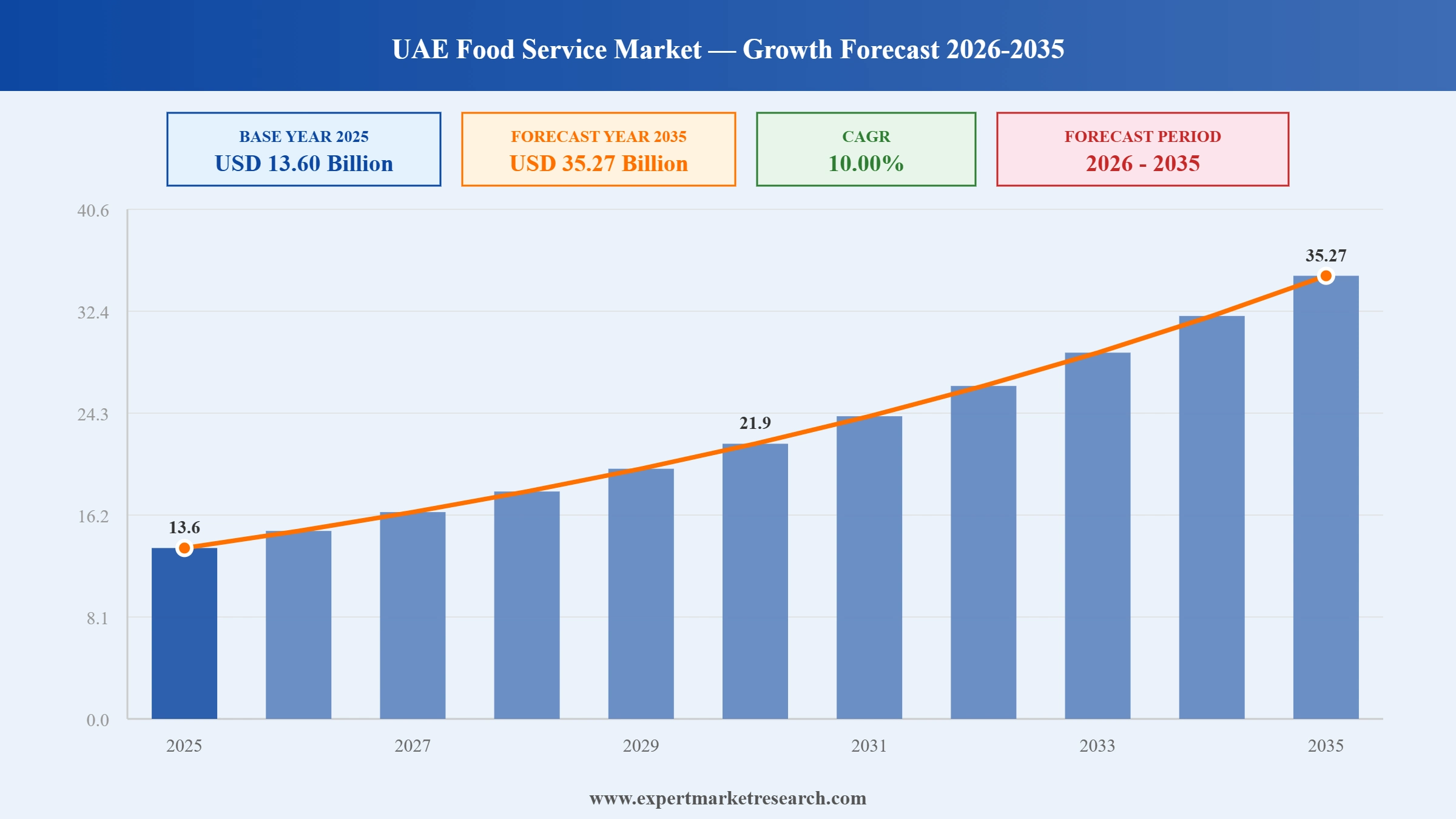
The UAE Food Service Market reached a value of USD 13.60 Billion at 2025 and is projected to expand at a CAGR of around 10.00% during the forecast period of 2026-2035. With record tourism inflows driving demand for premium and diverse dining experiences across Dubai and Abu Dhabi, the rapid proliferation of cloud kitchens and delivery platforms transforming food service consumption patterns, a growing and affluent expatriate population continuously broadening the market for international cuisines, and government-led hospitality investment reinforcing the UAE as a world-class culinary destination, the market is expected to reach USD 35.27 Billion by 2035.
Read more about this report - REQUEST FREE SAMPLE COPY IN PDF
| UAE Food Service Market Report Summary |
Description |
Value |
|
Base Year |
USD Billion |
2025 |
|
Historical Period |
USD Billion |
2019-2025 |
|
Forecast Period |
USD Billion |
2026-2035 |
|
Market Size 2025 |
USD Billion |
13.60 |
|
Market Size 2035 |
USD Billion |
35.27 |
|
CAGR 2019-2025 |
Percentage |
XX% |
|
CAGR 2026-2035 |
Percentage |
10.00% |
|
CAGR 2026-2035 - Market by Region |
Dubai |
10.6% |
|
CAGR 2026-2035 - Market by Type |
Cloud Kitchen |
11.1% |
|
CAGR 2026-2035 - Market by Outlet |
Chained |
10.9% |
The UAE food service market is being reshaped by the rapid scaling of cloud kitchens, sustained tourism-driven demand for diverse dining formats, the normalization of app-based food delivery, and a growing consumer appetite for health-conscious and experiential dining concepts that are raising the quality bar across all segments.
In September 2025, the Dubai Corporation for Consumer Protection and Fair Trade (DCCPFT), operating under the Dubai Department of Economy and Tourism, established a dedicated working group for the online food delivery sector. New regulatory guidelines were introduced to maintain competitive fairness, improve platform standards, and encourage continued investment in the digital food delivery ecosystem. The initiative represents Dubai's proactive approach to governing rapidly growing digital service sectors, ensuring that the consumer protection, business practice, and quality standards of the online food delivery segment keep pace with the market's expansion, and signals a maturing regulatory environment that is likely to enhance investor and operator confidence in the UAE's digital food service infrastructure.
In February 2025, Starbucks CEO Brian Niccol met with H.H. Sheikh Khaled bin Mohamed bin Zayed Al Nahyan, Crown Prince of Abu Dhabi, to discuss plans to elevate the retail and food service sectors in the UAE. At the UAE World Governments Summit in Dubai, Niccol spoke about Starbucks' growth plans in the region and pledged a joint USD 6 million donation with its franchise partner Alshaya Group to upskill and empower Emirati youth. Starbucks currently operates over 330 stores in the UAE through Alshaya Group and is pursuing a target of 500 stores across the Middle East by 2030, with UAE remaining its third-largest MENA market by revenue.
In February 2025, the Dubai International Chamber hosted 415 global food industry leaders at Gulfood 2025, reinforcing Dubai's position as a strategic hub for international food trade, production, and investment. The event brought together decision-makers from food manufacturers, distributors, hospitality operators, and food technology companies, driving bilateral trade discussions, partnership formations, and investment commitments across the UAE food service and food production ecosystem. Gulfood 2025 highlighted the continued appetite of global food businesses to establish or expand their presence in the UAE, leveraging the country's role as a gateway to the wider Middle East and Africa market.
In August 2024, the Veggie Mania Group launched GALA, Abu Dhabi's first dedicated gourmet vegetarian fine dining restaurant, located in the Al Zahiyah district. The restaurant combines classical vegetarian cuisine with innovative preparations within an upscale dining environment, targeting the growing segment of health-conscious, environmentally aware, and vegetarian diners in the UAE. The launch reflects the broader trend of plant-based and vegetarian dining gaining serious commercial traction in the UAE food service market, as both resident and tourist diners increasingly seek premium dining options that align with sustainability and wellness values without sacrificing the experiential quality expected in Abu Dhabi's competitive restaurant landscape.
In April 2024, Careem, one of the Middle East's leading technology and transport platforms, officially launched Careem Food and Careem Pay in Abu Dhabi as part of its market expansion strategy. The food delivery service provides Abu Dhabi residents and visitors with access to a curated selection of restaurants including popular establishments such as Allo Beirut, PF Chang's, and Pizza Di Rocco. The launch marked Careem's more direct competition with established UAE delivery platforms including Talabat and Deliveroo, and reflected the continued growth opportunity in Abu Dhabi's digital food ordering market as consumers increasingly default to app-based dining discovery and home delivery.
Cloud kitchens have moved from a niche pandemic workaround to a structural feature of the UAE food service landscape, with over 400 cloud kitchen businesses operating from 80 locations across the country in 2025, the majority concentrated in Dubai. The model appeals to operators because it requires significantly lower capital expenditure than traditional restaurants, eliminates front-of-house staffing costs, and enables rapid multi-brand scaling from a single kitchen facility. Platforms like Kitopi have pioneered a managed cloud kitchen model in the UAE, where the operator handles all food manufacturing, packaging, and delivery logistics on behalf of restaurant brands, allowing those brands to expand their delivery coverage area without incremental infrastructure investment. Technology enablement through smart kitchen operating systems is improving order throughput and delivery time accuracy. This UAE food service market growth driver is expected to accelerate through the forecast period as delivery-first consumer behaviors become increasingly entrenched. In 2024, Kitopi continued to grow its managed cloud kitchen network across Dubai and Abu Dhabi, collaborating with both international and local restaurant brands to extend their reach into delivery-only digital channels.
Tourism remains the most powerful and consistent demand driver for the UAE food service market, particularly in the premium and full-service restaurant segments. Dubai welcomed over 15.3 million hotel guests across all seven emirates in the first half of 2024 alone, a 10.5% increase from the prior year, and the city's target of welcoming 25 million tourists annually by 2025 under the Dubai Tourism Strategy 2031 is driving continuous investment in world-class dining infrastructure. Luxury hotels, beach resorts, and entertainment districts are expanding their food and beverage offerings with new celebrity chef partnerships, Michelin-starred concepts, and immersive dining experiences. Abu Dhabi is following a parallel trajectory, leveraging its cultural tourism assets, high-end hotel developments, and business travel infrastructure to support a growing premium dining ecosystem. Special events such as Dubai Food Festival, the Abu Dhabi Culinary Season, and major international conferences create concentrated demand spikes that reinforce the case for operators to invest in UAE market presence. In February 2025, Gulfood 2025 attracted 415 global food leaders to Dubai, confirming the market's role as the primary gateway for international food brands entering the Middle East.
Online food delivery has become a default consumption behavior for a large segment of UAE residents, driven by a combination of high smartphone penetration, congested urban environments where home delivery is a genuine convenience, and the aggressive growth of platforms including Talabat, Deliveroo, Zomato, and Careem. These platforms have made it possible for consumers to access hundreds of restaurant options across a single interface, with real-time tracking, contactless payment, and loyalty reward systems that encourage platform stickiness. Restaurants that previously relied solely on physical traffic are increasingly treating digital delivery channels as primary revenue streams, investing in delivery-optimized packaging, portion sizes, and menu engineering that maximize order quality at the point of consumption. The UAE government's September 2025 establishment of a dedicated online food delivery working group in Dubai signals that regulators view this segment as a structural part of the city's food service infrastructure rather than a transient trend. In April 2024, Careem launched its food delivery and payment service in Abu Dhabi, intensifying competition in a city where digital ordering adoption was already growing rapidly.
Health-conscious dining is transitioning from a niche positioning to a mainstream expectation across the UAE food service market, as a growing share of both resident and tourist diners actively seek menu options that align with wellness, sustainability, and dietary principles. Restaurants across all format types are expanding their plant-based, vegan, and low-calorie offerings, responding to consumer survey data that consistently shows strong demand for vegetarian, flexitarian, and protein-focused choices. The UAE's highly educated and internationally exposed expatriate community has been a primary driver of this shift, bringing dietary preferences developed in European, North American, and Australian food cultures to the local market. International alternative protein brands have entered the UAE food service sector following the visibility generated by COP28 in Dubai, validating the market's readiness for sustainable food concepts. In August 2024, Veggie Mania Group opened GALA, Abu Dhabi's first dedicated gourmet vegetarian fine dining restaurant, demonstrating that the plant-based opportunity has matured sufficiently to support standalone premium restaurant concepts in the UAE.
The Expert Market Research's report titled "United Arab Emirates Food Service Market Report and Forecast 2026 to 2035" offers a detailed analysis of the market based on the following segments:
Market Breakup by Type
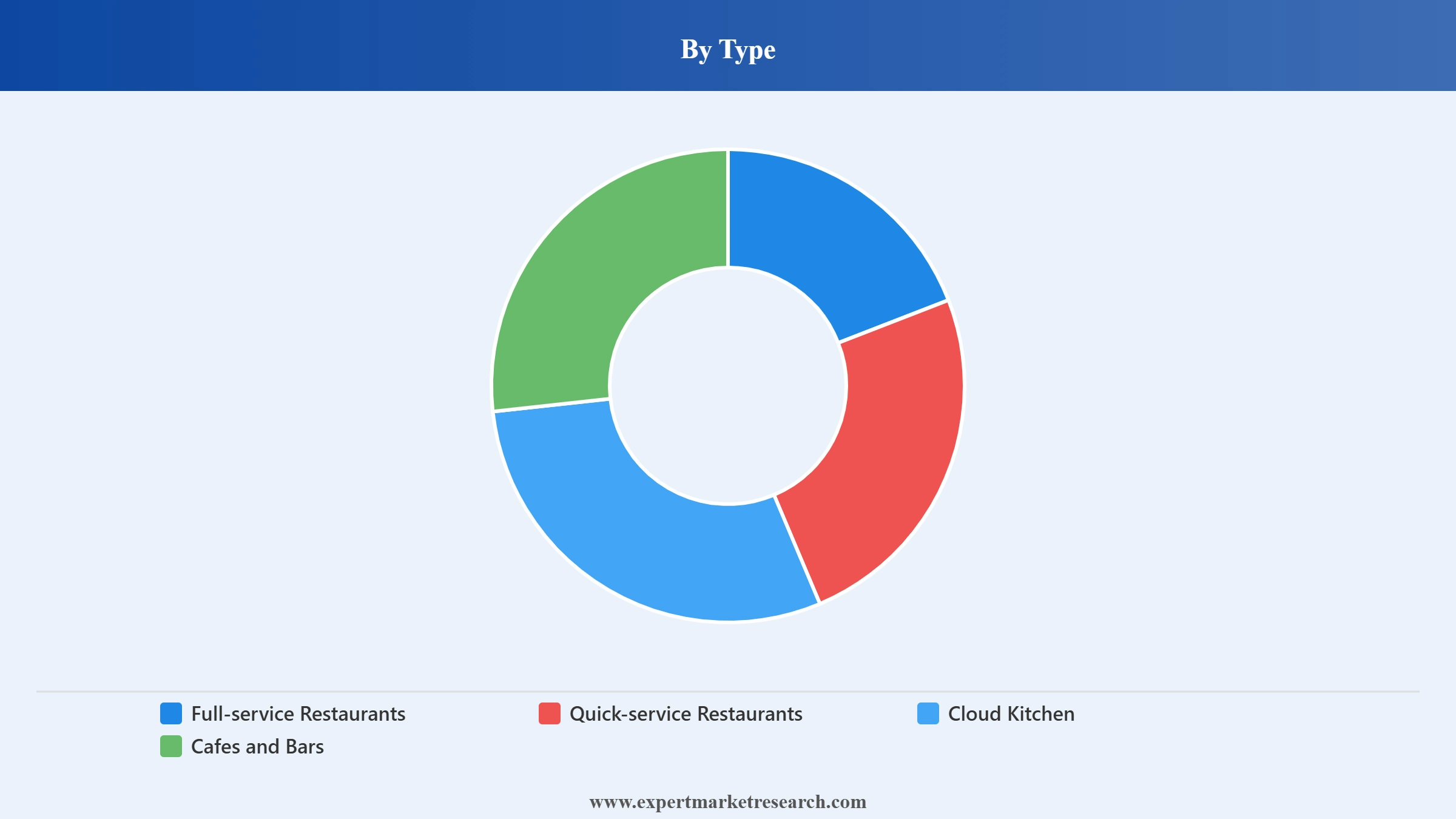
Key Insight: Full-service Restaurants hold the dominant share of the UAE food service market by type, commanding approximately 41.55% of total revenues in 2025. The segment's strength derives from the UAE's robust luxury hospitality infrastructure, the high-income resident and tourist demographics that drive demand for premium dining experiences, and the well-established culture of extended, occasion-oriented dining in Dubai and Abu Dhabi. International fine dining brands, celebrity chef-owned concepts, and hotel-based restaurants all operate within this segment and continue to attract investment. Cloud Kitchens represent the fastest-growing type within the market, benefiting from significantly lower operating costs, rapid scalability, and their structural alignment with the growth of digital food delivery. With over 400 cloud kitchen businesses already operating in the UAE, this segment is rapidly gaining market share. Quick-service Restaurants remain a high-volume, traffic-driven segment anchored by international franchise expansion. Cafes and Bars are growing as coffee culture deepens and social dining occasions expand.
Market Breakup by Outlet
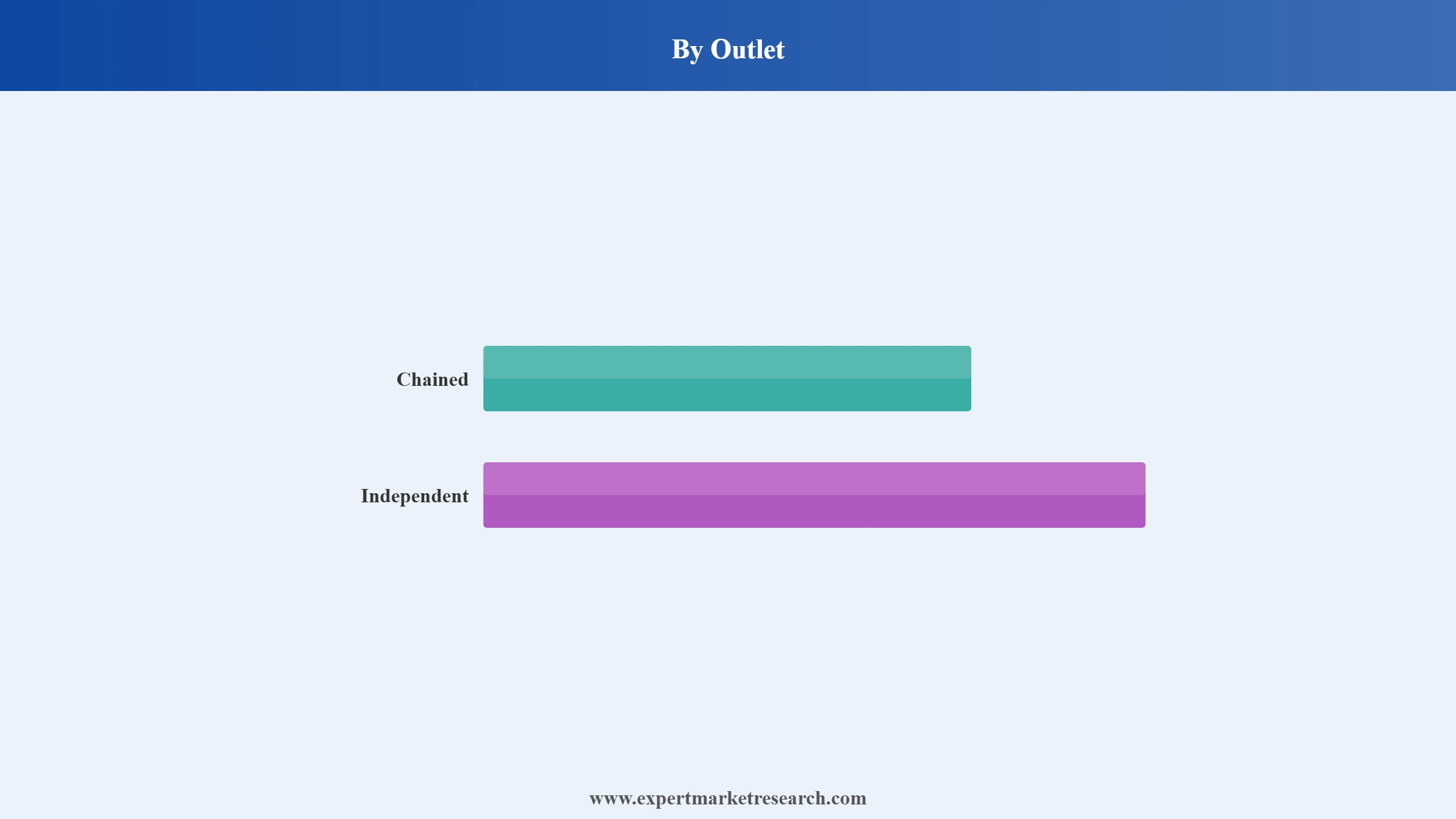
Key Insight: Chained outlets are the fastest-growing segment within the outlet segmentation of the UAE food service market, benefiting from the aggressive expansion of international franchises and regional food service groups that are deploying standardized operational models across multiple high-footfall locations. The UAE's extensive mall network, which includes over 65 malls in Dubai and 15 in Abu Dhabi, provides chained operators with premium, pre-qualified consumer environments that align with their brand standards and volume requirements. Independent outlets retained a 59.60% market share in 2025 and remain an essential part of the UAE's diverse culinary landscape, driven by chef-entrepreneur concepts, culturally specific dining formats, and community-oriented neighborhood restaurants. However, the pace of growth favors chained formats as international brands including Starbucks, McDonald's, and Restaurant Brands International continue to open new locations and deepen their UAE network infrastructure.
Market Breakup by Region
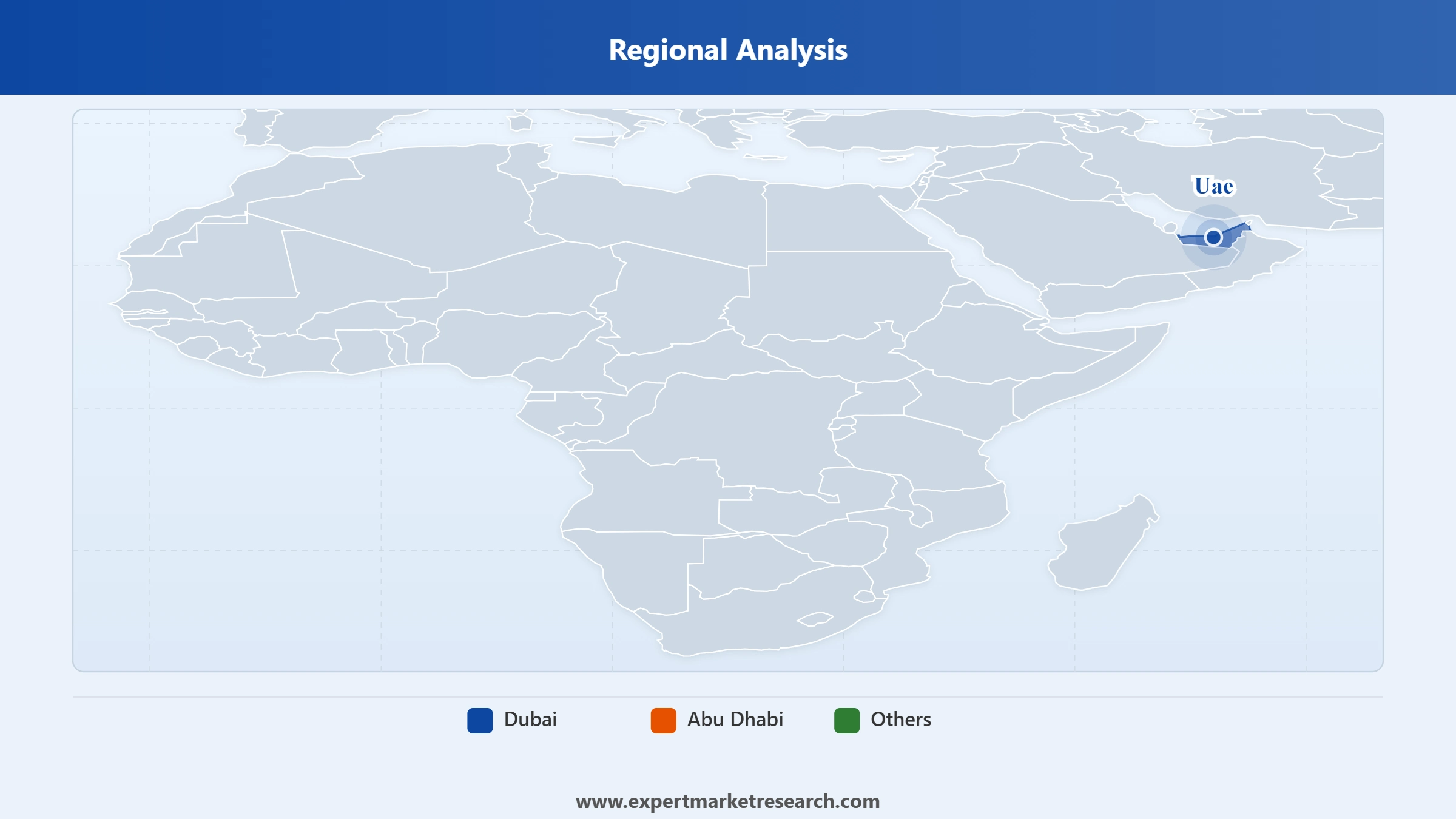
Key Insight: Dubai is both the largest and the fastest-growing regional market within the UAE food service sector, accounting for approximately 60% of total food service outlets nationwide. The city functions as the UAE's primary tourism engine, commercial capital, and cultural meeting point, generating the highest concentration of dining occasions across all formats from street food and quick service through to ultra-premium fine dining. Dubai's proactive hospitality investment strategy, anchored by the Dubai Tourism Strategy 2031 and supported by major annual events including Gulfood, Dubai Food Festival, and GITEX, creates consistent demand for new restaurant concepts and innovation. Abu Dhabi holds the second-largest regional market share, with a growing fine dining ecosystem supported by luxury hotel investment, a strong corporate and government dining segment, and increasing cultural tourism anchored by Louvre Abu Dhabi and Yas Island. The Northern Emirates and Sharjah represent a smaller but developing market, particularly in the quick-service and affordable dining categories.
Read more about this report - REQUEST FREE SAMPLE COPY IN PDF
Within the type segmentation, Full-service Restaurants hold the dominant market share of the UAE food service market, driven by the luxury positioning of Dubai and Abu Dhabi as global culinary destinations and the high-income demographics of both the resident expatriate community and the millions of international tourists who visit annually. Premium full-service restaurants, celebrity chef concepts, hotel dining establishments, and internationally recognized brand-name chains all contribute to this segment's revenue dominance, with particularly strong performance in Dubai's hotel corridor, JBR, Downtown, and DIFC districts. Cloud Kitchens are the dominant growth story by CAGR, having rapidly established themselves as viable standalone businesses that supplement or replace traditional restaurant operations for delivery-focused brands.
Read more about this report - REQUEST FREE SAMPLE COPY IN PDF
Within the outlet segmentation, Independent outlets retain the largest market share by count, reflecting the UAE's vibrant independent dining culture and the ongoing appeal of chef-driven concepts, culturally specific restaurants, and community-oriented dining in residential neighborhoods across Dubai and Abu Dhabi. However, Chained outlets are growing at a considerably faster pace as international franchise operators accelerate their UAE expansion and leverage the country's mall infrastructure, high consumer spending, and brand-receptive demographics. Brands such as Starbucks, McDonald's, Subway, and Restaurant Brands International's portfolio (which includes Burger King and Tim Hortons) have built extensive chained networks that benefit from standardized quality, loyalty programs, and digital ordering integration.
Read more about this report - REQUEST FREE SAMPLE COPY IN PDF
Dubai is the commanding center of the UAE food service market and one of the most dynamic restaurant markets anywhere in the world. Over 30,000 food service outlets operate across the UAE, with approximately 60% concentrated in Dubai, reflecting the emirate's role as the country's primary commercial hub, tourism destination, and lifestyle capital. The city's cosmopolitan population of over 3 million residents, drawn from more than 200 nationalities, creates constant demand for culinary diversity, and the annual influx of over 15 million international tourists generates additional spending across every food service format. Dubai's mall-centric consumer culture provides chained operators with access to premier, high-footfall commercial real estate, while its experiential dining ecosystem including Desert dining, rooftop restaurants, beachfront venues, and Michelin-starred establishments positions it at the global frontier of food service innovation. Government investments in culinary tourism infrastructure, the annual Dubai Food Festival, and the Dubai Restaurant Week program all actively stimulate consumer engagement and operator investment. Cloud kitchen adoption is most advanced in Dubai, where delivery platform penetration is exceptionally high and urban density makes delivery logistics economically efficient.
Read more about this report - REQUEST FREE SAMPLE COPY IN PDF
Abu Dhabi represents the UAE's second-largest food service market and is distinguished by its emphasis on family-friendly dining, government and corporate sector hospitality, and the luxury tourism generated by its world-class cultural and entertainment assets. Yas Island, home to Ferrari World, Warner Bros. World, and Yas Marina Circuit, creates concentrated high-footfall tourism demand that supports an expanding mix of full-service restaurants, quick-service chains, and experiential dining concepts. The corniche waterfront area, Louvre Abu Dhabi, and Saadiyat Island's cultural district attract a discerning visitor demographic that supports premium dining investment. Abu Dhabi's corporate sector generates sustained lunch and dinner demand from government ministries, sovereign wealth fund entities, and multinational offices located in the emirate's central business districts. The April 2024 launch of Careem Food in Abu Dhabi signals the market's growing readiness for digitally enabled food ordering, complementing the physical dining network with a rapidly expanding delivery channel. With ongoing hospitality infrastructure investment under the Abu Dhabi Economic Vision 2030, the emirate is closing the gap with Dubai in terms of restaurant format diversity and international brand presence.
The UAE food service market is highly competitive and densely populated with a mix of global quick-service and full-service chains, regional food and beverage operators, luxury hotel dining establishments, and a vibrant independent restaurant community. The market's sophistication and high consumer expectations make brand reputation, service consistency, menu innovation, and digital engagement capability essential competitive requirements. International franchise operators hold significant market power through the scale, brand recognition, and operational systems they bring from their global networks.
Competitive dynamics are increasingly shaped by digital capabilities, including app-based ordering, loyalty programs, delivery platform integration, and cloud kitchen expansion. Operators that can maintain quality and convenience across both physical and digital touchpoints are gaining structural advantages. The UAE's regulatory environment around food safety, municipality permits, and now the 2025 online delivery working group in Dubai is becoming a factor in competitive differentiation, as certified operators with stronger compliance infrastructure demonstrate greater institutional credibility to both consumers and franchise development partners.
Founded in 1971 and headquartered in Seattle, Washington, USA, Starbucks is the world's largest coffeehouse chain and operates in the UAE through its franchise partner Alshaya Group, which runs over 330 Starbucks locations across the country. The UAE represents Starbucks' third-largest market in the Middle East and North Africa region by revenue, behind Turkey and Saudi Arabia. In February 2025, Starbucks CEO Brian Niccol met the Crown Prince of Abu Dhabi to outline plans for further market investment and announced a USD 6 million joint pledge with Alshaya Group for Emirati youth development. The brand is pursuing 500 stores across the Middle East by 2030, with UAE being a central growth market. Starbucks also co-created the Dallah's Treasure Blend with Alshaya Group in 2024, a UAE-specific coffee blend that reflects the brand's localization strategy in the region.
Founded in 1997 and headquartered in Louisville, Kentucky, USA, Yum! Brands operates a portfolio of leading global quick-service restaurant chains including KFC, Pizza Hut, Taco Bell, and Habit Burger Grill. In the UAE, KFC and Pizza Hut maintain significant market presence through franchise arrangements with regional operators, benefiting from well-established brand recognition across both the resident and tourist population. Yum! Brands is at the forefront of AI-enabled quick-service operations globally, processing over 2 million AI-powered voice orders across 300 Taco Bell locations in 2024. The company's UAE operations are positioned in a highly competitive quick-service landscape where value, speed, and digital ordering capability are primary consumer expectations.
Founded in 1940 and headquartered in Chicago, Illinois, USA, McDonald's Corporation is one of the most widely recognized quick-service restaurant brands in the UAE, operating through franchise arrangements with regional operators. The brand's presence in the UAE is anchored by its broad accessibility, value positioning, and continuous menu localization, including halal-certified menu items designed for the local and Muslim expatriate population. McDonald's has been executing a global expansion strategy targeting 50,000 restaurants by 2027, with the Middle East including the UAE as a priority international market. Its digital ordering infrastructure, including mobile app and self-service kiosks, aligns with the UAE's high digital adoption rates and consumer preference for tech-enabled food service experiences.
Founded in 2014 through the merger of Burger King and Tim Hortons and headquartered in Toronto, Canada, Restaurant Brands International operates in the UAE primarily through the Burger King brand, which maintains a strong presence across Dubai and Abu Dhabi in mall food courts, standalone locations, and high-street venues. The Burger King brand appeals to both value-conscious and premium quick-service customers in the UAE, particularly in high-footfall mall and airport environments. Restaurant Brands International's global strategy of disciplined franchising and digital investment is reflected in the UAE market, where the brand has invested in delivery platform integration and loyalty program rollout to deepen consumer engagement across its UAE network.
Other key players in the market are Domino's Pizza, Inc., Al Khaja Group Of Companies, CKE Restaurants Holdings Inc. (Hardee's / Carl's Jr.), Subway IP LLC, and Others.
*Please note that this is only a partial list; the complete list of key players is available in the full report. Additionally, the list of key players can be customized to better suit your needs.*
Capture the full opportunity in one of the world's most dynamic food markets with our 2026 UAE Food Service Market report. From the cloud kitchen revolution and the surge in premium dining tourism, to the arrival of global franchises and the rise of plant-based concepts, this report equips you with the data and insight to make decisive strategic moves. Whether you are expanding a restaurant brand, evaluating franchise opportunities, or investing in UAE food service infrastructure, this report gives you the competitive edge. Download your free sample today and discover the opportunities shaping the future of Food Service in the UAE.


Upto 15% Off
USD
$2499 $2249
$3999 $3599
$4999 $4249
$5999 $5099


*While we strive to always give you current and accurate information, the numbers depicted on the website are indicative and may differ from the actual numbers in the main report. At Expert Market Research, we aim to bring you the latest insights and trends in the market. Using our analyses and forecasts, stakeholders can understand the market dynamics, navigate challenges, and capitalize on opportunities to make data-driven strategic decisions.*
In 2025, the UAE food service market reached an approximate value of USD 13.60 Billion.
The market is projected to grow at a CAGR of 10.00% between 2026 and 2035.
The key players in the market includes Starbucks Corp., Yum! Brands, Inc., McDonald's Corporation, Restaurant Brands International Inc., Domino’s Pizza, Inc., Al Khaja Group Of Companies, CKE Restaurants Holdings Inc., Subway IP LLC, among others.
The lithium iron phosphate battery type is gaining traction and anticipated to expand with a 15.1% CAGR through 2035.
Major strategies propelling the UAE food service market include digitalisation, menu localisation, sustainability efforts, cloud kitchen growth, collaborations, and customer experience improvement through loyalty schemes and contactless offerings.
Explore our key highlights of the report and gain a concise overview of key findings, trends, and actionable insights that will empower your strategic decisions.
| REPORT FEATURES | DETAILS |
| Base Year | 2025 |
| Historical Period | 2019-2025 |
| Forecast Period | 2026-2035 |
| Scope of the Report |
Historical and Forecast Trends, Industry Drivers and Constraints, Historical and Forecast Market Analysis by Segment:
|
| Breakup by Type |
|
| Breakup by Outlet |
|
| Breakup by Region |
|
| Market Dynamics |
|
| Competitive Landscape |
|
| Companies Covered |
|
Datasheet
One User
USD 2,499
USD 2,249
tax inclusive*
Single User License
One User
USD 3,999
USD 3,599
tax inclusive*
Five User License
Five User
USD 4,999
USD 4,249
tax inclusive*
Corporate License
Unlimited Users
USD 5,999
USD 5,099
tax inclusive*
*Please note that the prices mentioned below are starting prices for each bundle type. Kindly contact our team for further details.*
Flash Bundle
Small Business Bundle
Growth Bundle
Enterprise Bundle
*Please note that the prices mentioned below are starting prices for each bundle type. Kindly contact our team for further details.*
Flash Bundle
Number of Reports: 3
20%
tax inclusive*
Small Business Bundle
Number of Reports: 5
25%
tax inclusive*
Growth Bundle
Number of Reports: 8
30%
tax inclusive*
Enterprise Bundle
Number of Reports: 10
35%
tax inclusive*
How To Order

Select License Type
Choose the right license for your needs and access rights.

Click on ‘Buy Now’
Add the report to your cart with one click and proceed to register.

Select Mode of Payment
Choose a payment option for a secure checkout. You will be redirected accordingly.
Strategic Solutions for Informed Decision-Making
Gain insights to stay ahead and seize opportunities.

Get insights & trends for a competitive edge.

Track prices with detailed trend reports.

Analyse trade data for supply chain insights.

Leverage cost reports for smart savings

Enhance supply chain with partnerships.

Connect For More Information
Our expert team of analysts will offer full support and resolve any queries regarding the report, before and after the purchase.
Our expert team of analysts will offer full support and resolve any queries regarding the report, before and after the purchase.
We employ meticulous research methods, blending advanced analytics and expert insights to deliver accurate, actionable industry intelligence, staying ahead of competitors.
Our skilled analysts offer unparalleled competitive advantage with detailed insights on current and emerging markets, ensuring your strategic edge.
We offer an in-depth yet simplified presentation of industry insights and analysis to meet your specific requirements effectively.




