

Consumer Insights
Uncover trends and behaviors shaping consumer choices today
Procurement Insights
Optimize your sourcing strategy with key market data
Industry Stats
Stay ahead with the latest trends and market analysis.
The United States diaper market was valued at USD 9.52 Billion in 2025 and is projected to grow at a CAGR of 4.70% between 2026 and 2035, reaching USD 15.07 Billion by 2035. Rising birth rates, an ageing population requiring incontinence care, and growing consumer preference for sustainable and skin friendly materials are driving overall growth in the market, with subscription-based delivery models and advanced absorbent technologies reshaping how families and caregivers approach everyday hygiene needs.
The United States diaper market encompasses baby and adult diaper categories distributed through hypermarkets, pharmacies, convenience stores, and online channels across the country. Demand continues to be shaped by consistent birth rates, a rapidly ageing population requiring incontinence care, and rising consumer expectations around sustainability and premium comfort, with baby diapers accounting for the largest category share given sustained infant care needs across the market.
Established United States diaper companies are increasingly pursuing large scale acquisitions to consolidate personal care portfolios, reflecting growing institutional confidence in cross category synergies between baby care, skin health, and oral care segments. In November 2025, Kimberly-Clark announced its acquisition of Kenvue for 48.7 billion dollars, a deal expected to close in the second half of 2026 and create a combined entity with approximately 32 billion dollars in annual revenue.
The United States diaper market is increasingly directing product development toward advanced absorbent technology and premium skin protection formulations rather than relying solely on conventional designs, reflecting a strategic shift toward differentiated comfort as competition intensifies across baby and adult care categories. Companies are pursuing parallel investment across biodegradable materials, subscription delivery models, and premium branding rather than remaining narrowly focused on basic functionality, while strengthening distribution partnerships across retail and direct to consumer channels to accelerate category growth. In February 2026, Kimberly-Clark introduced advanced absorbent technology across its Huggies diaper range, enhancing leakage protection and skin comfort for infants.

Read more about this report - REQUEST FREE SAMPLE
Procter and Gamble launched Pampers AMORE, a premium diaper range featuring cashmere soft materials, achieving double digit growth in early international markets following its debut. Premium material upgrades of this kind allow brands across the United States diaper market to capture higher margin segments among quality focused parents, who increasingly base repeat purchases on comfort claims and perceived softness rather than price alone.
The Honest Company launched plant based, biodegradable diaper variants targeting environmentally conscious parents seeking reduced environmental impact without compromising performance or comfort standards. Such biodegradable formulations help brands across the United States diaper market tap into growing demand from sustainability focused consumers, a segment that has consistently shown willingness to pay a premium for verified environmental credentials over time.
Essity announced an agreement to acquire Edgewell Personal Care's feminine care business, including the Carefree, Stayfree, and Playtex brands, for approximately 340 million dollars to strengthen its North American hygiene portfolio significantly. Deals structured this way let acquirers across the United States diaper market grow market positions in high margin categories quickly, without bearing the cost and delay of building comparable brand recognition from scratch.
Ontex introduced 360-degree anti leak barriers for baby diapers in the United States, offering improved front to back and side to side protection to support better comfort and dryness. Barrier innovations of this nature give manufacturers a way to differentiate on core performance attributes, which often remain the deciding factor for parents comparing otherwise similar diaper brands.
Established personal care conglomerates across the United States diaper market are increasingly acquiring niche eco-friendly diaper startups, rather than developing sustainable lines internally, to accelerate access to specialised formulations and loyal customer bases. This is helping large manufacturers close capability gaps in fast growing sustainability focused segments. In April 2026, Procter and Gamble strengthened its North American baby care portfolio through a strategic acquisition of a niche eco-friendly diaper startup, and its proprietary sustainable formulations, packaging technology, and manufacturing know how across every regional market.
Established diaper manufacturers across the United States diaper market are increasingly exiting private label manufacturing contracts, rather than continuing dual branded and unbranded production, to concentrate resources on higher margin proprietary brands. This is helping manufacturers improve overall profitability despite near term revenue impact. In January 2025, Kimberly-Clark ceased production of private label diapers for Costco's Kirkland Signature brand, redirecting capacity toward its core Huggies portfolio and premium product lines across every market segment, consumer demographic, geographic region, retail channel, price tier, and category.
Established diaper brands across the United States diaper market are increasingly expanding subscription-based delivery models, rather than relying solely on traditional retail distribution, to build recurring revenue and strengthen customer loyalty. This is helping direct to consumer brands reduce customer acquisition costs over time. In December 2025, Parasol Co strengthened its subscription-based diaper delivery model across the United States, focusing on convenience for busy households’ income bracket, family structure, lifestyle preference, and daily routine overall, consistently, and reliably.
Established diaper manufacturers across the United States diaper market are increasingly acquiring regional manufacturing facilities, rather than relying solely on centralised production, to shorten supply chains and reduce logistics costs. This is helping manufacturers respond faster to regional demand fluctuations and retailer requirements. In March 2026, Kimberly-Clark Corporation acquired a regional private label diaper manufacturing facility to strengthen its domestic production footprint and reduce logistics costs further across every market, distribution channel, regional territory, supply route, retail partner, and manufacturing site.
Established global hygiene brands are increasingly forming distribution partnerships with regional players, rather than establishing independent local operations, to accelerate market entry with lower upfront investment. This is helping brands scale into new geographies more efficiently. In January 2026, Kao Corporation formed a distribution agreement with Magicwave in Vietnam to expand its Merries brand, which highlights breathable technology featuring 5 billion air vents per pack for infants, toddlers, and growing children alike across every market segment and category.
The Expert Market Research's report titled “United States Diaper Market Report and Forecast 2026-2035” offers a detailed analysis of the market based on the following segments:
Market Breakup by Product Type
Key Insight: Consistent birth rates and sustained infant care needs keep baby diapers as the largest product category across the United States diaper market, spanning disposable, training, cloth, swim pant, and biodegradable formats. An ageing population and rising incontinence awareness are fuelling faster growth in adult diapers, illustrated by First Quality Enterprises' September 2025 completion of an adult care capacity expansion, adding new production lines and a new automated warehouse facility.
Market Breakup by Distribution Channel
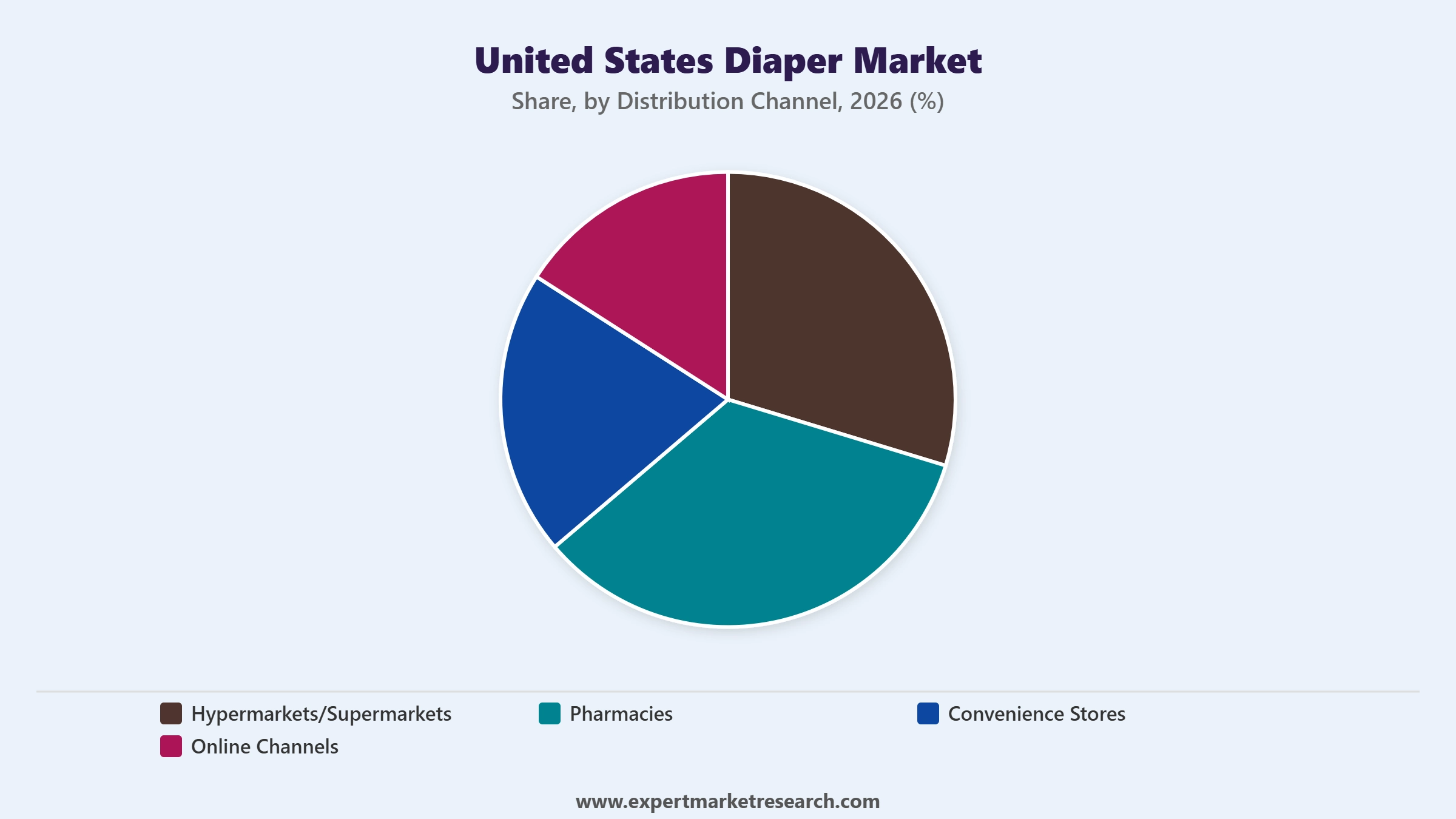
Key Insight: Broad product assortments and established retail networks across the United States diaper market keep hypermarkets and supermarkets as the leading distribution channel, while pharmacist guidance and insurance reimbursement pathways make pharmacies a trusted route for adult incontinence products. Densely populated areas rely on convenience stores for urgent, small basket purchases, and subscription-based delivery models are pushing online channels among the fastest growing routes for direct-to-consumer diaper brands. Warehouse clubs and specialty retailers round out the category, contributing additional demand across smaller, more specialised outlets.
Market Breakup by Region
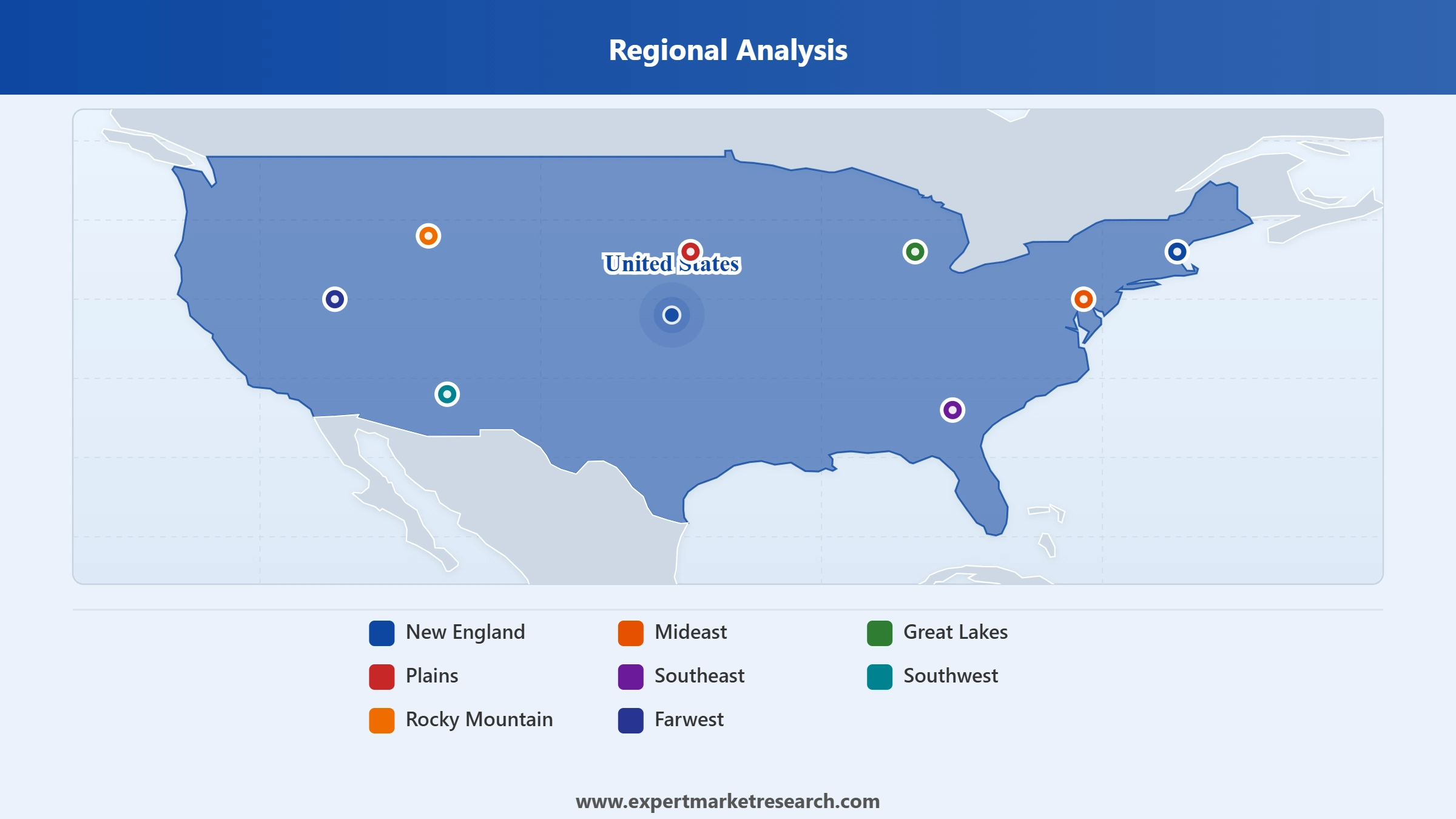
Key Insight: Regional dynamics in the market continue to shape competitive strategies. Dense population centres and established retail infrastructure keep the Mideast at the top of regional demand, while high household incomes support steady New England spending on established retail networks. A mature industrial base and consistent birth rates anchor demand across the Great Lakes, and rising birth rates paired with expanding retail penetration are pushing the Southeast toward the fastest regional growth. Population growth and urbanisation continue lifting the Southwest, and the Plains, Rocky Mountain, and Farwest regions round out the market with smaller but stable demand bases supported by suburban and coastal populations.
Read more about this report - REQUEST FREE SAMPLE
By product type, baby diapers dominate the market through consistent birth rates and sustained infant care needs
Baby diapers account for the largest product type share of the United States diaper market, supported by consistent birth rates and sustained infant care needs across households. In November 2025, Procter and Gamble unveiled Pampers Swaddlers Pxxs, described as the world's smallest diaper, designed for premature babies born as early as 21 to 22 weeks or weighing less than 500 grams and requiring specialised neonatal intensive care unit support and continuous monitoring across every hospital and clinic.

Read more about this report - REQUEST FREE SAMPLE
Adult diapers are growing quickly as an ageing population and rising incontinence awareness drive demand across pad, flat, and pant type formats. In February 2026, Unicharm Corporation introduced a new line of adult diapers featuring advanced moisture wicking technology, enhancing comfort and usability for elderly consumers across every care setting, from home to institutional and hospital facilities alike consistently, reliably, comfortably, and affordably across every income bracket, region, and demographic segment.
By distribution channel, hypermarkets and supermarkets dominate the market through broad product assortments
Hypermarkets and supermarkets account for the largest distribution channel share of the United States diaper market, offering broad product assortments through established retail networks across the country. In September 2025, Ontex celebrated tripling production capacity at its Stokesdale, North Carolina facility, representing a near 100-million-dollar investment supplying retailers across the East and West Coast supply chains and distribution networks nationwide and beyond regional borders substantially, consistently, reliably, efficiently, and sustainably over time.
Read more about this report - REQUEST FREE SAMPLE
Online channels are growing quickly as subscription-based delivery models expand across direct-to-consumer diaper brands seeking recurring revenue and stronger customer loyalty. In October 2025, Mammoth Brands acquired premium diaper brand Coterie, which generates approximately 200 million dollars in annual sales with roughly 90 percent of revenue coming directly from its subscription-based website and direct to consumer sales channels overall consistently, reliably, efficiently, and sustainably across every market segment and region.
Read more about this report - REQUEST FREE SAMPLE
Mideast dominates the market through dense population centres and established retail infrastructure
The Mideast region leads the United States diaper market, anchored by dense population centres and established retail infrastructure across major metropolitan areas. Established United States diaper companies continue to expand distribution networks across the Mideast, reinforcing the region's position as a core demand centre for the broader market and national economy overall today, tomorrow, and going forward substantially and consistently.
The Southeast is registering the fastest growth as rising birth rates and expanding retail penetration drive demand across the region's growing population centres. In June 2025, First Quality completed the baby care phase of its 418-million-dollar expansion at its Macon, Georgia facility, increasing diaper and training pant manufacturing capacity by 50 percent across its regional production facilities substantially and consistently over time going forward, beyond, consistently, and reliably.
The global industry is becoming increasingly competitive as major United States diaper companies invest in advanced absorbent technology, biodegradable materials, and premium branding to differentiate their portfolios across baby and adult care categories. Companies are prioritising large scale acquisitions, subscription delivery models, and skin protection innovation to appeal to increasingly discerning caregivers and ageing consumers. Established United States diaper companies are also deepening cross category synergies, regional manufacturing capacity, and direct to consumer channels to strengthen market positioning, while investing in sustainable formulations to defend market share against rising private label and niche competition.
Major United States diaper market players are also focusing on strategic acquisitions and portfolio consolidation to capture growing demand across baby and adult care categories. Strategic emphasis on sustainability and premium comfort is allowing established companies to capture market share as consumer expectations around biodegradable and skin friendly materials evolve. The market players continue to pursue partnerships with regional manufacturers and international distributors, particularly across Asia Pacific and Europe, to diversify revenue beyond the domestic market while smaller specialist brands compete on niche sustainability credentials to retain environmentally conscious customers.
Founded in 1837 and headquartered in Cincinnati, Ohio, United States, Procter and Gamble is a global consumer goods company whose baby care portfolio includes the Pampers brand, serving families across more than 180 countries. The company operates across five major business divisions, with baby, feminine, and family care representing one of its largest revenues generating segments worldwide.
Founded in 1872 and headquartered in Irving, Texas, United States, Kimberly-Clark is a global personal care company whose Huggies brand serves as a leading baby diaper franchise across North America and international markets. The company operates across three major business segments, selling products in more than 175 countries worldwide.
Founded in 2017 following a spin off with roots tracing to 1849, and headquartered in Stockholm, Sweden, Essity is a global hygiene and health company offering incontinence care products under brands including TENA. The company operates manufacturing facilities across multiple continents, serving both consumer and professional hygiene markets.
Founded in 1961 and headquartered in Tokyo, Japan, Unicharm is a global manufacturer of disposable hygiene products spanning baby and adult diapers, feminine care, and pet care categories. The company holds leading diaper market positions across multiple Asian markets, operating manufacturing and distribution networks spanning more than 80 countries worldwide.
Other key players in the market include Kao Corporation, Ontex BV, Domtar Corporation, The Hain Celestial Group, Inc., First Quality Enterprises, Inc., and The Honest Company, Inc., among others.
*Please note that this is only a partial list; the complete list of key players is available in the full report. Additionally, the list of key players can be customized to better suit your needs.*
Unlock the latest insights with our United States diaper market trends 2026 report. Discover regional growth patterns, product type and distribution channel economics, and key industry players. Stay ahead of competition with trusted data and expert analysis. Download your free sample report today and drive informed decisions in the market.


Upto 15% Off
USD
$2499 $2249
$3999 $3599
$4999 $4249
$5999 $5099


*While we strive to always give you current and accurate information, the numbers depicted on the website are indicative and may differ from the actual numbers in the main report. At Expert Market Research, we aim to bring you the latest insights and trends in the market. Using our analyses and forecasts, stakeholders can understand the market dynamics, navigate challenges, and capitalize on opportunities to make data-driven strategic decisions.*
In 2025, the market reached an approximate value of USD 9.52 Billion.
The market is projected to grow at a CAGR of 4.70% between 2026 and 2035.
The revenue generated from the diaper market is expected to reach USD 15.07 Billion in 2035.
The diaper market is categorised according to the product type, which includes baby diapers and adult diapers.
The key players in the market include Procter & Gamble Company, Kimberly-Clark Corporation, Essity AB, Unicharm Corporation, Kao Corporation, Ontex BV, Domtar Corporation, The Hain Celestial Group, Inc., First Quality Enterprises, Inc., and The Honest Company, Inc., among others.
Based on the distribution channel, the market is divided into hypermarkets/supermarkets, pharmacies, convenience stores, online channels, and others.
The market is broken down into New England, Mideast, Great Lakes, Plains, Southeast, Southwest, Rocky Mountain, and Far West.
The Mideast dominates the market, supported by dense population centres and established retail infrastructure.
Baby diapers hold the largest product type share, supported by consistent birth rates and sustained infant care needs.
Explore our key highlights of the report and gain a concise overview of key findings, trends, and actionable insights that will empower your strategic decisions.
| REPORT FEATURES | DETAILS |
| Base Year | 2025 |
| Historical Period | 2019-2025 |
| Forecast Period | 2026-2035 |
| Scope of the Report |
Historical and Forecast Trends, Industry Drivers and Constraints, Historical and Forecast Market Analysis by Segment:
|
| Breakup by Product Type |
|
| Breakup by Distribution Channel |
|
| Breakup by Region |
|
| Market Dynamics |
|
| Competitive Landscape |
|
| Companies Covered |
|
Datasheet
One User
USD 2,499
USD 2,249
tax inclusive*
Single User License
One User
USD 3,999
USD 3,599
tax inclusive*
Five User License
Five User
USD 4,999
USD 4,249
tax inclusive*
Corporate License
Unlimited Users
USD 5,999
USD 5,099
tax inclusive*
*Please note that the prices mentioned below are starting prices for each bundle type. Kindly contact our team for further details.*
Flash Bundle
Small Business Bundle
Growth Bundle
Enterprise Bundle
*Please note that the prices mentioned below are starting prices for each bundle type. Kindly contact our team for further details.*
Flash Bundle
Number of Reports: 3
20%
tax inclusive*
Small Business Bundle
Number of Reports: 5
25%
tax inclusive*
Growth Bundle
Number of Reports: 8
30%
tax inclusive*
Enterprise Bundle
Number of Reports: 10
35%
tax inclusive*
How To Order

Select License Type
Choose the right license for your needs and access rights.

Click on ‘Buy Now’
Add the report to your cart with one click and proceed to register.

Select Mode of Payment
Choose a payment option for a secure checkout. You will be redirected accordingly.
Strategic Solutions for Informed Decision-Making
Gain insights to stay ahead and seize opportunities.

Get insights & trends for a competitive edge.

Track prices with detailed trend reports.

Analyse trade data for supply chain insights.

Leverage cost reports for smart savings

Enhance supply chain with partnerships.

Connect For More Information
Our expert team of analysts will offer full support and resolve any queries regarding the report, before and after the purchase.
Our expert team of analysts will offer full support and resolve any queries regarding the report, before and after the purchase.
We employ meticulous research methods, blending advanced analytics and expert insights to deliver accurate, actionable industry intelligence, staying ahead of competitors.
Our skilled analysts offer unparalleled competitive advantage with detailed insights on current and emerging markets, ensuring your strategic edge.
We offer an in-depth yet simplified presentation of industry insights and analysis to meet your specific requirements effectively.




