

Consumer Insights
Uncover trends and behaviors shaping consumer choices today
Procurement Insights
Optimize your sourcing strategy with key market data
Industry Stats
Stay ahead with the latest trends and market analysis.
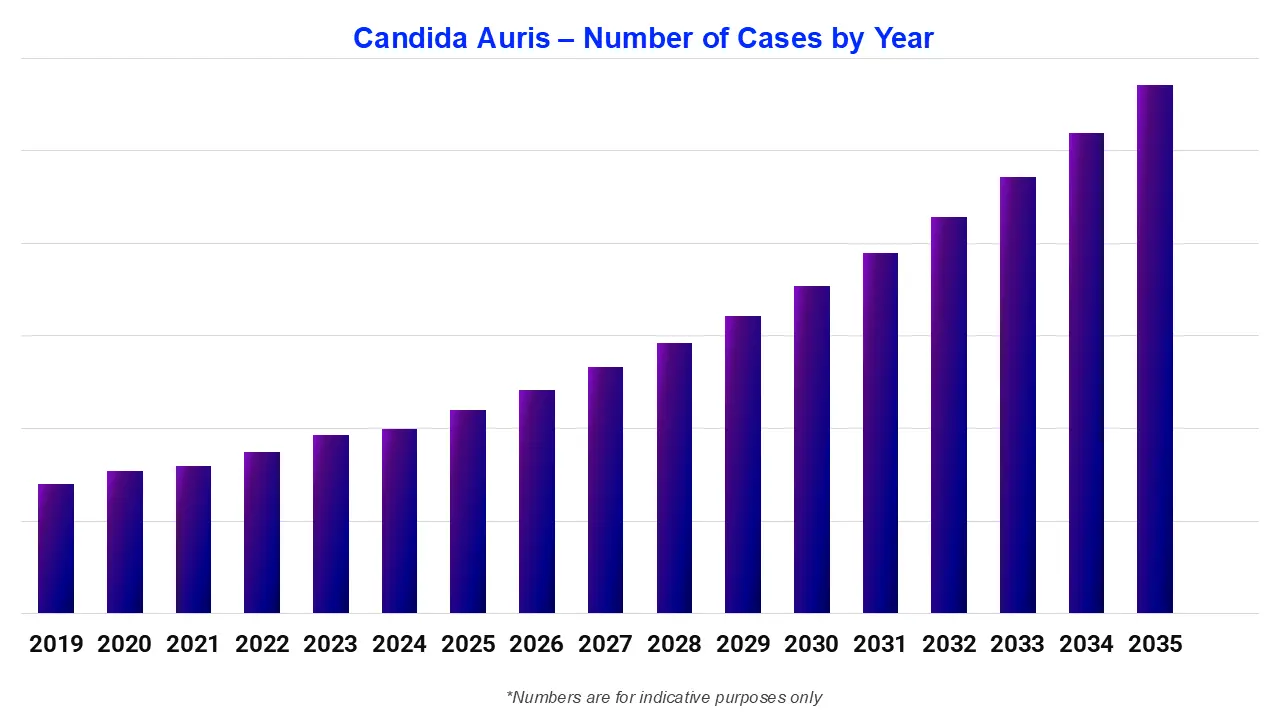
Candida auris (C. auris), also referred to as Candidozyma auris, is an emerging multidrug-resistant yeast that causes healthcare-associated colonization and invasive fungal infection. In the United States, CDC reported 4,428 clinical cases in 2023 and 6,197 cases in 2024 in its 2022-2024 surveillance analysis; the current CDC tracking page subsequently reported 6,304 clinical cases in 2024, reflecting differences between surveillance revisions and reporting systems. According to the Candida auris Epidemiology Forecast by Expert Market Research, C. auris is relevant to the broader infectious disease, antifungal therapeutics and healthcare-associated infection-control markets.
Base Year
Historical Period
Forecast Period
Read more about this report - Request a Free Sample
Expert Market Research's “Candida Auris Epidemiology Forecast Report 2026-2035” offers comprehensive information on the prevalence and demographics of Candida Auris. It projects the future incidence and prevalence rates of Candida Auris cases across various populations. The study covers age, gender, and type as major determinants of the Candida Auris population. The report highlights patterns in the prevalence of Candida Auris overtime and projects future trends based on multiple variables.
The report provides a comprehensive overview of the disease, as well as historical and projected data on the epidemiology of Candida Auris in the 8 major markets.
Regions Covered
Candida auris (C. auris), also referred to as Candidozyma auris, is an emerging multidrug-resistant yeast that causes healthcare-associated colonization and invasive fungal infection. Unlike most Candida species, C. auris can persist for prolonged periods on patients, environmental surfaces and medical equipment, facilitating transmission within healthcare facilities. Patients may remain asymptomatically colonized on the skin while serving as reservoirs for transmission or may develop invasive infection involving the bloodstream and other normally sterile sites. The organism is particularly important because it can be resistant to multiple classes of antifungal agents, can be difficult to identify using conventional yeast-identification systems and is associated with outbreaks among critically ill and medically complex patients. WHO classifies C. auris as a critical-priority fungal pathogen.
|
Parameter |
Insight |
|
Largest Patient Pool |
United States |
|
Fastest Growing Country |
United States |
|
High-Risk Population |
Older adults, critically ill patients, patients in intensive-care or long-term acute-care settings, individuals with prolonged healthcare exposure, invasive medical devices, recent broad-spectrum antimicrobial or antifungal exposure, and immunocompromised patients. |
|
Key Diagnostic Method |
Accurate identification generally requires MALDI-TOF mass spectrometry, sequencing or other validated molecular methods; conventional biochemical systems can misidentify C. auris. Screening is commonly performed using skin swabs and molecular testing. |
|
Major Risk Factor |
Prolonged or repeated healthcare exposure combined with severe underlying illness, invasive devices and antimicrobial or antifungal exposure. |
|
Major gap in the market |
Inconsistent national surveillance, substantial asymptomatic colonization, differences in screening practices and incomplete detection in healthcare facilities make true population burden difficult to determine. |
The Candida Auris epidemiology division offers information on the patient pool from history to the present as well as the projected trend for each of the 8 major markets. Expert Market Research provides both current and predicted trends for the Candida Auris epidemiology scenario by examining a wide range of studies. Additionally, the report covers the diagnosed patient pool for Candida Auris and their trends. The data is broken down into specific categories, such as total prevalent cases in males and females, and total diagnosed cases across different age groups and patient pools.
|
Epidemiology Segment |
Key Insights |
|
Diagnosed Prevalent Cases of the Disease |
4,428 clinical cases and 9,195 screening cases were reported in the CDC 2022–2024 surveillance dataset. 1,346 cases were reported across 18 EU/EEA countries. Spain, Greece, Italy, Romania and Germany represented the largest reported burdens. |
|
Gender-Specific Cases of the Disease |
Males represented 61.0% of U.S. clinical cases in 2022-2024 and 75% of English cases between January 2023 and September 2025. |
|
Age-Specific Cases of the Disease |
87.8% of U.S. clinical cases were aged ≥45 years, while 84% of English cases from January 2023–September 2025 were over 50 years old. |
|
Ethnicity-Wise Cases of the Disease |
Contemporary U.S. evidence indicates differences in racial and ethnic composition among affected populations, but these should not be interpreted as biological susceptibility. Recent U.S. genomic surveillance and candidemia research suggest that socioeconomic vulnerability, healthcare exposure, comorbidity and facility-level transmission can influence observed population distributions. |
|
Mortality and Survival Analysis of the Disease |
Contemporary invasive-disease studies report substantial mortality but considerable heterogeneity: 56.2% 30-day mortality in a 2024 international prospective candidemia cohort and 24% 30-day mortality in a 2026 South Korean multicenter bloodstream-infection cohort. |
|
Disease Type |
Prevalence |
|
Asymptomatic Colonization |
Asymptomatic colonization accounted for 84% of reported C. auris cases in England from January 2023 to September 2025. Colonized individuals may remain symptom-free while carrying the organism on their skin or other body sites and transmitting it in healthcare settings. |
|
Candidemia / Bloodstream Infection |
Candidemia is a serious manifestation of C. auris infection. In U.S. surveillance, blood specimens accounted for approximately 30.2% of reported clinical cases during 2022–2024, highlighting the importance of bloodstream infection as a major clinical presentation. |
|
Invasive C. auris Infection |
Invasive C. auris infection accounted for 14% of reported cases in England from January 2023 to September 2025. These infections involve normally sterile sites and are associated with severe clinical outcomes, including substantial morbidity and mortality. |
Read more about this report - Request a Free Sample
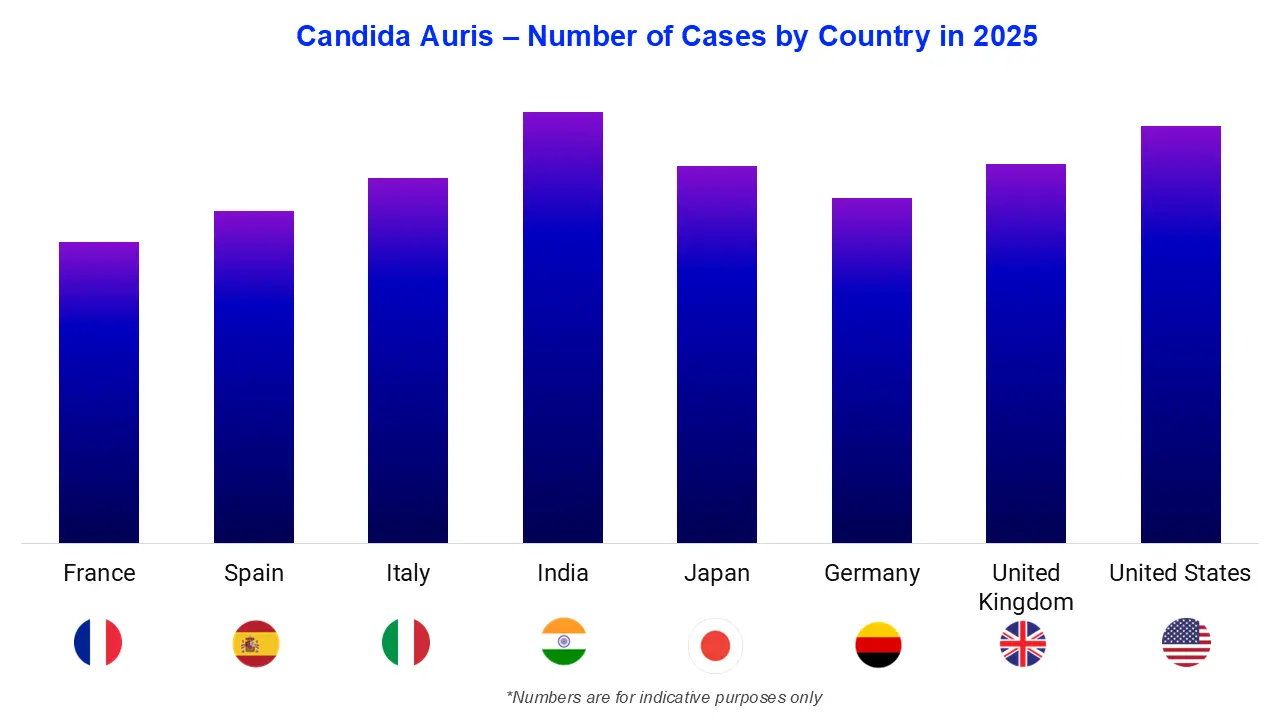
The Candida Auris epidemiology data and findings for the United States, Germany, Spain, Italy, France, the United Kingdom, Japan, and India are also provided in the epidemiology section.
|
Country |
Key Insights |
|
United States |
CDC reported 4,428 clinical cases and 9,195 screening cases in 2023, increasing to 6,197 clinical and 12,432 screening cases in 2024 in its detailed national surveillance analysis. The current CDC tracker reports 6,304 clinical cases in 2024 following subsequent surveillance updates. |
|
Germany |
Germany was among the five European countries contributing the largest cumulative number of reported C. auris cases in the ECDC survey. It also reported distinct outbreaks, emphasizing continuing healthcare-associated transmission rather than a purely sporadic imported-case pattern. |
|
France |
France reported C. auris activity to ECDC and was one of the countries reporting distinct outbreaks rather than established regional endemicity in the 2024 survey. Contemporary French surveillance identifies C. auris principally as a healthcare-associated multidrug-resistant fungal threat. |
|
Italy |
Italy was among Europe's highest-burden countries and was classified by ECDC as having regional endemicity, meaning individual outbreaks could no longer consistently be distinguished. |
|
Spain |
Spain was one of the five European countries with the highest cumulative reported burden and, like Italy and Greece, was classified as having regional endemicity by the 2024 ECDC assessment. |
|
United Kingdom |
England identified 212 first C. auris detections in 2024. Between January 2023 and September 2025, 496 patients were reported, 84% colonized and 14% invasive. London and South East England accounted for approximately 92% of reported cases. |
|
Japan |
Japan's contemporary national response recognizes C. auris as an emerging infection-control concern. The country had identified its first invasive bloodstream infection before the 2023–2026 period, but a nationally comparable 2023–2026 case series sufficient for direct ranking was not identified in the current evidence review. |
|
India |
No nationally representative 2023–2026 C. auris incidence estimate was identified. Contemporary tertiary-care evidence demonstrates a substantial clinical burden in selected hospitals; one South Indian study found 85 of 372 candidemia episodes (22.8%) were caused by C. auris. |
The primary epidemiological gap in C. auris is incomplete measurement of the distinction between colonization and invasive disease. Colonized patients frequently have no symptoms but can carry and transmit the organism, while invasive disease represents a clinically smaller but substantially more consequential subset. England's 2023–2025 data, in which 84% of detected patients were colonized and 14% were invasive, illustrate how strongly the measured burden depends on whether active screening accompanies clinical surveillance. A second gap is inconsistent national surveillance. ECDC reported 1,346 cases across 18 EU/EEA countries in 2023 but explicitly characterized these data as an underestimate because systematic surveillance was not implemented uniformly across Europe. Similar limitations apply in India and other countries where laboratory identification, reporting and screening vary substantially between institutions. Consequently, absence of reported cases cannot reliably be interpreted as absence of transmission.
The management of Candida auris primarily focuses on distinguishing colonization from clinical infection, treating invasive disease promptly, determining antifungal susceptibility, managing invasive devices and applying sustained infection-control precautions. CDC specifically recommends not treating patients who are colonized but have no signs or symptoms of infection, because antifungal treatment does not eradicate colonization reliably and exposes patients to unnecessary therapy. For adults and children older than two months with clinical C. auris infection, CDC currently recommends an echinocandin as initial therapy, using anidulafungin, caspofungin or micafungin according to patient characteristics and dosing requirements. Because C. auris may develop resistance during treatment, clinicians should monitor clinical response and obtain susceptibility testing.


Upto 15% Off
USD
$2699 $2429
$4299 $3869
$5799 $4949
$6999 $5949


*While we strive to always give you current and accurate information, the numbers depicted on the website are indicative and may differ from the actual numbers in the main report. At Expert Market Research, we aim to bring you the latest insights and trends in the market. Using our analyses and forecasts, stakeholders can understand the market dynamics, navigate challenges, and capitalize on opportunities to make data-driven strategic decisions.*
Explore our key highlights of the report and gain a concise overview of key findings, trends, and actionable insights that will empower your strategic decisions.
|
Report Features |
Details |
|
Base Year |
2025 |
|
Historical Period |
2019-2025 |
|
Forecast Period |
2026-2035 |
|
Epidemiology Statistics Provided |
|
|
Segmentation Provided |
|
|
Geographies Covered |
|
Datasheet
One User
USD 2,699
USD 2,429
tax inclusive*
Single User License
One User
USD 4,299
USD 3,869
tax inclusive*
Five User License
Five User
USD 5,799
USD 4,949
tax inclusive*
Corporate License
Unlimited Users
USD 6,999
USD 5,949
tax inclusive*
*Please note that the prices mentioned below are starting prices for each bundle type. Kindly contact our team for further details.*
Flash Bundle
Small Business Bundle
Growth Bundle
Enterprise Bundle
*Please note that the prices mentioned below are starting prices for each bundle type. Kindly contact our team for further details.*
Flash Bundle
Number of Reports: 3
20%
tax inclusive*
Small Business Bundle
Number of Reports: 5
25%
tax inclusive*
Growth Bundle
Number of Reports: 8
30%
tax inclusive*
Enterprise Bundle
Number of Reports: 10
35%
tax inclusive*
How To Order

Select License Type
Choose the right license for your needs and access rights.

Click on ‘Buy Now’
Add the report to your cart with one click and proceed to register.

Select Mode of Payment
Choose a payment option for a secure checkout. You will be redirected accordingly.
Strategic Solutions for Informed Decision-Making
Gain insights to stay ahead and seize opportunities.

Get insights & trends for a competitive edge.

Track prices with detailed trend reports.

Analyse trade data for supply chain insights.

Leverage cost reports for smart savings

Enhance supply chain with partnerships.

Connect For More Information
Our expert team of analysts will offer full support and resolve any queries regarding the report, before and after the purchase.
Our expert team of analysts will offer full support and resolve any queries regarding the report, before and after the purchase.
We employ meticulous research methods, blending advanced analytics and expert insights to deliver accurate, actionable industry intelligence, staying ahead of competitors.
Our skilled analysts offer unparalleled competitive advantage with detailed insights on current and emerging markets, ensuring your strategic edge.
We offer an in-depth yet simplified presentation of industry insights and analysis to meet your specific requirements effectively.




