

Consumer Insights
Uncover trends and behaviors shaping consumer choices today
Procurement Insights
Optimize your sourcing strategy with key market data
Industry Stats
Stay ahead with the latest trends and market analysis.
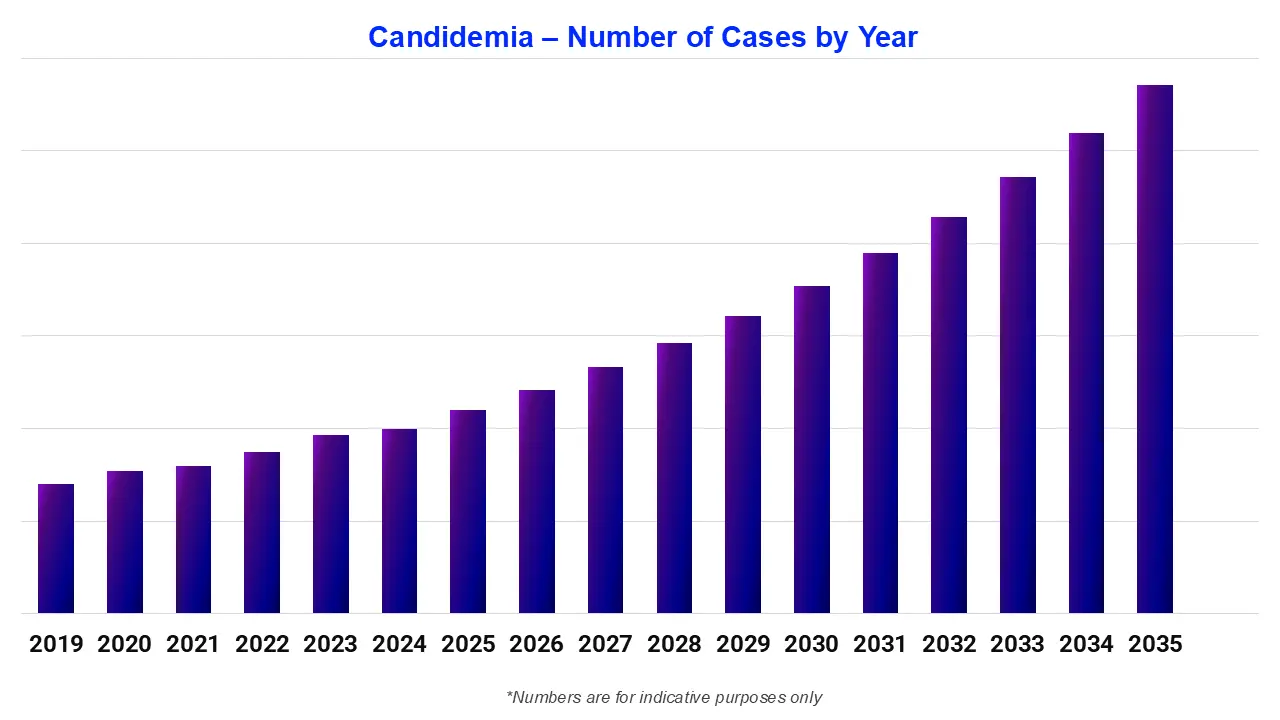
Candidemia is a serious bloodstream infection caused by Candida species and represents the most common invasive nosocomial fungal infection worldwide. According to Hemamalini Mohanraj et al. (2024), candidemia, the most prevalent invasive nosocomial fungal infection, has a global incidence of 0.33–6.51 episodes per 1,000 hospital admissions. According to the candidemia epidemiology forecast by Expert Market Research, the disease burden is expected to remain significant due to increasing clinical risk factors.
Base Year
Historical Period
Forecast Period
Read more about this report - Request a Free Sample
Expert Market Research's “Candidemia Epidemiology Forecast Report 2026-2035” offers comprehensive information on the prevalence and demographics of candidemia. It projects the future incidence and prevalence rates of candidemia cases across various populations. The study covers age, gender, and type as major determinants of the candidemia population. The report highlights patterns in the prevalence of candidemia over time and projects future trends based on multiple variables.
The report provides a comprehensive overview of the disease, as well as historical and projected data on the epidemiology of candidemia in the 8 major markets.
Regions Covered
Candidemia is a serious bloodstream infection caused by Candida species, most commonly Candida albicans, although non-albicans Candida species are increasingly reported. The infection occurs when Candida enters the bloodstream, often through central venous catheters, surgical procedures, prolonged hospitalization, or in individuals with weakened immune systems. Major causative species include Candida albicans, Candida glabrata, Candida tropicalis, Candida parapsilosis, and Candida krusei. If not diagnosed promptly, candidemia can spread to multiple organs and lead to life-threatening complications. Early bloodstream infection detection is critical for improving patient outcomes.
|
Parameter |
Insight |
|
Largest Patient Pool |
United States |
|
Fastest Growing Region |
India |
|
High-Risk Population |
Intensive care unit (ICU) patients, immunocompromised individuals, patients with central venous catheters, transplant recipients, and individuals with prolonged hospitalization. |
|
Key Diagnostic Method |
Blood culture supported by molecular diagnostics and non-culture-based fungal biomarker assays. |
|
Major Risk Factor |
Prolonged hospitalization, broad-spectrum antibiotic use, central venous catheterization, immunosuppression, and invasive medical procedures. |
|
Major gap in the market |
Delayed diagnosis due to low blood culture sensitivity, slow pathogen identification, and limited access to rapid fungal diagnostics. |
The candidemia epidemiology division offers information on the patient pool from history to the present as well as the projected trend for each of the 8 major markets. Expert Market Research provides both current and predicted trends for the candidemia epidemiology scenario by examining a wide range of studies. Additionally, the report covers the diagnosed patient pool for candidemia and their trends. The data is broken down into specific categories, such as total prevalent cases in males and females, and total diagnosed cases across different age groups and patient pools.
|
Epidemiology Segment |
Key Insights |
|
Diagnosed Prevalent Cases of the Disease |
According to Hemamalini Mohanraj et al. (2024), candidemia remains the most prevalent invasive nosocomial fungal infection worldwide, with a reported global incidence ranging from 0.33 to 6.51 episodes per 1,000 hospital admissions. As reported by Prof. David W. Denning et al. (2024), approximately 1.565 million people develop candida bloodstream infection or invasive candidiasis annually worldwide, demonstrating a substantial global disease burden. |
|
Gender-Specific Cases of the Disease |
As per Arati A. Bhadade et al. (2025), candidemia was more frequently reported among males (57.63%) than females (42.37%), indicating a relatively higher disease burden in men within the evaluated patient population. |
|
Age-Specific Cases of the Disease |
According to Arati A. Bhadade et al. (2025), non-Candida albicans candidemia was most common among individuals aged 19–60 years (53.4%), whereas Candida albicans candidemia was predominantly observed in the 0–18-year age group (47%). Based on findings by Silvia Meneghello et al. (2024), candidemia incidence is generally highest among pediatric and elderly populations. |
|
Ethnicity-Wise Cases of the Disease |
As documented by Jeffrey D. Jenks et al. (2023), candidemia incidence varies across racial groups in the United States. The overall incidence reached 7.0 cases per 100,000 persons, while Black or African American individuals experienced the highest incidence at 12.3 cases per 100,000 persons, highlighting important epidemiological disparities. |
|
Mortality and Survival Analysis of the Disease |
As reported by Prof. David W. Denning et al. (2024), invasive candidiasis and Candida bloodstream infections account for approximately 995,000 deaths annually, corresponding to an estimated 63.6% mortality. As observed by Jon Salmanton-García et al. (2024), overall mortality among candidemia patients was 40.4%, with an attributable mortality of 18.1%. |
|
Disease Type |
Prevalence |
|
Candida albicans Candidemia |
According to Hemamalini Mohanraj et al. (2024), Candida albicans remains the predominant pathogen, accounting for more than 50% of candidemia cases in several reported series worldwide. |
|
Non-Candida albicans (NAC) Candidemia |
As per Hemamalini Mohanraj et al. (2024), the incidence of candidemia caused by Candida tropicalis, Candida glabrata, Candida parapsilosis, and Candida krusei has increased globally, reflecting the growing epidemiological importance of non-Candida albicans species. |
|
Invasive Candidiasis |
Based on findings by Silvia Meneghello et al. (2024), invasive candidiasis is a major healthcare-associated fungal infection with increasing worldwide incidence and includes both bloodstream and deep-seated Candida infections. |
|
Candida auris Infection |
According to the Science Media Centre (2024), 4,012 Candida auris cases were reported across 36 European countries between 2013 and 2023. |
Read more about this report - Request a Free Sample
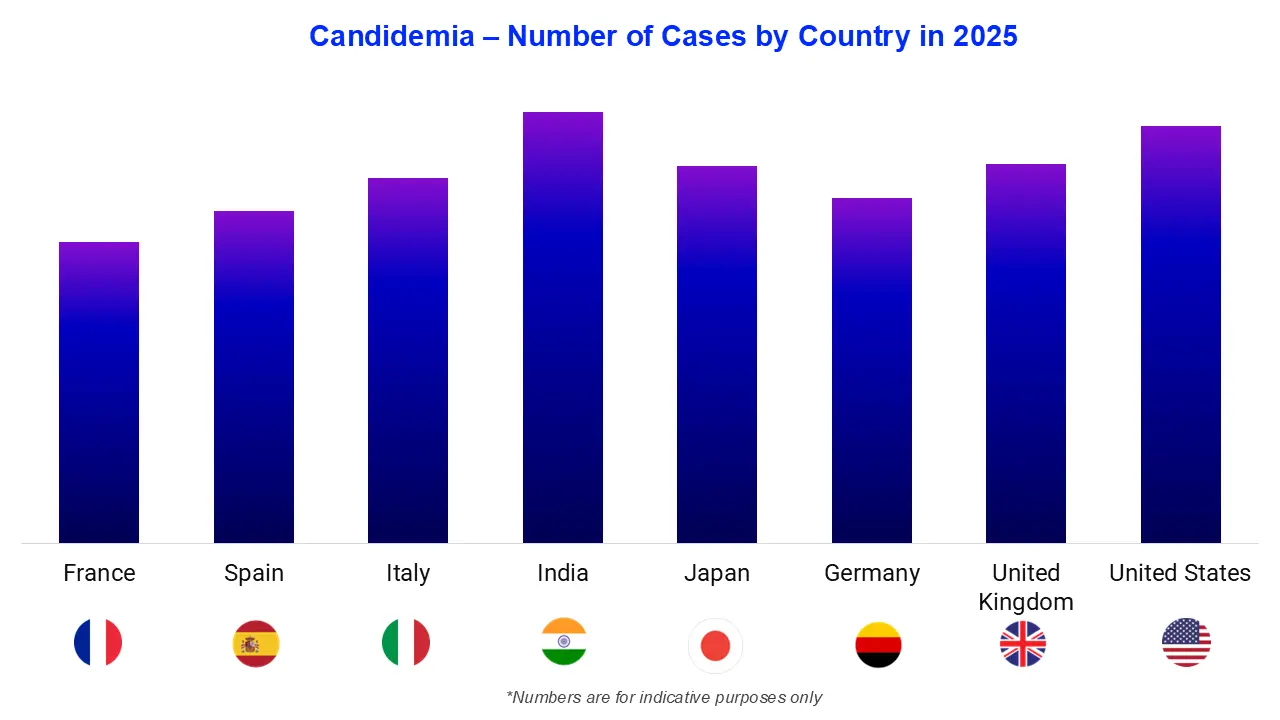
The candidemia epidemiology data and findings for the United States, Germany, Spain, Italy, France, the United Kingdom, Japan, and India are also provided in the epidemiology section.
|
Country |
Key Insights |
|
United States |
According to Arati A. Bhadade et al. (2025), the United States records approximately 25,000 candidemia cases annually. As documented by Jeffrey D. Jenks et al. (2023), the overall incidence was 7.0 cases per 100,000 persons, increasing to 12.3 cases per 100,000 persons among Black or African American individuals. |
|
Germany |
The country contributes to the overall European burden of invasive candidiasis, and continued surveillance supports disease monitoring and healthcare planning. |
|
France |
As highlighted by Stéphane Bretagne et al. (2022), France documented 10,886 invasive fungal disease cases between 2012 and 2018. Fungemia incidence increased from 1.03 to 1.19 per 10,000 hospitalization days, while the 1-month mortality rate remained 36.3%. Patients aged 65 years and older increased from 38.4% to 45.3% during the surveillance period. |
|
Italy |
Based on findings by Silvia Meneghello et al. (2024), Italy has experienced a threefold increase in candidemia incidence over the past two decades. A cumulative incidence of 2.5 per 1,000 hospital admissions and 30-day mortality rates ranging from 19.8% to 28% have been reported. |
|
Spain |
According to the Science Media Centre (2024), Spain reported 1,807 Candida auris cases between 2013 and 2023, representing the highest number among 36 European countries, indicating a substantial regional healthcare burden. |
|
United Kingdom |
In the United Kingdom, candidemia continues to represent a significant healthcare-associated bloodstream infection, particularly among hospitalized and critically ill patients. Ongoing surveillance and infection prevention strategies remain important for monitoring disease trends and supporting public health management. |
|
Japan |
In Japan, invasive Candida infections continue to contribute to the burden of healthcare-associated fungal diseases, particularly among patients with underlying medical conditions or prolonged hospitalization. Continuous surveillance supports early detection and epidemiological assessment. |
|
India |
As per Arati A. Bhadade et al. (2025), candidemia prevalence in India ranges from 1.31% to 3.41%. According to Hemamalini Mohanraj et al. (2024), candidemia incidence is increasing due to factors including intensive care unit admissions, invasive medical devices, and prolonged antibiotic exposure, contributing to a significant healthcare burden. |
The regional epidemiology landscape for candidemia is constrained by underdiagnosis, inconsistent surveillance systems, and variability in diagnostic capabilities across healthcare settings. Conventional blood cultures often delay diagnosis, resulting in late initiation of targeted antifungal therapy and unfavorable clinical outcomes. Significant opportunities exist to expand the adoption of rapid molecular diagnostics, fungal biomarker testing, and standardized surveillance programs to improve disease detection and epidemiological reporting. Increasing awareness among healthcare professionals, strengthened antimicrobial stewardship initiatives, and enhanced infection prevention measures in hospitals are expected to improve early diagnosis, patient management, and the overall understanding of candidemia epidemiology across the covered regions.
Treatment of candidemia requires the prompt initiation of antifungal therapy, source control, and close clinical monitoring. Echinocandins are generally recommended as first-line treatment for most adults, while fluconazole may be used in clinically stable patients with susceptible Candida species. Removal of infected central venous catheters, when feasible, is an important part of management to reduce the risk of persistent infection. Therapy is typically continued for at least 14 days after documented clearance of the bloodstream and symptom resolution. Comprehensive antifungal therapy combined with appropriate diagnostic evaluation and follow-up blood cultures helps minimize complications and improve survival.


Upto 15% Off
USD
$2699 $2429
$4299 $3869
$5799 $4949
$6999 $5949


*While we strive to always give you current and accurate information, the numbers depicted on the website are indicative and may differ from the actual numbers in the main report. At Expert Market Research, we aim to bring you the latest insights and trends in the market. Using our analyses and forecasts, stakeholders can understand the market dynamics, navigate challenges, and capitalize on opportunities to make data-driven strategic decisions.*
Explore our key highlights of the report and gain a concise overview of key findings, trends, and actionable insights that will empower your strategic decisions.
|
Report Features |
Details |
|
Base Year |
2025 |
|
Historical Period |
2019-2025 |
|
Forecast Period |
2026-2035 |
|
Epidemiology Statistics Provided |
|
|
Segmentation Provided |
|
|
Geographies Covered |
|
Datasheet
One User
USD 2,699
USD 2,429
tax inclusive*
Single User License
One User
USD 4,299
USD 3,869
tax inclusive*
Five User License
Five User
USD 5,799
USD 4,949
tax inclusive*
Corporate License
Unlimited Users
USD 6,999
USD 5,949
tax inclusive*
*Please note that the prices mentioned below are starting prices for each bundle type. Kindly contact our team for further details.*
Flash Bundle
Small Business Bundle
Growth Bundle
Enterprise Bundle
*Please note that the prices mentioned below are starting prices for each bundle type. Kindly contact our team for further details.*
Flash Bundle
Number of Reports: 3
20%
tax inclusive*
Small Business Bundle
Number of Reports: 5
25%
tax inclusive*
Growth Bundle
Number of Reports: 8
30%
tax inclusive*
Enterprise Bundle
Number of Reports: 10
35%
tax inclusive*
How To Order

Select License Type
Choose the right license for your needs and access rights.

Click on ‘Buy Now’
Add the report to your cart with one click and proceed to register.

Select Mode of Payment
Choose a payment option for a secure checkout. You will be redirected accordingly.
Strategic Solutions for Informed Decision-Making
Gain insights to stay ahead and seize opportunities.

Get insights & trends for a competitive edge.

Track prices with detailed trend reports.

Analyse trade data for supply chain insights.

Leverage cost reports for smart savings

Enhance supply chain with partnerships.

Connect For More Information
Our expert team of analysts will offer full support and resolve any queries regarding the report, before and after the purchase.
Our expert team of analysts will offer full support and resolve any queries regarding the report, before and after the purchase.
We employ meticulous research methods, blending advanced analytics and expert insights to deliver accurate, actionable industry intelligence, staying ahead of competitors.
Our skilled analysts offer unparalleled competitive advantage with detailed insights on current and emerging markets, ensuring your strategic edge.
We offer an in-depth yet simplified presentation of industry insights and analysis to meet your specific requirements effectively.




