

Consumer Insights
Uncover trends and behaviors shaping consumer choices today
Procurement Insights
Optimize your sourcing strategy with key market data
Industry Stats
Stay ahead with the latest trends and market analysis.
Dry eye disease (DED) is a chronic, multifactorial ocular-surface disorder involving tear-film instability, inflammation, hyperosmolarity and neurosensory abnormalities, causing dryness, burning, foreign-body sensation, fluctuating vision and discomfort. A 2026 systematic review and meta-analysis by Xiao et al., covering 119 studies and 15,251,528 participants, estimated the global pooled prevalence of DED at 34.6% (95% CI: 30.2–39.4%). According to the dry eye disease epidemiology forecast by Expert Market Research, DED continues to represent a significant clinical and healthcare burden because of its high prevalence, chronicity, recurrent symptoms, impaired visual function, productivity losses, treatment dependence and substantial effect on quality of life.
Base Year
Historical Period
Forecast Period
Read more about this report - Request a Free Sample
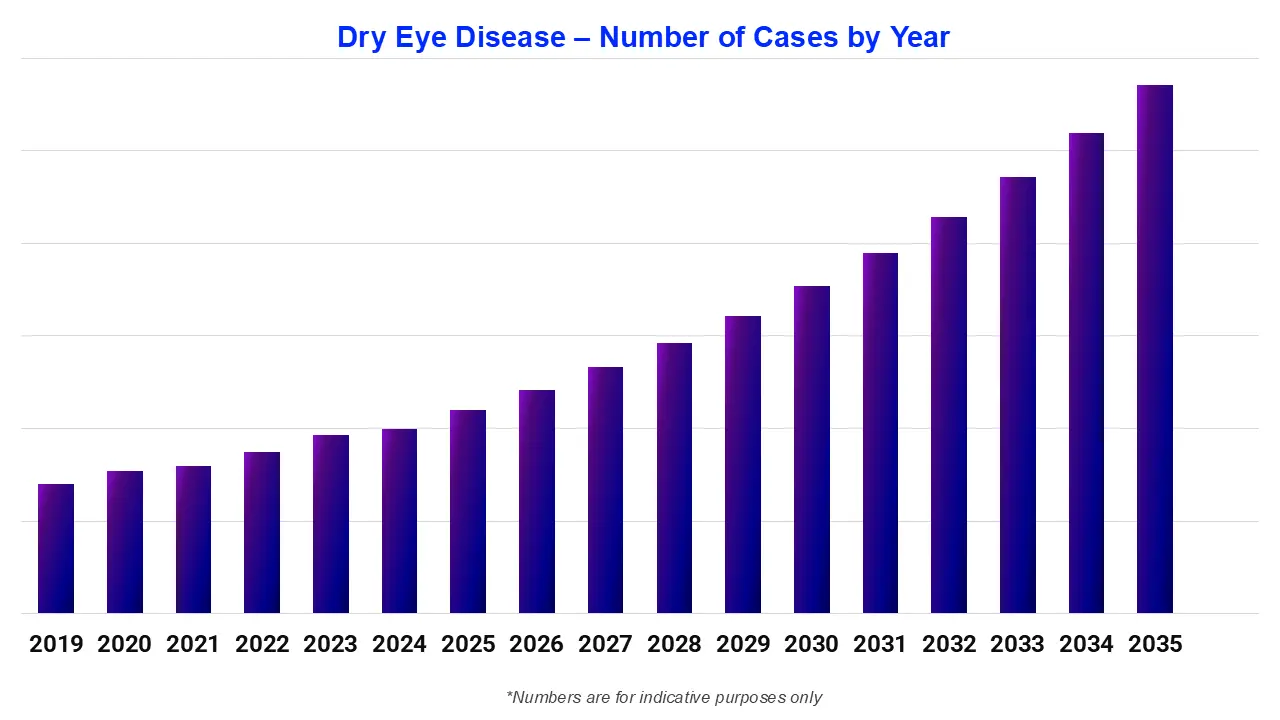
Expert Market Research's “Dry Eye Disease Epidemiology Forecast Report 2026-2035” offers comprehensive information on the prevalence and demographics of Dry Eye Disease. It projects the future incidence and prevalence rates of Dry Eye Disease cases across various populations. The study covers age, gender, and type as major determinants of the Dry Eye Disease population. The report highlights patterns in the prevalence of Dry Eye Disease overtime and projects future trends based on multiple variables.
The report provides a comprehensive overview of the disease, as well as historical and projected data on the epidemiology of Dry Eye Disease in the 8 major markets.
Regions Covered
Dry eye disease (DED) remains a chronic, multifactorial ocular-surface disorder characterized by loss of tear-film homeostasis, tear-film instability, ocular-surface inflammation, hyperosmolarity and neurosensory abnormalities, producing symptoms such as dryness, burning, foreign-body sensation, fluctuating vision and ocular discomfort. Contemporary understanding increasingly recognizes DED as a heterogeneous disorder involving aqueous tear deficiency, excessive evaporation, meibomian gland dysfunction (MGD), ocular-surface inflammation, epithelial dysfunction, altered corneal innervation and, in some patients, neuropathic pain.
|
Parameter |
Insight |
|
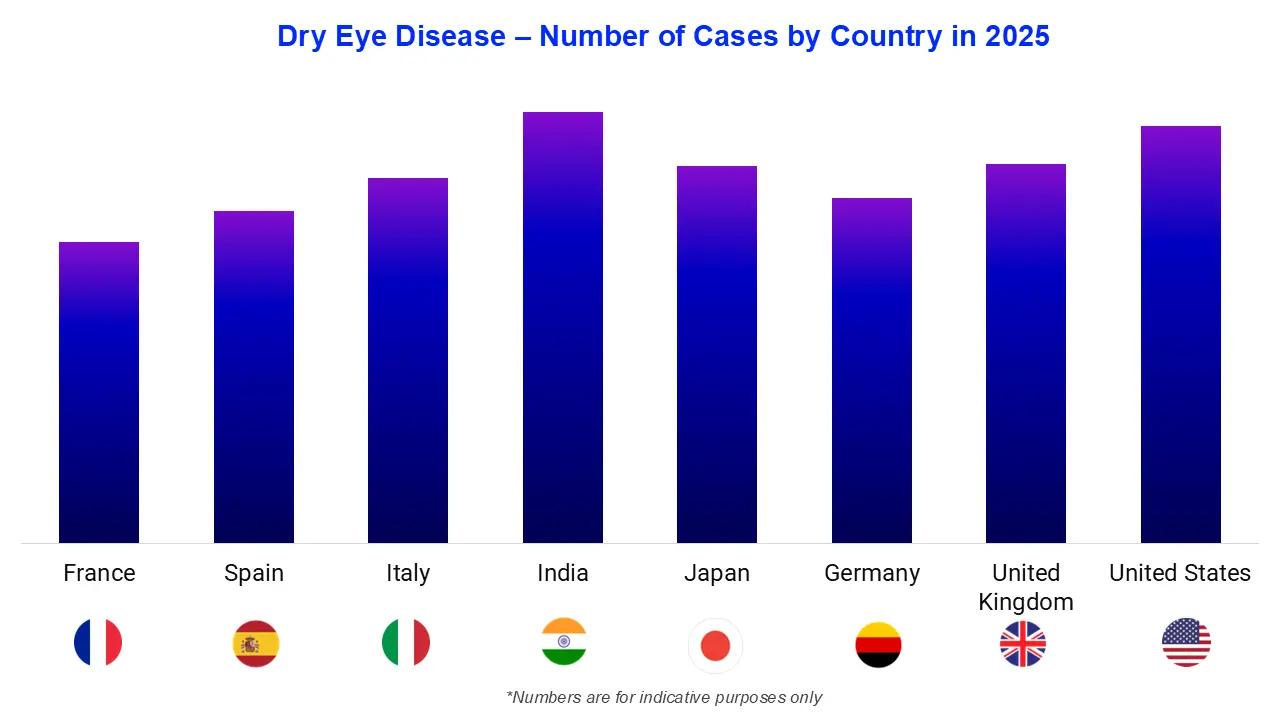
Largest Patient Pool |
United States |
|
Fastest Growing Country |
India |
|
High-Risk Population |
Older adults, postmenopausal women, contact-lens users, patients with MGD, individuals undergoing ocular surgery, people with autoimmune disease such as Sjögren's disease, and individuals with substantial digital-device exposure |
|
Key Diagnostic Method |
Integrated ocular-surface assessment |
|
Major Risk Factor |
Increasing age and female sex |
|
Major gap in the market |
Poor correlation between symptoms and signs, heterogeneous disease mechanisms, limited validated biomarkers, variable treatment response, chronic treatment burden, incomplete management of MGD and lack of widely accepted disease-modifying therapy |
The Dry Eye Disease epidemiology division offers information on the patient pool from history to the present as well as the projected trend for each of the 8 major markets. Expert Market Research provides both current and predicted trends for the Dry Eye Disease epidemiology scenario by examining a wide range of studies. Additionally, the report covers the diagnosed patient pool for Dry Eye Disease and their trends. The data is broken down into specific categories, such as total prevalent cases in males and females, and total diagnosed cases across different age groups and patient pools.
|
Epidemiology Segment |
Key Insights |
|
Diagnosed Prevalent Cases of the Disease |
According to Xiao et al., the 2026 global systematic review and meta-analysis estimated pooled DED prevalence at 34.6% (95% CI 30.2–39.4%) across 119 studies involving more than 15.25 million participants. The authors emphasized pronounced heterogeneity between geographical regions, diagnostic criteria and study settings. This estimate should therefore be regarded as a pooled epidemiological benchmark rather than a universal population prevalence. |
|
Gender-Specific Cases of the Disease |
Contemporary evidence continues to demonstrate a female predominance. The 2025 review of sex differences in the lacrimal gland describes biologically relevant sex-related differences in lacrimal-gland ageing and function and identifies women, particularly after menopause, as more susceptible to DED. The magnitude of the difference varies among populations according to disease definition and age structure. |
|
Age-Specific Cases of the Disease |
DED generally increases with advancing age, particularly after middle age, because of age-associated changes in lacrimal secretion, meibomian-gland structure, corneal innervation and ocular-surface homeostasis. Contemporary reviews identify advanced age as one of the principal non-modifiable risk characteristics. |
|
Ethnicity-Wise Cases of the Disease |
The 2026 global meta-analysis identified major regional rather than simple ethnic differences, with prevalence ranging from 20.9% in North America to 43.9% in Africa. The investigators emphasized differences in diagnostic methodology and study populations, indicating that regional estimates cannot be interpreted as a direct biological ethnicity effect. |
|
Mortality and Survival Analysis of the Disease |
DED is primarily a chronic morbidity and quality-of-life disorder rather than a fatal disease. Contemporary outcome research therefore focuses on ocular discomfort, fluctuating vision, daily functioning, productivity, emotional wellbeing and treatment burden rather than disease-specific mortality. The 2025 Save Sight Dry Eye Registry study documented substantial effects on emotional wellbeing, daily activities and employment-related functioning. |
|
Disease Type |
Prevalence |
|
Aqueous-Deficient Dry Eye Disease (ADDE) |
ADDE is characterized predominantly by inadequate aqueous tear production and may result from lacrimal-gland dysfunction, ageing, medications or systemic autoimmune disease. Severe aqueous deficiency is particularly characteristic of Sjögren-associated DED, where lacrimal-gland inflammation and glandular destruction can produce persistent and treatment-resistant ocular-surface disease. |
|
Evaporative Dry Eye Disease (EDE) |
EDE results primarily from excessive tear-film evaporation and is strongly associated with MGD. Contemporary data-driven classification found evaporative disease to be the predominant subtype in a UK population sample, with MGD frequently accompanying evaporative instability. |
|
Meibomian Gland Dysfunction–Associated DED |
MGD is a major driver of evaporative DED and involves altered meibum quality or quantity, gland obstruction and gland atrophy. A 2026 meta-analysis reported an extremely high pooled MGD prevalence among adults aged ≥40 years, although heterogeneity exceeded 99%, preventing use of the pooled estimate as a universal population rate. |
|
Mixed Aqueous-Deficient and Evaporative DED |
Many patients display overlapping mechanisms rather than a single pure phenotype. Contemporary classification studies identify patients with simultaneous aqueous deficiency and evaporative abnormalities, emphasizing that treatment should target the dominant mechanisms rather than rely on rigid mutually exclusive categories. |
Read more about this report - Request a Free Sample
The Dry Eye Disease epidemiology data and findings for the United States, Germany, Spain, Italy, France, the United Kingdom, Japan, and India are also provided in the epidemiology section.
|
Country |
Key Insights |
|
United States |
The 2026 global meta-analysis estimated pooled DED prevalence at 20.9% in North America, although this is a regional estimate rather than a U.S.-specific national prevalence. Contemporary U.S. evidence also demonstrates substantial socioeconomic and healthcare-access determinants of DED, with a 2024 systematic review identifying social and structural factors as important influences on disease burden and care. |
|
Germany |
A 2024 representative German population study reported a high burden of DED symptoms and confirmed strong associations with female sex, older age, fatigue and reduced health-related quality of life. The study was based on a survey conducted before 2023, so its numerical prevalence is deliberately not reproduced here under the present 2023–2026 restriction. The contemporary publication nevertheless reinforces the clinical importance of DED in Germany. |
|
France |
France remains a major European ophthalmology market with substantial demand for chronic DED management, including topical anti-inflammatory therapy, tear-film supplementation and MGD-directed procedures. A directly comparable nationally representative French prevalence estimate published from 2023–2026 was not identified in the reviewed literature; therefore, an older national figure has not been substituted. |
|
Italy |
Italy represents an important European DED treatment market with increasing clinical interest in mechanism-based pharmacotherapy, MGD treatment and newer tear-film therapies. Contemporary pharmacological reviews involving Italian investigators identify lifitegrast, cyclosporine, perfluorohexyloctane, varenicline and emerging biological approaches as important components of the changing treatment landscape. A nationally representative 2023–2026 prevalence figure was not identified and is therefore not supplied. |
|
Spain |
A 2025 population-based Spanish survey reported substantial DED prevalence, including 16.6% using WHS criteria and 22.5% using BES criteria, but the underlying survey fieldwork occurred in 2022. Because the requested cutoff is no data before 2023, these numerical prevalence estimates are intentionally not used in the current epidemiological calculation. |
|
United Kingdom |
A 2024 data-driven UK classification study found that evaporative DED represented 64.2% of diagnosed DED, whereas aqueous-deficient DED alone accounted for 6.2%; 11.1% showed mixed features and 18.5% remained unclassified. This contemporary evidence reinforces the dominant role of MGD/evaporative mechanisms in UK clinical populations. |
|
Japan |
Japan represents an important ageing-market setting for DED and MGD research. The contemporary global literature identifies Asia as an important region for DED burden, while current Japanese ophthalmology research continues to focus on tear-film instability, meibomian-gland changes and device-supported treatment. A recent nationally representative Japanese DED prevalence estimate meeting the 2023–2026 observation requirement was not identified in the reviewed sources; older estimates have therefore been excluded. |
|
India |
India represents a major expanding ophthalmic market because of population size, digital-device exposure, environmental conditions and increasing ophthalmic-care access. A 2025 prospective Central Indian tertiary-eye-care database analysis evaluated 2,560 patients and identified DED in 640 (25%), with higher prevalence in people over 50 years and significant associations with smoking, ocular allergy, contact-lens use and several occupational categories. |
According to contemporary 2023–2026 evidence, substantial gaps remain in the epidemiological characterization, standardized diagnosis, mechanism-based classification and long-term management of dry eye disease. The 2026 global systematic review identified a pooled prevalence of 34.6% across more than 15.25 million participants, but the authors reported pronounced regional and methodological heterogeneity. This variability represents a major epidemiological challenge because symptom-only studies, sign-based studies and studies using combined clinical criteria identify partially different populations.
A major opportunity therefore exists in standardized DED phenotyping. A 2024 UK data-driven classification study demonstrated that 64.2% of diagnosed DED had evaporative features, 6.2% had isolated aqueous deficiency, 11.1% had mixed disease and 18.5% could not be cleanly classified.
The management of dry eye disease primarily focuses on restoring tear-film homeostasis, controlling ocular-surface inflammation, improving lubrication, reducing excessive evaporation, treating meibomian-gland dysfunction, addressing contributing systemic or environmental factors and preserving visual function and quality of life. The 2025 TFOS DEWS III management report provides the current comprehensive evidence-based framework and emphasizes that DED should be managed according to its underlying mechanisms rather than as a single uniform disease. First-line care includes tear-film replenishment, conservation and stimulation, with individualized treatment according to severity and subtype. Artificial tears and tear substitutes remain foundational therapy. Contemporary treatment increasingly emphasizes formulation characteristics such as viscosity, lipid content, osmolarity and preservative exposure.


Upto 15% Off
USD
$2699 $2429
$4299 $3869
$5799 $4949
$6999 $5949


*While we strive to always give you current and accurate information, the numbers depicted on the website are indicative and may differ from the actual numbers in the main report. At Expert Market Research, we aim to bring you the latest insights and trends in the market. Using our analyses and forecasts, stakeholders can understand the market dynamics, navigate challenges, and capitalize on opportunities to make data-driven strategic decisions.*
Explore our key highlights of the report and gain a concise overview of key findings, trends, and actionable insights that will empower your strategic decisions.
|
Report Features |
Details |
|
Base Year |
2025 |
|
Historical Period |
2019-2025 |
|
Forecast Period |
2026-2035 |
|
Epidemiology Statistics Provided |
|
|
Segmentation Provided |
|
|
Geographies Covered |
|
Datasheet
One User
USD 2,699
USD 2,429
tax inclusive*
Single User License
One User
USD 4,299
USD 3,869
tax inclusive*
Five User License
Five User
USD 5,799
USD 4,949
tax inclusive*
Corporate License
Unlimited Users
USD 6,999
USD 5,949
tax inclusive*
*Please note that the prices mentioned below are starting prices for each bundle type. Kindly contact our team for further details.*
Flash Bundle
Small Business Bundle
Growth Bundle
Enterprise Bundle
*Please note that the prices mentioned below are starting prices for each bundle type. Kindly contact our team for further details.*
Flash Bundle
Number of Reports: 3
20%
tax inclusive*
Small Business Bundle
Number of Reports: 5
25%
tax inclusive*
Growth Bundle
Number of Reports: 8
30%
tax inclusive*
Enterprise Bundle
Number of Reports: 10
35%
tax inclusive*
How To Order

Select License Type
Choose the right license for your needs and access rights.

Click on ‘Buy Now’
Add the report to your cart with one click and proceed to register.

Select Mode of Payment
Choose a payment option for a secure checkout. You will be redirected accordingly.
Strategic Solutions for Informed Decision-Making
Gain insights to stay ahead and seize opportunities.

Get insights & trends for a competitive edge.

Track prices with detailed trend reports.

Analyse trade data for supply chain insights.

Leverage cost reports for smart savings

Enhance supply chain with partnerships.

Connect For More Information
Our expert team of analysts will offer full support and resolve any queries regarding the report, before and after the purchase.
Our expert team of analysts will offer full support and resolve any queries regarding the report, before and after the purchase.
We employ meticulous research methods, blending advanced analytics and expert insights to deliver accurate, actionable industry intelligence, staying ahead of competitors.
Our skilled analysts offer unparalleled competitive advantage with detailed insights on current and emerging markets, ensuring your strategic edge.
We offer an in-depth yet simplified presentation of industry insights and analysis to meet your specific requirements effectively.




