

Consumer Insights
Uncover trends and behaviors shaping consumer choices today
Procurement Insights
Optimize your sourcing strategy with key market data
Industry Stats
Stay ahead with the latest trends and market analysis.
Escherichia coli outbreaks are clusters of gastrointestinal or extraintestinal illness caused by a common pathogenic E. coli strain, food, water source, animal exposure, or person-to-person transmission route. Germany reported 4,458 notified STEC infections in 2023, with increased detection associated in part with multiplex PCR implementation. A major O45 outbreak emerged in 2025. According to E. coli outbreak epidemiology forecast by Expert Market Research (EMR), the epidemiology of E. coli outbreaks is strongly influenced by diagnostic methodology. Multiplex PCR has increased detection of STEC, particularly non-O157 strains, because testing is no longer restricted to patients with classical bloody diarrhea.
Base Year
Historical Period
Forecast Period
Read more about this report - Request a Free Sample
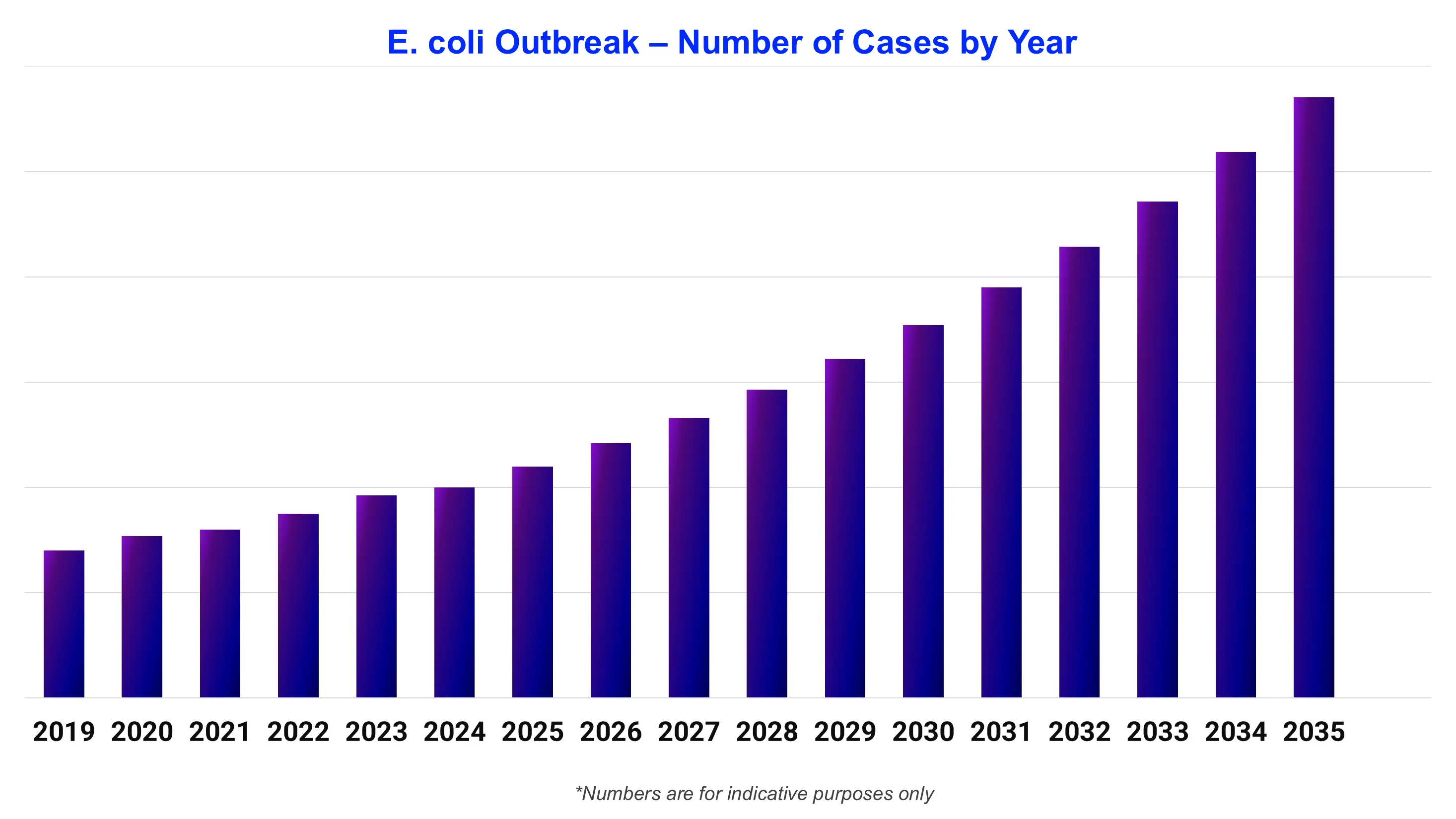
Expert Market Research's “E. coli Outbreak Epidemiology Forecast Report 2026-2035” offers comprehensive information on the prevalence and demographics of E. coli Outbreak. It projects the future incidence and prevalence rates of E. coli Outbreak cases across various populations. The study covers age, gender, and type as major determinants of the E. coli Outbreak population. The report highlights patterns in the prevalence of E. coli Outbreak over time and projects future trends based on multiple variables.
The report provides a comprehensive overview of the disease, as well as historical and projected data on the epidemiology of E. coli Outbreak in the 8 major markets.
Regions Covered
Escherichia coli outbreaks are clusters of gastrointestinal or extraintestinal illness caused by a common pathogenic E. coli strain, food, water source, animal exposure, or person-to-person transmission route. For foodborne public-health surveillance, Shiga toxin-producing E. coli (STEC), including enterohaemorrhagic E. coli (EHEC), represents the principal outbreak-associated category because infection can progress from acute diarrhea to hemorrhagic colitis and hemolytic uremic syndrome (HUS). Other diarrhoeagenic pathotypes, including enteropathogenic E. coli (EPEC), enteroaggregative E. coli (EAEC), enterotoxigenic E. coli (ETEC), and enteroinvasive E. coli (EIEC), can also produce outbreaks, particularly in waterborne, institutional and community settings. Current surveillance systems differ substantially in which pathotypes they capture and whether they count sporadic infections, outbreak-associated cases, or severe complications.
|
Parameter |
Insight |
|
Largest Patient Pool |
Germany |
|
Fastest Growing Country |
United States |
|
High-Risk Population |
Children, particularly those under 5 years; older adults; people exposed to contaminated food or water; and individuals with immunocompromising conditions. |
|
Key Diagnostic Method |
Multiplex gastrointestinal PCR or Shiga-toxin detection followed by culture and whole-genome sequencing (WGS) for confirmation, serotyping and outbreak linkage. |
|
Major Risk Factor |
Consumption of contaminated food or water, particularly undercooked beef, unpasteurized dairy, leafy vegetables, fresh produce and contaminated drinking water. |
|
Major gap in the market |
Delayed case recognition, incomplete pathogen isolation after PCR diagnosis, heterogeneous surveillance, limited source attribution and continued under-recognition of non-O157 STEC and non-STEC diarrhoeagenic E. coli. |
The E. coli Outbreak epidemiology division offers information on the patient pool from history to the present as well as the projected trend for each of the 8 major markets. Expert Market Research provides both current and predicted trends for the E. coli Outbreak epidemiology scenario by examining a wide range of studies. Additionally, the report covers the diagnosed patient pool for E. coli Outbreak and their trends. The data is broken down into specific categories, such as total prevalent cases in males and females, and total diagnosed cases across different age groups and patient pools.
|
Epidemiology Segment |
Key Insights |
|
Diagnosed Prevalent Cases of the Disease |
Conventional prevalence is not an appropriate measure for an outbreak. Surveillance instead uses confirmed outbreak-associated cases. EU surveillance recorded 11,738 confirmed STEC infections in 2024, while 31 foodborne STEC outbreaks generated 158 outbreak-associated cases |
|
Gender-Specific Cases of the Disease |
In England in 2025, 306/568 (53.9%) confirmed O157 cases were female. Sex distribution varies substantially by outbreak; the 2023 West Sikkim STEC outbreak in India involved 30 male cases because the affected population was an army camp. |
|
Age-Specific Cases of the Disease |
Young children are disproportionately affected by severe STEC disease. In England in 2025, children aged 1-4 years had the highest O157 incidence at 3.60/100,000. In the EU, children aged 0–4 years represented the largest HUS burden, while older adults had a disproportionate share of fatal HUS outcomes. |
|
Ethnicity-Wise Cases of the Disease |
No harmonized 8MM ethnicity-specific outbreak dataset is available. U.S. FoodNet surveillance collects race and ethnicity for laboratory-confirmed STEC infections, but outbreak-specific ethnicity distributions are not directly comparable with European or Indian surveillance systems. |
|
Mortality and Survival Analysis of the Disease |
EU surveillance recorded 25 deaths among 11,738 confirmed STEC infections in 2024. England reported no deaths among O157 cases and three deaths among non-O157 STEC cases in 2025. The 2024 UK O145 outbreak caused 2 deaths and 11 HUS cases among 293 confirmed cases. The 2025 German O45 outbreak had two confirmed deaths by 22 October, with an additional probable fatal case under investigation. |
|
Disease Type |
Prevalence |
|
Asymptomatic STEC Infection |
Laboratory-confirmed infection without clinically apparent gastrointestinal disease, frequently detected through contact or outbreak screening. Although symptoms may be absent, infected individuals can still carry and transmit STEC, making case identification important for outbreak control. |
|
Acute Uncomplicated STEC Gastroenteritis |
Diarrheal illness with abdominal pain, nausea or vomiting without hemorrhagic colitis or HUS. In 2023, FoodNet identified 3,351 STEC infections within its surveillance area, although this figure includes the broader spectrum of clinically recognized STEC infections rather than uncomplicated gastroenteritis alone. |
|
Hemorrhagic Colitis |
Severe STEC-associated intestinal disease characterized by abdominal cramping and bloody diarrhea. Patients may develop marked abdominal tenderness, fever, and dehydration, with some progressing to hemolytic uremic syndrome (HUS). |
|
STEC Infection with HUS |
Systemic complication involving microangiopathic hemolytic anemia, thrombocytopenia and acute kidney injury; disproportionately affects young children. In the FoodNet surveillance area, 61 post-diarrhoeal HUS cases among people aged <18 years were identified in 2022, including 39 cases among children aged <5 years. The incidence was 0.6 per 100,000 among those aged <18 years and 1.4 per 100,000 among children aged <5 years. |
Read more about this report - Request a Free Sample
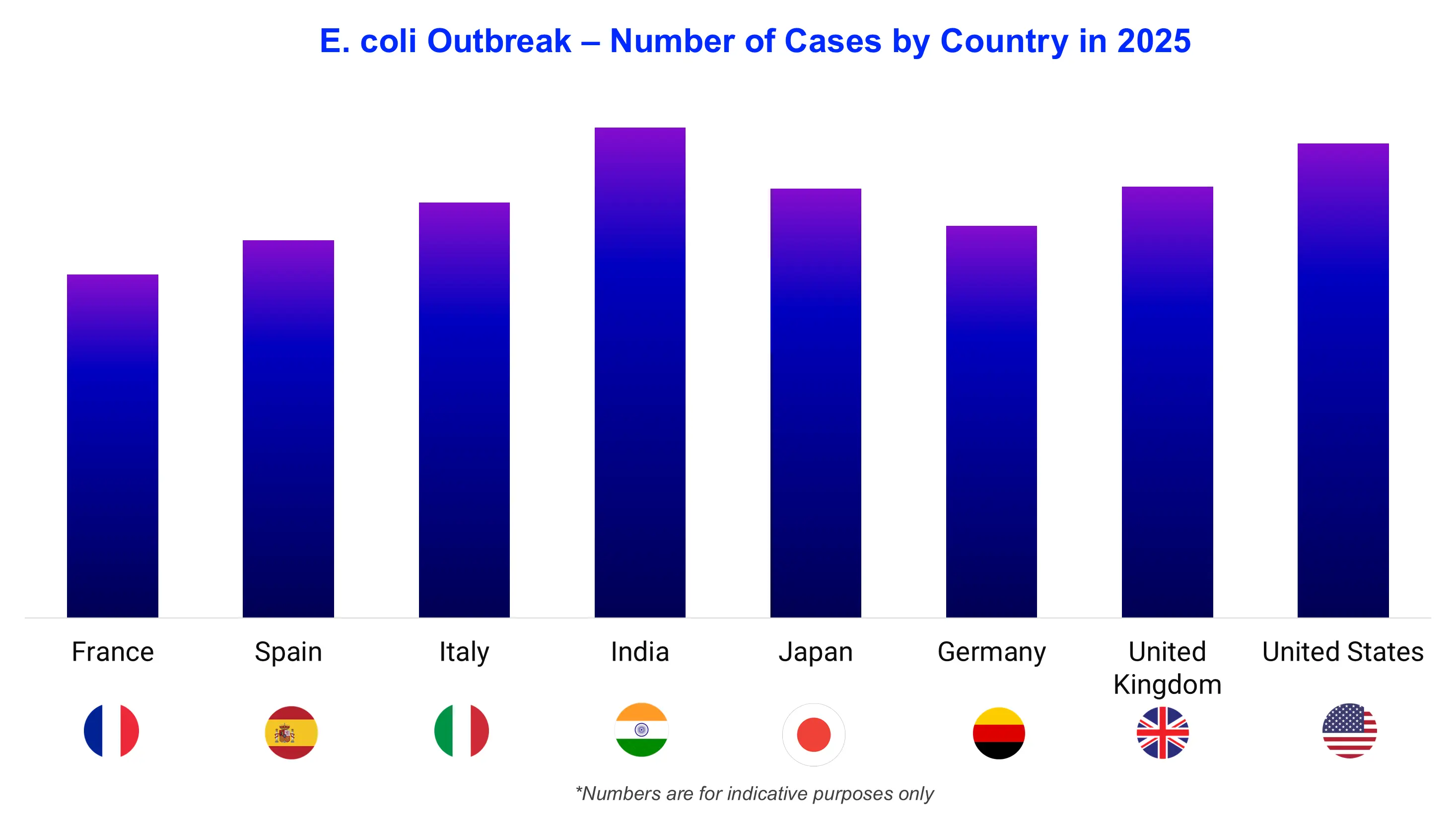
The E. coli Outbreak epidemiology data and findings for the United States, Germany, Spain, Italy, France, the United Kingdom, Japan, and India are also provided in the epidemiology section.
|
Country |
Key Insights |
|
United States |
FoodNet 2024 preliminary surveillance identified 3,635 STEC infections within its approximately 16% population surveillance area. Current 2026 investigations include a sprout-associated outbreak involving 55 total illnesses, four hospitalizations and no deaths, and a raw-milk-cheese O26 outbreak involving 13 illnesses, 8 hospitalizations and 3 HUS cases as of 25 September 2026. |
|
Germany |
Germany reported 4,458 notified STEC infections in 2023, with increased detection associated in part with multiplex PCR implementation. A major O45 outbreak emerged in 2025. By 22 October 2025, 183 confirmed cases, including 48 HUS cases, were linked to the outbreak; 8 probable and 160 possible cases were additionally under investigation. Two confirmed deaths and one probable death had been reported at that stage. |
|
France |
France participates in EU STEC surveillance, but its system is voluntary and sentinel rather than fully population-comprehensive. Notification rates are therefore not calculated in the ECDC/EFSA comparison; surveillance is primarily based on HUS and selected STEC surveillance rather than providing a directly comparable national incidence denominator. |
|
Italy |
Italy similarly operates a sentinel STEC surveillance system primarily focused on HUS rather than comprehensive population-wide STEC infection. The Italian HUS registry recorded 57 HUS cases in 2024, with the overwhelming majority occurring in children and adolescents. The surveillance structure means these figures should not be compared directly with comprehensive STEC notification counts from Germany, Spain or the UK. |
|
Spain |
Spain reported 844 confirmed STEC infections in 2024, corresponding to 1.7 cases per 100,000 population; estimated population coverage was approximately 97%. Spain was also one of the principal EU countries identified as a probable country of infection among imported EU-acquired STEC cases. |
|
United Kingdom |
England reported 2,544 culture-confirmed STEC infections in 2024 and 2,457 in 2025. The 2024 national outbreak series comprised five outbreaks involving 467 people, including a UK-wide O145 outbreak of 293 confirmed cases, 11 HUS cases and 2 deaths. In 2025, two outbreaks involving 19 cases were investigated. |
|
Japan |
Japan maintains national surveillance for enterohaemorrhagic E. coli food poisoning and infection. MHLW records show 19 food-poisoning outbreaks with 265 patients in 2023, 16 outbreaks with 124 patients in 2024, and 10 outbreaks with 362 patients in 2025. These figures represent food-poisoning events specifically and should not be interpreted as total STEC infection incidence. |
|
India |
A 2023 outbreak in an army facility in West Sikkim involved 30 cases among 223 residents, an attack rate of 13.5%, with STEC identified during the investigation and no deaths. India also has documented outbreaks caused by other diarrhoeagenic E. coli pathotypes, including a 2026-published investigation of an acute gastroenteritis outbreak in Mizoram in which atypical EPEC was isolated from all 40 affected individuals and one implicated food specimen. |
The principal epidemiological gap is the lack of a uniformly comparable definition of an E. coli outbreak across countries. The U.S. and UK increasingly integrate laboratory surveillance with WGS-based cluster detection, whereas France and Italy rely more on restricted or sentinel STEC surveillance. India’s IDSP captures outbreaks largely by syndromes such as acute diarrhoeal disease and food poisoning rather than systematically identifying E. coli pathotypes. India reported 3,020 outbreaks in 2024 and 2,285 in 2025, but these totals include multiple pathogens. Diagnostic gaps also remain, as culture-independent testing can limit isolate recovery, serotyping, and WGS-based source attribution.
Management of E. coli outbreak-associated disease focuses on early recognition, hydration, clinical monitoring, and public-health control. Patients with suspected STEC infection, particularly bloody diarrhoea, should be assessed for dehydration and monitored for evolving HUS. Antibiotic and antimotility therapy requires caution because of potential complications. HUS requires hospital-based supportive care, including fluid and electrolyte management, transfusion support, renal replacement therapy when indicated, and specialist nephrological care. Outbreak control includes laboratory confirmation, case finding, source investigation, food or water control, contact assessment, and genomic analysis. Whole-genome sequencing (WGS) helps identify related isolates and link sporadic cases to common transmission sources, supporting targeted epidemiological and food-chain investigations.


Upto 15% Off
USD
$2699 $2429
$4299 $3869
$5799 $4949
$6999 $5949


*While we strive to always give you current and accurate information, the numbers depicted on the website are indicative and may differ from the actual numbers in the main report. At Expert Market Research, we aim to bring you the latest insights and trends in the market. Using our analyses and forecasts, stakeholders can understand the market dynamics, navigate challenges, and capitalize on opportunities to make data-driven strategic decisions.*
Explore our key highlights of the report and gain a concise overview of key findings, trends, and actionable insights that will empower your strategic decisions.
|
Report Features |
Details |
|
Base Year |
2025 |
|
Historical Period |
2019-2025 |
|
Forecast Period |
2026-2035 |
|
Epidemiology Statistics Provided |
|
|
Segmentation Provided |
|
|
Geographies Covered |
|
Datasheet
One User
USD 2,699
USD 2,429
tax inclusive*
Single User License
One User
USD 4,299
USD 3,869
tax inclusive*
Five User License
Five User
USD 5,799
USD 4,949
tax inclusive*
Corporate License
Unlimited Users
USD 6,999
USD 5,949
tax inclusive*
*Please note that the prices mentioned below are starting prices for each bundle type. Kindly contact our team for further details.*
Flash Bundle
Small Business Bundle
Growth Bundle
Enterprise Bundle
*Please note that the prices mentioned below are starting prices for each bundle type. Kindly contact our team for further details.*
Flash Bundle
Number of Reports: 3
20%
tax inclusive*
Small Business Bundle
Number of Reports: 5
25%
tax inclusive*
Growth Bundle
Number of Reports: 8
30%
tax inclusive*
Enterprise Bundle
Number of Reports: 10
35%
tax inclusive*
How To Order

Select License Type
Choose the right license for your needs and access rights.

Click on ‘Buy Now’
Add the report to your cart with one click and proceed to register.

Select Mode of Payment
Choose a payment option for a secure checkout. You will be redirected accordingly.
Strategic Solutions for Informed Decision-Making
Gain insights to stay ahead and seize opportunities.

Get insights & trends for a competitive edge.

Track prices with detailed trend reports.

Analyse trade data for supply chain insights.

Leverage cost reports for smart savings

Enhance supply chain with partnerships.

Connect For More Information
Our expert team of analysts will offer full support and resolve any queries regarding the report, before and after the purchase.
Our expert team of analysts will offer full support and resolve any queries regarding the report, before and after the purchase.
We employ meticulous research methods, blending advanced analytics and expert insights to deliver accurate, actionable industry intelligence, staying ahead of competitors.
Our skilled analysts offer unparalleled competitive advantage with detailed insights on current and emerging markets, ensuring your strategic edge.
We offer an in-depth yet simplified presentation of industry insights and analysis to meet your specific requirements effectively.




